
Under the EUDR the face veneer is a relevant commodity in its own right: it needs its species, country of production and plot geolocation in the importer's file, just like the core. Truc Mai sends origin records and GeoJSON plots for both layers of each EU-bound panel, so the importer files one statement for the whole sheet.
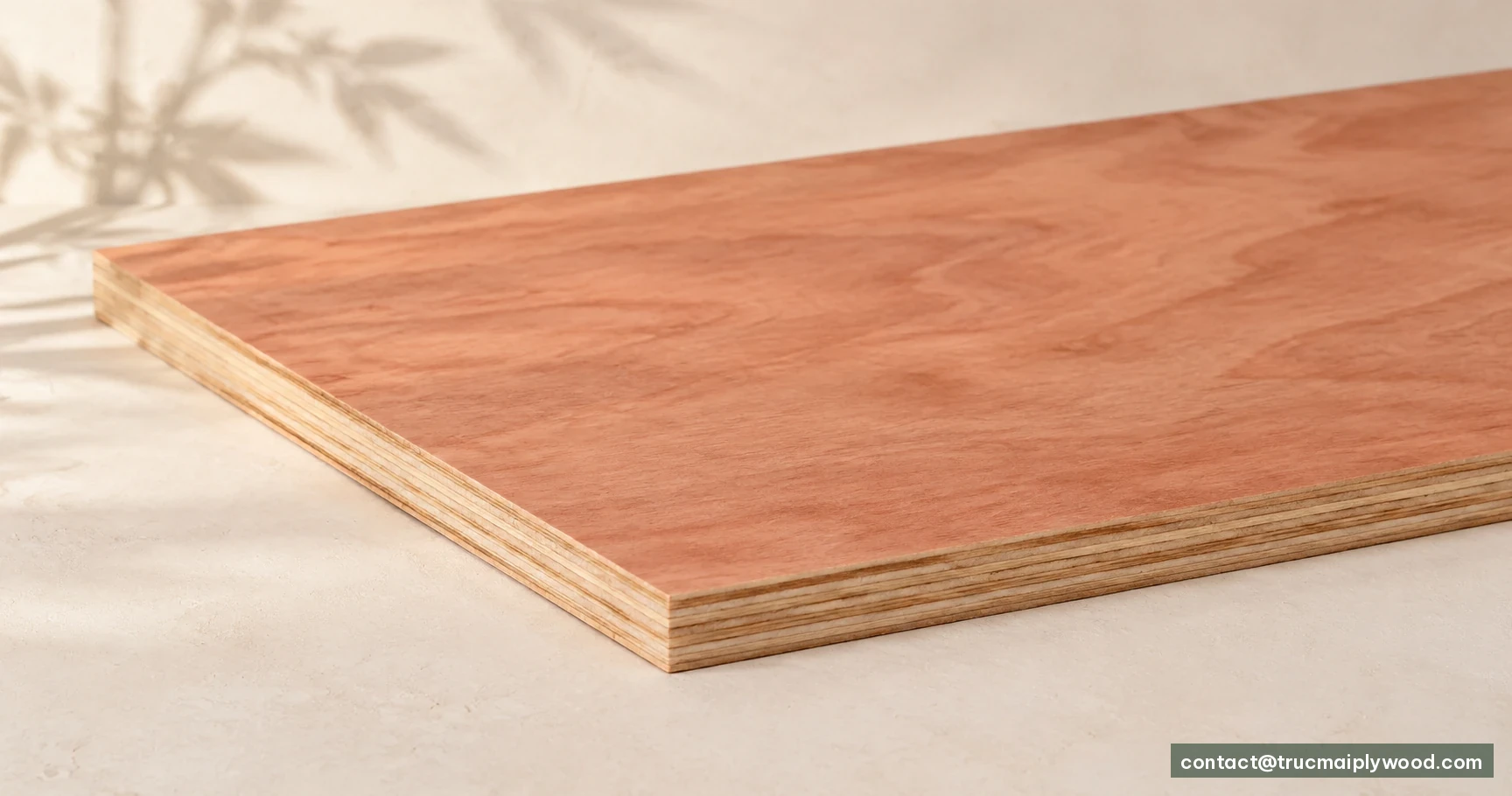
Which face species on a Truc Mai panel come with their own geolocation files?
Every face species on an EU-bound Truc Mai panel comes with its own geolocation file: white poplar EV, poplar and bleached poplar, birch, okoume, bintangor, pine, eucalyptus, gurjan, sapele and faces made on request. Each face lot gets an origin record and GeoJSON plots, joined to the core file in one set.
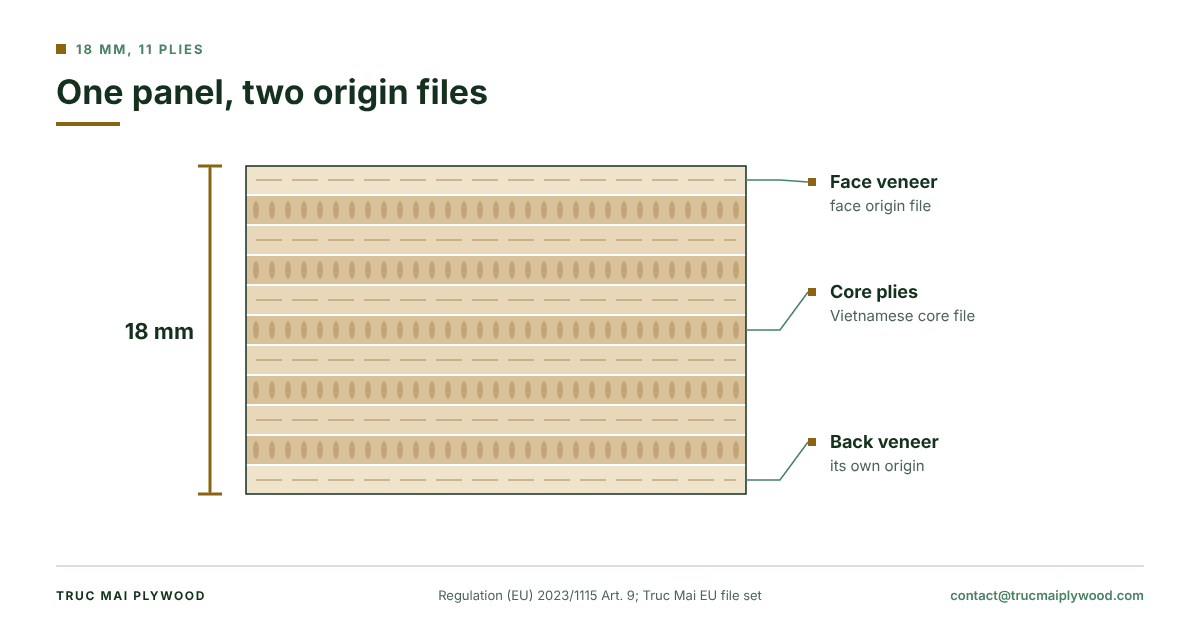
The reason is in the panel. A plywood sheet is two products glued together: a Vietnamese plantation core and a face veneer that may come from a different country, a different species and a different forest. The EU Deforestation Regulation does not let an importer describe the core and stay silent about the face. Both layers are wood, both are in the panel, so both need the information the regulation lists.
Truc Mai’s practice follows that rule layer by layer. For each EU-bound lot the mill sends origin records and GeoJSON files for the core logs and for the face veneer, with species, quantities, countries of production and production dates. The EU importer uses that set to file its own due-diligence statement for the whole sheet.
| Face on the panel | Usual form | What the face file carries |
|---|---|---|
| White poplar EV | Reconstituted veneer, 2500 × 1300 mm sheets, 0.3 or 0.4 mm | Poplar plots behind the veneer, certificates, import papers |
| Poplar, bleached poplar | Rotary or sliced veneer | Species, country of production, plots |
| Birch | Imported face on a Vietnamese core | Species, country of production, plots |
| Okoume | Imported face | Species, country of production, plots or concession |
| Bintangor | Imported face | Species, country of production, plots or concession |
| Pine | Face veneer | Species, country of production, plots |
| Eucalyptus | Face veneer | Species, country of production, plots |
| Gurjan, sapele | Imported face | Species, country of production, plots or concession |
The table shows the shape of the file, not where each face came from on a given order. The country of production of a face lot is fixed per order and confirmed at enquiry, because face veneer is bought by the lot.
Why does an EUDR face veneer need its own origin file?
Because the EUDR defines the country of production per commodity, not per finished product. A face veneer peeled or sliced from logs grown in one country has that country as its country of production, even when it is pressed onto a Vietnamese core. The panel can therefore have two or more countries of production.
Regulation (EU) 2023/1115 defines the country of production as “the country or territory where the relevant commodity or the relevant commodity used in the production of, or contained in, a relevant product was produced”. For plywood, the relevant commodity is wood, and the face is wood grown somewhere.
The face is thin, which is why buyers forget it. On a Truc Mai panel the face veneer is 0.2–0.5 mm, usually 0.3 mm for Europe, while each core ply is 1.4–2.0 mm. On an 18 mm sheet with 11 plies, the face and the back are two of the eleven layers. By volume the face is a small share of the panel; by law it is a full entry in the file.
The same logic covers the back veneer. When the back is a different species or comes from a different lot than the face, it is a third origin. Most Truc Mai orders quote face and back as a pair, for example “white poplar EV face / poplar back”, and the file lists each.
What does a face-veneer origin file contain?
A face-veneer file contains the species with its common and scientific name, the quantity in the lot, the country of production and the GeoJSON plots with production dates. It also holds the papers that link the veneer sheets to those plots: certificates, the supplier’s deforestation-free declaration, export and import declarations and the origin form.
Truc Mai’s sample EV face dossier shows what that looks like for an imported face. The white poplar EV is a reconstituted veneer made from plantation poplar, Populus deltoides. Its file runs from the forest to the mill gate:
| Document in the EV face file | What it proves |
|---|---|
| FSC forest-management certificate of the poplar source | The forest unit is certified |
| FSC chain-of-custody certificates along the chain | The claim was not broken between forest and veneer plant |
| GeoJSON polygon of the poplar plots | Where the wood was grown, to six decimals |
| Supplier EUDR deforestation-free declaration | No deforestation after the 31 December 2020 cut-off |
| Export declaration of the supplying country | The lot left the country of production |
| Vietnamese import declaration | The same lot entered Vietnam |
| Vietnamese imported-timber list | The lot was recorded as imported timber |
| Certificate of origin form | The origin the veneer supplier declared |
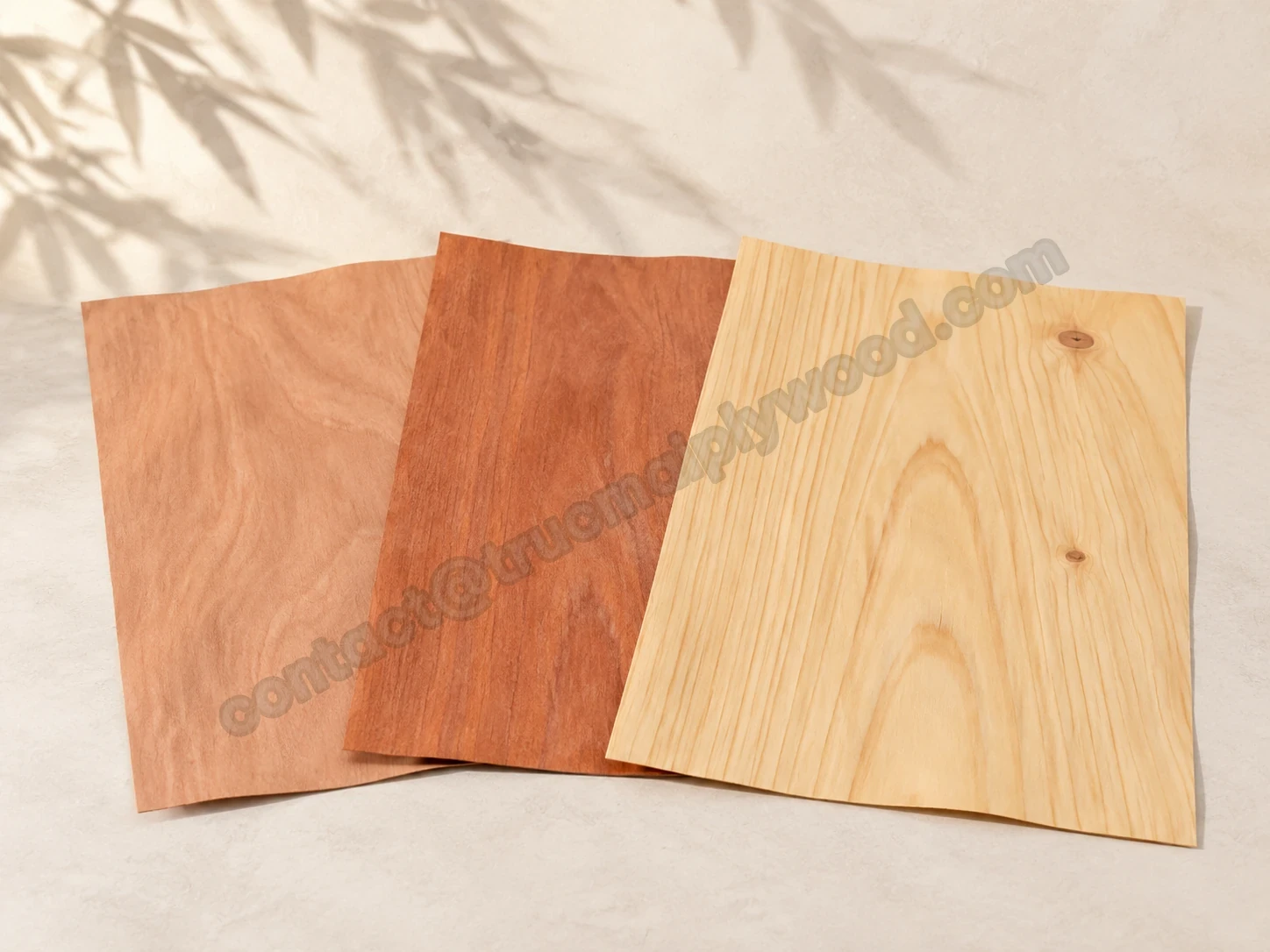
The core file runs in parallel. The sample core dossier holds plot coordinates, a polygon map, harvest permit papers, forest-product lists and weighbridge tickets for FSC 100% Acacia mangium from a smallholder plantation in Vietnam. Put side by side, the two files describe one panel.
How do the face file and the core file join in one due-diligence statement?
They join line by line under the information list of the regulation. The statement names the product, then every species with its scientific name, the quantity, each country of production, and the geolocation of every plot with its production date. The face and the core each fill their own rows, and the plots of both are attached.
Article 9 of Regulation (EU) 2023/1115 asks for “the geolocation of all plots of land where the relevant commodities that the relevant product contains, or has been made using, were produced, as well as the date or time range of production”. It adds that where a product is made with commodities from “different plots of land, the geolocation of all different plots of land shall be included”.
| Statement item | Core rows | Face rows |
|---|---|---|
| Description | 18 mm plywood, HS 4412, sheet count and m³ | Same product line |
| Species | Acacia mangium, Styrax, eucalyptus or pine | Face species, for example Populus deltoides |
| Quantity | Core share of the lot | Face share of the lot |
| Country of production | Vietnam | The face lot’s own country |
| Geolocation | Core plots, GeoJSON | Face plots, GeoJSON |
| Production date | Harvest period per core plot | Harvest period per face plot |
| Legality evidence | Harvest permits, forest-product lists | Certificates, declarations, import papers |
The practical rule for the importer is that the face rows must be as complete as the core rows. A statement with a perfect core file and a face file that says only “imported veneer” has a gap that any competent authority finds in its first question.
How many decimal digits does face veneer geolocation need?
Face veneer geolocation needs at least six decimal digits for both latitude and longitude. The regulation defines geolocation as coordinates “using at least six decimal digits”, and six decimals of a degree locate a point to about 10 centimetres, finer than any plantation boundary needs.
The definition in Regulation (EU) 2023/1115 is “latitude and longitude coordinates corresponding to at least one latitude and one longitude point and using at least six decimal digits”. A coordinate written as 21.5 or 105.2 fails the rule even if the plot is right; it must carry six digits after the decimal point.
The precision is not arbitrary. The GeoJSON standard, RFC 7946, notes that “6 decimal places” of a geographic coordinate amounts to about 10 centimeters. That is why the rule asks for six and not three: three decimals would place a point within a hundred metres or so, enough to land in the neighbour’s plot.
For a face veneer the six-digit rule bites at the veneer supplier, not at the plywood mill. The mill cannot invent precision it was not given. That is why the face file has to start with the veneer supplier’s own GeoJSON, and why the importer checks the digits when the file arrives.
When does a face-veneer plot need a polygon instead of a point?
When the plot is larger than four hectares. For wood, a plot of more than 4 ha must be described by a polygon with enough points to trace its perimeter; a plot of 4 ha or less can be given as a single point. Most commercial veneer plots, and every natural-forest concession, are well above that size.
The regulation says that “for plots of land of more than four hectares used for the production of the relevant commodities other than cattle, this shall be provided using polygons with sufficient latitude and longitude points to describe the perimeter of each plot of land”. The definition sits in Article 2 of Regulation (EU) 2023/1115.
| Plot | How it is described | Typical case |
|---|---|---|
| 4 ha or less | One point, six decimals | A small household plantation plot |
| More than 4 ha | Polygon tracing the perimeter | A larger plantation block, a concession |
| Several plots in one lot | One feature per plot | A veneer lot drawn from several plantations |
A “plot of land” is itself defined: land within a single real-estate property, as recognised by the law of the country of production, with conditions homogeneous enough to assess the risk of deforestation together. A veneer supplier cannot merge a district into one polygon and call it a plot.
In the sample EV dossier the poplar is traced to a GeoJSON polygon, and the sample core dossier holds a polygon map as well. For small smallholder plots, a point is allowed under the size threshold, but a polygon is stronger evidence when the plot boundary is known.
How is the EUDR plywood geolocation file for a face lot built?
A GeoJSON file holds one feature per plot, each with a point or a polygon in WGS 84 decimal degrees, written longitude first and latitude second, plus properties such as species and production date. Polygons must be closed: the first and last positions are identical.
RFC 7946 states that “The coordinate reference system for all GeoJSON coordinates is a geographic coordinate reference system, using the World Geodetic System 1984 (WGS 84)” datum. It also fixes the order: “The first two elements are longitude and latitude”, precisely in that order.
Four errors are easy to make in a face-veneer file, and each takes a minute to check:
- Swapped coordinates. Latitude first puts a Vietnamese or European plot in the ocean or on another continent. Opening the file on a map shows it at once.
- Too few decimals. Spreadsheets round to four or five digits on export. The raw file must still carry six.
- Open polygons. A ring whose last point does not repeat the first is not a valid polygon under the standard.
- One polygon for many plots. A merged shape hides the plot boundaries the regulation asks for. Each plot is its own feature.
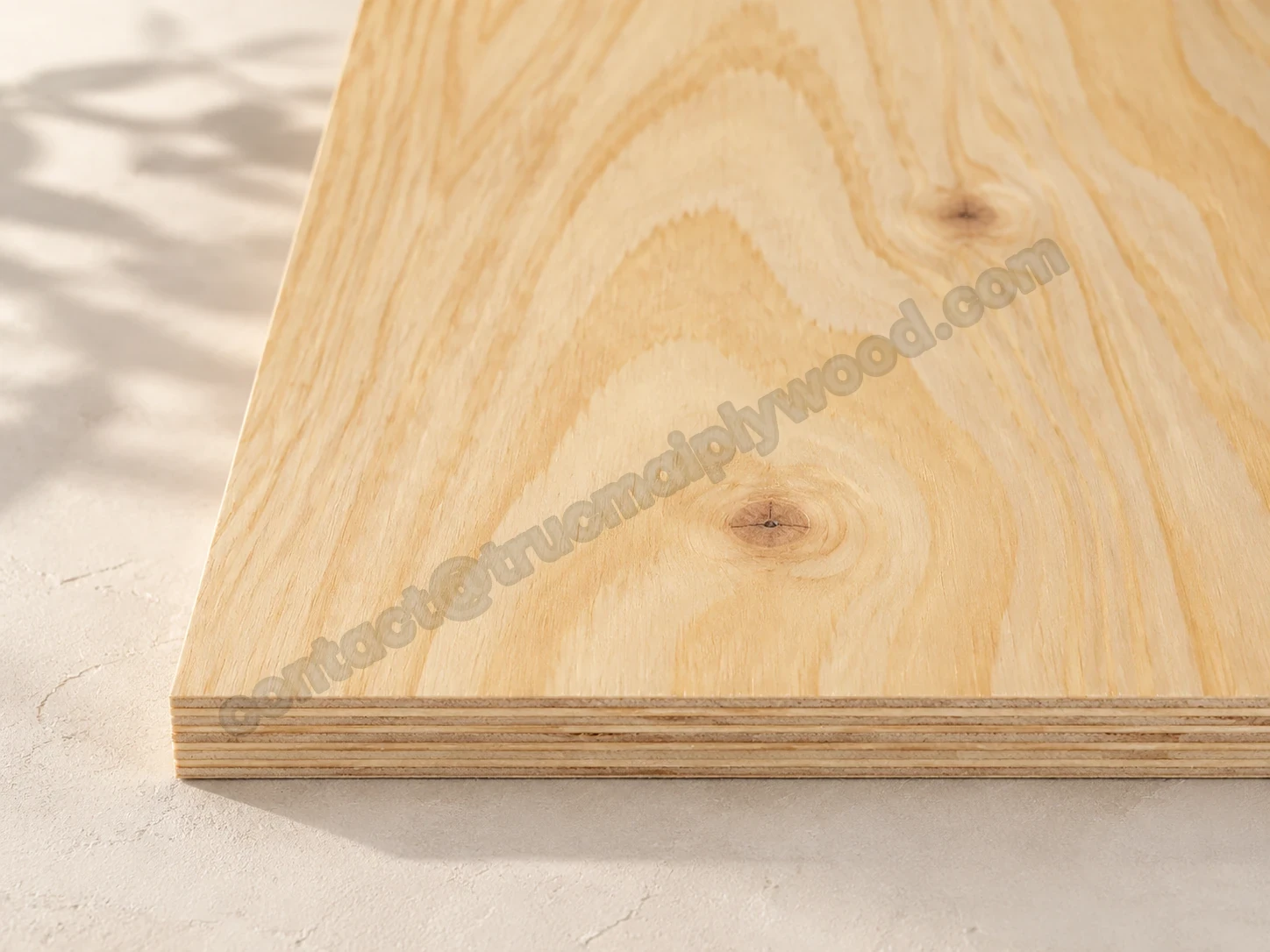
The production date belongs in the file too. The information list asks for the date or time range of production, so each feature carries the harvest period of its plot. For the sample core plot, that is a clear-fell in July 2025 on land planted in 2019.
Which species names go on the statement for each face?
The statement lists the common name and the scientific name of every wood in the panel. For the faces Truc Mai presses most often, the scientific names are Populus deltoides for the white poplar EV, Aucoumea klaineana for okoume, Calophyllum for bintangor, Betula for birch, Pinus for pine, Eucalyptus, Dipterocarpus for gurjan and Entandrophragma cylindricum for sapele.
| Face (trade name) | Scientific name on the file | Note for the importer |
|---|---|---|
| White poplar EV | Populus deltoides | Reconstituted veneer; the poplar is the commodity |
| Poplar, bleached poplar | Populus | Species named per lot |
| Birch | Betula | Imported face on a Vietnamese core; never an all-birch panel |
| Okoume | Aucoumea klaineana | One species, one name |
| Bintangor | Calophyllum | Several species traded under one name: species per lot |
| Pine | Pinus | Species per lot |
| Eucalyptus | Eucalyptus | Species per lot |
| Gurjan | Dipterocarpus | Several species traded together: species per lot |
| Sapele | Entandrophragma cylindricum | One species, one name |
Trade names hide species. “Bintangor” and “gurjan” each cover several species of one genus, and a veneer lot may contain more than one. The file names what is in the lot, and the invoice uses the same names, so the statement, the invoice and the packing list agree.
The core rows follow the same rule. A Styrax core is listed as Styrax, an acacia core as Acacia mangium or the species in the lot, and a combined core lists each species laid together in the panel.
Does simplified due diligence still apply when the face veneer comes from outside Vietnam?
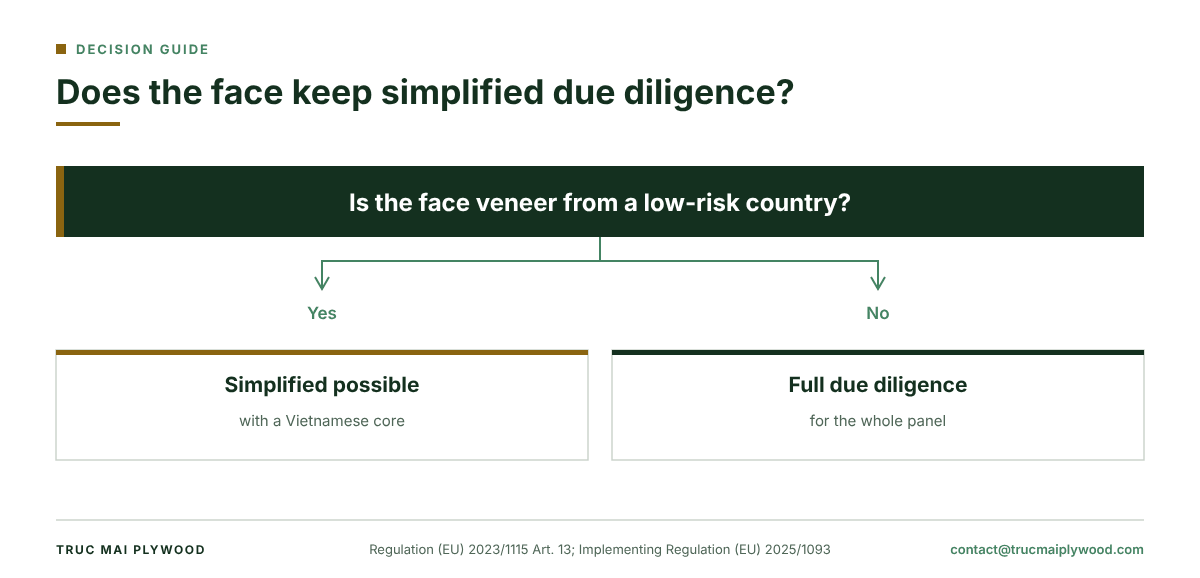
Only if the face comes from a country that is also classed low risk. Simplified due diligence needs every commodity in the product to come from low-risk countries. A Vietnamese core with a face from a low-risk country keeps it; a face from a standard-risk or high-risk country takes the whole panel into full due diligence.
The Annex of Implementing Regulation (EU) 2025/1093 has two lists, headed “Low risk countries” and “High risk countries”. Vietnam, China, Gabon, Finland, Latvia, Ukraine, the United States, Uruguay and New Zealand are on the low-risk list; Belarus, Myanmar and the Russian Federation are on the high-risk list. A country on neither list is standard risk.
Under Article 13 of the main regulation, an operator may skip the risk assessment and risk mitigation only after it has made sure that all relevant commodities in the product were produced in low-risk countries. The information and the geolocation are collected in every case; simplified due diligence saves the assessment, not the file.
The classes also set how often authorities look. The regulation requires annual checks on at least 1% of operators for low-risk origins, 3% for standard risk and 9% for high risk. A face from a standard-risk country moves the importer into a group that is checked three times as often.
Which face origins change the importer’s checks?
Any face from a country outside the low-risk list changes them. Indonesia, Malaysia and Cameroon, for example, are on neither list and are therefore standard risk; Belarus, Myanmar and Russia are high risk. A buyer who fixes the face origin on the order line fixes the due-diligence route for every repeat container.
| Country class | Examples from the 2025 list | Effect on a panel with a Vietnamese core |
|---|---|---|
| Low risk | Vietnam, China, Gabon, Finland, Latvia, Uruguay, United States, New Zealand | Simplified due diligence possible if every layer is low risk |
| Standard risk | Any country on neither list, for example Indonesia, Malaysia, Cameroon | Full due diligence for the whole panel |
| High risk | Belarus, Myanmar, Russian Federation | Full due diligence with enhanced scrutiny |
The class is a property of the country, not of the supplier or the certificate. A well-run concession in a standard-risk country still sends the panel through full due diligence, and an FSC claim does not move the country into another class. What the face supplier’s file can do is make the risk assessment short and conclusive.
Birch is the case most buyers ask about. Birch from Russia or Belarus is high risk under this list and also falls under EU sanctions on wood products from both countries. For an EU order, the country of the birch face lot is written on the order line and checked against both rules before the deposit. The birch-faced plywood page covers the face grades.
Who files the due-diligence statement for imported plywood, the mill or the EU importer?
The EU importer files it. The company that places the plywood on the EU market is the operator, and the operator submits the due-diligence statement. Truc Mai, as a mill outside the EU, has no filing duty; it holds the plot data for core and face and hands it over so the importer can file.
The split is the same for every layer of the panel. The importer files one statement for the product it imports, and the statement covers every commodity inside it. The mill does not file a separate “face statement” and the veneer supplier does not file one either. Their job is to supply the information; the operator’s job is to assess it and sign.
| Party | Role under the EUDR | What it does with the face file |
|---|---|---|
| Face veneer supplier | Outside the EU, no filing duty | Produces the plot data and the declarations |
| Truc Mai mill | Outside the EU, no filing duty | Collects, checks and forwards face and core files |
| EU importer | Operator | Assesses risk, files the statement, keeps records five years |
| EU furniture maker buying the plywood | Downstream operator | Keeps the reference number of the importer’s statement |
One statement can cover several shipments, and its reference number must exist before the customs declaration is lodged. For a monthly programme, a statement per order line or per month keeps the face and core files attached to the right containers. The EU import steps show where the reference goes among the other import papers.
From which date does EUDR apply to plywood importers?
From 30 December 2026, for every plywood importer regardless of size. The later date of 30 June 2027 for micro and small operators does not cover products that were under the EU Timber Regulation, and plywood was. The 31 December 2020 cut-off date for deforestation is unchanged.
The dates come from Regulation (EU) 2025/2650, which postponed the obligations and states that they “shall apply from 30 December 2026”. The same act keeps the earlier regime for old stock: the EU Timber Regulation continues to apply until 31 December 2029 to timber produced before 29 June 2023 and placed on the market from 30 December 2026.
For a face veneer this means one thing in practice. A face lot pressed onto a panel after the date needs its plot file on the first container after the date; there is no grace period for the face because it is a small layer. The EUDR dates page sets out the full timeline.
Running the process on a container before the date is the cheap way to find a gap. A trial statement filed on a real lot shows whether the face supplier’s files load, whether the species names match and whether the face origin keeps the panel in simplified due diligence.
Does a face from natural forest need more than a plantation face?
It needs the same information plus a closer look at forest degradation. For wood, deforestation-free also means harvested without inducing forest degradation after 31 December 2020, and degradation includes converting primary or naturally regenerating forest into plantation. A natural-forest face file must show that this did not happen.
Regulation (EU) 2023/1115 defines deforestation-free for wood as harvested “from the forest without inducing forest degradation after 31 December, 2020”. It defines forest degradation as “structural changes to forest cover, taking the form of the conversion of” primary or naturally regenerating forests into plantation forests or other wooded land, or primary forests into planted forests.
The difference shows in the papers. A plantation face such as the poplar behind the EV has a planting record and a harvest at the end of a rotation. A face sliced from a natural-forest log needs evidence about the forest after the harvest: a management plan, the concession boundary as a polygon, and a statement that the forest stayed forest.
The same test applies to the core, but Vietnamese plywood cores come from plantations of eucalyptus, acacia, Styrax and pine, which makes the core side simpler. The natural-forest question, when it arises, is almost always on the face.
Why is an engineered veneer face traced to poplar plots?
Because the commodity in an engineered veneer is the wood it is made from. A white poplar EV face is reconstituted veneer: plantation poplar is peeled, dyed, glued into a block and sliced again into sheets with a repeatable look. The process changes the appearance, not the origin, so the file traces the poplar back to its plots.
The federal US definition of veneer even names it: engineered veneer is veneer, made from leaves of real wood. The EU regulation reaches the same result through its own wording, since a relevant product “made using” wood carries the geolocation of the plots where that wood was produced. Re-forming the veneer in a factory does not reset the country of production.
On Truc Mai panels the white poplar EV arrives in 2500 × 1300 mm sheets, 0.3 or 0.4 mm thick, FSC 100% available, made from plantation poplar, Populus deltoides. The sample EV dossier shows the full chain: forest-management and chain-of-custody certificates, a GeoJSON polygon, the supplier’s deforestation-free declaration, the export and import declarations, the imported-timber list and the origin form.
The EV face has one practical advantage in a monthly programme. Because the veneer factory makes the same look from the same plantation supply, the face file for next month’s lot tends to repeat the same country, the same species and a similar set of plots. A natural sliced face, by contrast, changes with every log.
| Face type | How it is made | What changes from lot to lot in the file |
|---|---|---|
| Engineered veneer (EV) | Peeled, dyed, glued into a block, re-sliced | Plots and dates; species and country usually stable |
| Rotary-peeled face | Peeled from plantation or forest logs | Plots, dates, sometimes species within a genus |
| Sliced natural face | Sliced from selected logs | Plots, dates, often the forest unit itself |
What does a competent authority ask about the face?
A competent authority checking a plywood importer asks the same questions of the face as of the core: which species, which country, which plots, which dates, and what evidence that the plots were not deforested or degraded after the cut-off. It also checks that the quantities make sense for the volume of plywood declared.
That last check is where weak face files fail. A container of 18 mm panels carries a known area of face veneer: two faces of 1220 × 2440 mm for each sheet, at 0.3 mm or so per face. If the face file declares a quantity that could not cover that area, or a single small plot that could not have produced it, the file does not hold together.
An authority can also ask how the operator knows the face veneer in the panel is the veneer in the file. The answer is the paper chain: the veneer supplier’s export declaration, the Vietnamese import declaration and the imported-timber list tie a face lot to the mill, and the mill’s order and lot records tie it to the panels in the container. The importer’s job is to keep that chain with the statement.
The checks are annual and risk-based. Under the regulation, authorities check at least 1% of operators for low-risk origins, 3% for standard risk and 9% for high risk. The face origin decides which group a panel falls into, so it decides how likely the question is to be asked at all.
How does FSC 100% sit next to the face-veneer file?
FSC 100% supports the face-veneer file but does not replace it. An FSC chain-of-custody claim says the wood came through certified hands from a certified forest; the EUDR asks for plot coordinates, production dates and a statement filed by the importer. A buyer needs both on an FSC order, and the plot file on every order.
Truc Mai holds FSC chain of custody under licence code FSC-C196493, certificate SA-COC-014545, FSC 100% only. The claim is stated on sales and shipping documents for products listed on the current product schedule, so it does not cover every panel automatically. The FSC licence check guide shows how to confirm the code in the public database.
The two systems help each other on the face. In the sample EV dossier the poplar is traced through FSC forest-management and chain-of-custody certificates to its polygon, so the certificate chain and the plot file confirm each other. When the face is not FSC, the plot file has to carry the whole proof by itself, which is why the declarations and import papers matter.
| Question | FSC 100% claim | EUDR face file |
|---|---|---|
| Was the forest certified? | Yes, through the chain | Not asked |
| Where exactly was the wood grown? | Not to six decimals | Yes, GeoJSON plots |
| When was it harvested? | Not per plot | Yes, date or range per plot |
| Who signs for the EU market? | The certificate holder for its claim | The EU importer, in its statement |
What stays private, and what does the importer receive?
The importer receives the full file: plot coordinates and polygons, species, quantities, production dates and the supporting papers. The public sees an outline only. Plot owners, plot numbers, coordinates, supplier names and contract data are never published, on this site or elsewhere. The mill-level certificates, FSC-C196493, ISO 9001, ISO 14001 and CARB P2, are listed on the quality and compliance page.
That split protects people who are easy to forget in a compliance discussion. Many core plots belong to smallholders, and a published coordinate is a published home. Face veneer suppliers have commercial reasons to keep their sources private. The regulation gives the importer what it needs without making either public.
The importer keeps what it receives. Due-diligence records are kept for five years, so the face file for each lot has to be stored with the statement it supported, not overwritten by the next month’s file. Naming files by order line and lot makes that simple.
The outline is enough to judge the system before an order. The EUDR geolocation data page shows the file contents generically, and a sample dossier for the exact build is sent before the order is confirmed.
How should the face origin be fixed on a repeat order?
Write the face species and its country of production on the order line, and keep both the same on every repeat. When the face stays the same, the file process repeats with new plots and dates; when the face changes, the importer reviews a new risk class and a new set of papers before the container is loaded.
A monthly buyer gains from a fixed face. The importer’s system learns one face supplier’s file format, the risk class stays stable, and the statement for each month follows the same pattern. A buyer who lets the face float to whatever veneer is cheapest that month also lets the due-diligence route float.
Face changes still happen: a species runs short, a buyer moves from okoume to bintangor for colour, or a grade is not available in the usual lot. The safe way to handle it is to treat a face change as a change to the order line, agreed in writing, with the new face file in hand before loading. The okoume and bintangor product pages show the two faces most often swapped for each other.
- Name the face species and back species on the order line.
- Name the country of production of the face lot.
- Ask for the face file with the sample, before the deposit.
- Check that the face country keeps or breaks simplified due diligence.
- Agree that any face change is a written change, with a new file before loading.
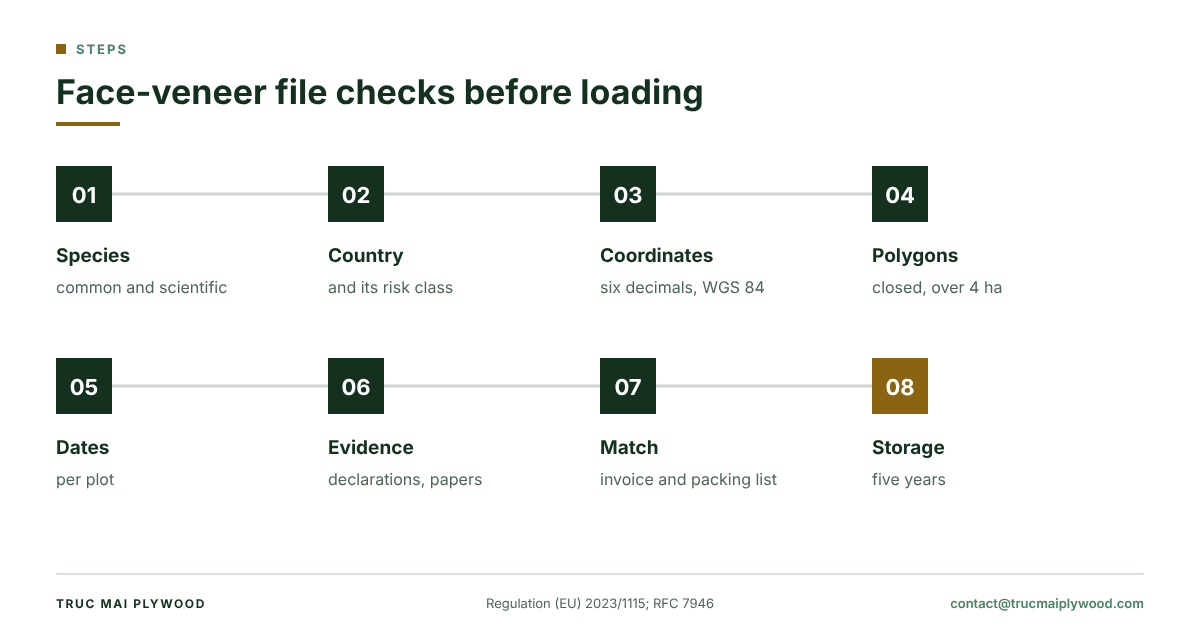
What should a buyer check in the face-veneer file before the container leaves?
Check that the face file names the species with its scientific name, the country of production, the quantity, plots with six-decimal coordinates or closed polygons over 4 ha, a production date per plot and the supporting declarations, and that every name and quantity matches the invoice and packing list.
- Species. Common and scientific name, the same on the file, the invoice and the packing list.
- Country. The face lot’s country of production, and its class on the 2025 list.
- Coordinates. Six decimals, longitude first, WGS 84; the plots open in the right place on a map.
- Polygons. Closed rings for every plot over 4 ha, one feature per plot.
- Dates. A date or time range of production for each plot.
- Evidence. Certificates where they exist, the supplier’s deforestation-free declaration, export and import declarations, the origin form.
- Match. Quantities on the file add up to the face share of the lot.
- Storage. File and statement kept together for five years.
A buyer who receives the file after loading can still check it, but cannot fix it. The checks belong between sample approval and the deposit, and again when the draft shipping documents arrive for approval after loading.
What does the order line say for a panel with an imported face?
The order line names the core, the face and back with their species, the face lot’s country of production, the glue and emission, the size and tolerance, and the EUDR file set for core and face. Written once, it travels unchanged onto each monthly order so the panel and its file stay the same.
18 mm plywood, furniture interior. Styrax core, A-grade, stitched. UF glue at E0 emission. White poplar EV face (Populus deltoides) / poplar back, FSC 100% claim. 1220 × 2440 mm, ±0.3 mm sanded and calibrated. HS 4412. EUDR file set: core and face geolocation (GeoJSON, six decimals, polygons over 4 ha), species, quantity, production dates. 1×40HC, FOB Hai Phong.
Send the line to the quotation desk or to contact@trucmaiplywood.com and ask for the sample face and core dossier for that build. The engineered veneer page covers the EV face, and the documents per container page lists the papers that travel with the file set.
Questions buyers ask
Does an EV face need a plot file if it is reconstituted veneer?
Yes. Engineered veneer is still made from wood, so the plantation poplar behind it has a country of production and plots. Truc Mai's EV face file traces the poplar to a GeoJSON polygon.
What scientific name goes on the statement for an okoume face?
Aucoumea klaineana. The statement lists the common and the scientific name for each wood in the panel, face and core alike.
Is Gabon a low-risk country under the EUDR?
Yes. Gabon is on the low-risk list in Implementing Regulation (EU) 2025/1093, alongside Vietnam and China.
Are faces from Indonesia or Malaysia low risk?
Neither country is on the low-risk or the high-risk list of Implementing Regulation (EU) 2025/1093, so both are standard risk, and a panel with such a face needs full due diligence.
Can a birch face come from Russia or Belarus for the EU?
Both countries are classed high risk under the EUDR country list, and Russian and Belarusian wood products are also under EU sanctions. The birch face origin is therefore written on the order line and checked before the deposit.
What coordinate system does the GeoJSON file use?
WGS 84, in decimal degrees, as the GeoJSON standard RFC 7946 requires. Each point is written longitude first, then latitude.
How precise are six decimal digits in a plot coordinate?
About 10 centimetres, according to RFC 7946, which is well within the precision of a handheld GPS reading.
Does the face-veneer file show the production date?
Yes. The information list asks for the date or time range of production for every plot, so each face plot carries its harvest period next to its coordinates.
Does Truc Mai publish plot coordinates on its website?
No. Plot owners, plot numbers, coordinates and supplier names go only to the importer that files the statement; the website describes the file contents in outline.
Does a face veneer from a natural forest need more than a plantation face?
It needs the same information, plus proof that the harvest caused no forest degradation after 31 December 2020, such as the conversion of primary forest into plantation.
Can one GeoJSON file cover several face-veneer plots?
Yes. One file can hold several features, one per plot, and the statement must include every plot that produced wood in the lot.
What happens to the file when the buyer changes the face species?
The face file is replaced before loading: new species, new country of production, new plots. The order line names the face so that a repeat order keeps the same file.