
The EUDR delay moved dates, not duties: the regulation is in force, and its obligations apply from 30 December 2026 to large and medium operators and to every plywood importer, because plywood was already under the EU Timber Regulation. The 31 December 2020 cut-off is unchanged. Truc Mai already sends plot geolocation for both the Vietnamese core and the face veneer.
Is the EUDR currently in effect?
Yes, the EUDR is in force, but its duties do not bite yet. The regulation entered into force on 29 June 2023, and after two postponements its obligations on operators and traders apply from 30 December 2026. A plywood importer of any size works to that date, because plywood was already under the EU Timber Regulation.
The EU Deforestation Regulation page of the European Commission lists the regulation as in force since 29 June 2023, with application on 30 December 2026 for large and medium-sized operators and traders and on 30 June 2027 for micro and small enterprises. The second date has a carve-out that matters for panels, explained below.
“In force but not applying” is the gap that confuses buyers. Until 30 December 2026 the EU Timber Regulation (EUTR) still governs timber placed on the market, so a container landing this winter is checked under the old due-diligence system. From that date the new statement, with plot geolocation, is required before the plywood is placed on the market.
For an importer who reorders every month, this means the switch happens between two containers of the same order line. The specification does not change; the file behind it does. Truc Mai already sends the EUDR file set with each EU-bound lot, so a buyer can run its own process on today’s containers and have it tested before the date.
What did the EUDR delay change, and what did it leave alone?
The delay moved the date of application by 12 months and added a category of downstream operator with lighter duties. It did not change the products in scope, the cut-off date, the geolocation rule, the five-year record or the penalties. For plywood, the work behind each container is the same as it was before the delay.
EUDR delayed twice: the dates as they stand
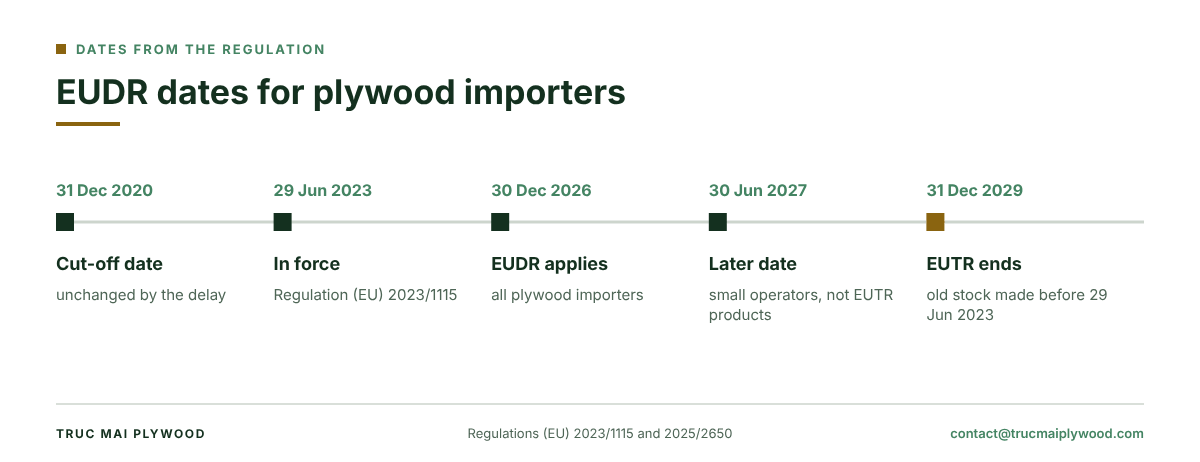
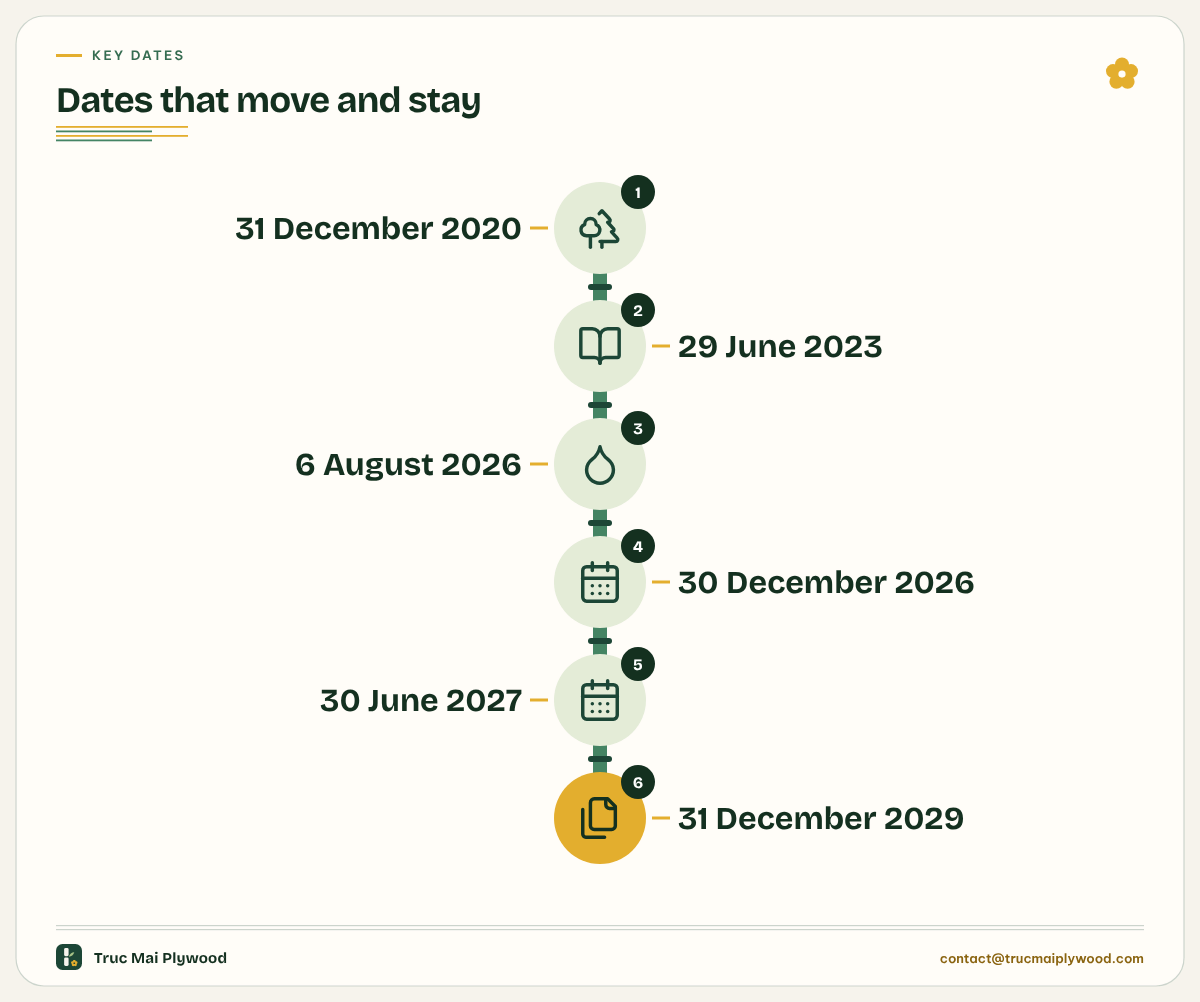
| Date | What happens | Who it concerns |
|---|---|---|
| 29 June 2023 | Regulation (EU) 2023/1115 enters into force | Everyone; cut-off and scope fixed |
| 31 December 2020 | Deforestation cut-off date | Every plot that produced the wood |
| 6 August 2026 | REACH formaldehyde limit 0.062 mg/m³ (separate law) | Furniture and wood-based articles |
| 30 December 2026 | EUDR obligations apply; EUTR repealed | Large and medium operators, and all importers of EUTR products, plywood included |
| 30 June 2027 | Later application date | Micro and small operators of products that were not under EUTR |
| 31 December 2029 | EUTR stops applying to old stock | Timber produced before 29 June 2023 |
EUDR 30 December 2026: who starts then
Regulation (EU) 2025/2650 states that Articles 3 to 13, Articles 16 to 24 and Articles 26, 31 and 32 “shall apply from 30 December 2026”. Those articles hold the prohibition, the due-diligence duty, the information requirements, the risk assessment and the checks by competent authorities, which is to say everything an importer has to do.
The recitals of the same act give the reason: the date “should be postponed by 12 months” so that third countries, Member States, operators and traders can be “fully prepared”. The first postponement had already moved the original start by a year, which is why buyers saw two delays in two years.
What stayed the same is longer than what moved. Annex I still lists HS heading 4412, so plywood, veneered panels and similar laminated wood remain relevant products. The definition of geolocation, the duty to collect information, the ban on placing non-compliant products on the market, and the penalty rules are unchanged.
When does the EUDR apply to a plywood importer already under EUTR?
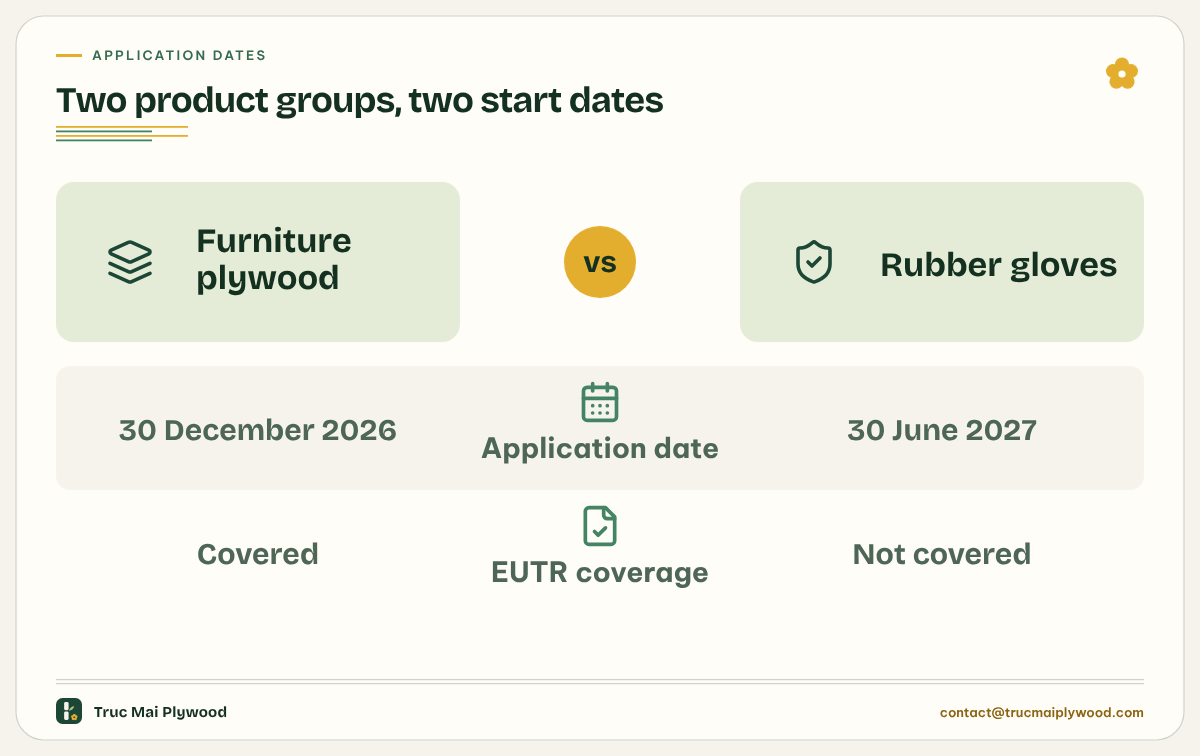
From 30 December 2026, whatever the size of the importer. The later date of 30 June 2027 is reserved for micro and small operators established by 31 December 2024, and it explicitly excludes products covered by the Annex to the EU Timber Regulation. Plywood is in that Annex, so a two-person plywood importer has the same date as a large distributor.
The carve-out is written into the replaced Article 38 of the regulation. Regulation (EU) 2025/2650 gives the 30 June 2027 date “Except as regards the products covered by the Annex to Regulation (EU) No 995/2010”. The reasoning is simple: businesses that already ran EUTR due diligence on timber have the systems, so they get no extra year.
Read the exception carefully if your company also imports other commodities. A small importer of furniture plywood that also buys, say, rubber gloves could find two dates in its own business: 30 December 2026 for the plywood, 30 June 2027 for the rubber products, if those were never under EUTR. For panels, there is one date.
Does EUTR still apply to timber produced before 29 June 2023?
Yes, for a while. The EU Timber Regulation is repealed from 30 December 2026, but it keeps applying until 31 December 2029 to timber and timber products produced before 29 June 2023 and placed on the market from 30 December 2026. From 31 December 2029 such old timber must meet the EUDR prohibition as well.
Regulation (EU) 2025/2650 rewrote Article 37 to say that Regulation (EU) No 995/2010 “shall continue to apply until 31 December 2029” to timber products “produced before 29 June 2023 and placed on the market from 30 December 2026”.
For plywood the transition matters less than it sounds. A panel pressed this year from veneer peeled this year was produced long after 29 June 2023, so it falls under the EUDR from the first container after the date. The transition rule is for warehouse stock and old logs, not for monthly production lines. If a buyer holds older stock bought under EUTR, keep the EUTR file for it until 2029.
Does the 31 December 2020 cut-off date change with the delay?
No. The deforestation cut-off stays at 31 December 2020. Wood from land converted from forest after that date cannot be placed on the EU market, and wood from forest degraded by harvesting after that date is also excluded. The delay changed when the duty starts, not which land qualifies.
The cut-off is set in Regulation (EU) 2023/1115, whose recitals explain that it “should be set on 31 December 2020” to match international forest commitments and to avoid a rush of clearing before the law applied. None of the amending acts moved it.
For a plantation core this is a question of plot history. The core logs on a Truc Mai panel come from plantations in northern Vietnam; a sample core dossier shows a plot planted in 2019, before the cut-off, and clear-felled in 2025 at the end of its rotation. The polygon and the harvest papers are what let the importer show it.
Who files the due-diligence statement for a plywood container from Vietnam?
The EU importer files it. Under the EUDR the importer that places the plywood on the market is the operator, and the operator submits the due-diligence statement before the goods are placed on the market. The mill supplies the data behind it; it cannot file for the buyer, and its data does not replace the buyer’s own risk assessment.
Three roles appear in a plywood chain:
- Operator. The EU importer. It collects the information, assesses risk, submits the statement and keeps the records for five years.
- Downstream operator. A new category added by the amending act, for example an EU furniture maker that turns imported plywood into cabinets. It does not file a new statement; the first downstream operator collects and keeps the reference number.
- Supplier outside the EU. The mill. It has no filing duty under the regulation but is the only party that holds the plot data for core and face.
One statement can cover several shipments, and its reference number must exist before the customs declaration is lodged. For a buyer on a monthly programme, a statement per order line or per month is the practical unit. The EU import steps guide places the statement among the other import papers.
What does EUDR compliance require for plywood importers?
Compliance needs three things: information about each product, a risk assessment, and risk mitigation where the risk is not negligible. The information is a fixed list in Article 9 of the regulation, and most of it can only come from the mill and its veneer suppliers.
| Article 9 item | What it means for a plywood order | Where it comes from |
|---|---|---|
| Description and trade name | “18 mm plywood, poplar face, Styrax core” | Invoice and packing list |
| Species, common and scientific name | Core and face species, both layers | Mill origin records |
| Quantity | m³ and sheet count per lot | Packing list |
| Country of production | Vietnam for core; the face veneer’s own country | Mill and veneer supplier |
| Geolocation of every plot, with production dates | Coordinates and polygons for core and face | Mill GeoJSON files |
| Supplier and customer details | Names and addresses in the chain | Contract papers |
| Evidence of legality and deforestation-free status | Harvest permits, forest-product lists, declarations | Mill dossier |
The legal definition is strict on precision. Regulation (EU) 2023/1115 defines geolocation as coordinates “using at least six decimal digits”, and for plots of more than four hectares it asks for polygons that describe the perimeter of each plot.
There is no official “EUDR certificate”. The operator files a statement and keeps the evidence; a certificate from a third party can support the risk assessment but is not a substitute for it.
What geolocation data does Truc Mai send for core and face veneer?
For each EU-bound container Truc Mai sends origin records and GeoJSON files for both layers of the panel: the Vietnamese core logs and the face veneer. The importer gets plot coordinates, polygons and production dates for each layer, so its statement covers the whole panel, not only the core.

Two sample dossiers show what the files contain:
- Core. FSC 100% Acacia mangium logs grown by a smallholder plantation that belongs to an FSC forest-management group in Vietnam. The core dossier holds the harvest permit papers, a polygon map and the plot coordinates, then the forest-product lists and the weighbridge tickets from the log yard.
- Face. The EV face is reconstituted veneer made from plantation poplar (Populus deltoides). It is traced through forest-management and chain-of-custody certificates to a GeoJSON polygon, with the supplier’s deforestation-free declaration referencing the 31 December 2020 cut-off, the export and import declarations, the imported-timber list and the origin form.
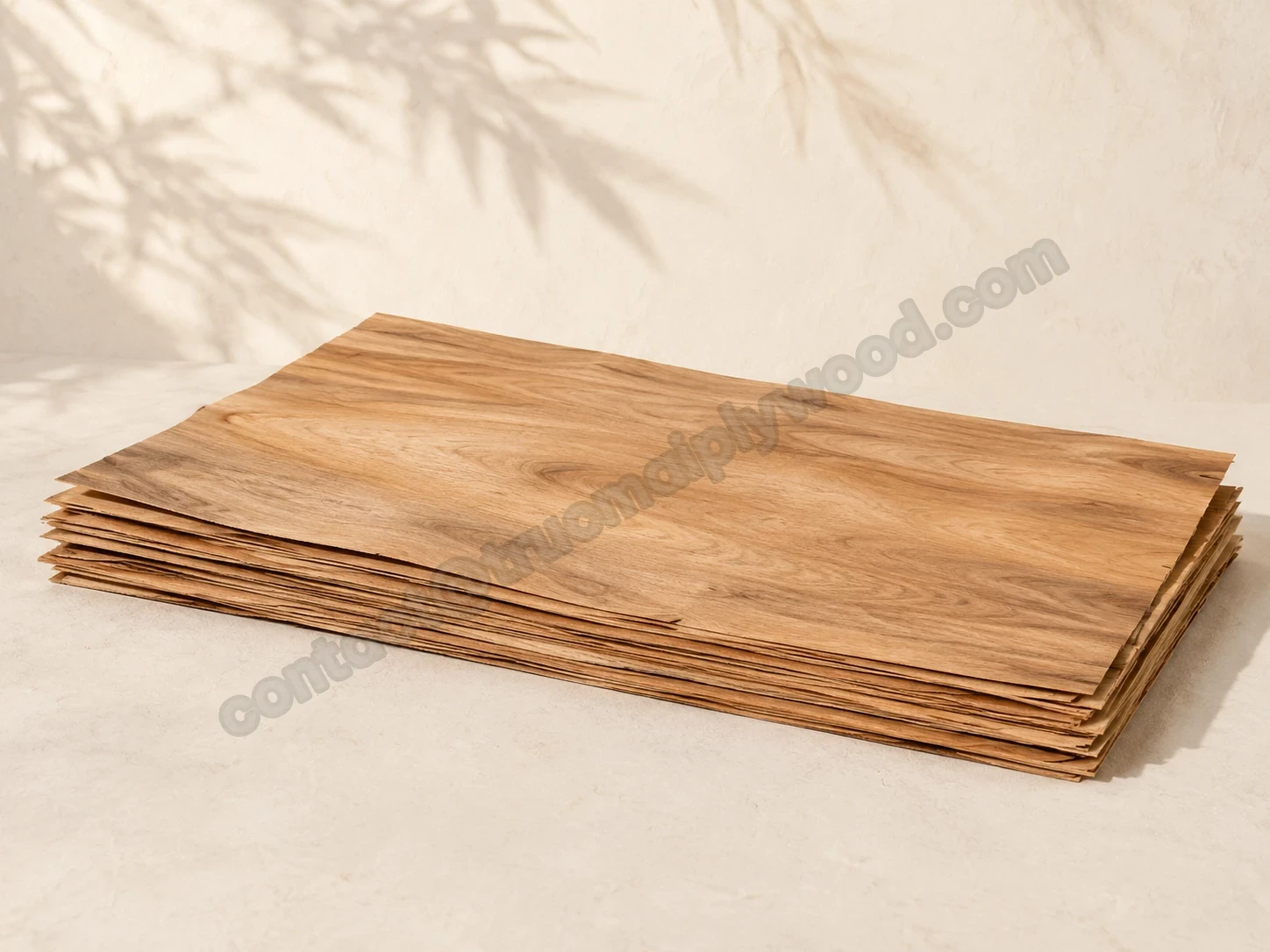
The face is the layer most buyers forget. A panel with a Vietnamese core and an imported face has two countries of production, and the statement must name both. Files that cover only the core leave a gap that the competent authority can find in one question.
Plot owners, plot numbers, coordinates and supplier names stay in the importer’s file and are never published. The EUDR geolocation data page shows the file contents in outline, and a sample dossier is sent before the order is confirmed.

Does Vietnam’s low-risk class reduce the importer’s checks?
Partly. Vietnam is classed low risk, which lets an operator use simplified due diligence: it still collects the Article 9 information, including geolocation, but it may skip the risk assessment and mitigation steps. That only works when every commodity in the product comes from low-risk countries, so the face veneer’s origin decides as much as the core’s.
The country list sits in the Annex of Implementing Regulation (EU) 2025/1093, headed “Low risk countries”, which lists Vietnam and China among others. Article 13 of the main regulation sets the condition: simplified due diligence is allowed only after the operator has ascertained that all relevant commodities were produced in low-risk countries and has assessed the risk of mixing with products of unknown origin.
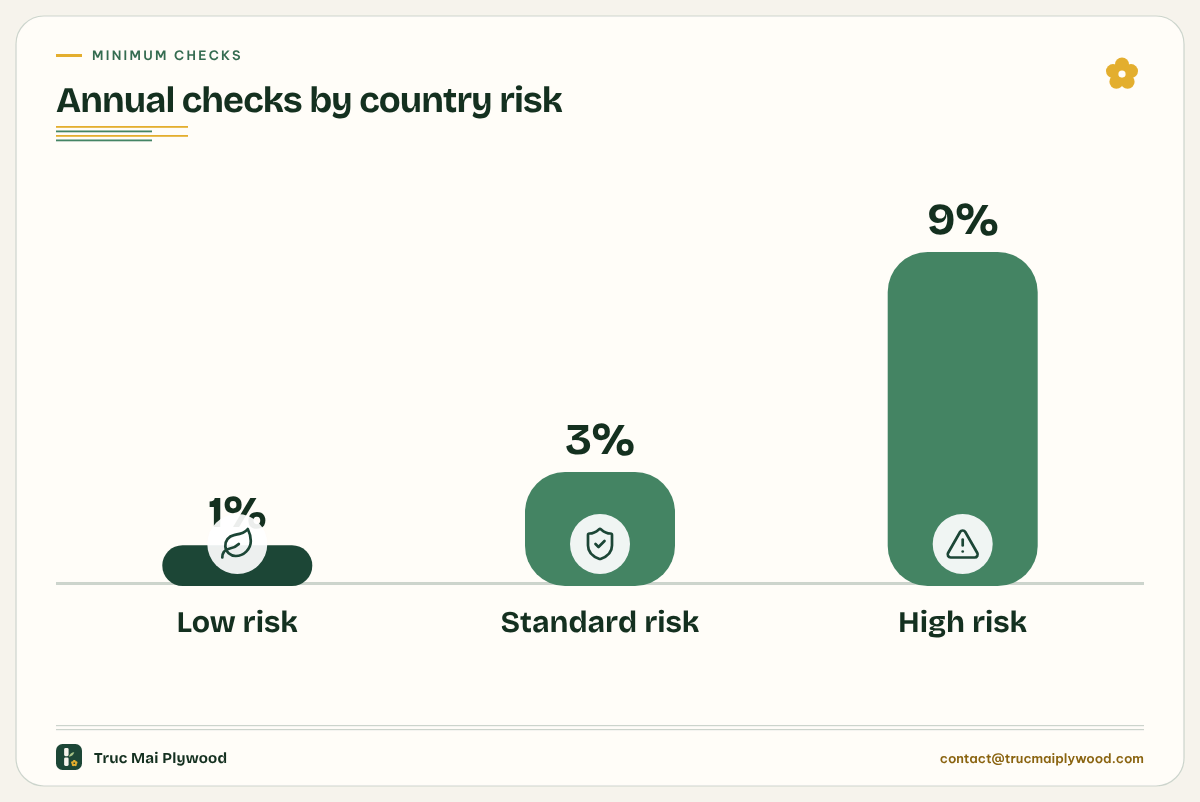
Low risk also changes how often authorities look. Regulation (EU) 2023/1115 requires annual checks covering at least 1 % of operators for low-risk origins, at least 3 % for standard risk and at least 9 % for high risk.
| Country class | Minimum annual checks on operators | Due diligence |
|---|---|---|
| Low risk | 1% | Simplified allowed if every commodity is low risk |
| Standard risk | 3% | Full: information, risk assessment, mitigation |
| High risk | 9% (operators and quantity) | Full, with enhanced scrutiny |
A face veneer from a standard-risk country on a Vietnamese core takes the whole panel out of simplified due diligence. That is a reason to fix the face origin on the order line and keep it the same on every repeat.
What penalties apply for EUDR non-compliance?
Member States set the penalties, and the regulation fixes their floor. For a legal person the maximum fine must be at least 4 % of total annual Union-wide turnover, and authorities can also confiscate the goods and the revenue, exclude the company from public tenders and funding, and suspend its right to submit simplified statements.
Regulation (EU) 2023/1115 says in Article 25 that “the maximum amount of such a fine shall be at least 4 %” of the operator’s or trader’s total annual Union-wide turnover. The fine is a ceiling set nationally, so the actual amount differs from country to country.
The practical risk for a plywood importer is less the fine than the hold. Goods without a statement reference cannot be released for free circulation, and a container sitting in a port terminal costs storage and demurrage every day. A complete file before loading is cheaper than any of these.
How does EUDR interact with REACH formaldehyde limits?
The two rules run side by side and do not cover each other. EUDR asks where the wood came from; REACH entry 77 asks how much formaldehyde the finished article releases. A plywood order for the EU needs a geolocation file and an emission line, and neither replaces the other.
The REACH limit came first. Regulation (EU) 2023/1464 bars furniture and wood-based articles from the market after 6 August 2026 if formaldehyde release exceeds 0.062 mg/m³ under the chamber conditions of Appendix 14.
On a Truc Mai order the glue and emission class are two separate lines: the default is UF glue at E0 emission. The emission class per order page explains how the emission line is written, and the chamber test is arranged when the buyer’s market asks for it. Packaging adds a third file: the PPWR packaging test, which covers the packing materials, not the panel.
What should a plywood buyer do before 30 December 2026?
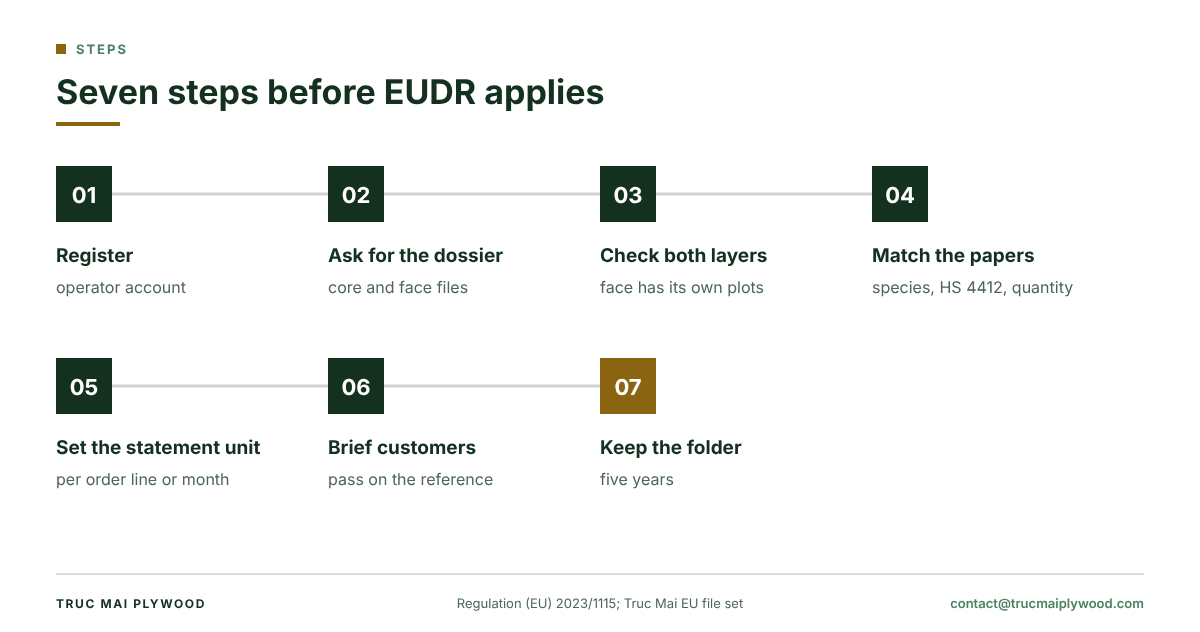
Run the full EUDR process on one container before the date, not after it. A test run on a real lot shows whether the mill’s files load into your system, whether the species names match the invoice and whether the face origin keeps the panel in simplified due diligence.
- Register. Open the operator account in the EU information system and name who submits statements.
- Ask for the sample dossier. Request the core and face files for the exact build you buy, before the next order is confirmed.
- Check both layers. Confirm that the face veneer has its own plot data and country of production, not only the core.
- Match the papers. The species, HS code and quantity on the statement should be identical to the invoice and packing list.
- Decide the statement unit. One statement per order line or per month, with the reference number ready before the customs declaration.
- Brief your customers. Downstream operators keep your reference number, so print it on your sales invoice.
- Keep the folder. Five years per statement, with the mill’s files, the FSC claim as printed on the invoice and the emission line.
Does FSC certification satisfy the EUDR?
No. FSC 100% is a chain-of-custody claim that supports the risk assessment, but the EUDR asks for plot geolocation and a statement filed by the operator. An FSC claim on the invoice and a GeoJSON file in the folder answer different questions, and an EU buyer needs both.
Truc Mai holds FSC chain of custody under licence code FSC-C196493 (certificate SA-COC-014545), FSC 100% only. The claim is stated on sales and shipping documents for products on the current product schedule, which is why the claim and the geolocation file arrive together for a listed product. How to check the licence code yourself is set out in the FSC licence check guide, and the scope of the claim on the FSC 100% page.
FSC helps in one more way: it ties the face veneer to a certified chain. In the sample EV face dossier the poplar is traced through forest-management and chain-of-custody certificates to its polygon, so the certificate chain and the plot file confirm each other.
What can still change before the application date?
The legal text in force sets 30 December 2026. The amending act also required the Commission to carry out a simplification review and report on it, and any change that came out of that would need another regulation published in the Official Journal before it could move a date.
Regulation (EU) 2025/2650 asks for “a simplification review” with a report “by 30 April 2026”, and a general review by 30 June 2030. Watch the Official Journal, not press headlines: each delay so far was a published act, and a proposal changes nothing until it is adopted.
For planning, assume the date holds. A buyer who has the file process working on 30 December 2026 loses nothing if a date moves again; a buyer who waits loses containers at the port if it does not.
What should the EU order line say from 30 December 2026?
The order line adds the file set to the usual specification: core and face species with their origins, the emission line, the FSC claim where the product is listed, and the request for core and face geolocation files. Written once, it is copied onto each monthly order so the file and the panel stay the same.
HS 4412 plywood, 18 mm, for furniture interiors. EUDR file set requested: geolocation (GeoJSON) for core and face, species, quantity. Core: Styrax, A-grade, stitched. Face: white poplar EV, poplar back, FSC 100% claim. Glue: UF at E0 emission. Size 1220 × 2440 mm, sanded and calibrated to ±0.3 mm. Packaging tested to PPWR. Origin proof EUR.1. Quantity 1×40HC on FOB Hai Phong.
Paste that line into a request on the quotation desk, or mail it to contact@trucmaiplywood.com, with a note that you want the sample EUDR dossier for exactly that build before the first order. Certificate files are sent before the order is confirmed; draft shipping documents follow for approval after loading. The furniture and interior plywood range lists the faces and cores the line can carry.
Questions buyers ask
Is the EUDR delayed again?
The dates in force today come from Regulation (EU) 2025/2650, which postponed the obligations by 12 months to 30 December 2026. Plan to that date; a later change would need a new act published in the Official Journal.
Is EUDR mandatory for plywood importers?
Yes. Plywood is HS heading 4412, listed in Annex I of the regulation, so every EU importer that places plywood on the market is an operator with due-diligence duties from 30 December 2026.
Does the 30 June 2027 date apply to a small plywood importer?
No. The later date for micro and small operators excludes products covered by the Annex to the EU Timber Regulation, and plywood is one of them.
Does the 31 December 2020 cut-off move with the delay?
No. Wood from land deforested after 31 December 2020 cannot be placed on the EU market, whatever the application date.
Is there an EUDR certificate for plywood?
No. The operator files a due-diligence statement and keeps the records behind it; there is no certificate issued by a body. FSC 100% is a separate claim that can support the file.
What geolocation data does Truc Mai send?
Origin records and GeoJSON files with plot coordinates and polygons for the Vietnamese core logs and for the face veneer, so the EU importer can file its own statement.
Can one due-diligence statement cover several containers?
Yes. One statement can cover several shipments, and its reference number must exist before the customs declaration is lodged.
How long does the importer keep the EUDR records?
Five years. The operator keeps the information, documents and data behind each statement for five years from placing on the market.
Does Vietnam's low-risk class remove the need for geolocation?
No. Simplified due diligence drops the risk assessment and mitigation steps only when every commodity in the product comes from low-risk countries; the information and geolocation are still collected.
Does EUTR still apply after 30 December 2026?
Only to timber produced before 29 June 2023 and placed on the market from 30 December 2026, until 31 December 2029.
Does the EUDR file cover formaldehyde?
No. Formaldehyde is a separate REACH limit of 0.062 mg/m³ for wood-based articles from 6 August 2026, written as its own line on the order.
What happens if the importer has no statement?
The goods may not be placed on the market. Member States set penalties, and for a legal person the maximum fine must be at least 4% of total annual Union-wide turnover.