
Bintangor vs okoume is chiefly a choice of decorative appearance: bintangor gives a warmer reddish face, while okoume tends towards a lighter pink tone. Pine adds a more pronounced softwood grain. For furniture orders, compare finished samples on the same core and specify face grade, coating, thickness and matching before choosing.

Bintangor vs okoume: what changes on a finished plywood face?
Bintangor offers a warmer reddish face, while okoume gives furniture a lighter pink tone; pine has more pronounced softwood grain. Compare the three on equally prepared panels with the intended finish. Record the approved colour range and lighting, then view each sample beside the other materials in the furniture design.
Bintangor and okoume are names for decorative face veneers, not complete plywood constructions. Bintangor generally presents a warmer reddish-brown impression, while okoume tends towards a lighter pink or salmon-brown surface. Pine offers a visibly different, pale softwood character with more prominent growth features. These are appearance descriptions, not universal colour specifications: natural veneer sheets differ, and grading and finishing change the finished panel.
For a repeat furniture programme, begin with the approved face sample rather than a species label alone. Ask for an uncoated full-face photograph under neutral lighting, a finished sample and a description of accepted knots, patches, colour variation and grain. A face with a convincing showroom photograph can still produce a visibly mixed run when individual sheets are laid side by side. Compare the actual approved sample with a production sample before releasing the main order.
The veneer is the visible outer layer. Core species, bonding system, thickness, pressing, sanding and calibration are separate purchasing decisions. A bintangor face over Styrax core is a different panel from the same face over Eucalyptus core. That distinction matters for machining, sheet weight and shipping. Buyers can examine the Bintangor-faced plywood and Okoume-faced plywood product configurations without treating the face name as a performance grade.
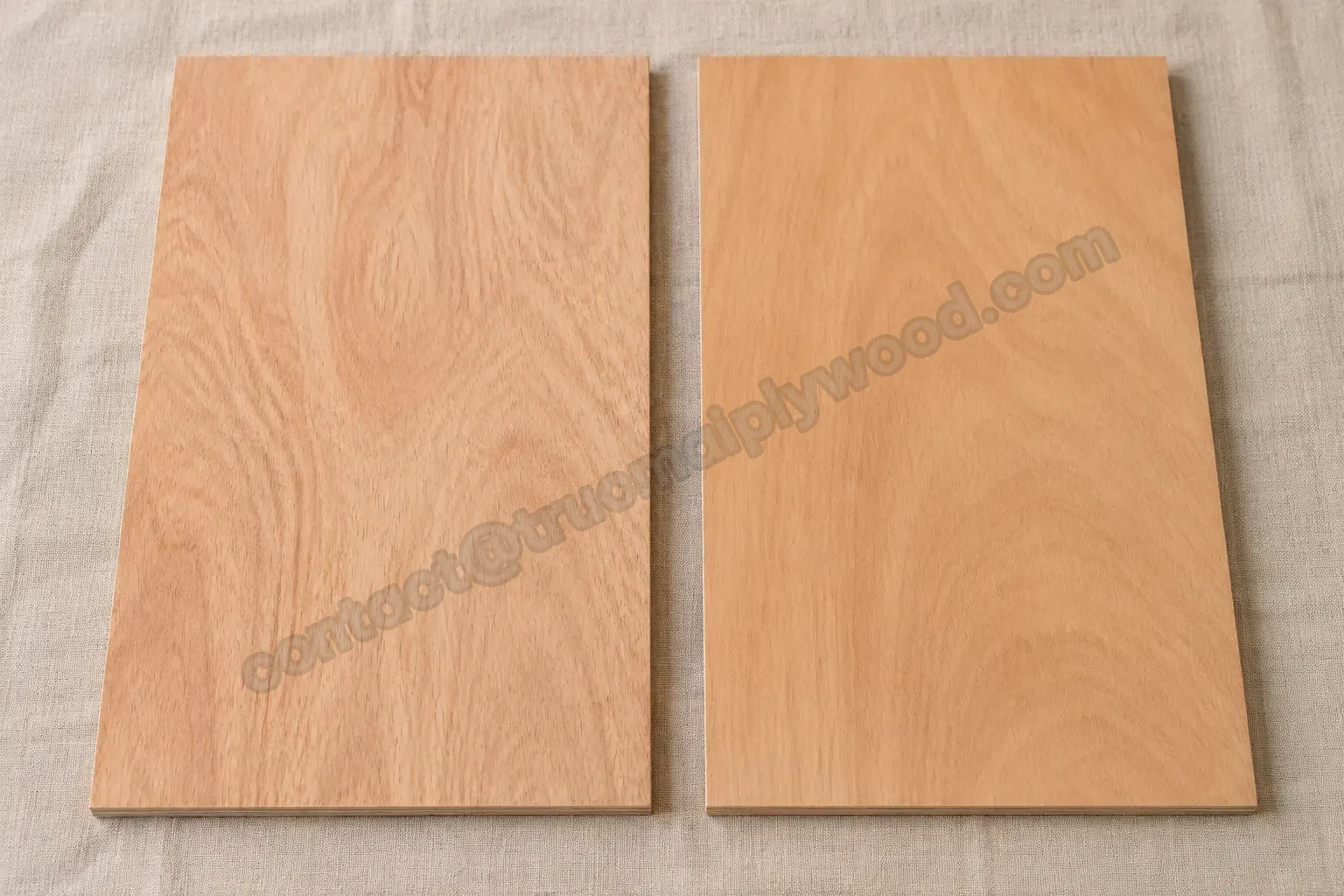
Okoume, bintangor or pine face veneer: which surface suits which use?
Choose okoume for lighter cabinet fronts, bintangor for warm reddish furniture faces, and pine for interiors where visible knots and softwood grain suit the design. Compare several adjacent sheets for colour consistency. Specify both face and back grades for two-sided partitions; hidden parts can use a less demanding appearance grade.
Choose okoume for a relatively even, light warm face on painted or clear-finished furniture, bintangor for a deeper reddish decorative face, and pine when an intentionally visible softwood grain suits the design. These are design starting points, followed by a physical sample and the intended coating trial.
| Buyer application | First face to sample | What to check on the actual panel |
|---|---|---|
| Light-coloured cabinet doors | Okoume | Tone consistency, sanding scratches and colour after sealing |
| Warm reddish furniture fronts | Bintangor | Face-to-face colour spread and veneer matching |
| Rustic or natural-looking interior panels | Pine | Knots, grain contrast and resin-related finish behaviour |
| Opaque painted parts | Okoume or an alternative smooth face | Filling, primer adhesion and telegraphing of defects |
| Decorative clear-coated panels | Bintangor or okoume | Wet-out colour, grain and patch visibility |
| Hidden furniture components | Choose by approved construction | Core, machining and coating requirements rather than face colour |
An opaque finish changes the buying logic. When every face is covered by paint, colour differences under the paint may matter less than surface preparation, veneer repair and uniform absorption. Under a clear coating, the same variations become design features or rejection reasons. For kitchen work, use the cabinet-grade plywood selection criteria and compare faces only after the construction is fixed.
Pine is not a substitute for a fine-textured hardwood look simply because both can be sanded. Its distinct grain can be an advantage for deliberately natural interiors. A buyer specifying pale and uniform doors should ask to see several adjacent panels rather than one attractive sheet.
Which face costs least per m3: okoume, bintangor or pine?
Request a written explanation whenever the proposed alternative changes more than the veneer. A lower quotation may reflect a thinner face, more open repairs, a different back grade or a less demanding sanding specification. Those are legitimate options, but they must be compared openly. The buyer can then decide whether the finished product accepts them. In a repeat programme, compare consistency between deliveries as carefully as the initial offer. A face that matches the first approved batch saves sorting time in later furniture production. Keep the original reference sample available to both purchasing and quality teams.
Pine is often the first candidate for a cost-focused face specification, but no fixed cheapest species can be named without comparable offers for the same panel build. Okoume and bintangor can change order according to veneer grade, supply, matching, face thickness and the destination specification. A quotation for one face cannot be compared with another if the core, thickness or sanding has also changed.
Use one request for quotation with three face alternatives and hold the other inputs constant. Specify identical sheet size, nominal thickness, core species and grade, face/back pairing, veneer thickness, glue and emission specification, sanding, packing and volume. Ask the mill to quote each as a separate line. The result identifies the least costly approved construction rather than merely the lowest face-veneer label.
A buyer also needs to consider yield after machining and finishing. A face that needs extensive filling, sorting or rework can raise the effective cost of accepted furniture parts even when the incoming panel quotation is attractive. Compare the usable panels after the agreed visual acceptance test, and document the acceptance boundary with photos. The plywood pricing guide explains why changing a core or grade at the same time distorts comparisons.
How do grain and colour differ across the three veneers?
A useful inspection method is to divide the sheet visually into a grid and mark the position of noticeable colour or grain changes. The buyer can then say whether variation is acceptable anywhere, only at the edge or only on hidden parts. Do not reduce the decision to a single average colour measurement when the product is made of adjacent doors. Directional grain also matters: a vertical run can look deliberate on a tall cabinet, while alternating direction across neighbouring fronts can appear accidental. Include a grain arrow on the sample label and cutting instruction.
Okoume typically has a fine, fairly subdued grain with warm pinkish tones; bintangor is commonly selected for its reddish decorative appearance; pine tends to show more conspicuous grain contrast and knots. The decisive evidence is a set of samples finished with the buyer’s actual coating, viewed together under the intended lighting.
Ask for photographs of a complete sheet and close-ups from more than one position. A small cropped photograph hides the frequency of colour bands and repaired areas. For book-matched or sequence-matched furniture fronts, specify the matching method and acceptable variation. Random matching may be adequate for less prominent components but can look inconsistent across adjacent doors.
Clear lacquer often deepens the perceived colour of a veneer, while whitewash or stain can shift the relative appearance of different species. Make a finish board that includes the sealer, stain if used, and final topcoat. Record the approved board as a reference. It is much easier to reject an unsuitable finish at the sample stage than to sort a shipment after panels have been cut.
Does the face species determine hardness or dent resistance?
A practical workshop trial can use the same handling sequence for every sample: stack the panels, move them through the saw, machine a representative edge and inspect after finishing. Note any face tearing, local compression or damage at the veneer boundary. Compare parts made with the intended tools and feed settings. These observations are more useful for a furniture production line than an isolated species hardness figure. If the application involves a worktop, choose the protective finish and service conditions first, then assess the finished assembly rather than attributing performance to the face alone.
No. A veneer species influences surface behaviour, but the finished panel’s resistance to indentation also reflects veneer thickness, the support beneath it, core quality and the coating. Do not equate a face species name with a tested indentation value for the complete panel.
A thin decorative veneer can show an impact mark when the supporting cross-band or core compresses. The same face on a better-supported core can behave differently. Ask for an impact or indentation trial on the proposed construction if the application involves heavily used desk tops, shelving fronts or public-area furniture. Compare the results after the intended coating has cured.
Edge durability is a separate issue. Routing through the face exposes inner layers; an attractive face does not guarantee a clean routed edge. Specify the intended machining operation and inspect the cut. When a part will receive edge banding, the consistency of the core and the bond line may matter more than small differences in face hardness.
Which face is easier to paint, stain or clear-coat?
For repeat finishing, make the approval board large enough to include a natural veneer joint and any accepted repair. A flawless central strip can hide the very defects that later become visible after staining. Inspect the finished board in both diffuse daylight and the artificial light used in the customer premises. Gloss reveals surface irregularity; a lower-sheen finish may emphasise grain differently. Keep a small sealed reference board at the finishing station, and compare it with panels at the start of each new run. The comparison should use the same coating schedule, drying conditions and preparation as the production order.
Okoume is a practical starting point for smooth painted or lightly toned furniture, while bintangor is attractive when its natural warm colour remains visible. Pine is useful where stronger grain character is intentional. All three need coating trials on the actual panel construction.
For paint, inspect the face after primer and again after the topcoat. Raised fibres, veneer joints, patches and sanding marks may become clearer under a glossy finish. For stain, check uneven uptake, especially where patches or variable grain are present. For clear coating, judge the whole sheet rather than a small sample square.
The coating line should receive the agreed face grade and preparation instructions. Truc Mai supplies sanded and calibrated faces and offers UV-ready panels, meaning the surfaces are prepared for the buyer’s UV finishing process. The buyer applies the UV coating. The distinction matters when comparing a bare panel with a fully finished decorative board.
What does the face veneer hide about the plywood core?
A cross-section also reveals whether the apparent face quality is supported by a consistent substrate. Check for core overlaps directly below the face, since local thickness differences can become visible after sanding or coating. Examine several edges, not only the cleanest corner of the sample. When parts are narrow, a void that occupies little of a full sheet can still affect a high proportion of one finished component. Buyers ordering many small cabinet pieces should therefore inspect the machining yield on the actual cut pattern. Specify whether the edge will be concealed by banding, painted or left visible.
A face veneer hides most of the internal construction, so the core specification must be written separately. Truc Mai’s furniture and commercial panels use Eucalyptus, Acacia, Styrax or Pine cores, including agreed combinations. A visible okoume or bintangor face does not identify the core underneath.
Furniture-grade construction uses a selected stitched core and sanded faces; commercial constructions can use a different core preparation and surface finish. Inspect a clean cross-section for overlaps, gaps, inconsistent ply thickness and local voids. Ask the mill to show the edge of the same panel from which the face sample was taken.
For cabinets, assess screw holding and edge machining on the proposed core. For lightweight parts, compare the weight of the actual finished sheet. For large flat doors, assess flatness after the intended machining and coating sequence. Those tests reveal useful differences that a face-only comparison misses.
Which plywood dimensions should a buyer specify?
Grain direction should be specified with an arrow and a dimension, especially when the panel will be cut into tall narrow doors. A sheet can have the correct external dimensions yet produce unusable parts if the decorative grain runs across the intended door height. The same issue appears when a cutting contractor rotates pieces to improve nesting yield. Mark visible faces and the orientation of each part on the drawing. Where panels are paired, include their sequence numbers. A clear cut list helps the mill produce labelled pieces that reach the furniture line in the intended order.
Write the finished sheet dimensions and thickness before choosing the decorative face. The Truc Mai range includes 1220 × 2440 mm, 1220 × 2280 mm and 1250 × 2500 mm sheets, with thicknesses from 3 to 40 mm. The selected sheet format affects the nesting plan, visible grain direction and the number of parts produced.
| Specification line | What the buyer should write |
|---|---|
| Nominal thickness | Finished sanded thickness in mm |
| Sheet dimensions | Length × width in mm |
| Face direction | Grain parallel to specified sheet edge |
| Face and back | Two separately named veneer grades |
| Core | Species and core preparation |
| Finish | Sanded, calibrated or UV-ready surface |
| Tolerance | Agreed thickness and size limits |
| Packing | Number of sheets per pack and labels |
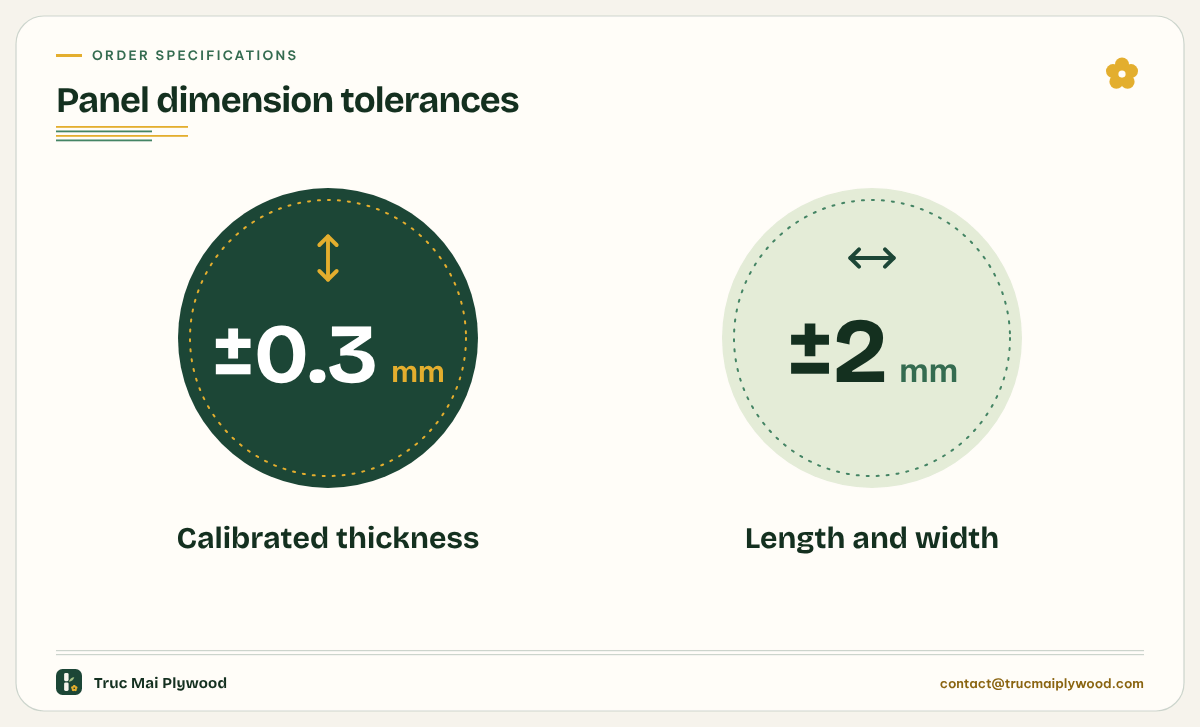
Thickness tolerance is an order specification. A calibrated furniture panel may be ordered to ±0.3 mm, while other lines use different agreed tolerances. Length and width are normally controlled to ±2 mm. Write the tolerance in the purchase order instead of relying on a generic catalogue description. The thin-panel range is useful when planning lightweight furniture backs and door components.
How should buyers approve face grades and veneer matching?
Keep the accepted and rejected samples together in the approval record. A description such as “few marks” is difficult to enforce, while a photograph with an annotated acceptable patch gives the production inspector a usable decision rule. Separate natural grain variation from manufacturing defects such as open joints, sanding-through or glue marks. The first may be a design choice; the latter needs an explicit acceptance limit. For large orders, agree how panels are sampled across packs and how a disputed face is assessed. This avoids changing the grade standard after a shipment has been manufactured.
Approve a physical face/back pair, not an unexplained letter grade. Trade labels such as A/B or BB/CC can differ among sellers. ISO 2426-2:2020 describes hardwood surface appearance classes E, I, II, III and IV; a supplier’s commercial shorthand should be translated into a written visual acceptance schedule rather than assumed equivalent to that system.
Set the allowable natural marks, repairs, colour bands, open joints and patches. Include an agreed sample photograph showing the entire sheet and a second image showing acceptable defects close up. Where several panels meet in a cabinet elevation, request a laid-out sample group so that the matching expectation is visible.
Record whether the back must be decorative or simply sound for an unseen surface. Specifying the same appearance on both faces can be unnecessary for a wall-backed component, while a two-sided partition needs deliberate face/back selection. The approved sample and purchase-order grade pair should travel together through production inspection.
How do adhesive and emission requirements change the choice?
A buyer making both European and US furniture should keep destination compliance requirements in separate order fields. A certificate reference, adhesive name and emission test result answer different questions. The buyer should identify the product type covered by the certificate and the panel thickness ordered, then attach the relevant document set to that order. For moisture-prone interior applications, describe the actual exposure and the required bond test instead of assuming that a darker or denser face offers better resistance. Decorative veneer selection is best made after the performance requirements have been fixed.
Choose the bonding and emission requirements for the destination and use, then compare decorative faces within that construction. The face species does not set a formaldehyde emission class or a moisture-resistance class. Glue chemistry, bond performance and emission testing are different specifications.
The US 40 CFR Part 770 sets a 0.05 ppm formaldehyde limit for hardwood plywood with veneer core under TSCA Title VI. Truc Mai’s third-party CARB Phase 2 and TSCA Title VI certification covers hardwood veneer-core plywood from 3 to 25 mm, certificate CARB/EPA 26053, mill ICTT-26053. Buyers should match the certificate scope to the ordered construction.
The NIST PS 1-22 structural plywood standard describes structural grades and bond classifications; those names should not be borrowed to describe an ordinary decorative furniture panel. The mill’s standard interior specification uses UF glue at E0 emission, with the emission requirement recorded separately from the adhesive system. Buyers should write the test method and requested result in their own specification.
What should an importer check about veneer origin?
A traceability request should distinguish the plantation or forest where the wood grew, the facility that converted it into veneer and the mill that assembled the plywood. These are different stages and may be in different countries. For a mixed-species core, the origin record needs to identify the species represented in the production material. Maintain document identifiers alongside the shipment and product lines so that the buyer can retrieve the correct file for a particular delivery. A consistent file structure makes repeated orders easier to audit and reduces confusion when several face options share one container.
Request origin documentation for both the decorative face and the core. A Vietnamese-manufactured plywood sheet may contain an imported face veneer and locally sourced core wood. Treating the entire sheet as if every component grew in one country loses information needed for traceability.
For EU purchasing, collect species names, countries of production and the plot information supporting the due-diligence file. Truc Mai supplies origin records and geolocation files for the core and face supply chains. The face-veneer origin files page describes the document categories that buyers can request.
For FSC-eligible products, check the chain-of-custody claim on the sales documents. The FSC Chain of Custody standard requires the seller’s certificate code and the claim for the product on relevant sales documentation. Truc Mai’s FSC licence is FSC-C196493 and its certificate code is SA-COC-014545; FSC 100% applies to eligible products within the certificate schedule. A decorative face name alone says nothing about that claim.
How can a buyer inspect a sample before ordering?
Photograph each trial before and after coating, and record the same viewing angle for every face. Mark the panel identity on the reverse rather than the decorative surface. When a defect appears after finishing, return to the uncoated photograph to determine whether it was already visible or developed during preparation. A simple comparison sheet can record face colour, visible repairs, sanding quality, machining edge and finish acceptance. The sample approval should name the actual product construction, not only the decorative veneer. Keep one signed reference with the buyer and one with the mill.
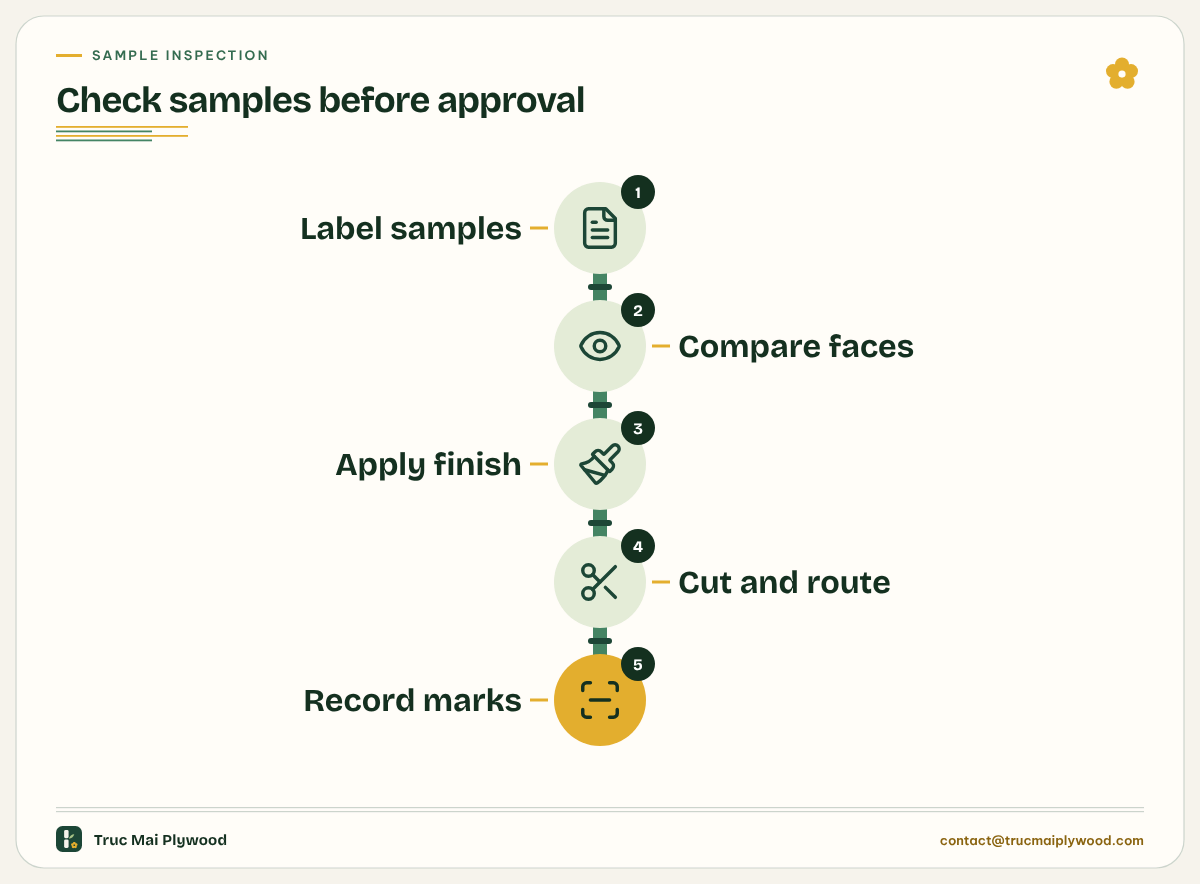
Inspect at least one complete panel of each proposed face and run the same finishing and machining steps on each. Start with face appearance, then assess edges, thickness and finished-part yield. A comparison is only meaningful when the underlying core and other specifications match.
- Label the three samples with their actual face and core constructions.
- View the uncoated faces side by side under the lighting used for final furniture inspection.
- Apply the production primer, stain or clear finish to comparable areas.
- Cut and route the planned furniture component, then inspect exposed layers and veneer edges.
- Record accepted and rejected surface marks with photographs.
- Sign off one reference sample and attach its identification to the order specification.
A small offcut is useful for testing a finish but cannot show whole-sheet colour distribution. Where cabinet doors will be arranged in a run, place multiple finished samples next to one another. Buyers can use the sample-ordering process to arrange the reference material before writing the final specification.
Can the mill cut decorative panels to furniture-part sizes?
The nesting drawing should distinguish finished part size from saw-cut allowance. It should also identify which edge becomes the top of a visible door or panel. For matching cabinet fronts, number pieces in the order they will be installed. If the design has left-hand and right-hand parts, note the orientation of the face and any pre-drilled operations. These instructions help prevent an apparently efficient cutting layout from producing the wrong visual sequence. Pack labels should use the same identifiers as the cutting drawing and the buyer production list.
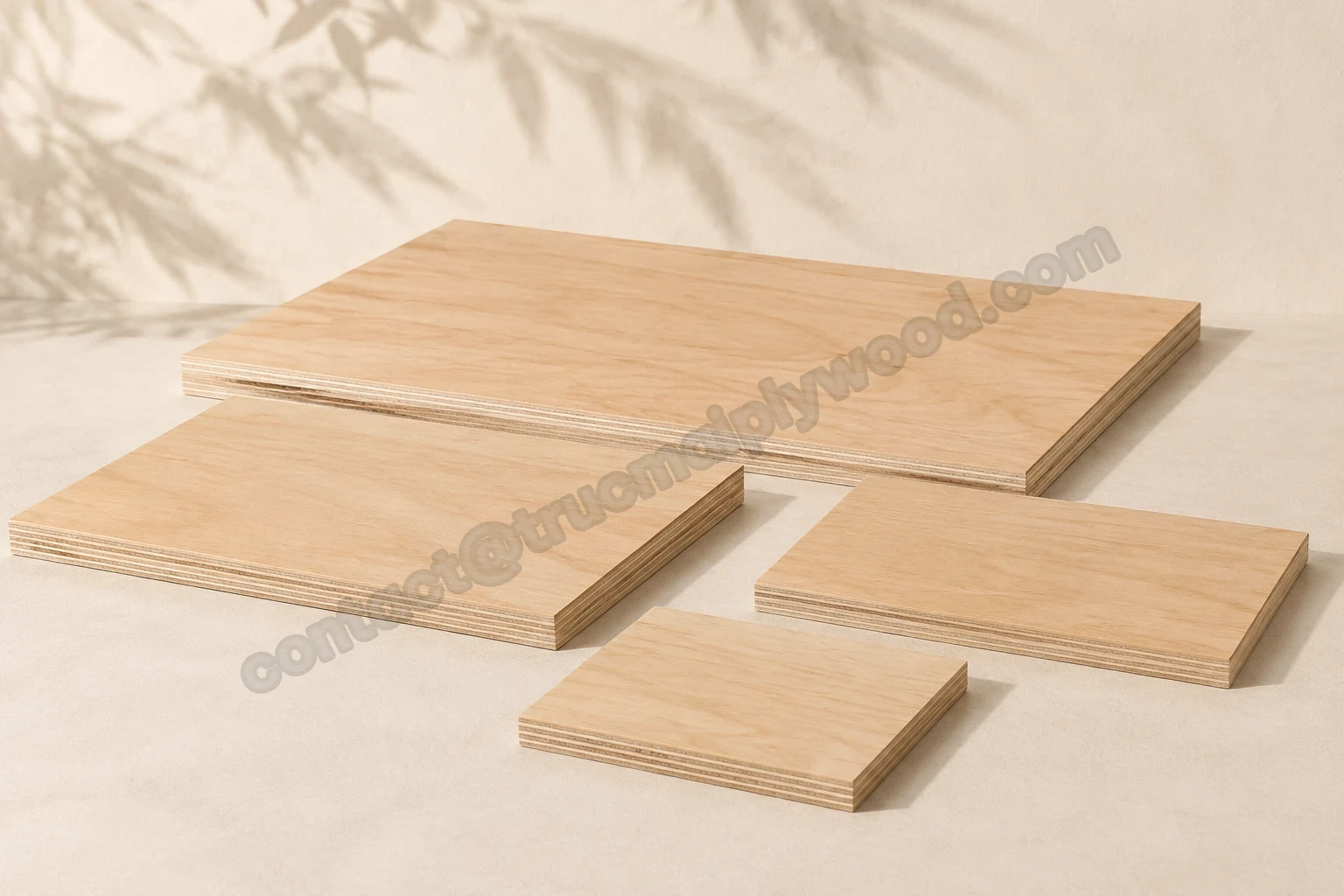
Yes. Cut-to-size is a customer option, with labelled parts made from the agreed parent sheet and cut list. The cutting layout should follow the grain direction and the intended visible face, rather than merely maximise the number of rectangles.
Common patterns include a sheet split lengthwise into two 610 × 2440 mm parts, a three-part layout of 1200 × 800 mm pieces, or four 1220 × 610 mm parts. Six-part layouts are also available. The exact dimensions and nesting arrangement are agreed by email against the parent sheet and cutting plan.
Ask for labels that distinguish part dimensions, face orientation, order line and pack. If a customer has a large number of visually matched doors, keeping neighbouring parts in a known sequence makes subsequent finishing easier. Include the allowance for the saw cut in the approved drawing, and have the mill return the final nesting diagram before cutting.
What does a 40HC planning table reveal about the core?
For a buyer choosing between decorative faces, the practical lesson is that changing only the veneer usually leaves the core-led loading calculation largely unchanged. Changing the core can alter the sheet count and total cargo mass. The purchase order should therefore keep the core line visible alongside the face selection. When comparing freight efficiency, use the planned finished panel weight and the packing design rather than a face-species label. The table gives a consistent basis for discussing a shipment, while the final load plan is prepared from the actual order and booking.
The 40HC planning model shows how core weight changes the number of panels shipped even when the decorative face is unchanged. The following figures are calculated for panels only, with the specified pack arrangement and reference core densities. They are planning figures rather than observed loading records.
The model uses packs of approximately 1,000 mm height, with 18 Styrax packs, 16 Acacia packs or 15 Eucalyptus packs, and a 28,000 kg cargo planning payload. Reference densities are 500, 580 and 650 kg/m³ respectively. The carrier and route determine the actual booking payload; final loading uses weighed panels and packing materials. See the container loading explanation for the method.
| Core | Thickness (mm) | Sheet size (mm) | Packs | Sheets/pack | Weight-capped | Sheets | m³ | kg/sheet | Total kg |
|---|---|---|---|---|---|---|---|---|---|
| Styrax | 12 | 1220x2440 | 18 | 83 | No | 1494 | 53.4 | 17.9 | 26680 |
| Acacia | 12 | 1220x2440 | 16 | 83 | No | 1328 | 47.4 | 20.7 | 27510 |
| Eucalyptus | 12 | 1220x2440 | 15 | 80 | Yes | 1200 | 42.9 | 23.2 | 27860 |
| Styrax | 15 | 1220x2440 | 18 | 66 | No | 1188 | 53.0 | 22.3 | 26520 |
| Acacia | 15 | 1220x2440 | 16 | 66 | No | 1056 | 47.2 | 25.9 | 27350 |
| Eucalyptus | 15 | 1220x2440 | 15 | 64 | Yes | 960 | 42.9 | 29.0 | 27860 |
| Styrax | 18 | 1220x2440 | 18 | 55 | No | 990 | 53.0 | 26.8 | 26520 |
| Acacia | 18 | 1220x2440 | 16 | 55 | No | 880 | 47.2 | 31.1 | 27350 |
| Eucalyptus | 18 | 1220x2440 | 15 | 53 | Yes | 795 | 42.6 | 34.8 | 27690 |
| Styrax | 21 | 1220x2440 | 18 | 47 | No | 846 | 52.9 | 31.3 | 26440 |
| Acacia | 21 | 1220x2440 | 16 | 47 | No | 752 | 47.0 | 36.3 | 27270 |
| Eucalyptus | 21 | 1220x2440 | 15 | 45 | Yes | 675 | 42.2 | 40.6 | 27430 |
How should the final RFQ compare three face options?
Attach the same furniture drawing and finish schedule to all three alternatives. Ask the supplier to identify any proposed change to the face thickness, grade, back veneer or core rather than silently substituting a different build. Name the person or department that approves the visual sample and keep the approval record with the purchase order. When a later shipment is ordered, refer to the same approved construction and sample identifier. That continuity makes the comparison useful beyond the first container and helps purchasing, production and inspection teams work from one specification.
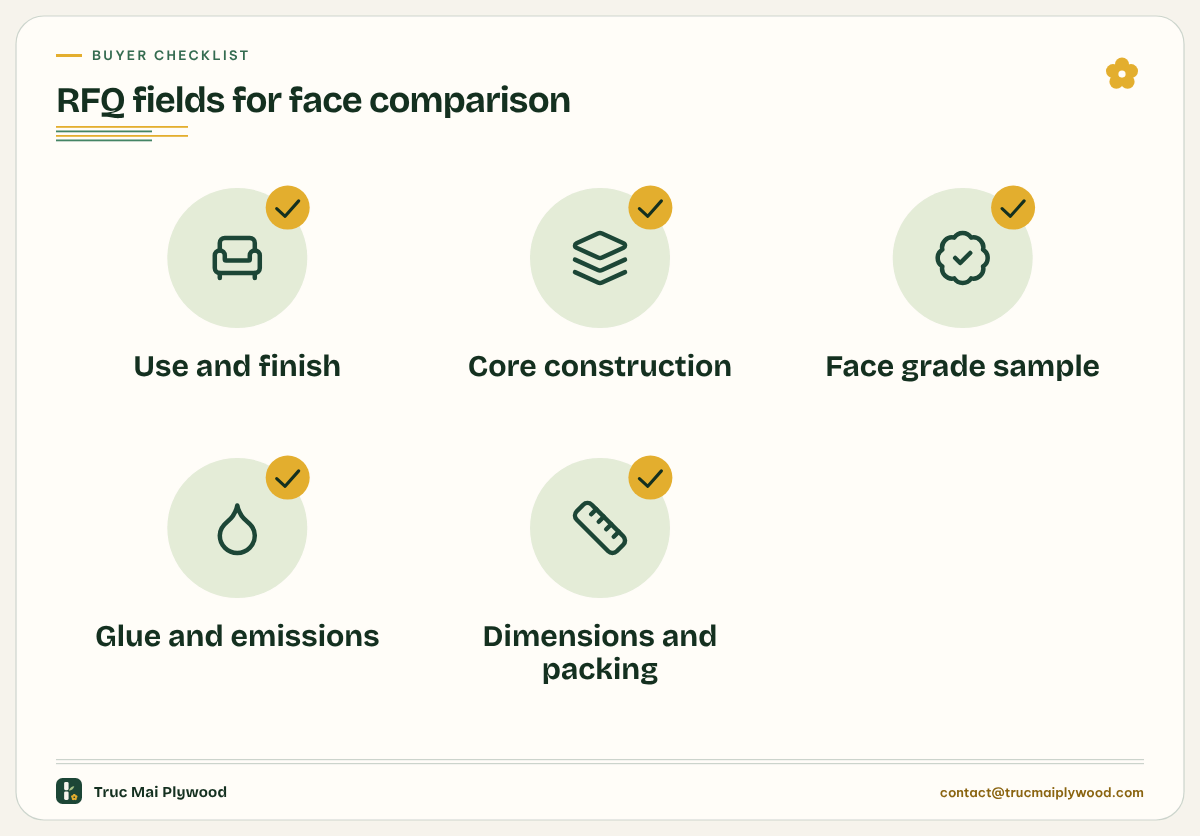
Send one common construction schedule with three separate face options. That lets the supplier price and sample the visual difference without silently changing the core or grade. The purchasing decision then rests on an approved appearance, a workable finish and a complete landed specification.
- State the end use and whether the visible surface is painted, stained or clear-coated.
- Fix the core species, joining method and nominal thickness.
- Name the face/back grade pair and attach an accepted visual sample.
- Specify glue, emission method and any destination certification requirements.
- Set sheet dimensions, grain direction, cut list and packing labels.
- Give the order quantity, destination port and delivery term.
Request separate sample and quotation lines for okoume, bintangor and pine. Ask for the face-veneer source records where needed and make the approved sample part of the purchase-order reference. The plywood RFQ checklist gives a structured way to send the specification without leaving critical fields blank.
Send your specification to contact@trucmaiplywood.com or through the quotation form.
Questions buyers ask
Can I order a different face and back veneer?
Yes. Specify the decorative face and the back separately, with an approved grade pair and sample.
Does bintangor plywood have a bintangor core?
No. Bintangor describes the visible face; the core species must be stated on the order.
Is okoume suitable for painted furniture?
Okoume is a useful sample candidate for painted furniture. Test the actual panel with the planned primer and topcoat.
Can pine veneer be clear-coated?
Yes. A clear coat highlights the natural pine grain, so approve a finished sample showing knots and colour variation.
Can a buyer request matched veneers?
Yes. Specify the matching method, allowable variation and arrangement of adjacent panels in the approved sample.
What if the two faces have different grades?
Write the face/back grade pair and the appearance requirements for each side. This is common where only one face remains visible.
Are the three veneers interchangeable in an existing design?
Not automatically. Compare finished colour, machining and accepted visual defects before substituting one face for another.
Should a buyer inspect an entire sheet?
Yes. A full sheet shows colour spread and repairs that may be missed in a small offcut.
Can cut panels carry part labels?
Yes. Specify part identifiers, dimensions and grain direction in the cutting and packing instructions.
What should appear on the purchase order?
Record face, back, core, glue and emission requirements, thickness, sheet size, finish, grade sample, packing and quantity.