
Plywood white means a pale veneer face or an opaque white decorative surface, not one standard plywood grade. Bleached poplar shows wood grain; white melamine and paper overlays cover it. Specify the surface, core, face/back pair and approved colour sample for container orders.
What do you call plywood white?
White plywood means a plywood sheet with a pale veneer, an opaque white decorative surface or white paint. It is an appearance description, not a species or bond grade. Bleached poplar retains visible grain; melamine and paper overlays cover the wood. State the exact face construction on the purchase order.
In the UK, “white faced plywood” is often used for an already decorative surface, while “bleached poplar plywood” describes a light-coloured wood face. “White plywood sheet” may refer to either. A listing for “white plywood 4x8” says something about format, not the surface. The decisive question is whether the finished part should display wood grain or a uniform white field. The answer changes the specification and the inspection method.
An interior joinery buyer who wants a visible pale grain can start with bleached poplar plywood. A buyer who wants an even, ready-decorated white surface can examine white melamine-faced plywood. These are different purchasing routes, even when both appear white in a catalogue photograph. Ask for face and back photographs in natural light and an edge photograph that reveals the core.
Colour words also need a physical reference. “Snow white”, “warm white” and “off-white” are useful design descriptions, but the terms are not interchangeable inspection standards. The approved sample should establish the visual target. Note whether it represents the face alone or the completed panel with its intended finishing system. For an exposed cabinet door, compare finished faces; for a concealed packing insert, inspect the supplied face as ordered.
What is the difference between bleached poplar and white melamine faces?
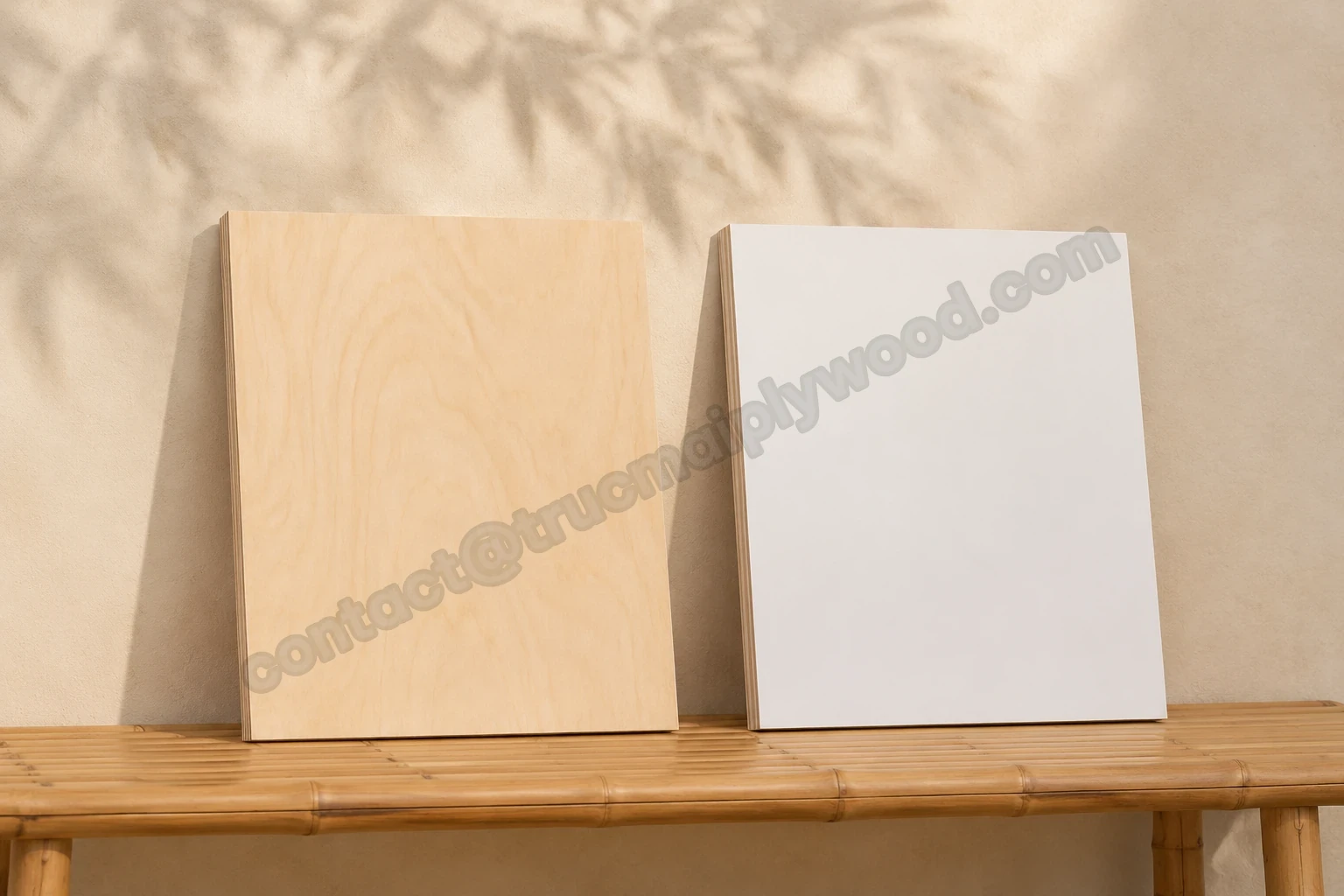
Bleached poplar is a pale real-wood veneer; white melamine is an opaque decorative surface. The first shows wood fibres and grain, while the second gives a more uniform white appearance. Paper-overlay plywood is a third category and must be identified separately. The surface name belongs on the order line before the thickness or sheet count, because a substitution can change the visible result even when the panel dimensions match.
Bleached poplar works where buyers want a light natural face for crafts, packaging presentation, drawer components and painted or clear-finished interiors. Its figure remains visible. A finishing sample is useful because a clear coating changes how the grain and underlying tones appear. Where the designer wants a flat white cabinet interior with no wood pattern, a decorative white overlay is usually the more direct specification.
Melamine-faced plywood carries a decorative melamine surface over a plywood substrate. It is useful for cabinetry and shopfitting components that need a finished face. The surface specification should include colour reference, texture or sheen, face/back pairing and machining expectations. A buyer should compare the proposed finish under the lighting used at the destination, rather than infer gloss or whiteness from a product name.
White paper overlay is a separate surface option. The paper, impregnation and finishing construction need to be written down; a white appearance alone does not establish its wear performance or cleaning resistance. Ask the supplier for a representative piece and evaluate the actual surface against the intended use. If the panel will be painted, confirm whether the paper is the desired painting substrate rather than buying it solely because it looks white.
| Face specification | What the buyer sees | Typical purchasing purpose | Key approval item |
|---|---|---|---|
| Bleached poplar veneer | Pale timber grain | Light wood appearance, crafts, interior parts | Grain and shade reference |
| White melamine face | Opaque, consistent white field | Cabinet and interior decorative components | Colour, sheen and surface sample |
| White paper overlay | White covered face | Specified overlay or further finishing | Overlay construction and finish trial |
| UV-ready pale veneer | Prepared wood surface | Buyer applies its own UV coating | Sanding and coating trial |
When comparing quotations, ask for the same underlying panel construction. An overlay on a jointed commercial core and an overlay on a stitched furniture core may look similar in a small photograph but are different builds. The approved sample should include a full-thickness edge, not only a face swatch. This is particularly important when exposed edges, screw holding or machining will matter in the final component.
Does the shade of a bleached face stay the same from container to container?
The shade is controlled against an approved sample, with face and back grades written as a pair. Natural bleached veneer still has grain and timber variation. For repeat containers, the practical buying method is to agree the visual reference at the start, retain a reference sample and inspect later production against that reference. The word “white” on successive invoices is too broad to serve as the acceptance criterion.
Assess shade on a broad face, not a tiny corner. A pale face can show slight differences between veneer leaves, particularly where grain direction, light reflection and the chosen finish interact. Lay the comparison sheets flat under consistent lighting. Examine the centre and the perimeter, then view several sheets from the pack. A sample selected only from the cleanest small area may hide the appearance of a normal full sheet.
For a cabinet programme, describe the acceptable appearance in buyer language: visible grain allowed, natural tonal movement allowed, patching or discoloration agreed against the sample, and reverse-side appearance stated separately. The supplier can then grade the face and back consistently with that agreement. Cabinet-grade plywood explains why the face pair matters as much as the product name.
Keep the same reference for the first order and the replenishment order. Photograph it with a neutral background, but retain the physical sample because screen settings alter white balance. Mark which side is the face. When a panel is to be painted, assess a painted trial as well as the raw veneer. A colour mismatch discovered after assembly is more costly to correct than a shade issue found at the panel inspection stage.
White melamine is assessed differently. Compare the supplied decorative surface with the chosen finish reference, including sheen and texture. Two nominally white surfaces can appear different when installed side by side, even if their basic colour seems close. Specify the same finish reference for adjacent components and order enough matching material for a continuous production run.
Which cores go under a white face?
Styrax, Eucalyptus, Acacia, Pine and agreed mixed-species cores can sit beneath a white face. The visible face and the core are separate choices. Truc Mai Plywood makes furniture and commercial plywood in Ha Hoa, Phu Tho, with the core selected for weight, machining, panel construction and the buyer’s application. A white poplar face does not mean that the inner plies are poplar.
Styrax is a useful starting point for lighter furniture and interior panels. Eucalyptus and Acacia are alternative core choices when a buyer prefers their handling or construction characteristics. Pine and mixed-species builds can also be specified. Ask to see the edge and the face together: the face photograph shows colour, while the edge reveals the inner construction that affects machining and pack weight.
The furniture/interior line uses a stitched, A-grade core and sanded faces. Commercial panels can use an AB core with loose-laid or jointed construction and lighter sanding. Those are meaningful distinctions when a white panel is to be routed for furniture rather than used as a temporary packing separator. A buyer should state the application first and then request the corresponding core construction.
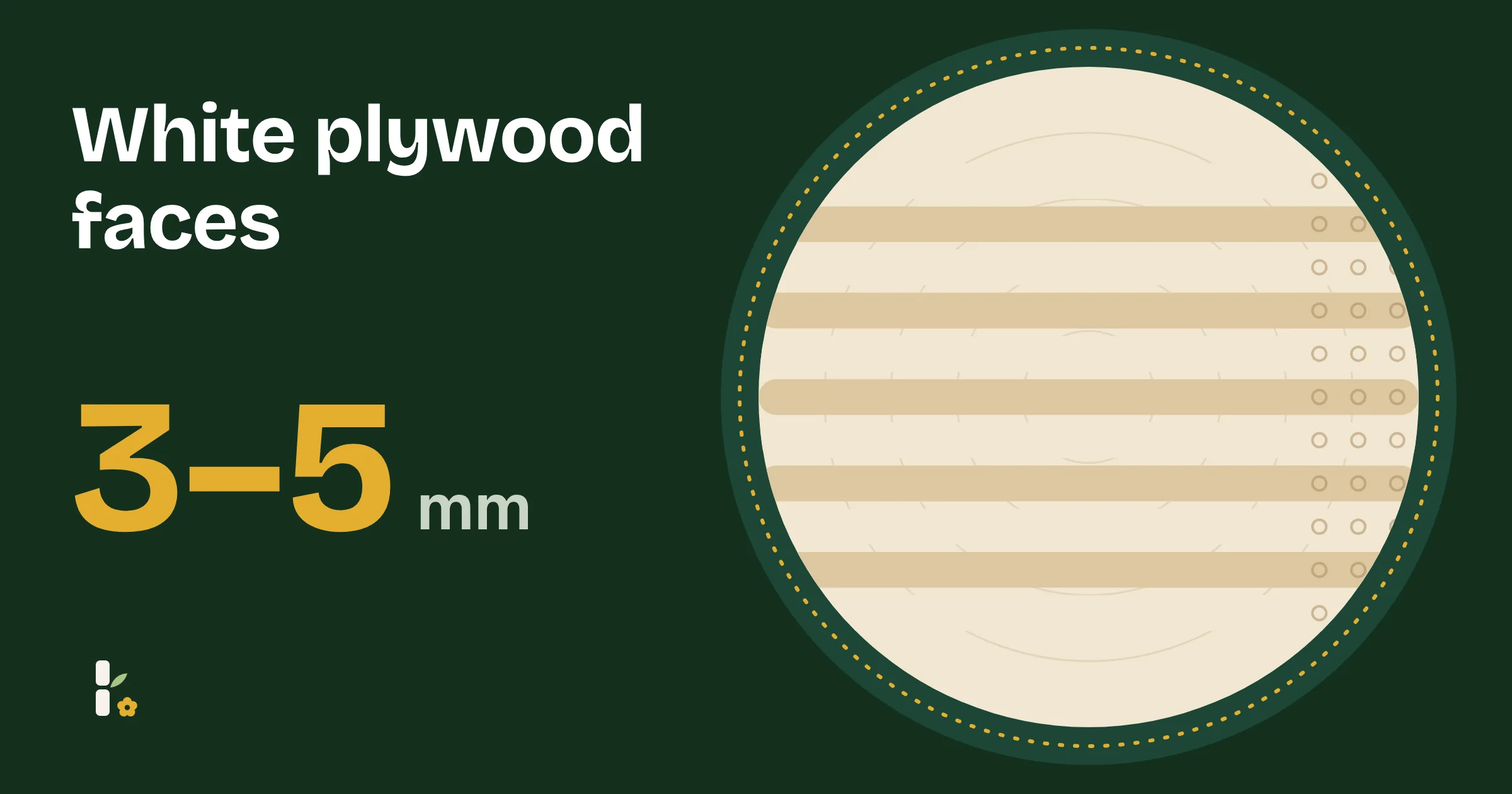
For thin panels, 3–5 mm is built with five plies; 6 mm construction is set by the order. At 18 mm, the usual build is 11–13 plies, most often 11. These are construction details to put alongside the white face specification when edge appearance and machining matter. The thin plywood range helps distinguish lightweight craft panels from thicker cabinet parts.
A useful inspection routine checks the face for colour and veneer preparation, the edge for gaps and ply arrangement, and the thickness at several points. The buyer should specify a thickness tolerance separately from the appearance grade. Sanded calibrated furniture panels can be ordered at ±0.3 mm; commercial and packing specifications use different tolerances. An approved sample links these otherwise separate choices into one agreed build.
Can white melamine-faced plywood be ordered by the 40HC?
Yes, white melamine-faced plywood can be ordered by the 40HC. The standard minimum order is one 40-foot high-cube container, with the loading plan based on the actual core, thickness, sheet format and pack weights. A container can carry one or two products as a straightforward order, or a wider mix by agreement. Specify whether the white melamine panels are a full-container line or part of a mixed load.
The figures below are the supplied planning model for panels only, not a record of an actual white melamine shipment. They use a nominal 1,000 mm pack height and a 28,000 kg cargo planning payload; carrier and route limits determine the loading plan. The model treats the panel core as the density input. Final loading uses weighed sheets and packing material in the gross-weight calculation.
| Core | Thickness (mm) | Sheet (mm) | Packs | Sheets/pack | Sheets | m³ | kg/sheet | Total kg | Weight capped |
|---|---|---|---|---|---|---|---|---|---|
| Styrax | 12 | 1220 × 2440 | 18 | 83 | 1494 | 53.4 | 17.9 | 26680 | No |
| Acacia | 12 | 1220 × 2440 | 16 | 83 | 1328 | 47.4 | 20.7 | 27510 | No |
| Eucalyptus | 12 | 1220 × 2440 | 15 | 80 | 1200 | 42.9 | 23.2 | 27860 | Yes |
| Styrax | 15 | 1220 × 2440 | 18 | 66 | 1188 | 53.0 | 22.3 | 26520 | No |
| Acacia | 15 | 1220 × 2440 | 16 | 66 | 1056 | 47.2 | 25.9 | 27350 | No |
| Eucalyptus | 15 | 1220 × 2440 | 15 | 64 | 960 | 42.9 | 29.0 | 27860 | Yes |
| Core | Thickness (mm) | Sheet (mm) | Packs | Sheets/pack | Sheets | m³ | kg/sheet | Total kg | Weight capped |
|---|---|---|---|---|---|---|---|---|---|
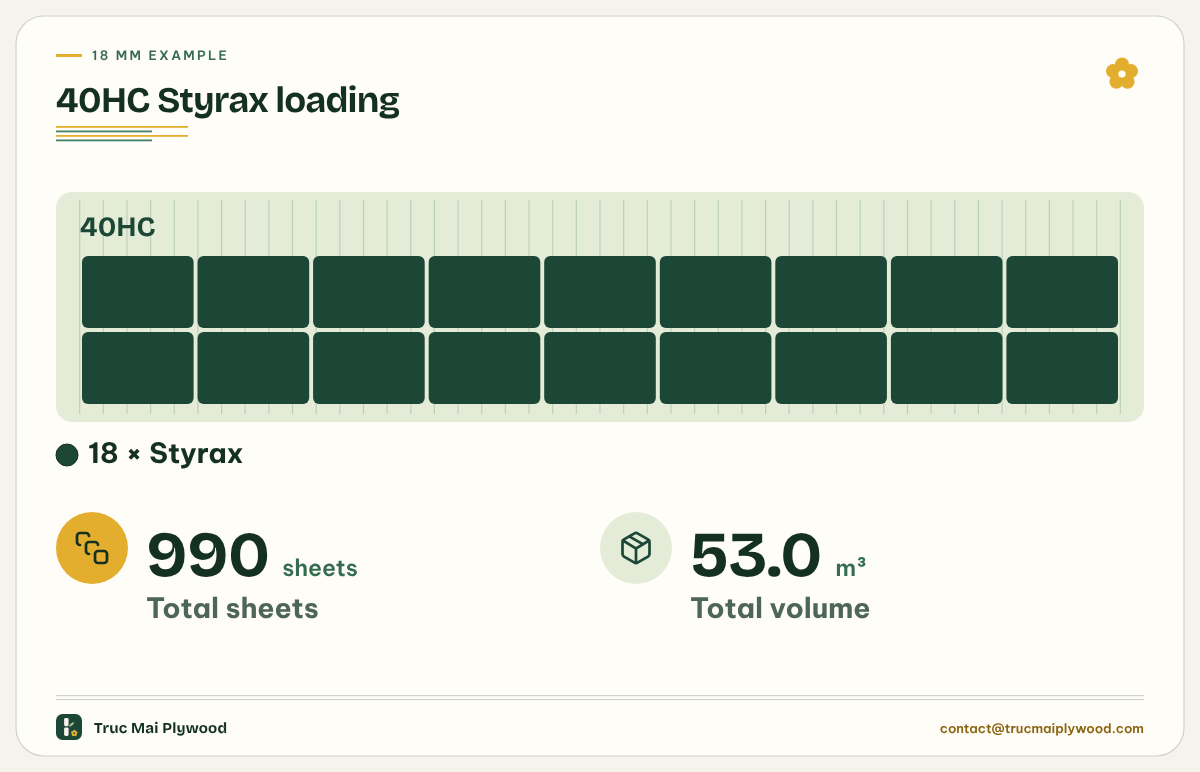
| Styrax | 18 | 1220 × 2440 | 18 | 55 | 990 | 53.0 | 26.8 | 26520 | No |
| Acacia | 18 | 1220 × 2440 | 16 | 55 | 880 | 47.2 | 31.1 | 27350 | No |
| Eucalyptus | 18 | 1220 × 2440 | 15 | 53 | 795 | 42.6 | 34.8 | 27690 | Yes |
| Styrax | 21 | 1220 × 2440 | 18 | 47 | 846 | 52.9 | 31.3 | 26440 | No |
| Acacia | 21 | 1220 × 2440 | 16 | 47 | 752 | 47.0 | 36.3 | 27270 | No |
| Eucalyptus | 21 | 1220 × 2440 | 15 | 45 | 675 | 42.2 | 40.6 | 27430 | Yes |
Read the table as a planning comparison of cores, not as a fixed booking allocation. The same sheet format can carry different sheet counts because pack count and panel weight differ. A decorative face and packing materials need to be included when the final weights are checked. The 40HC loading guide explains the packing logic, while 18 mm panel specifications help buyers check a common cabinet thickness.
A mixed order needs separate pack lines. State the number of packs for each face and core, their thicknesses and the labels to appear on the packing list. If a buyer wants both bleached veneer and white melamine in one container, identify each as a separate product line. This makes it possible to count packs at destination without relying on visual guesses through the wrapping.
For a first order, production is normally planned 15–45 days after the deposit according to the agreed quantity and production conditions. The commercial terms can be reviewed alongside deposit and balance terms. Production time and ocean transit are different parts of the schedule, so the purchase order should show the intended shipment window separately from the destination arrival plan.
Is a UV-ready white panel coated at the mill?
No. A UV-ready white panel is prepared for the buyer’s UV coating; the mill does not apply that coating. The distinction matters when comparing an uncoated, sanded pale veneer with a finished decorative board. A “UV-ready” description concerns the surface preparation for the next process, not the colour, film thickness or performance of a coating that has already been applied.
A finishing line needs a predictable substrate. The buyer should test the actual coating system on the supplied veneer, looking at absorption, grain raise, colour change and adhesion after curing. A smooth raw face can look different after the first coat. The coating trial should therefore be approved in the same lighting and end-use conditions as the finished furniture part.
UV-ready veneer and white melamine answer different manufacturing needs. UV-ready is appropriate when the buyer wants to control the final finish in its own line. White melamine is chosen when the decorative surface is supplied as part of the panel. A painted-white panel is a further distinct option: its coating system, substrate preparation and acceptance criteria belong in the purchase specification.
When requesting a sample, write “uncoated UV-ready face” if that is the required construction. For a ready-decorated surface, write the actual overlay and finish instead. The engineered veneer range offers another pale-grain face option for buyers who want a regular wood appearance without an opaque white surface.
Which white face works for cabinets, crafts and packaging?
Cabinet interiors usually favour a uniform decorative white surface, while crafts and presentation packaging often favour a pale veneer. The application determines which trade-off matters. An exposed cabinet side needs a stable visual match with adjacent panels. A craft component may benefit from a natural pale grain that can be stained or painted. A packaging insert may prioritise an attractive light face and straightforward cutting.
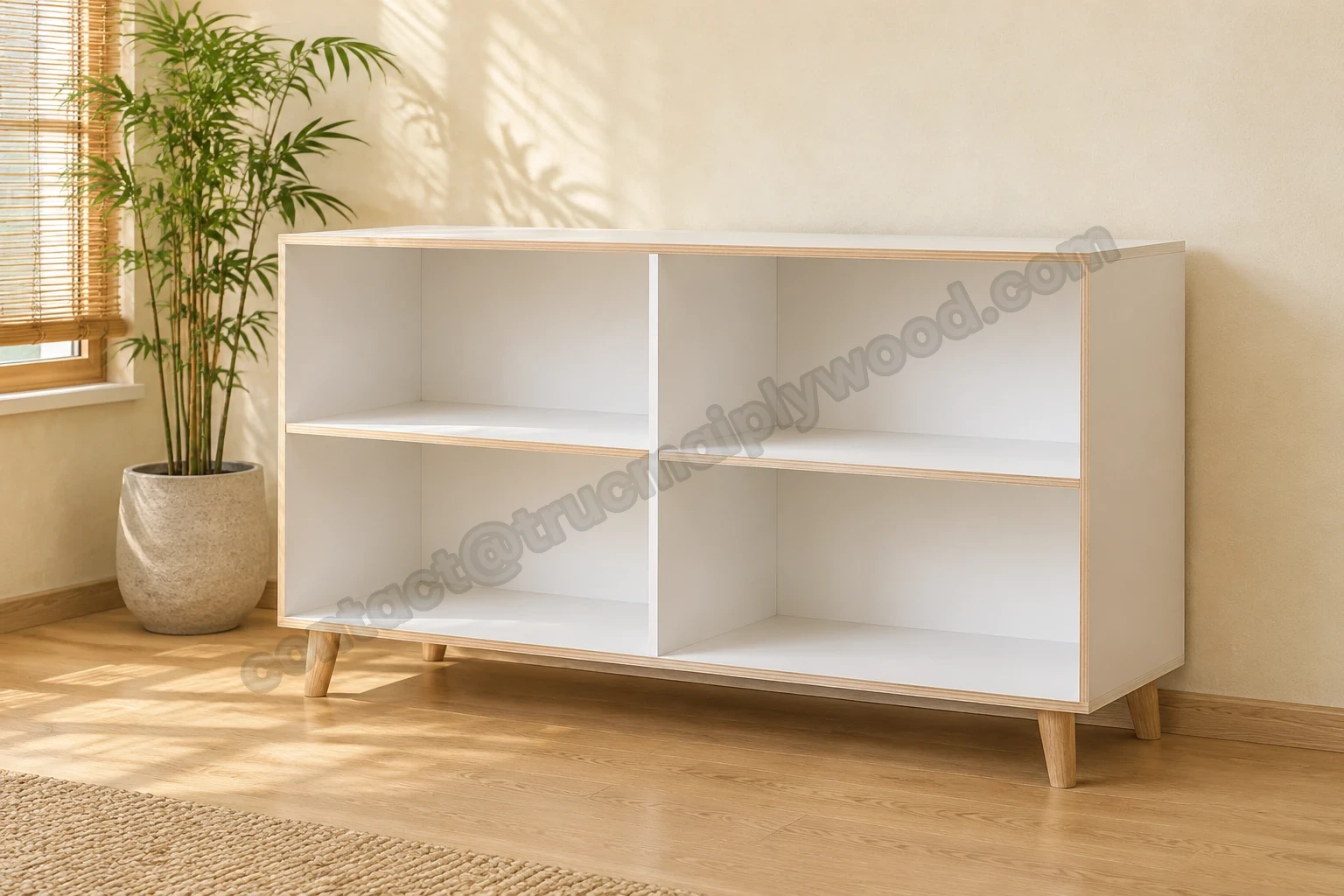
For cabinet doors and shelves, start with the surface finish, then work backwards to the core and thickness. Ask whether the face is visible from both sides, whether the edges will be banded and whether the panel will be drilled or routed. A white face can hide differences in the raw substrate until the edge is exposed. The finished component therefore needs a full-panel approval rather than an isolated decorative swatch.
For drawer parts and internal partitions, face/back pairing can be more important than a showroom-grade face on both sides. A concealed back may use a different appearance grade, provided the order records it. The buyer can avoid paying for appearance that is never visible while still specifying a clean working face. The interior plywood selection guide discusses how the use changes the panel specification.
For crafts, bleached veneer gives a light starting colour and real grain. A buyer planning to paint should test primer and topcoat on the supplied face; a buyer planning to laser-cut or engrave should assess the actual construction in its own process. For packaging, describe the contact surface and handling expectations. A white appearance does not, by itself, define food-contact suitability or a packaging compliance result.
How should a buyer specify white plywood sheet sizes?
Write the size in millimetres, followed by thickness and face construction. Common sheet formats are 1220 × 2440 mm, 1220 × 2280 mm and 1250 × 2500 mm. The first is the familiar 4 × 8 ft format; the shorter sheet suits selected furniture components; the European format gives a different cutting layout. These sizes belong on the purchase order rather than being inferred from a catalogue photograph.
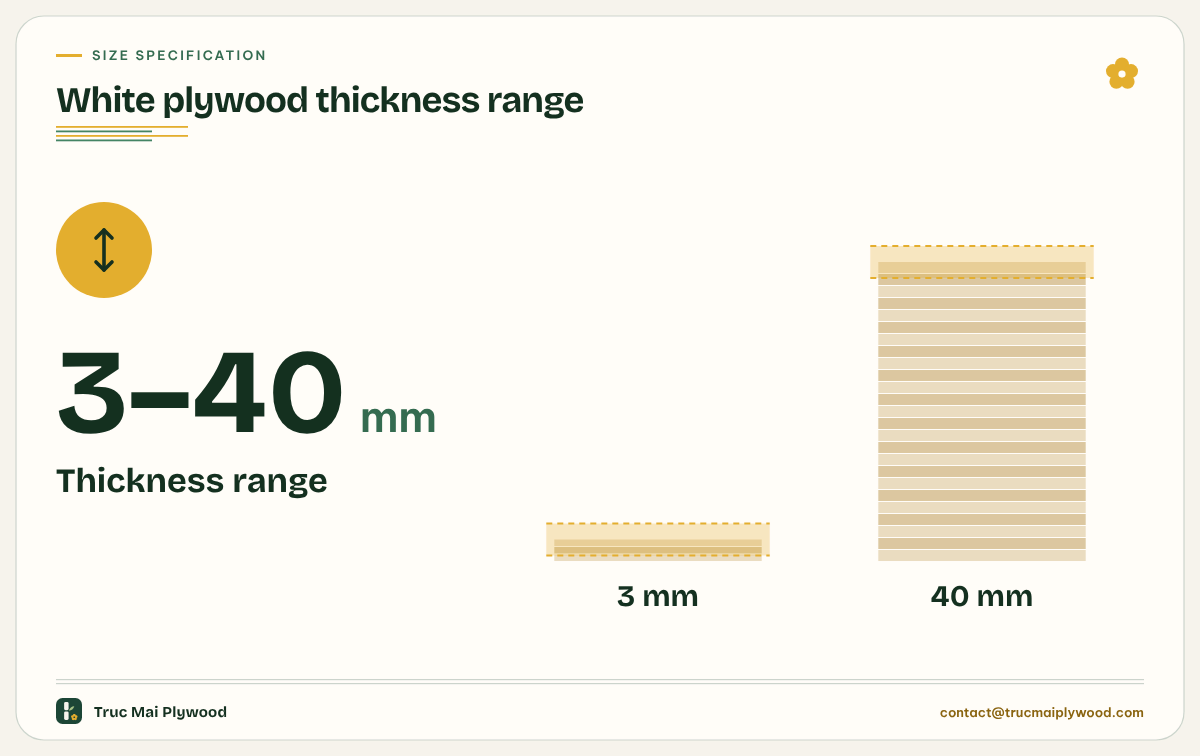
Thickness is a separate selection from the surface. The regular range runs from 3 to 40 mm. Thin pale panels suit some craft and lining work, while thicker panels are used for furniture parts that need more section depth. The finished part design, support spacing and machining programme determine the selection. Avoid choosing thickness from the word “white”: colour supplies no information about stiffness or fastening behaviour.
If the customer needs components rather than full sheets, the mill can cut to an agreed list. Examples include 610 × 2440 mm halves, 1200 × 800 mm thirds and 1220 × 610 mm quarters, with six-way cuts also available. The exact output follows the source sheet and the agreed cut pattern. Labels should identify the part or bundle, particularly when several white surfaces look similar after wrapping.
A good cutting enquiry includes the original sheet, final piece dimensions, quantity of each piece, grain direction where visible and any face-side marking. For bleached veneer, grain direction affects the visual arrangement across adjoining components. For a uniform overlay, orientation may instead be dictated by the surface texture. See mill cut-to-size panels for the purchasing route.
What face grade and inspection evidence belong on the order?
Approve a face/back grade pair against a real sample and keep that pair on the order. Appearance terms such as A/B or BB/CC are often trade descriptions rather than a universal interchangeability promise. The useful specification is the actual permitted appearance on each face. A reference sample is more informative than a letter grade detached from the supplier’s grading practice.
An inspector should first verify the product identity and pack labels, then examine face colour, grain, repairs and edge quality. Measure thickness on representative sheets and compare the result with the order tolerance. For a white overlay, add the finish reference and any agreed sheen or texture comparison. For a bleached veneer, inspect both natural variation and the preparation of the surface that will receive the buyer’s finish.
Where the buyer uses an international appearance standard, the classification needs to be named precisely. The hardwood appearance standard ISO 2426-2:2020 identifies classes E, I, II, III and IV; it does not turn every supplier’s local A/B shorthand into an identical specification. The safest acceptance method joins the written grade, physical reference and inspection record.
Photographs should show the whole sheet, an edge and a close view of the face under consistent light. A photograph taken at an extreme angle can exaggerate or conceal grain and gloss. For a repeat programme, keep a retained reference from the first approved shipment. This makes later comparisons easier for both production and purchasing teams.
How do glue and emission requirements affect a white face?
Glue specification and formaldehyde emission class are separate order lines. A pale face or a white overlay tells the buyer nothing about the adhesive system within the panel. For dry furniture interiors, the buyer should identify the required bond and emission documentation independently of colour. Truc Mai’s default interior construction uses UF glue at E0 emission as its commercial specification, with the buyer’s agreed testing requirements written on the order.
For US-bound hardwood plywood with veneer core, the US Environmental Protection Agency explains the TSCA Title VI standard: 0.05 ppm formaldehyde. Truc Mai holds CARB Phase 2 and TSCA Title VI third-party certification for hardwood plywood with veneer core within its certified thickness scope of 3–25 mm. The certification details belong with the shipment’s agreed product configuration, not with the colour description.
For European furniture, formaldehyde requirements are assessed under the applicable product and test regime. A buyer should identify the destination rule and the method required in the purchase file. Do not translate a ppm result from a US chamber method into a European mg/m³ figure as though the test conditions were identical. The formaldehyde limits explainer gives buyers a separate reference for emissions rather than folding the subject into surface appearance.
For a white melamine surface, confirm whether the compliance file describes the panel construction being ordered. The substrate, face treatment and product classification can affect what documentation is relevant. The commercial advantage of writing these details early is straightforward: the supplier can select the correct panel build and provide the appropriate file before the shipment is booked.
Which origin and chain-of-custody documents matter?
The relevant documents identify the wood origin, eligible FSC claim and shipment configuration. The face veneer and the core can have different origins, so an EU buyer should request information for both. Truc Mai supplies origin records and geolocation files for the core and face veneer as part of the EUDR due-diligence dossier.
The European Commission’s EUDR overview describes the due-diligence requirements for covered wood products, including production-plot geolocation and evidence concerning the 31 December 2020 deforestation cut-off. A buyer importing plywood into the EU uses the dossier in its own due-diligence workflow. A pale face is no substitute for tracing the actual veneer and core materials.
FSC chain-of-custody is another distinct document trail. The Forest Stewardship Council explains that an FSC claim appears on sales documents and is associated with the certificate code. Truc Mai’s licence code is FSC-C196493 and its chain-of-custody certificate is SA-COC-014545. Eligible products are sold with the FSC 100% claim shown on the relevant sales and shipping documents.
An importer can check the FSC licence verification guide and request the shipment documents for the specific white-faced panel. The useful question is not simply whether a factory holds a certificate; it is which product line and order documents carry the claim. For an engineered or imported face, origin records should cover that face as well as the Vietnamese core.
How should a buyer compare two white plywood quotations?
Compare the same surface, core, thickness, face/back pair and packing basis. Two offers both labelled “white plywood” can represent different constructions. A quote for bleached veneer cannot be compared as a like-for-like substitute for an opaque melamine panel without first deciding which surface the project needs. The first comparison should therefore be technical, not a comparison of product names.
Write a single enquiry sheet and send the same specification to each candidate. Begin with the application and visible finish, then list the core, glue and emission requirement, face/back grade, sheet format, tolerance, cut list, pack labels and total quantity. Attach the same colour reference to every enquiry. Ask each supplier to identify any proposed alternative explicitly, rather than silently replacing the surface construction.
For a repeat buying programme, record the approval path: sample received, finish trial completed, edge and machining checked, commercial specification accepted and packing method agreed. The plywood RFQ guide provides a practical structure, and the sample ordering guide helps organise the initial comparison.
When comparing a factory-direct offer with a local cut-to-size listing, remember that they serve different purchasing stages. The local listing may be convenient for a single trial sheet; a container order needs repeatable face selection, an agreed pack plan and a shipping document set. The buyer’s task is to establish a reproducible specification before scaling the quantity.
What should be included in a first-container purchase order?
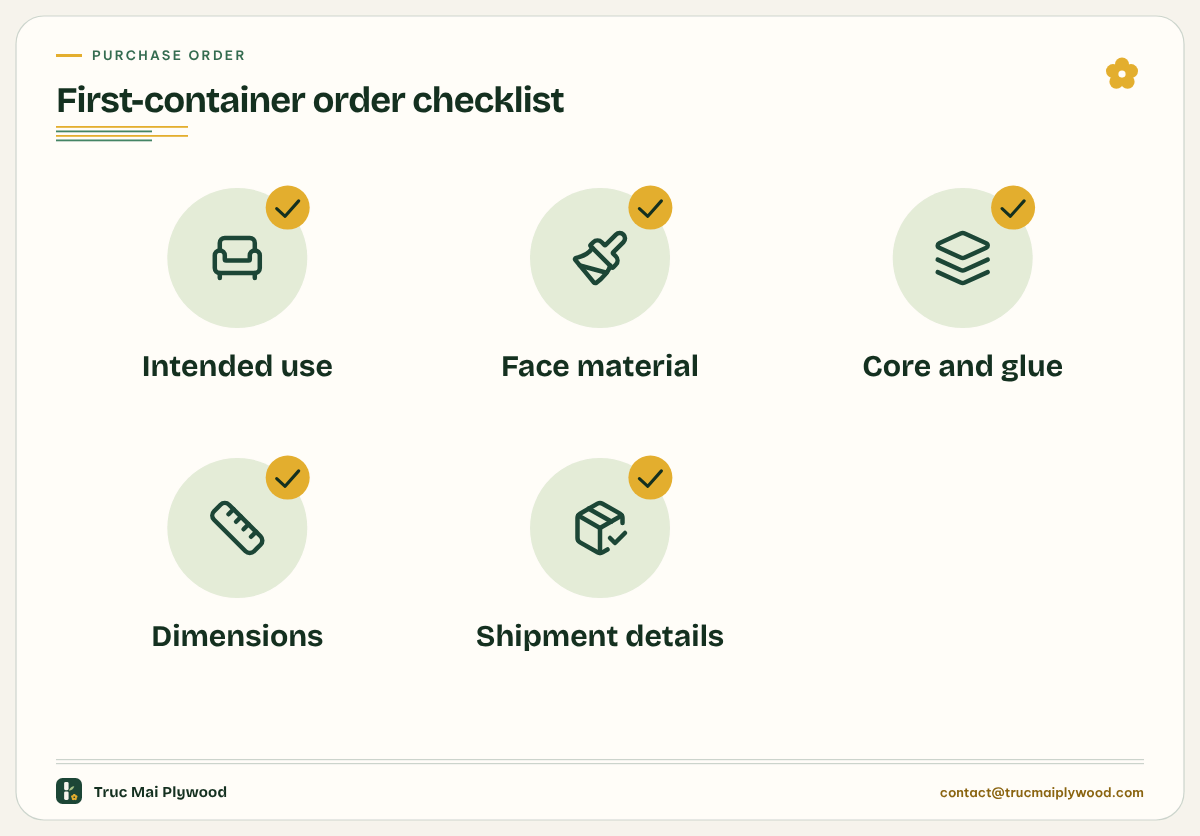
Put the approved face reference and the full panel build on the first order line. The order should make it possible for production, inspection and the receiving warehouse to identify the same product without interpretation. A concise description might name bleached poplar veneer or white melamine, the chosen core, the face/back pair, thickness, sheet format and the intended application.
- Identify the use: cabinet interiors, furniture parts, crafts or packaging, including which faces remain visible.
- Name the surface: bleached poplar, white melamine or paper overlay, with an approved colour and finish reference.
- Set the construction: core species, joining method, glue and emission requirement.
- Set the dimensions: thickness, full-sheet format or cut list, with the agreed tolerance.
- Set the shipment: pack labels, container mix, destination port and document requirements.
- Approve the sample: compare the actual face, reverse and edge before production.
For container trade, the usual terms are FOB Hai Phong, CFR or CIF. The standard payment structure is a deposit followed by the balance against the scanned bill of lading, with the detailed arrangement recorded in the order. The documents per container page explains why the invoice, packing list, bill of lading and any agreed certificate files should match the actual goods.
Use the quotation request to ask for a matching sample and a pack plan for the chosen specification. A buyer who needs a pale timber face should send a grain and shade reference; a buyer who needs opaque white should send the finish reference. That small distinction at the enquiry stage prevents a full-container misunderstanding later.
Send your specification to contact@trucmaiplywood.com or through the quotation form.
Questions buyers ask
Is white plywood the same as painted plywood?
No. White plywood can be pale natural veneer, a decorative overlay or a painted panel. Specify the face material rather than relying on the colour name.
Is white melamine-faced plywood suitable for kitchen cabinets?
It is used for dry-interior cabinet components where a consistent finished face is wanted. Specify edge treatment and the intended cleaning conditions.
Can bleached poplar plywood be stained?
A bleached veneer can receive a finishing system selected for the veneer and adhesive. Approve a finished sample before specifying a colour across production.
Does a white face mean a white core?
No. The face determines the visible surface; the core species and edge appearance are separate order specifications.
Can I order a white face on only one side?
Face and back are specified as a pair. State whether the reverse is exposed, concealed or to receive another finish.
Is paper-overlay plywood the same as melamine plywood?
No. Paper overlay and melamine-faced panels are distinct surface constructions. Request a physical sample and a surface specification for the intended application.
What dimensions should I put on a white plywood enquiry?
Give the sheet format, thickness, cut list if relevant and number of sheets or containers. Include the intended application and surface choice.
Can white panels be cut for cabinet parts before shipment?
Yes. Mill cutting is available to an agreed cut list, with piece sizes and labels recorded on the order.
What should I inspect on a white plywood sample?
Inspect the face in daylight, compare the approved reference, check edges and measure thickness. Test the intended finish on the same surface construction.
Are white plywood sheets waterproof?
A white appearance does not determine bond durability. Select the adhesive system and service conditions separately from the face colour.