
Vietnamese wood includes plantation acacia and eucalyptus, timber for processing, decorative veneers and finished furniture panels. Truc Mai Plywood makes commercial and interior plywood using specified cores and faces, including imported decorative veneer. For importers, the useful distinction is where each wood component originated and how the finished panel is built.

What kind of wood comes from Vietnam?
Acacia and eucalyptus are two prominent plantation timbers in Vietnam, while its wood-processing industry also uses imported hardwoods and softwoods. For an importer, “wood from Vietnam” can mean harvested logs, locally made veneer, or a finished panel assembled in Vietnam from domestic core wood and imported decorative faces. Those are different origin statements, and the purchase order should distinguish them.
The US Forest Service’s 2018 study of plantations in central Vietnam examines acacia and eucalyptus plantations and the economics of smallholder wood production. This distinction is particularly useful for plywood: a panel manufactured in Vietnam need not contain only Vietnamese-grown wood.
At a furniture-plywood mill, the core and visible surface serve different jobs. Core veneers determine much of the panel’s weight, construction and machining behaviour. Face veneers determine colour, grain and finishing appearance. A buyer who specifies only “Vietnamese hardwood” leaves both decisions open. The more useful enquiry identifies the intended cabinet, drawer, door or packaging application and then requests a core and face combination.
Truc Mai Plywood manufactures commercial and furniture/interior plywood in Ha Hoa, Phu Tho, with annual capacity around 60,000 m³. Its core options are eucalyptus, acacia, styrax, pine and combinations of these species. A decorative face can be selected independently. That separation gives an importer a way to compare panels by build rather than by country label alone.
What types of wood are found in Vietnam?
Acacia, eucalyptus and pine are three commercially relevant plantation woods; styrax is another core-veneer option used in Vietnamese plywood. Vietnam also has native forest species, but a species being present in the country does not mean it is a routine or legally available export input. Commercial sourcing begins with the actual harvested material and its documents.
The USDA’s research on plantation management in central Vietnam examines acacia and eucalyptus plantations and the choices faced by growers. It helps explain why a species name alone cannot tell a buyer whether the timber was grown for chips, sawn wood or veneer. Log diameter, straightness and peeling quality determine the processing route.
For a veneer-core order, the useful questions concern the core species, the arrangement of the plies and the joining method. Styrax provides a lighter core option; eucalyptus provides a denser one. Acacia offers another core choice, and mixed-species constructions let a mill balance weight, cost and panel appearance. These are construction choices, not interchangeable labels for a single material.
A birch-faced panel is another good illustration. Birch can describe the face veneer even when the core is Vietnamese plantation wood. The same distinction applies to okoume, bintangor and gurjan faces. Importers should read “birch-faced plywood” literally and request the core species on the same specification line.
Which Vietnamese woods are legal and plantation-grown?
Yes, documented plantation acacia and eucalyptus can be legally harvested Vietnamese wood; legality is established through the actual source and harvest records, not the species name. Pine and styrax can also be specified as plantation-derived core material when the shipment’s origin documentation supports that description. A photograph of a plantation or a general supplier statement cannot replace a traceable material file.
For European shipments, the European Commission’s due-diligence guidance identifies the production country, wood species, quantity, evidence of legal production and plot geolocation as key information. The regulation’s deforestation cut-off is 31 December 2020. It is useful to collect the core and face files separately because their forests, processors and countries can differ.
A practical document request starts with the species’ common and scientific names, harvest location, relevant harvest papers and chain-of-custody records where a certified claim is ordered. For engineered veneer, it also follows the material through the veneer producer rather than stopping at the Vietnamese panel factory. Truc Mai supplies EUDR origin records and geolocation files for both core and face material, so an importer can assemble the required product dossier.
FSC chain-of-custody evidence is another distinct check. The mill holds licence FSC-C196493 and certificate SA-COC-014545 for eligible FSC 100% products. The FSC Chain of Custody Standard requires the appropriate certificate code and product claim on sales documentation. Specify the FSC claim in the enquiry and check it against the invoice and current certificate scope.
Which wood products does Vietnam export?
Vietnam exports six broad wood-product groups: furniture, wood chips, sawn wood, processed wood, veneer and wood-based panels, including plywood. These are separate supply chains with different grading, packaging and import-document requirements. The USDA’s wood-processing industry report describes both the plantation feedstock and the industry’s use of imported timber for higher-value processing.
| Product family | What the buyer receives | Main specification decision | Typical buyer use |
|---|---|---|---|
| Plantation logs and sawn wood | Raw or sawn timber | Species, dimensions, moisture, legal origin | Further processing |
| Wood chips | Bulk fibre feedstock | Species mix and handling specification | Pulp and fibre processing |
| Decorative veneer | Thin visible wood layer | Species, cut, colour and grade | Furniture and panel faces |
| Furniture and commercial plywood | Cross-laminated veneer panel | Face, core, glue, thickness and tolerance | Cabinets, interior components and packaging |
| Finished furniture | Assembled article | Construction, finish and product testing | Retail and contract furnishing |
| Non-structural laminated veneer lumber | Laminated veneer section | Section, build and intended use | Door stock, furniture components and packing |
The important purchasing distinction is between a finished product and the material used to make it. An importer buying cabinets assesses joinery, finish and finished-article requirements. An importer buying plywood assesses the panel’s veneer construction, adhesive, emissions and thickness. One supplier may make several product families, but each needs its own specification and test evidence.
For panel orders, start with the Vietnamese plywood import guide and the supplier verification checklist. They connect the general wood trade to the checks that belong on a plywood purchase order.
Which wood is famous in Vietnam?
Acacia is a named example of Vietnam’s best-known commercial plantation woods, especially in discussions of plantation timber and wood processing. Decorative and traditional woodworking can involve many other species, so “famous Vietnamese wood” is not a grade, a botanical identification or an export specification.
The USDA’s plantation research discusses acacia cultivation in central Vietnam, while its industry report identifies acacia and eucalyptus as major planted inputs. Neither source makes a single species the correct answer for every furniture or panel application. Buyers should identify the wood by species and product form rather than relying on a traditional or marketing name.
For plywood, a visible decorative species can be more important to the customer than the core’s name. Poplar or bleached-poplar faces can give a light appearance; engineered veneer can deliver a repeatable decorative pattern; eucalyptus and pine faces offer different visual choices. The face sample, back grade and finishing requirement belong together on the approved reference sheet.
If a seller uses a local wood name, ask for the scientific species name and whether it describes the face, core or solid timber. That request prevents a decorative face being mistaken for a full-thickness construction.
Is furniture made in Vietnam of good quality?
Yes, Vietnamese factories can produce good-quality furniture and furniture panels when the construction, surface finish and testing match the intended use. Country of manufacture is less useful than a measurable specification and a sample approved before production. A cabinet maker should judge flatness, surface appearance, edge machining and glue-bond performance on the actual panel build.
For plywood, the face grade and core grade need separate descriptions. A clear face can still cover an uneven or poorly joined core. A strong core can still be unsuitable for visible doors if the face has colour variation or sanding defects. Inspect the face and back against the agreed sample, then examine a cut edge for voids, overlap and veneer arrangement.
The ISO 2426-2 hardwood plywood appearance standard describes appearance classes E, I, II, III and IV. Trade descriptions such as B/BB and BB/CC require the supplier’s own grading sheet rather than an assumed equivalence. For a practical purchasing route, see cabinet-grade plywood and Vietnamese plywood quality by grade.
A repeat furniture programme benefits from a signed specification, approved sample and incoming checks on each shipment. Compare panel edges and surfaces from more than one pack, not merely the display sheet. The same process helps an importer assess a new mill without relying on a general national-quality claim.
How does Vietnamese wood become furniture plywood?
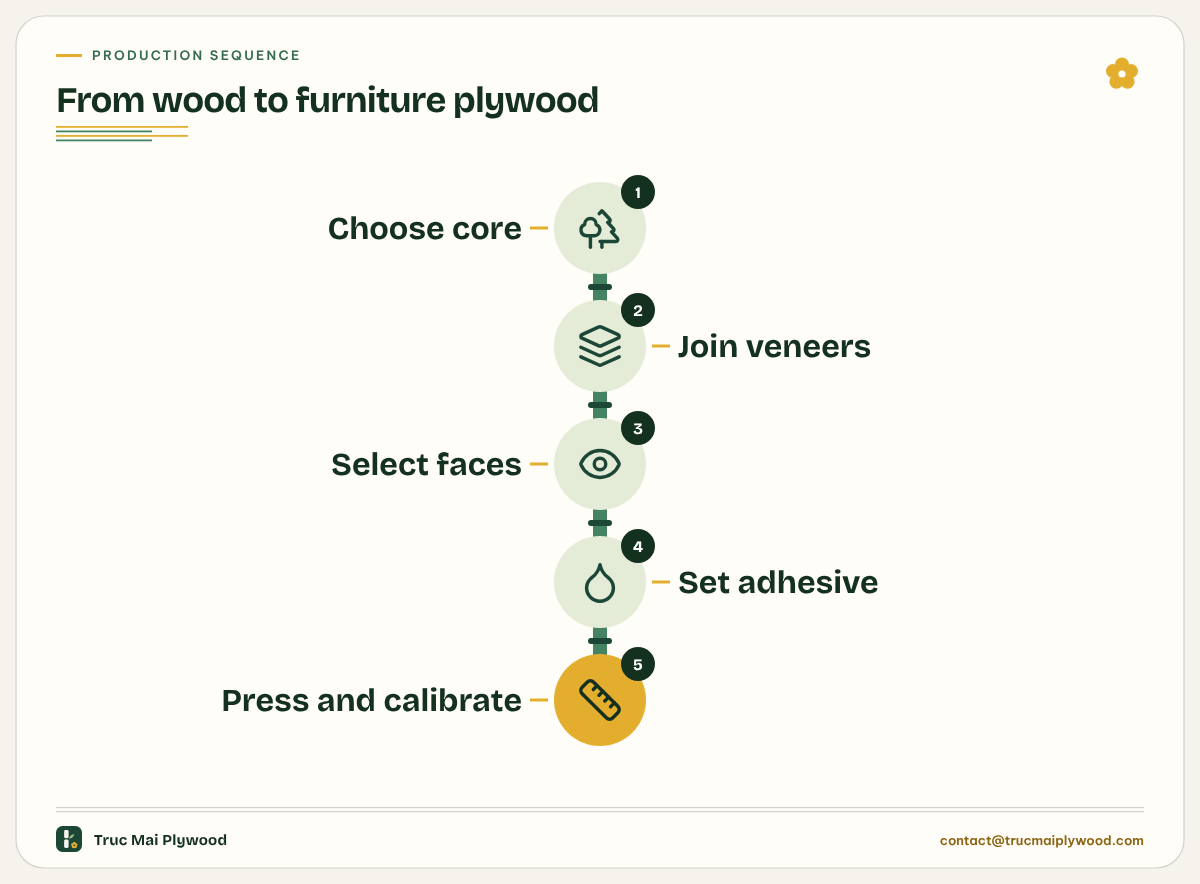
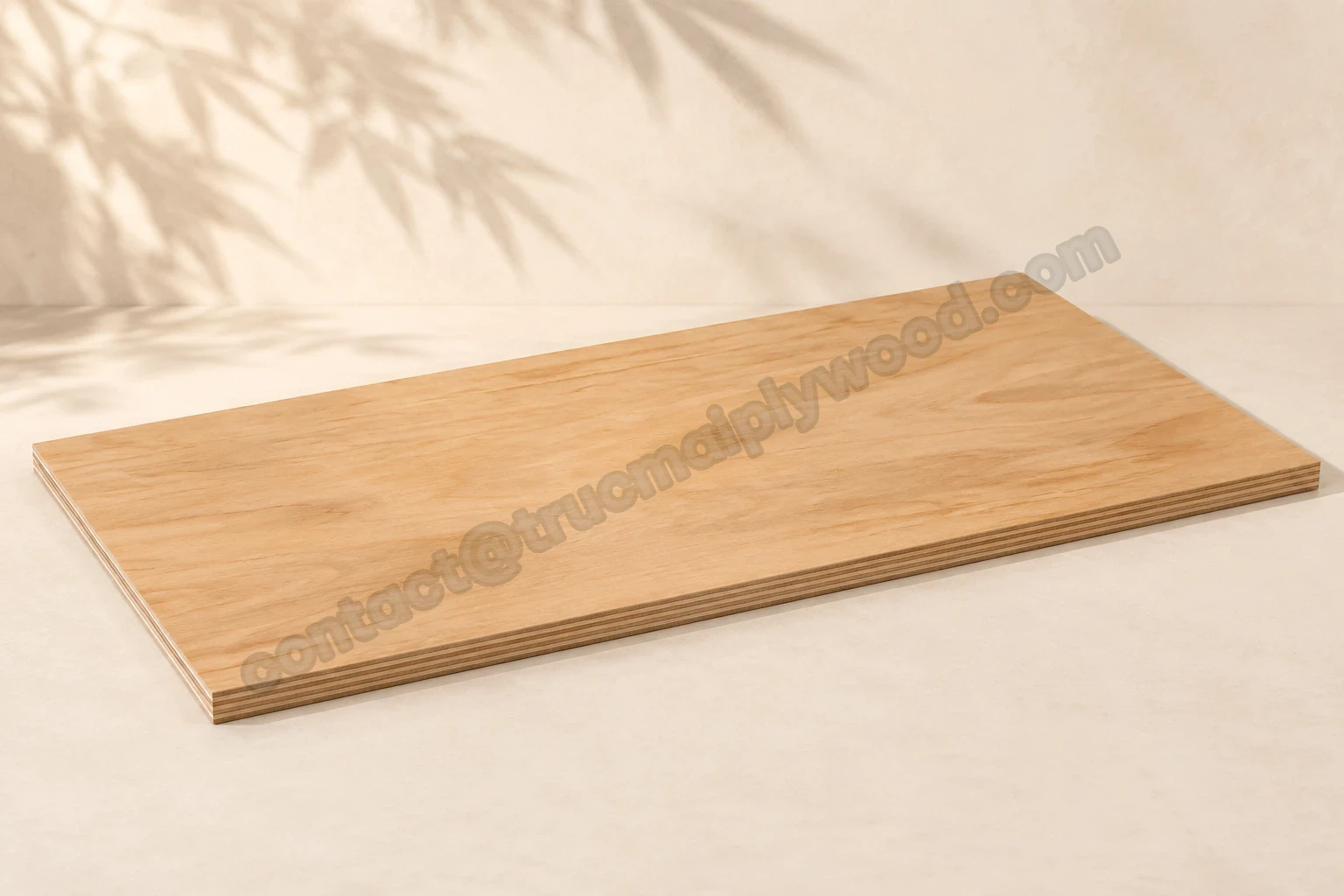
Furniture plywood is made by assembling veneer layers with alternating grain directions, bonding them under pressure and finishing the panel to the agreed thickness and face quality. The buyer’s final specification starts before pressing, when the mill selects core veneers and decides how to join them.
- Choose the core: record eucalyptus, acacia, styrax, pine or an agreed combination.
- Prepare and join veneers: identify whether the core is stitched, jointed or loose-laid; furniture-grade construction uses a stitched core.
- Select face and back: approve species, veneer appearance and the grade pair against physical samples.
- Specify the adhesive and emission requirement: write the adhesive system and emissions as separate lines.
- Press, trim and calibrate: check the panel’s final thickness and both faces before packing.
- Inspect and pack: match finished sheets, pack labels and the shipment’s order lines.
The mill’s furniture construction uses an A-grade stitched core and sanded faces, while commercial panels can use an AB core and lighter surface preparation. Core stitching can run across and along the sheet; the outer plies are commonly stitched, with further stitching available by order. Those details explain why two panels carrying the same decorative face name can machine differently.
A useful inspection cuts across the full panel edge, because a face photograph cannot show internal joints. Record the agreed core build alongside the sample and ask for a production sample when the order changes veneer species or thickness.
Which face veneers can a Vietnamese plywood buyer specify?
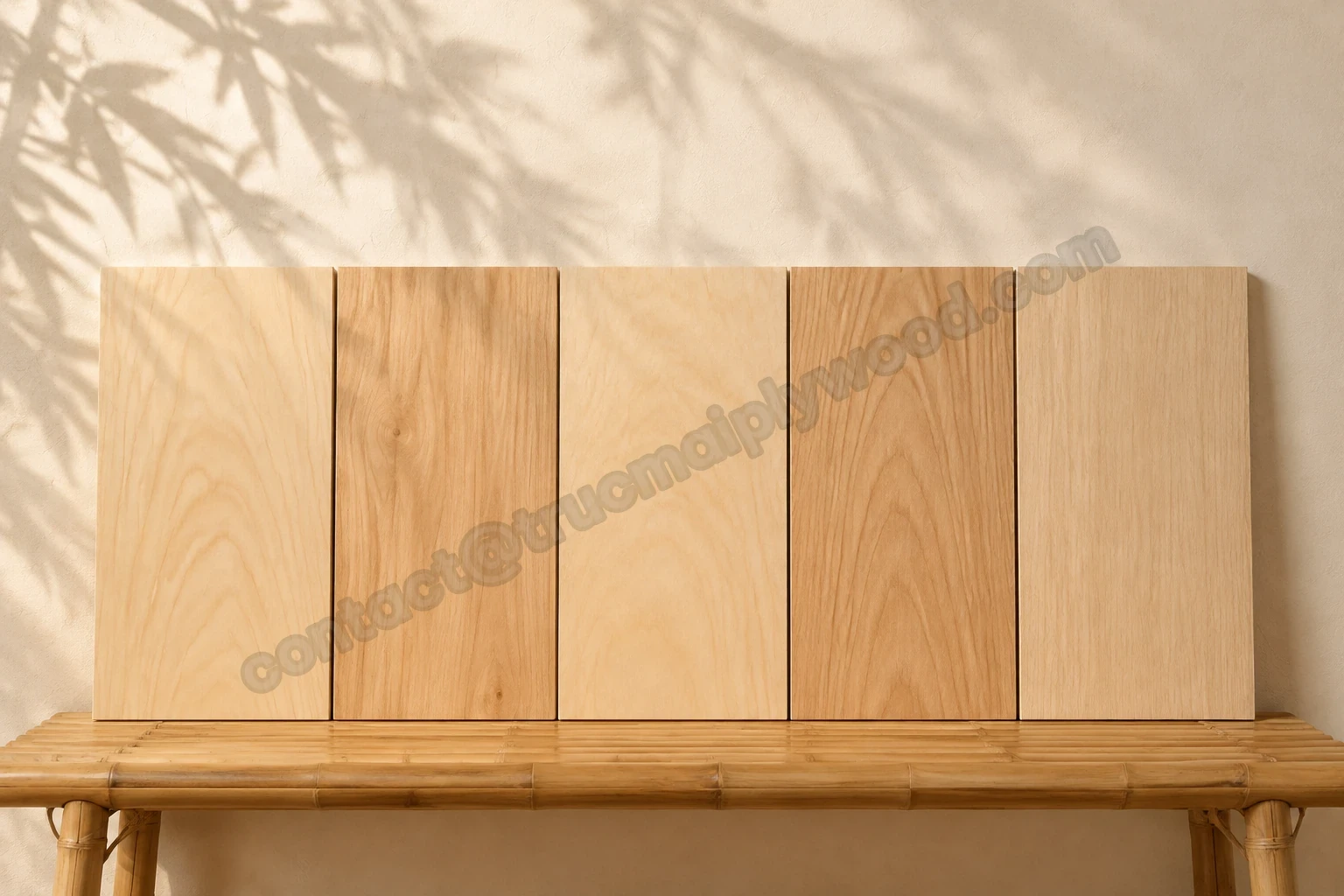
Poplar, engineered veneer, birch, okoume, bintangor, pine, eucalyptus, gurjan and sapele are face options for furniture and commercial plywood. The face choice affects appearance and finishing; it does not automatically identify the panel’s core or the origin of every veneer.
| Face choice | Useful purchasing distinction | Detail to put on the order |
|---|---|---|
| Poplar or bleached poplar | Light surface for interior components | Colour reference and face/back pair |
| Engineered veneer (EV) | Reconstituted decorative grain | Pattern, shade and approved sample |
| Birch | Birch appearance on a separately specified core | State “birch-faced” and name core |
| Okoume or bintangor | Decorative face for furniture and door work | Veneer grade and finishing method |
| Pine or eucalyptus | Species-specific appearance | Grain and colour acceptance |
| Gurjan or sapele | Alternative decorative face | Sample approval and veneer availability |
Truc Mai’s EV option includes reconstituted poplar veneer; the finished panel can pair that face with a Vietnamese core. For a buyer managing repeated cabinet runs, the approved face sample should show both colour and the acceptable natural variation. A single species name does not specify either one.
See engineered-veneer plywood, birch-faced plywood and okoume-faced plywood for panel-specific choices. Each option should be compared using the same core, adhesive and dimensions so the appearance decision is isolated.
Which specifications matter when buying vietnamese wood panels?
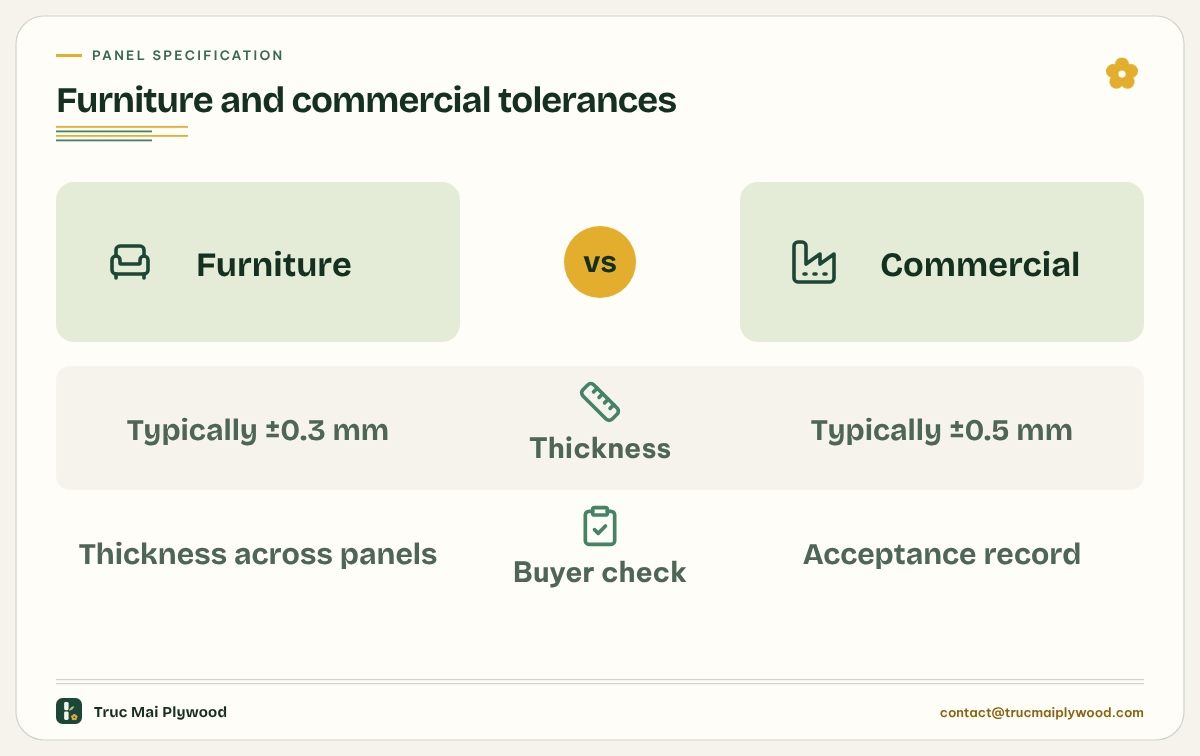
Core construction, face grade, glue system, emissions, dimensions and thickness tolerance matter more than the country label when comparing two furniture plywood offers. These fields determine whether the sheets fit a machining line and the destination market’s purchasing requirements.
| Specification | Available mill choice | Buyer check |
|---|---|---|
| Core | Styrax, eucalyptus, acacia, pine or combined | Species and joining method |
| Face | Natural or engineered veneer | Approved face/back sample |
| Thickness | 3–40 mm standard range | Nominal thickness and tolerance |
| Sheet size | 1220 × 2440, 1220 × 2280 or 1250 × 2500 mm | Saw and nesting plan |
| Furniture tolerance | Typically ±0.3 mm for calibrated sheets | Thickness checks across panels |
| Commercial tolerance | Typically ±0.5 mm | Acceptance record |
| Surface | Sanded, calibrated, UV-ready or specified overlay | Finish compatibility |
“UV-ready” describes a prepared surface for the buyer’s coating process, rather than a UV coating applied at the mill. Similarly, a melamine-faced or HPL-faced sheet should be specified by the finished overlay and underlying panel construction. The visible face can change while the core build stays constant.
For cut-to-size orders, the mill can supply labelled parts cut from standard sheets. Examples include lengthwise halves at 610 × 2440 mm, thirds at 1200 × 800 mm, quarters at 1220 × 610 mm and six-part patterns. The exact piece size and layout follow the approved cut list. The cut-to-size panel page explains the ordering route.
How should a US importer check plywood emissions?
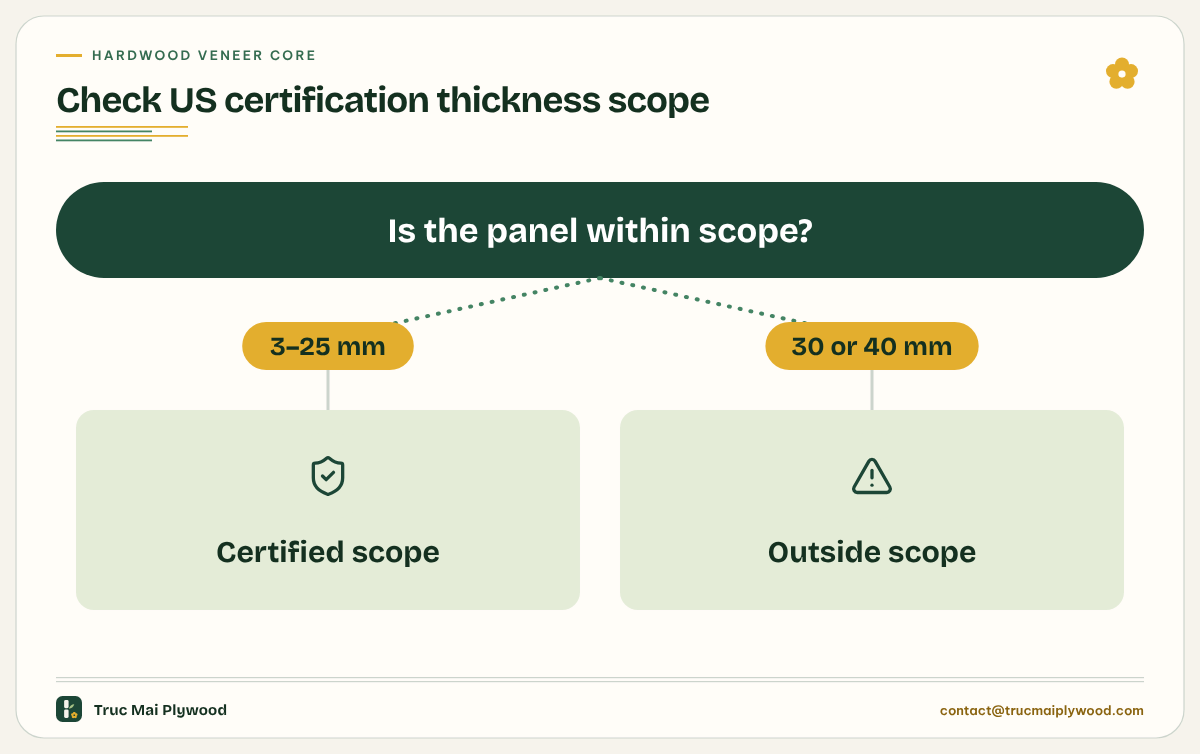
For US hardwood plywood with veneer core, TSCA Title VI sets a formaldehyde emission limit of 0.05 ppm under the specified test framework. The US Environmental Protection Agency’s 40 CFR Part 770 defines the product categories, certification requirements and emission standards. Ask for documentation matching the panel construction and thickness being purchased.
Truc Mai holds CARB Phase 2 and TSCA Title VI certification for hardwood plywood with veneer core, 3–25 mm, under certificate CARB/EPA 26053. A 30 mm or 40 mm panel falls outside that certified thickness scope. State the exact build on the order and match the certificate’s product description before comparing emission paperwork.
Glue type and emission performance are separate decisions. For interior panels, the mill’s standard offering uses UF glue at E0 emission, with the emission requirement written into the order. A buyer who needs a particular US certification should request the applicable certified configuration rather than treating an informal emission label as the test result.
For the documentary sequence, use the US plywood import steps and the Phase 2 formaldehyde limits page. They address regulatory checks alongside the purchase specification.
What origin records does an EU plywood importer need?
An EU importer needs wood-species and origin information for the material in the panel, including the production plots relevant to its due-diligence filing. The European Commission’s EUDR guidance describes the collection of source information and geolocation before a regulated product enters the EU market.
The core and decorative face should be tracked as distinct inputs. For example, a Vietnamese plantation core may be combined with imported engineered veneer. The paperwork needs to follow both paths through their suppliers and production locations. That is a better starting point than asking whether a finished sheet is simply “Vietnamese wood”.
The EUDR application dates in the supplied trade reference are 30 December 2026 for large and medium operators and certain smaller operators already under the earlier timber regime, and 30 June 2027 for other micro and small operators. Buyers should prepare origin files alongside the specification, before production and shipping documents are finalised.
For the detailed file contents, consult face-veneer origin records and EUDR dates for panel buyers. These checks belong with the supplier shortlist, especially when a decorative face is imported into Vietnam before panel manufacture.
How can an importer compare Vietnamese panel mills?
Compare mills using one written panel specification, an approved sample and a documentary checklist. A factory tour can show the equipment and finished stacks, but it cannot substitute for agreement on core grade, face appearance, adhesive, emissions and shipment quantities.
- Send the same application and drawing to each mill.
- Request the core species, veneer arrangement and face/back grade pair.
- Ask for a sample with the agreed surface finish and nominal thickness.
- Check the certificate scope for the exact product and destination market.
- Compare pack configuration, labels and the proposed loading plan.
- Keep the approved sample and specification for the repeat order.
A large-volume mill should be able to describe how a repeat specification is controlled across production runs. Ask which fields are copied from the approved order into production and packing documents. Also ask how a proposed core or face substitution would be communicated before manufacture.
Verify a mill before the deposit covers the practical checks, while writing a plywood RFQ turns them into a purchase-ready request. A buyer gains more from comparable answers than from a collection of general factory claims.
What should a first container order from Vietnam include?
A first plywood container order should specify the application, core, face/back grade, adhesive and emission requirement, sheet dimensions, packing and quantity. Truc Mai’s standard minimum is one 40HC, with FOB Hai Phong, CFR or CIF terms available. The quotation should reflect the precise build and destination rather than a generic wood-product description.
For packing, distinguish sheets per pack from packs per container. The core species changes the weight of each sheet, and the booking’s payload controls the final loading plan. Use the cubic-metres-per-40HC planning table to understand the effect of core and thickness, then request a pack list for the selected construction. A planning calculation is different from the signed packing list for an actual shipment.
The standard production window is 15–45 days after the deposit; shipping time is a separate part of the schedule. Payment terms are 30% deposit and 70% against the scanned bill of lading, with T/T or irrevocable letter of credit at sight. The purchase order should record the agreed Incoterm, destination port and the documentary requirements.
Before sending the enquiry, prepare the cut list if parts will be supplied rather than full sheets. Mark each part’s finished dimensions, quantity and label code, and identify the parent sheet. For a repeat programme, retain the approved specification as the reference for the next order.
Which documents should travel with a plywood shipment?
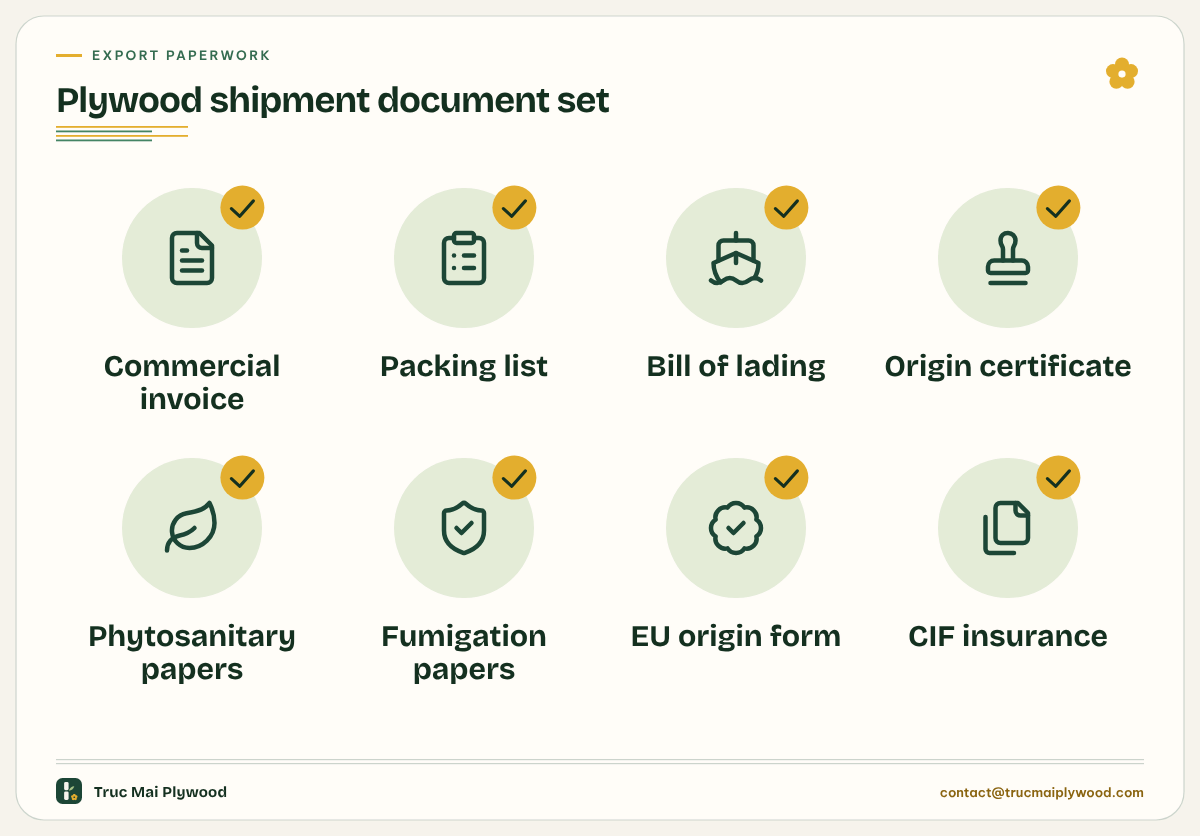
A commercial invoice, packing list and bill of lading form the core shipping-document set for a plywood container. The order may also call for a certificate of origin, phytosanitary or fumigation documents, insurance under CIF and product-specific certificates. Agree the document list before the shipment is booked.
The packing list should identify each panel specification and the actual pack and sheet counts. When several face or core combinations share one container, separate them into clear lines. The invoice, purchase order and labels should use consistent product descriptions so the importer can reconcile goods on arrival.
For certified orders, check the relevant claim on the sales documents rather than assuming a factory certificate automatically covers every line. For EU-bound material, keep the source-origin file alongside the shipment record. For US-bound certified hardwood plywood, match the certified product description to the actual sheets.
Documents per container provides the broader document sequence, and ordering samples explains how to approve the construction before the full run. Send the application, core, glue/emission, face, size, packing, quantity and destination port to contact@trucmaiplywood.com for a specification-based quotation.
Send your specification to contact@trucmaiplywood.com or through the quotation form.
Questions buyers ask
Is Vietnamese wood always grown in Vietnam?
No. A wood product manufactured in Vietnam can contain imported face veneer or timber. Request origin information for each material in the product.
Can I order birch-faced plywood with a Vietnamese core?
Yes. Birch-faced plywood can use a separately specified Vietnamese plantation core; the face species does not describe the whole panel.
Is acacia the only plantation core available?
No. Eucalyptus, styrax and pine are also core choices, and mixed cores can be specified.
What should I write instead of “Vietnamese hardwood plywood”?
Write the application, core species, face/back grade, adhesive and emission requirement, thickness, sheet size and packing.
Can furniture plywood arrive as labelled cabinet parts?
Yes. Cut-to-size labelled panels can be ordered from standard parent sheets against an agreed cut list.
Can I order an FSC 100% plywood product?
Eligible FSC 100% products can be ordered under Truc Mai Plywood certificate SA-COC-014545. Specify the claim and check the sales documents.
Does a CARB certificate cover every panel thickness?
No. Truc Mai Plywood certificate CARB/EPA 26053 covers veneer-core hardwood plywood from 3 to 25 mm.
Is engineered veneer the same as solid poplar timber?
No. Engineered veneer is a reconstituted decorative veneer, used as a face on a separately specified plywood core.
Can different plywood specifications share a container?
Yes. Mixed products can be agreed in advance, with a separate pack and weight plan for each order line.
Should I request samples before a container order?
Yes. Approve a representative panel sample and retain its construction and face/back grade as the production reference.