
Veneered ply is plywood finished with a decorative real-wood face over a cross-laminated core. Buyers choose the face for grain and colour, then specify the core, adhesive, grade and thickness for cabinet performance. The most useful comparison checks the visible surface, exposed edge and approved finish sample together.
What is veneered ply, and how is it built?
Veneered ply is a plywood panel carrying a decorative wood face over a cross-laminated veneer core. The outer veneer supplies the visible grain and colour; the inner plies supply thickness, fastening material and dimensional stability. It is a practical way to specify a real-wood appearance without building an entire cabinet from the decorative species.
A buyer should separate three elements on the drawing: the visible face, the back and the core. “Oak veneered” describes the surface, not necessarily the wood throughout the sheet. A cabinet with visible doors and concealed carcass parts can therefore use different face and back specifications while retaining a consistent core construction.
Cross-lamination means successive veneer layers have alternating grain directions. This reduces the tendency of a board to move as a single solid-wood plank would. It does not remove the need for balanced lay-up, correct storage and suitable finishing. For an explanation of veneer itself, see real veneer sheets and wood veneer panels.
How does the decorative face stay flat on a commercial core?
A balanced lay-up, sound veneer joints and controlled pressing keep a decorative face supported across the sheet. The face is bonded to a core built from several cross-grain layers; the back face counterbalances the front. If a maker specifies a show face on only one side, the reverse still needs a suitable balancing construction.
At Truc Mai Plywood, furniture panels use an A-grade stitched core and sanded faces. Stitching joins veneer pieces across and along the sheet, usually in the outer 2–4 plies. The objective is a more continuous support under the decorative veneer, particularly where a dark stain or grazing light might expose surface irregularities.
The inspection sequence matters. Check the raw core for gaps, inspect the bonded sheet for blisters, then examine the sanded surface under side lighting. A beautiful face cannot hide a raised core overlap indefinitely. When requesting samples, examine a full-width section and an exposed edge, rather than judging only a small central patch. Compare the cabinet-grade plywood specification for a more detailed buying checklist.
Which wood veneers work for cabinet doors and furniture?
Poplar, engineered veneer, birch, okoume, bintangor, pine, eucalyptus, gurjan and sapele are face options for furniture plywood. Their visual character and supply route differ, so the choice starts with the finish and the design programme rather than the species name alone.
| Face option | Visual or procurement consideration | Suitable brief |
|---|---|---|
| Poplar or bleached poplar | Light-coloured, restrained grain | Painted or pale interior schemes |
| Engineered veneer (EV) | Reconstituted pattern with repeatable appearance | Repeating cabinet fronts |
| Birch | Light, fine-grained face; imported veneer on Vietnamese core | Clean-lined furniture |
| Okoume | Warm, relatively even appearance | Door skins and interior joinery |
| Bintangor | Reddish decorative face | Warm-toned cabinetry |
| Pine | Visible softwood grain | Natural-looking panels |
| Eucalyptus | Distinctive wood appearance | Decorative furniture |
| Gurjan or sapele | Stronger visual character | Feature surfaces |
The table is a selection guide, not a universal grading system. Ask for actual face samples from the intended production specification. Birch-faced plywood here means birch on the surface, not a through-birch core. Compare birch-faced plywood with engineered veneer panels before fixing a finish.
What is the difference between natural veneer and engineered veneer?
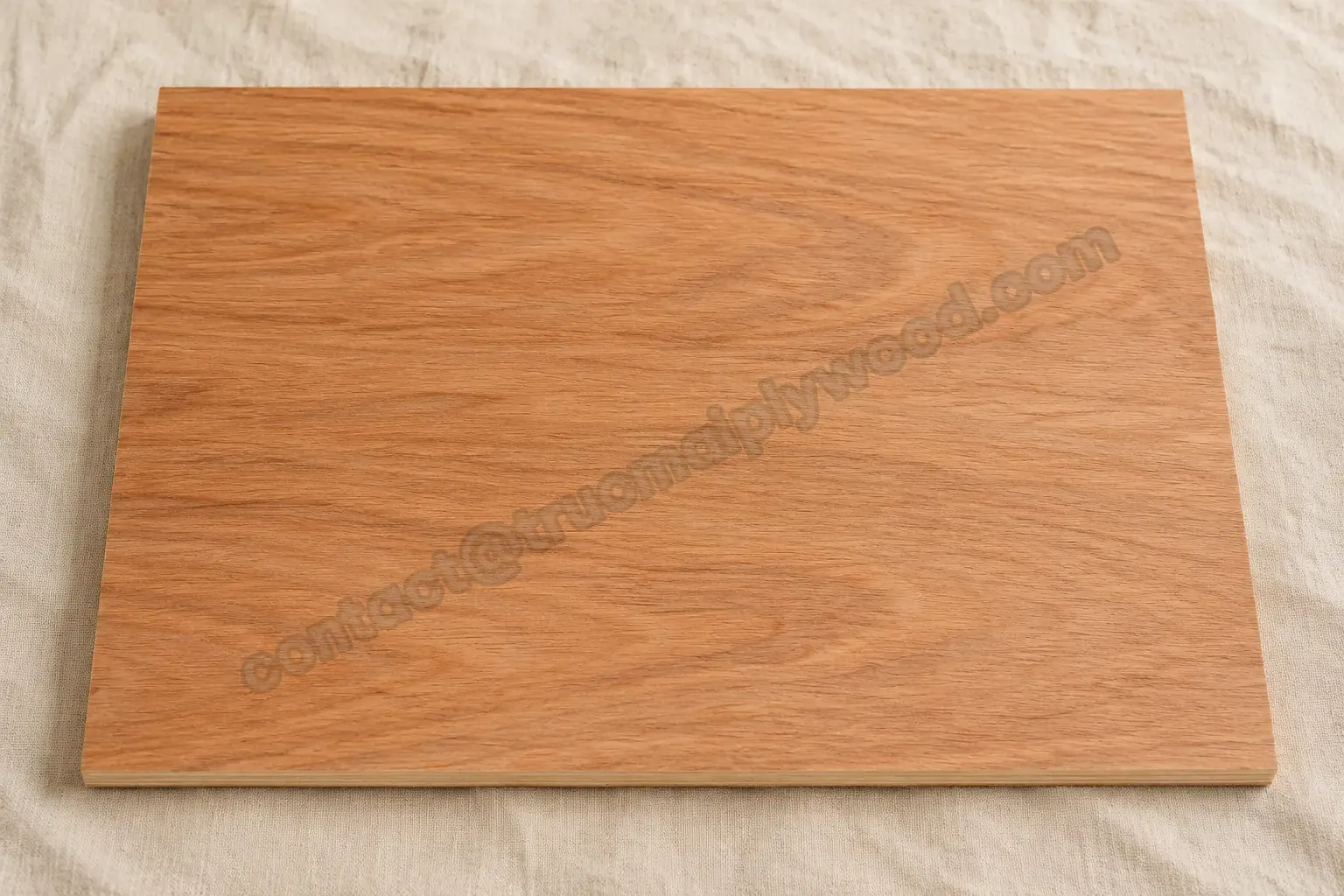
Natural veneer retains the variation of a sliced or peeled log; engineered veneer rearranges wood material into a designed, repeatable grain pattern. Both are real wood surfaces, but they answer different design and purchasing needs.
Natural faces may show more variation between adjacent sheets, even within a selected grade. For a prominent bank of cabinet doors, that variation can be desirable when the grain is intentionally matched. It can also complicate replacements if the original batch has been exhausted. Engineered veneer is useful when the designer wants a repeatable visual rhythm across many fronts.
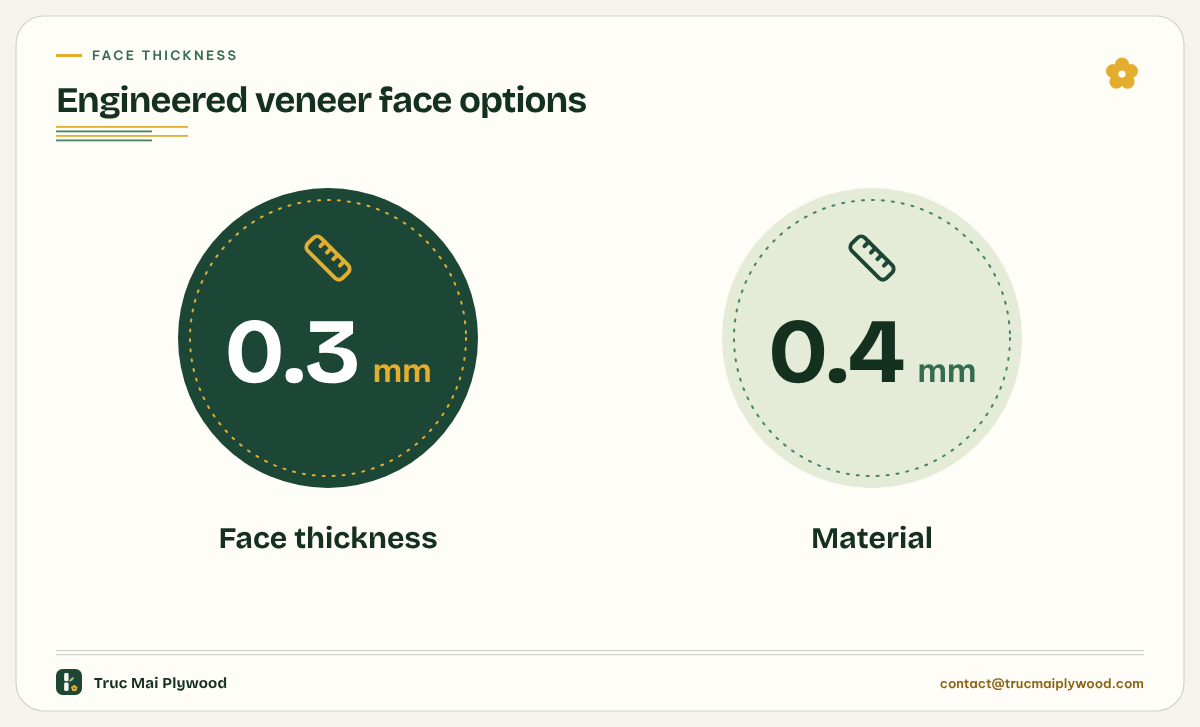
The mill offers white poplar EV made from plantation poplar, Populus deltoides, as an imported face veneer. Available face thicknesses include 0.3 and 0.4 mm for this material. A buyer can specify a reference sample and acceptable colour variation, then use that approved sample when checking the delivered panels. See the EV plywood range for the corresponding panel option.
Which core should sit beneath a wood veneer board?
Styrax, eucalyptus, acacia and pine are core choices for decorative plywood, with mixed-species lay-ups also available. Core selection changes sheet weight, machining behaviour and the finish quality achievable at a given construction.
A core is not merely a hidden filler. A loose joint can show through a thin face after sanding or finishing; an inconsistent layer can affect the edge exposed by a routed groove. The core therefore deserves its own line in the purchase specification, even where every exposed surface will be covered.
For a clean cabinet face, start with stitched A-grade core construction. For a commercial interior where the panel is concealed or subsequently covered, an AB core with loose-laid or jointed veneer may meet the design brief. Ask for the same face over two core samples if weight and surface appearance are competing priorities. Plywood for kitchen cabinets explains the application choices.
What thickness and sheet size should a buyer specify?
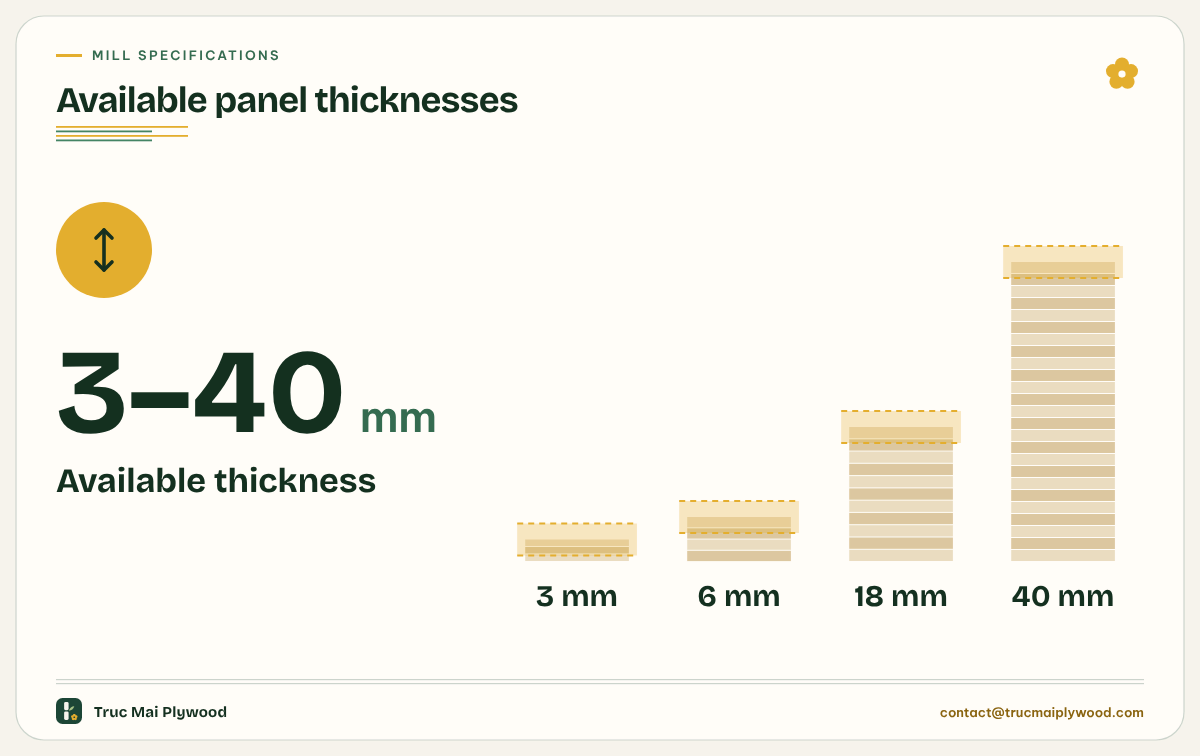
The furniture and commercial range covers 3–40 mm thickness, with standard sheet formats of 1220 × 2440 mm, 1220 × 2280 mm and 1250 × 2500 mm. The drawing should state finished nominal thickness, sheet dimensions and the intended cutting orientation.
| Specification line | Available mill detail | Buying implication |
|---|---|---|
| Thickness | 3, 4, 5, 6, 9, 12, 15, 18, 21, 25, 30, 40 mm | Choose for the component and machining plan |
| Standard sheet | 1220 × 2440 mm | Common furniture cutting layout |
| Short sheet | 1220 × 2280 mm | Useful for certain furniture parts |
| European format | 1250 × 2500 mm | Useful where drawings use metric modules |
| Sanded furniture tolerance | ±0.3 mm when specified | Write the tolerance into the order |
| Length and width tolerance | ±2 mm | Allow for trimming and fit |
Thin 3–5 mm panels use five plies. An 18 mm panel commonly uses 11–13 plies, often 11. A ply count should be written alongside the approved construction rather than inferred from thickness alone. For further sizing context, consult 18 mm plywood specifications and thin plywood panels.
How do face thickness and grading affect the finished surface?
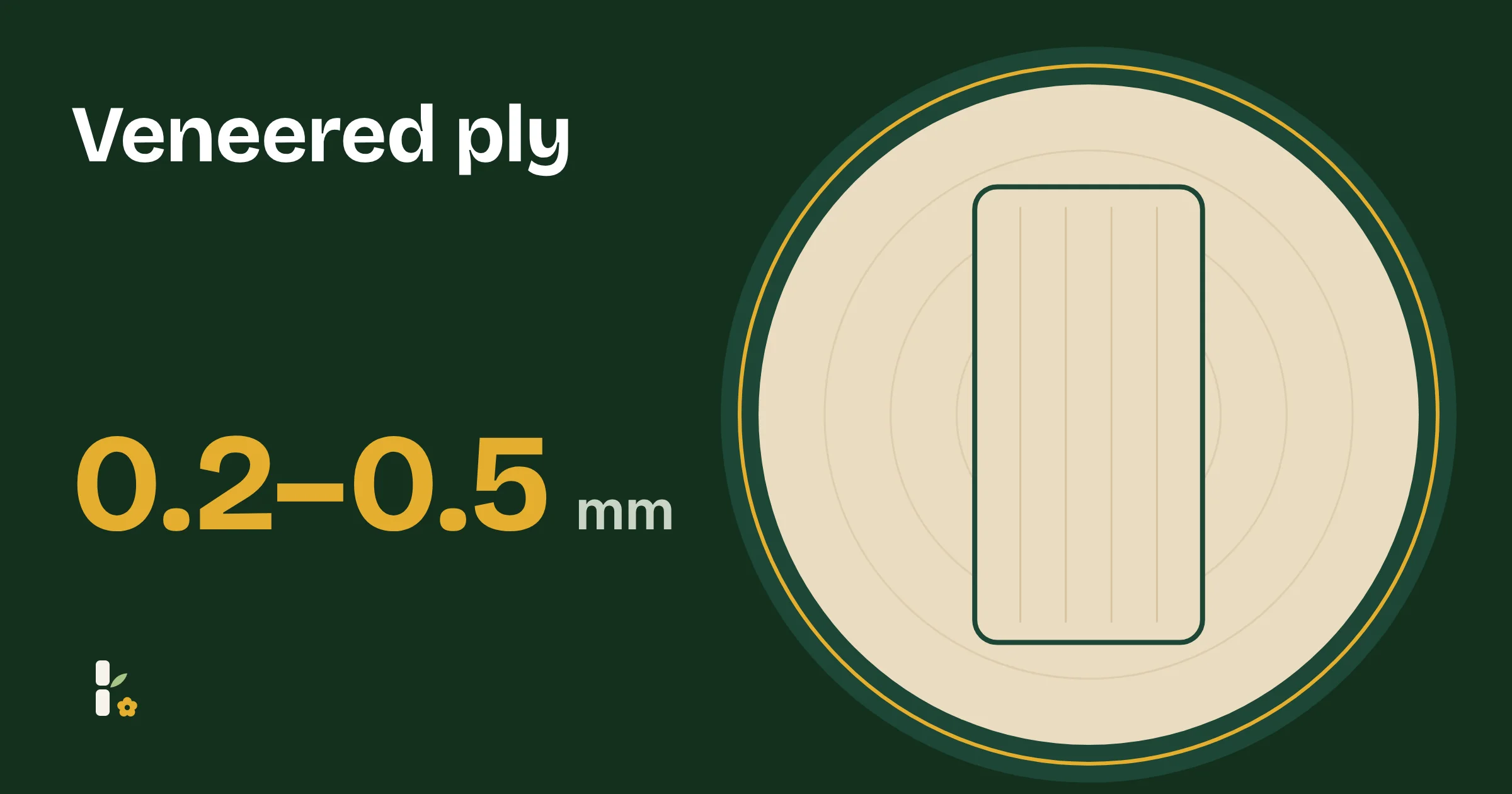
Face veneer thickness and the approved appearance sample determine how much decorative material remains for finishing. Typical mill face veneer is 0.2–0.5 mm, with 0.3 mm often selected for European orders. Excessive sanding can cut through the visible face, particularly at a high point in the underlying core.
Specify face and back separately. A pair such as A/B is a trade description whose exact meaning belongs in the supplier’s sample and written acceptance criteria. Colour, open defects, patches, grain figure and repairs should be agreed on the same sample used for inspection. Do not assume that similarly named trade grades from different factories have identical allowances.
For standardised hardwood appearance classification, ISO 2426-2:2020 identifies appearance classes E, I, II, III and IV. A buyer can reference a formal classification where appropriate, but the actual purchase line should still identify which face is exposed and which will be concealed. For design-led procurement, compare face veneer thicknesses and choosing a face by colour.
Where is veneered board used in an interior?
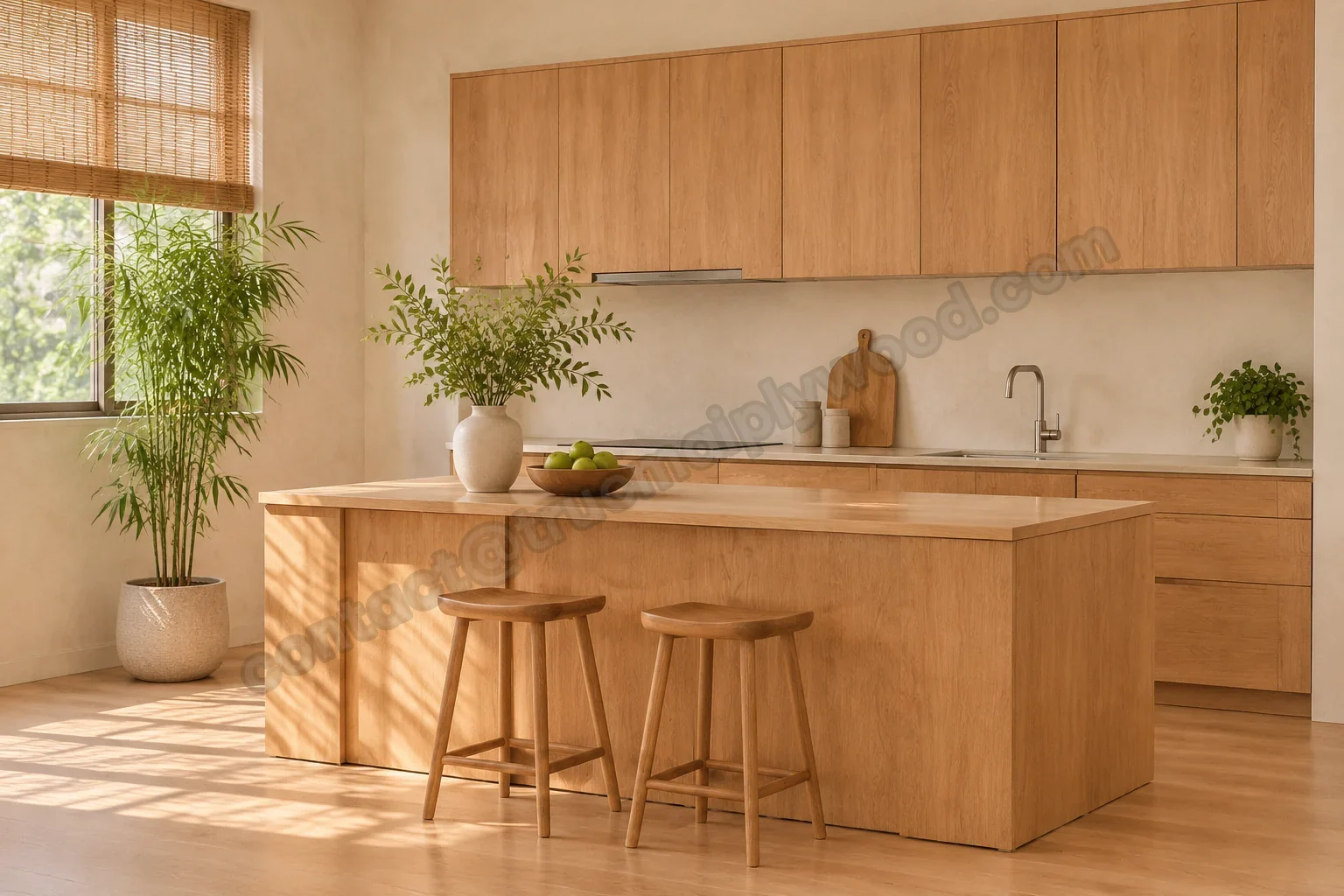
Cabinet doors, wardrobes, wall panelling, shelving and furniture components are the principal interior uses of decorative veneered board. The correct construction follows the component: a large door needs a balanced panel, a visible shelf edge needs an intentional edge detail, and a concealed carcass part can use a simpler surface grade.
A cabinet front is judged under direct light at eye level. For that application, ask for face continuity and an approved finish sample. A wall panel may instead be judged across a large area, where neighbouring sheet colour and grain matching become more important than the appearance of any individual piece.
Shelves introduce a different requirement: span, load and support determine deflection. A decorative face does not give the panel a structural span rating. Set the shelf dimensions and support layout with the furniture designer, then choose a panel build that meets the design. The best plywood for interiors article compares the relevant furniture applications.
Can veneered plywood be cut to finished cabinet parts?
Yes. The mill can supply labelled cut-to-size panels from standard sheets, using the buyer’s cut list and agreed dimensions. This is useful for repeated furniture components, especially when the destination workshop wants to reduce its first cutting operation.
A 1220 × 2440 mm sheet may be divided lengthwise into 610 × 2440 mm parts, or into four 1220 × 610 mm parts. A three-part arrangement such as 1200 × 800 mm is also used; six-part layouts can be agreed against the sheet and cut list. The precise finished pieces and saw allowances belong in the approved cutting drawing.
The purchase document should identify the visible face, grain direction, labels, bundle order and edge condition. Cutting a decorative sheet without indicating grain direction can create visually inconsistent adjacent doors even when every part is dimensionally correct. For ordering details, see panels cut at the mill.
How should the edges of a veneered board be finished?
Edge banding, solid-wood lipping or an intentionally visible plywood edge are the main finishing choices. The appropriate detail depends on whether the design wants the face species to continue around the edge or wants the layered plywood construction to remain visible.
For an edge that visually matches the face, specify the banding species, colour and finish alongside the veneer sample. For a routed or exposed edge, inspect the core for voids and irregular veneer joints before approving the design. A smooth face alone cannot tell you how a long exposed edge will look after machining.
Joinery drawings should also mark hinge bores, screw positions and any grooves near the edge. Those features interact with the core and the chosen thickness. A sample cabinet corner, finished using the actual banding and adhesive process, is a more useful acceptance piece than a photograph of an unmachined sheet. The laminates for plywood guide addresses alternative finished surfaces.
How do veneer plywood and melamine-faced plywood compare?
Veneer plywood has a real-wood face that buyers can stain or clear-finish, while melamine-faced plywood arrives with a decorative surface already applied. For cabinet orders, choose veneer when the design calls for wood grain and a separate finishing stage; choose melamine when a consistent, factory-finished decor is the priority.
| Decision | Real-wood veneered ply | Melamine-faced plywood |
|---|---|---|
| Visible character | Natural or engineered wood grain | Decorative melamine surface |
| Finishing | Usually needs a buyer-applied finish | Surface is supplied faced |
| Colour matching | Agree veneer samples and finish | Agree decor reference and finish |
| Edge detail | Match veneer or expose plywood | Match melamine decor or expose plywood |
| Typical design priority | Real-wood appearance | Repeatable finished decor |
HPL-faced panels provide another surface option for projects where a laminate finish is specified. The core, sheet dimensions and edge details still need separate attention. See melamine-faced plywood and HPL-faced plywood for the two alternative product constructions.
Which glue and emission documents matter for a veneered panel?
Adhesive bond performance and formaldehyde emissions are separate specification lines. A decorative face does not establish either property; buyers should identify the adhesive system, the intended indoor conditions and the emission documents for the ordered panel build.
The standard interior option is UF glue at E0 emission in the mill’s terminology. For moisture exposure, specify the application and request the corresponding adhesive and test configuration. The US Environmental Protection Agency identifies hardwood plywood among the composite wood products covered by TSCA Title VI import requirements. Truc Mai’s CARB Phase 2 and TSCA Title VI third-party certification covers hardwood plywood with veneer core from 3–25 mm, certificate CARB/EPA 26053, mill ICTT-26053.
European E1 chamber assessment under EN 717-1 uses a 0.124 mg/m³ limit, as described by Fraunhofer WKI. This test framework and the US test framework use different methods. For a US-bound order, review Phase 2 formaldehyde limits.
What traceability records should an importer request?
An importer should request the wood-origin and product-identification records for the actual veneer face and core, plus the certificate claim on the sales documents when certified material is ordered. Decorative plywood can combine wood sourced in different countries, making both components relevant to the import file.
The European Commission’s EUDR guidance describes due diligence using origin information and geolocation of production plots. Truc Mai supplies origin records and geolocation files for both the Vietnamese core and imported face veneer. The file set can include species identification, harvest and transport records, and GeoJSON information used by the EU importer for its due diligence statement.
For FSC 100% eligible products, the mill’s chain-of-custody certificate is SA-COC-014545 and its licence code is FSC-C196493. The Forest Stewardship Council’s chain-of-custody standard requires sales documents for FSC-claimed products to state the seller’s FSC certificate code and the FSC claim for each product. Buyers can use the FSC licence verification guide and face veneer origin files when assembling their order dossier.
How can buyers compare quotations for the same veneered ply?
Compare like-for-like construction before comparing the commercial offers. Two panels described as “veneered plywood” can differ in core grade, veneer jointing, face thickness, sanding and adhesive specification. Those differences affect appearance, machining yield and finishing work.
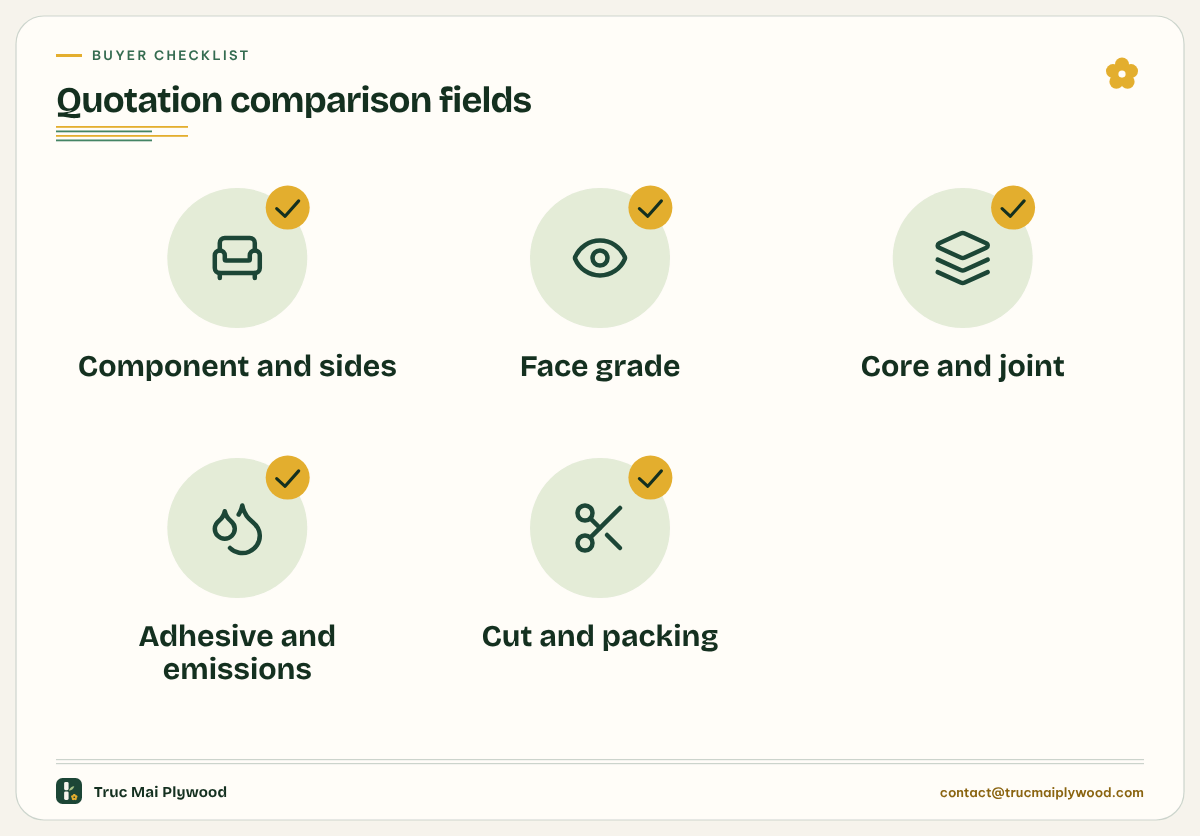
A practical comparison uses one written schedule:
- State the furniture component and whether the face is visible on one or both sides.
- Identify face species, face/back grade pair and approved reference sample.
- Record the core species, jointing method, nominal thickness and tolerance.
- State the adhesive and emission requirements as separate entries.
- Add sheet format, cut list, grain direction, edge finish and packing labels.
- Request the relevant test and origin documents for the intended destination market.
Ask suppliers to quote against the same sample and drawing. If a line is omitted, the resulting offers cannot be judged as equivalent simply because the species name matches. For a fuller purchasing template, use writing a plywood RFQ and how plywood is priced.
What should be checked before approving a production sample?
Approve the surface, edge and machined part together. A full-size face sample demonstrates grain and colour; an exposed edge reveals the core; a finished test component reveals how sanding, staining and edge treatment interact with the veneer.
Inspect the face under the lighting expected in the finished room. Look for telegraphing from core joints, surface repairs, raised grain and uneven sanding. Check the reverse face for balance and the edge for voids. Measure thickness at several positions using the same method that will be used for incoming inspection.
Record the accepted sample, the finish applied and the face/back designation on the order. When the project uses repeating doors, lay several panels next to each other before final approval. This catches colour discontinuities that a single attractive sheet cannot show. The ordering plywood samples page explains the practical sample request.
How should a factory-direct veneered plywood order be written?
Write one order line for each distinct panel construction and finish. A clear request names the furniture application, core, adhesive and emission specification, decorative face, dimensions, cut pattern, packing and quantity, followed by the destination port.
Truc Mai Plywood manufactures furniture and commercial plywood in Ha Hoa, Phu Tho, Vietnam, with production capacity around 60,000 m³ annually. The standard minimum order is one 40HC; production normally takes 15–45 days after the deposit according to the agreed order. For cut parts, attach the drawing with face orientation and labels, and specify whether each component needs a show face on one or both sides.
The next action is to send the face reference, drawing and specification schedule through the quotation page. Ask for a matched sample set and the documents associated with the selected build. That gives the mill a usable production instruction and the buyer a consistent basis for incoming inspection.
Questions buyers ask
Can a veneered sheet have a decorative face on only one side?
Yes. Specify the show face and back separately, and request a balanced panel construction for the intended furniture component.
Is engineered veneer made from real wood?
Yes. Engineered veneer is reconstituted from wood to produce a controlled grain pattern; it is distinct from a printed melamine surface.
Can I order a birch appearance without a birch core?
Yes. Birch-faced plywood uses a birch decorative face over a specified core, such as Styrax or eucalyptus.
Should the veneer grain run along the long edge of a cabinet door?
State the grain direction on the cut drawing. The intended visual layout and component orientation determine the correct direction.
Can a veneered panel be stained after delivery?
Yes. Test the stain and clear finish on an approved sample first, because species, grain and sanding affect the final colour.
Do I need to specify the back veneer grade?
Yes. A face/back grade pair clarifies the visible appearance and prevents an unspecified reverse surface from changing the accepted construction.
What sample is most useful for checking a decorative face?
Request a face sample together with an exposed-edge piece and a finished test part. They reveal appearance, core construction and finishing response.
Can decorative plywood be supplied with labels for each cut part?
Yes. Labelled cut-to-size panels can be supplied against an agreed cut list and part-identification schedule.
Is veneer plywood the same as a solid-wood board?
No. Veneer plywood has a decorative wood surface over cross-laminated inner plies, whereas solid-wood board is built from solid timber.
What details should appear on a veneered plywood sample approval?
Record the face species, face/back grades, core, thickness, finish reference and grain direction. Keep the approved sample with the order specification.