
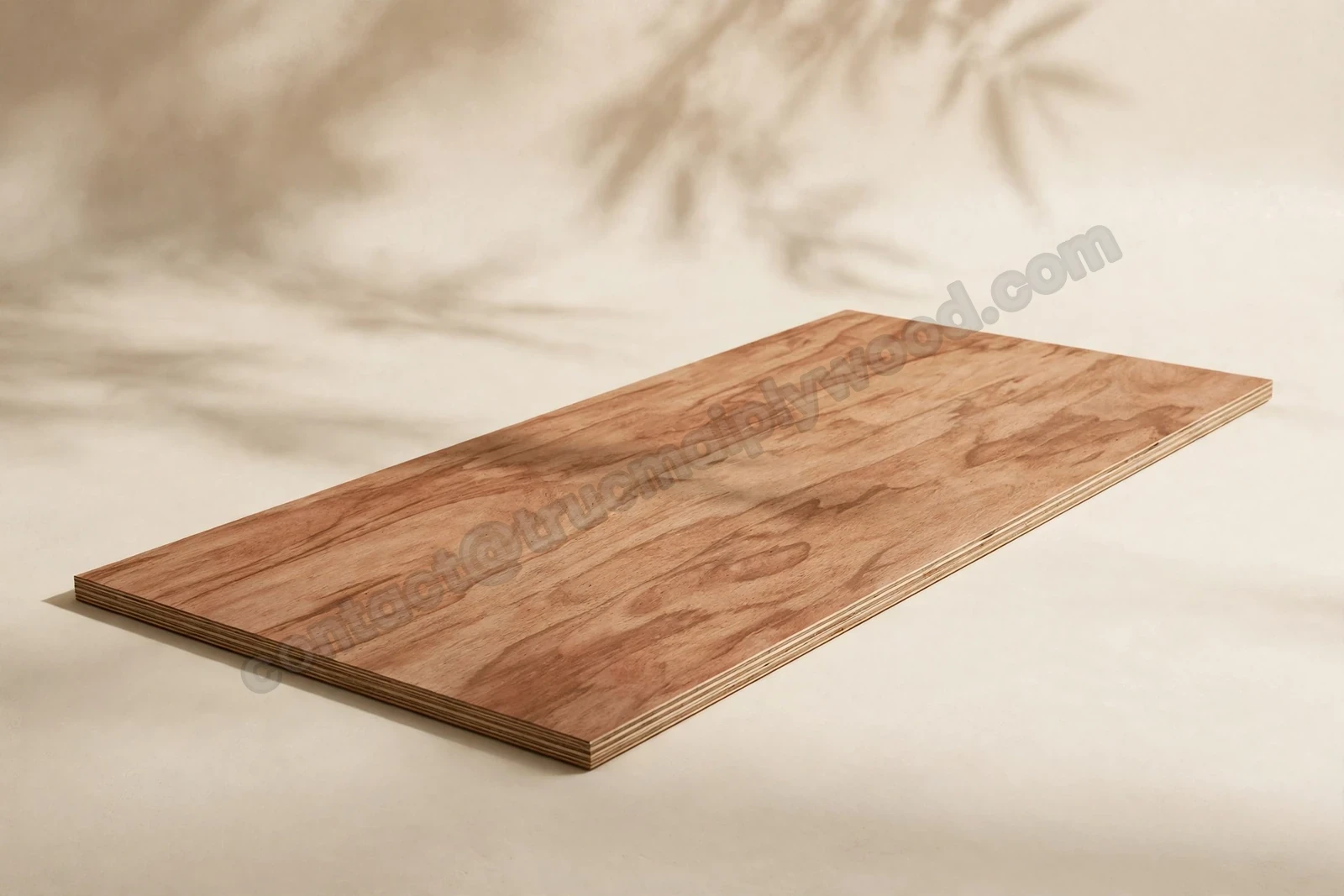
A wood veneer panel combines a thin real-wood face with a supporting board. Veneered plywood is the practical choice for cabinet components needing reliable screw fixing and balanced construction; veneered MDF suits smooth, consistently machined interior faces; veneered particleboard suits economical, supported furniture parts. Specify the substrate and veneer separately before comparing quotations.
What is a veneered panel?
Yes, a veneered panel is a manufactured board with a thin layer of real wood bonded to at least one face. The substrate provides most of the panel’s thickness and its machining behaviour; the face determines the visible species, grain and colour. A buyer asking for a wood veneer panel therefore needs two specifications, not a species name alone.
A walnut face can sit on MDF, plywood or particleboard, with three different edges and fastening behaviours.
The face is commonly selected for appearance while the substrate is selected for use. A natural veneer can show changes in colour and figure across a batch. An engineered veneer is made to deliver a more repeatable pattern. Neither choice automatically specifies the core, adhesive or surface finish. A board sold as an oak veneer panel may also differ in back veneer, cut, matching and the way its edges are supplied.
For a panel that already has veneer pressed onto its substrate, start with the veneered plywood boards specification. Buyers purchasing loose leaves to press themselves need real veneer sheets instead. Those are distinct procurement items, even when the same timber species appears on both invoices.
Veneered MDF vs veneered plywood: which is better?
Yes, veneered plywood is the stronger default for cabinet components with frequent fixings and handled edges; veneered MDF is the smoother choice for routed, flat interior decorative surfaces. Particleboard is a further option for well-supported, enclosed furniture parts. The decision starts with the load path and exposure, not the photograph of the face.
| Buyer criterion | Veneered plywood | Veneered MDF | Veneered particleboard |
|---|---|---|---|
| Substrate construction | Cross-laid wood veneers | Compressed wood fibres | Bonded wood particles |
| Visible cut edge | Distinct wood plies | Uniform fine fibre | Coarser particle structure |
| Fixings | Useful for cabinet joints and edge fixings with suitable design | Good machined faces; edge fixings need careful design | Best with fittings specified for particleboard |
| Routed profile | Shows layers at exposed cuts | Smooth continuous profile | Exposed cut may need filling or edging |
| Moisture response | Cross-lamination helps restrain movement; grade and sealing still matter | Standard grades can swell at exposed edges | Exposed edges require careful protection |
| Typical purchasing decision | Cabinets, shelving, doors and furniture components | Flat decorative fronts and interior panels | Supported carcasses and interior furniture |
The plywood advantage in humid markets is dimensional restraint from alternating grain directions. It is not a promise that an unsealed plywood edge stays unaffected by water. For bathrooms, utility rooms or coastal installations, ask for the complete board and finishing specification rather than treating the word ‘plywood’ as a moisture rating. MDF and particleboard also come in grades with different moisture performance; compare the actual grade and the intended service conditions.
How do oak, walnut and other wood veneer panel faces differ?
Oak, walnut and birch faces differ in grain, colour, cut and supply consistency. Quarter-cut veneer generally produces straighter grain, while crown-cut leaves show broader figure. Specify the matching pattern for the finished door or wall panel; compare the birch-faced plywood specification.
Oak faces show visible grain; walnut faces offer darker decoration. A hardwood veneer panel can still have a softwood or mixed-species core.
Which face veneers can be pressed onto furniture plywood?
Poplar, bleached poplar, birch, okoume, bintangor, pine, eucalyptus, gurjan, sapele and engineered veneer are face options for furniture plywood. Truc Mai Plywood produces furniture and commercial plywood in Ha Hoa, Phu Tho, Vietnam, using eucalyptus, acacia, styrax, pine or mixed-species cores. These core and face choices are written separately on the order.
Birch-faced plywood means a birch decorative face over a different core, not an all-birch construction. The birch-faced plywood product specification makes that distinction explicit. Engineered veneer, including a white poplar appearance, can provide a repeatable face for large runs; see engineered veneer plywood.
How thick is the veneer, and what does it change?
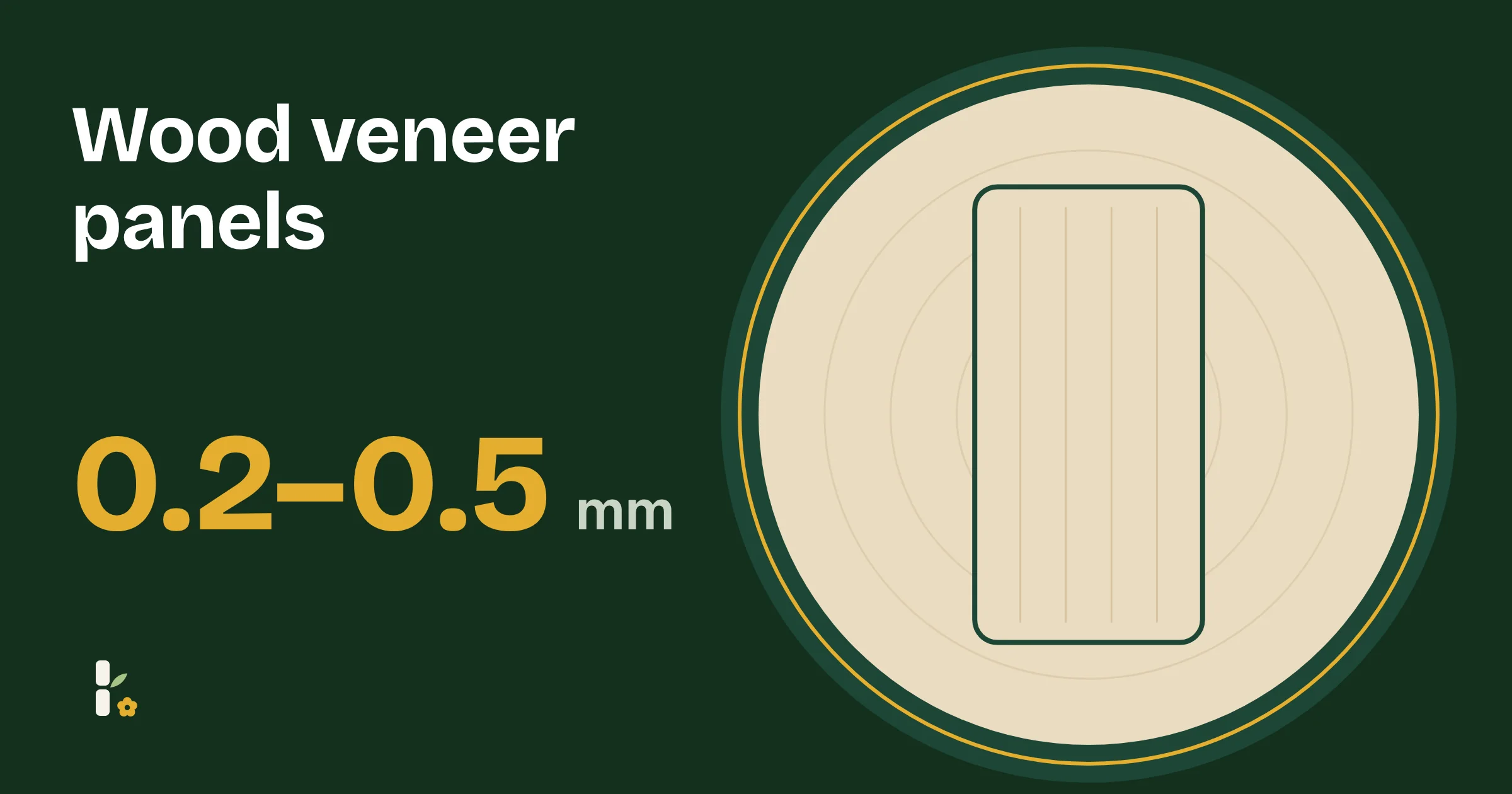
Face veneer on this furniture plywood range is 0.2–0.5 mm, with 0.3 mm commonly specified for European orders. The face thickness affects sanding allowance and the care needed during machining and finishing. It does not turn a plywood substrate into solid timber, and aggressive sanding can cut through a thin decorative face.
The core veneer is a separate construction component, usually 1.4–2.0 mm in the mill specification. Buyers should identify the face thickness, number of plies and calibrated final panel thickness as different fields. A thicker decorative face may be requested for a particular finish, but the available species, yield and matching plan govern the practical choice.
What panel thickness and sheet sizes can buyers specify?
The standard furniture and commercial plywood range runs from 3 to 40 mm, with common sheet formats of 1220 × 2440 mm, 1220 × 2280 mm and 1250 × 2500 mm. These are finished sheet dimensions, not loose veneer dimensions. A buyer planning cabinet nesting should specify the parent sheet first, then the cutting drawing and orientation.
| Specification field | Example purchasing entry | Why it matters |
|---|---|---|
| Finished thickness | 18 mm, calibrated | Fitting clearances and edge treatment |
| Parent sheet | 1250 × 2500 mm | Yield from the cutting plan |
| Decorative face | Engineered veneer, approved pattern | Repeatability across doors |
| Back face | Matching or balancing veneer, agreed grade | Balance and reverse appearance |
| Core | Styrax, eucalyptus, acacia or pine | Weight and handling characteristics |
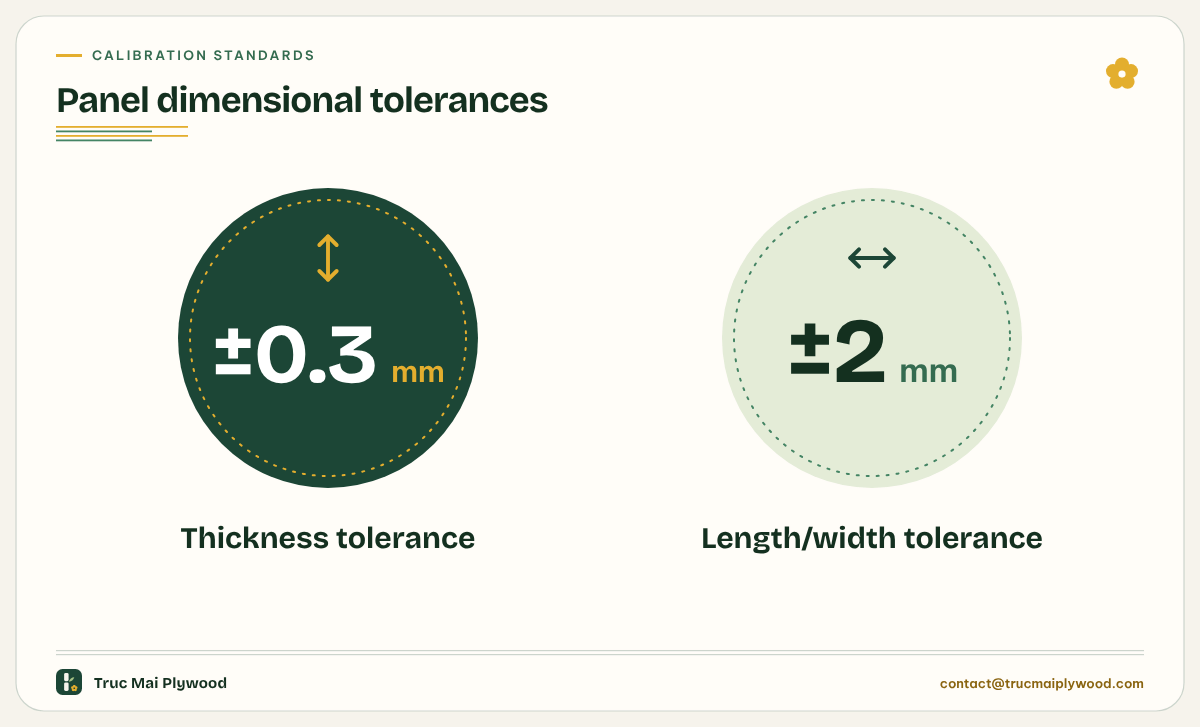
| Thickness tolerance | ±0.3 mm on calibrated furniture panels | Consistent assembly clearances |
| Length and width tolerance | ±2 mm | Nesting and assembly |
The order specification can state a different tolerance for commercial or packing grades. A calibrated furniture panel has a more exacting target than a lightly sanded general-purpose board. Compare the supplier’s declared tolerance to the tolerance required by your CNC and fitting system, rather than assuming every 18 mm panel measures identically.
How should the face and back be balanced?
Specify both the decorative face and the back, including a balancing veneer where needed. Unequal stresses between sides can contribute to bowing or cupping; see the plywood RFQ guide.
Write face/back grades as a pair. Wall linings may accept a utilitarian reverse; exposed shelves need an agreed two-sided appearance.
How does veneer matching affect doors and wall panels?
Book matching mirrors adjacent leaves; slip matching keeps their orientation similar; random matching is less uniform. Agree the pattern against plywood samples.
Specify matching within 1 panel, across consecutive panels or across the whole installation. Supply labelled wall elevations or door drawings showing hinge side and grain direction.
What happens to a veneer panel in humid interiors?
Plywood’s cross-laid veneers help restrain movement across the board, making a suitable plywood build a practical choice where interior humidity fluctuates. The exposed edge and the selected adhesive system still need attention. MDF and particleboard have their own moisture-rated variants, so the comparison is between specified products rather than generic labels.
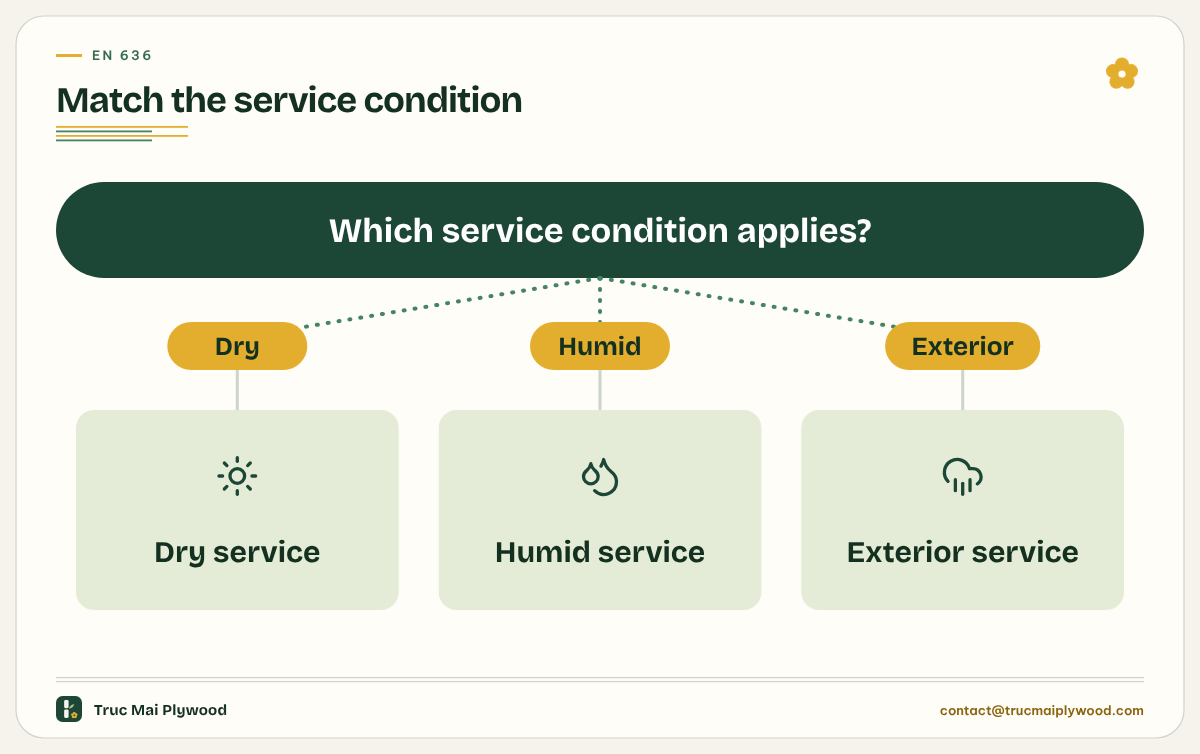
EN 636 distinguishes dry, humid and exterior service conditions. The EN 636 standard preview describes dry service in its first class and humid service in its second. A buyer should name the service environment and request the corresponding evidence for the offered panel construction. A furniture veneer face by itself does not define that classification.
Which adhesive and emission documents matter?
Adhesive bond performance and formaldehyde emissions are separate specifications. A bond test assesses the integrity of the glue line under its prescribed conditioning; an emissions test measures released formaldehyde using a named method. The United States Environmental Protection Agency lists hardwood plywood, medium-density fibreboard and particleboard as regulated product groups under TSCA Title VI.
For hardwood plywood with veneer core, the US formaldehyde emission limit is 0.05 ppm under the relevant test framework. The EPA compliance guide distinguishes that category from MDF and particleboard. Do not use a test result from one substrate to describe another substrate or a different finished construction.
The mill’s own CARB Phase 2 and TSCA Title VI certification covers veneer-core hardwood plywood within its certified thickness and ply scope, 3–25 mm and 3–15 plies. The certificate identifies ICTT Corporation as third-party certifier TPC-43, with certificate CARB/EPA 26053. For a US order, record the exact configuration and the required shipment documents in the contract. For other destinations, state the buyer’s emission specification and test method explicitly.
How should a buyer assess face grades and defects?
Approve face grades against physical samples and written defect allowances. Letters such as A/B or B/BB are used in trade, but the precise appearance allowances must be defined by the supplier’s specification. A face/back grade pair is more informative than a single grade label.
The ISO 2426-2 hardwood plywood preview identifies formal hardwood face appearance classes. It does not create a universal equivalence between those classes and every regional trade grade. When a tender names a grade, ask for the defects allowed on the face, the reverse and the repaired areas.
How are edges finished on veneered plywood, MDF and particleboard?
Plywood edges can remain visible or receive matching veneer tape. MDF and particleboard edges generally need a suitable finish; see cut-to-size panels.
Specify edge band species, colour, thickness and grain direction. Agree butt, mitre or wrapped corners against the sample.
Can a mill supply cut-to-size veneered panels?
Yes. A standard sheet can be cut into labelled furniture parts from an agreed cutting list. Typical arrangements include lengthwise halves at 610 × 2440 mm, three pieces at 1200 × 800 mm or quarters at 1220 × 610 mm. Other agreed patterns include six pieces, with the final piece size taken from the actual parent sheet and the cutting drawing.
Send the mill the finished dimensions, grain arrows, saw-cut allowance, acceptable edge condition and the label for each piece. A pattern that looks efficient on a spreadsheet can fail if the grain direction is rotated or if a required visible edge falls on the wrong side. The cutting drawing therefore needs the same approval as the veneer sample.
The cut-to-size plywood panels page covers the production option. For recurring cabinet programmes, use a piece identifier that matches the buyer’s assembly drawing so receiving staff can sort panels without remeasuring every item.
How many veneer-faced plywood sheets fit in a 40HC?
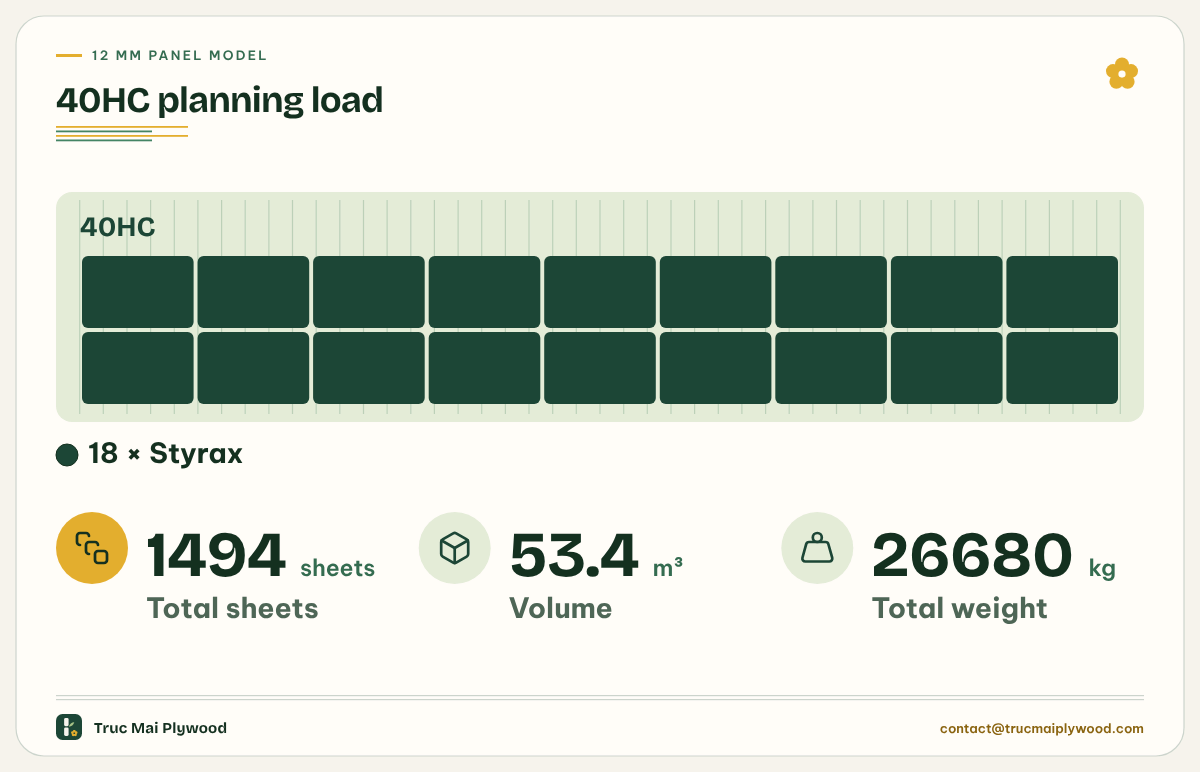
The 40HC planning count changes with core density and thickness, even when the decorative veneer is identical. The table below reproduces the supplied planning model for 1220 × 2440 mm sheets. It is a panel-only model using pack heights of 1,000 mm, 18 Styrax packs, 16 Acacia packs or 15 Eucalyptus packs, reference densities of 500, 580 and 650 kg/m³ respectively, and a 28,000 kg planning payload. Sheet counts are weight-capped where indicated. Carrier, route and actual packaging determine the shipment plan.
| Core | Thickness | Packs | Sheets/pack | Sheets | Volume (m³) | kg/sheet | Total kg | Weight-capped |
|---|---|---|---|---|---|---|---|---|
| Styrax | 12 mm | 18 | 83 | 1494 | 53.4 | 17.9 | 26680 | No |
| Acacia | 12 mm | 16 | 83 | 1328 | 47.4 | 20.7 | 27510 | No |
| Eucalyptus | 12 mm | 15 | 80 | 1200 | 42.9 | 23.2 | 27860 | Yes |
| Styrax | 15 mm | 18 | 66 | 1188 | 53.0 | 22.3 | 26520 | No |
| Acacia | 15 mm | 16 | 66 | 1056 | 47.2 | 25.9 | 27350 | No |
| Eucalyptus | 15 mm | 15 | 64 | 960 | 42.9 | 29.0 | 27860 | Yes |
| Styrax | 18 mm | 18 | 55 | 990 | 53.0 | 26.8 | 26520 | No |
| Acacia | 18 mm | 16 | 55 | 880 | 47.2 | 31.1 | 27350 | No |
| Eucalyptus | 18 mm | 15 | 53 | 795 | 42.6 | 34.8 | 27690 | Yes |
| Styrax | 21 mm | 18 | 47 | 846 | 52.9 | 31.3 | 26440 | No |
| Acacia | 21 mm | 16 | 47 | 752 | 47.0 | 36.3 | 27270 | No |
| Eucalyptus | 21 mm | 15 | 45 | 675 | 42.2 | 40.6 | 27430 | Yes |
These figures describe a container-loading calculation, not a record of a loaded consignment. Veneer species is less important to this planning table than the weight and construction of the underlying plywood. The cubic metres per 40HC by thickness reference provides the wider packing context. For a mixed-product shipment, the mill checks each pack and the actual cargo weight against the booking.
What paperwork accompanies certified veneer-faced plywood?
A buyer should receive documents matching the ordered panel configuration and destination. For FSC 100% material, the seller’s chain-of-custody code and the applicable claim belong on the sales documentation. The FSC chain-of-custody standard sets out the sales-document requirements.
Truc Mai Plywood holds FSC chain-of-custody certificate SA-COC-014545 and licence FSC-C196493 for eligible products. The shipment specification should identify which products carry the FSC 100% claim. For EU-bound plywood, the mill supplies origin and geolocation documentation for the Vietnamese core and imported face veneer, allowing the importer to prepare its due-diligence file. See the face veneer origin files explanation.
How should an importer compare veneered panel quotations?
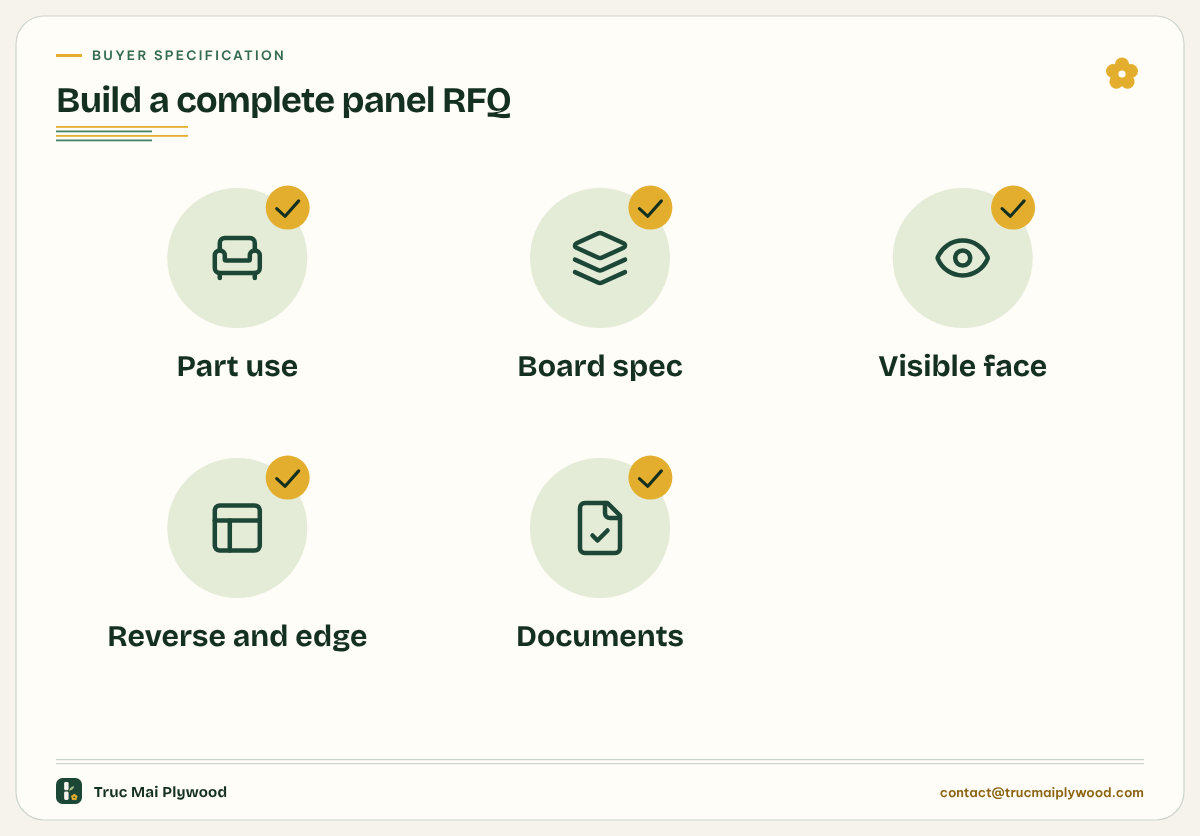
Compare quotations line by line using the substrate, face and finished component requirements. The most useful enquiry identifies the application first, then names the core, veneer, glue and emission requirements, sheet dimensions, tolerances, edge treatment, packing and quantity. A single line saying ‘oak veneered board’ leaves too many commercial differences hidden.
- Describe the part: cabinet door, carcass, wall lining or shelf, including the indoor environment and fastening method.
- Specify the board: plywood, MDF or particleboard, with its construction, thickness and required tolerances.
- Define the visible face: species, natural or engineered veneer, cut, matching, grade and finish preparation.
- Define the reverse and edge: balancing face, back grade, banding and any cut-to-size labels.
- Attach the documentation schedule: emission evidence, origin files and certified claims where required.
- Approve a sample and cutting plan: compare the production-ready build, not merely a catalogue photograph.
The plywood RFQ writing guide gives a useful order of fields. New buyers can also arrange plywood samples before agreeing the finished appearance range. Send the intended application, substrate, face and back, thickness, sheet or piece drawing, finish, destination port and required quantity with the quotation request.
Send your specification to contact@trucmaiplywood.com or through the quotation form.
Questions buyers ask
Can I specify oak veneer on a plywood core?
Oak is a face-veneer choice to request with a sample and matching edge treatment. State the veneer species, cut, matching pattern and core in the enquiry.
Is a walnut veneer panel solid walnut?
No. Walnut veneer panels have a thin walnut face bonded to a separate substrate; the edge reveals the core unless it is covered.
Should I order veneer on one face or both?
Specify both face and back, including whether the reverse is a balancing veneer. One decorative face does not remove the need to manage panel balance.
Do I need edge banding for a veneered shelf?
Yes, where a visible core edge would spoil the appearance. Match the edging to the face species, grain direction and final finish.
What is an engineered veneer face?
Engineered veneer is reconstituted wood veneer designed for a more repeatable appearance. It remains a wood face rather than a printed melamine pattern.
Can a factory supply cut-to-size panels?
Yes. Send a drawing with finished dimensions, grain direction, edge treatment and piece labels; the cutting pattern is agreed against the parent sheet.
What should an approved veneer sample show?
The approved sample should show colour range, grain pattern, allowable marks, surface preparation and the face/back pairing. Keep a signed reference for production inspection.
Are veneer-faced boards suitable for a kitchen?
Veneer-faced plywood is used for cabinet fronts and interior furniture. Specify the moisture exposure, finishing system and edge sealing for the actual location.
How do I compare veneer grades from different suppliers?
Compare physical samples and written defect allowances rather than relying on a grade letter alone. Request face and back grades as a pair.
Can I buy FSC 100% veneer-faced plywood?
Eligible products can carry an FSC 100% claim when the relevant certified chain and product schedule support it. Check the claim and certificate code on the sales documents.