
Teak veneer gives furniture a warm brown appearance and distinctive grain, while oak, walnut and maple create different visual effects. For repeat plywood orders, the face must also match the core, grade sample and finishing process. Truc Mai Plywood offers production faces including engineered veneer, poplar, birch and okoume for furniture and commercial panels.
What makes teak veneer distinctive on furniture?
Teak veneer has a golden-to-medium-brown visual character, often with darker streaks and a pronounced grain that suits cabinet fronts, furniture panels and decorative joinery. The term describes the decorative wood face, not the complete construction beneath it. Two panels sold as teak-faced can differ substantially in substrate, face matching, sanding and coating.
For a furniture programme, the first decision is whether the design needs the visual identity of genuine teak or simply a warm, straight-grained appearance. A genuine species requirement belongs in the purchasing specification. A colour reference alone can be met by several different decorative faces, but the buyer should approve the actual sample rather than rely on a species name in a catalogue.
A veneer leaf also differs from a ready-to-use veneered plywood sheet. The former needs pressing onto a substrate; the latter is purchased as a panel with the bond and face preparation already completed. For the broader distinction, see real veneer sheets.
Which veneer is best for furniture?
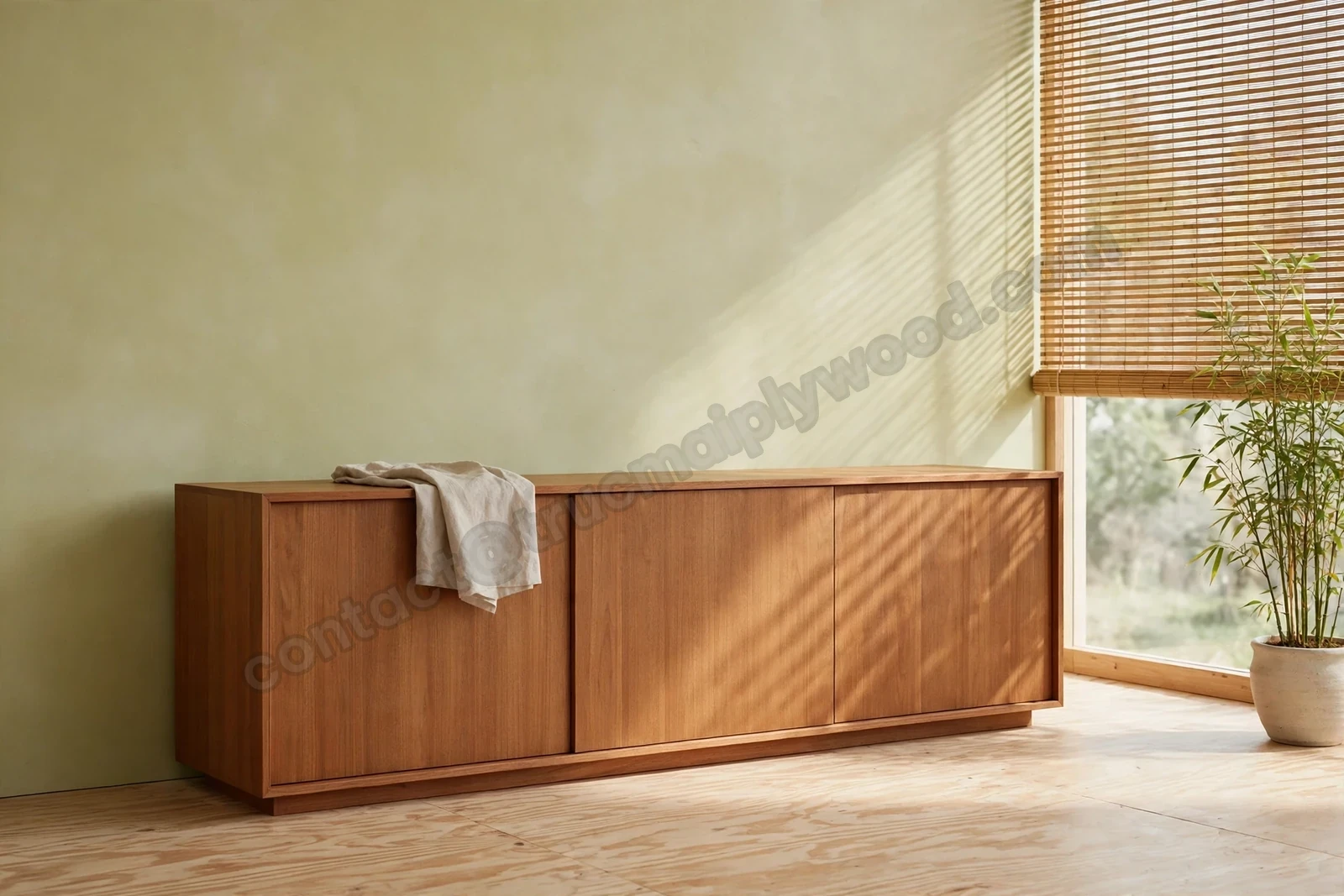
Oak is a strong visual choice for furniture needing conspicuous grain; walnut suits darker premium interiors; maple suits pale, understated work; and engineered veneer is useful when repeated production needs a more controlled pattern. Teak works particularly well where the design calls for its warm brown figure. There is no single species that wins every furniture application.
The buying decision starts with the finished component. A cabinet door needs compatible grain direction across adjacent fronts. A visible table panel needs an agreed match and finish. A concealed carcass component usually benefits more from a consistent panel build than from a costly decorative face. A retail furniture line may prioritise colour repeatability across successive production runs.
A plywood manufacturer can separate those decisions: specify the decorative face and back first, then choose the core and bond for the component. Truc Mai’s furniture-panel cores include Styrax, Eucalyptus, Acacia and Pine, with combined cores also offered. Birch-faced plywood and engineered veneer plywood show two different approaches to appearance on a Vietnamese core.
How do teak veneer, oak, walnut, maple and other faces compare?
The table separates design character from factory availability. Colour descriptions are broad appearance guides, not fixed grading limits; real veneer is selected against a sample. The availability column distinguishes faces in Truc Mai’s stated panel range from species discussed for design comparison.
| Veneer face | Typical visual character | Common design direction | Truc Mai panel range |
|---|---|---|---|
| Teak | Warm golden to brown, variable darker figure | Warm statement furniture | On request |
| Oak | Light tan to medium brown, prominent grain | Cabinet fronts, architectural joinery | On request |
| Walnut | Medium to dark brown, flowing figure | Dark furniture fronts | On request |
| Maple | Pale cream, generally restrained figure | Light contemporary furniture | On request |
| Sycamore | Pale cream to light pinkish tones | Light decorative panels | On request |
| Mahogany | Reddish brown, often ribbon figure | Traditional decorative work | On request |
| Poplar or bleached poplar | Pale, relatively quiet appearance | Light-faced production panels | Offered |
| Birch | Light, fine visual texture | Cabinet and furniture faces | Offered |
| Okoume | Pinkish to reddish brown | Warm interior and door faces | Offered |
| Bintangor | Reddish to pink-brown | Decorative commercial panels | Offered |
| Pine | Pale yellow, visible growth pattern | Natural-looking interior work | Offered |
| Eucalyptus | Variable pinkish or brown tones | Decorative plywood faces | Offered |
| Gurjan | Brown to reddish-brown | Decorative furniture faces | Offered |
| Sapele | Reddish brown, sometimes ribbon figure | Darker decorative interiors | Offered |
| Engineered veneer (EV) | Designed, more repeatable colour and pattern | Repeated furniture programmes | Offered |
This is a species-selection chart, not a universal price ranking. Veneer costs respond to species, cut, matching, usable leaf yield, face grade and the finished panel construction. A buyer comparing quotations should hold the core, thickness and finishing requirement constant before judging the effect of a face change.
How do flat-cut and quarter-cut veneers change the grain?
Flat-cut veneer often displays broad, cathedral-like grain, while quarter-cut veneer tends towards straighter lines. The cutting direction changes how the annual rings meet the exposed face, and matching the resulting leaves changes the final panel appearance again.
For cabinet fronts arranged side by side, a sample board showing several consecutive leaves is more informative than a single attractive photograph. Ask whether the supplier will book-match, slip-match or use a random arrangement. These are appearance decisions, not strength grades. Grain direction also matters: a vertical figure across tall doors produces a different visual rhythm from horizontal grain across drawer fronts.
The USDA Forest Products Laboratory’s Wood Handbook chapter on wood adhesives describes veneer surfaces and the importance of surface preparation to bonding. For a veneered panel, cutting and matching determine what the buyer sees; surface condition and pressing determine how the face joins the substrate.
What is marquetry veneer?
Marquetry veneer is thin decorative wood cut into shapes and assembled into a picture, motif or geometric composition on a substrate. It is a decorative technique rather than a particular tree species. A marquetry design can combine contrasting woods and grain directions to create an image or pattern.
Marquetry wood veneer and ordinary full-sheet furniture veneer therefore serve different production routes. A marquetry workshop selects small pieces for visual contrast and fine cutting. A factory making repeated cabinet fronts usually needs large, matched faces with predictable placement. A decorative panel may incorporate a marquetry insert, but the insert must be specified separately from the plywood construction.
For a purchase order, send a scaled drawing showing the inlay position, grain direction and finish. Identify whether the mill is supplying a plain substrate for later marquetry work or a completed decorative face. A sample of the assembled pattern is the most useful reference for acceptance.
What are white sycamore veneer and maple veneer used for?
White sycamore veneer and maple veneer are selected for light furniture surfaces where a pale face is the design priority. Their subtle figure can make joins and differences between neighbouring panels particularly visible under a clear finish. The final appearance therefore relies heavily on matching and on the approved colour range.
The word sycamore needs care in international orders because common names can refer to different trees in different markets. Record the botanical identification supplied by the veneer seller when species identity matters. The same applies to maple: a trade label such as wood veneer maple is not a substitute for an agreed species and face sample.
For painted furniture, the buyer should also compare a smooth prepared plywood face with a naturally pale decorative veneer. If the wood grain will disappear beneath an opaque coating, the premium decorative leaf may offer little visible benefit. A face intended for clear lacquer, by contrast, should be selected under the actual finish sample.
When should a buyer choose mahogany veneer or a reddish face?
Mahogany veneer is an appearance choice for reddish-brown furniture, but the common name alone does not identify one uniform commercial species. Ask for the botanical name, sample and intended cut before specifying it as an exact material.
A buyer seeking the visual effect rather than a named species can compare reddish faces such as okoume, bintangor and sapele. Those are distinct materials and should appear under their own names in the approved specification. The okoume-faced plywood product line provides a practical route for furniture and door components needing a warm decorative face.
Natural reddish faces can darken or shift in appearance after coating. Approve the face with the intended finish, and keep the approval panel available for repeat-order comparisons. This matters most where replacement doors must match an existing furniture collection.
Is tabu veneer the same as natural veneer?
Tabu veneer is commonly used as a commercial name for decorative coloured or processed veneer, whereas natural veneer describes a wood face retaining its natural species appearance. The label alone cannot tell a buyer the underlying species, treatment or panel construction.
For any coloured or reconstructed face, request the base wood identification, the actual finish sample and the acceptable colour range. A coloured leaf can help achieve a specified visual palette, but dyeing, processing and finishing methods affect how the sample looks under different lighting.
Keep a distinction between a coloured wood veneer and a printed decorative overlay. Both can give a consistent design, but their surfaces, finishing routes and repair options differ. The purchase order should name the material type rather than using white veneer or dark veneer as the entire specification.
Which faces can a Vietnamese plywood mill repeat in volume?
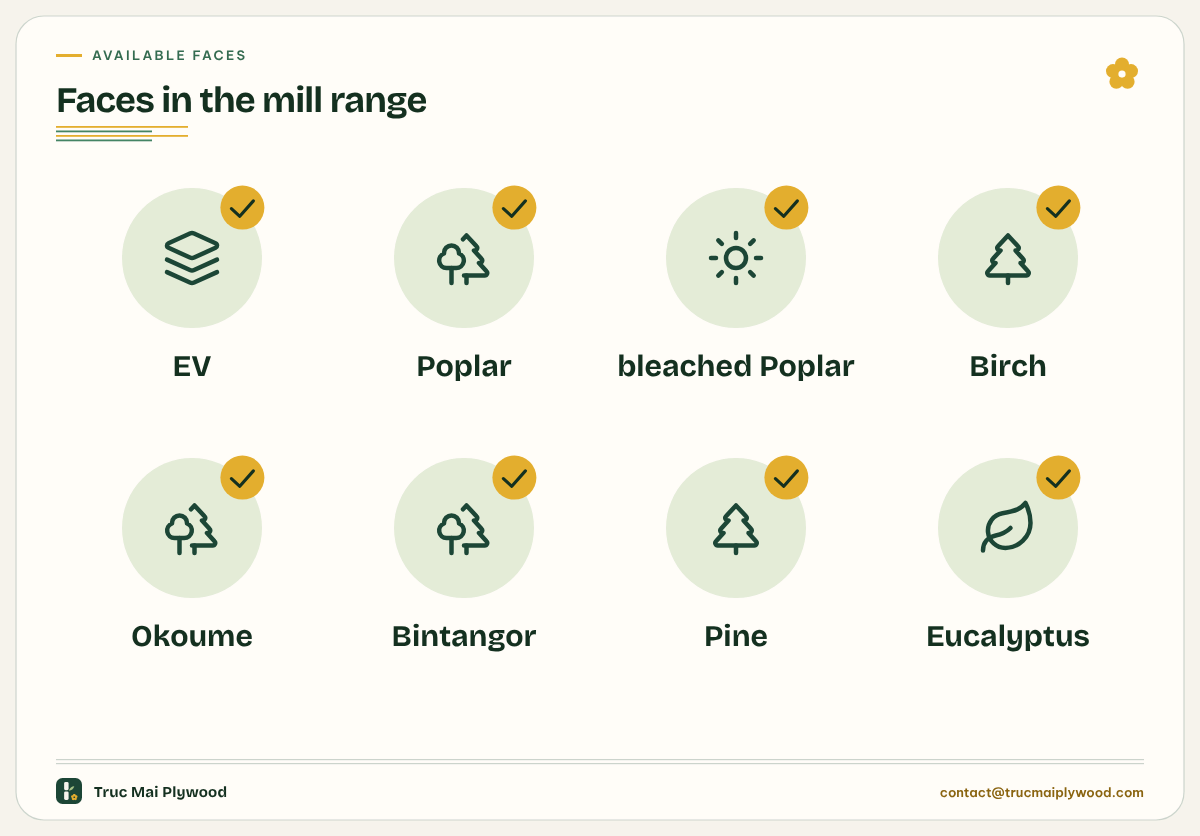
Engineered veneer, poplar, birch, okoume, bintangor, pine, eucalyptus, gurjan and sapele are among Truc Mai’s offered decorative faces. For repeat furniture programmes, the practical advantage is a defined face sample combined with a repeatable core, thickness and sanding specification.
Truc Mai Plywood manufactures furniture and commercial plywood in Ha Hoa, Phu Tho, Vietnam, with annual capacity around 60,000 m³. Its EV face includes reconstituted plantation-poplar veneer; the white-poplar EV option is a practical starting point for buyers seeking a controlled pale appearance. Poplar-faced plywood provides a different face route, and ordering samples explains how to compare physical panels before committing to a run.
A named decorative species requested outside the regular face list should be treated as a specific sourcing requirement, with the approved sample and construction written on the order. A buyer should not assume that every species appearing in a design chart is held as routine factory stock.
How should the face and core be specified separately?
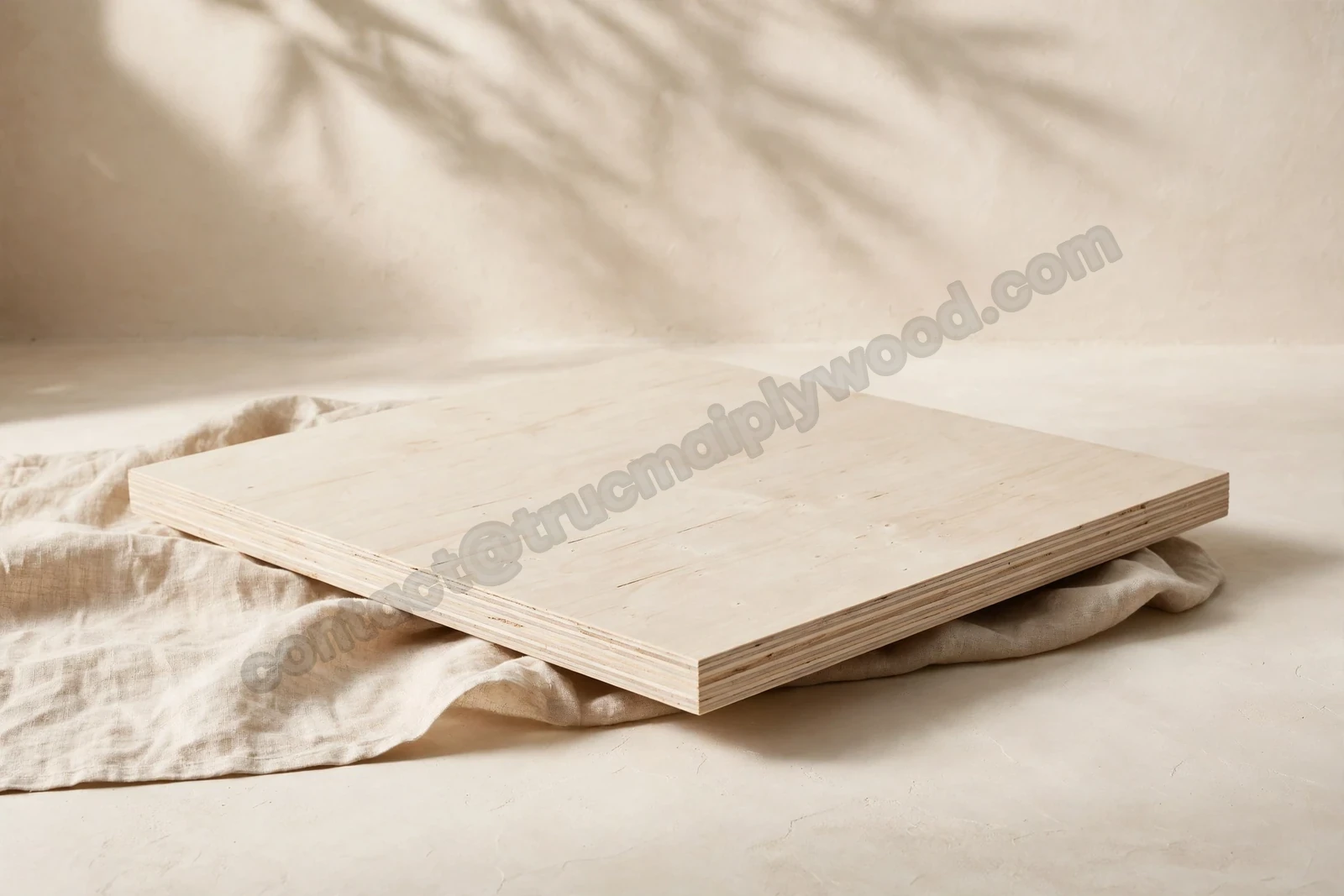
Specify the face species, back face, core species and adhesive system as separate order fields. A teak-looking face does not mean the inner plies are teak. Likewise, a birch-faced sheet from a Vietnamese mill is not automatically an all-birch panel.
For a furniture order, choose a stitched and sanded core where a clean decorative surface is needed. The face and back grade should be agreed as a pair against a physical sample. Core construction influences flatness, edge appearance and the suitability of the panel for machining, while the face controls the visible figure.
The USDA wood bonding reference explains why moisture, surface preparation and adhesive selection matter to bonded wood products. The face and core veneer thickness topic gives a useful specification checklist for separating the decorative layer from the interior build.
What face thickness and panel size belong on the order?
A typical decorative face in Truc Mai’s range is 0.2–0.5 mm, with 0.3 mm commonly used for European furniture orders. This is the face veneer thickness, not the finished plywood thickness. The panel itself is selected separately for the furniture component.
Regular sheet formats include 1220 × 2440 mm, 1220 × 2280 mm and 1250 × 2500 mm. Buyers should specify grain direction relative to the final cut parts: the same face on a full sheet can produce a different appearance when rotated or divided into doors.
Cut-to-size is available with labelled panels. Common layouts include two lengthwise pieces at 610 × 2440 mm, three at 1200 × 800 mm, and four at 1220 × 610 mm; six-piece patterns can also be agreed from a supplied cut list. The mill establishes the actual piece dimensions against the parent sheet and the buyer’s drawing. These are ordering formats, not a calculated yield promise.
How do appearance grades and samples control acceptance?
An approved physical sample is the most useful reference for veneer colour, permitted marks, grain and face matching. A letter grade without a sample can conceal different commercial grading conventions between suppliers.
The ISO 2426-2:2020 hardwood plywood appearance standard uses appearance classes E, I, II, III and IV. Trade terms such as A/B or BB/CC should therefore be defined on the supplier’s own specification sheet rather than assumed to be identical to an ISO class.
For repeat orders, keep one approved reference for the face and another for the back. Record whether knots, streaks, colour movement, filled defects and veneer joins are acceptable on the visible surface. The factory can then assess panels against a written standard rather than an informal description such as premium teak colour.
How should veneer-faced furniture panels be finished?
Choose the finishing process before approving the veneer face. Clear coating exposes natural grain and colour variation; staining changes the apparent shade; opaque finishes place more emphasis on surface smoothness than on the decorative species.
For buyers applying their own coating, a sanded and calibrated panel can be supplied with faces prepared for subsequent finishing. Truc Mai also offers UV-ready faces, meaning the buyer applies the UV coating after receiving the prepared panel. A finishing trial should use the intended coating system, especially where adjacent panels must match under shop lighting.
The adhesive and emission specification is separate from the coating specification. The USDA wood-adhesives chapter distinguishes interior-oriented urea-formaldehyde systems from more moisture-resistant adhesive families. Buyers should identify their interior service conditions before selecting a bond requirement, rather than using the appearance of teak or another face as a proxy for bond performance.
Which documents matter when sourcing veneer-faced plywood?
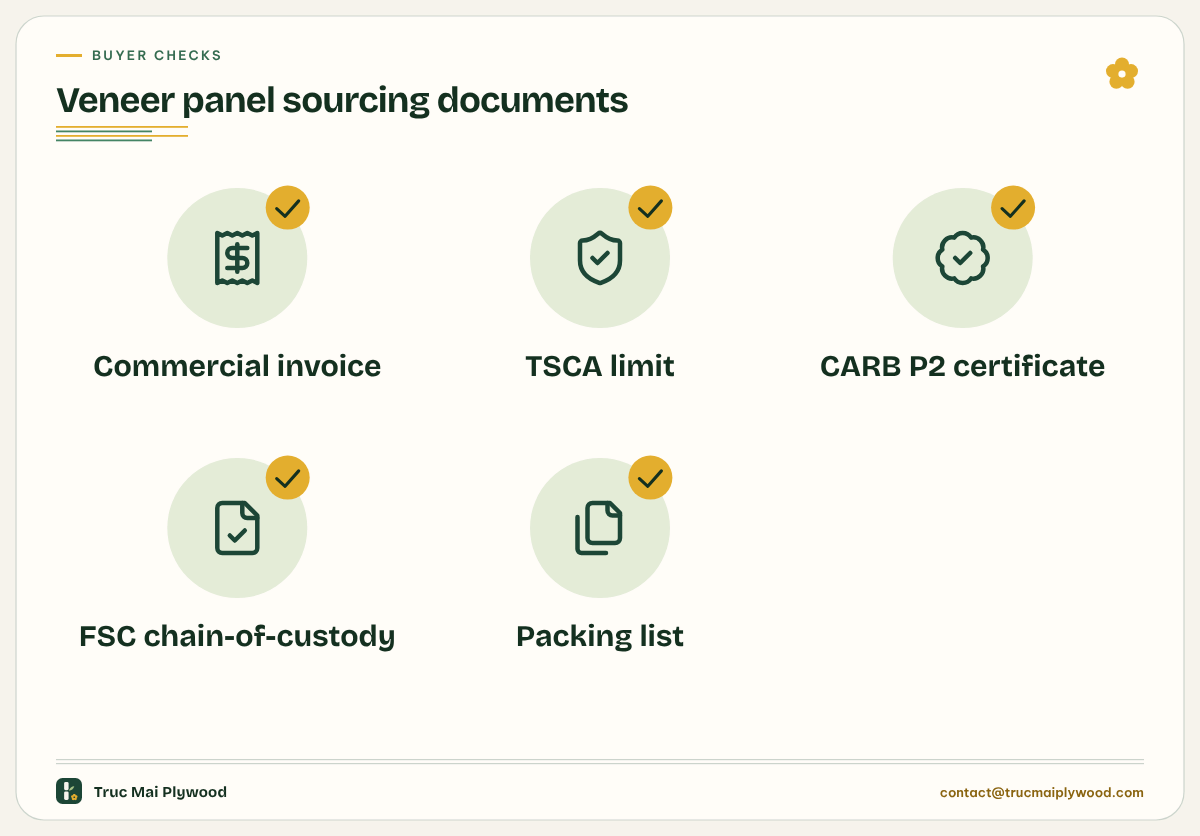
Ask for the product construction sheet, face approval sample and the documents that match the destination market. A decorative species name cannot replace an emission or chain-of-custody record.
For relevant US hardwood plywood with veneer core, 40 CFR Part 770 sets a formaldehyde limit of 0.05 ppm under TSCA Title VI. Truc Mai’s CARB Phase 2 and TSCA Title VI certification covers hardwood plywood with veneer core in the stated 3–25 mm scope, certificate CARB/EPA 26053. The buyer should identify the certified panel configuration on the order.
For eligible FSC 100% products, the mill’s chain-of-custody certificate is SA-COC-014545 and licence code FSC-C196493. The FSC Chain of Custody standard requires the applicable FSC claim and certificate code on sales documentation. Buyers importing into the EU can also request the face veneer origin files alongside core-origin information for their due-diligence work.
How can buyers compare two veneer-panel quotations fairly?
Compare identical panel constructions first, then compare face appearance and supply arrangements. An offer for a natural teak face and another for engineered veneer are different decorative products, even if the sample colours appear similar.
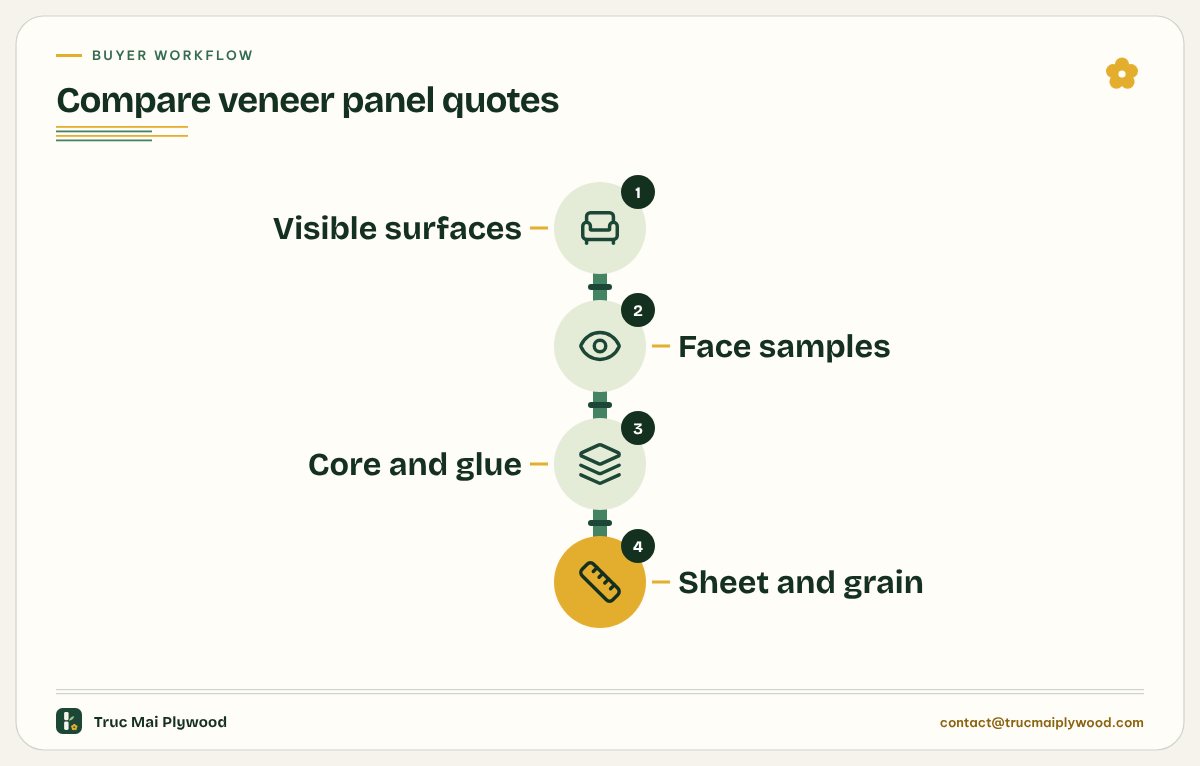
Use this order of review:
- Identify the furniture application and which surfaces remain visible.
- Approve the face species or engineered pattern, matching method and face/back samples.
- Fix the core, panel thickness, adhesive and emission requirement.
- Record sheet dimensions, grain direction, cut list and label positions.
- Compare packing, destination documents and the repeat-order sample procedure.
A practical request includes the number of panel types, the intended finishing process and a drawing for every cut part. The plywood RFQ checklist helps keep those fields together. When several furniture fronts share a finish, ask for a sample set representing the full colour range rather than a single unusually uniform leaf.
What should go into the final veneer-panel RFQ?
Send the application, face and back sample, core, glue and emission requirement, panel dimensions, cut list, packing and quantity. Include the destination port and the grain direction for any visible parts. That gives the mill a buildable specification rather than a request for a species name alone.
For a repeat furniture programme, attach a photograph of the approved finish beside the actual physical sample reference, then identify the face pattern used on the first production order. Where a lighter, more repeatable decorative surface is the aim, start with engineered veneer plywood. For a naturally pale face, compare the relevant species samples before choosing.
Send the specification to contact@trucmaiplywood.com or use the quotation route listed in the buyer’s ordering documents. Ask for a sample set covering the visible face, back and finished edge so the order can be reviewed as a complete furniture panel.
Questions buyers ask
Can teak veneer be used on a plywood panel?
Yes. Teak veneer can be bonded to a suitable plywood substrate when the supplier offers that face and the adhesive and finishing specification fit the intended interior use.
Is teak veneer the same as solid teak?
No. Veneer is a thin wood face bonded to a substrate; solid teak is timber throughout the section. Specify the substrate separately when buying veneered panels.
What does quarter-cut veneer look like?
Quarter-cut veneer commonly shows straighter, more parallel grain than flat-cut material. Appearance still changes with the log and how the leaves are matched.
What is the difference between white veneer and white melamine?
White veneer is a wood-based decorative face, either naturally pale or processed for a pale appearance. White melamine is a decorative surface treatment, not a wood species.
Can walnut veneer be replaced by engineered veneer?
Engineered veneer can be selected for a controlled dark or walnut-like appearance. Approve a physical sample before changing the face named on a furniture order.
Does the face veneer determine plywood strength?
The face contributes to panel construction, but strength and suitability also depend on the core, lay-up, bond and full panel specification. A species name alone is insufficient.
Can I specify different face and back veneers?
Yes. Write the face and back as a pair, with an approved sample for each exposed surface. The back may have a different appearance requirement.
Is engineered veneer a natural wood product?
Engineered veneer is made from real wood that has been processed and reconstituted into a controlled appearance. It is different from printed paper or a plastic decorative film.
Should the buyer approve veneer before production?
Yes. Approve a representative face and back sample with the grain direction, colour range and permitted natural features recorded on the order.
Can veneer-faced plywood be supplied cut to size?
Yes. Truc Mai offers labelled cut-to-size panels from standard sheets, with the cutting pattern and final dimensions agreed against the buyer's parts list.