
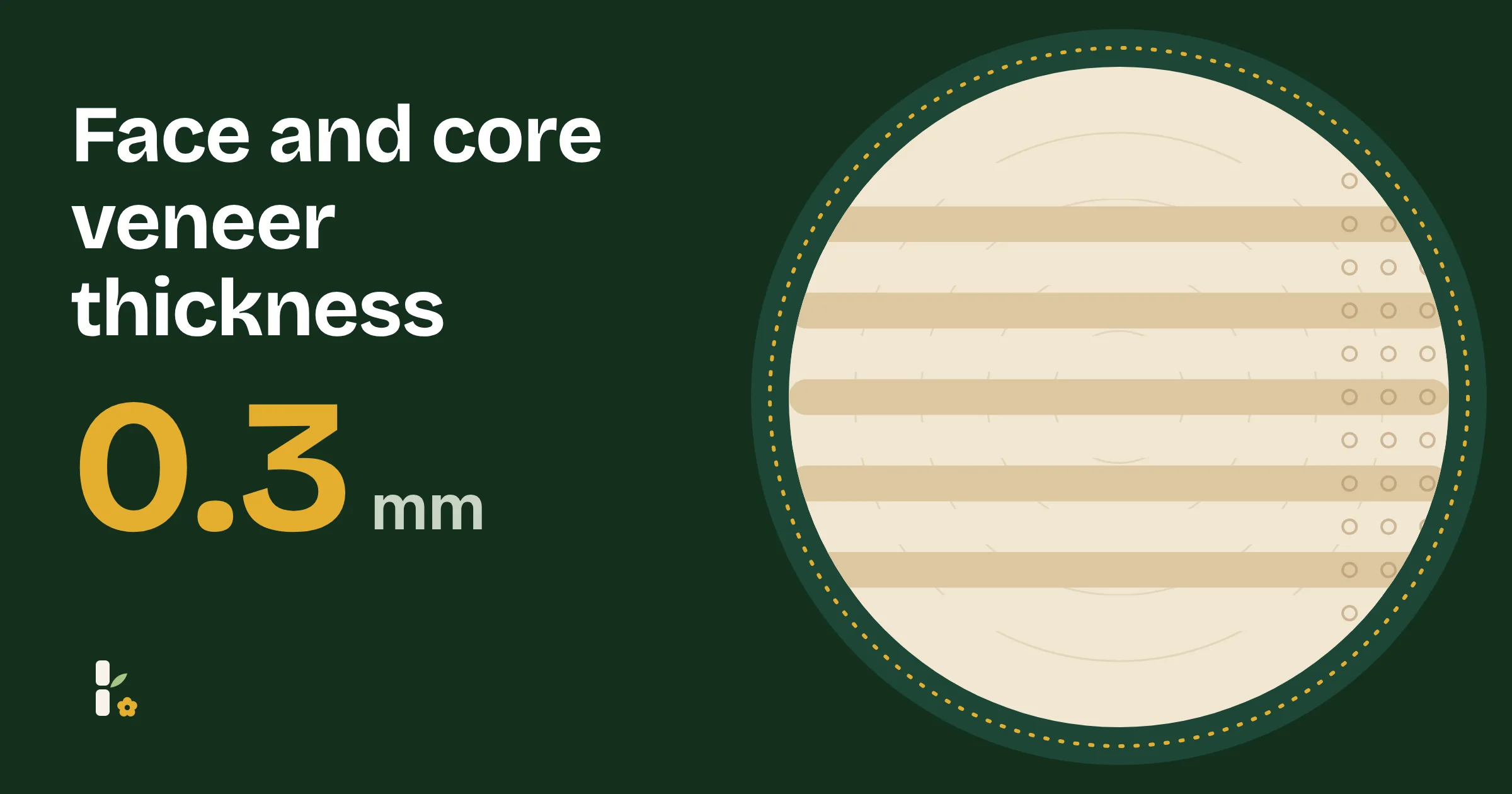
For Truc Mai Plywood, veneer thickness in mm means a decorative face of 0.2–0.5 mm, commonly 0.3 mm for European furniture orders, over core veneers usually 1.4–2.0 mm. Choose the face gauge for finishing and appearance, then specify core construction, sanding, adhesive and finished-panel tolerance separately on the purchase order.
How thick is face veneer on plywood?
Face veneer on this furniture and commercial plywood is 0.2–0.5 mm. This decorative layer provides the specified species, grain and appearance, while inner plies supply most of the panel thickness. Measure the face as a veneer component before lay-up and measure the finished board after gluing, pressing and calibration. Specify both dimensions separately.
A buyer ordering birch-faced, poplar-faced or engineered-veneer plywood should therefore ask for two distinct dimensions: the face gauge and the overall finished thickness. A panel described only as “birch 18 mm” does not tell the buyer how much birch sits on the surface. The birch-faced plywood range illustrates why the face name and the core construction need separate order lines.
The back is another face layer, with its own appearance grade. For a visible cabinet door, both sides can matter. For a concealed cabinet back or drawer component, the back can have a different grade agreed against the approved sample. Specify the face/back pair before asking the mill to match colour and grain.
Which veneer thickness in mm belongs on the order?
Put the face gauge, core veneer gauge and finished panel thickness on separate lines. A specification that says “0.3 mm face” describes one constituent layer; it does not replace the overall sheet gauge or the thickness tolerance. This separation matters when two quotations use the same panel name but different inner builds.
| Specification line | What it describes | Truc Mai order reference | Buyer decision |
|---|---|---|---|
| Decorative face | Visible wood layer | 0.2–0.5 mm | Appearance and finishing allowance |
| Inner veneer | Individual core layer | Usually 1.4–2.0 mm | Lay-up and core build |
| Thin-panel exception | Inner veneer for a 4 mm board | 1.3 mm | Thin-stock availability |
| Finished panel | Complete pressed board | 3–40 mm range | Fit to cabinet or machining drawing |
| Sanded furniture tolerance | Finished thickness | ±0.3 mm | Fit and calibration |
| Commercial tolerance | Finished thickness | ±0.5 mm | General commercial parts |
The order should name the veneer species, not merely “natural wood”. A pale engineered face, a bleached poplar face and a birch face can look similar in a small photograph while giving different grain, colour and cutting behaviour. Use a labelled physical sample and a written specification together.
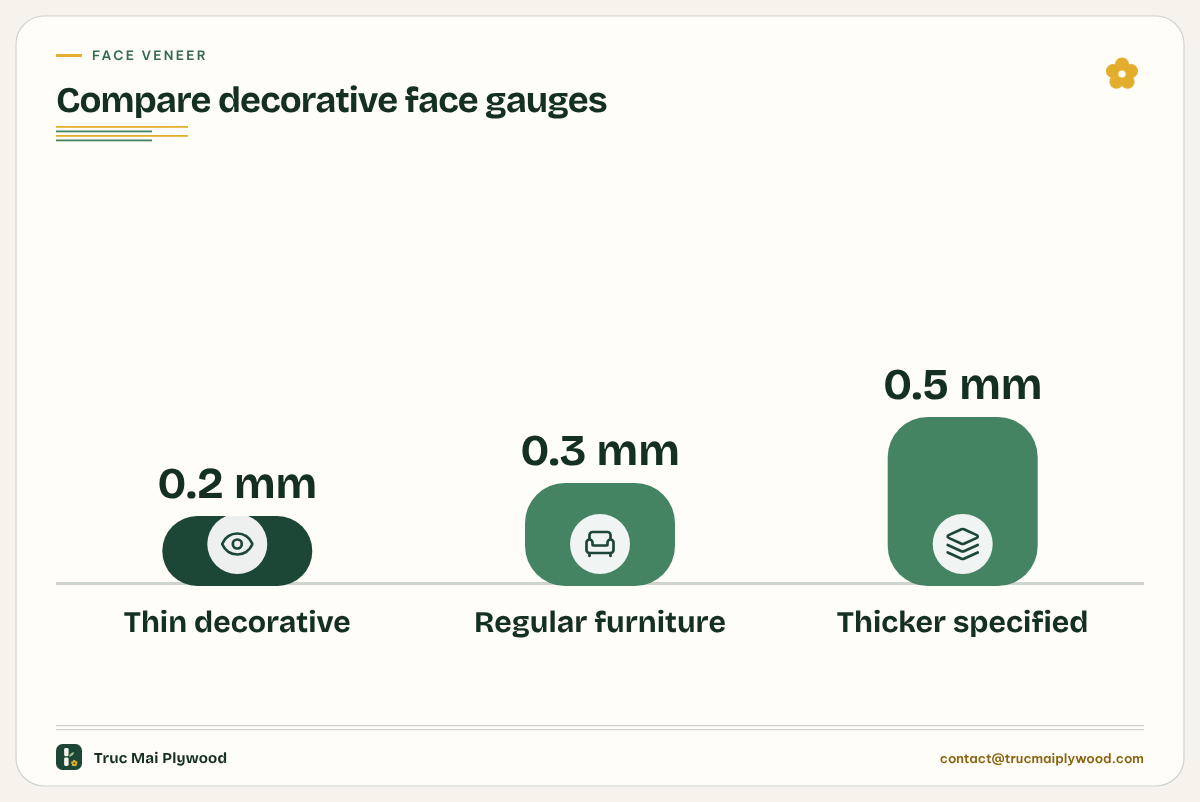
0.2 vs 0.3 vs 0.5 mm face veneer: which should buyers choose?
Choose 0.2 mm for a light decorative skin, 0.3 mm for the usual European furniture face, or 0.5 mm when the specification calls for a thicker wood surface. Those are face gauges, not promises about how much material a downstream sander can remove. Sanding allowance must be agreed for the actual finished panel and finish route.
| Face gauge | Typical purchasing reason | Finishing discussion | Inspection priority |
|---|---|---|---|
| 0.2 mm | Thin decorative coverage | Minimise stock removal | Local thin spots and show-through |
| 0.3 mm | Regular furniture/interior face | Controlled light preparation | Uniform sanding and colour |
| 0.5 mm | More face material in the specified build | Agree downstream sanding trial | Face integrity and surface consistency |
A thicker face uses more decorative wood, but face quality is not measured by gauge alone. Open joints, torn grain, stains and visible core marks are separate acceptance issues. A clean thin face on a well-prepared core can produce a better finished surface than a thicker face over a poorly joined core.
For repeat cabinet programmes, the most useful comparison is a finished sample from each gauge, using the buyer’s own stain or coating. Record which face was approved, how it was prepared and which surface defects were rejected. That sample becomes the production reference rather than a vague request for “thick veneer”.
What is core veneer thickness?
Core veneer thickness is usually 1.4–2.0 mm per inner wood ply in this mill’s regular plywood construction. Core veneer is the material inside the decorative faces, laid with alternating grain directions in a conventional plywood build. The species, jointing and layer arrangement determine how the finished edge looks and how evenly the panel can be calibrated.
A core may use Styrax, Eucalyptus, Acacia, Pine or an agreed combination. Those names identify inner wood, not the decorative face. A birch-faced board can therefore have a Styrax core; an engineered-veneer board can have an Eucalyptus core. The face and core are chosen together for the order’s appearance, handling and weight priorities.
The nominal thickness of each loose veneer does not add up mechanically to the exact final board gauge. Pressing compresses the lay-up, glue lines occupy space and sanding removes material. Ask for the finished board thickness and tolerance as the acceptance measure, with core veneer gauge recorded as a construction detail.
How does ply count change the veneer build?
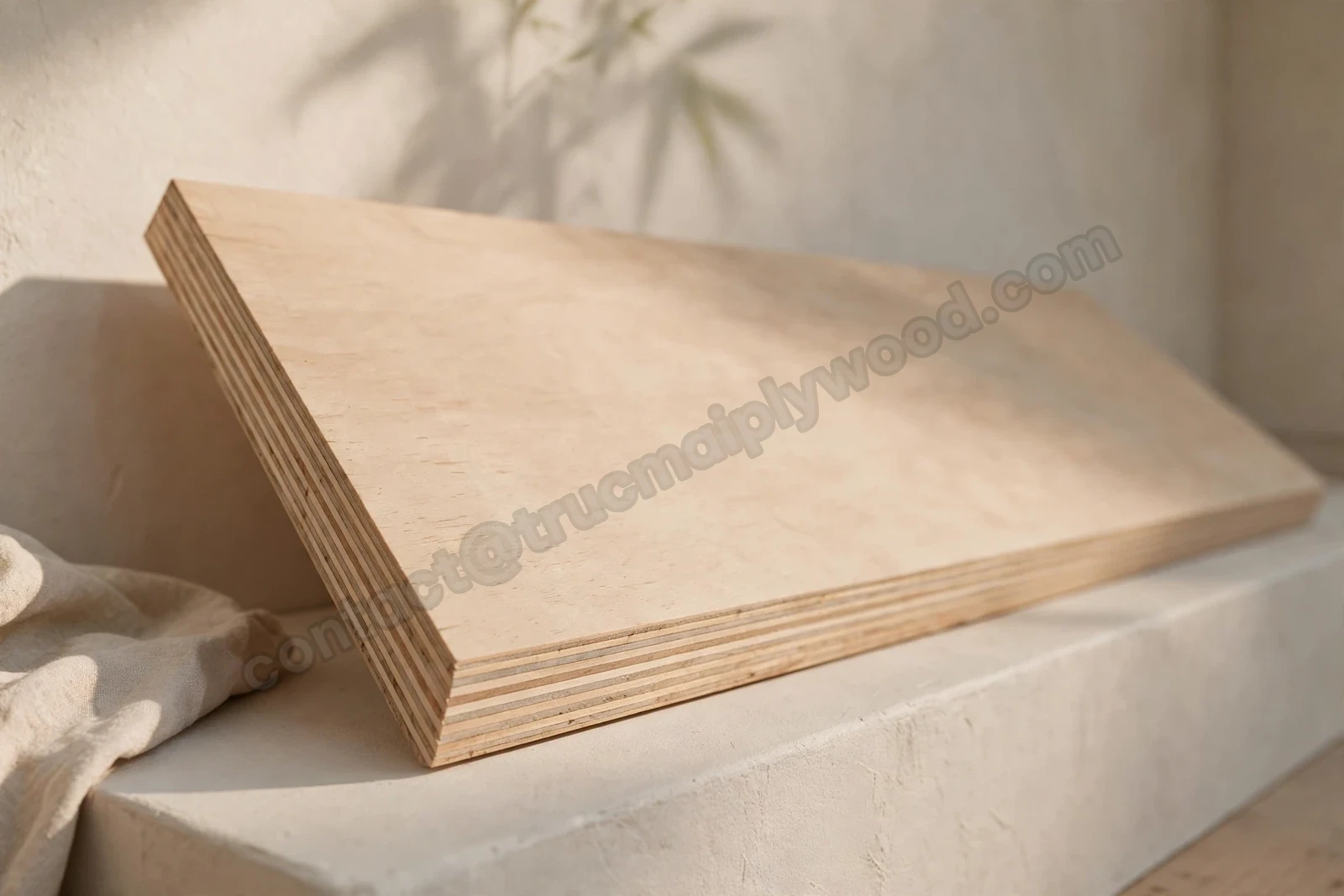
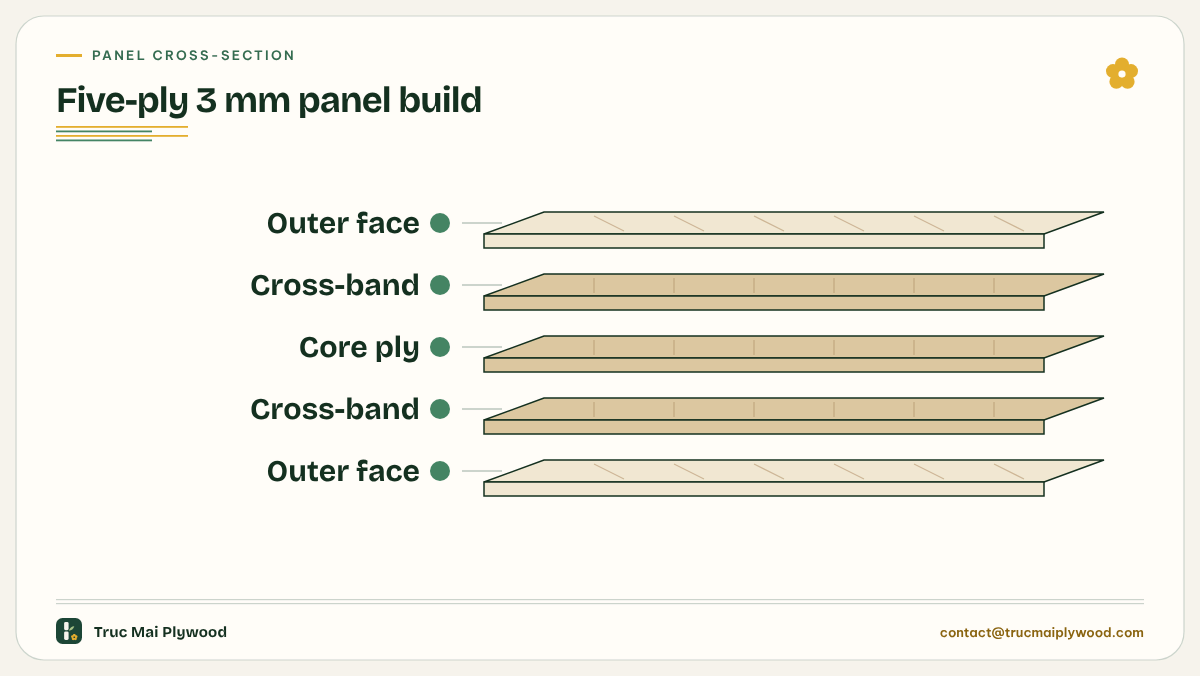
An 18 mm furniture panel commonly has 11–13 plies, most often 11, while the thin 3–5 mm range uses five plies. The count is the number of wood layers, including the outer faces. A thicker board does not automatically have better quality merely because its ply count is higher.
In a 3 mm panel, the five-ply arrangement comprises one core ply, two cross-bands and two outer faces. In the 4 and 5 mm constructions, three core plies sit between the faces. The 6 mm build is set per order. The thin plywood panel range is relevant when a buyer needs cabinet backs, drawer bottoms or other light components.
Compare ply count together with core joints. A high count of poorly joined inner veneers can leave local voids and inconsistent edges. Conversely, a carefully stitched core can make a regular furniture panel easier to machine and finish. Ask for an edge sample that shows both the number and continuity of the plies.
Why does core stitching matter beneath a thin face?
Core stitching controls how tightly adjacent inner veneer strips meet beneath the face. On furniture panels, the outer inner layers are commonly stitched across and along the sheet; stitching of all inner plies can be specified. The aim is a more continuous foundation for the decorative surface.
Loose-laid or jointed cores are used in commercial constructions where the approved specification allows them. The buyer should not infer the joining method from the word “hardwood” or the advertised face species. A stitched core is a separate build choice, and the visible result is checked on the panel edge and the finished face.
For an order with thin decorative veneer, inspect any surface ridges that follow inner joints. Look across the board in raking light, then examine a trimmed edge. This catches a mismatch between the face requirement and the core build before the buyer runs a coating or laminating line.
How much sanding can a decorative veneer face take?
A 0.2 mm face calls for very light surface preparation, while a thicker specified face offers more material for a controlled finishing operation. Set the sanding-removal allowance through a trial on the specified species and board. The correct test is on a representative panel made to the agreed face gauge and calibration route.
The mill supplies sanded and calibrated faces, with polishing available on request. That means the buyer should describe the next operation: direct staining, clear coating, painting, a UV coating line or lamination. “UV-ready” describes surface preparation for the customer’s coating process; it is not a statement that a UV finish has already been applied.
A practical receiving trial checks the surface after a light pass with the buyer’s normal abrasive sequence. Inspect corners and high spots, where thin faces are most vulnerable. The cabinet-grade plywood specification helps separate surface appearance from core and dimensional requirements.
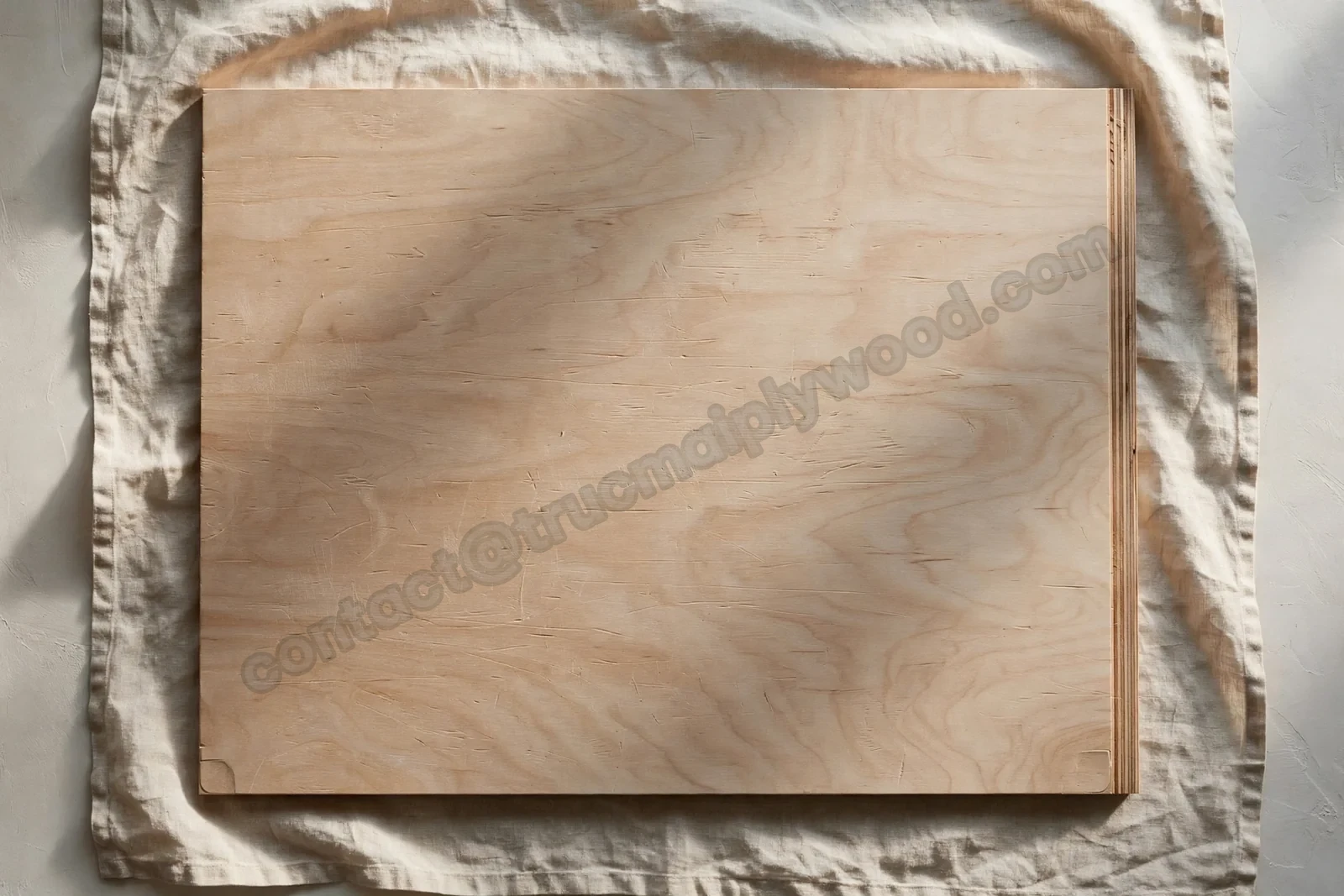
What does veneer thickness mean for paint, stain and clear finish?
For a clear or stained wood finish, the visible face’s species, colour and grain matter as much as its gauge. For opaque paint, surface smoothness and the absence of underlying joint marks take priority. The buyer should decide the finish before choosing between a natural face, an engineered face and a separate overlay.
The US Forest Service’s diagnostic report on veneered furniture and cabinetry identifies moisture changes as a major cause of surface distortion, including veneer buckling and finish cracking. That makes conditioning, balanced construction and the finishing environment part of the discussion alongside thickness.
A pale face intended for paint should be inspected for filled defects, rough fibres and glue marks. A clear-finished face should be assessed for grain matching and shade across several sheets, not a single sample square. The face-colour selection article covers the appearance decision that thickness alone cannot settle.
How do veneer species and engineered faces change the choice?
Engineered veneer gives a controlled repeatable grain appearance, while natural sliced faces retain the variation of the individual wood. The face selection includes EV, poplar or bleached poplar, birch, okoume, bintangor, pine, eucalyptus, gurjan and sapele. The buyer can specify the face separately from the Vietnamese core.
The EV face used here is reconstituted plantation poplar veneer, offered in 0.3 or 0.4 mm sheets. For a repeated cabinet programme, that controlled face pattern can make matching across runs easier. Natural faces may be selected when the brief calls for characteristic figure or species-specific grain.
The engineered veneer plywood product page shows the relevant panel category. Ask for the actual sample to be finished with the intended stain, lacquer or coating. A colour description such as “white poplar” is a starting point, while the approved sample defines what the order should look like.
How do veneer backing systems differ from plywood faces?
A paper-backed veneer sheet is a separate surface material, while a factory-pressed plywood face is bonded as part of the panel lay-up. Backed veneer is often sold by its backing specification and overall sheet construction. Those measurements should not be substituted for the wood face gauge on a plywood purchase order.
For instance, a buyer may receive a sample of decorative veneer intended for bonding to an existing substrate. Its backing helps with handling and application, but the resulting component is different from a factory-built plywood board with cross-laid inner veneers. Specify whether the quotation is for loose veneer, backed veneer or a finished plywood panel.
When comparing samples, inspect the wood surface rather than treating the backing as extra sanding allowance. If the buyer wants ready-to-machine panels, request the finished board specification and a representative edge section. The real veneer sheets topic is a useful companion to the finished-panel choice.
How are veneer thickness and plywood thickness measured?
Measure the loose face veneer and the finished plywood as different items. A loose veneer gauge is checked before lay-up; the pressed panel thickness is checked after the sanding and calibration steps. Measuring only the total board thickness cannot reveal the face thickness hidden beneath the surface.
At incoming inspection, the buyer can request a loose veneer reference and an edge section from the approved build. Use a suitable micrometer for the loose veneer without crushing the wood, and check finished boards at agreed positions with calibrated equipment. Record the nominal target and tolerance rather than relying on one measurement at one corner.
For dimensional context, the official NIST PS 1-22 structural plywood standard distinguishes veneer construction from panel thickness and contains its own grade-specific requirements. It concerns structural plywood, so its veneer minima are not a substitute for a decorative furniture-panel specification. The buyer’s approved build remains the reference for this product.
What finished-panel tolerance should the buyer specify?
Write ±0.3 mm for sanded, calibrated furniture panels or ±0.5 mm for regular commercial panels, with the agreed grade and measuring method on the order. Packing-grade panels use their own wider tolerance. Thickness tolerance describes the complete board, not the face veneer by itself.
Tolerance is especially relevant when a panel passes through cabinet nesting, edge banding or a close-fitting slot. A nominal board can meet its appearance sample yet create machining problems if thickness moves beyond the drawing’s allowance. Receiving inspection should therefore check both surface and dimensions.
For buyers using European drawings, EN 315’s published preview defines dimensional measurements and tolerances for plywood. A negotiated factory tolerance and a standard’s default tolerance are different specification routes. Put the intended acceptance requirement in writing before production.
How does face gauge affect panel appearance and defects?
The face gauge affects how readily core marks can show through, but the finish quality also depends on veneer preparation, glue application and core smoothness. A buyer should assess these as separate checks instead of treating thickness as a single quality score.
Inspect the face under both direct and angled light. Check for splits, pinholes, overlaps, glue stains and uneven colour. Then turn the sheet and inspect the back. Finally examine the edge for open core joints. A decorative surface can look acceptable at arm’s length while a defect becomes obvious after clear coating.
The US Forest Service wood-products handbook discusses panel manufacture and finishing as related but distinct processes. A useful mill sample should represent the actual proposed lay-up and surface preparation. Record any rejected feature in the sample approval, so inspection at loading uses the same criteria.
Can veneer edge banding use the same thickness as the face?
Yes, matching the face appearance is possible, but edge banding is a separate purchased component with its own construction, thickness and adhesive. A veneer-faced plywood board does not automatically arrive with finished edges.
The visible edge of a cabinet part can show the plywood layers, be covered by a matching wood strip or receive another specified edge finish. A matching face and banding colour is often more important visually than identical raw gauges. For clear-coated furniture, approve the edge sample alongside the face sample under the same lighting.
When requesting factory-cut parts, identify which edges will remain exposed and which will be covered downstream. A cut list without edge orientation can cause confusion on parts with directional grain. Mark the face side and grain direction on the drawing, and include the banding operation in the customer’s downstream process plan.
What records help repeat the same veneer specification?
Keep the approved sample, veneer gauge and core construction together with the order revision. Reordering by a short product nickname can change the build if a buyer later changes the face, finish or machining route without updating the specification.
A practical record includes the face species and appearance grade, the back grade, the loose face gauge, inner species, jointing method, finished thickness tolerance, surface preparation and pack labels. The mill can then compare incoming veneer and finished boards with the same agreed criteria on each repeat run.
Where the order uses certified material, keep the commercial documents and product claim with the relevant lot. The FSC licence verification article explains how to check certificate identity, while face veneer origin files covers the documentation chain for imported decorative faces. Those records answer different questions from the dimensional inspection.
Does face veneer thickness determine adhesive or emission grade?
No. Face thickness, adhesive type and formaldehyde emission are different specification lines. The regular interior build uses UF glue at E0 emission in the mill’s terminology; a buyer should also state the emission requirement and the evidence required for the destination market.
For US-bound hardwood plywood with veneer core, 40 CFR Part 770 sets the TSCA Title VI formaldehyde limit at 0.05 ppm under its referenced chamber method. The brand’s CARB P2 and TSCA Title VI certification covers the specified veneer-core hardwood plywood range of 3–25 mm, not every thickness offered in the catalogue.
The same regulation distinguishes veneer core from composite core. For purchasing, list the panel construction, adhesive and emission requirement separately, then ask for the certificate scope matching the proposed board. A face species or decorative gauge is not an emission test.
What should a buyer inspect before approving a container?
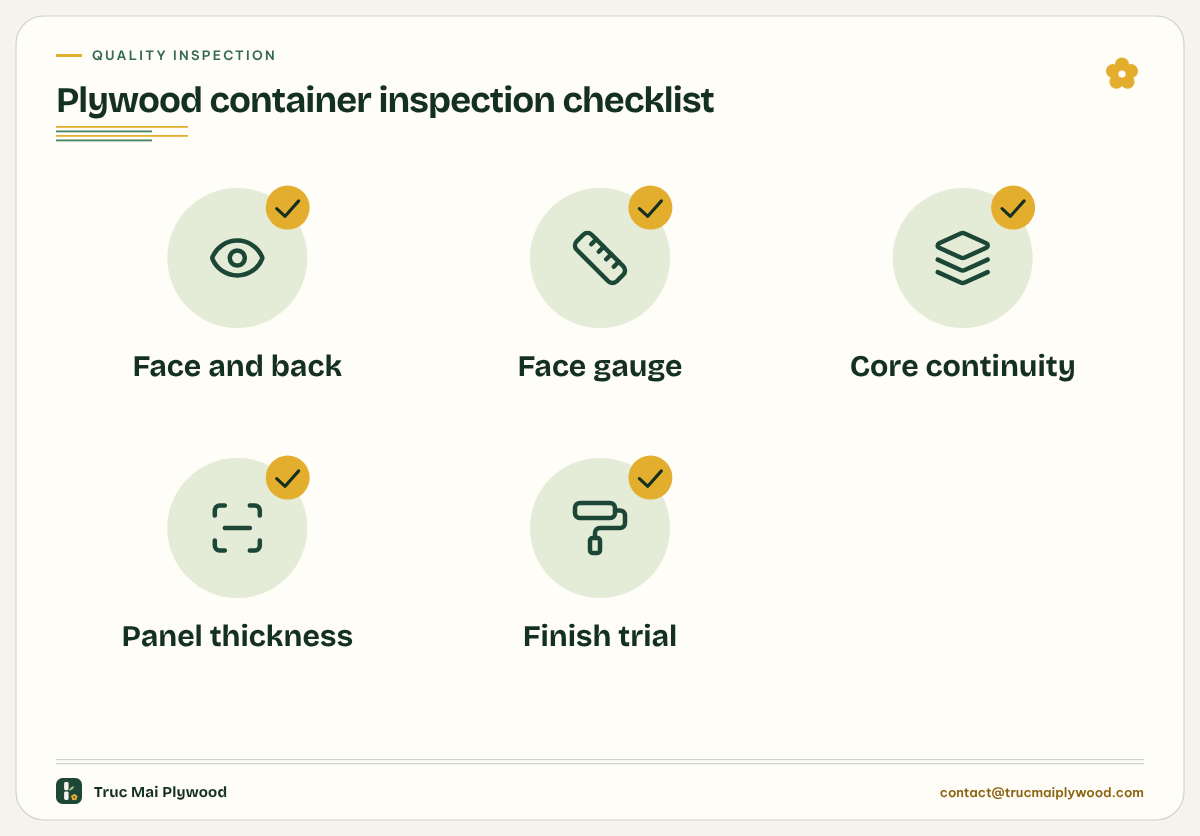
Approve a face sample, a cut edge and the finished thickness before repeating a container order. A sample of the decorative face alone misses the core construction, while an edge offcut alone misses colour and finish behaviour.
A practical inspection sequence is:
- Compare the face and back against the approved species and grade pair.
- Check the loose veneer reference or documented face gauge.
- Inspect the cut edge for core joints, gaps and layer continuity.
- Measure finished-panel thickness at the agreed locations.
- Trial the intended coating or machining process on representative pieces.
- Match labels and pack identification to the order specification.
The same sequence is useful for the first order and for later repeat production. Store the signed-off sample description with the purchase order. For an 18 mm plywood specification, record both ply construction and finished gauge so the next production run is compared on the same basis.
How should veneer thickness appear in a plywood RFQ?
Write one order line for the face, one for the core and one for the finished panel, then add the finish, adhesive, packing and quantity. This gives the mill enough detail to quote the intended construction rather than a broad product name.
A workable request reads: “Furniture cabinet panels, engineered poplar veneer face, specified face gauge, Styrax core with stitched outer plies, UF glue at E0 emission, sanded and calibrated, finished sheet size 1220 × 2440 mm, approved face/back grade pair, labelled packs, one 40HC, FOB Hai Phong.” The face gauge and finish trial are chosen from the earlier comparison, then written into the final order.
For cut-to-size parts, send a drawing and a label list. Standard sheets can be split lengthwise into two 610 × 2440 mm parts, into three 1200 × 800 mm parts, into four 1220 × 610 mm parts, or into six agreed pieces. The exact piece layout is set from the source sheet and cutting schedule. The RFQ writing checklist gives the full specification order. Send application, core, glue/emission, face, size, packing, quantity and destination to the quotation desk.
Questions buyers ask
Does the back veneer need the same appearance grade as the face?
No. Specify face and back grades as a pair, with the visible face selected for appearance and the back selected for its actual use.
Can a buyer order a birch face on a Vietnamese core?
Yes. Birch-faced plywood can use a Vietnamese Styrax, Acacia, Eucalyptus or Pine core; birch describes the face, not every ply.
Is engineered veneer the same as printed paper?
No. Engineered veneer is real wood reconstructed for a controlled grain appearance. Printed paper is a separate decorative overlay.
Can I specify different face and back species?
Yes. State the face species and back species separately, and approve the sample before production.
Will a thicker face remove every visible core joint?
No. Core preparation, joining and calibration affect telegraphing as well as face thickness.
Can I request a polished face?
Yes. Sanded and calibrated faces are standard, with polishing available on request.
Is a veneer face suitable beneath a melamine overlay?
The overlay specification should be selected separately from a decorative wood veneer face. State the finished surface you intend to receive.
What evidence accompanies FSC veneer?
For an eligible FSC 100% product, the sales documents carry the seller’s certificate code and the product claim.
Can panels arrive labelled after cutting?
Yes. Send the cutting schedule and label identifiers so pieces can be cut and grouped for your production line.
Does veneer thickness specify formaldehyde emission?
No. The adhesive and emission requirement are separate order lines, supported by the applicable certificate or test evidence.