
A project panel is a convenient-size board sold for general jobs; the name alone says little about its plywood construction. Utility plywood, ordinary plywood and Far Eastern ply are similarly broad trade descriptions. Truc Mai Plywood supplies commercial panels by a written face, core, adhesive, thickness and cutting specification so distributors can reorder the same build.

What does project panel mean in the plywood trade?
A project panel is a board sold in a convenient size for a defined task, rather than necessarily a distinct plywood grade. In Australian distribution, the term can cover plywood alongside MDF, hardboard, melamine-faced boards and other sheet materials. The useful question for an importer is which plywood construction sits behind the retail category.
For a distributor filling repeat orders, the label can describe a shelf-ready cut piece, a general-purpose plywood blank or a small-format panel for joinery. These are different commercial offers. A board for painted storage compartments needs a different face description from one intended to show natural timber grain. The purchase order should distinguish the end use before specifying the sheet.
A mill can make commercial plywood as full sheets or cut pieces. The same basic panel can enter several retail categories after cutting, packing and labelling. That makes the production specification more useful than the shelf name when comparing suppliers.
Are utility plywood, ordinary plywood and Far Eastern ply the same product?
No. These names overlap in trade use, but none supplies a complete technical specification. Utility plywood usually signals a general-purpose, cost-conscious selection. Ordinary plywood is another broad description; Far Eastern plywood often describes an Asian-sourced commercial hardwood panel. None fixes veneer species, glue, face appearance or dimensional tolerance.
| Name on an enquiry | What it communicates | What the buyer still specifies |
|---|---|---|
| Project panel | Convenient format or application category | Material, final size, finish and packaging |
| Utility plywood | General-purpose commercial positioning | Core build, faces, bond and tolerance |
| Ordinary plywood | Broad plywood product description | Species, grade, sanding and intended use |
| Far Eastern plywood | Regional trade description | Actual origin, veneer species and construction |
| General purpose plywood | Intended versatility | Conditions of use, adhesive and acceptance criteria |
| 18mm Far Eastern plywood | Nominal thickness plus trade name | Measured thickness range and all other construction lines |
A name that works on a warehouse price ticket may be too loose for factory production. Translate the label into the same fields each time. This also avoids comparing an attractive sanded panel with an unsanded utility board as though they were identical.
Which applications suit a commercial plywood project panel?
Dry interior furniture components, cabinet backs, drawer parts, display fittings, shopfitting and packaging are practical applications for commercial plywood project panels. The required finish changes with the location of the panel in the finished item. A concealed partition can accept a different face from a visible shop display.
For cabinet carcasses, a consistent thickness and flat surface matter because panels must fit repeated cutting and assembly operations. For display work, colour and grain consistency may matter more than the hidden core appearance. Packing panels put more emphasis on handling, assembly and the agreed face quality.
The best plywood for interiors discussion helps separate visible interior work from concealed parts. The cabinet-grade plywood specification goes further into appearance and assembly requirements. Project-panel language is useful for merchandising, but these application distinctions belong in the factory instruction.
Which face veneer should be written on the order?
Name the face species and the back appearance separately. Poplar, bleached poplar, engineered veneer (EV), birch, okoume, bintangor, pine, eucalyptus, gurjan and sapele are face options in the Truc Mai commercial and interior range. A birch-faced sheet uses a birch veneer on a Vietnamese core; the face name does not describe the entire plywood thickness.
A buyer selling pale, paint-ready panels might select bleached poplar or an EV face. A visible timber-grain product might use bintangor or okoume, with appearance agreed against a sample. A decorative face should be paired with a specified back grade, because one good-looking face alone leaves the reverse side undefined.
The bintangor-faced plywood product page shows one such face family. The bleached poplar plywood page is another useful reference for pale faces. On the order, identify the veneer by name, the face/back grade pair and the approved sample code rather than relying on a photograph alone.
How does the core change a utility panel?
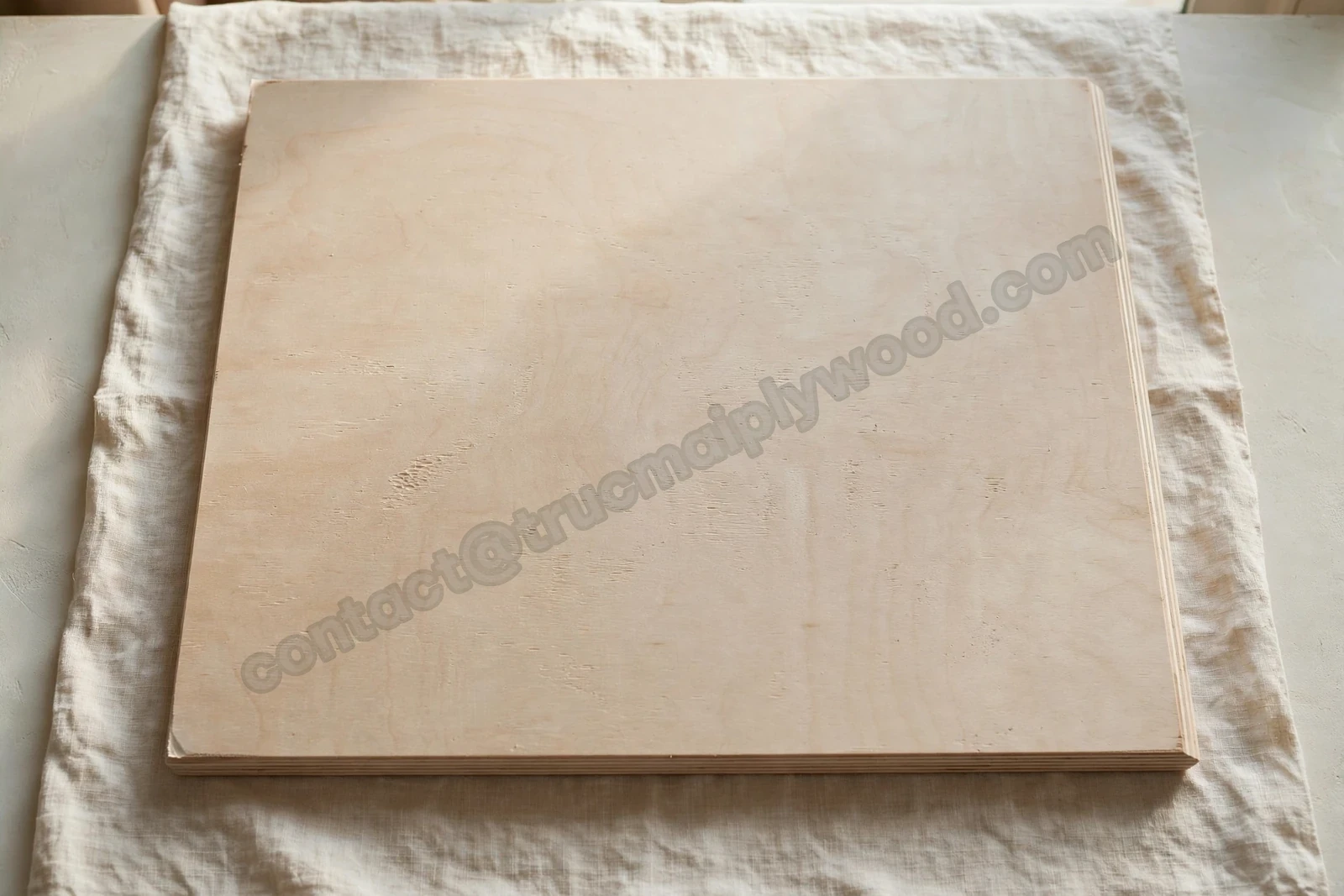
The core changes the sheet’s weight, internal appearance and production cost. Styrax, eucalyptus, acacia, pine and mixed-species constructions are available. The buyer should state both the species and the way the core veneers are joined, since a loosely laid commercial core is different from a stitched furniture core.
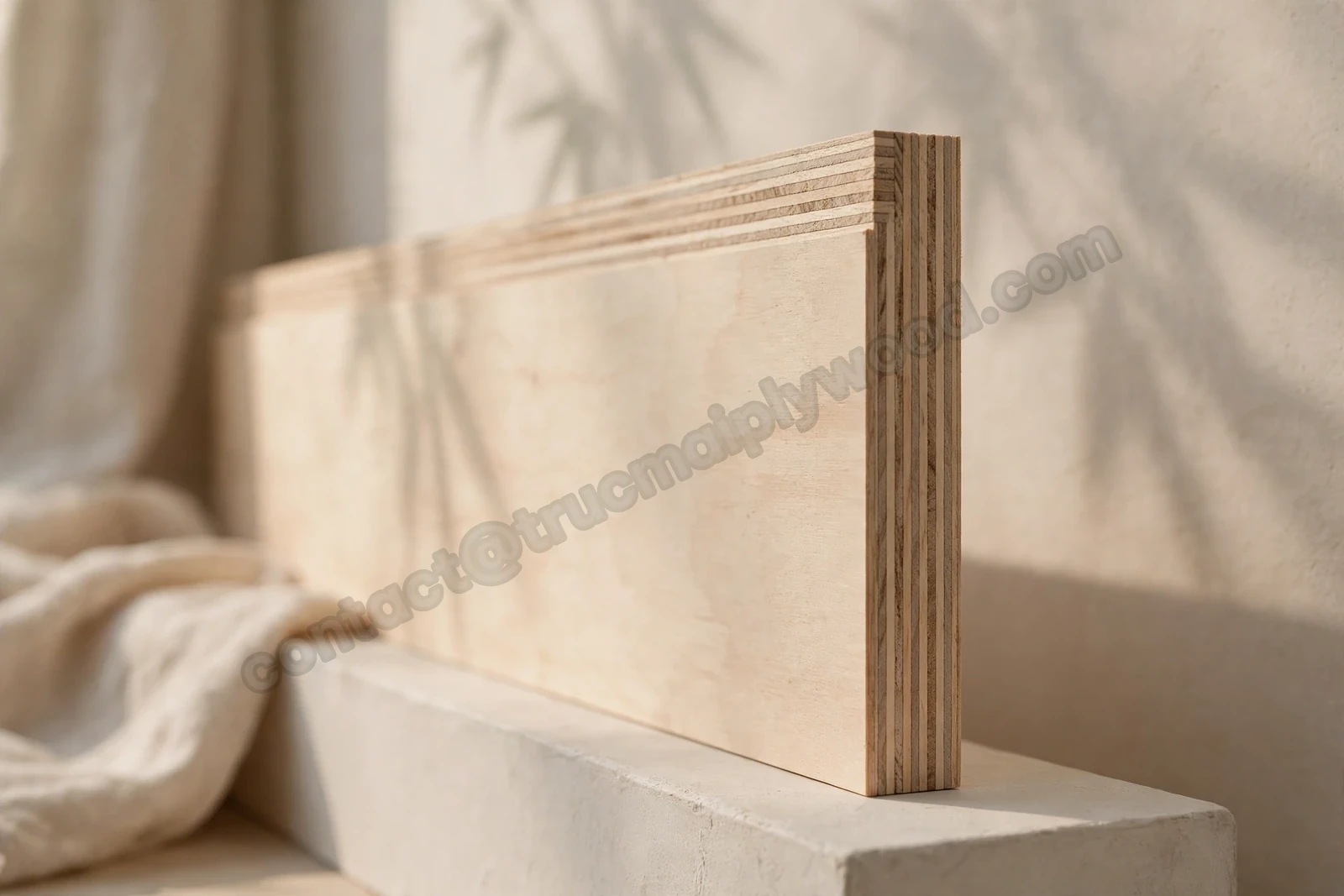
For interior furniture panels, an A-grade stitched core and sanded faces are the usual build. Commercial panels commonly use an AB core with loose-laid or jointed veneers and a lighter surface preparation. The difference can be seen at a cut edge and in how consistently a panel machines across its width.
Core stitching can run along and across the sheet. The outer 2–4 core plies are commonly stitched, with further stitching specified for the order. If the distributor sells exposed-edge pieces, the sample should show the edge as well as the broad face. A hidden core cannot be judged from a front-facing catalogue image.
What thickness and sheet sizes can be ordered?
The standard Truc Mai range runs from 3–40 mm, with regular full-sheet formats of 1220 × 2440, 1220 × 2280 and 1250 × 2500 mm. The shorter format can suit furniture-part programmes; the European format can match buyers’ cutting layouts. Specify the exact nominal thickness and the intended finish.
Thickness tolerance is written on the order. Sanded and calibrated furniture panels can be specified at ±0.3 mm; commercial panels commonly use ±0.5 mm. Length and width tolerance is ±2 mm. These numbers are order parameters, not properties conferred by the phrase general purpose plywood.
The 18 mm plywood specification is useful when comparing common cabinet-stock enquiries. For a shorter furniture format, see 1220 × 2280 mm panels. The best size is the one that fits the customer’s cutting list and packing method, not simply the most familiar trade dimension.
Can project panels be cut and labelled at the mill?
Yes. Cut-to-size plywood can be produced from standard sheets and packed as labelled pieces. Common arrangements include lengthwise halves of 610 × 2440 mm, thirds of 1200 × 800 mm, quarters of 1220 × 610 mm and six-piece layouts. Other cut dimensions can be planned from a 1250 × 2500 mm sheet under the agreed cut list.
The mill and buyer agree the final piece dimensions by email against a drawing. The cut list should show orientation, finished dimensions, face direction, labels and grouping per pack. That matters where the veneer grain is visible: rotating a cut can change the appearance of the finished component even when its dimensions are correct.
For a repeat distributor programme, identify each piece by stock code and the master sheet from which it is cut. The cut-to-size plywood panels page describes this service. The buyer can then replenish a labelled assortment without asking the warehouse to interpret a vague phrase such as small project board.
How should face grades and repairs be agreed?
Use a face/back grade pair and an approved sample. Trade descriptions such as A/B, B/BB or BB/CC are supplier grading language, while ISO 2426-2:2020 identifies hardwood plywood surface-appearance classes E, I, II, III and IV. A trade letter pair should therefore be backed by a written defect schedule.
The acceptance sample should show permissible knots, patches, colour variation, sanding marks and repairs on both sides. For clear finishing, compare pieces under the same lighting. For painted or laminated work, surface preparation and soundness can take priority over natural grain matching.
The Vietnamese plywood quality by grade page offers more detail on how suppliers describe grades. An inspector can then compare the shipped faces with the approved sample rather than making a subjective judgement from the marketing name.
Which adhesive and emission lines belong in the specification?
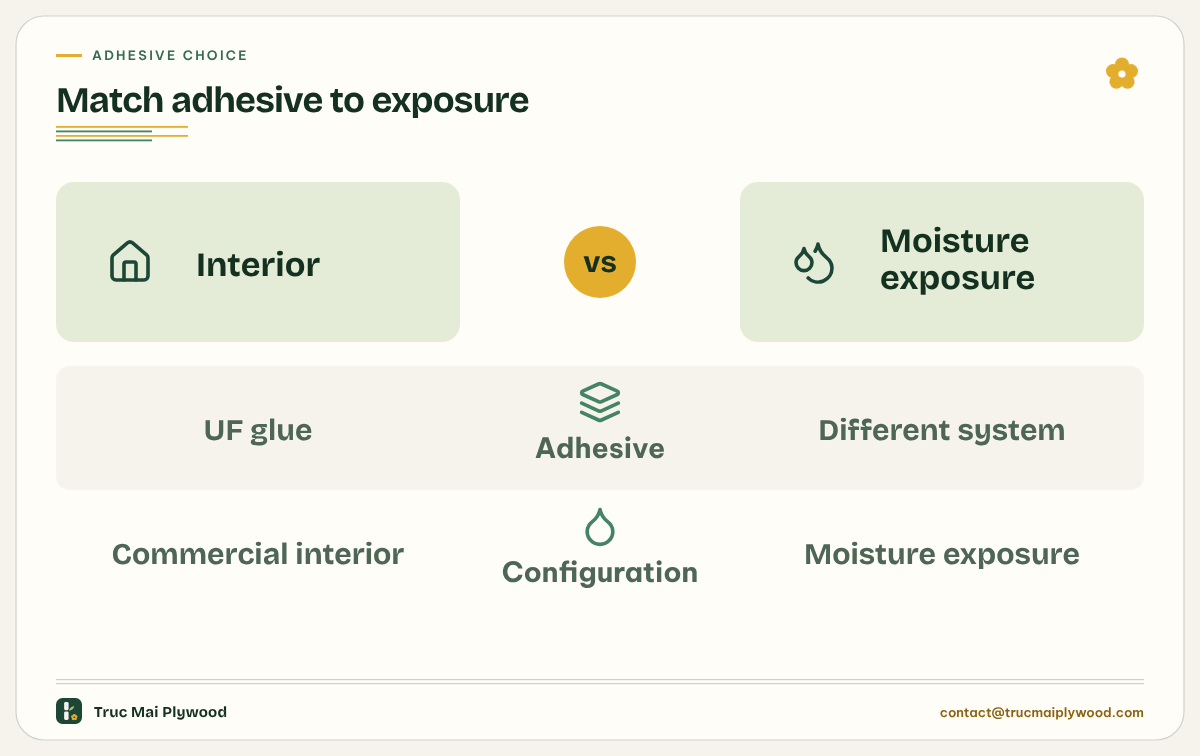
Write adhesive type and emission requirement as two separate lines. UF glue at E0 emission is a commercial interior configuration, while a different adhesive system is selected for moisture exposure. The name of the glue alone does not state a tested bond class, and an emission label does not describe water resistance.
The USDA Forest Products Laboratory’s Wood Handbook, chapter 10 describes UF adhesives as suited to interior panels with limited wetting resistance. A buyer requiring a particular bond performance should specify the test method and acceptance criteria on the actual panel build.
For a US-bound hardwood plywood veneer-core order, 40 CFR 770.10 sets the TSCA Title VI formaldehyde limit at 0.05 ppm under its specified testing framework. Truc Mai’s CARB P2 and TSCA Title VI certificate CARB/EPA 26053 covers hardwood plywood with veneer core from 3–25 mm. The requested product and its documents should match that certified scope.
Does a general-purpose name indicate a structural grade?
No. General-purpose or utility plywood describes a commercial application category rather than a structural certification. The US NIST PS 1-22 structural plywood standard establishes separate requirements for structural grades, bonding, testing and marking. A generic project-panel label carries none of those designations.
For a buyer supplying interior furniture or commercial displays, this distinction keeps the purchasing conversation focused on the actual use. A shelf sold as a furniture component needs an agreed panel construction and appropriate product design; a load-bearing building element requires its own structural specification and verified performance.
When reviewing an enquiry, record whether the panel is used inside furniture, as a decorative lining, as packaging or in another non-structural role. Do not infer suitability from the words hardwood or heavy duty. The specification is what allows a mill to select the correct construction.
How do coated and unfinished project panels differ?
Unfinished veneer-faced panels leave the buyer to sand, paint, stain or laminate the surface. Melamine- and HPL-faced plywood add a finished or decorative surface at the panel stage. UV-ready plywood has faces prepared for the customer’s subsequent UV coating; the mill does not apply that coating.
The buyer should name the surface on each side and state whether exposed edges need treatment after cutting. A melamine-faced piece and a raw plywood piece can share a nominal size while serving quite different display or cabinet applications. Their packing also needs to protect different surfaces from rubbing.
For coated options, compare melamine-faced plywood and HPL-faced plywood. The laminates for plywood article helps buyers separate substrate construction from decorative finish. In a purchase order, list substrate, overlay, colour reference, face direction and edge requirement as individual fields.
What should a supplier sample prove before a container order?
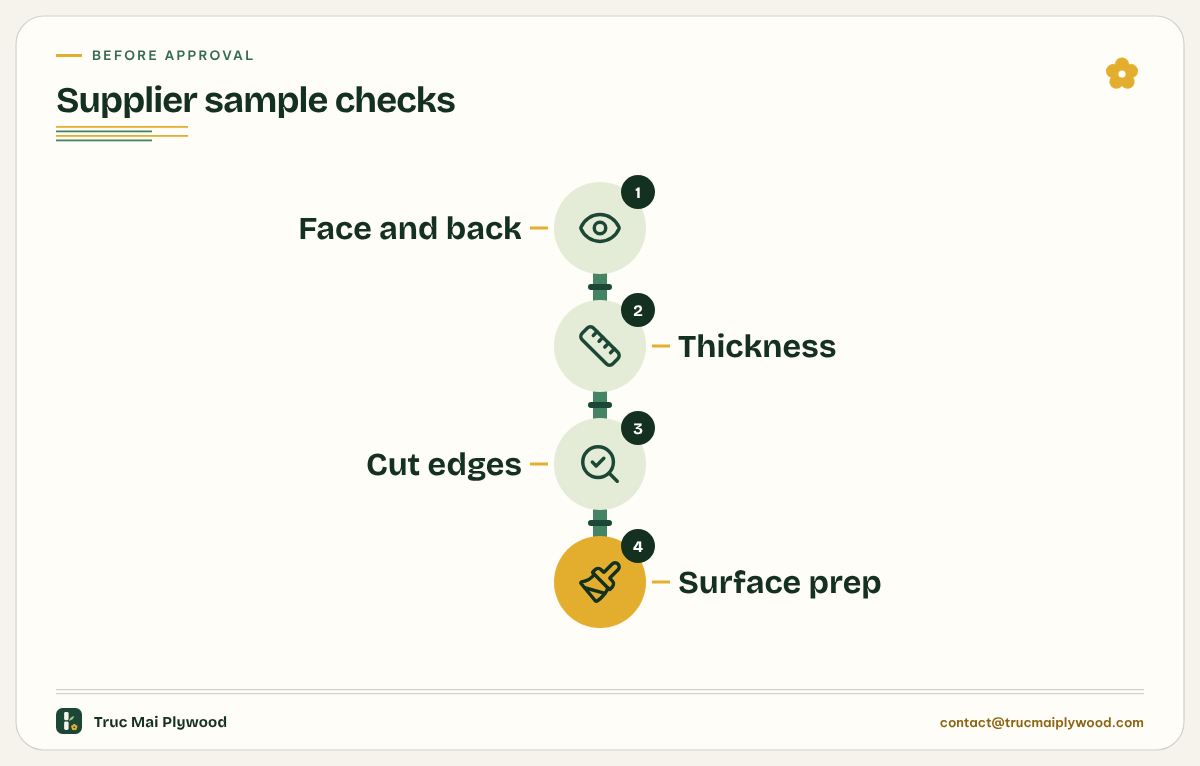
A sample should prove the agreed appearance, edge construction, surface preparation and thickness. Request a representative full-edge view alongside the face sample, and keep a signed or coded reference for later inspections. A sample of only the decorative face leaves core joining and back appearance unresolved.
A practical acceptance sequence is:
- Compare face and back with the approved reference under consistent light.
- Check thickness at agreed positions using the order tolerance.
- Inspect cut edges for veneer arrangement, joints and visible gaps.
- Check surface preparation for the buyer’s finishing process.
- Record the sample code and any agreed defect limits in the order.
The ordering plywood samples page sets out the sampling route. New buyers can receive free samples and arrange the courier; the courier charge can be credited against an actual order. The useful output is a shared physical reference, not merely a sample photograph.
How can a distributor compare two offers for ordinary plywood?
Compare the construction line by line before comparing the quoted commercial terms. Two offers headed ordinary plywood can differ in core joining, face thickness, sanding, emission scope and cutting. A cheaper-looking description may simply omit work included in the other specification.
| Comparison field | Offer A | Offer B | Buyer decision |
|---|---|---|---|
| Face/back | Named veneer and sample pair | Generic hardwood face | Ask for the exact face pair |
| Core | Named species and stitched build | Mixed core, joining unspecified | Specify acceptable construction |
| Adhesive | Named type and test requirement | General-purpose glue | Write bond and emission separately |
| Thickness | Nominal plus tolerance | Nominal only | Add measurable tolerance |
| Cut pieces | Drawing, grain direction, labels | Sizes listed without layout | Approve a cut list |
| Packing | Packs and item codes | Bulk description | Define receiving identification |
The supplier shortlist checklist provides a broader comparison framework. A buyer should request a revised quotation on one shared specification rather than assuming the two supplier labels describe the same board.
What traceability and certificate documents should travel with the panels?
Match documents to the actual product and destination market. Truc Mai holds FSC chain-of-custody certificate SA-COC-014545 under licence FSC-C196493 for eligible FSC 100% products. Under FSC-STD-40-004, the sales documents identify the certificate code and product claim. Buyers should put the requested FSC claim on the order line.
For EU shipments, the factory can supply EUDR origin and plot-geolocation files for both core and face veneer, supporting the importer’s due-diligence process. Different faces can have different origin records, so a generic description such as Far Eastern ply is insufficient for that paperwork. The face veneer origin files page explains the two material streams.
Keep the invoice, packing list and bill of lading aligned with the product codes. The documents per container page lists the shipment file. Document review belongs before the order is fixed, when the buyer can still align the chosen construction with its intended market.
How should a repeat project-panel order be packed and shipped?
Use one pack code per product and cut-size group, with the packing list recording the quantities actually loaded. Full sheets, small cut pieces and decorative surfaces have different handling needs. A distributor receiving several stock codes in one container benefits from clear pack identification and a receiving sequence that matches its warehouse plan.
Truc Mai’s minimum order is one 40HC, with production normally 15–45 days after the deposit under the agreed programme. Standard terms include FOB Hai Phong, CFR and CIF. A mixed container can carry different product lines by agreement, provided the loading plan accounts for the combined weight and pack positions.
For volume planning, consult m³ per 40HC by thickness, which separates calculated loading figures from shipment records. Keep the final packing list as the receiving reference. If an assortment changes between replenishments, revise its pack codes and cutting drawings before production rather than relying on the previous container’s product names.
What belongs in the first project-panel RFQ?
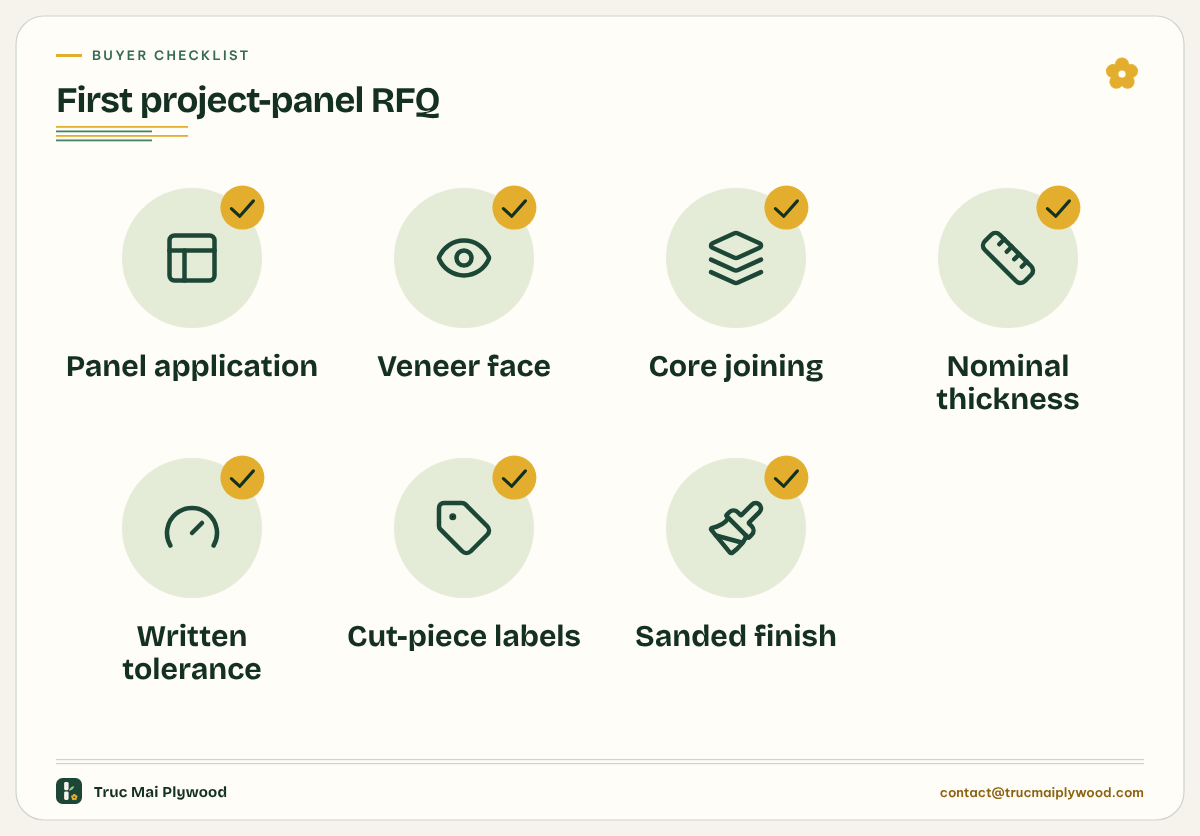
A useful request for quotation identifies the intended application, face and back, core construction, adhesive and emission requirement, thickness and tolerance, full-sheet or cut-piece dimensions, packing and container quantity. Attach the cut list and approved sample reference when the order includes smaller retail panels.
For example, a buyer can request a sanded commercial panel for indoor display fittings with a named veneer face, specified core joining, nominal 18 mm thickness, written tolerance and labelled cut pieces. That description gives production and quality teams something measurable. The words project panel can remain on the buyer’s stock label without carrying the entire technical meaning.
Send the completed specification through the quotation page or use the structure in writing a plywood RFQ. Include destination port and preferred shipping term so the quotation and packing proposal describe the same order.
Questions buyers ask
Can a distributor sell cut plywood under its own project-panel label?
Yes. Specify the board construction, final dimensions, piece labels and packing layout so each replenishment uses the same product description.
Does ordinary plywood mean the faces are unsanded?
No. Ordinary plywood describes a market category, while sanding and face appearance must be written as separate order requirements.
Can one order include several veneer appearances?
Yes. List each face and back combination as a separate item with its own approved sample and packing identification.
Is 18mm Far Eastern plywood a fixed international grade?
No. The phrase identifies a trade description and nominal thickness, not a single recognised face grade or adhesive bond class.
Can a buyer request both a decorative face and a commercial core?
Yes. Name the decorative face veneer and specify the core species, jointing method and acceptance sample independently.
What does a sample approval need to record?
Record face and back appearance, exposed edges, surface finish, thickness and any permitted repairs. Keep the approved sample identifier on the purchase order.
Should each cut piece carry a label?
Yes, where the buyer's packing plan calls for identification. Labels can distinguish dimensions, finish, order line and destination stock code.
Can a mixed container carry different panel thicknesses?
Yes, by agreement. The packing plan identifies each product line and checks the combined cargo weight against the booked limit.
Is FSC wording the same as a generic plantation-wood description?
No. An FSC product claim must identify the eligible product and its chain-of-custody claim on the sales documentation.
What information belongs on a repeat-order reference?
Use the approved sample identifier, construction specification, cutting drawing, packaging code and prior order reference. This lets the mill compare the new instruction with the agreed build.