
What is commercial plywood? It is a trade name for multi-layer veneer panels used in furniture, joinery, interior fit-out and packing. It is not one fixed grade: face appearance, core species, bonding, thickness and tolerances define the product. Buyers should specify those details and approve a sample before ordering container quantities.

What is commercial plywood, and what is commercial ply?
Commercial plywood is a general-purpose, multi-ply veneer panel for furniture, joinery and interior fabrication, rather than a single internationally fixed grade. Its face, core, adhesive and finished dimensions must be specified for the intended use. A buyer therefore needs a written construction specification, not merely the words “commercial plywood” on a proforma invoice.
Veneers are laid with adjacent grain directions crossed, bonded under pressure, then trimmed and supplied either unsanded or with a prepared surface. The face, core, bond and tolerance together decide whether the delivered panel is suitable for a particular job.
The term also appears in the question “what is commercial ply” and as “commercial ply”, “commercial ply wood” and “commercial plywood material” in purchasing enquiries. Those names do not identify the species inside the panel. A smooth outer veneer can conceal a different inner species, a different jointing method and a different adhesive system. Start with the end use, then define each layer and the evidence needed at receiving inspection.
Commercial grade: what specification does it describe?
Commercial grade plywood is plywood supplied to an agreed trade specification for general-purpose work, often with appearance and core allowances different from furniture-grade material. It is not one universal appearance class. For example, a commercial panel may have a lightly sanded face and an AB core assembled from loose-laid or jointed veneers, while a furniture panel is commonly built around a stitched A-grade core with sanded faces.
A useful quotation distinguishes face grade from core grade. A/B or BB/CC on an offer can be the seller’s own appearance convention. Request a face-and-back reference sample, a written allowance for knots and patches, and a cross-section sample that shows internal joins. Appearance systems differ between markets. The NIST structural plywood standard is a separate US grading framework, rather than a definition of every merchant’s BB or AB label.
What does commercial plywood mean in construction?
In construction, commercial plywood means general-purpose sheet material for non-load-bearing fit-out, temporary protection or joinery. The words alone do not specify a structural panel or a concrete-forming sheet. For load-bearing work, the buyer should instead specify a recognised structural standard and the required marked grade.
The US National Institute of Standards and Technology lists PS 1-22 as the current structural plywood standard. Its structural classification addresses panel construction, bond and grading in a way that the informal commercial label does not. A contractor preparing shop drawings for cabinets, wall linings or service enclosures can use commercial plywood once the moisture exposure and finish are specified. A designer selecting a structural diaphragm or weather-exposed deck needs a separately qualified product. Keeping those procurement streams distinct prevents a familiar product name from being mistaken for a performance rating.
What does commercial plywood mean in manufacturing?
In manufacturing, commercial plywood means a configurable pressed-veneer panel whose bill of materials changes with the order. The factory selects core species and core assembly, lays cross-bands and faces, applies the specified adhesive, presses, trims and checks the finished sheets. The same external colour can therefore accompany several constructions.
Core jointing is a major distinction. Loose-laid veneers can suit packing and less visible work; joined veneers give more predictable support under a visible face. For a furniture build, stitching the outer core plies across and along the sheet helps close openings that could print through a thin veneer. At Truc Mai Plywood, the usual furniture build uses a stitched core and sanded faces; commercial panels can use an AB core and a lighter sanding pass. Buyers who will laminate or machine the sheet should examine the edge as closely as the surface.
The production order should record the approved face sample, core species, thickness tolerance and finish. These are practical manufacturing controls, unlike a broad marketing description.
What does commercial plywood mean? Examples for buyers
Examples of what commercial plywood means include a plain panel for concealed cabinet backs, a decorative veneer-faced panel for visible furniture and a utility panel for protective packaging. Each can be sold in the commercial trade, yet the face quality, internal construction and finishing work differ.
A cabinet-back order prioritises flatness, machining and repeatable thickness. A visible shelf side prioritises face matching, sanding and an agreed front/back grade. A crate panel prioritises usable area and packing efficiency. The purchasing document should name which of these outcomes matters. A buyer ordering a decorative face solely because the sample looks attractive may pay for surface preparation that will be hidden. Conversely, selecting the loosest core construction for a high-gloss laminate can expose core irregularities after pressing.
The comparison with cabinet-grade plywood is particularly useful when the finished part has an exposed edge.
Applications: where are commercial panels used?
Commercial plywood is used for furniture parts, interior linings, shelving, drawer components, door components, shopfitting and packaging. The right construction follows the component: a painted panel needs a clean and uniform substrate; a veneer-finished panel needs an attractive face; a crate side needs reliable assembly and economical cutting.
For kitchens, the location of the panel matters as much as its name. A dry cabinet carcass, a sink-adjacent panel and a decorative end panel do not have identical exposure or finish requirements. Specify the expected moisture conditions and adhesive performance separately. The plywood for kitchen cabinets guide treats that application in greater depth.
Commercial plywood is also used as a substrate for melamine, high-pressure laminate and paper overlay. A buyer planning a coating line may prefer sanded, UV-ready surfaces; “UV-ready” describes surface preparation, not an applied UV coating. For painted joinery, the face veneer and sanding quality often matter more than a decorative wood grain. For packing, ask about edge condition, cutting yield and the strength needed around fasteners rather than requesting a furniture appearance grade.
What are the standard sizes of commercial ply?
The main sheet sizes are 1220 × 2440 mm, 1220 × 2280 mm and 1250 × 2500 mm in this Vietnamese furniture and commercial range. The first is the familiar 4 × 8 ft format; the European format offers a different cutting layout. The shorter sheet can reduce waste for furniture components designed around its length.
| Sheet format | Typical purchasing reason | Cutting consideration |
|---|---|---|
| 1220 × 2440 mm | General furniture and joinery | Common machine and rack format |
| 1220 × 2280 mm | Repeated shorter components | Check nesting before choosing |
| 1250 × 2500 mm | European cutting programmes | Check saw bed and finished dimensions |
Cut-to-size is an order option. A 1220 × 2440 mm sheet can be split lengthwise into 610 × 2440 mm halves or into 1220 × 610 mm quarters. A three-piece layout can produce 1200 × 800 mm pieces where the chosen parent sheet and saw plan allow. Six-piece patterns are also available. The exact finished pieces, kerf allowance, bundle labels and drawing revision belong on the cutting list. Cut-to-size panels can arrive grouped by component, saving sorting time at the destination factory.
What is the thickness of commercial plywood?
Commercial plywood in this range is supplied from 3 to 40 mm, with common ordered thicknesses including 3, 4, 5, 6, 9, 12, 15, 18, 21, 25, 30 and 40 mm. Thickness is a nominal specification, while the acceptable finished measurement is a separate line on the purchase order.
| Use | Thickness choices to evaluate | Inspection priority |
|---|---|---|
| Thin backs and decorative parts | 3, 4, 5 or 6 mm | Flatness and edge integrity |
| Furniture components | 9, 12, 15 or 18 mm | Calibrated thickness and core |
| Heavier joinery components | 21, 25, 30 or 40 mm | Weight, machining and edge finish |
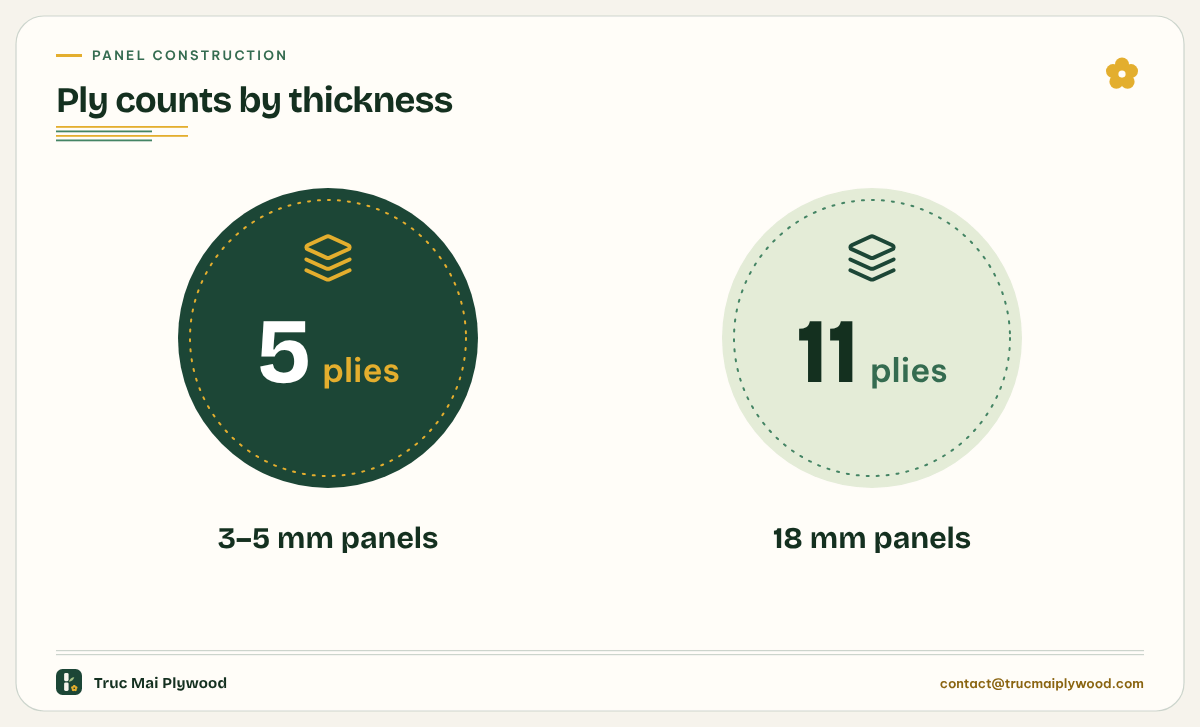
The 3–5 mm panels use five plies in this range; the 6 mm construction is set by order. An 18 mm panel most often uses eleven plies, sometimes thirteen. For sanded and calibrated furniture panels, a written ±0.3 mm thickness tolerance can be specified; commercial grade is commonly ±0.5 mm and packing grade ±0.5–1.0 mm. The buyer should also agree how measurements are sampled across the sheet. Thin plywood panels deserve particular attention when the part will be bent, grooved or veneered.
What faces does commercial plywood from Vietnam use?
Vietnamese commercial plywood uses a choice of poplar, bleached poplar, engineered veneer (EV), pine, eucalyptus, okoume, bintangor, gurjan, birch or other decorative faces, paired with locally sourced core veneers. A face name tells you the visible species or decorative surface, not the entire cross-section.
| Face | Visual character | Suitable specification focus |
|---|---|---|
| Poplar or bleached poplar | Light, relatively plain | Painting and clean surface preparation |
| EV | Consistent engineered pattern | Repeatable decorative appearance |
| Pine | Recognisable grain | Knot allowance and colour selection |
| Okoume | Warm reddish tone | Matching face/back samples |
| Bintangor | Distinct warm decorative grain | Face continuity |
| Birch | Pale, fine-grained look | Imported face on Vietnamese core |
| Eucalyptus or gurjan | Species-specific colour and texture | Grade and veneer sample |
An imported birch face on a Vietnamese core is birch-faced plywood, not all-birch plywood. EV is reconstituted veneer; a uniform decorative pattern should be assessed on an approved panel, not inferred from the species label alone. Buyers can compare engineered-veneer panels and birch-faced plywood as distinct face choices.
Which core species make the best commercial plywood for a given job?
Styrax is a useful starting point for lightweight furniture parts, Acacia for a denser general-purpose build and Eucalyptus for a heavier core specification. Pine and mixed-species cores are further options where the required weight, stiffness, machining and appearance justify them. The best commercial plywood is the build that meets the component specification with the least avoidable processing and shipping burden.
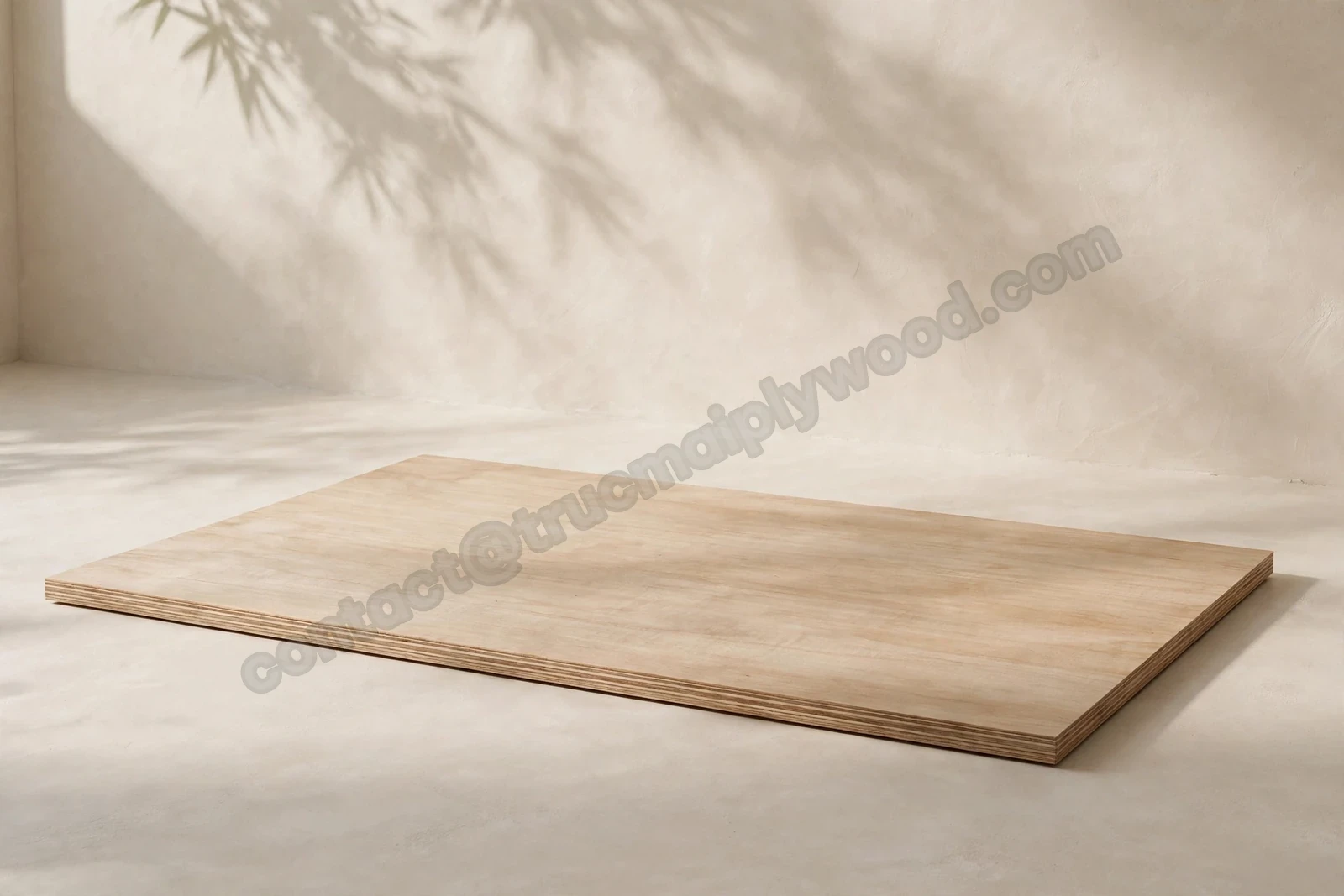
At the mill, core veneers are generally thicker than the decorative face. A buyer inspecting the cross-section should look for open joins, overlaps, voids and the regularity of the lay-up. Stitched outer core plies improve the support immediately below a thin decorative face. Mixed species should be named on the order instead of hidden behind “hardwood core”.
For container purchasing, a lighter core can move more panel volume within the same planning payload. That is a logistics advantage, not an automatic quality ranking. Compare two quotations on the same face grade, core joining method, adhesive, emission requirement and tolerance before comparing the total shipment.
How do adhesive, bond performance and emissions differ?
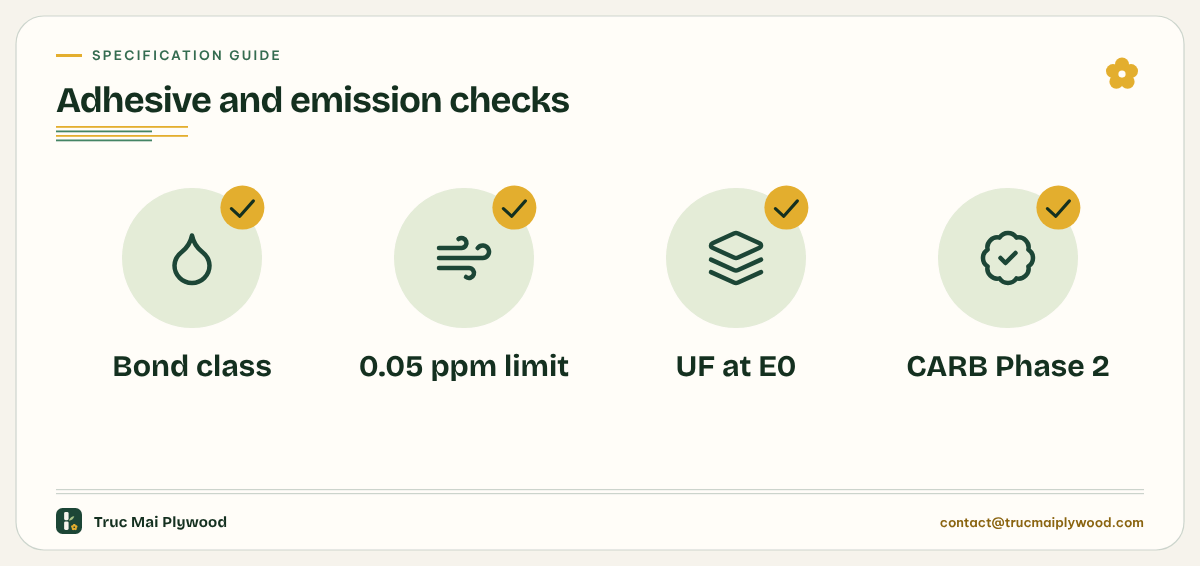
Adhesive chemistry, bond durability and formaldehyde emissions are three separate specification lines. Urea-formaldehyde (UF) is commonly used for dry interior panels; a moisture-resistant adhesive system is selected where the service conditions require it. A resin name alone does not give a tested bond class.
The European EN 314-2 framework distinguishes bond classes for dry, humid and exterior conditions. A laboratory report should identify the panel construction and the conditioning and test method used. For US-bound regulated hardwood plywood, the US Environmental Protection Agency’s TSCA Title VI programme requires third-party certification and labelling. Its hardwood-plywood emission limit is 0.05 ppm under the relevant test framework.
The mill’s default interior configuration is UF glue at E0 emission, with glue and emission stated separately. Truc Mai holds CARB Phase 2 and TSCA Title VI certification for veneer-core hardwood plywood from 3 to 25 mm, under certificate CARB/EPA 26053, mill ICTT-26053. The buyer should align the order’s actual construction with the certification scope and ask for the applicable document set. The Phase 2 formaldehyde limits page explains the US requirement.
Is commercial plywood from Vietnam good quality, and what should I check before ordering?
Yes, Vietnamese commercial plywood can be a dependable furniture and joinery material when the approved sample and the production specification match the intended use. Quality should be judged by face condition, internal veneer construction, finished dimensions, bond performance and documented emission requirements, rather than country of origin alone.
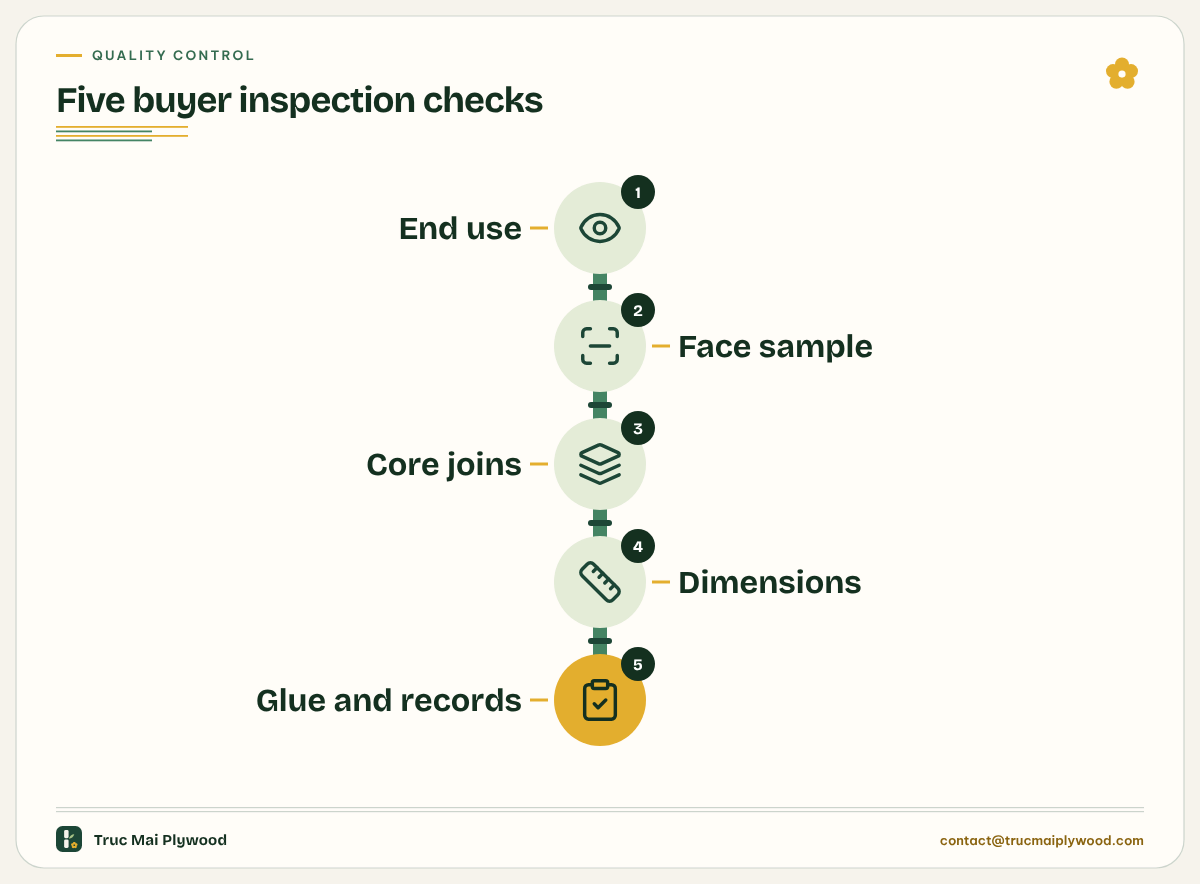
A practical incoming-inspection sequence is:
- Identify the application. Record whether the panel will be visible, laminated, painted, machined or used for packing.
- Approve the face and back. Compare colour, knots, repairs and sanding against retained samples.
- Inspect the edge. Check core joins, gaps and any visible overlaps on representative sheets.
- Measure the panel. Sample thickness across the face and check length, width and squareness against the order.
- Match documents. Compare the named glue system, emission evidence, lot details and packing list with the agreed configuration.
- Run a trial. Cut, edge-band, laminate or finish a sample on the buyer’s actual production line.
For a first import order, the supplier shortlist checklist and sample-ordering process help turn these checks into purchase conditions. A labelled sample board is more useful than a verbal promise of a grade.
How should a buyer compare commercial plywood types and grades?
Compare commercial plywood types using one specification grid that keeps surface appearance separate from core construction, bonding and tolerances. Two panels described as “commercial grade” can have very different machining yield or finishing costs.
| Order field | What to write | What to inspect |
|---|---|---|
| Application | Cabinet, shopfitting, lining or packing | Trial part |
| Face/back | Species and approved paired grades | Both faces |
| Core | Named species and joining method | Cut edge |
| Adhesive | Resin system and required bond evidence | Report for construction |
| Emission | Named scheme and test scope | Certificate or report |
| Dimensions | Nominal size and finished tolerance | Sample measurements |
| Packing | Pack height, labels and sheet count | Packing list |
Face grades are especially easy to misunderstand. A merchant’s A/B or BB/CC shorthand needs a physical benchmark and a defect schedule. The word “commercial” alone cannot settle whether repairs, colour variation or sanding marks are acceptable. The Vietnamese plywood grades article helps buyers write those allowances clearly.
How many commercial plywood sheets fit in a 40HC container?
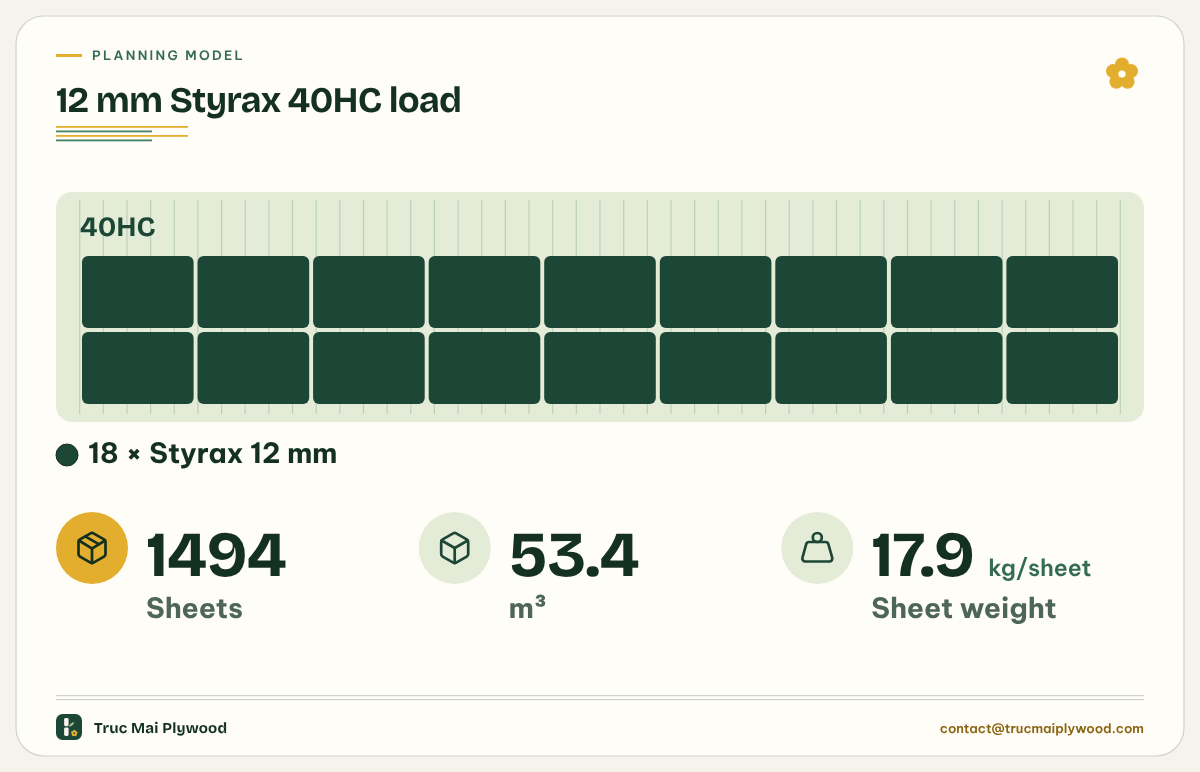
A 40HC planning load changes materially with core density and thickness. The following values are the supplied calculation rows for 1220 × 2440 mm sheets; the model uses a 28,000 kg planning payload for panels and a pack height of 1,000 mm. The container booking, packaging weight and weighed sheets govern the final load plan.
| Core | Thickness (mm) | Size | Packs | Sheets/pack | Sheets | m³ | kg/sheet | Total kg | Weight-capped |
|---|---|---|---|---|---|---|---|---|---|
| Styrax | 12 | 1220x2440 | 18 | 83 | 1494 | 53.4 | 17.9 | 26680 | false |
| Acacia | 12 | 1220x2440 | 16 | 83 | 1328 | 47.4 | 20.7 | 27510 | false |
| Eucalyptus | 12 | 1220x2440 | 15 | 80 | 1200 | 42.9 | 23.2 | 27860 | true |
| Styrax | 15 | 1220x2440 | 18 | 66 | 1188 | 53.0 | 22.3 | 26520 | false |
| Acacia | 15 | 1220x2440 | 16 | 66 | 1056 | 47.2 | 25.9 | 27350 | false |
| Eucalyptus | 15 | 1220x2440 | 15 | 64 | 960 | 42.9 | 29.0 | 27860 | true |
| Styrax | 18 | 1220x2440 | 18 | 55 | 990 | 53.0 | 26.8 | 26520 | false |
| Acacia | 18 | 1220x2440 | 16 | 55 | 880 | 47.2 | 31.1 | 27350 | false |
| Eucalyptus | 18 | 1220x2440 | 15 | 53 | 795 | 42.6 | 34.8 | 27690 | true |
| Styrax | 21 | 1220x2440 | 18 | 47 | 846 | 52.9 | 31.3 | 26440 | false |
| Acacia | 21 | 1220x2440 | 16 | 47 | 752 | 47.0 | 36.3 | 27270 | false |
| Eucalyptus | 21 | 1220x2440 | 15 | 45 | 675 | 42.2 | 40.6 | 27430 | true |
The planning model assumes Styrax at 500 kg/m³, Acacia at 580 kg/m³ and Eucalyptus at 650 kg/m³. Its pack allowances are 18, 16 and 15 respectively. These are calculated planning figures, not measured shipment records. Read the 40HC loading table by thickness when arranging mixed thicknesses or different sheet formats.
What documents should accompany an imported commercial plywood order?
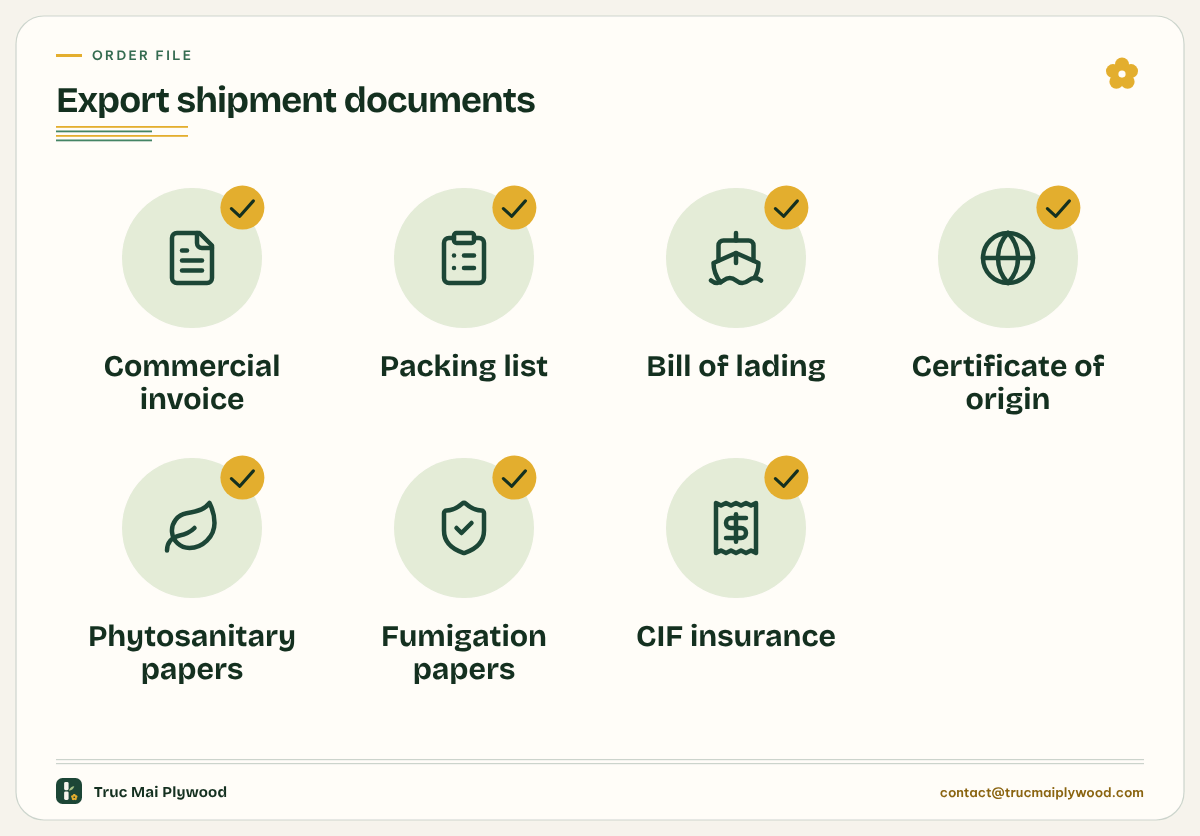
An imported commercial plywood order should have a commercial invoice, packing list and bill of lading, together with the origin and compliance papers relevant to the destination and agreed panel. For EU orders, plot-origin and geolocation records for core and face veneers support the importer’s due-diligence file.
Truc Mai Plywood holds FSC chain-of-custody certificate SA-COC-014545 and trademark licence FSC-C196493. Eligible FSC 100% products carry the applicable claim on sales and shipping documents. The Forest Stewardship Council explains why the certificate code and product-level claim are essential. The mill also holds ISO 9001:2015 quality-management and ISO 14001:2015 environmental-management certifications for plywood manufacturing. These management-system credentials should be read alongside, rather than in place of, the actual panel specification.
For EU purchasing, ask for origin records covering the face as well as the core; for US purchasing, align the order with its hardwood-plywood emission certification. The documents per container checklist separates shipping paperwork from product evidence.
How do you write a commercial plywood RFQ that a mill can build?
A usable commercial plywood request for quotation states the finished component, face, core, adhesive and emission requirement, dimensions, packing and quantity in one consistent specification. That gives the mill enough information to propose the correct construction and a matching sample.
Send the following in order: application and finished surface; face/back species and grade pair; core species and joining method; adhesive system and emission requirement; sheet size, thickness and tolerance; cut list if required; packing labels, quantity and destination port. Include photos of the finish or a retained sample reference where appearance is critical.
For container programmes, request the pack plan by thickness and core, and keep sample approval tied to the order revision. Truc Mai Plywood manufactures furniture and commercial plywood in Ha Hoa, Phu Tho, with annual capacity around 60,000 m³. The normal minimum order is one 40HC, with production generally 15–45 days after the deposit. Buyers can use the plywood RFQ guide to send a complete specification rather than an ambiguous grade name.
Send your specification to contact@trucmaiplywood.com or through the quotation form.
Questions buyers ask
Can commercial plywood be edge-banded?
Yes. A sound, even core and a clean cut edge help the band adhere uniformly; approve a trial part before production.
Is engineered veneer the same as natural poplar face?
No. Engineered veneer is reconstituted for a more repeatable visual pattern, while natural poplar veneer retains its natural grain variation.
Should the face and back grades match?
Not necessarily. A visible face and concealed back can use different approved appearance grades, written as a pair on the order.
Does a thicker panel always have more plies?
Not necessarily. Veneer thickness and lay-up also determine ply count; request the specified construction for the ordered thickness.
Can I order labelled components instead of full sheets?
Yes. The mill can cut standard sheets into agreed components and label the bundles to the buyer’s cutting list.
Is a decorative birch face an all-birch core?
No. A birch-faced panel can have a Vietnamese hardwood core; the core species must be specified separately.
What does a sanded face change?
Sanding improves surface consistency and helps prepare a panel for coating or lamination; the approved sample defines the required finish.
Can different products share one container?
Yes. One or two products is usual, with a larger mix possible by agreement and a pack plan for the combined load.
When should I approve a physical sample?
Approve the sample before confirming the final production specification, particularly when colour, repairs or machining yield are important.