
A hardwood plywood association can help buyers find industry contacts, technical standards and supplier directories. DHA publishes the US decorative plywood standard; IWPA supports importers, while VIFOREST and the VN Plywood Association represent Vietnamese industry interests. Truc Mai Plywood recommends checking each factory’s actual panel construction, sample and documents before ordering.

Which hardwood plywood association sets the US reference?
The Decorative Hardwoods Association (DHA), formerly the Hardwood Plywood and Veneer Association (HPVA), publishes ANSI/HPVA HP-1-2024. Its current hardwood and decorative plywood standard defines face, back and inner-ply grades, panel construction, bond performance, dimensions, moisture and formaldehyde provisions. The hardwood plywood association name still appears in the standard’s title and in older purchasing documents.
For a US cabinet maker, the useful distinction is between an association and its technical publication. DHA represents an industry and offers a buying directory; HP-1 describes a product specification. Neither the association’s directory entry nor a factory’s use of the letters HPVA substitutes for an agreed grade, sampling method and test evidence. The association’s publications page also offers a hardwood plywood handbook and veneer species guide.
A buyer asking for an HPVA birch plywood grade should start with the face and back grade designations in HP-1 and compare them against a physical approved sample. Birch is a face species, while the core construction needs a separate line on the purchase order. For imported birch-faced plywood, the veneer species and the core species should be identified independently.
Where is the VIFOREST Vietnam timber and forest products association directory?
VIFOREST is the Vietnam Timber and Forest Products Association, but its public materials do not provide a verified plywood-mill directory. Buyers can contact the association for current member details, then check each producer’s factory and panel specifications. Its official website describes its national wood-industry role.
A buyer searching for a VIFOREST directory should request a current member list from the association and state the exact product category. The broad term ‘wood products’ includes furniture, timber processing and other activities beyond plywood manufacturing. Ask for mills making commercial veneer-core plywood, then establish which names operate production lines and which supply other materials or services.
A practical first message gives the application, target face, core, sheet format and anticipated container frequency. That produces a narrower and more useful reply than requesting every timber exporter in Vietnam. Compare the returned names with the mill verification checklist before paying a deposit.
Which Vietnam plywood manufacturers exporters association should buyers approach?
The VN Plywood Association is the plywood-specific organisation named in the same 2025 joint industry filing. VIFOREST is the broader timber and forest-products body. Buyers can approach both: one for the plywood industry contact network, the other for the wider wood-processing network and policy context.
The distinction matters when an enquiry uses the word ‘manufacturer’. An exporter may arrange a shipment without running the pressing, sanding and packing line. Request the producing mill’s location, product scope and a specification sheet before assigning it to a factory shortlist. A buyer who needs regular furniture plywood should also ask whether the same factory controls core lay-up, face matching and calibration across repeat orders.
Do not treat a trade-body membership as a product certificate. For a real supply decision, compare the factory’s production capability with its sample, certificate scope and proposed order terms. The supplier shortlist checklist gives a separate framework for comparing responses on the same construction rather than on company descriptions.
Where can buyers find a Vietnam plywood industry directory or association?
2 starting points are VIFOREST and the VN Plywood Association; build a product-specific shortlist from current contacts. The 2025 association statement does not provide an audited factory list.
| Buyer need | Association or record | What to request | Independent follow-up |
|---|---|---|---|
| Vietnam timber industry contacts | VIFOREST | Current plywood-relevant member contacts | Factory location and production scope |
| Vietnam plywood sector contacts | VN Plywood Association | Member firms making the requested panel | Sample and producing-mill identity |
| US decorative plywood grades | DHA / HPVA | ANSI/HPVA HP-1-2024 | Written grade and test requirements |
| US import trade contacts | IWPA | Directory filtered by product and activity | Origin and import documents |
| Canadian veneer and decorative panels | CHPVA | Member categories and technical information | Construction and face specification |
Use the Vietnam plywood import guide to separate sourcing, shipping paperwork and quality checks.
How do buyers obtain Vietnam plywood association members contact details?
2 steps are to request current association contacts and verify each producing mill’s identity and sample documentation.
Use a short contact request with five fields: panel application, face species, core species, nominal thickness and planned shipment format. Add the destination market and ask about repeat-order sample and tolerance consistency.
After receiving a contact, request a factory video showing actual panel processing, an identifiable address at district and province level, and a recent specimen of the proposed construction. Compare the sample with the written offer rather than judging by a product photograph. The pre-deposit factory checks are useful before issuing a purchase order.
Does the Vietnam plywood association publish a product-by-product member list?
No. The public 2025 association filing identifies the VN Plywood Association but gives no product-by-product membership list. Ask the association for producers of the required panel category, then examine their catalogue and production evidence.
A buyer comparing suppliers should separate product categories before sending one RFQ to every contact. Surface finish, bond specification and intended application must match the order.
For Truc Mai’s own range, the relevant products are commercial, furniture/interior and packing panels. A buyer needing furniture stock can compare commercial plywood grades and request a matching approved sample.
Can Vietnam plywood association members supply birch-faced plywood?
Yes, birch-faced plywood is a product category that a Vietnamese commercial plywood mill can offer; association membership alone does not identify which members carry it. Request a birch face specification, a named core species and a sample of the face/back combination. The distinction between birch-faced and all-birch construction should appear in the RFQ.
For example, Truc Mai Plywood offers birch-faced panels on Vietnamese veneer cores including Styrax, Eucalyptus, Acacia or Pine. That is a face-and-core construction, not a claim that the whole panel is birch. Its commercial and interior range is produced in Ha Hoa, Phu Tho, with annual capacity around 60,000 m³.
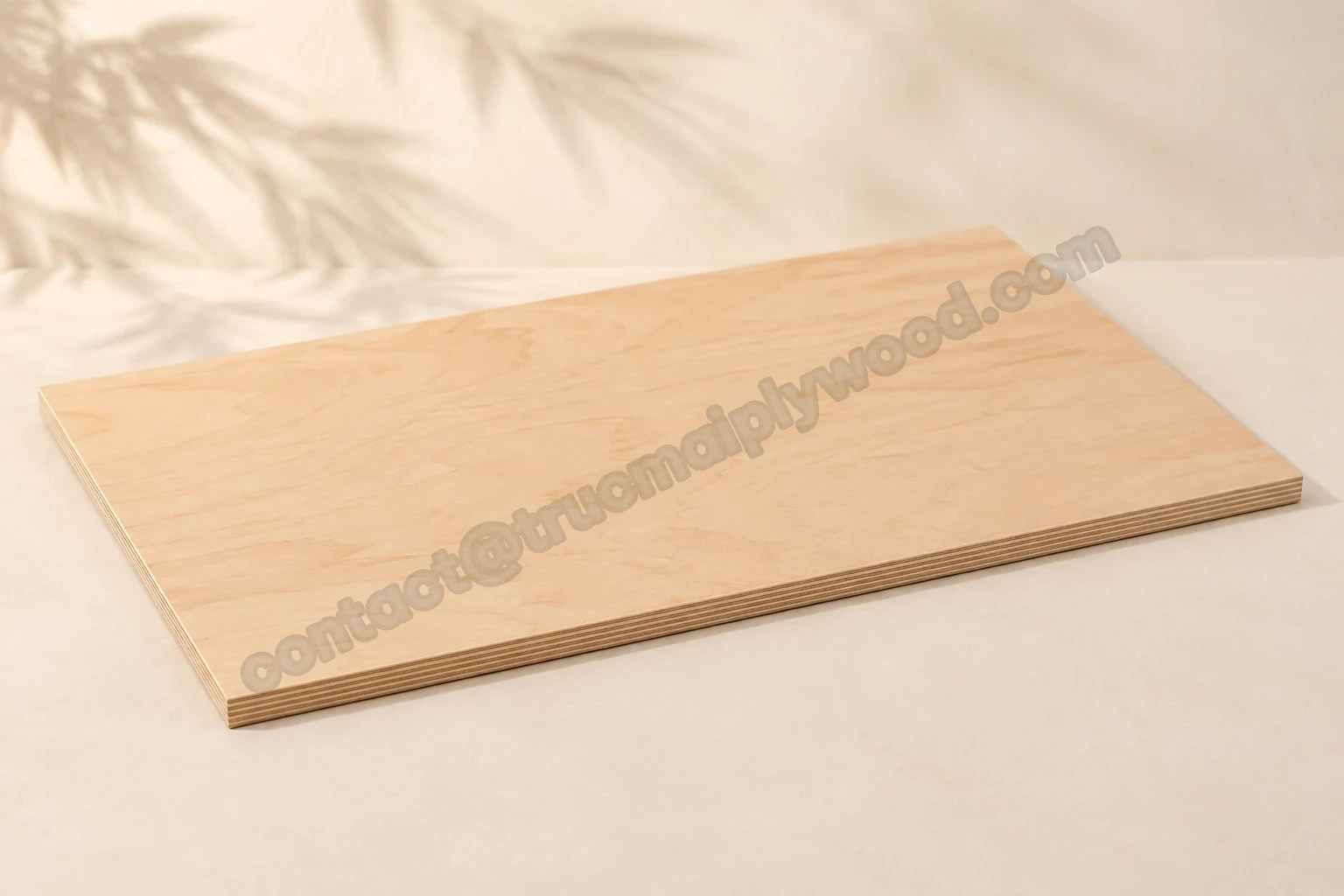
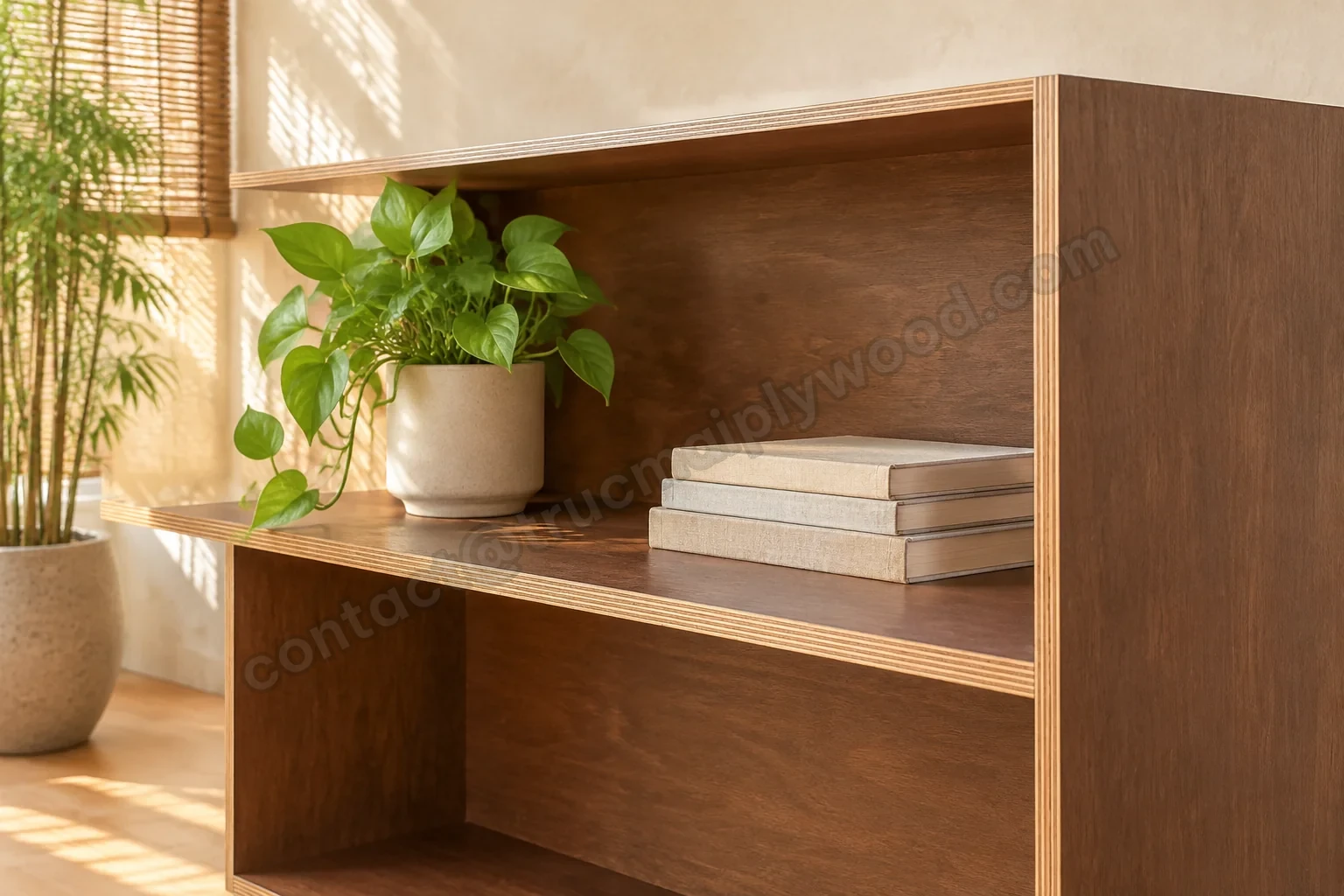
The face should be checked for colour matching, patches and the accepted appearance grade. The edge reveals the core lay-up and whether veneer gaps or joints meet the sample standard. For a procurement comparison, use the birch-faced plywood product page and the Baltic birch alternative discussion to specify the actual construction rather than relying on the word ‘birch’.
Which association helps US importers of plywood?
The International Wood Products Association (IWPA) serves companies trading imported wood products into North America. Its official resources page offers a supplier search filtered by product, species and business activity, along with wood-trade education and import compliance material.
IWPA has a different role from DHA: the first addresses imported-wood trade and its participants, while the second publishes the hardwood plywood grading standard. A US importer can use the IWPA network to identify possible trade contacts, then use HP-1 to define the panel and federal rules to check regulated emissions.
A contact from a directory still needs the ordinary buying checks: named factory, exact construction, sample approval, certificate applicability and shipping documents. The US plywood import steps set out the shipment sequence. For first-time buyers, a consistent RFQ is a better comparison tool than collecting unrelated brochures.
What does the Canadian hardwood plywood and veneer association publish?
The Canadian Hardwood Plywood and Veneer Association (CHPVA) represents manufacturers of decorative hardwood panels and veneers, including products for cabinets, furniture, doors and architectural joinery. Its official site explains its work on technical, regulatory, quality and product acceptance issues and links to its membership information.
The Canadian hardwood plywood and veneer association is useful for identifying the local industry vocabulary and member categories. The site distinguishes producing members from associate businesses supplying materials, machinery and services. That separation helps a buyer avoid assuming every listing operates a veneer press.
When comparing Canadian and imported panels, ask for the same face grade, core build, bond specification, panel size and intended use. A standards document may give a common vocabulary, but the purchase order still needs the agreed appearance sample and measurable acceptance criteria. For cabinet orders, cabinet-grade plywood gives the application context.
What happened to the Douglas Fir Plywood Association?
The Douglas Fir Plywood Association is a historical association name associated with the development of the North American plywood industry, rather than the current body publishing hardwood decorative plywood grades. A buyer seeking today’s hardwood panel specification should use DHA’s HP-1 standard, not an old Douglas-fir association reference.
Douglas-fir construction plywood and decorative hardwood plywood are different specification subjects. The NIST PS 1-22 structural plywood standard addresses structural plywood; ANSI/HPVA HP-1-2024 covers hardwood and decorative plywood. A purchasing document should identify the intended standard by number and edition, because a historical trade-body name does not tell a mill what grade to produce.
For furniture importers, this distinction prevents a mistaken substitution. Decorative face quality, inner-ply construction and emission documents belong on the order even when the supplier advertises the material simply as ‘hardwood plywood’.
How should a buyer use association standards to specify panels?
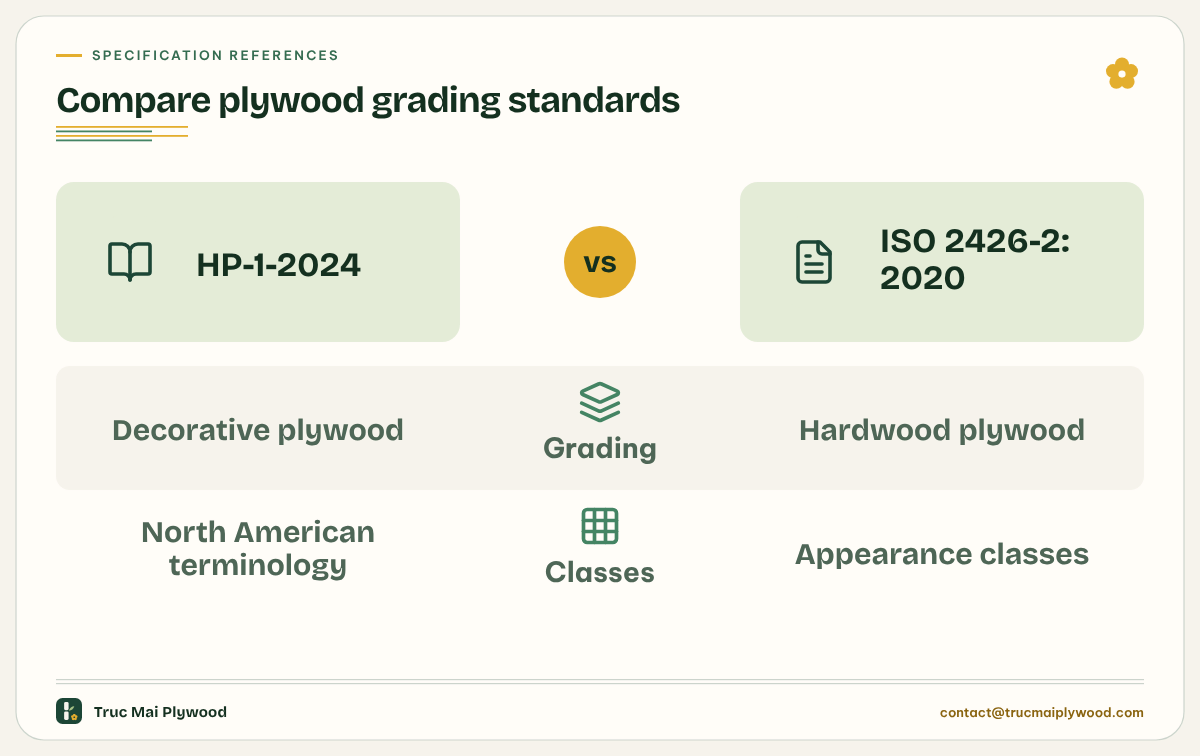
Use the standard as a shared vocabulary, then write the actual panel construction and acceptance tests into the contract. HP-1-2024 provides North American decorative plywood grading terminology, while ISO 2426-2:2020 describes hardwood plywood surface appearance classes E, I, II, III and IV. Trade grades such as B/BB require an agreed supplier description rather than an assumed one-to-one mapping.
A working specification starts with a reference sample for each visible face. Next record the core species, joining method, glue system, emission requirement, thickness tolerance and packing. When the order needs a standard test, identify the method and specimen configuration, and obtain the corresponding report for that product type.
| Specification line | What the buyer writes | What the mill checks |
|---|---|---|
| Application | Cabinet carcass, door skin or packing | Appropriate panel construction |
| Face/back | Species and approved appearance sample | Matching, repairs and sanding |
| Core | Named veneer species and joining | Gaps, lay-up and edge quality |
| Glue and emission | Separate adhesive and emission requirements | Bond and emissions documents |
| Size and tolerance | Nominal dimensions and allowed deviation | Calibration and trimming |
| Packing | Pack labels and shipment mix | Count and handling plan |
The plywood RFQ instructions turn these lines into a repeatable enquiry. For imported veneer faces, also specify the species and origin record so the invoice and due-diligence documents describe the same panel.
What documents verify a factory beyond association membership?
Three document groups matter: company and production evidence, product-specific test or certification evidence, and shipment records. A directory entry can introduce the mill, but the buyer needs to match each document to the actual construction ordered.
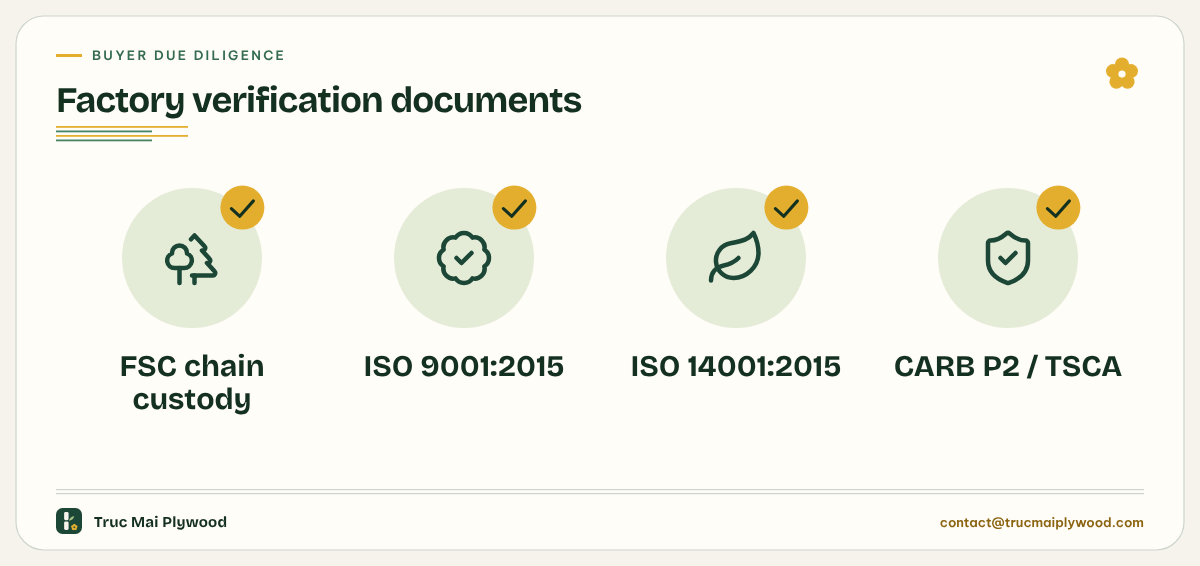
For FSC products, the FSC chain-of-custody standard requires the seller’s certificate code and the relevant FSC claim on sales documents. Truc Mai holds FSC chain of custody under certificate SA-COC-014545 and licence FSC-C196493, with FSC 100% available for eligible products. The claim should appear against the qualifying order line.
A quality-management certificate concerns the management system; a panel test concerns the panel. The mill also holds ISO 9001:2015 and ISO 14001:2015 certification for plywood manufacturing. For a US-bound veneer-core hardwood plywood order, its CARB P2 and TSCA Title VI certificate CARB/EPA26053 covers the specified 3–25 mm product scope. Check the ordered thickness and construction against the document rather than asking only whether the factory ‘has CARB’.
Before the deposit, request the sample record and the relevant certificate details. After loading, reconcile the packing list, invoice and bill of lading with the agreed specification. The documents per container page lists the shipping file separately from the product evidence.
How do EU and US compliance files differ?
EU importers need timber-origin due-diligence information and the applicable product documentation; US buyers of regulated hardwood plywood need the relevant formaldehyde certification and import records. The document sets address different legal questions and should be requested as separate folders.
For the US, 40 CFR Part 770 sets a formaldehyde emission limit of 0.05 ppm for hardwood plywood with veneer core. The rule addresses defined composite-wood product categories. Ask for the certificate covering the actual panel type, thickness and producer, then match the shipping and product descriptions.
For the EU, the EUDR file addresses origin and geolocation of wood used in the panel. A veneer-faced sheet can contain a Vietnamese core and an imported face, so origin records must cover both material streams. Truc Mai provides plot geolocation and origin files for its core and face veneer; the EU importer uses these records in its due-diligence process. The face veneer origin files and EUDR buyer dates explain the document request.
Keep bond performance, formaldehyde emissions and timber origin as distinct checks. A document addressing one cannot answer the other two. This makes a supplier comparison clearer and avoids treating an association logo as evidence of regulatory compliance.
How should buyers shortlist a mill from a directory?
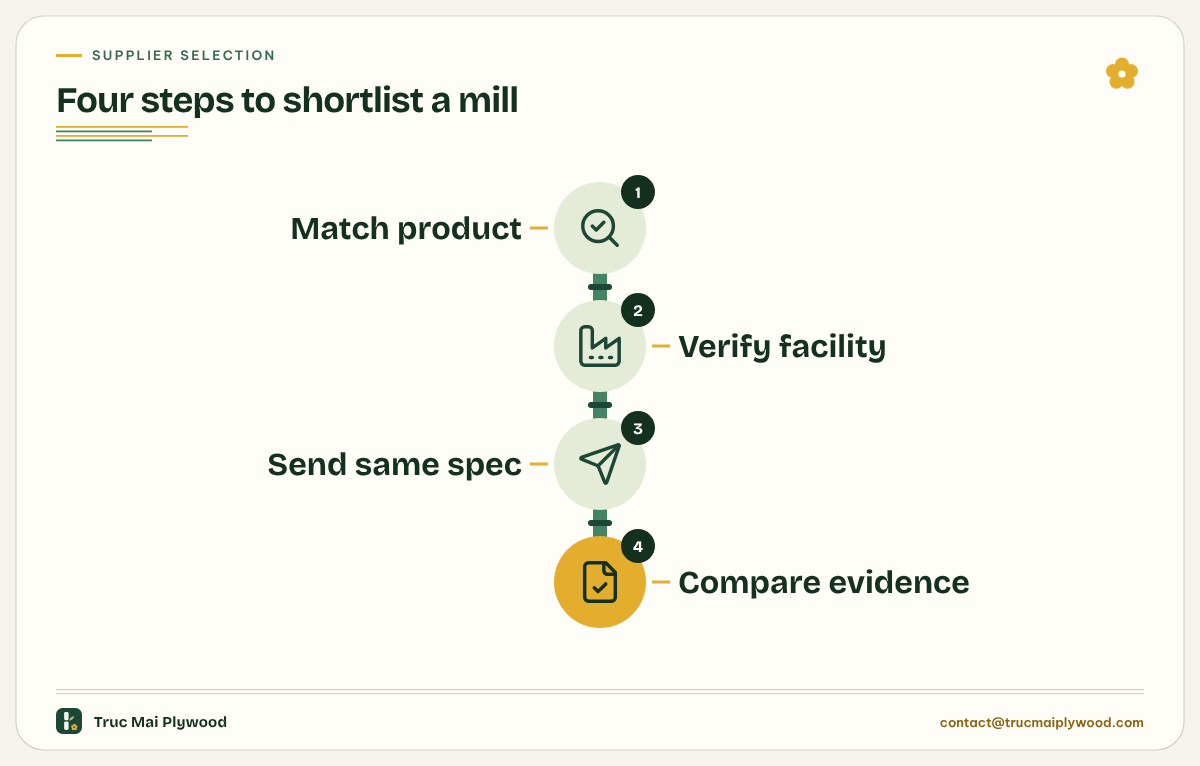
Shortlist factories against one written panel specification and one shipment requirement. A five-stage process turns a broad association contact list into a workable purchasing decision:
- Filter contacts by actual product, including face, core and application.
- Establish which facility presses, sands, trims and packs the panels.
- Send the same specification and destination market to each candidate.
- Compare approved samples, applicable certificates and the proposed packing plan.
- Place a controlled first order and record the accepted sample for repeats.
The most informative difference often appears in the edge, not the marketing description. Ask whether the outer core plies are stitched, whether the face is calibrated, and how the factory records thickness checks. Two sheets described as ‘18 mm birch plywood’ can differ in core species, joining, face appearance and weight.
A repeat buyer should also ask how the factory handles one product line across consecutive containers. The first-order-to-monthly-supply workflow addresses that handover. For a volume programme, compare freight on the same core and panel size, since a heavier construction changes the usable cargo volume.
What should a container-scale plywood enquiry contain?
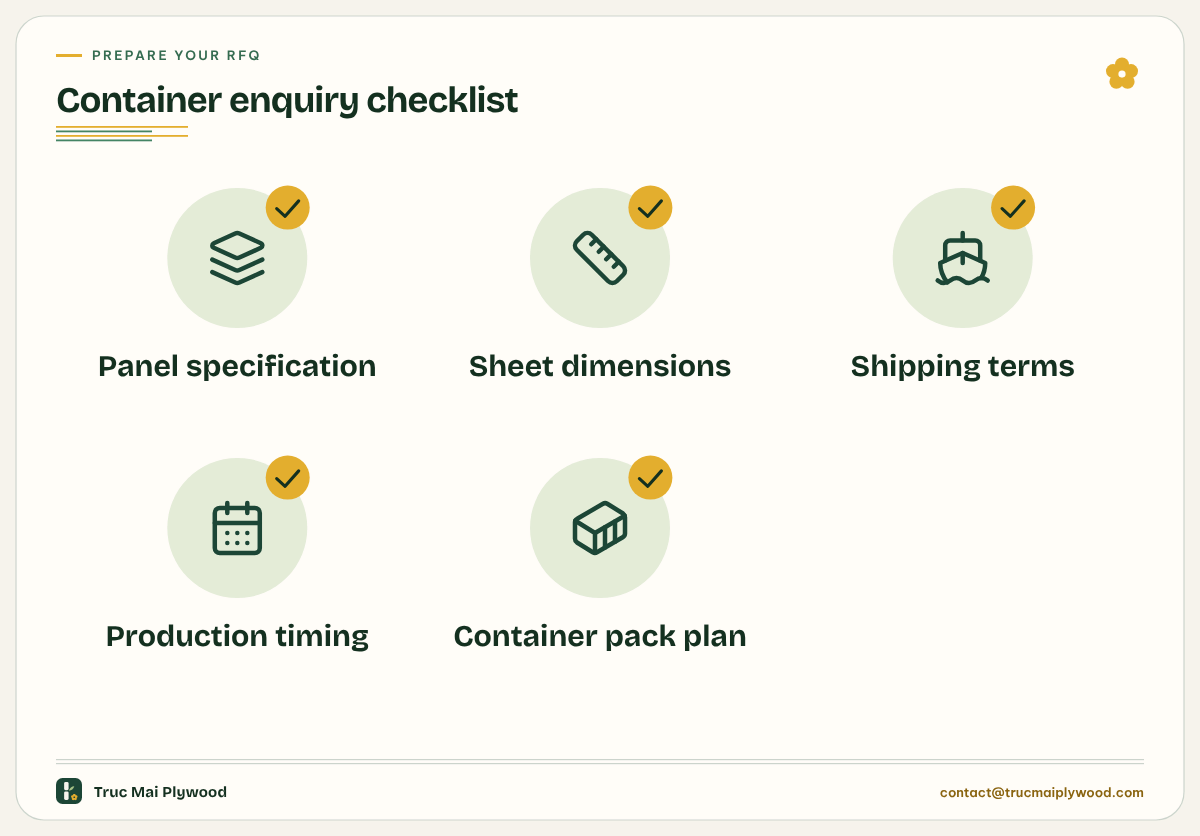
Send six specification lines plus the destination port: application, core, glue and emission, face/back, dimensions, and packing with quantity. For Truc Mai’s commercial and interior panels, the minimum order is one 40HC, with FOB Hai Phong, CFR or CIF terms available. Production is planned at 15–45 days after the deposit according to the agreed order.
A cabinet maker might ask for birch-faced plywood with a Styrax core, calibrated at an agreed tolerance, in 1220 × 2440 mm sheets. A packing buyer may choose a different core and face standard. The correct comparison uses the complete build, not the word ‘plywood’ alone.
The mill also offers cut-to-size panels with labelled pieces from standard sheets. State the finished-piece drawing and packing labels rather than assuming that a nominal cut dimension is automatically the usable piece size. Buyers can ask for a pack plan using the 40HC volume-by-thickness reference.
For a quotation, send the specification, shipment mix and destination to contact@trucmaiplywood.com or use the quotation route in the site’s navigation. Include the sample reference when ordering a repeat construction, so the response can be compared with the same approved panel.
Questions buyers ask
Is HPVA still the name used on plywood standards?
Yes. The association now uses the Decorative Hardwoods Association name, while ANSI/HPVA remains in the HP-1 standard designation.
Is an association membership a factory audit?
No. Check the producing facility, the sample and the relevant product documents separately.
Can an importer search IWPA by wood species?
Yes. IWPA describes a member search by product, species and business activity.
Does a plywood association issue an FSC claim?
FSC chain-of-custody claims are issued through the certified seller’s sales documentation for eligible products, rather than through ordinary trade-association membership.
What is HP-1-2024 used for?
It sets a common specification framework for decorative and hardwood plywood grades, construction and tests.
Should a buyer specify birch face and birch core separately?
Yes. State the face species and core construction independently to avoid receiving a different panel build.
Can a supplier quote from a photograph alone?
A photograph helps show appearance, but the RFQ should also include the core, adhesive, emission class, dimensions and packing.
What should accompany a first sample?
Ask for a written construction specification, face/back grade and a reference identifying the approved sample.
Can a Canadian association contact replace a mill quotation?
No. Use the contact to identify possible suppliers, then request a quotation against a single written specification.
Which document identifies the actual loaded sheet count?
The packing list records the loaded quantities and should match the invoice and order.