
A plywood data sheet should identify the panel build, face and core, thickness tolerance, adhesive, emissions, test evidence and packing. Read these lines against the intended use before comparing quotations. Truc Mai Plywood supplies furniture and commercial panels with specifications written for the ordered construction, so buyers can match samples, documents and repeat deliveries.
How to read a plywood specification sheet
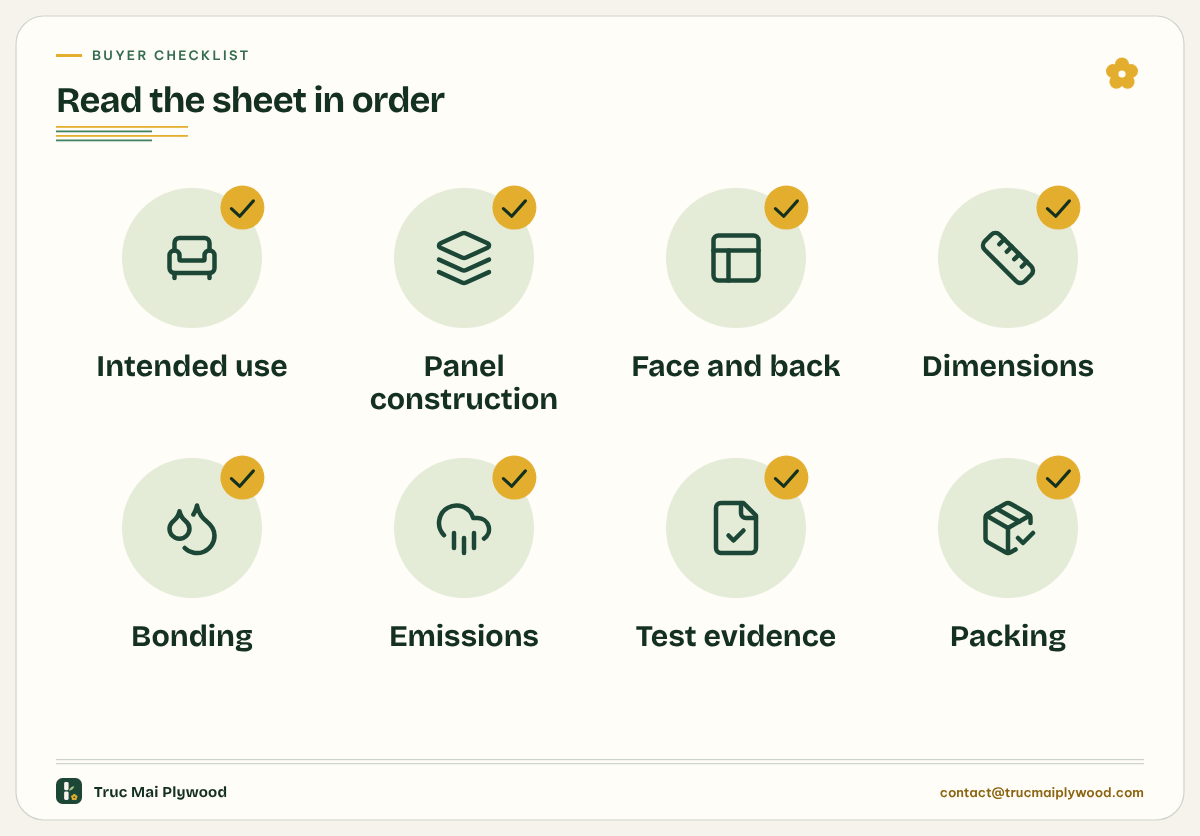
Read a plywood specification sheet in 8 steps: intended use, panel construction, face and back, dimensions, bonding, emissions, test evidence and packing. The order matters because two panels described as “18 mm hardwood plywood” can contain different veneers, core joints and adhesives. A buyer comparing quotations should put the same construction and acceptance criteria beside every supplier’s offer.
- Identify the application and whether the panel is decorative, cabinet stock or packing material.
- Record the face veneer and the separate core species; “birch-faced” describes the surface, not an all-birch construction.
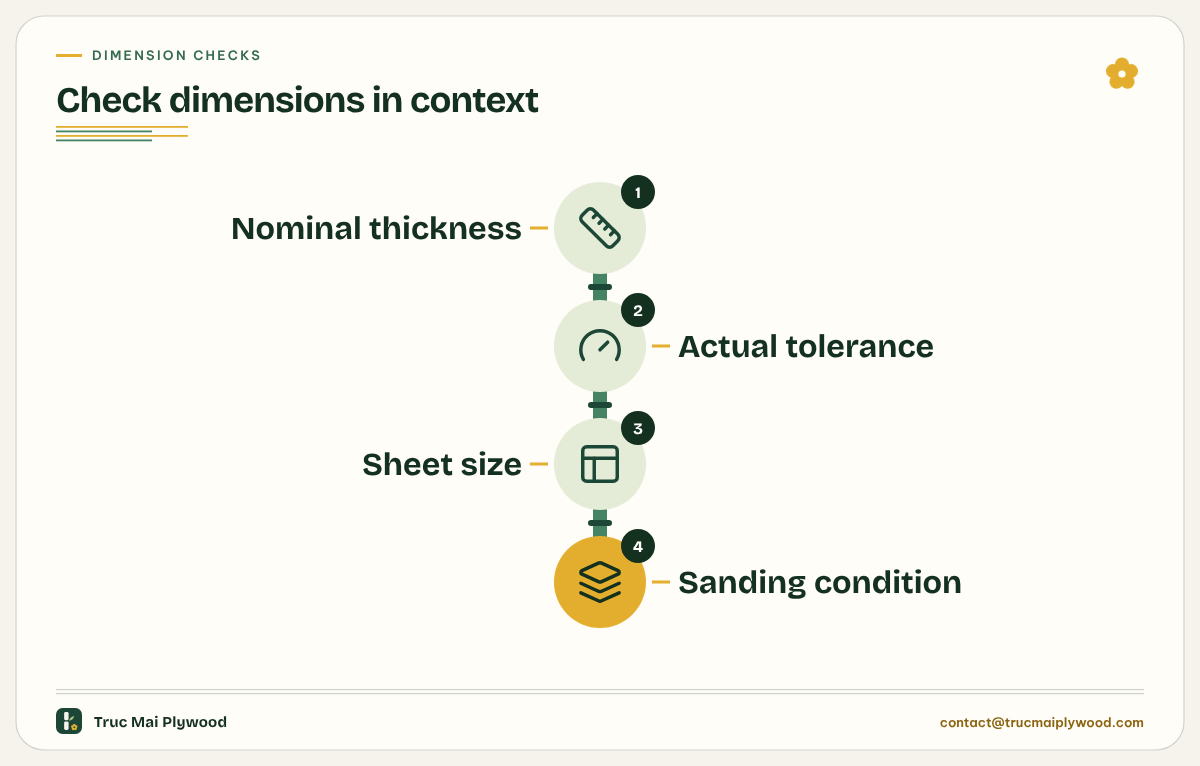
- Compare the nominal thickness, actual tolerance, sheet size and sanding condition.
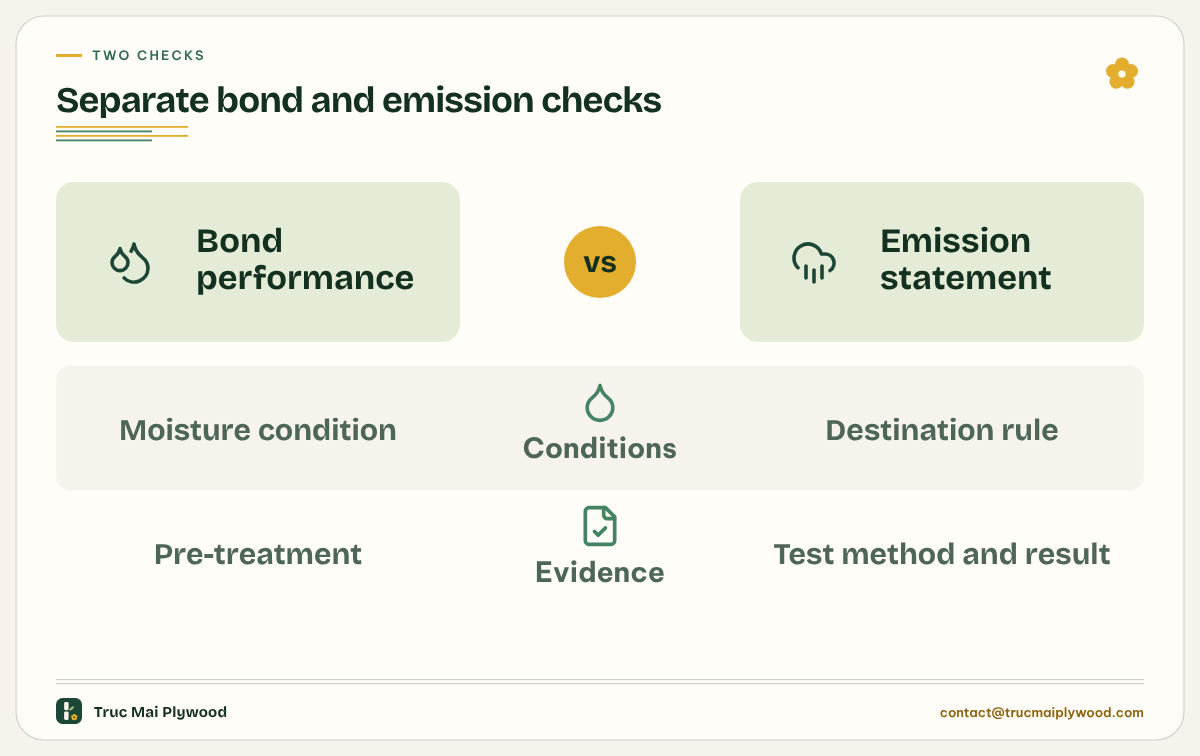
- Read the adhesive and bond performance separately from the emission statement.
- Match every certificate or report to its panel type, thickness and test method.
- Transfer the agreed specification into the purchase order and approved sample record.
The practical companion to this sequence is writing a plywood RFQ. The RFQ records what the mill must make; the TDS explains the properties being ordered.
What belongs on a plywood product data sheet?
A useful plywood product data sheet identifies a single panel build, with measured or specified characteristics and a document revision. A generic catalogue description is useful for selecting a family of products, but the purchase specification needs more detail.
| TDS line | Buyer should see | Why it changes the order |
|---|---|---|
| Product identity | Panel type, intended use, revision | Separates similar-looking products |
| Construction | Face, back, core species, ply arrangement | Controls appearance and internal build |
| Surface | Grade pair, sanding, overlay or coating preparation | Sets finishing and rejection criteria |
| Dimensions | Nominal thickness, tolerance, width, length | Sets machining allowances |
| Bond | Adhesive family and any documented bond test | Sets moisture-use expectations |
| Emissions | Regulation, product scope, method, evidence | Sets destination-market paperwork |
| Supply | Cut list, pack labels, quantity and loading documents | Makes receiving and repeat orders traceable |
Keep a version identifier at the top of the sheet. If a veneer source or construction changes, the purchasing team can compare revisions rather than rely on a familiar product name. A specification for cabinet grade plywood should give a face and back grade pair as well as core details.
Which core and face descriptions matter most?
Face species and core species are separate purchase decisions. Truc Mai Plywood offers engineered veneer (EV), poplar, bleached poplar, birch, okoume, bintangor, pine, eucalyptus, gurjan and sapele faces, with eucalyptus, acacia, styrax, pine or combined cores. A birch face over a Vietnamese veneer core should be described as birch-faced plywood.
A core line should identify whether the veneers are stitched, jointed or loose-laid. Furniture panels use an A-grade stitched core and sanded faces; commercial panels can use an AB core, jointed or loose-laid, with lighter surface preparation. These are construction choices with consequences for machining and edge appearance. The grade of the exposed face cannot describe gaps hidden inside the panel.
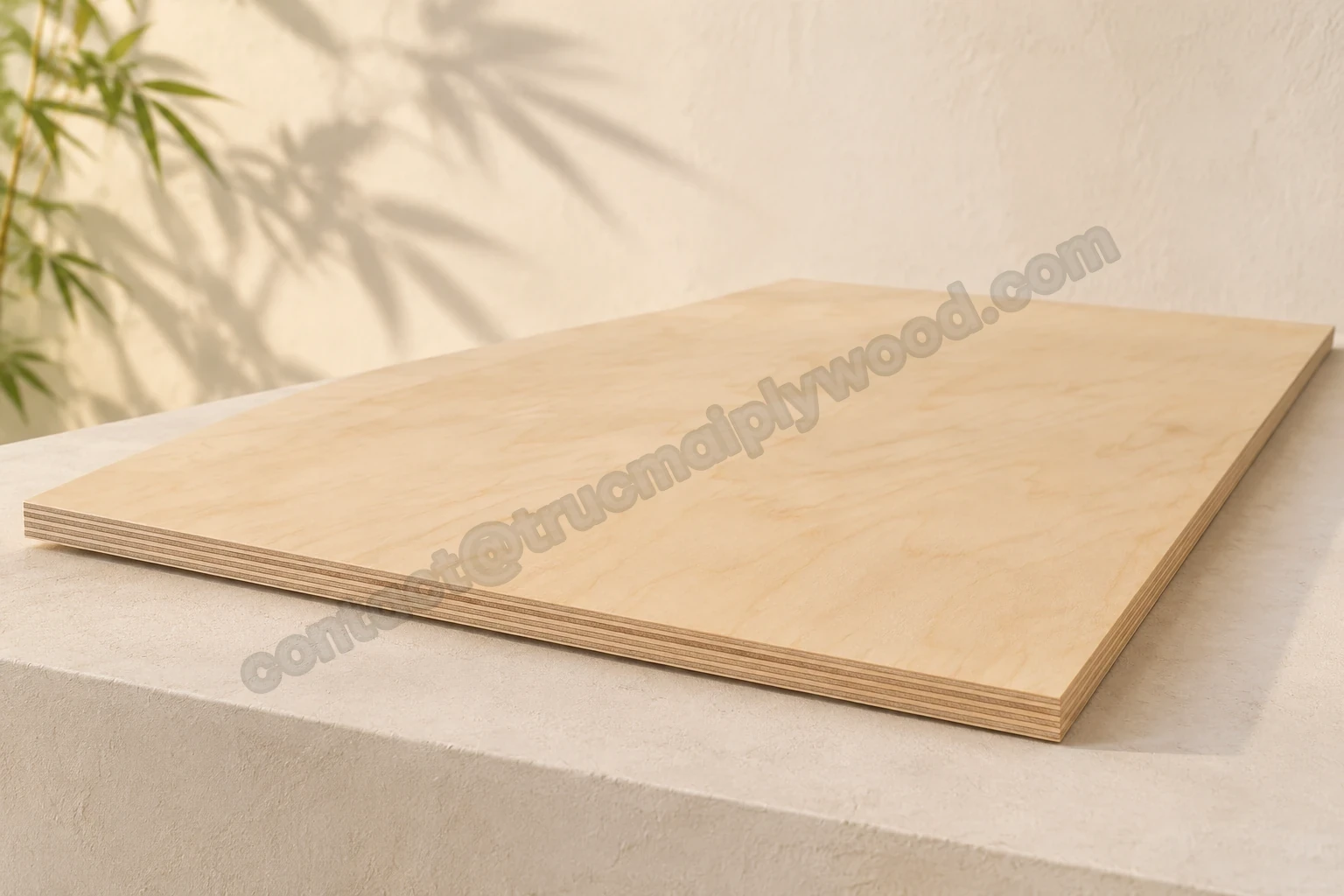
Ask for an edge photograph from the proposed build and a face photograph under ordinary workshop lighting. Compare the edge against the approved sample, especially at cabinet doors and visible shelving. The birch-faced plywood and engineered veneer plywood pages show two different surface choices without treating the core as the face species.
How should face and back grades be written?
Write two grades, one for the face and one for the back, then attach the approved sample. A/B and BB/CC are trade descriptions whose acceptance criteria need to be defined in the supplier’s own specification. A surface grade cannot be inferred from a photograph of an uncut pack.
The ISO 2426-2:2020 preview identifies hardwood appearance classes E, I, II, III and IV. Those classifications should not be silently equated with commercial letter pairs. Specify permitted knots, repairs, patches, colour differences and sanding marks against the physical sample. Record which side will remain visible after assembly.
A cabinet door with a decorative face and a concealed back needs a different grade pair from a panel whose two faces are visible. A packing panel has another acceptance standard. The Vietnamese plywood quality by grade article provides a useful purchasing context; the signed sample still determines the exact appearance ordered.
What do nominal thickness and tolerance tell you?
Nominal thickness is the target designation; tolerance describes the accepted measured interval. The mill’s standard panel range is 3–40 mm, with 1220 × 2440, 1220 × 2280 and 1250 × 2500 mm formats. For sanded and calibrated furniture panels, the order can specify ±0.3 mm; commercial panels commonly use ±0.5 mm, and length and width are specified at ±2 mm.
A TDS should distinguish the thickness measured at the edge from variation across the sheet. Record the method, measurement positions and whether the panel is sanded. EN 315 describes dimensional tolerances under defined moisture conditions; a supplier’s tighter contractual tolerance is a separate line to agree. Compare an offered thickness tolerance with the finished cabinet component, rather than accepting “calibrated” as a substitute for a number.
For a familiar reference configuration, see 18 mm plywood loading and specification. When a drawing calls for finished components rather than full sheets, put the cut drawing and piece tolerance on the same order line.
How do glue, bond class and moisture exposure differ?
Glue type names the adhesive; bond class describes tested performance under defined conditions. A TDS should show both where the buyer needs a moisture-performance claim. Urea-formaldehyde (UF) is common for interior plywood, while melamine-fortified systems can be selected for wetter service. The presence of a particular resin name alone does not establish an EN bond class.
EN 314-2 distinguishes Class 1 dry, Class 2 humid and Class 3 exterior bond conditions. The Class 2 pre-treatment includes a six-hour boiling-water stage under EN 314-1; Class 3 uses more demanding pre-treatment. These are bond tests, not emission tests. The order should name the test standard and class only where the actual panel build has supporting results.
The phrase “WBP plywood data sheet” often appears in enquiries. Replace the broad trade description with the adhesive system, intended exposure and the requested test evidence. The exterior glue panels range is a starting point for discussing adhesive options for non-structural panels.
Which formaldehyde figures belong on a TDS?
An emission entry needs the destination rule, product scope, test method and result or certification evidence. “E0” by itself supplies no single harmonised European limit under EN 13986. Keep resin chemistry and formaldehyde emissions on different lines, and do not convert a chamber result in ppm into a result in mg/m³.
For US hardwood plywood with veneer core, 40 CFR 770.10 specifies 0.05 ppm under TSCA Title VI. The EU Commission’s July 2023 explanation of the formaldehyde restriction gives 0.062 mg/m³ for furniture and wood-based articles under its specified testing conditions. The methods and legal scopes differ.
The mill holds CARB Phase 2 and TSCA Title VI certification, CARB/EPA 26053, for hardwood plywood with veneer core in the 3–25 mm scope. The TDS for a qualifying build should identify the certificate and its scope; thicker configurations need their own evidence. See Phase 2 formaldehyde limits when assembling a US buyer’s document set.
Which standards on another supplier’s sheet apply to your panel?
A standard applies only to the product and purpose within its scope. The NIST PS 1-22 structural plywood standard addresses structural panel grades, bonds, dimensions and marking. Its structural performance categories should not be copied onto a furniture-panel sheet without the corresponding product evaluation.
For European documents, EN 636 describes plywood conditions of use, EN 314 addresses bond testing and EN 315 addresses dimensions. They answer different questions. A supplier might quote an EN bond test without offering a structural panel, or quote a dimensional tolerance without declaring an EN service classification. Keep each entry tied to its report and intended application.
The most useful comparison is a matrix of claimed standard, tested property, panel configuration and supporting report. Empty cells reveal what the buyer must specify in the contract. A standards acronym printed on a pallet is less informative than a traceable report for the actual ordered construction.
What do plywood markings and pack labels prove?
A pack label identifies goods; a certification mark has meaning only within its scheme and authorised scope. For commercial plywood, a practical label includes product description, thickness, sheet dimensions, grade pair, quantity, lot reference and destination or buyer code. Those fields allow receiving staff to reconcile packs with the packing list.
Do not confuse a manufacturer code with a laboratory report number. The former helps trace production; the latter identifies test evidence. If a label mentions a standard, check the corresponding product declaration rather than reading the mark as a universal approval for every use. The same logic applies when a warehouse mixes grades in one container.
The documents per container page separates the commercial invoice, packing list and supporting compliance papers. For repeat purchasing, keep the label format identical between the approved sample, first shipment and subsequent orders.
How do FSC and origin records fit alongside the sheet?
FSC chain-of-custody evidence belongs in the transaction file, with the product claim on the sales document. Under FSC-STD-40-004 V3-1, the seller’s certificate code and the claim for each qualifying item are recorded on sales documentation.
The mill’s FSC licence is FSC-C196493 and its chain-of-custody certificate is SA-COC-014545. The eligible product claim is FSC 100% within the certificate’s product schedule. Buyers should match the order description and sales-document claim to the eligible line. The FSC licence verification page explains the check.
EU origin files answer another question: where the core wood and face veneer came from. The mill supplies plot geolocation and origin records for both components as part of its EUDR dossier. Keep those files linked to the product identity on the TDS, without placing confidential plot information on a public sheet. See face veneer origin files for the separate veneer trail.
How should a buyer compare two plywood product data sheets?
Compare like-for-like construction before comparing commercial terms. Put the two offers into columns and highlight every difference that affects machining, finish, compliance or receiving. A shared headline such as “hardwood ply” is not an equivalence test.
| Comparison question | Sheet A | Sheet B | Buyer action |
|---|---|---|---|
| Same core species and joining? | Record actual build | Record actual build | Ask for edge sample |
| Same face/back grade pair? | Record sample code | Record sample code | Compare approved faces |
| Same tolerance and sanding? | Record measurements | Record measurements | Check machine allowance |
| Same adhesive and bond evidence? | Record report | Record report | Match use conditions |
| Same emission scope? | Record certificate | Record certificate | Match destination |
| Same pack and label specification? | Record pack line | Record pack line | Check receiving process |
Before accepting either sheet, copy the proposed panel identity into a comparison record. Include the face and back veneer descriptions, core species, joining method, thickness, sheet format and surface preparation. Put the supplier’s document revision beside the sample reference. A quotation that lists only a nominal thickness and a broad grade name leaves the purchasing team unable to identify which construction was approved. Ask for the missing construction fields in writing before comparing the offers.
Treat a reported test as evidence for a defined product rather than as a substitute for the specification. Record the report identifier, testing method, sampled construction and applicable thickness range beside the claimed property. Keep bonding results separate from emissions evidence: a moisture bond test cannot establish a formaldehyde emission result. Where a buyer requires certification for a destination market, compare the covered product category with the panel on the quotation. A certificate covering veneer-core hardwood plywood does not automatically describe a different core construction.
Finally, compare the receiving instructions. A purchase specification can identify pack quantity, lot labels, grade markings and the documents expected with the shipment. Ask how mixed panel specifications will be separated on the packing list and on individual packs. For repeat orders, use the same approved sample identifier and revision on the purchase order, supplier confirmation and receiving record. This gives the warehouse a clear way to identify a changed face grade or core build before panels enter production.
A buyer making furniture can give greater weight to face appearance and calibrated thickness. A packing buyer can prioritise the core construction and handling requirements. Keep the final decision tied to the intended product rather than the number of standards printed on the sheet. The supplier shortlist checklist adds mill-verification questions beyond the TDS.
What should a sample approval record contain?
An approval record should connect the physical panel to the specification revision, grade pair and acceptance criteria. Mark the sample with its panel type and date, then record the face appearance, edge construction, thickness measurements and finishing trial. A photo is useful for reference, but the retained sample gives a direct comparison when a later shipment arrives.
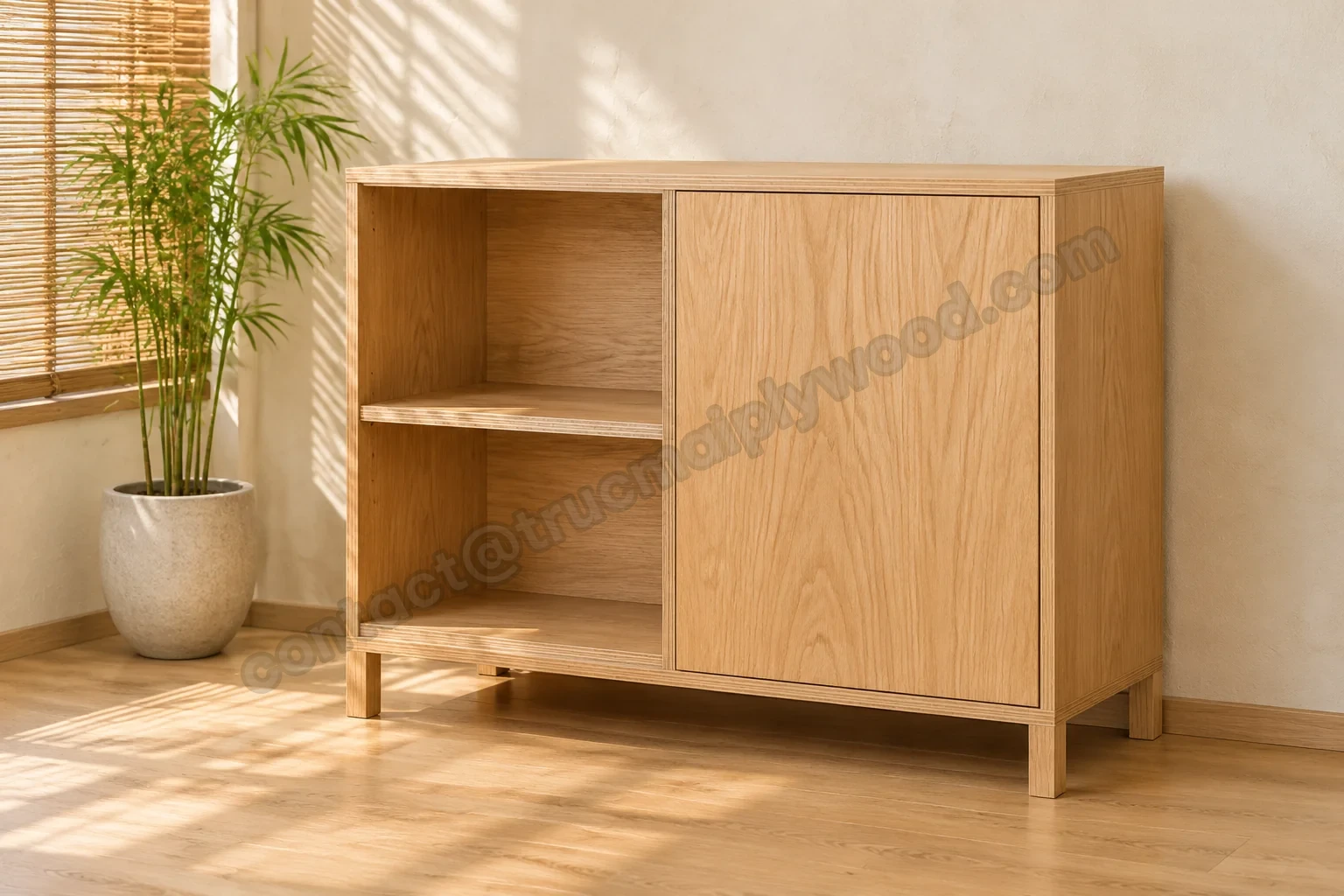
For a kitchen cabinet buyer, inspect the panel after sawing, edge treatment and the intended surface finish. Note any repair visibility, core openings or sanding marks against the agreed sample. For a veneered door skin, the face colour and the finishing response matter more than a generic grade name.
If a specification is revised after approval, issue a new sample reference. A purchasing team should be able to tell whether a changed face veneer, altered glue system or new cut pattern has been accepted. The ordering samples page sets out how to request representative panel pieces.
How should cut-to-size plywood be specified?
Cut-to-size orders need a drawing, finished piece dimensions, orientation, edge requirements and a label scheme. Available patterns include halves such as 610 × 2440 mm, thirds such as 1200 × 800 mm, quarters such as 1220 × 610 mm, and six-piece cuts. The exact pieces are agreed from the parent sheet and cut list.
The TDS still describes the original panel construction. The cut list adds the parts to manufacture and how they are packed. A buyer should state whether veneer grain must run along the long or short edge of each component, and whether mixed sizes can share a pack. Labelled components simplify warehouse counting and factory feeding.
Ask the mill to return a marked-up cutting diagram with the quotation. Compare that diagram against the production drawing before confirming the order. The panels cut at the mill page describes the available service without assuming that every drawing fits every parent sheet.
What belongs in the final purchase specification?
The purchase specification should identify the approved build, measurable acceptance points and documents to accompany the shipment. Start with application, core, glue and emission requirement, face and back, dimensions, packing and quantity. Add the sample code, revision and required certificate scope.
For example, a cabinet panel order can state: “Birch-faced plywood, styrax core, stitched A-grade construction, sanded and calibrated, 18 mm, 1220 × 2440 mm, ±0.3 mm thickness, face/back grades to approved sample; UF glue at E0 emission specification; packing and label details per agreed schedule.” Any emission statement should be accompanied by the specified test method or applicable certificate in the order file.
Use a single document revision for purchasing, production and receiving. At shipment, reconcile the product lines with the packing list and any certificate records. For a first order, verify the mill before the deposit and request the agreed sample and documentation together.
How can you request a TDS for your own panel build?
Send a complete RFQ using the plywood RFQ guide and include the panel’s application, core, glue and emission requirement, face and back, sheet size, thickness tolerance, packing, quantity and destination port. Include the intended finishing process and any document scope needed by the importer. The response can then describe one manufacturable build rather than a generic product family.
For a repeat programme, ask for the same revision code on the TDS, approved sample and order confirmation. If the application changes, request a separate configuration so the receiving team does not confuse similar-looking sheets. A full-container purchase can include multiple agreed products, each with its own specification line and pack identification.
Send the details to contact@trucmaiplywood.com or use the quotation route listed in the site navigation. Specify the final destination and the documents required at the time of ordering, then use the approved specification as the reference for subsequent containers.
Send your specification to contact@trucmaiplywood.com or through the quotation form.
Questions buyers ask
Is a TDS the same as a test report?
No. A technical data sheet describes a product configuration and its specified properties; a test report records results from an identified sample and method.
Can I compare an E0 statement with an E1 certificate?
Only after identifying the test methods and limits used. E0 is not a harmonised EN 13986 emission class.
Does a birch face mean a birch core?
No. Birch-faced plywood can have a different veneer core; the core species should be written separately.
Should the TDS name the face and back grades?
Yes. Specify the grade pair and the approved sample that defines acceptable appearance.
Is a pack label enough for FSC purchasing?
No. The qualifying product and FSC claim should appear with the seller certificate code on the sales documents.
Can the same TDS cover every thickness?
A family sheet can list variants, but test and certification scope should identify which thicknesses and constructions are covered.
What should I request for a US veneer-core panel?
Ask for the product configuration and the CARB Phase 2 or TSCA Title VI certification evidence applicable to that panel.
Do I need a cut list for small plywood parts?
Yes. Supply finished dimensions, grain orientation, piece quantities and pack labels for each cutting pattern.
What does a revision number achieve?
It connects the approved specification to the sample, order and later shipments, making changed construction details visible.
Should a TDS include shipping terms?
Keep shipping terms in the quotation or contract; the TDS should identify the panel and the packing specification used for shipment.