
A plywood sds describes hazards from handling and processing panels, especially airborne wood dust and possible formaldehyde exposure. US rules exempt some finished articles, but plywood that will be sawn or sanded needs closer hazard-communication review. Truc Mai Plywood buyers should request product-specific safety information alongside separate emission and shipping records.
Does plywood need a safety data sheet?
Yes. Plywood that will be sawn or sanded can create hazardous wood dust and does not qualify for the US wood-products exemption on that basis. Some unprocessed wood products and finished articles are exempt. 29 CFR 1910.1200(b)(6) distinguishes these cases by hazards and normal use.
For a US importer supplying cabinet factories, a safety-information request belongs in the purchase review. Ask the producer to identify the panel construction, describe cutting and sanding hazards, and provide the applicable hazard communication document. A buyer distributing finished panels for use without processing should assess the article conditions separately. US plywood import steps covers the wider import file.
What is a plywood sds, and what should it identify?
A plywood SDS is a safety data sheet describing a particular panel’s hazards, handling precautions and emergency measures. It is often searched for as a plywood MSDS, the older name for the same type of workplace document. The current US framework sets out 16 SDS sections in 29 CFR 1910.1200(g).
The identification section should let the receiving team match the document to the goods: product name, supplier details, intended use and an emergency contact where relevant. For plywood, the panel description matters because an uncoated veneer-faced board and an overlay-faced board have different surface materials. A generic title such as “wood panel” gives purchasing staff too little information to connect the safety document to the order.
Match the identifier against the sample label, purchase specification and packing description. Keep revisions together with the relevant order record. A sheet copied from an unrelated product family should never be treated as the producer’s document for the purchased goods.
Which SDS sections matter most to a plywood importer?
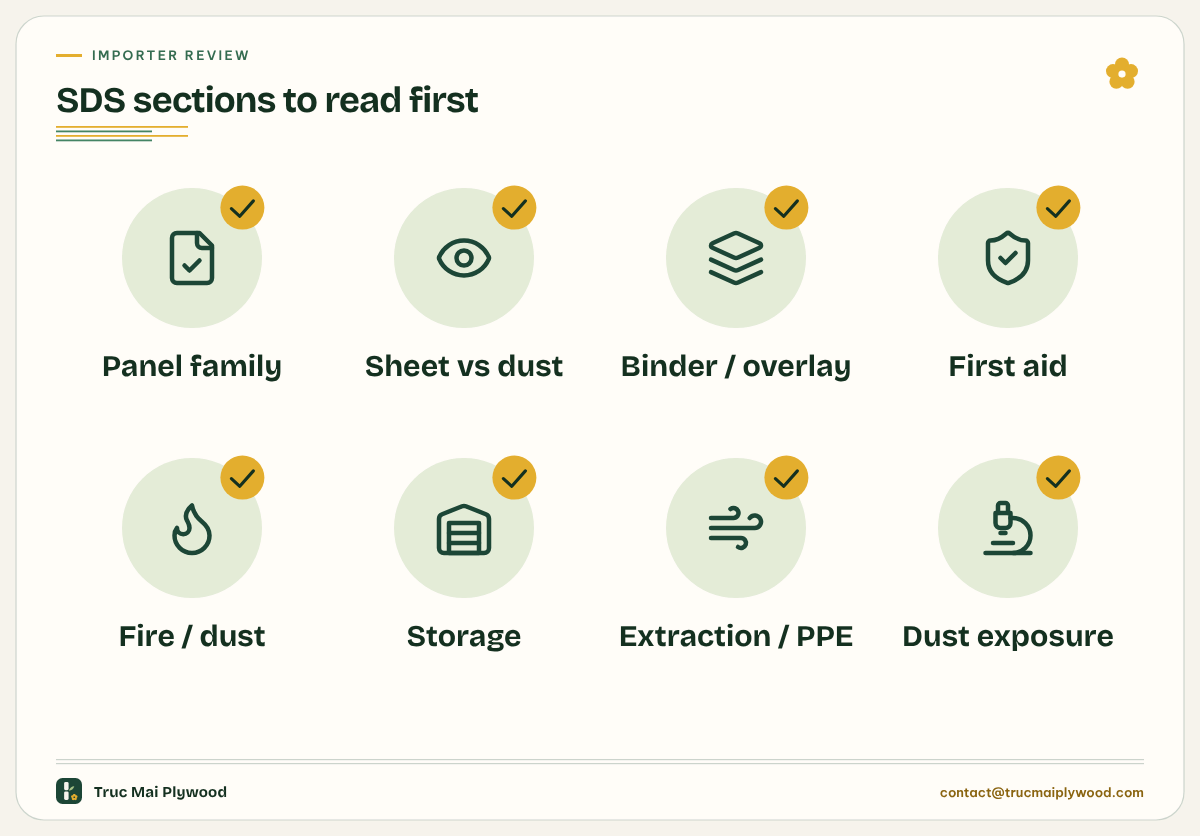
Sections 1, 2, 3, 4, 7, 8, 9, 10 and 11 deserve the first reading because they connect the supplied material with hazards, controls and first aid. The full 16-section structure also covers fire response, spills, disposal, transport and regulatory information. The US Hazard Communication rule sets the required format and the content rules.
| SDS section | Buyer check | Why the detail matters |
|---|---|---|
| 1 Identification | Exact panel family and supplier | Connects document to the order |
| 2 Hazard identification | Shipped sheet versus dust-producing work | Guides receiving and workshop briefing |
| 3 Composition | Wood and relevant binder or overlay constituents | Flags a construction mismatch |
| 4 First aid | Eye, skin and inhalation response | Supports workplace instructions |
| 5 Firefighting | Fire and dust considerations | Informs storage and housekeeping |
| 7 Handling and storage | Cutting, stacking and storage practices | Supports warehouse procedures |
| 8 Exposure controls | Extraction and personal protection | Helps workshop risk assessment |
| 9 Physical properties | Panel form and material description | Checks document applicability |
| 10 Stability and reactivity | Heat and incompatible conditions | Helps process planning |
| 11 Toxicological information | Dust and chemical exposure routes | Supports health training |
A well-prepared safety sheet distinguishes the solid board as delivered from dust or fumes created during processing. Buyers should read both situations, since the same shipment may pass through a warehouse and then a machining line.
What does the SDS say about wood dust?
Wood dust is the central workplace hazard when plywood is sawn, routed, drilled or sanded. The US Occupational Safety and Health Administration (OSHA) identifies respiratory irritation, asthma, dermatitis and other serious effects associated with wood-dust exposure in its woodworking health guidance. A clean, intact sheet and a cutting station create different exposure conditions.
Dust is released at the blade or abrasive surface. The practical control is extraction close to that point, followed by suitable housekeeping and worker protection. OSHA describes local exhaust ventilation as the principal method of controlling airborne wood dust. A workshop should match the extraction hood to its saw or sander rather than relying on open doors or general room airflow.
For a furniture buyer, this is relevant to all core choices. Styrax, Acacia, Eucalyptus and Pine veneers are machined into panels and can produce dust when cut. A face veneer changes appearance and surface machining characteristics, but it does not remove the need to control airborne particles.
How does formaldehyde appear in a plywood safety sheet?
Formaldehyde may be discussed as a constituent or exposure concern where the panel’s adhesive system contains formaldehyde-based resin. The SDS explains relevant hazards and handling; emission compliance is checked using a separate product standard and test evidence. The distinction is important because a hazard description does not state the chamber-test result of the ordered panel.
For US-bound hardwood plywood, 40 CFR 770.10 sets a formaldehyde emission limit of 0.05 ppm for the covered hardwood-plywood categories, using the specified test framework. The US Environmental Protection Agency (EPA) explains the certification, labelling and record requirements on its composite wood products page.
A buyer comparing documents should put the SDS beside the panel’s emission certificate, not substitute one for the other. The Phase 2 formaldehyde limits page deals with that separate compliance question.
How is a plywood SDS different from an emission certificate?
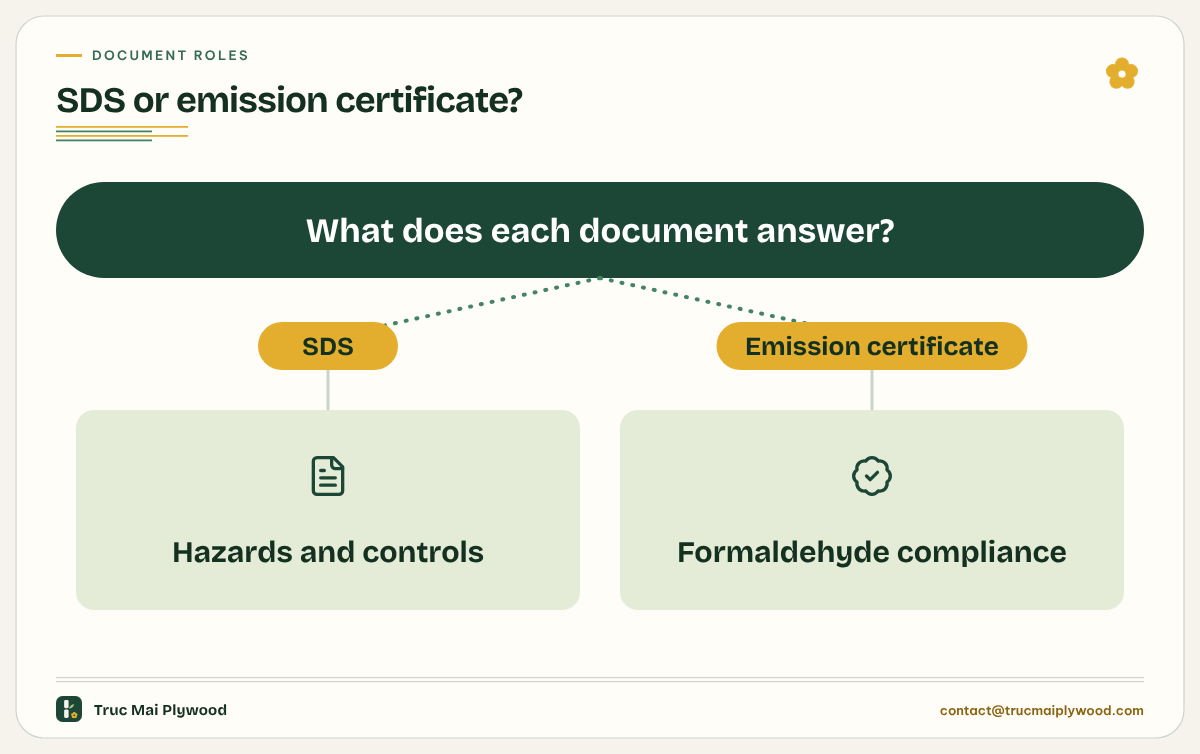
An SDS communicates workplace hazards; an emission certificate identifies the product scope tested or certified under an emission programme. Their purposes, readers and evidence are different. Procurement staff need both types of information when the destination and downstream operations call for them.
| Document | Main question answered | Detail to match |
|---|---|---|
| Safety data sheet | How is the panel handled and processed safely? | Product identifier, hazards, controls, revision |
| Emission certificate | Which panel construction is within the certification scope? | Product type, thickness, certifier, certificate identifier |
| Technical data sheet | What was specified for the purchased board? | Face, core, adhesive, thickness, dimensions |
| Packing list | What was actually loaded? | Packs, sheet count, net and gross weights |
| Commercial invoice | What goods were sold? | Product description and order references |
Truc Mai’s CARB Phase 2 and TSCA Title VI certification, CARB/EPA 26053, covers hardwood plywood with veneer core in the 3–25 mm range. The certificate is tied to that defined product scope. An importer should carry the correct scope into the purchase line, the panel label and the document folder. The documents per container page sets out the shipment paperwork.
Does a plywood SDS cover every core, face and overlay?
No. The document must describe the relevant panel construction, including material differences that change hazard information. A product family can share a document when its assessed hazards and composition support that scope; buyers should check the identification and revision rather than assuming all plywood is identical.
An order can combine an EV face with a Styrax core, a birch face with an Eucalyptus core, or a melamine surface over a veneer-core panel. Those configurations should be clearly described on the order. Birch-faced plywood means a birch veneer face on the specified core, rather than an all-birch construction.
For purchasing, begin with the actual application and then state face, core, adhesive system, emission requirement and overlay. The supplier can then match the safety information to the build. Where a mixed container carries several panel types, list each type separately so receiving staff can match documents without guessing from a common container number.
What should a US importer check before the container ships?
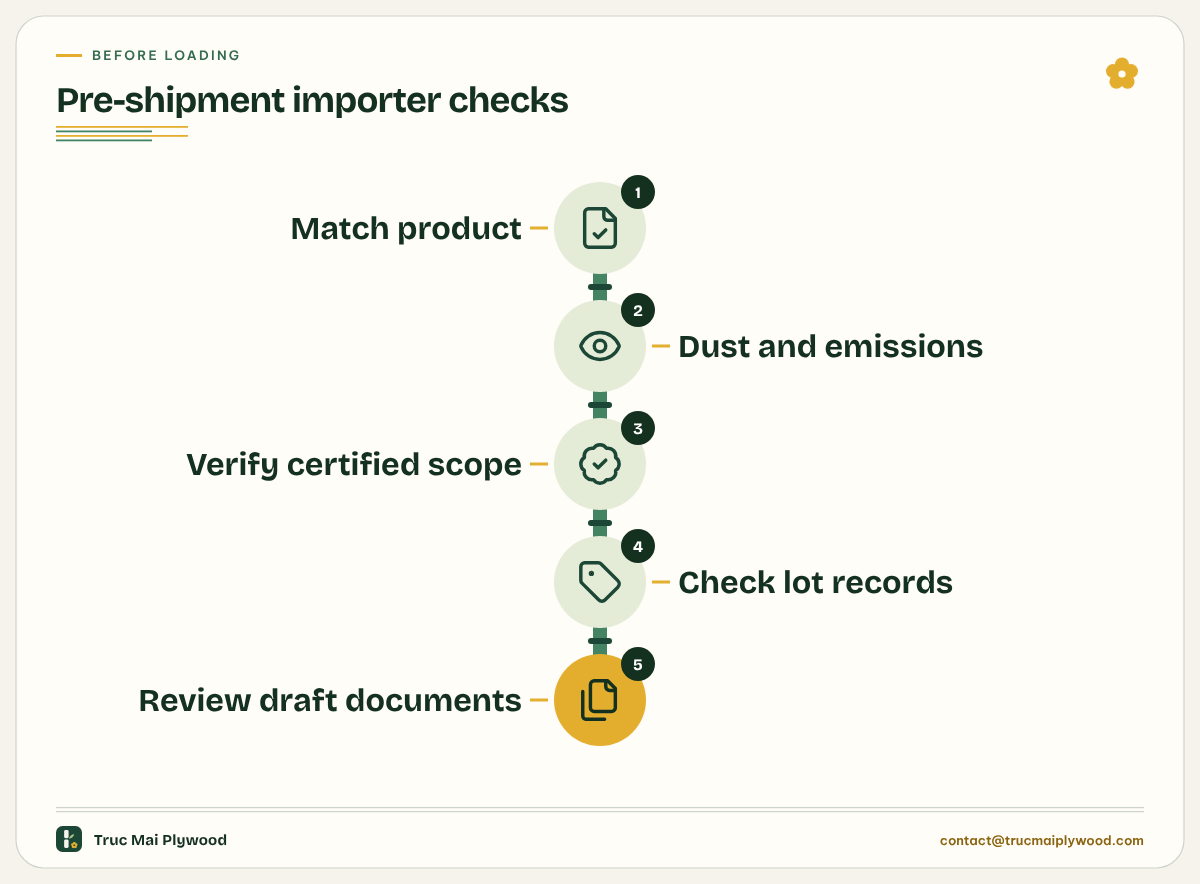
Check the product identity, SDS revision, emission certification scope and shipment description before the documents are finalised. The EPA’s regulated stakeholder questions explain how panel labels connect to the producer, lot and third-party certifier.
- Match the safety sheet’s product name to the approved sample and purchase order.
- Read the dust and formaldehyde sections for the actual downstream operations.
- Compare the certified product type and thickness against the ordered construction.
- Check that labels and accompanying records identify the producer and relevant lot.
- Ask for draft commercial and packing descriptions before shipment documents are issued.
- File the final SDS with the receiving and workplace safety records.
This review is particularly useful for a repeat container programme. A stable specification makes document matching faster, while a new overlay or adhesive calls for an updated review. The mill verification checklist helps buyers organise pre-order evidence.
What does the SDS mean for cutting and sanding at the buyer’s factory?
It means the receiving team should pass the dust-control information to the workshop before the panels reach the saw. OSHA’s wood-dust control guidance identifies extraction at the cutting point as the main engineering control. Machine setup, extraction maintenance and cleaning routines belong in the factory’s own risk assessment.
A cabinet line may trim full sheets, drill hinge holes, rout edges and sand faces. Each operation changes how particles are released. Staff who only unload and stack intact packs face a different work pattern from operators feeding panels through a saw. The safety briefing should reflect that distinction rather than give every worker the same generic instruction.
For pre-cut panels, the mill can supply labelled pieces from an agreed cut list. This moves some cutting away from the buyer’s workshop, while any later machining still needs its own dust controls. A buyer can request ordering plywood samples before setting the production cut list.
How should an importer read the fire and combustible-dust information?
Read the fire section together with the dust-hazard section, because airborne fine wood particles present a different hazard from stacked solid sheets. OSHA’s plant-wide woodworking hazards include fire and explosion alongside dust exposure. The document should guide storage, ignition-source controls and dust collection practices.
The relevant workshop question is where dust accumulates: inside extraction ductwork, on machine ledges, near motors or around a collection point. An importer supplying panels to furniture workshops should communicate the hazard without presenting the boards as a regulated dangerous-goods cargo solely because they are combustible.
Keep safety-sheet fire information distinct from a fire-resistance classification for a building product. A search for “fire rated plywood msds” often combines these unrelated needs. Fire performance requires its own product evidence; an SDS is concerned with handling hazards and emergency response.
What is different for Canada, Australia and Middle East buyers?
The destination’s workplace hazard-communication rules determine the required format, language and classification details. The US 16-section structure is a useful reading framework, but it should not be treated as a substitute for destination-specific review. Importers should give their supplier the destination and the intended downstream operation when requesting safety information.
For Canada, ask the receiving safety team to check the document against its workplace hazardous-product requirements. For Australia, the workplace health and safety team should check the applicable safety data sheet rules and the local handling procedures. For a Middle East destination, the importer should identify the relevant national requirements and the language needed by its workforce.
The underlying technical questions stay practical: what is the panel, what happens when it is machined, what controls are required and how is the document matched to the goods? The plywood import guide covers the broader trade sequence without mixing it into the workplace safety review.
How can buyers compare safety information from two plywood suppliers?
Compare documents against the same purchase specification, not against the length or graphic design of the SDS. A document that clearly identifies the product and explains dust controls is more useful than a generic sheet that cannot be linked to the supplied panel. Compare revision dates, stated product scope and the hazards addressed.
Start with one defined furniture-panel specification. Give both mills the same core, face, adhesive and surface requirements, and ask each to identify the matching SDS and emission evidence. Review whether the supplied documents identify the actual product rather than a broad category with no construction detail.
For a repeat order, check whether the next shipment uses the same approved build. If the supplier proposes a new face or overlay, review the revised documentation at the same time as the sample. This makes document control part of specification control, rather than an afterthought at the port.
What should a Truc Mai plywood order say about safety documents?
The order should name the application, core, face, adhesive and emission specification, panel size, packing arrangement and quantity, with a request for the matching safety information. Truc Mai Plywood manufactures furniture/interior and commercial plywood in Ha Hoa, Phu Tho, Vietnam, with an annual capacity of around 60,000 m³. Those product details allow the mill to prepare a consistent order file.
For example, a cabinet maker can specify birch-faced plywood on Styrax core, UF glue at E0 emission to the agreed test specification, sanded faces, 1220 × 2440 mm sheets and a thickness tolerance of ±0.3 mm. A packing-panel buyer can request a different face and core construction, with the grade and tolerance written against the approved sample.
Ask for the product-specific SDS, the applicable emission evidence and the technical specification in the same document request. Writing a plywood RFQ shows how to set out the product lines so they can be compared across offers.
How do you request the right documents with a quotation?
Send one complete specification and ask for the safety and compliance file for that exact construction. The quotation request should describe the downstream processing operation, since a factory that will sand every sheet needs different handling information from a distributor selling uncut panels.
Include the application, face and back appearance, core species, adhesive and emission target, thickness and sheet dimensions, packing, quantity and destination port. Add whether the buyer needs a workplace SDS, a technical data sheet, a formaldehyde certificate or all three. The requested documents can then be indexed to the same product line.
Use the quotation desk for the specification or send the details to contact@trucmaiplywood.com. Include any required destination-language version and identify the receiving team that will review the safety sheet. The next step is a document set matched to the agreed panel, followed by sample approval and the final order specification.
Questions buyers ask
Is an MSDS different from an SDS?
MSDS is the older name for a material safety data sheet. Ask for the current safety data sheet for the exact panel construction and destination market.
Can a plywood SDS be used for every veneer face?
Use a sheet that identifies the supplied product family and its relevant materials. A changed overlay, coating or adhesive system calls for a fresh document review.
Should a distributor send the SDS to a cabinet workshop?
Send the product safety information with the panel specification, particularly when the workshop will cut, rout or sand the sheets. The workshop uses it to plan dust controls.
Is a certificate number printed on the SDS?
An SDS identifies hazards and handling measures. Ask separately for the applicable formaldehyde certification and product identification records.
Does an SDS state the plywood face grade?
A safety sheet is not a grading schedule. Specify the face and back grades against an approved sample and put them on the purchase order.
Can I request an SDS before paying a deposit?
Yes. Request the current document for the proposed construction alongside the sample and emission evidence before approving the order.
Should a warehouse keep the SDS with its receiving records?
Keep the document accessible to staff who handle or process the panels and link it to the product identifier in the receiving record.
Does a low-emission panel still produce sawdust?
Yes. Emission certification concerns formaldehyde released under a test method; cutting and sanding create airborne wood dust that needs extraction.
Can an SDS replace the packing list?
No. A packing list identifies the shipped packs, sheet counts and weights, while an SDS explains handling hazards.
What should I request for melamine-faced plywood?
Request the safety information for the melamine-faced construction and the separate emission evidence relevant to the destination. State the overlay and substrate in the specification.