
Plywood prices Australia buyers see on a merchant shelf and a mill's container quote are different numbers until both are turned into one cost per sheet delivered to the same door. This page shows how that conversion is built, what a 25 mm sheet count looks like in a 40HC, and what to write in the enquiry.
Plywood prices Australia 2024: what is actually being compared?
A 2024 Australian merchant plywood price and a mill’s container quote are comparable only as cost per sheet delivered to the same destination. Convert the mill’s FOB price by adding freight, insurance, import charges, inland delivery and taxes. The merchant’s shelf price already includes local distribution costs and margin.
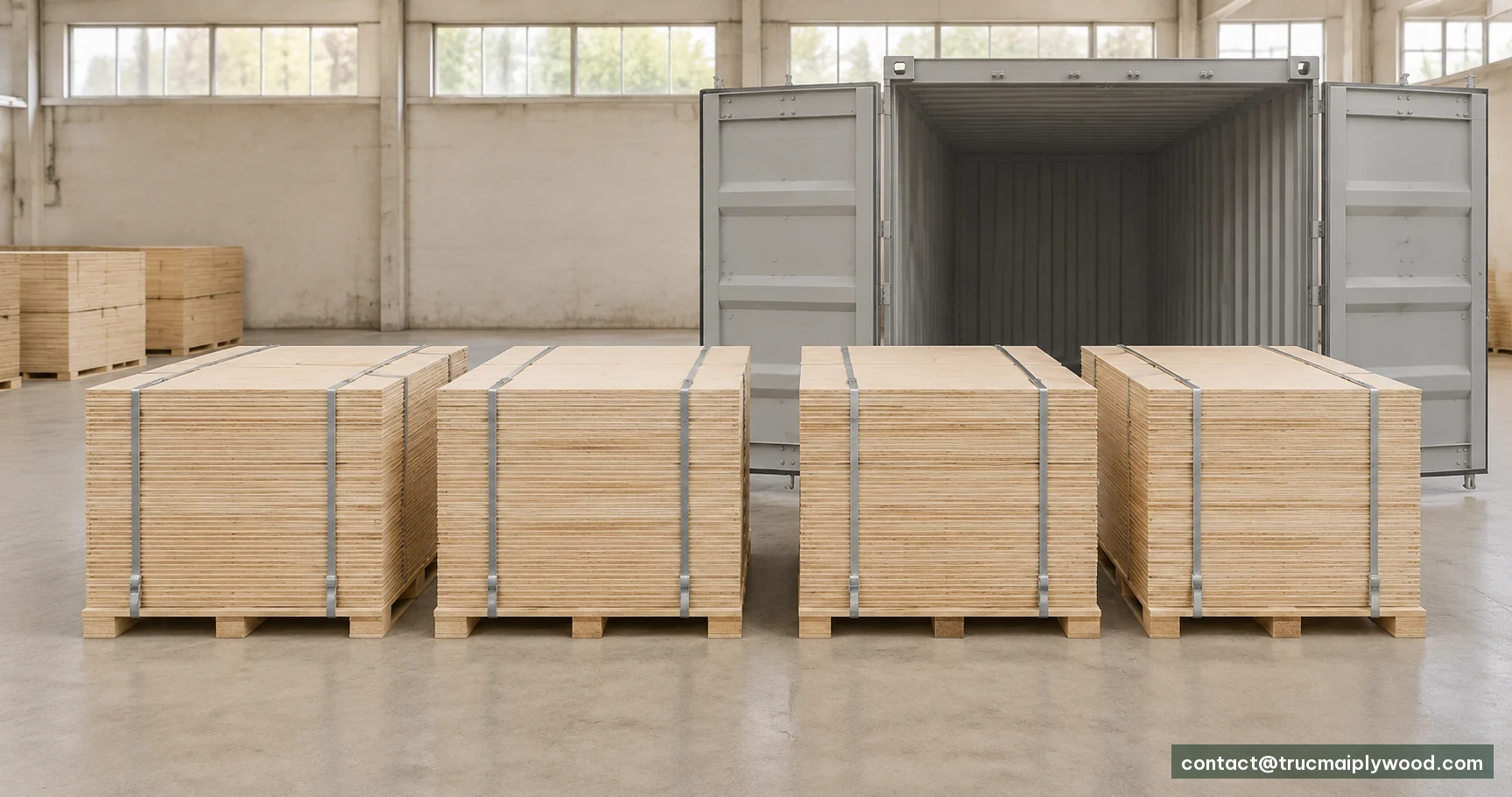
The mill’s number is normally a free-on-board figure at Hai Phong. It covers the panels, the packing and the loading, and stops at the ship’s rail. A merchant’s number starts from the same panels, then carries ocean freight, marine insurance, the importer’s duty and tax position, port and terminal charges, inland haulage, storage, handling, the cost of money while the stock sits, the merchant’s margin and the local tax on the sale. Setting one beside the other is like setting a farm-gate rate beside a supermarket shelf.
| Cost line | In a mill FOB quote | In a merchant shelf rate |
|---|---|---|
| Panels, core, face and glue | Yes | Yes |
| Export packing and loading | Yes | Yes |
| Ocean freight | No (CFR and CIF include it) | Yes |
| Marine insurance | No (CIF includes it) | Yes |
| Import duty, tax and clearance | No | Yes |
| Port, terminal and inland haulage | No | Yes |
| Storage, handling and stock risk | No | Yes |
| Merchant margin and sale tax | No | Yes |
The table is why the two numbers sit far apart without anyone being unfair. The fair test is to build the importer’s side of the chain line by line and arrive at the same unit. The section on landed cost per sheet below shows the arithmetic, and the page on how plywood is priced explains what moves the mill’s own number: core, face, glue, thickness tolerance and order size.
A figure dated 2024 also needs a second look before it goes into a 2026 budget. Exchange rates, freight and local costs have moved since, and the Australian Bureau of Statistics publishes the Producer Price Indexes quarterly; its September 2026 quarter release, issued on 30 October 2026, includes an input to house construction index, which is an official place to check the direction of travel. The mill does not publish a price list, and this page prints no rates: a rate that is two years old does more harm than a missing one.
What follows is the method, so that a buyer can fill in current quotes and reach a number that holds.
Plywood prices per sheet Australia 2024: how is a per-sheet rate built?
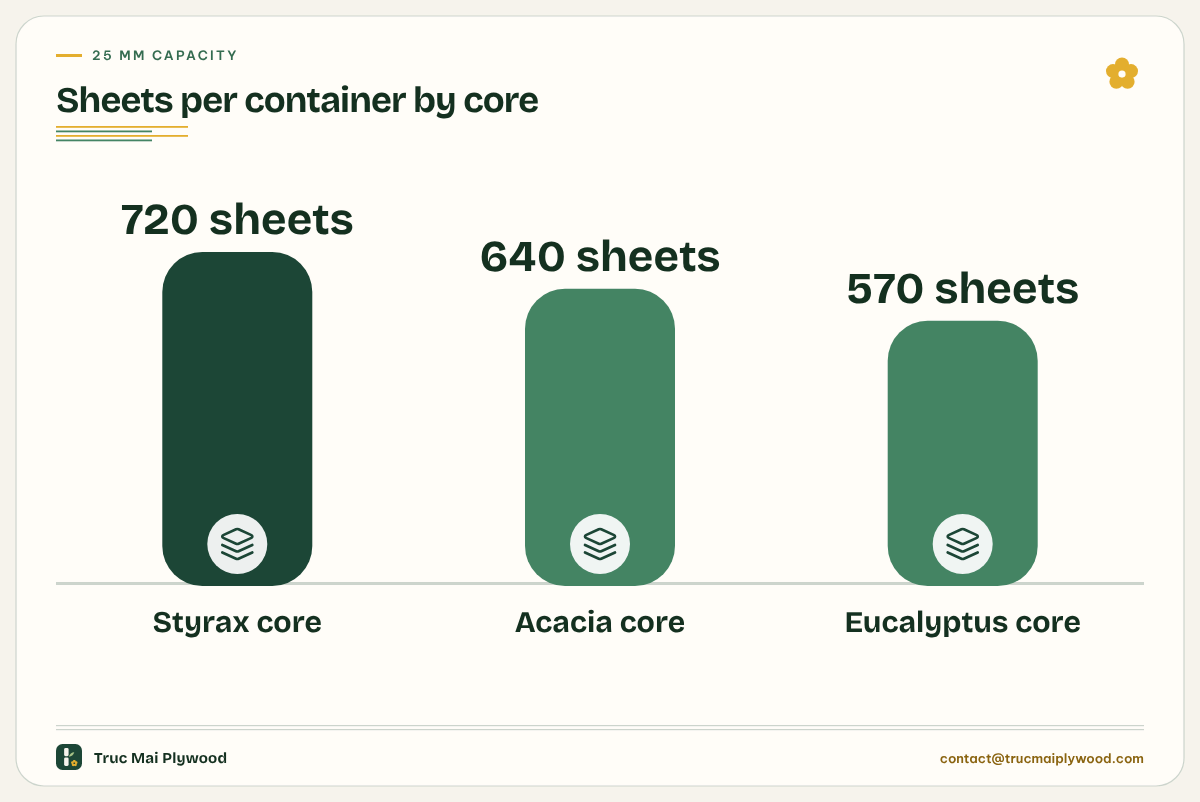
A per-sheet rate is the total landed cost of 1 container divided by the number of sheets in it, so the sheet count matters as much as the money. For 25 mm panels at 1220 × 2440 mm on the Truc Mai planning model, one 40HC holds 720, 640 or 570 sheets depending on the core.
| Core | Thickness | Size | Sheets per 40HC | m³ per 40HC | kg per sheet | Total kg |
|---|---|---|---|---|---|---|
| Styrax | 25 mm | 1220 × 2440 mm | 720 | 53.6 | 37.2 | 26,790 |
| Acacia | 25 mm | 1220 × 2440 mm | 640 | 47.6 | 43.2 | 27,620 |
| Eucalyptus (weight-capped) | 25 mm | 1220 × 2440 mm | 570 | 42.4 | 48.4 | 27,570 |
Basis: 40HC planning model, panels only. Packs per core are 18 for Styrax, 16 for Acacia and 15 for Eucalyptus. Pack height is 1,000 mm, and sheets per pack are the pack height divided by the thickness, rounded down and capped by a 28,000 kg planning payload (unconfirmed; the carrier and route decide). Densities are 500 kg/m³ for Styrax, 580 for Acacia and 650 for Eucalyptus. It is a planning figure, not a loading record. The page on m³ per 40HC by thickness carries the same model for every thickness from 3 to 40 mm.
The arithmetic a buyer runs is short:
- Take the total landed cost of the container: FOB, plus ocean freight, plus insurance, plus duty and tax, plus port and haulage charges.
- Divide it by the sheet count for the core and thickness in the table.
- Add the merchant-side costs that a distributor carries: storage, handling, margin and sale tax.
- Compare the result with the merchant’s shelf rate for a panel of the same build, not the same name.
Because the Styrax row holds 720 sheets and the Eucalyptus row holds 570, the same container cost spreads over more sheets on Styrax, before any difference in the FOB rate itself. The heavier core costs more per sheet to ship even if its FOB rate per sheet is the same, because weight, not space, ends the load. A buyer who asks only for a rate per sheet without naming the core can get two honest quotes that differ for this reason alone.
The per-sheet view also hides the other direction. A buyer who prices only per m³ and ignores sheet count will find that thin panels and thick panels cost the same to ship per cubic metre but very different amounts per sheet. Freight is charged on the box, so the sheet count is the only honest divisor.
Plywood prices New Zealand 2024: what changes compared with Australia?
2 things change: the biosecurity rules the shipment must meet, and the way structural plywood is separated from interior plywood on the local shelf. The cost chain in the first section is the same, and the sheet counts in the table above do not change with the destination.
New Zealand’s Ministry for Primary Industries treats plywood as a manufactured wood product. Its steps for importing wood products cover furniture, ornaments, barrels, plywood and particleboard, and require the importer to meet the import health standard for the product and to arrange the treatment and papers the standard asks for. Offshore treatment and phytosanitary certificates come from the exporting country’s national plant protection organisation, through the customs broker or directly. These are inputs to cost: a treatment, a certificate or an inspection adds a line to the landed total, and a delay at the border adds storage.
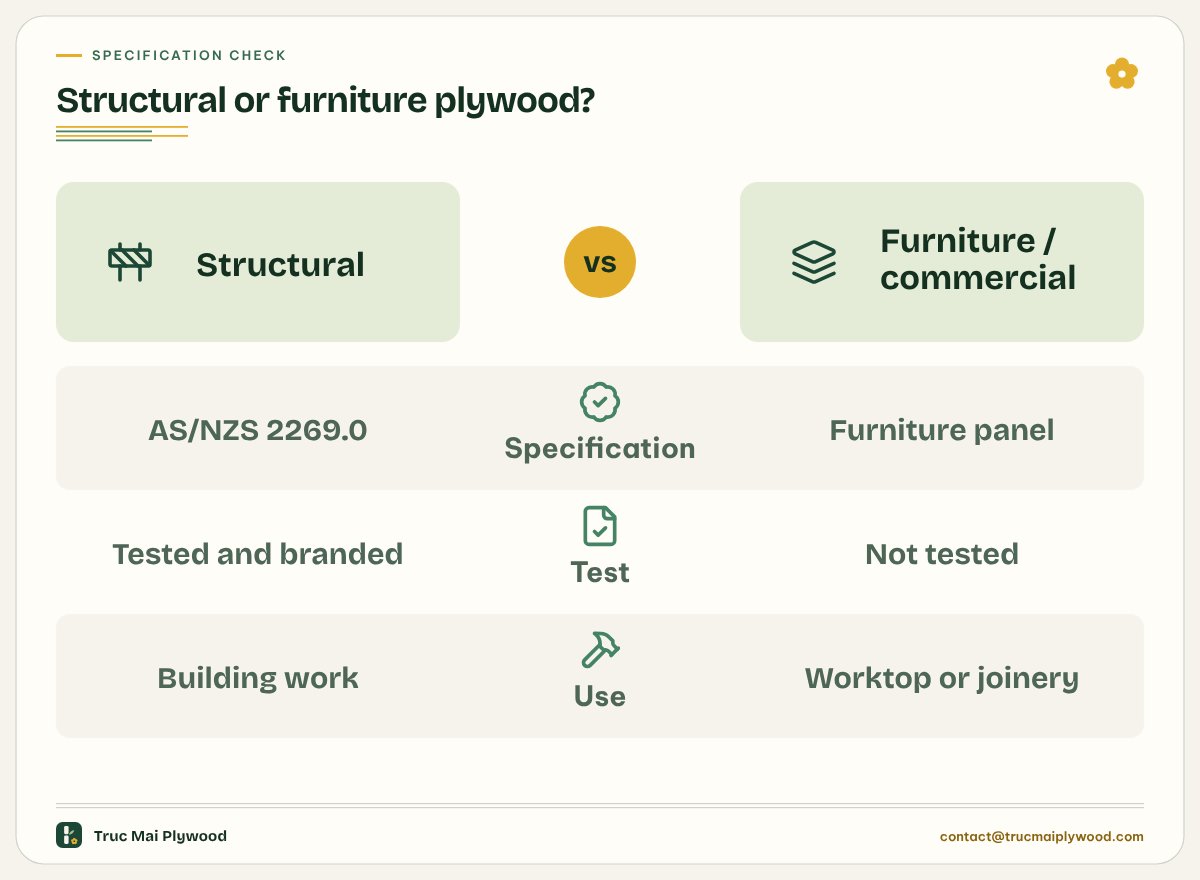
The second difference is how the local shelf is split. Structural plywood is a separate, branded category in New Zealand, made and graded to a joint New Zealand and Australian standard, so a shelf listing has to be checked for whether it prices a structural sheet or an interior one. A later section looks at what that means for a mill that does not make structural panels. A furniture or commercial panel is a different product with a different cost chain, so a shelf rate for a branded structural sheet is not a fair benchmark for an interior panel. Compare like with like: interior against interior, commercial against commercial.
The country also affects which terms are practical. FOB Hai Phong leaves booking and insurance to the buyer’s forwarder, which suits importers who already ship regularly. CFR or CIF puts the freight inside the mill’s quote, which suits a first container because the buyer sees one number to the destination port. The page on sea freight per m³ shows how freight is built, and FOB Hai Phong prices explains what the FOB line holds.
Plywood prices NZ 2024: which merchant figures hold up in 2026?
4 details decide whether a figure holds: its date, the panel build, the quantity and the place it is priced at, and even then it needs a check against today’s quote. A listing that says “plywood” with a thickness and a size has not described a panel yet.
The four details, in the order to check them:
- The date. Freight, exchange rates and local costs have moved since 2024, so an old figure shows direction, not level.
- The build. Core species, face grade, joining method and glue system set the panel’s cost; a name such as “18 mm plywood” covers all of them.
- The quantity. A shelf rate for one sheet carries the merchant’s handling and margin, while a pack, a pallet or a container sits on a different basis.
- The place. A rate at a port, at a merchant’s yard and delivered to a site are three different numbers.
The same discipline applies to the secondary search that brings many buyers here, “plywood prices nz”: a bare figure without those four details is not a price, only a number. A buyer who collects three NZ merchant listings should write the four details next to each before comparing anything with a landed quote.
For a mill’s side of the conversation, the answer to a price question is a short list of drivers. Core and face choice, thickness tolerance, glue and emission class, sheet size, packing and quantity per order decide the FOB line. The writing a plywood RFQ page sets these out in the order a mill needs them.
Plywood sheet price New Zealand: what sits inside the shelf number?
10 cost lines sit inside a New Zealand shelf number, and only 1 of them is the panel. Start from the panel, then add freight, insurance, duty and border costs, port charges, haulage to the yard, storage, the cost of holding stock, margin and local tax on the sale.
The shelf number also depends on how the sheet is sold. A sheet picked up from a trade counter, a sheet cut to a customer’s size and a sheet delivered to a building site carry different handling. A merchant who cuts panels carries offcuts, saw time and wastage, and these appear in the rate for a cut panel. That is a real service, and a fair comparison with a container buyer’s cost needs the container buyer to price their own handling and storage too.
Local cost lines that the container buyer carries and the merchant already absorbed:
- Unloading and moving the container to a yard or warehouse.
- Storage of a full load that sells over weeks or months.
- Insurance and financing cost while the stock is held.
- Breakage, damaged edges and sheets that fall short of a customer’s face requirement.
- Delivery to the customer, in whole packs or by the sheet.
A container buyer who sells whole packs to cabinet makers or trade customers avoids most of the cutting and counter handling, and may save on the middle of the chain. A buyer who must sell one sheet at a time carries the merchant’s costs and needs the merchant’s margin. The sheet count in the table above sets how many times each fixed cost is divided, which is why a 25 mm Styrax container of 720 sheets and a 9 mm Eucalyptus container of 1,605 sheets cannot be compared by container cost alone.
25mm structural plywood New Zealand price: can the mill quote it?
No. The mill makes furniture and commercial plywood, not structural plywood, and a New Zealand structural sheet is a different product with a different price chain. This section explains what drives that price and what is available at 25 mm instead.
Structural plywood in New Zealand is specified to AS/NZS 2269.0. The standard, held by Standards New Zealand and Standards Australia, “specifies requirements for the manufacture, grading, finishing and branding of structural plywood” and covers stress and surface grades, veneer and bond quality, lay-up construction, dimensional tolerances, joints, moisture content and the strength values of the F-grades. Structural plywood is also branded on the back: the manufacturer, the standard, the grades, the glue bond type, the stress grade and a construction code. The BRANZ guide on structural plywood states that plywood that has not been tested to AS/NZS 2269 cannot be substituted for structural plywood.
What moves the price of a 25 mm structural sheet therefore is the testing and grading behind the brand, not only the veneer:
- The stress grade, such as F8 or F11, which the manufacturer proves by testing.
- The face and back grades, where grade C and D carry different appearance limits.
- The glue bond type and the formaldehyde class stated on the brand.
- The construction code, which sets how many veneers and what face thickness make up the 25 mm.
- Treatment, if the sheet is treated for exposure to moisture.
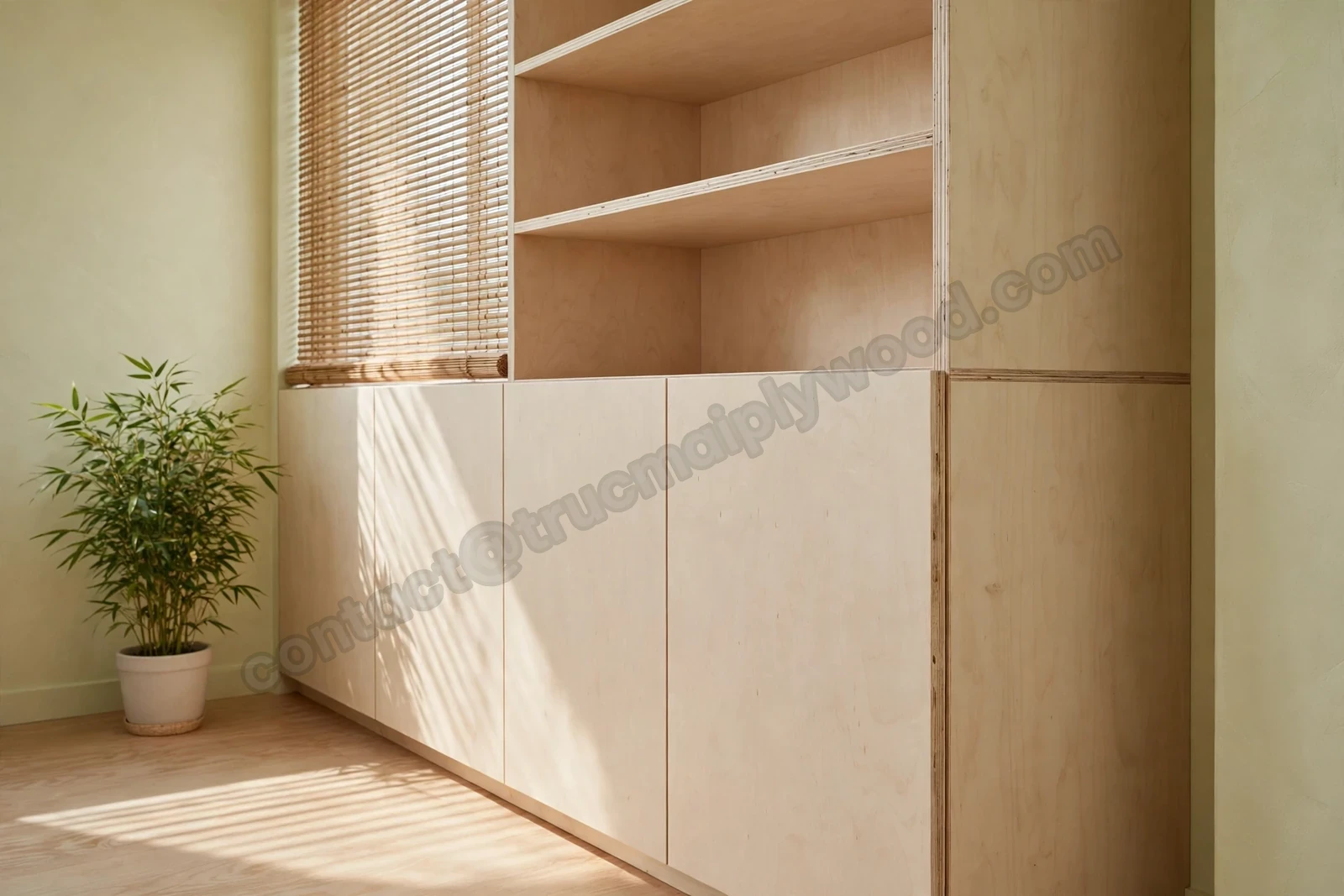
A buyer who needs structural plywood for building work should buy a branded structural sheet from a manufacturer that tests and brands to AS/NZS 2269.0. For a 25 mm sheet that is not structural, such as a worktop substrate, joinery panel, shopfitting panel, packing deck or furniture part, the container figures in the table above apply. The mill builds 25 mm furniture and commercial panels on Styrax, Acacia or Eucalyptus core, and the emission certificate it holds covers 3 to 25 mm, which includes 25 mm at the top end of that range. Panels of 30 mm and 40 mm sit outside that certified range.
If the end use is not clear, say so in the enquiry before asking for a price. A mill cannot choose between a structural and a joinery sheet on the buyer’s behalf, and a wrong guess costs a container.
Plywood suppliers New Zealand prices: how do you compare quotes?
Compare 6 lines, in this order: panel build, sheet and thickness, tolerance, quantity, delivery term and papers. A supplier who answers all six lines on the same basis has given a quote; a supplier who gives one number has given a headline.
Two offers carrying the same product name are often not the same construction. Core grade, joining method, face preparation, glue system and tolerance each change what the panel is. For a furniture buyer the mill’s default is an A-grade core, stitched, with sanded faces; for commercial panels it is an AB core, loose-laid or jointed, unsanded or lightly sanded. Thickness tolerance is written per order at ±0.3–0.5 mm, with ±0.3 mm on sanded and calibrated furniture panels.
| Line | What to ask each supplier | Why it moves the number |
|---|---|---|
| Panel build | Core, face, grade pair, glue and emission class | Different builds are different products |
| Sheet and thickness | 1220 × 2440, 1250 × 2500 or 1220 × 2280 mm; the thickness | Sets the sheet count and the weight |
| Tolerance | Thickness tolerance written on the order | Calibrated panels cost more to make |
| Quantity | Whole 40HC, mixed load or part load | Mill terms start at one 40HC |
| Delivery term | FOB, CFR or CIF, and which port | Decides who pays freight and insurance |
| Papers | Invoice, packing list, certificate files, origin records | Drive clearance and the importer’s own checks |
New Zealand importers also carry the biosecurity file described above, so ask each overseas supplier which papers travel with the goods and how treatment is evidenced where the import health standard calls for it. The supplier shortlist checklist turns these lines into a score sheet, and verify a mill before the deposit covers the checks that come before money moves.
One practical rule: never accept a quote that names only a thickness and a sheet size. A quote that does not name the core cannot be divided by a sheet count, and a quote that does not name the delivery term cannot be added to anything.
Plywood suppliers wholesale Australia prices: what do wholesale buyers check?
Wholesale buyers in Australia check 3 things beyond the rate: the importer’s legal duty, the panel build and the container terms. The first is the one most often skipped by a buyer comparing quotes, and it sits with the importer, not the mill.
Plywood is a regulated timber product in Australia. The Illegal Logging Prohibition Rules 2024, made under the Illegal Logging Prohibition Act 2012, prescribe timber products by their Customs Tariff heading, and heading 4412, plywood, veneered panels and similar laminated wood, is item 9 in section 5.
The Department of Agriculture states on its guidance for importers that importers must assess and mitigate illegal-logging risk before importing regulated timber products. Failure to perform due diligence can bring significant financial penalties; importing illegally logged timber is a criminal offence.
The department also states that the earlier Community Protection Question is no longer required. The new notice requirement under the reformed Act is not yet in effect, so importers must continue to meet their due diligence requirements and keep records.
The importer owns that duty. What a mill can do is supply the records that feed it. Truc Mai supplies origin records for the core and the face veneer, the FSC claim on sales documents for eligible products, and the order’s certificate files. Those are inputs to the importer’s own assessment, not a substitute for it.
| Check | Question to put to the supplier | What it shows |
|---|---|---|
| Origin | Which species and which country for the core and the face veneer | Input to the importer’s risk assessment |
| Chain of custody | FSC licence code and the FSC claim per product on the invoice | A code that can be checked in the public database |
| Build | Core, glue, face grade pair, tolerance | The panel being priced |
| Container terms | Minimum order, deposit, balance, delivery term | Cash flow and risk split |
| Documents | Packing list, bill of lading, certificate files | What reaches the broker before arrival |
The verify an FSC licence code page explains how to check a code before relying on it. For a wholesale buyer the point is simple: a low FOB figure from a supplier that cannot supply origin records can cost more at the border than a higher figure from one that can.
Landed cost per sheet: which line comes from whom?
7 lines make up a landed cost per sheet, and each should be collected from the party that issues it. A line copied from a forum or an old listing breaks the sum.
| Line | Who issues it | Document to ask for |
|---|---|---|
| Panels, packing, loading (FOB) | The mill | Quotation with core, face, glue, size, tolerance and pack plan |
| Ocean freight | Carrier or forwarder | Freight quote to the named port, with the booking basis |
| Marine insurance | Insurer or forwarder | Policy terms, unless the mill quotes CIF |
| Duty, tax and border clearance | Customs broker | Broker’s estimate against the tariff heading 4412 |
| Biosecurity and treatment papers | Mill and national plant protection office; Ministry for Primary Industries in New Zealand | The import health standard for the product and the certificates it asks for |
| Port, terminal and haulage | Broker, terminal, haulier | Itemised charges to the yard |
| Storage, handling, cost of money | The importer | Own costing, per sheet |
The tariff heading matters twice. It is the line the broker uses for duty, and the same heading, 4412, is the one that makes plywood a regulated timber product under the Australian rules described above. A broker’s estimate and the importer’s due diligence file therefore start from the same four digits.
Once every line is in, the sum is divided by the sheet count of the pack plan. The result is one number per sheet for one build, delivered to one place, and it can be set beside a merchant’s rate for the same build. If the merchant’s rate is lower, the merchant is buying better, selling at lower margin or carrying a different build; each of those is worth knowing before the first deposit is paid.
What does cheap plywood NZ actually mean on the sheet?
Cheap plywood NZ listings usually mean a lighter build, a lower face grade or a thinner face veneer, not a cheaper way of making the same panel. A low rate is a fact about the panel and the chain behind it, and the panel is the part a buyer can check.
Reading the sheet takes five checks. Look at the edge for the number of plies and whether they are even. Look at the core for gaps and overlaps. Look at the face for the grade written on the order against the approved sample. Measure the thickness against the tolerance in the order. Ask what glue and emission class the build carries. Face grade is agreed against the approved sample and quoted as a pair, front and back; a rate that does not say which pair it prices is not a rate for a known panel.
Where the cost comes from at the mill is part of the answer. Ha Hoa in Phu Tho has plantation forest nearby that supplies core wood at low cost, and skilled labour costs less there, so mills in the area can price the same quality lower. That is a regional cost advantage, not a lower specification, and the way to confirm it is to put the same specification to every supplier.
The words “cost-effective” apply when the panel meets the application and no more. A cabinet carcass needs flat sanded faces on a stable core; a packing deck needs strength and a clean, dry panel, not a decorative face. The value grades and commercial ply cost pages go further into that choice. A buyer who writes the application first will find that the cheapest suitable panel is rarely the cheapest listed panel.
How do FOB, CFR and CIF change an Australia or New Zealand comparison?
3 delivery terms are on offer, FOB Hai Phong, CFR (CNF) and CIF, and each moves the line where the mill’s responsibility ends and the buyer’s cost starts. Choose the term first, then compare quotes on that term only.
| Term | Mill pays for | Buyer pays for |
|---|---|---|
| FOB Hai Phong | Panels, export packing, loading at Hai Phong | Ocean freight, insurance, import side |
| CFR (CNF) | The above plus ocean freight to the named port | Insurance, import side |
| CIF | The above plus marine insurance | Import side |
FOB suits an importer with a forwarder and a booking rate it trusts. CFR or CIF suits a first container, because one quote then reaches the destination port. The comparison with a merchant shelf rate still needs the import side added to either, and the page on one container costed to your door walks through that addition on a worked container.
The payment terms are the same on any delivery term. Production runs 15–45 days from a 30% deposit, depending on quantity, production conditions and agreement, and the remaining 70% falls due against the scanned bill of lading, by T/T or irrevocable L/C at sight. The page on deposit and balance terms sets out the order of payments.
The documents travel with the term. Each shipment has a commercial invoice, packing list, bill of lading, certificate of origin, phytosanitary and fumigation papers, and insurance under CIF, plus the certificate files of the order. Certificate files go out before the order is confirmed, and draft shipping documents go to the buyer for approval after loading. Plywood is processed wood and sits outside ISPM 15, but solid-wood pallets, battens and dunnage shipped with it fall under that standard, which the broker will ask about.
Which sheet sizes and thicknesses suit an Australian or New Zealand order?
Three regular sheet sizes are made, 1220 × 2440 mm (4 × 8 ft), 1250 × 2500 mm and 1220 × 2280 mm, with custom sizes up to 1250 × 2500 mm and nothing larger. Custom cut-to-size panels are available on request. Thickness runs from 3 to 40 mm in the steps 3, 4, 5, 6, 9, 12, 15, 18, 21, 25, 30 and 40 mm.
Sheet size changes the container fill only for Styrax core, where the 1250 × 2500 mm sheet raises the 25 mm load to 54.8 m³ and 702 sheets, weight-capped. Acacia and Eucalyptus stay near their weight limits whichever size is chosen. A buyer seeking a non-standard merchant format should include the cut list in the enquiry and request the sheet count on the pack plan.
Cut to size is a customer option and works from a labelled standard sheet. A sheet cut in two lengthwise gives 610 × 2440 mm, in three gives 1200 × 800 mm, in four gives 1220 × 610 mm, and six is also available. The mill sets the exact piece size from the buyer’s sheet and cut list; for example, pieces can be cut from a 1250 × 2500 mm sheet. Panels are labelled, and sizes are agreed by email before production. See panels cut at the mill for the option.
Tolerance on length and width is ±2 mm, and thickness tolerance is written per order at ±0.3–0.5 mm. Face veneer is usually 0.3 mm for the European market, and a buyer should say whether the panels are to be sanded and calibrated. The 1220 × 2280 mm panels page lists the shorter furniture format.
Is a mixed container worth it for an Australian or New Zealand importer?
Yes, by agreement: 1 or 2 products per container is the norm, and 3 to 6 products can share a box when the loading plan is built for the mix. A mix suits an importer who stocks several thicknesses or faces but cannot yet fill a container with one.
The weight rule decides the plan. Add the cargo weight of each product (its m³ multiplied by the core density), compare the total with the booked payload and only then check pack positions. The planning densities are 500 kg/m³ for Styrax, 580 for Acacia and 650 for Eucalyptus, so a Styrax pack and a Eucalyptus pack of the same thickness weigh differently, and the denser core sets the limit. The 25 mm table above shows the effect at its simplest: the Eucalyptus row is weight-capped at 570 sheets while the Styrax row holds 720.
A mix also changes the price comparison. Each product needs its own line on the packing list and its own certificate scope, and the per-sheet divisor is then different for each product: the freight is shared in proportion to how the load is made up, so the landed cost per sheet for a 9 mm panel and a 25 mm panel in the same box are two separate calculations. Ask the mill for the pack plan of the mix, with the sheet count per product, and run the division on each.
Thickness can be mixed in the same way. Packs of different thickness sit side by side, each about 1,000 mm high, so the stack positions stay the same and only the sheet count per pack changes. The first order to monthly supply page shows how a mixed first order becomes a repeat programme with a fixed specification line per product.
What goes into the enquiry so quotes can be compared?
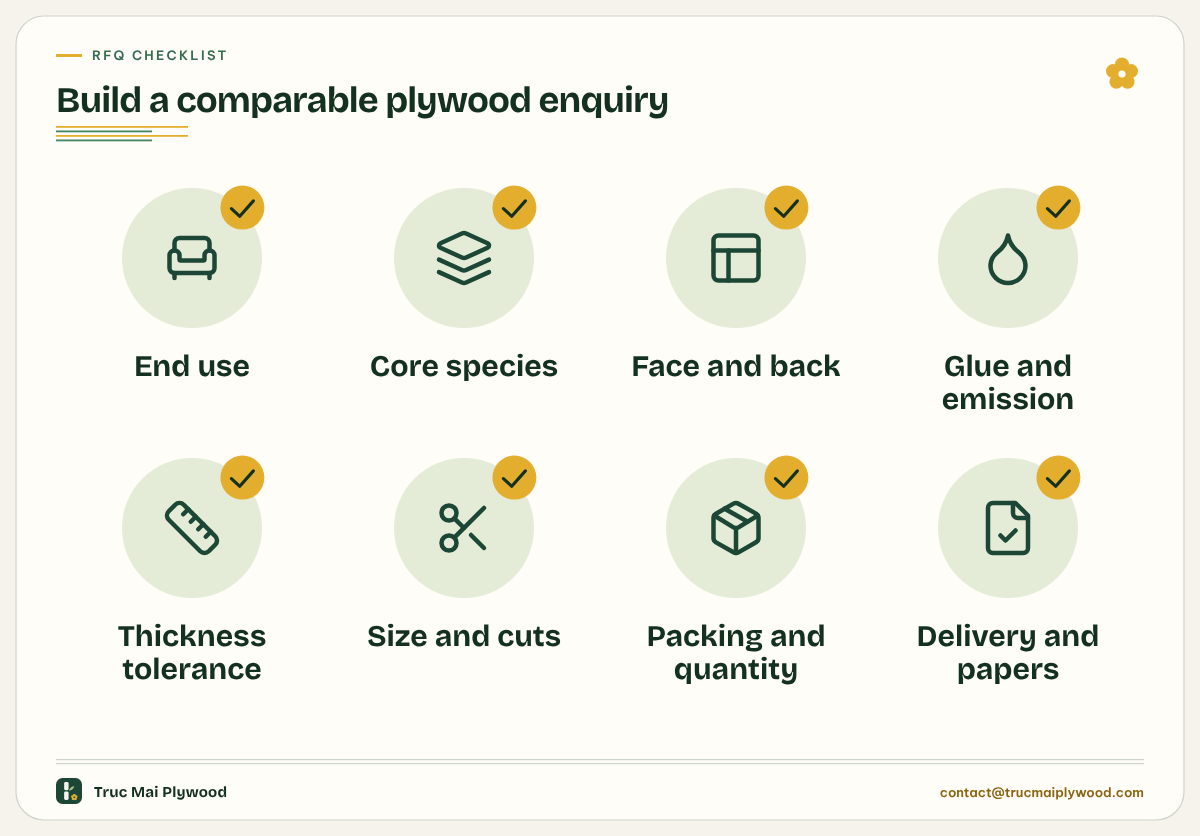
11 lines go into the enquiry, and the first of them is the end use. A mill that knows what the sheet will do can choose the core, the glue and the face; a mill that only receives a thickness and a quantity can only guess.
- End use: cabinetry, shopfitting, packing, joinery or furniture parts, and whether any structural role is involved.
- Core: Styrax, Eucalyptus, Acacia or Pine, or a combined build.
- Face and back: species and grade pair, agreed against an approved sample.
- Glue and emission class, as two separate lines.
- Thickness, with the tolerance wanted per order.
- Sheet size, and any cut-to-size list with the labels needed.
- Packing: packs of about 1,000 mm, crating for thin panels, labels.
- Quantity: one 40HC, a mixed load, or a repeat programme.
- Delivery term and port, and the shipment window.
- Certificates and files wanted: FSC claim, emission certificate, origin records.
- Whether the quote is for first order or repeat supply.
Writing these lines once saves rounds of email. The page on writing a plywood RFQ gives the order, and the quotation desk takes the same lines in a form. A pack plan comes back for the exact core and thickness, and a sample can travel with the reply. Samples are free: new buyers book their own courier, and the cost can be credited against a real order.
For a first Australian or New Zealand container the useful extra lines are the port of discharge, the name of the customs broker and the biosecurity papers the broker expects. Sending those on the first message shortens the exchange, because the mill can then say which documents will be ready before loading.
Which certificates and records travel with an AU or NZ order?
The mill holds FSC chain of custody (licence code FSC-C196493, certificate SA-COC-014545, FSC 100% only), ISO 9001:2015 and ISO 14001:2015 for plywood manufacturing, and third-party CARB Phase 2 and TSCA Title VI certification for hardwood plywood with veneer core, 3 to 25 mm. Due-diligence data with plot geolocation for the core and the face veneer is supplied with the order.
FSC applies only to the eligible products on the certificate’s product schedule, and the claim is written on the sales and shipping documents for those products. It does not cover every panel automatically, so the enquiry should name the products for which an FSC claim is wanted. A buyer can check a code in the public database before the order; the page on verifying an FSC licence code shows how.
The emission certificate belongs to the US and California schemes. It still has a use for an importer: it is a third-party result on formaldehyde for hardwood plywood with veneer core, which a buyer can set beside any requirement the end customer states. Glue type and emission class are separate lines on the specification, and a bond test says nothing about emission.
For EU-bound lots the mill also supplies the due-diligence file set, and the same kind of origin records can feed an Australian importer’s own illegal-logging due diligence. The face veneer origin files page describes what the files contain, and papers per container lists the shipment documents.
How do you start a first Australian or New Zealand container?
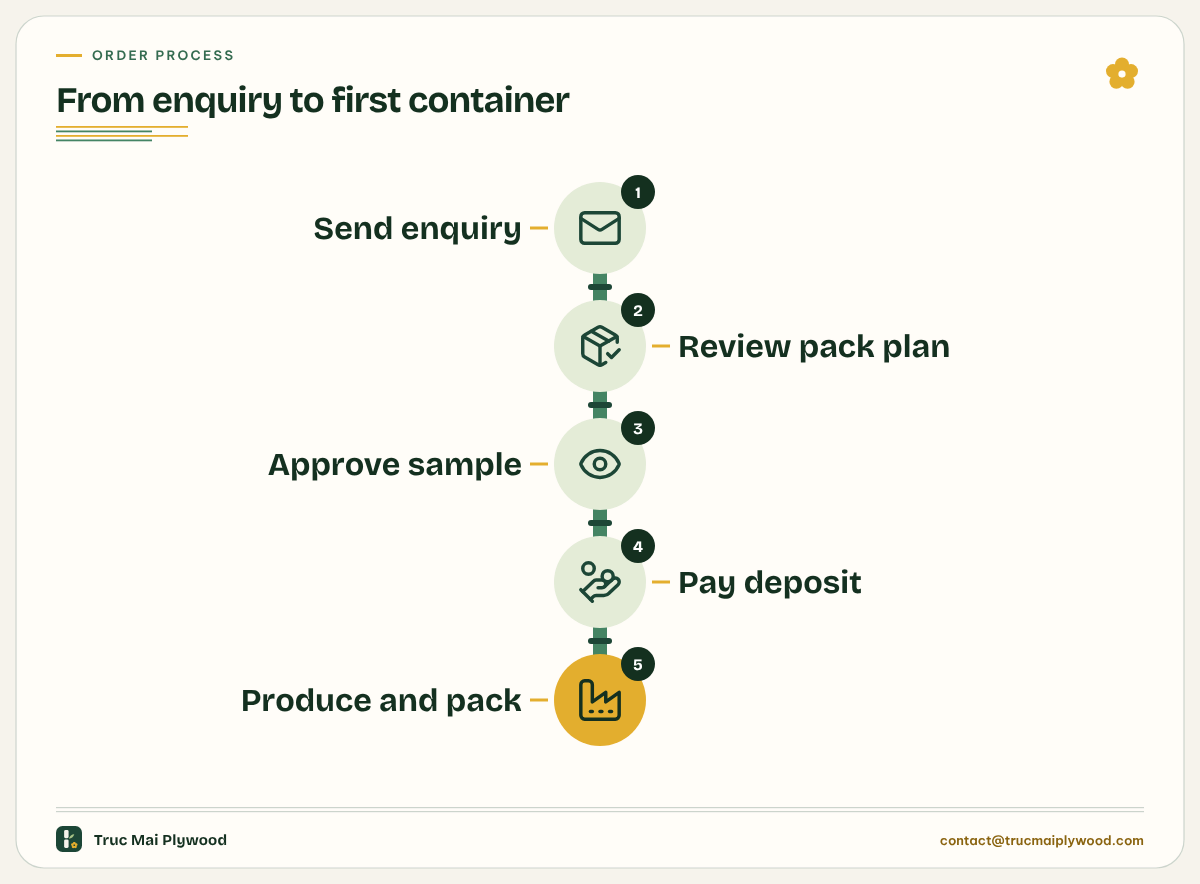
Start with an enquiry that carries the eleven lines above, then ask for samples, a pack plan and the document list. The minimum order is one 40HC, built in 15–45 days from the 30% deposit, with the 70% balance against the scanned bill of lading.
A first order usually runs in five steps:
- Send the enquiry with end use, build, size, quantity, term and port.
- Receive the quote with the pack plan, stating the core and the sheet count per container.
- Approve a sample of the build, with the face grade agreed against it.
- Pay the deposit; production starts and the packing list is prepared.
- Approve draft documents after loading, pay the balance against the scanned bill of lading and book the importer’s side: broker, treatment papers where the standard asks, and storage.
After the first container, the repeat programme is simpler: the same specification line is copied onto each order, and the pack plan stays the reference. The page on first order to monthly supply describes that step, and the furniture and interior plywood range page lists the faces and cores on offer.
Landed cost is then a calculation a buyer can repeat each quarter: the FOB or CFR quote from the mill, the freight and insurance lines for the term chosen, the importer’s duty, tax, port and haulage lines for Australia or New Zealand, divided by the sheet count from the pack plan. Replace each line with the current quote, and set the result against the merchant’s listing for a panel of the same build.
Send the specification lines to contact@trucmaiplywood.com or through the quotation page, and ask for a free sample of the same build.
Questions buyers ask
Is a mill's FOB quote lower than a merchant's shelf rate for the same sheet?
They cannot be compared as quoted, because a shelf rate already carries freight, duty, port costs, storage, margin and local tax. Add those steps to the FOB quote first, then divide by the sheets in the container.
How many 25 mm sheets fit in one 40HC?
On the Truc Mai planning model at 1220 × 2440 mm, a Styrax core holds 720 sheets, Acacia 640 and Eucalyptus 570. These are planning figures for panels only, not a loading record.
Can Truc Mai supply structural plywood for New Zealand building work?
No. The mill makes furniture and commercial plywood, and structural plywood in New Zealand is specified to AS/NZS 2269.0 with stress grades and branding that a furniture panel does not carry.
Is plywood a regulated timber product in Australia?
Yes. Heading 4412, plywood, veneered panels and similar laminated wood, is listed in section 5 of the Illegal Logging Prohibition Rules 2024, so the importer must do due diligence before the goods arrive.
Does New Zealand apply its own import rules to plywood?
Yes. The Ministry for Primary Industries lists plywood among the manufactured wood products that must meet the import health standard for the product, with treatment and phytosanitary papers where the standard asks for them.
What is the minimum order for an Australian or New Zealand shipment?
One 40HC. Production takes 15–45 days from the 30% deposit, and the remaining 70% falls due against the scanned bill of lading.
Which delivery terms does the mill quote for Australia and New Zealand?
FOB Hai Phong, CFR (CNF) or CIF. FOB leaves ocean freight and insurance to the buyer, while CFR and CIF fold freight, and for CIF insurance, into the quote.
Can the mill supply custom-cut sheets?
Yes, on request. The regular formats are 1220 × 2440 mm, 1220 × 2280 mm and 1250 × 2500 mm, with cut-to-size options from standard sheets.
Why do two quotes for 18 mm plywood differ so much?
Often the panels are different builds: core grade, joining method, face preparation, glue system and thickness tolerance all differ under one product name. Write the full specification on the enquiry so every offer prices the same panel.
Are free samples available before a container order?
Yes. New buyers receive free samples and book their own courier, and the courier cost can be credited against a real order.
Can one container carry more than one product?
Yes. A container usually carries one or two products, and three to six can be mixed by agreement. The heaviest core decides the weight of the load.
Where does the cut-to-size option fit into a sheet rate?
Cut to size is a customer option, with labelled panels cut from a standard sheet in two, three, four or six. The mill sets the exact piece size from the buyer's sheet and cut list, so a rate per sheet turns into a rate per cut panel only after the cut list is agreed.