
Furniture plywood price rises when buyers specify a cleaner decorative face, repaired and stitched core, tighter calibration or a tested adhesive system. The useful comparison is a matched factory quotation for the same thickness, sheet size, finish and shipping terms. Truc Mai Plywood supplies furniture and commercial constructions for that comparison.
What is the cheapest cabinet grade plywood?
One economical cabinet-grade choice is a sound, sanded veneer-core panel with a functional face on the hidden side. It puts money into a continuous core and machining surface instead of decorative veneer that the finished cabinet will conceal. A visible door or open shelf needs a different face selection from a cabinet back or concealed divider.
For a production cabinet, the lowest initial sheet quotation can be the wrong purchasing decision. A poorly joined core creates voids at hinge bores, exposed edges and narrow rails. The factory may then spend time sorting pieces or reworking edges. Specify the minimum acceptable core integrity before discussing face appearance.
An economical comparison starts with cabinet-grade plywood for exposed components and a commercial construction for concealed parts. Ask for paired face/back grades, a photographed cut edge, a representative full-sheet sample and the agreed thickness tolerance. A grade name without those details is an incomplete purchase specification.
For a modular kitchen, split the bill of materials into visible doors, carcass sides, shelves and backs. This prevents an attractive veneer from being paid for where a laminate will hide it. For an uncoated face, consider how knots, patches and colour variation will show after the customer applies a clear finish.
What does furniture-grade plywood cost per m3 FOB?
No verified numerical FOB rate per m³ is available for this furniture-grade construction; use the factory quotation for the specified build. No current dated furniture-grade FOB quotation has been supplied for publication, so a numerical rate would misrepresent the offer. The buyer can still obtain a comparable quotation by locking the product specification and the named port.
FOB Hai Phong describes the agreed export delivery basis; it is different from a local retail sheet price or an import landed cost. Ask the exporter to show the exact face/back grade, veneer species, core build, adhesive and emission requirement, sanded thickness tolerance, sheet dimensions, pack configuration and shipment quantity. Compare quotations with identical fields.
Use how plywood is priced for the construction logic and writing a plywood RFQ for the enquiry format. If one supplier quotes an unsanded AB commercial core and another quotes a stitched A-grade furniture core, the two FOB figures are not comparable even when both invoices say furniture plywood.
A full-container quotation should state whether the volume is measured from nominal sheet dimensions, which packing components are included, and how many distinct products share the load. A per-volume quotation is useful for factory comparisons; a per-usable-component view is better for the furniture production budget.
How much more does a BB face cost than a CC face?
No verified numerical BB-to-CC face premium is available; calculate it from two matched supplier quotations for the same veneer species and construction. BB and CC are supplier trade-grade labels, so a reliable difference comes from two quotations using the same veneer species, panel construction and approved appearance samples. The grade premium should be quoted separately from any change in core or finishing.
An appearance upgrade can require more selective veneer matching, additional patching and more rejected face sheets. It may be valuable for clear-finished doors and unnecessary under an opaque melamine surface. Compare photographs under consistent lighting and agree the number, size and location of permissible defects on the actual approved sample.
The ISO 2426-2 hardwood plywood appearance standard uses its own appearance classes; a seller’s BB or CC label should not be presented as a universal ISO grade. Keep the supplier grade and the agreed sample reference on the order line.
For a fair comparison request the same core and face thickness in both versions. A higher-grade face on a weaker core can still yield poorer cabinet components than a modest face over tightly joined inner veneers. Decide where the finished part exposes the face before purchasing an upgrade.
What drives the price of furniture-grade plywood from Vietnam, and what is a typical FOB price per cubic metre? furniture plywood price factors
5 factors drive the factory cost: face selection, core construction, panel calibration, adhesive specification and container utilisation. A typical FOB figure cannot be stated without a dated quotation for a defined build. The practical comparison is a matched specification sent to Vietnamese mills, with each response identifying its own construction and shipment basis.
The highest-value upgrade is often the one that reduces rejection during cutting. A sanded face supports consistent lamination, while joined core veneers reduce gaps at machined edges. An imported decorative veneer changes the visible result but need not change the species of the inner plies.
Vietnamese core choices include Styrax, Acacia, Eucalyptus and Pine. They differ in density and available veneer, affecting both the panel build and the freight volume that can fit under a cargo weight allowance. A lighter panel can improve the amount of saleable board in a 40HC, even when the factory quote for each cubic metre is not the lowest.
Ask for separate quotations for the base commercial build, a furniture core upgrade, and a selected face. That isolates the incremental choices instead of hiding them in one label. The FOB Hai Phong pricing explainer covers the shipping term; the container table below explains why the shipped quantity changes by core.
Which construction details distinguish furniture grade from commercial grade?
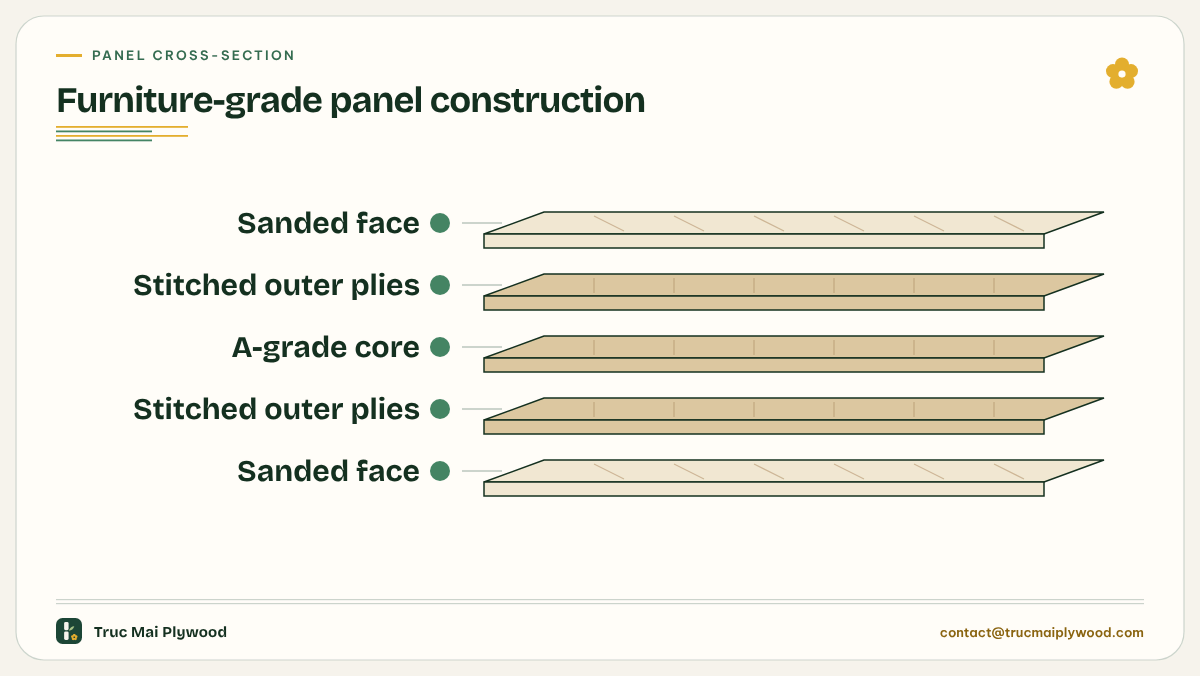
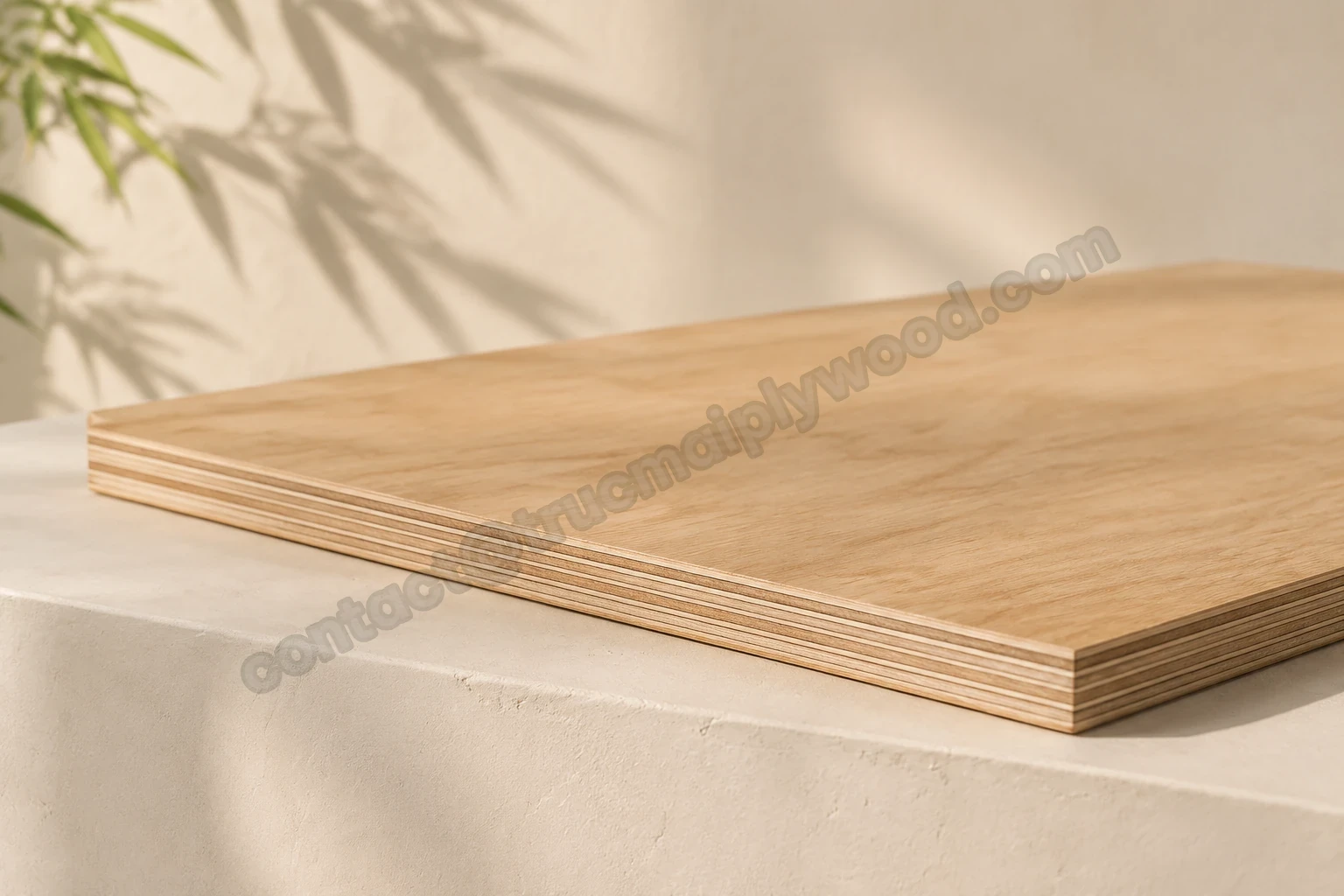
A furniture panel normally specifies an A-grade core with 2–4 outer plies stitched and calibrated, sanded faces; a commercial panel can use an AB core with loose-laid or jointed inner veneers and lighter surface preparation. The difference is visible at the cut edge and during machining, not only on the face of a full sheet.
Inspect the full face and a sawn cross-section for gaps, overlaps and unbonded areas. Retain the approved sample and specify acceptable edge quality for repeated CNC operations.
How do face veneer species change the buying decision?
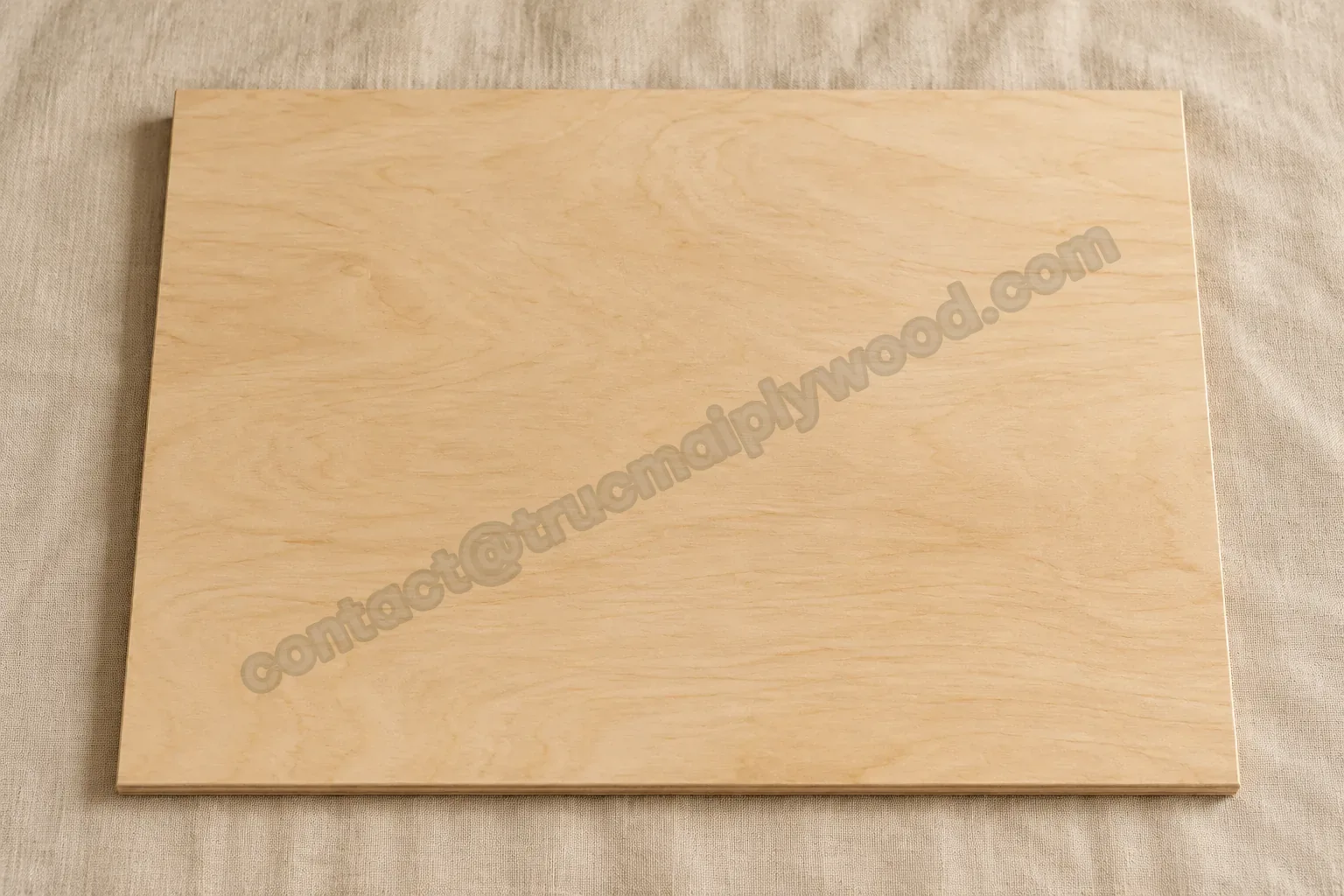
Choose the face species for the finish and appearance the furniture line needs. Birch-faced plywood gives a different visual result from poplar, engineered veneer, Okoume, Bintangor, Pine, Eucalyptus or Gurjan faces; those names identify the outer veneer, not necessarily the core.
Birch is an imported face veneer on a Vietnamese core for this product line. An engineered white poplar veneer is a reconstituted face, useful where repeatable grain appearance matters. A natural veneer can show more variation between sheets, so the buyer should define how panels will be matched across adjacent cabinet fronts.
If the buyer intends to apply a laminate, spending on decorative natural grain may add little value. A sanded and calibrated substrate can be more relevant than a show face. Compare birch-faced plywood with the surface requirement of the final furniture part.
Ask for face and back separately. A cabinet door with two visible sides can need a balanced appearance; a fixed carcass side may need one presentation face and one functional back. The correct pair depends on where the part will sit in the assembled product.
Which thickness and tolerance belong on the order?
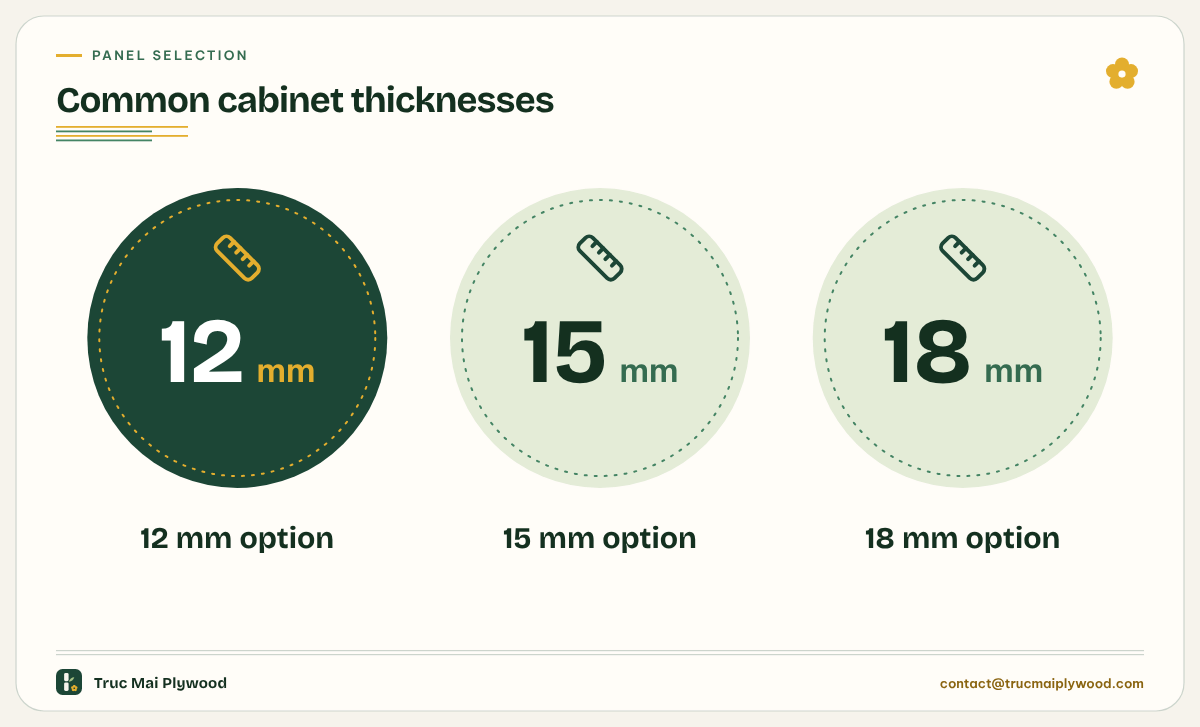
Thickness must match the component design, with a written tolerance and a measured sample. Standard production thicknesses run from 3 to 40 mm; cabinet makers commonly compare 12, 15 and 18 mm for different parts, while thinner sheets serve backs and linings.
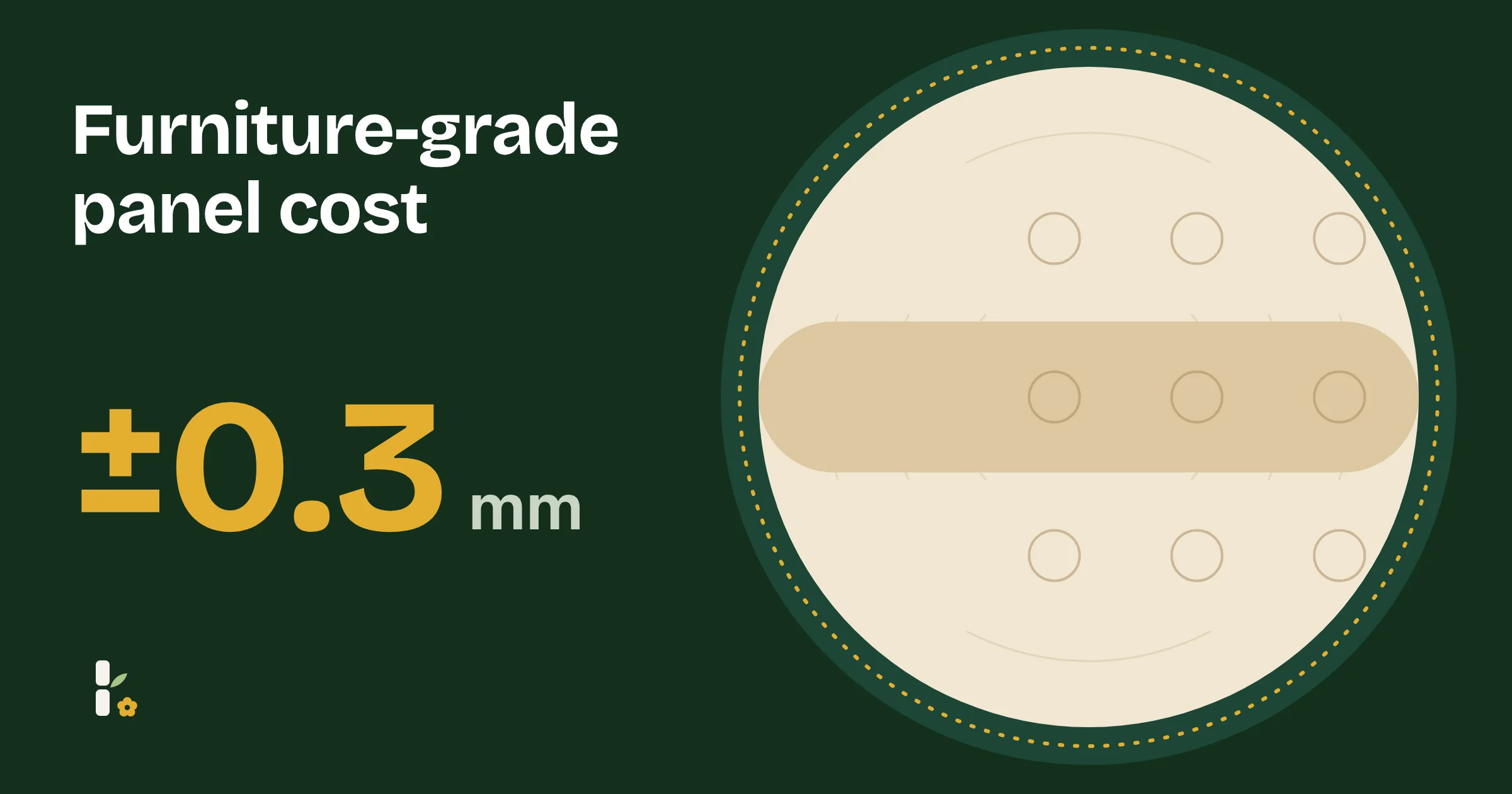
For calibrated furniture panels, a stated ±0.3 mm tolerance is available, with broader tolerances used for other grades. The length and width tolerance is ±2 mm. Record whether measurements are taken before or after any finishing process and agree the nominal thickness used for CNC programmes.
A thicker panel is not automatically the better shelf. Span, loading, fixing pattern and edge design all influence service performance. A buyer ordering a cabinet door should also account for hinge drilling, edge finishing and the weight of the assembled door.
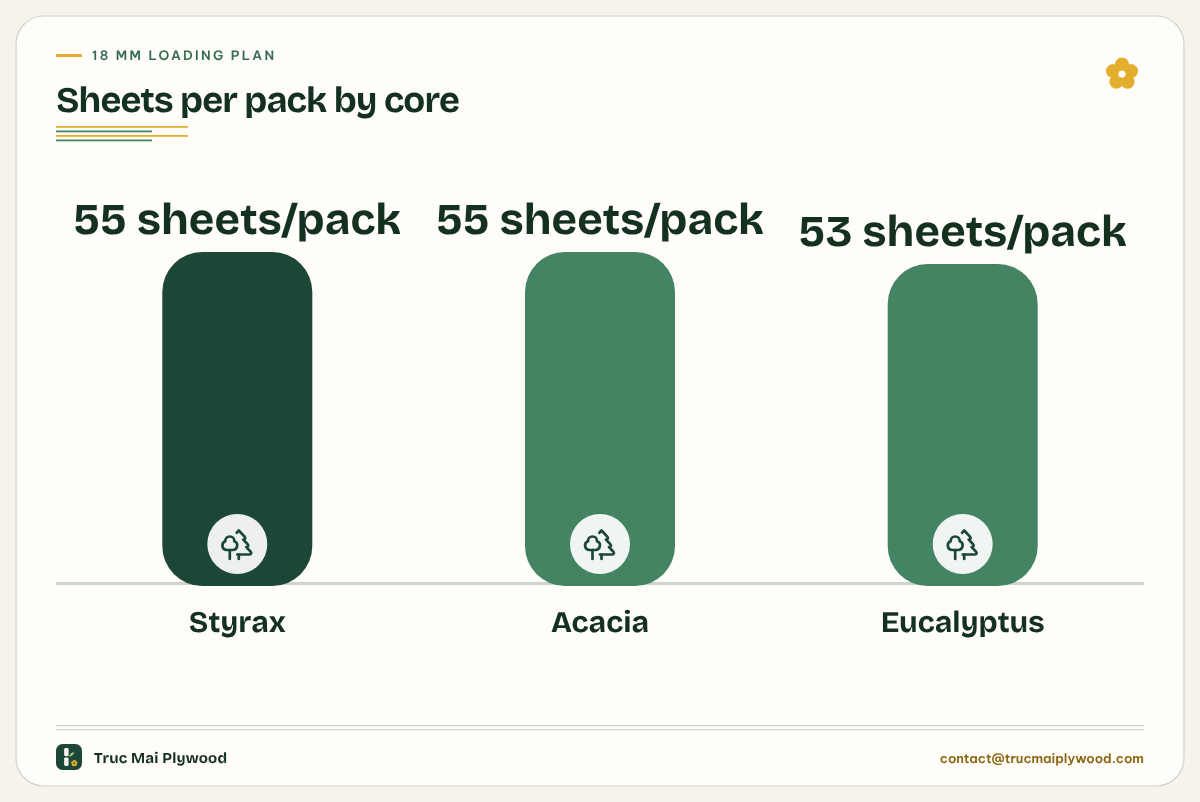
The 18 mm loading and specification page shows why sheet thickness changes the count per pack. Ask the supplier to report actual measured thickness at several points on a sample panel and check the cut edges for core continuity.
How do adhesive and emission requirements affect specification?
Specify adhesive chemistry and formaldehyde emission performance as two separate lines. Urea-formaldehyde (UF) adhesive is used for dry interior panels; moisture-resistant formulations belong to a different service requirement. The USDA Forest Products Laboratory Wood Handbook, chapter 10 describes how adhesive selection relates to wetting and service conditions.
For the US, EPA guidance on TSCA Title VI gives a 0.05 ppm emission limit for covered hardwood plywood with veneer or composite cores. The Truc Mai third-party certification covers hardwood veneer-core plywood from 3 to 25 mm, with certificate CARB/EPA 26053 and mill reference ICTT-26053. The certificate scope should be written against the ordered construction.
For EU furniture, the European Commission’s formaldehyde restriction notice addresses emissions from furniture and wood-based articles. A test report needs the actual method and article configuration; a US chamber result and an EU chamber result should be recorded under their own methods.
A kitchen carcass may see occasional humidity, but that does not turn every interior adhesive into an exterior bond. Describe the real service exposure, then select the tested bond specification. Keep moisture resistance, face appearance and emission documents distinct in the RFQ.
What does a 40HC furniture-plywood loading plan show?
A 40HC plan converts the sheet specification into pack count, sheet count and cargo weight. The figures below are model outputs for panels only, using the packing assumptions in the supplied calculation data. They are planning quantities, and the shipment is packed against the actual carrier booking and weighed panels.
At the same thickness, denser cores use the cargo weight allowance sooner. This makes the number of cubic metres in a container a procurement variable, not merely a freight-forwarding detail. Compare the model with the container volume by thickness reference when setting the purchase quantity.
| Core | Thickness | Sheet size | Packs | Sheets/pack | Sheets | Volume | kg/sheet | Total kg | Weight capped |
|---|---|---|---|---|---|---|---|---|---|
| Styrax | 12 mm | 1220 × 2440 mm | 18 | 83 | 1494 | 53.4 m³ | 17.9 | 26680 | false |
| Acacia | 12 mm | 1220 × 2440 mm | 16 | 83 | 1328 | 47.4 m³ | 20.7 | 27510 | false |
| Eucalyptus | 12 mm | 1220 × 2440 mm | 15 | 80 | 1200 | 42.9 m³ | 23.2 | 27860 | true |
| Styrax | 15 mm | 1220 × 2440 mm | 18 | 66 | 1188 | 53.0 m³ | 22.3 | 26520 | false |
| Acacia | 15 mm | 1220 × 2440 mm | 16 | 66 | 1056 | 47.2 m³ | 25.9 | 27350 | false |
| Eucalyptus | 15 mm | 1220 × 2440 mm | 15 | 64 | 960 | 42.9 m³ | 29.0 | 27860 | true |
| Styrax | 18 mm | 1220 × 2440 mm | 18 | 55 | 990 | 53.0 m³ | 26.8 | 26520 | false |
| Acacia | 18 mm | 1220 × 2440 mm | 16 | 55 | 880 | 47.2 m³ | 31.1 | 27350 | false |
| Eucalyptus | 18 mm | 1220 × 2440 mm | 15 | 53 | 795 | 42.6 m³ | 34.8 | 27690 | true |
| Styrax | 21 mm | 1220 × 2440 mm | 18 | 47 | 846 | 52.9 m³ | 31.3 | 26440 | false |
| Acacia | 21 mm | 1220 × 2440 mm | 16 | 47 | 752 | 47.0 m³ | 36.3 | 27270 | false |
| Eucalyptus | 21 mm | 1220 × 2440 mm | 15 | 45 | 675 | 42.2 m³ | 40.6 | 27430 | true |
Calculation basis: 40HC planning model, panels only. Packs per core: Styrax 18, Acacia 16, Eucalyptus 15. Pack height 1,000 mm; sheets per pack are pack height divided by thickness, rounded down and capped by the 28,000 kg planning cargo payload. Reference densities: Styrax 500 kg/m³, Acacia 580 kg/m³, Eucalyptus 650 kg/m³. The payload is unconfirmed and the carrier and route determine the booked limit. These are planning figures, not loading records.
What is the cost effect of sanding and calibration?
Sanding and calibration add factory processing but can reduce downstream machining and lamination work. The benefit is greatest when a furniture line needs repeatable panel thickness and a clean surface for adhesive, veneer or finish application.
Compare an unsanded commercial sheet with a calibrated sheet under the same lighting and use the same thickness gauge. A surface that looks smooth in a photograph may still vary across the width. For nested CNC cutting, consistency at the reference surface can be as important as nominal thickness.
If the buyer applies a UV finish, specify a UV-ready face rather than assuming that the factory has coated it. If the buyer purchases a melamine- or HPL-faced panel, the overlay and its edge treatment should appear as separate order details. See laminated plywood cost for the difference between substrate and overlay.
A practical trial is to run the approved sample through the intended sanding, laminating or coating line. Record any surface defects, sanding breakthrough and glue-line exposure. Those observations tell the buyer whether a higher face selection or a better core is the useful next upgrade.
How should buyers compare an imported sheet with a factory shipment?
Compare at the same delivery stage and the same usable-panel specification. A local distributor’s shelf price includes a different service from an FOB factory shipment: inventory holding, local delivery, handling and smaller-quantity availability.
For a container purchase, the relevant commercial questions are the agreed Incoterm, shipment quantity, production schedule, destination port and document set. The one-container costing guide helps separate the factory stage from freight and destination charges.
Ask each supplier for an identical specification sheet and the same packing basis. A quote that looks attractive per sheet can carry a different nominal thickness, face grade or usable cutting yield. Comparing only the headline rate rewards missing detail rather than better manufacturing.
For a factory trial, check whether the sample is the same construction as the container order. Document its face, edge, weight and thickness. A written approved sample is a useful common reference for purchasing, factory quality control and goods receipt.
What documents matter for an EU or US furniture shipment?
An importer needs the ordinary shipping documents and the compliance evidence relevant to the ordered product. For EU-bound timber products, the European Commission’s EUDR due-diligence guidance describes plot geolocation, production information and evidence of legal production.
Truc Mai supplies origin records and geolocation files for both the Vietnamese core and imported face veneer for the EU dossier. This is useful when the furniture manufacturer needs to link an assembled cabinet to the plywood input. The importer’s documentation workflow should identify the relevant wood species and the product lot.
For FSC 100% eligible products, sales documentation carries the claim and certificate code SA-COC-014545; the corresponding trademark licence is FSC-C196493. The FSC chain-of-custody standard requires the certificate code and product claim on sales documents; the trademark licence is a separate identifier.
For shipment paperwork, request the invoice, packing list, bill of lading, certificate of origin and any agreed phytosanitary, fumigation or test documents. The documents per container checklist provides the order-stage view. Keep the product certificate scope aligned with the actual thickness and construction.
How can a buyer inspect the grade before ordering?
Use a representative full-sheet sample, a cut edge and a written acceptance record. A small decorative swatch shows colour but cannot demonstrate the internal construction or how the board behaves during repetitive machining.
- Approve a face and back sample with photographs and a clear description of allowed defects.
- Cut the sample to expose inner plies and record gaps, overlaps and repairs.
- Measure thickness at several positions and note the agreed tolerance.
- Trial the intended sawing, edge treatment and surface finish.
- Retain the signed sample reference for the production order.
Where the buyer has several suppliers, use one acceptance sheet for all of them. That makes differences in veneer matching and core quality visible without relying on labels such as premium or export grade. A sample should represent the product being manufactured, not an unrelated display panel.
Use the sample-ordering procedure to start with the right configuration. New buyers can request free samples and arrange courier collection. Record the requested veneer, core, adhesive and thickness on the sample request itself.
Which commercial terms should be on a container quotation?
A container quotation should state the product build, delivery term, payment schedule and packing description on one written order. The standard shipment minimum is one 40HC, with production normally taking 15–45 days after the initial deposit.
The standard payment arrangement is a 30% deposit and 70% against the scanned bill of lading, by telegraphic transfer or irrevocable letter of credit at sight. Available shipping terms are FOB Hai Phong, CFR and CIF. Agree the destination and shipping term before comparing offers.
If the buyer mixes products, list each construction as a separate line with its sheet count and pack count. One or two products are usual in a container; a broader assortment can be agreed for the production plan. The buyer can then track the cost and volume of each cabinet component type.
For a first order, the mill verification checklist provides a practical way to compare factory information, samples and documents before paying. The accepted purchase order should reference the same approved sample that the factory will manufacture.
What should a furniture-plywood RFQ contain?
Send the intended furniture application and the exact panel construction before requesting a factory quotation. The RFQ should allow a production manager to identify the core, face, glue system and finishing work without guessing what the buyer means by cabinet grade.
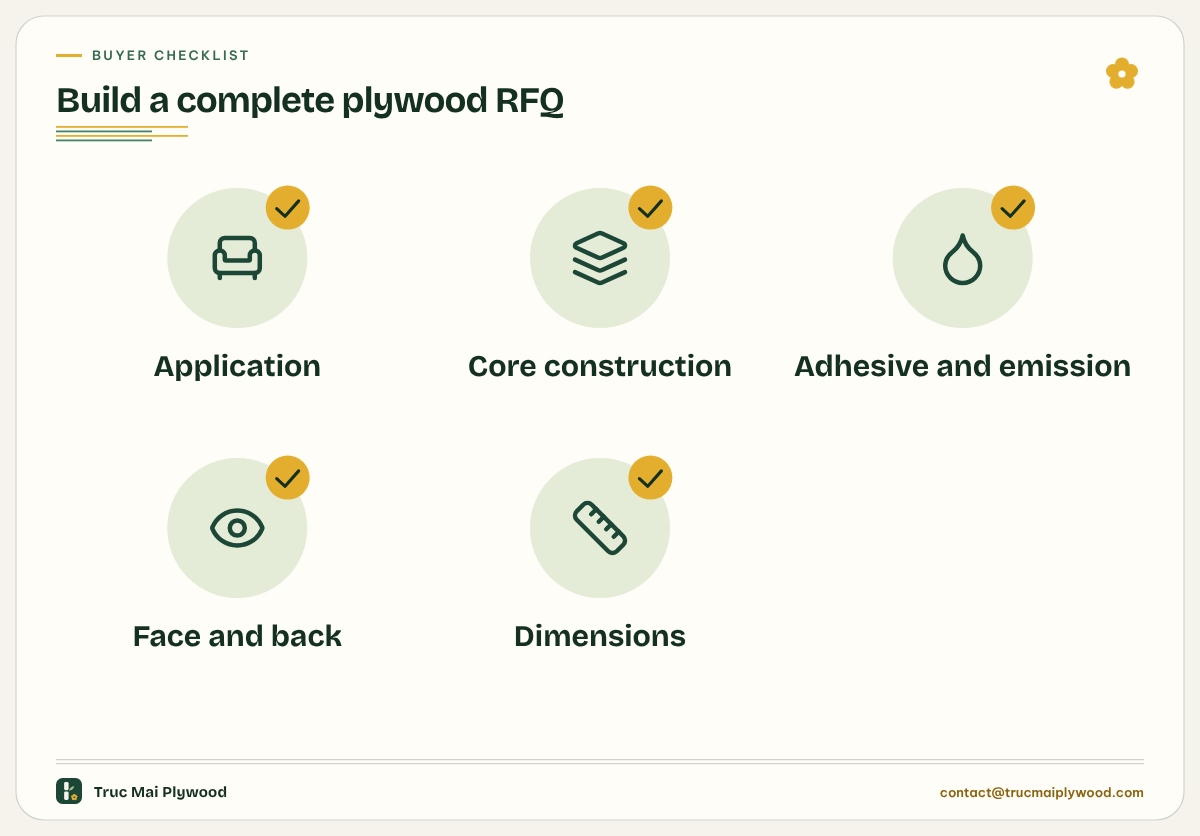
- Application: carcass, shelf, door, back or laminated furniture part.
- Core: Styrax, Eucalyptus, Acacia, Pine or a specified combined construction.
- Adhesive and emission: name the adhesive requirement and the test or certificate scope separately.
- Face and back: species, grade pair, appearance sample and intended finish.
- Dimensions: nominal thickness, tolerance, sheet size and any cut-to-size drawing.
- Packing and quantity: labelled parts or full sheets, packs, container mix and destination port.
Cut-to-size parts can be prepared from a standard sheet, including lengthwise halves, thirds, quarters or six-part layouts. For example, 610 × 2440 mm halves come from a 1220 × 2440 mm sheet; the final cutting schedule is agreed from the selected stock size and the buyer’s part list.
For a repeat furniture programme, ask for the same written construction on subsequent orders. Consistency across orders is more valuable than a headline grade label that can be interpreted differently by each supplier. Submit the RFQ with the approved sample reference and requested delivery term.
Send your specification to contact@trucmaiplywood.com or through the quotation form.
Questions buyers ask
Can a cabinet carcass use a different face from a visible door?
Yes. Specify a functional, sound surface for concealed carcass parts and a selected decorative face for exposed doors. Quote the two constructions separately.
Is birch-faced plywood made entirely of birch?
No. Birch-faced plywood can use imported birch face veneer over a different veneer core. State the face species and core species separately on the purchase order.
Does UV-ready mean that the plywood is already coated?
No. UV-ready panels are prepared for coating by the furniture maker. They are supplied without a factory-applied UV finish.
Which dimensions are available for furniture panels?
Standard sheet options include 1220 × 2440 mm, 1220 × 2280 mm and 1250 × 2500 mm. The cut list can specify smaller labelled parts.
Can I order FSC 100% furniture plywood?
FSC 100% products are available within the applicable certificate product schedule. The invoice identifies the eligible product and carries the certificate code and FSC claim.
How long does production take after the deposit?
The normal production window is 15–45 days after receipt of the deposit, according to the agreed order. Sea transit is a separate stage.
What is the minimum shipment for a factory order?
The standard minimum order is one 40HC container. A container usually contains one or two products, with a broader mix arranged by agreement.
What is the difference between face grade and emission class?
Face grade describes visible surface appearance; emission class describes formaldehyde release under a defined test. Both belong on separate specification lines.
Should a kitchen order specify moisture exposure?
Yes. Describe whether the panel is for a dry cabinet interior or a humid-use location and request the corresponding adhesive and bond-test specification.
Can the factory label cut cabinet components?
Yes. Cut-to-size parts can be labelled against the approved cutting schedule, with exact dimensions agreed before production.