
Ash veneer plywood is a plywood panel surfaced with thin natural ash veneer for visible furniture, doors and interior joinery. Buyers choose it for the pale colour and pronounced grain, then specify cut, matching, back face and core separately. Truc Mai Plywood offers natural ash faces on request and repeatable light-face alternatives in engineered veneer and poplar.
What is ash veneer plywood?
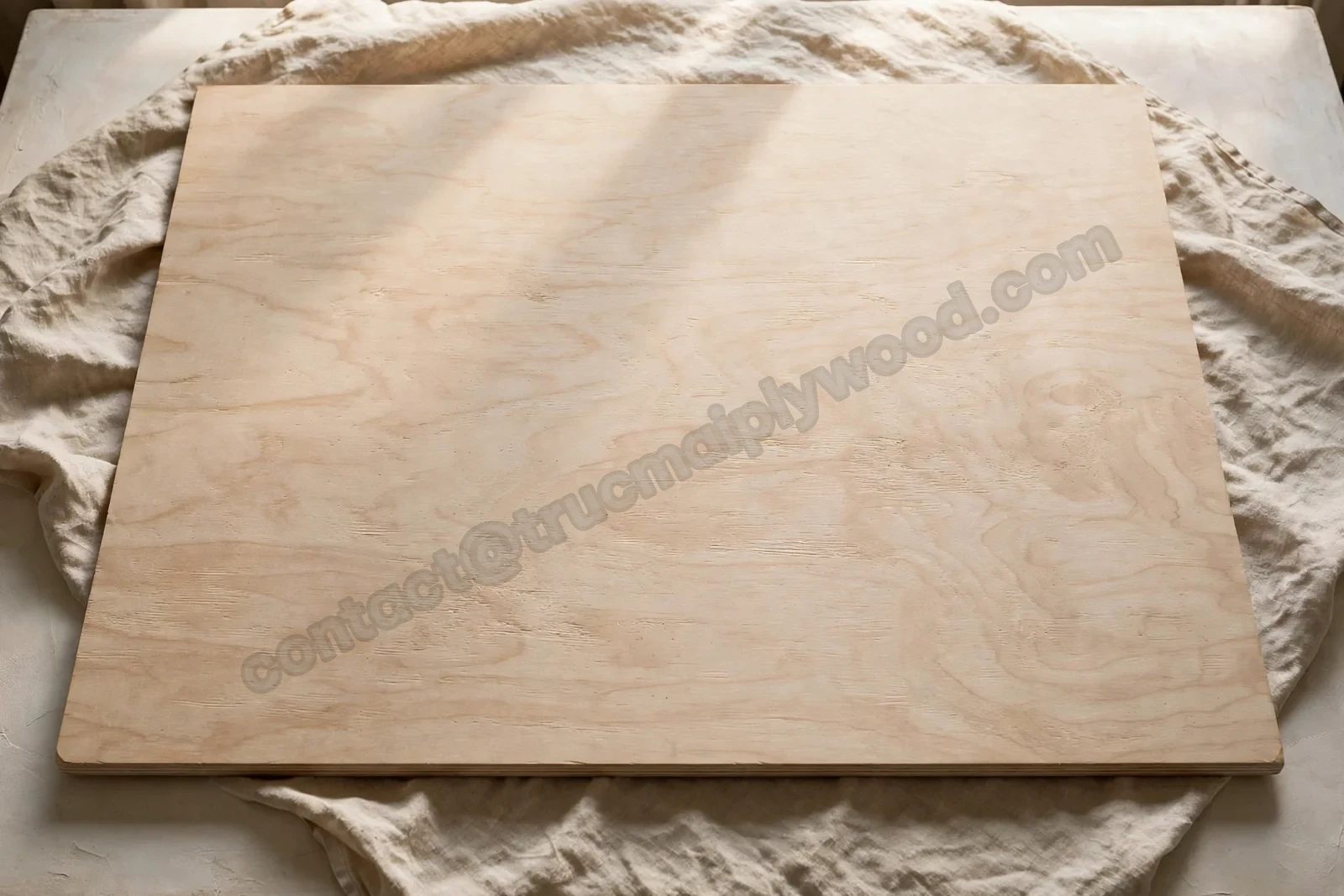
Ash veneer plywood is a layered plywood panel with a thin decorative ash face. Its visible grain comes from that face; the core influences weight, edge appearance and machining. Unlike solid ash, it is not ash throughout. For cabinet doors, specify the presentation face, back construction, core and intended finish separately.
Natural ash shows open, prominent grain with pale cream to light brown colour. Adjacent leaves can differ, so a photograph of a single small sample is less useful than a full-panel reference. For a repeat furniture programme, the approved face sample should capture the permitted colour spread and the way veneer leaves meet. Cabinet-grade plywood explains the related core and appearance choices.
Where is ash-faced ply used in interiors?
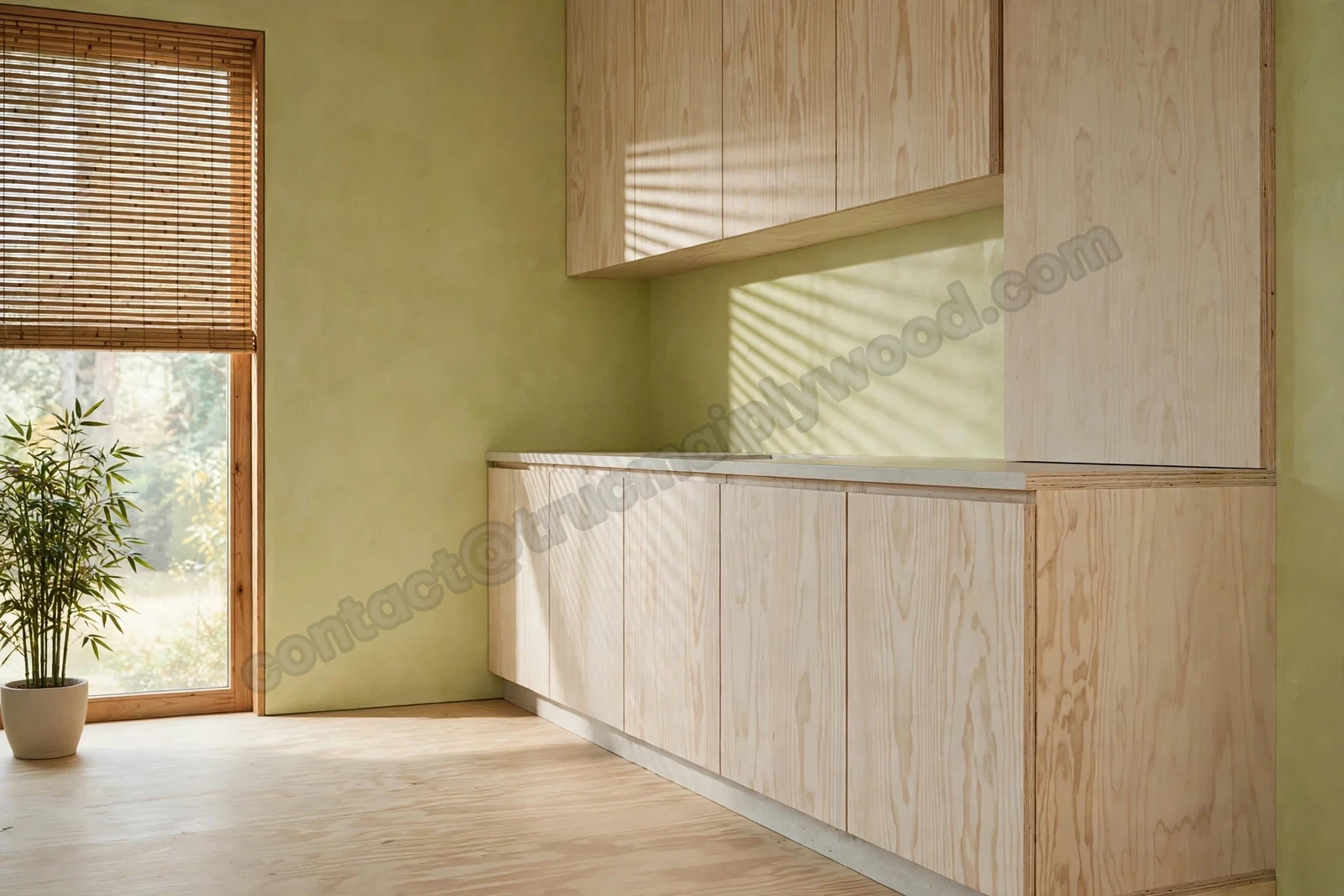
Ash-faced ply is used for cabinet doors, furniture fronts, wall linings, shelving and visible joinery where the timber grain is part of the design. A decorative face gives a large, consistent panel format that can be cut into repeated components. It is particularly useful when a designer wants a natural timber appearance across a run of doors without constructing each front from solid boards.
The application changes the purchase specification. A door front needs a deliberate back face and stable construction; a wall panel may have one presentation face and a balancing reverse; a shelf also needs a core and thickness selected for the supported span and load. The face itself is not a structural rating. A furniture maker can compare lighter alternatives in best plywood for interiors before settling the finish.
How do crown-cut and quarter-cut ash faces differ?
Crown-cut ash typically displays sweeping, cathedral-like figure, while quarter-cut ash produces straighter, more linear grain. Both come from how the veneer is sliced relative to the growth rings. They should be specified by visual sample rather than by the word ash alone.
A crown figure can make individual doors expressive, but an entire cabinet bank needs a plan for where the figure starts and ends. Straight grain can be easier to arrange across repeated narrow fronts. The veneer supplier may offer 3 matching approaches: book matching, slip matching or a more random lay-up. Ask for a photograph of the assembled face at the actual sheet scale, not merely a close-up of one leaf.
For a project with multiple room elevations, label the preferred grain direction on the cutting schedule. A horizontal crown on a wide drawer front reads differently from the same veneer turned vertically. The mill and fabricator need that orientation before face lay-up and panel cutting.
What should a buyer specify about veneer matching?
Specify the face cut, grain direction, matching pattern and approved reference panel as 4 separate appearance decisions. Book matching alternates veneer leaves to create a mirrored figure; slip matching places leaves in the same orientation; random matching gives a less regular field. Each can look attractive, but changing method between containers can make a finished installation visibly inconsistent.
A useful approval pack includes a whole-face photograph, a close-up of any accepted knots or mineral marks, and a physical sample under the intended coating. State whether the face is intended for clear lacquer, stain or another finish. The mill should record the agreed front and back grades together. When doors are cut from a larger sheet, the cutting plan should identify which parts must remain visually adjacent.
A matching request is different from a demand for identical natural grain. Wood figure changes between veneer leaves. Define acceptable variation by sample and use the same sample reference on repeat orders.
How does natural ash compare with EV and poplar faces?
Natural ash is the choice for genuine ash grain; white poplar engineered veneer (EV) and poplar faces are alternatives when a pale surface and repeat-order consistency matter more than the exact ash figure. The light faces should be compared as different materials, not presented as identical species.
| Face | Visual character | Best buying reason | What to approve |
|---|---|---|---|
| Natural ash | Distinct open grain, natural colour spread | Visible ash timber design | Cut, matching and full-face sample |
| White poplar EV | Engineered, more regular decorative figure | Repeatable pale furniture fronts | Pattern, colour and face thickness |
| Poplar or bleached poplar | Light, comparatively quiet appearance | Light base for finishing | Bleaching, surface preparation and grade |
| Birch face | Pale timber figure, different grain from ash | Natural light furniture appearance | Face source and sample |
Truc Mai’s engineered veneer plywood uses a reconstituted poplar face, whereas poplar plywood is the relevant product route for a natural or bleached poplar appearance. Neither should be relabelled as natural ash. For purchasing, ask for side-by-side samples under the same finish and lighting.
Which plywood core belongs beneath an ash face?
A veneer core made from Styrax, Eucalyptus, Acacia, Pine or a specified combination can support a decorative face. The choice affects weight, panel feel, machining and the quality of the exposed edge. A face species is therefore an incomplete product description.
A furniture-grade build normally uses an A-grade stitched core and sanded faces. Stitching helps keep the veneer lay-up closed and regular before pressing. Commercial construction can use a different core preparation, so two sheets with the same ash face may behave differently in the workshop.
Ask the mill to show a clean cross-section of the actual core build. Look for open gaps, overlapping strips and inconsistent layer thickness. If edges will be exposed, the edge sample is just as important as the decorative face. If edges will be banded, the core still matters for machining and fastening. The 18 mm hardwood plywood page offers a thickness-specific starting point.
What thickness and sheet sizes can be ordered?
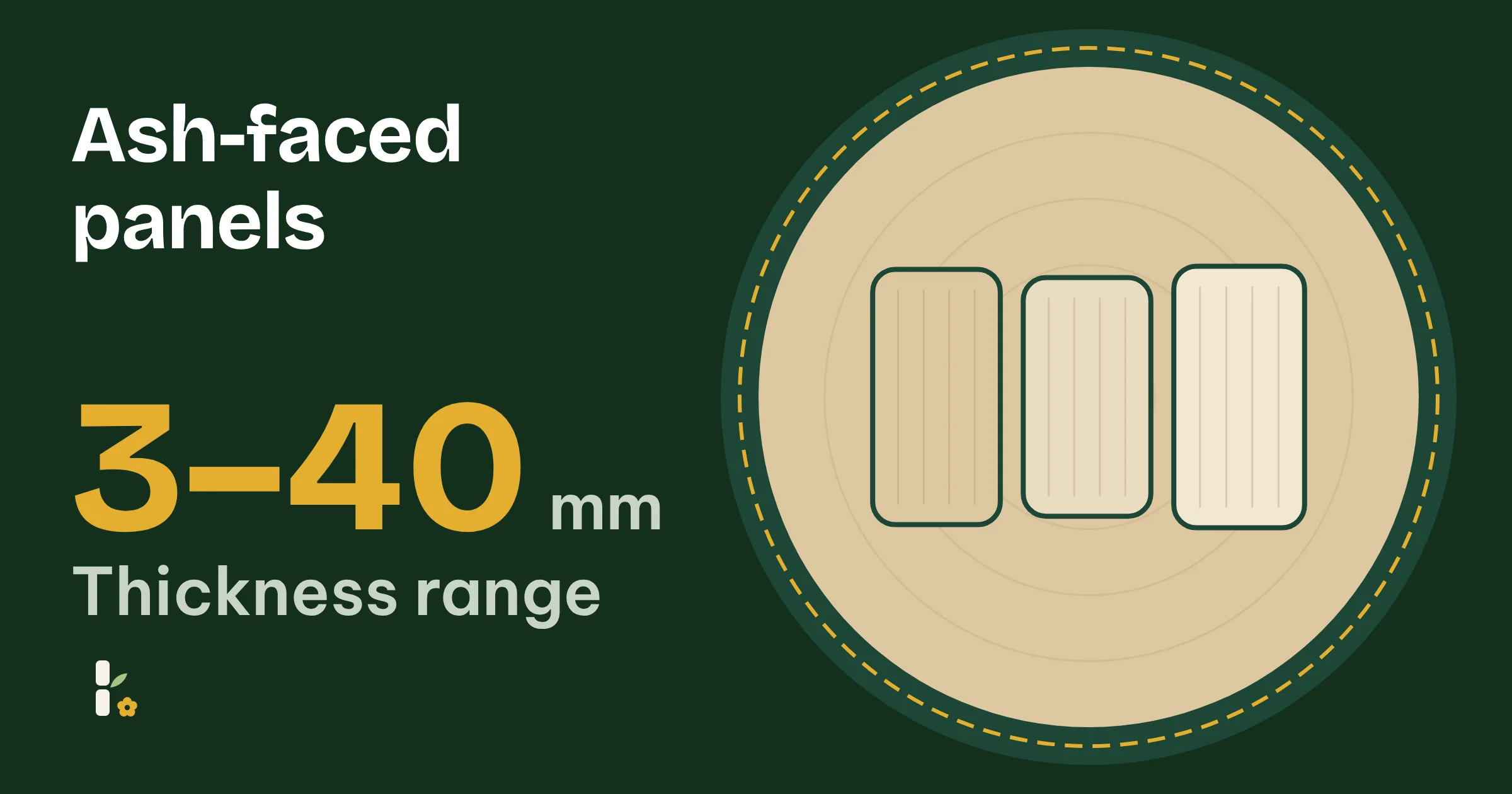
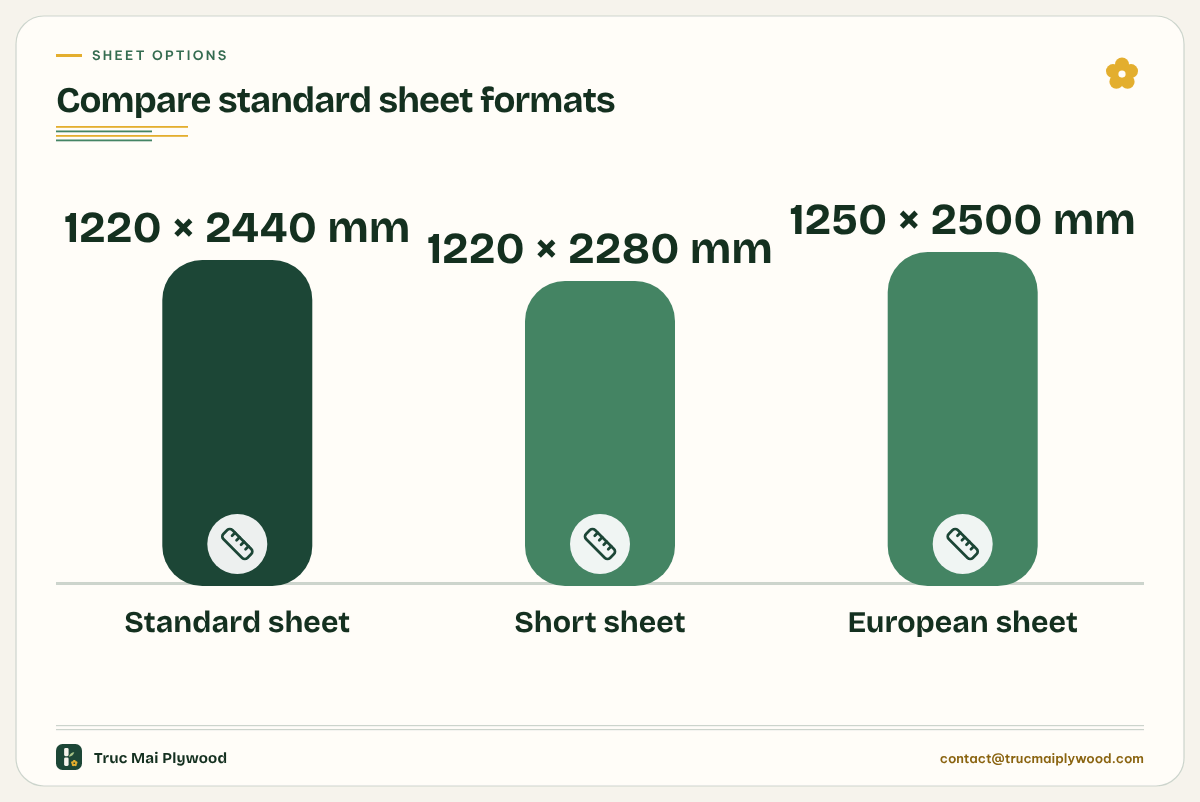
Truc Mai makes furniture and commercial panels from 3 to 40 mm in regular sheet formats of 1220 × 2440, 1220 × 2280 and 1250 × 2500 mm. Natural ash is a request-led face option, so the buyer should identify the required build before selecting the format.
| Order item | Truc Mai specification | Buyer decision |
|---|---|---|
| Panel thickness | 3–40 mm | Finished component and machining requirement |
| Standard sheet | 1220 × 2440 mm | Conventional full-sheet cutting |
| Short sheet | 1220 × 2280 mm | Furniture component nesting |
| European sheet | 1250 × 2500 mm | Metric cutting layouts |
| Furniture thickness tolerance | ±0.3 mm for sanded, calibrated panels | Written order tolerance |
| Commercial thickness tolerance | ±0.5 mm | Written order tolerance |
Specify whether thickness is measured before or after any subsequent surface finish applied by the buyer. Record the final panel size in millimetres, not simply as a nominal foot-based description. The 1220 × 2280 mm panel option can be relevant when the buyer’s cutting layout leaves less waste on a shorter sheet.
How are face grades assessed before ordering?
Appearance is agreed against a sample and a written defect schedule. The 2020 edition of ISO 2426-2 classifies hardwood plywood surface appearance by the characteristics and manufacturing defects visible on the face. Trade descriptions such as A/B or B/BB are not a universal substitute for the buyer-approved reference.
A good grade discussion starts with the presentation side. Define accepted knots, splits, patches, colour marks, grain irregularities and repaired areas in words and photographs. Then define the reverse separately. A decorative front can need a stricter face than a concealed cabinet back even though both use the same nominal panel.
For repeat orders, keep a retained reference sample and an inspection photograph from the first approved lot. A label that only says ash A grade cannot tell a receiving inspector how much variation was agreed. The Vietnamese plywood quality by grade article covers the broader grading conversation.
What is the difference between veneer grade and glue performance?
Veneer grade describes appearance; glue performance describes the bond between layers. These are 2 separate order lines. They are independent specifications, and neither can be inferred from the other. A pale, clean face can sit on a panel intended for dry furniture use, while a darker face may be bonded with a different adhesive system.
For dry interiors, the mill commonly uses UF adhesive. A moisture-exposed application needs a separately selected adhesive and documented bond performance. The buyer should write the service environment, glue system and emission requirement on separate lines. A surface grade such as A/B cannot answer whether a bond has been tested for a humid environment.
If a buyer requests an EN bond class, the test report should identify the tested build. A generic description of the resin is not a substitute for the bond test. The same principle applies when the buyer changes face or core and expects the earlier paperwork to cover the new construction.
Which formaldehyde documents matter for UK and US buyers?
For US hardwood plywood with veneer core, 40 CFR 770.10 sets a formaldehyde emission limit of 0.05 ppm under TSCA Title VI. The US eCFR regulation sets out the product definitions and certification requirements. Truc Mai holds CARB Phase 2 and TSCA Title VI certification for hardwood plywood with veneer core in the 3–25 mm range, certificate CARB/EPA 26053.
For a UK furniture order, ask for the emission requirement in the buyer’s own product specification and the corresponding test method. An emission grade and a glue-bond class answer different questions. The panel build, thickness and paperwork should align with the material named on the purchase order.
Where a US buyer asks for a certified panel, the exact construction and thickness must sit within the certificate scope. This is especially important when the decorative face is changed on a repeat programme. See Phase 2 formaldehyde limits for the regulatory distinction.
How should FSC and face-origin documents be checked?
FSC chain-of-custody purchasing requires the correct claim on the sales documentation for the eligible product. The FSC Chain of Custody standard requires the seller certificate code and product claim to be recorded. Truc Mai holds licence FSC-C196493 and chain-of-custody certificate SA-COC-014545, with FSC 100% available for eligible listed products.
For natural ash, the buyer should also request the face veneer species and origin file. The source of the decorative veneer and the source of the plywood core are separate material streams. A finished panel can combine imported face material with Vietnamese plantation core wood, so a single country name on the invoice does not explain both.
The face veneer origin files page explains the practical paperwork trail. Ask for the document set alongside the approved face specification, rather than trying to reconstruct it after the container is packed.
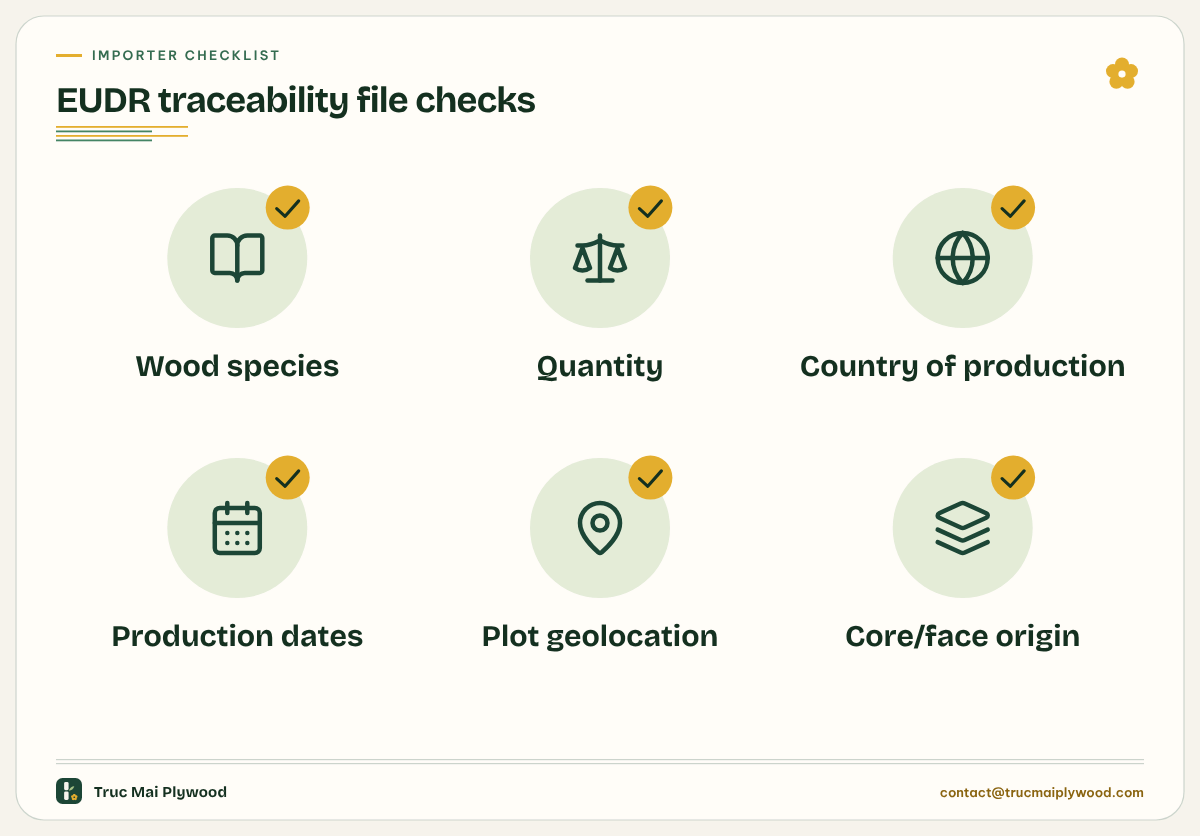
What should an importer check for EUDR traceability?
An EU-bound plywood order needs traceability for the core wood and the decorative face veneer. Truc Mai supplies origin records and plot geolocation data for both streams. This is especially relevant when a buyer substitutes natural ash with engineered poplar veneer because the face source has changed.
The buyer should identify each material species, production origin, traceability record and the related shipment references. Keep the file names connected to the order and product description so the importer can match the delivered panels to the material records.
The paperwork should follow the actual material selected, not the colour name used by a designer. A light-coloured panel described casually as ash-effect can be an engineered poplar face, and the origin documents should describe that real material. The EUDR dates for plywood buyers page addresses the timing of the EU process.
Can a mill cut ash-faced panels to cabinet sizes?
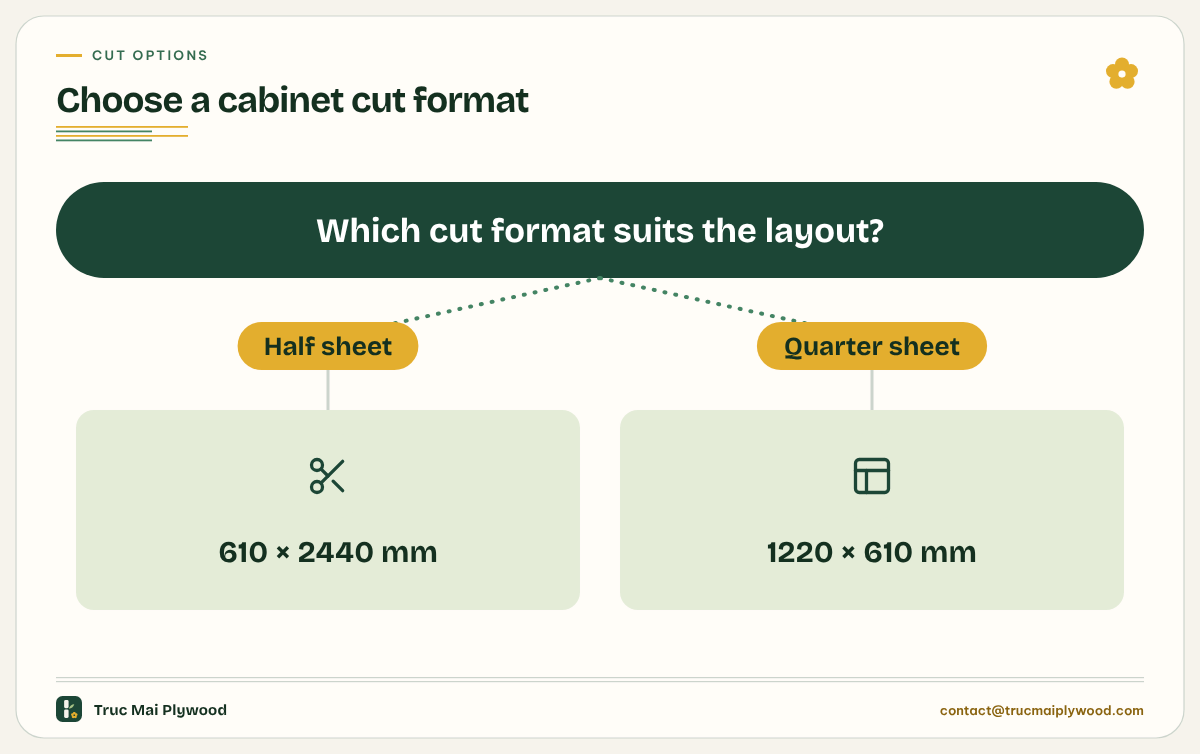
Yes. Cut-to-size panels can be supplied from a standard sheet when the buyer provides the cutting list and approves the finished dimensions. The mill can divide sheets into halves, thirds, quarters or six pieces, with labels to identify each component.
A useful cutting schedule lists component length, width, grain direction, face side, edge treatment and quantity. The grain arrow is essential for a decorative face: a panel rotated for material yield can look wrong when installed beside its neighbour. For book-matched faces, the schedule also needs a sequence identifier.
A half-sheet format such as 610 × 2440 mm and a quarter-sheet format such as 1220 × 610 mm are possible examples. The exact pattern is agreed from the source sheet and cut list, with the saw kerf and handling allowance accounted for in production. Cut-to-size plywood panels describes the ordering route.
How should a buyer inspect a pre-production sample?
Inspect one full-face sample, one edge cross-section and one finished sample under the intended coating. These 3 views answer different questions: appearance, core construction and final colour. Small bare veneer offcuts alone cannot show how a whole door bank will read under site lighting.
Check face and back separately. On the front, examine colour range, leaf joints, repairs, sanding marks and grain direction. On the edge, examine the core’s lay-up and gaps. On the coated sample, check whether stain collects in ash pores and whether the finish changes the perceived colour.
Record the sample identification on the order and keep a reference at the receiving factory. For a repeat container, compare incoming material with the retained reference rather than relying on a fresh photograph taken under different light. The ordering samples page covers the first-sample workflow.
How does packaging protect a decorative veneer face?
Decorative faces need clean interleaving, aligned stacks and protection against edge impacts during handling. A face that looks acceptable at the press can be scratched during trimming, strapping or unloading. Packing instructions therefore belong in the product specification rather than being left as an afterthought.
Ask for face-to-face protection appropriate to the approved finish state, corner protection and a clear pack label showing the face specification. A receiving team should know which side is decorative before it cuts the wrapping.
A repeat programme also benefits from pack labels that match the cutting schedule and purchase-order line. When several faces share a container, label the face species and grade on each pack. The documents per container page shows where the final pack count and product descriptions belong.
What belongs in an ash-faced plywood RFQ?
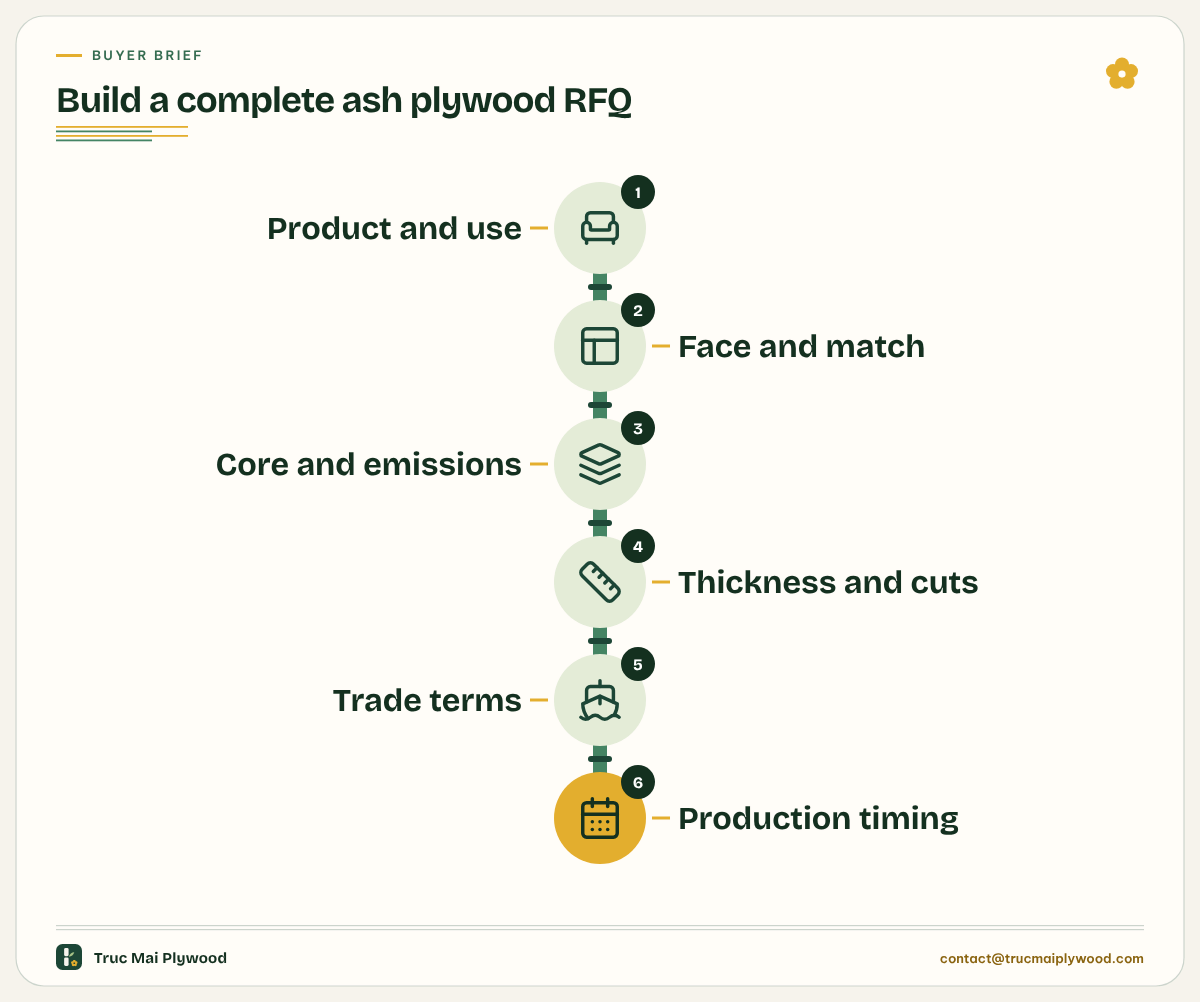
An ash-faced plywood request should name the application, face cut, matching, core, glue and emission requirement, thickness, sheet size, packing and container quantity. Send the same construction in the sample request and the production RFQ so quotations can be compared on equivalent panels.
- Describe the finished product, such as cabinet doors or wall panels, and which faces remain visible.
- Specify natural ash or a named light-face alternative, plus veneer matching and grain direction.
- Choose the core construction, adhesive system and emission documentation needed for the destination market.
- State thickness, sheet dimensions, tolerance and any labelled cut list.
- Give packing instructions, order volume and destination port.
Truc Mai’s minimum order is one 40HC, with FOB Hai Phong, CFR or CIF terms. Production is planned at 15–45 days after the deposit. Use the plywood RFQ checklist and quotation page to submit the specification.
Questions buyers ask
Is ash-faced plywood the same as solid ash?
No. Ash-faced plywood has a decorative ash veneer over a plywood core; solid ash is timber throughout.
Can I order a matching back veneer?
Yes. Specify a two-sided decorative face or a balancing back in the sample approval, including the acceptable back appearance.
Can the veneer be stained grey?
Natural ash can be sampled with a grey stain, but approve the colour on the actual face veneer and finishing system before production.
Is ash plywood suitable for painted cabinetry?
A smooth calibrated panel can be painted, although an ash face is usually selected to show its grain. A paint-grade face can be a more practical specification.
Do I need edge banding?
Use matching edge banding where the plywood layers should be concealed. An exposed layered edge is a separate design choice.
Can I order only one sheet from the mill?
Truc Mai Plywood supplies container-volume orders, with a minimum of one 40HC. Samples can be requested before a production order.
Does a pale EV face contain ash wood?
No. The white poplar engineered veneer offered as a light-face alternative is made from poplar, not ash.
Should I specify A/B for the face?
Write an approved visual sample and permitted defects alongside any trade grade. A/B is not a universal appearance class.
Can both sides have the same grain pattern?
Ask for a matched face and back if visual continuity matters; agree the matching method and reference sample before cutting.
Is a veneer face suitable for repeated sanding?
A decorative veneer has limited sanding allowance. Specify the face thickness and finishing process before ordering.