
Beech ply is plywood faced with beech veneer, often chosen for its fine grain, warm pale colour and furniture-friendly finish. A beech face does not identify the core: buyers should compare the veneer, internal plies, bonding specification and panel weight. Okoume, bintangor and engineered veneer provide different visual options for repeat production.
What is beech ply, and what does the name tell a buyer?
Beech ply is a cross-laminated wood panel with a beech veneer surface; the name alone does not identify whether the inner plies are also beech. In British timber trade listings, beech-faced ply, beech veneer plywood and beech veneered plywood can describe a decorative face over a different core.
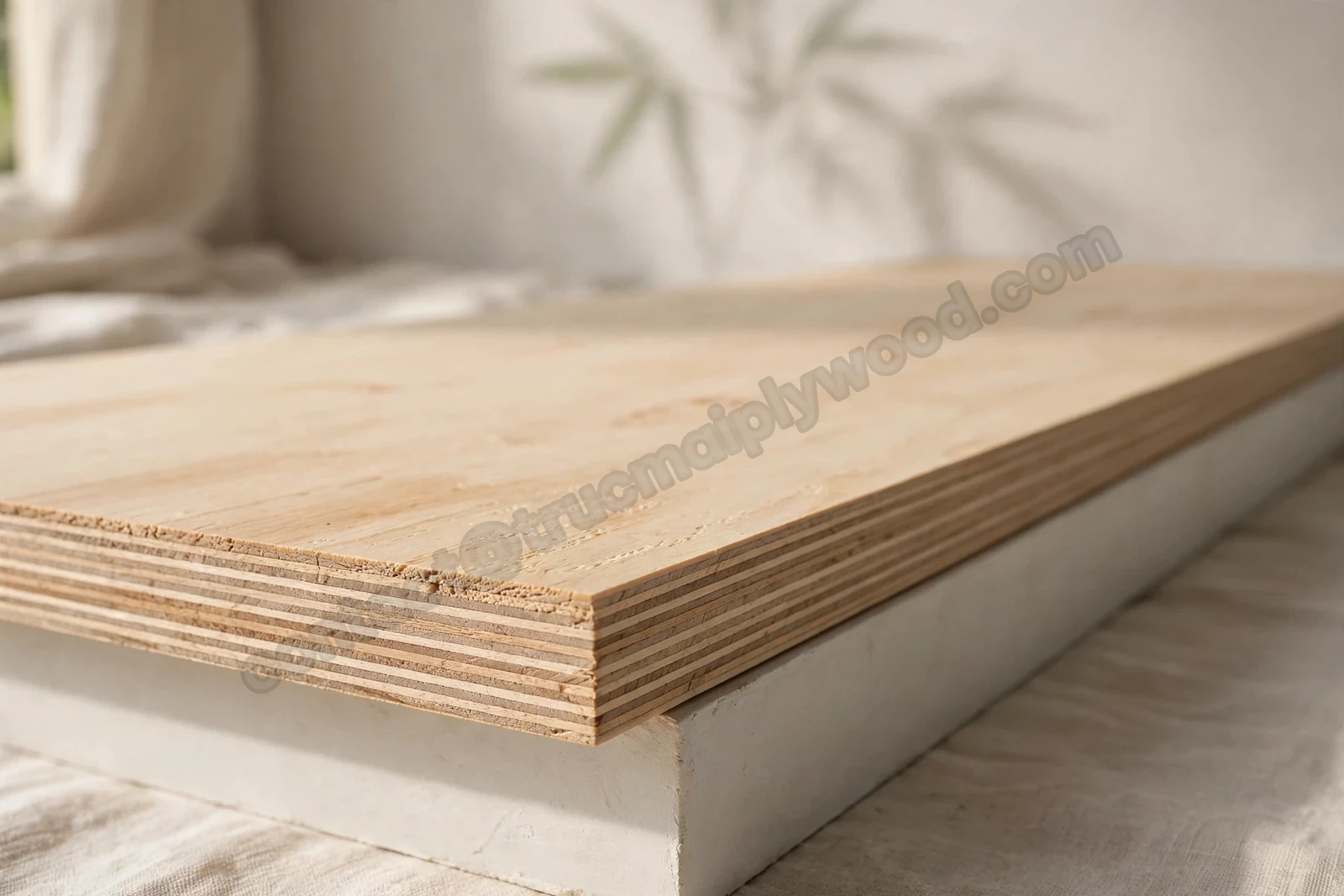
An all-beech construction is a separate specification. Ask for a photograph of the exposed edge as well as the face: the edge reveals whether the panel contains similar hardwood veneers throughout or a mixed core.
European beech, Fagus sylvatica, typically shows a fine, relatively quiet grain and pale cream-to-pink colouring. Steamed veneer can look warmer or more pink. These differences matter when a cabinet run has adjacent doors under the same light. Grain direction, veneer matching and finish should be specified independently of the species name. The hardwood-faced plywood options page sets out the wider choice of decorative surfaces.
Where does beech plywood work best in furniture?
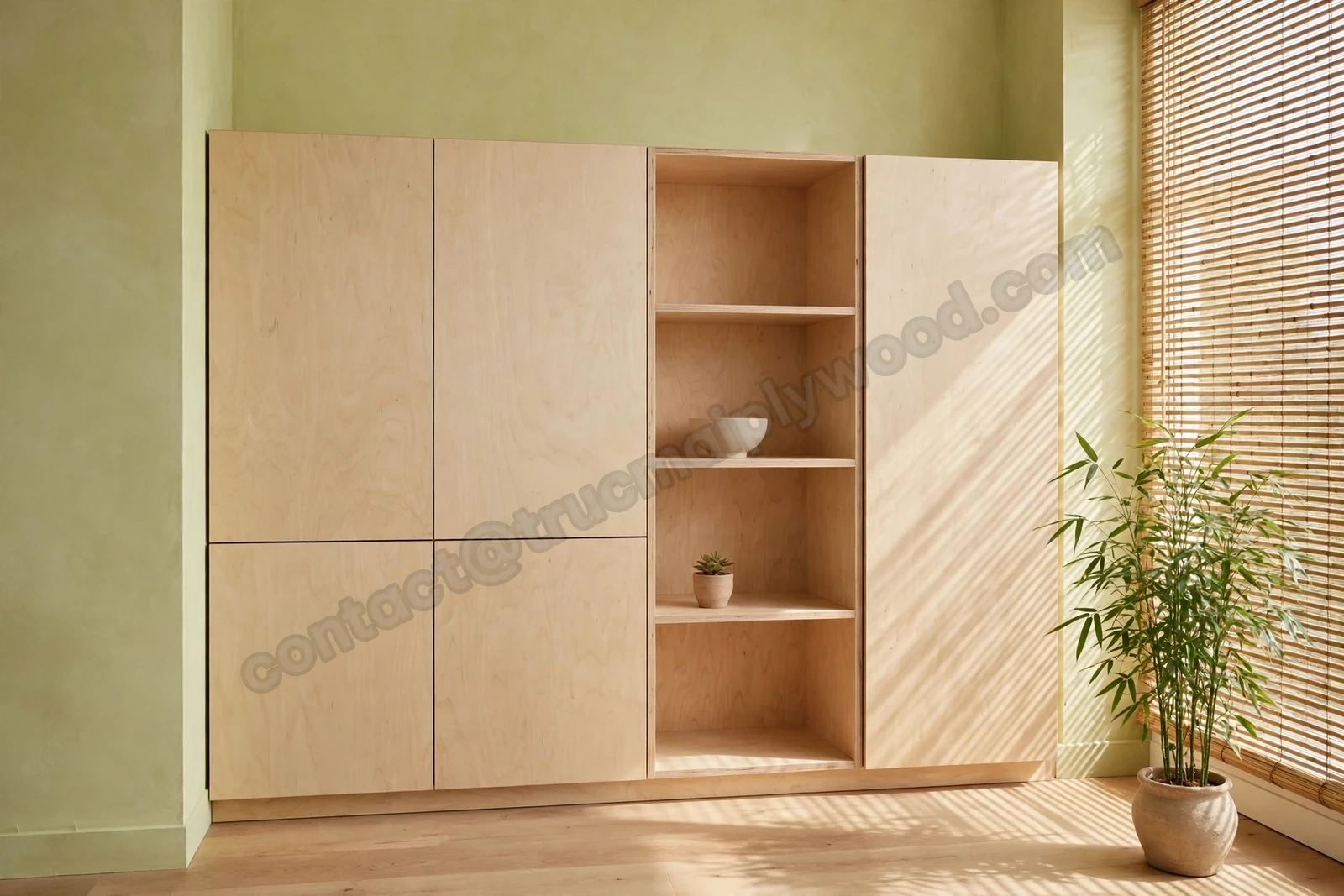
Beech-faced plywood suits visible interior furniture parts where buyers want a calm grain rather than pronounced figure. Cabinet doors, shelving, fitted joinery, shop interiors and furniture sides can use a natural veneer surface. Which faces remain visible after assembly determines the face/back grade and whether the edge needs lipping.
Kitchen-cabinet buyers can use the cabinet-grade plywood checklist to separate visible face requirements from concealed carcase requirements. Decorative veneer often adds little value inside a hidden cabinet back, where the purchasing priority is flatness, machining and the agreed emission specification.
How do beech, okoume and bintangor faces compare?
Beech is the pale, fine-grained choice; okoume is generally warmer and more softly figured, while bintangor commonly gives a stronger reddish-brown appearance. These are face-appearance comparisons, not statements that the panels have equal cores or equal mechanical properties. Buyers choosing a substitute should compare finished samples under their own lighting rather than relying on species names alone.
| Face option | Typical visual direction | Where it can fit | What to specify |
|---|---|---|---|
| Beech | Pale cream to pink, close grain | Exposed interior joinery and furniture | Veneer matching, colour range and finish |
| Okoume | Warm pinkish to reddish tone, gentler figure | Doors, furniture fronts and decorative panels | Face grade, sanding and approved colour sample |
| Bintangor | Warm red-brown tone with visible variation | Cabinet fronts and interior panelling | Face/back pairing and permitted colour variation |
| Engineered veneer (EV) | Repeatable designed pattern and pale tones | Programmes needing coordinated faces | Pattern code, sample and veneer orientation |
| Birch face | Light face with a different grain character | Furniture and cabinet surfaces | Imported face identity and core construction |
The mill’s okoume-faced plywood and bintangor-faced plywood pages show alternative surface specifications. Engineered veneer panels are another route when repeatable appearance matters more than the natural variation of beech. These options do not make an unlisted beech programme a standard stock product: specify the required beech appearance and ask for a sample or a proposed alternative.
Does beech-faced mean beech throughout the sheet?
No. Beech-faced means that the outer decorative veneer is beech; the internal layers can be a different species or a combination of species. Some European panels are made with beech throughout, but that construction must be named expressly in the order. The face cannot tell a buyer the number of internal veneers, their joining method or the panel density.
A buyer comparing two sheets should request an edge photograph, core-specification line and cut sample. A core assembled from joined veneers can perform differently in machining from a carefully stitched furniture core. Gaps, overlaps and local thickness variation may show up at a routed edge even if the face looks excellent. Ask for a trial of the intended hinge boring, screw fixing or CNC profile before adopting a replacement core.
Truc Mai Plywood manufactures furniture and commercial plywood in Ha Hoa, Phu Tho, using Styrax, Eucalyptus, Acacia, Pine or combined cores. Its established face options include okoume, bintangor, birch-faced panels and engineered veneer; other decorative faces are handled by specification. For a beech-look brief, the right comparison is a physical face sample on the proposed core, not an assumption that a beech face is standard stock.
Which face grade should a beech plywood buyer request?
Request a face and back grade against an approved sample, with explicit limits on visible repairs, knots, discolouration and sanding defects. An isolated letter such as A or B does not create a universal specification. Trade names vary between suppliers, and a grade name used on an Asian furniture panel need not match a European appearance class.
ISO 2426-2:2020 classifies hardwood plywood faces separately as E, I, II, III or IV. It addresses permissible appearance characteristics and manufacturing defects, not the whole panel’s bonding class. Ask which grading system the seller is using, then write the agreed defect allowances on the purchase order.
For a visible door, the front may need a tighter appearance specification than the reverse. For double-sided partitions, both faces matter. Photograph the approved sample in neutral light, record grain direction and mark any acceptable natural colour variation. A consistent grading method saves disputes at inspection because the comparison becomes an observable surface, rather than a marketing adjective.
How do sheet size, thickness and machining affect the choice?
Choose sheet dimensions around the cutting plan, not merely the catalogue’s nominal size. Common formats for furniture buyers include 1220 × 2440 mm and 1250 × 2500 mm; 1220 × 2280 mm can suit shorter components. The available Truc Mai interior and commercial range is 3–40 mm, with cut-to-size options based on a supplied cut list.
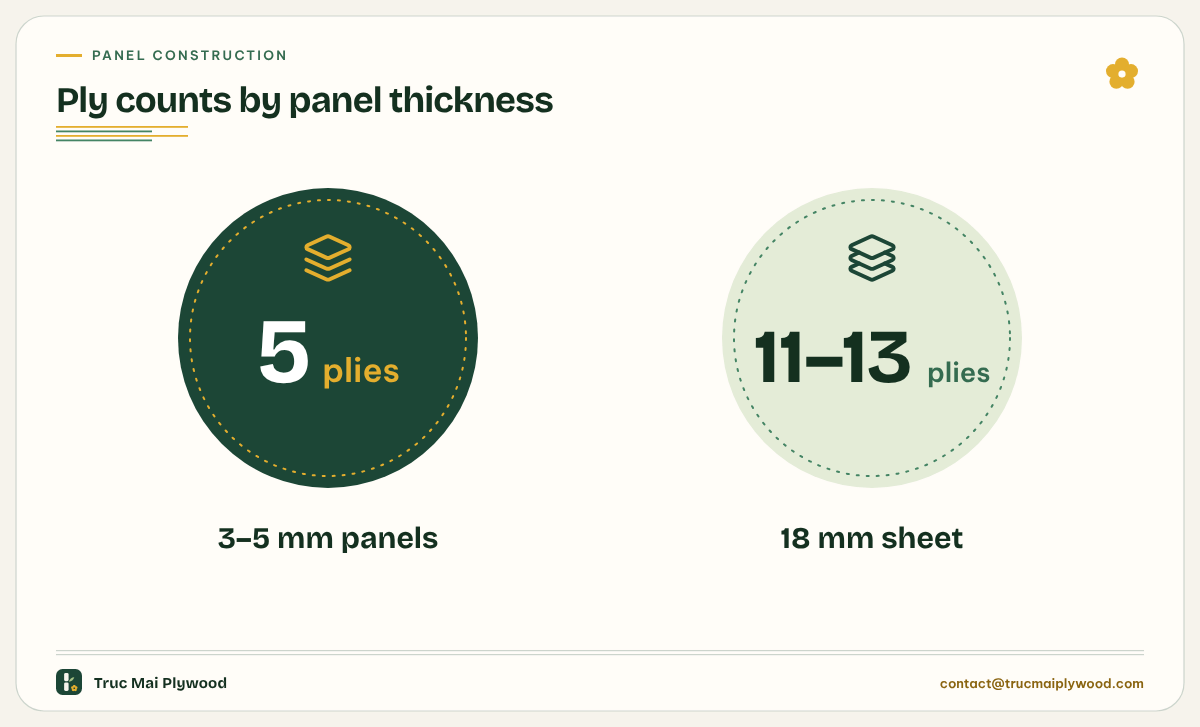
For thin door skins, a surface veneer must survive sanding and subsequent finishing. For thicker shelves or cabinets, the edge and screw-holding behaviour become more important. At 3–5 mm, Truc Mai’s thin panels use five plies; the 6 mm build is specified by order. An 18 mm furniture sheet commonly uses 11–13 plies, most often 11. Those counts describe the mill’s builds, not every beech plywood sold in the UK.
Specify the thickness tolerance in the order. Calibrated furniture panels can be agreed at ±0.3 mm; commercial panels use a wider tolerance. A router set to a nominal thickness will still expose variation when cutting tight-fitting joints. Check the actual panel with callipers and run a short machining trial before releasing a full cabinet programme.
How heavy is beech plywood compared with alternative cores?
Weight is governed by the complete panel’s density, not the visible beech veneer alone. A face of decorative veneer contributes much less mass than the inner plies. Two beech-faced sheets of the same thickness can therefore have different handling weights, container totals and shipping efficiency.
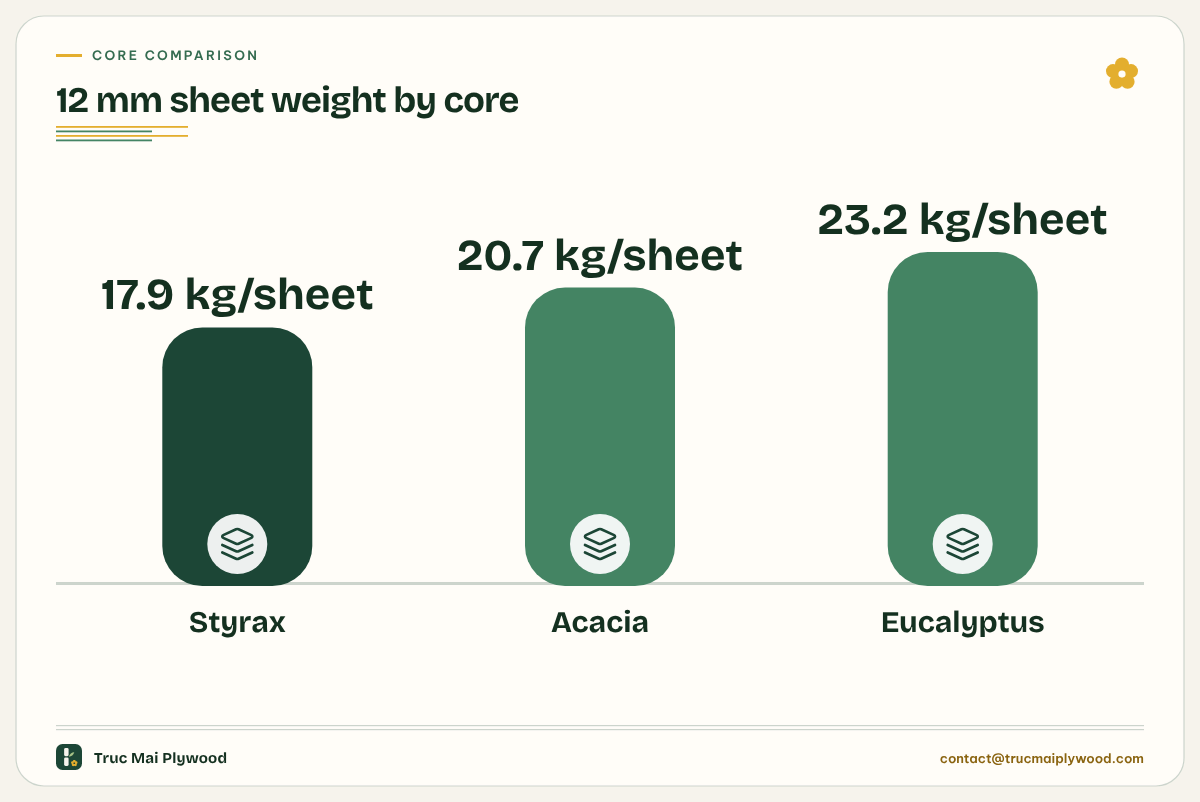
For the Vietnamese core choices in the mill’s planning model, reference densities are Styrax 500 kg/m³, Acacia 580 kg/m³ and Eucalyptus 650 kg/m³. These are model inputs for those cores, not measured densities of a beech-faced product. Use the container loading by thickness reference when planning a full shipment.
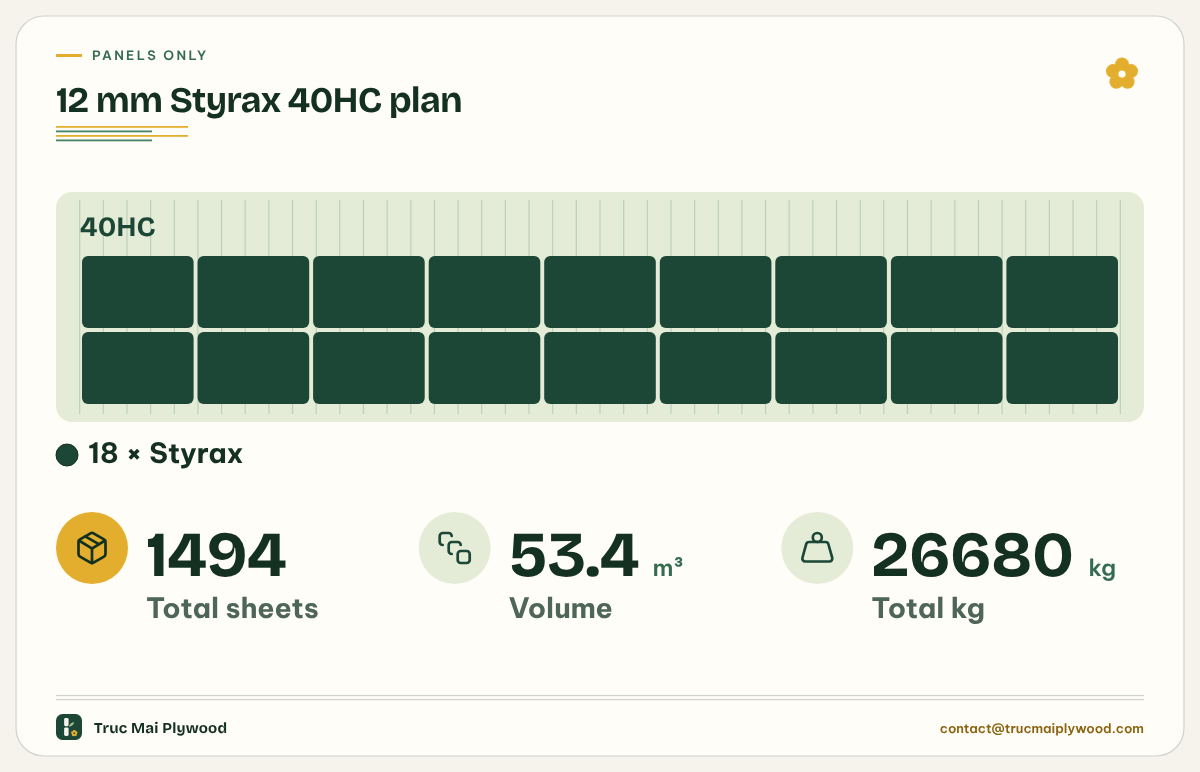
The table below preserves every supplied calculation row, including the model’s sheet weights and total cargo masses. Its basis is a 40HC planning model for panels only: Styrax 18 packs, Acacia 16, Eucalyptus 15; pack height 1,000 mm; sheets per pack are rounded down from height divided by thickness and capped against a 28,000 kg planning payload. The assumed core densities are those above. It is a planning figure rather than a loading record; final cargo weight includes packaging and is checked against the carrier booking and route.
| Core | Thickness (mm) | Sheet (mm) | Packs | Sheets/pack | Weight-capped | Total sheets | Volume (m³) | kg/sheet | Total kg |
|---|---|---|---|---|---|---|---|---|---|
| Styrax | 12 | 1220 × 2440 | 18 | 83 | No | 1494 | 53.4 | 17.9 | 26680 |
| Acacia | 12 | 1220 × 2440 | 16 | 83 | No | 1328 | 47.4 | 20.7 | 27510 |
| Eucalyptus | 12 | 1220 × 2440 | 15 | 80 | Yes | 1200 | 42.9 | 23.2 | 27860 |
| Styrax | 15 | 1220 × 2440 | 18 | 66 | No | 1188 | 53.0 | 22.3 | 26520 |
| Acacia | 15 | 1220 × 2440 | 16 | 66 | No | 1056 | 47.2 | 25.9 | 27350 |
| Eucalyptus | 15 | 1220 × 2440 | 15 | 64 | Yes | 960 | 42.9 | 29.0 | 27860 |
| Styrax | 18 | 1220 × 2440 | 18 | 55 | No | 990 | 53.0 | 26.8 | 26520 |
| Acacia | 18 | 1220 × 2440 | 16 | 55 | No | 880 | 47.2 | 31.1 | 27350 |
| Eucalyptus | 18 | 1220 × 2440 | 15 | 53 | Yes | 795 | 42.6 | 34.8 | 27690 |
| Styrax | 21 | 1220 × 2440 | 18 | 47 | No | 846 | 52.9 | 31.3 | 26440 |
| Acacia | 21 | 1220 × 2440 | 16 | 47 | No | 752 | 47.0 | 36.3 | 27270 |
| Eucalyptus | 21 | 1220 × 2440 | 15 | 45 | Yes | 675 | 42.2 | 40.6 | 27430 |
The practical comparison is not simply sheets per container. A lighter core can make the same visible surface easier to handle and allow a larger panel volume within a weight-limited booking. For the finished product, weigh a representative stack with its packing materials and agree the loading plan with the freight provider.
How should a buyer compare beech plywood quotations?
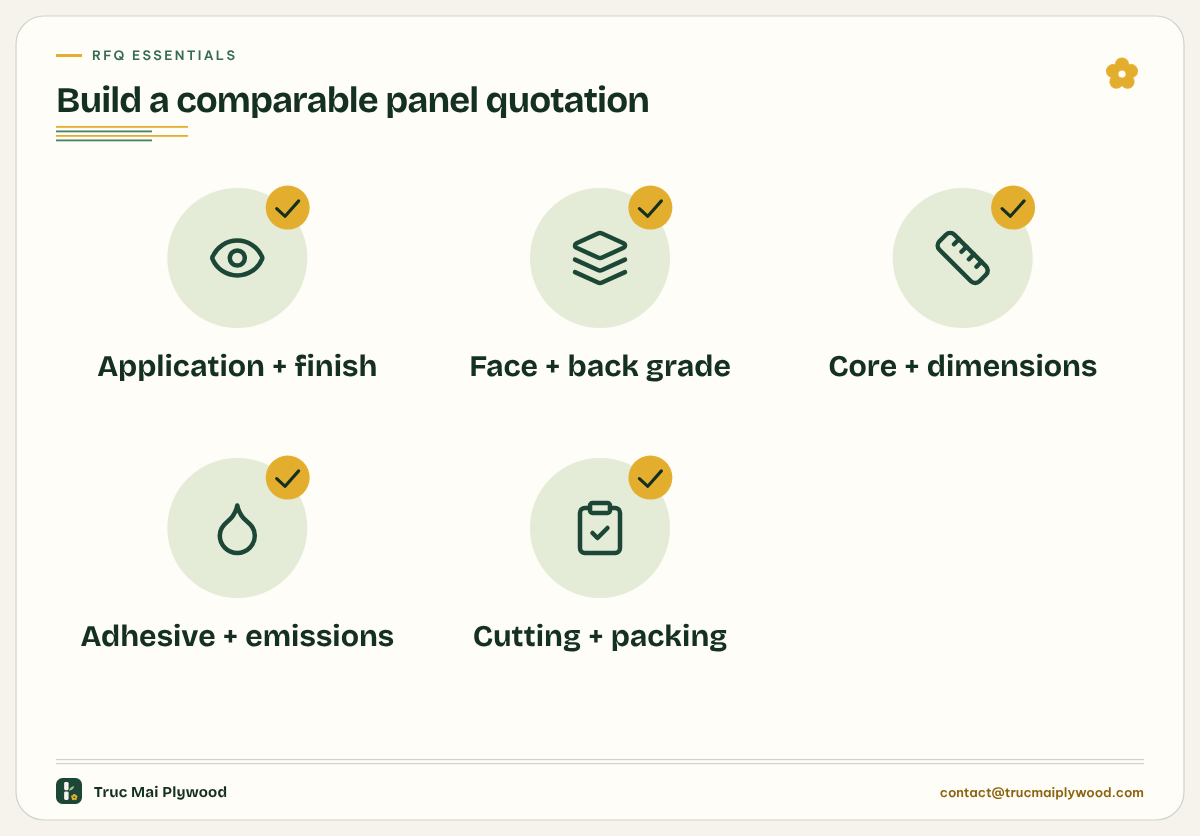
Compare offers using one written construction schedule, starting with the intended furniture application. A quote that names only a species and thickness leaves too many variables open. In particular, a beech-faced sheet with a mixed core is a different product from an all-beech panel even when both are marketed as beech plywood sheets.
- State the visible application, whether the reverse is exposed and the intended finish.
- Define the face species or approved beech-look sample, matching arrangement and face/back grade.
- Specify core species, joining method, nominal thickness, sheet size and tolerances.
- State the adhesive system and emission requirement as separate specification lines.
- Attach the cutting drawing, edge-finishing details and packing labels.
- Request a representative sample, production lead time and shipping documents for the destination market.
A well-written plywood RFQ checklist helps the supplier quote the same build on every revision. If an alternative face is offered, ask for the alternative to be named clearly on the sample and quotation. This prevents an attractive substitute being mistaken for a beech veneer when it reaches the furniture workshop.
Which bonding and emission documents matter for interior panels?
Bond durability and formaldehyde emissions are separate properties, so they need separate evidence. A buyer should identify the intended indoor service conditions and then specify the applicable bonding test or class, along with the destination market’s emission requirement. The veneer species does not determine either one.
The US Forest Service adhesive reference describes urea-formaldehyde systems as common in interior panels and distinguishes their moisture behaviour from more water-resistant adhesive families. For US hardwood plywood with veneer core, 40 CFR Part 770 sets the TSCA Title VI formaldehyde emission limit at 0.05 ppm under the specified testing framework. That is a product and test-method requirement, not a property inferred from a pale face.
For the mill’s own certified hardwood plywood with veneer core, CARB Phase 2 and TSCA Title VI certification covers 3–25 mm products under certificate CARB/EPA 26053. A thicker sheet is a separate scope question. Buyers should request the certificate documents for the actual panel configuration and destination market rather than copying a label from an unrelated product.
What should a workshop check when finishing beech veneer?
Test the selected stain, clear coat or lacquer on the actual veneer and sanding preparation before ordering finished furniture components. Beech’s subtle grain makes colour differences and sanding marks conspicuous across a row of cabinet fronts. A small test panel should include the intended finish, edge banding and lighting conditions.
Check for glue bleed-through, scratches, sanding-through and colour variation near joints. A natural veneer may accept a stain differently from a reconstituted veneer, even when the unfinished sheets look similar. Use the same coating schedule and drying conditions planned for production. For a UV coating line, specify a UV-ready sanded surface; that term means prepared for the buyer’s coating process, not already UV-coated at the mill.
Where the edge remains exposed, test how the plies look under a clear finish. Where a clean solid-wood appearance is required, specify matching lipping and assess its colour beside the veneer. These finishing decisions often matter more to the customer than the species name printed on a packing label.
When is engineered veneer a better choice than beech?
Engineered veneer is a strong candidate when the design calls for a repeatable pale surface across many furniture parts. Natural beech has its own grain and colour variation; engineered veneer can be selected against a controlled visual pattern. The correct choice follows the approved furniture design, not a claim that one face is universally superior.
Truc Mai’s engineered white poplar veneer is a reconstituted face made from plantation poplar. It is supplied as a face on Vietnamese-core panels, giving buyers a defined alternative when they want the look of a pale decorative hardwood but do not require genuine beech. The species description on the order should remain accurate: engineered poplar veneer is not beech veneer.
How can a buyer inspect samples before committing to production?
Approve a face sample, an exposed edge and a machined test piece before releasing a container programme. A photograph alone cannot show veneer thickness, core gaps or how a finish reacts after sanding. Mark the approved sample with the order reference and retain a duplicate for incoming inspection.
The ordering plywood samples process gives buyers a practical starting point. For repeat production, a sample is most useful when it is tied to a written specification and a finishing method; otherwise a visually pleasing offcut may not represent the part the workshop actually needs.
What documentation supports an FSC-specified order?
An FSC-specified plywood order needs an eligible product claim on the sales documentation, alongside the seller’s certificate identification. FSC-STD-40-004 sets out chain-of-custody sales-document requirements, including the certificate code and the FSC claim for each product.
The mill holds FSC chain-of-custody certificate SA-COC-014545 and licence FSC-C196493 for eligible FSC 100% products. That claim is attached to the qualifying item on its sales and shipping paperwork. The FSC licence-code verification page explains what a purchaser can check when a certificate is part of the procurement brief.
For EU-bound orders, origin and geolocation records can be supplied for the core wood and face veneer as part of the EUDR due-diligence file set. Keep the traceability request linked to the actual materials on the purchase order, especially when a proposed substitute changes the veneer species or source.
What details belong in the final furniture-panel order?
A complete order identifies the application, approved face sample, core, adhesive and emission specification, face/back grade, thickness, sheet size, machining requirements, packing and quantity. Include the destination port and the document set required by the importer. If the buyer wants a beech look rather than genuine beech veneer, write that distinction into the brief before samples are approved.
Cut-to-size work starts from a standard sheet and a dimensioned drawing. Common arrangements include halves at 610 × 2440 mm, thirds around 1200 × 800 mm and quarters at 1220 × 610 mm, with other agreed layouts and labels. The mill uses the customer’s cut list to settle finished piece dimensions and packing sequence. This is especially useful for repeat furniture components where the workshop wants identified parts instead of full sheets.
For a factory-direct enquiry, send the face reference or finished sample photograph, the proposed core, panel thickness, dimensions, order quantity and destination port. Ask for the physical sample and the exact construction schedule together. The next useful step is an RFQ built around the furniture component that will actually be manufactured, rather than an unspecific request for beech plywood.
Send your specification to contact@trucmaiplywood.com or through the quotation form.
Questions buyers ask
Is beech-faced plywood the same as solid beech?
No. A beech-faced sheet has decorative beech veneer bonded to a plywood core; solid beech is timber throughout its thickness.
Can I stain beech veneer darker?
Yes. Test stain on an approved offcut first because the colour of the veneer and its preparation affect absorption.
Will a beech face match across several cabinet doors?
A sequence-matched veneer set gives better continuity than random faces. Specify the matching arrangement and approve a laid-out sample before cutting.
Is beech veneer suitable for painted furniture?
It can be painted, but an even paint-ready face may be a more efficient specification when the grain will be completely hidden.
Can I order a different face on the reverse?
Yes. State the face and back as a grade pair and explain whether both sides remain visible in the finished item.
Does a thicker panel automatically hold screws better?
No. Screw retention also depends on core construction, edge distance, pilot holes and the fixing used.
Can beech-faced sheets be supplied pre-cut?
Cut-to-size panels can be specified from standard sheets with a drawing, finished dimensions and labels for each part.
What does an FSC claim look like on an invoice?
For an eligible FSC order, the sales documents identify the seller’s certificate code and the FSC claim for the product.
Should I buy a sample before a container order?
Yes. Compare a representative face, an exposed edge and a finished sample under the intended lighting before approving the specification.
Are beech plywood sheets suitable for wet rooms?
Select the panel by its tested bonding class and intended service conditions, not by the beech veneer name alone.