
Maple ply is plywood with a natural maple veneer face, chosen for pale colour, fine grain and cabinet interiors. Canadian buyers can source individual sheets locally or specify volume orders by face grade, core and finish. Truc Mai Plywood offers light-faced furniture panels in repeatable specifications; natural maple veneer is an on-request face.
What is maple ply and what is inside the sheet?
Maple ply is a layered wood panel whose visible surface is natural maple veneer. The veneer supplies the pale, fine-grained appearance; the core supplies most of the thickness and influences weight, machining and edge quality. Maple wood plywood is therefore a face-and-core specification rather than a promise that every ply is maple.
For a cabinet buyer, the distinction is practical. A natural maple face may be selected for clear-finished doors, drawer fronts, shelves and exposed cabinet interiors. A separate back veneer can balance appearance and production requirements. A cross-banded core is useful for wide panels, while the veneer face provides the colour the customer sees.
Ask the seller to identify the actual face species, core construction and back grade. A photograph of a pale sheet cannot establish those details. The hardwood-faced plywood options article places maple alongside other decorative faces, while cabinet-grade plywood explains how a face grade fits into the whole panel.
What does sanded maple plywood veneer look like?
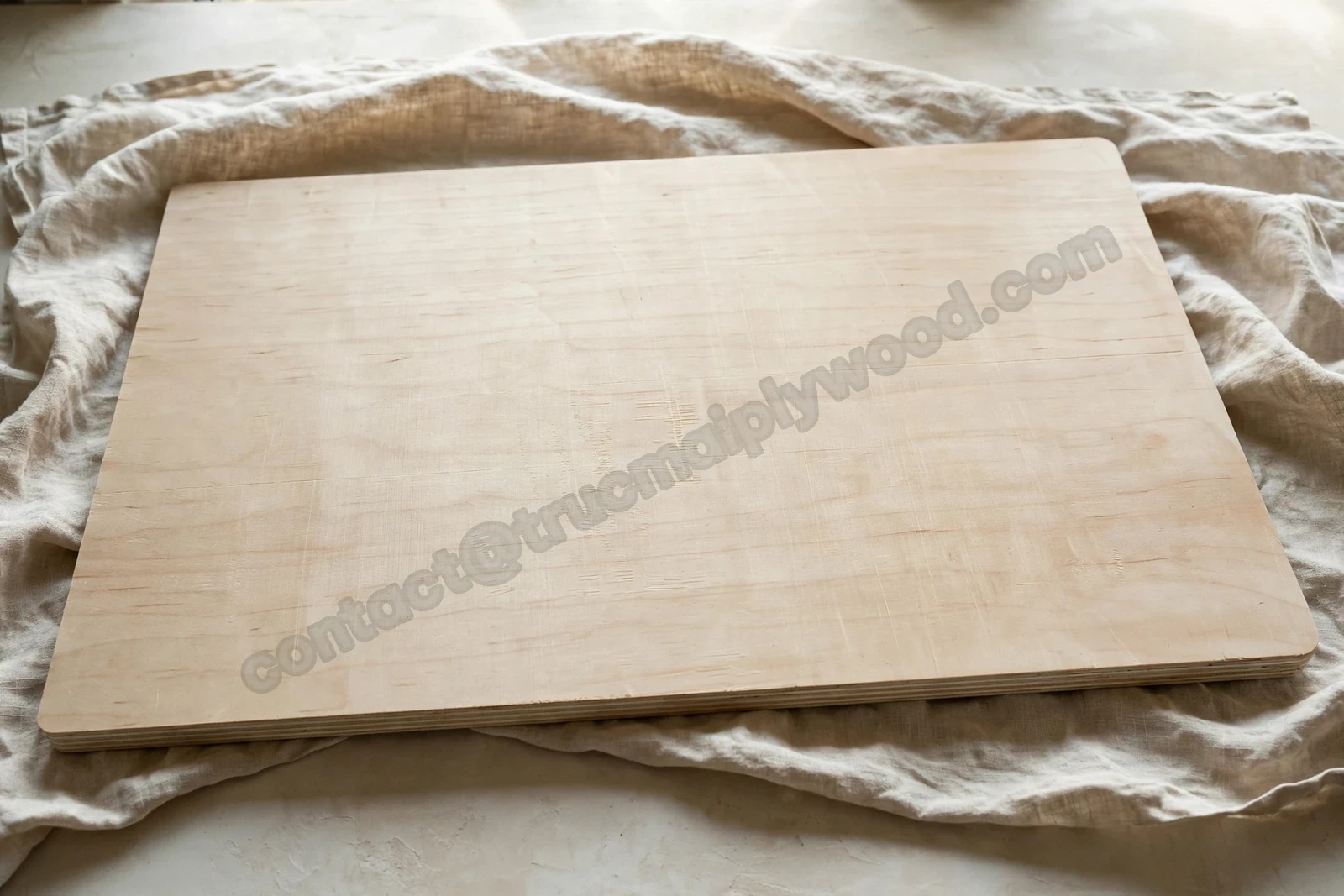
Sanded maple plywood veneer normally has a light cream appearance, fine texture and comparatively restrained grain. Natural variation can include darker mineral marks, figure and changes in tone between adjacent leaves. The selected cut and matching method affect whether a run of cabinet fronts looks uniform or intentionally varied.
A buyer should compare actual finished samples under the lighting planned for the room. Clear coating can make small colour differences more visible; a tinted finish changes the result again. Inspect the face across the full panel rather than judging a small corner. A sanded face is prepared for finishing, whereas a prefinished face already carries a coating.
For a large cabinet programme, the approval sample should record acceptable colour variation, grain direction and visible repairs. Ask for a matching face-and-back specification rather than relying on the word sanded. That word describes surface preparation, not the veneer grade or the core.
Is maple plywood good for kitchen cabinets?
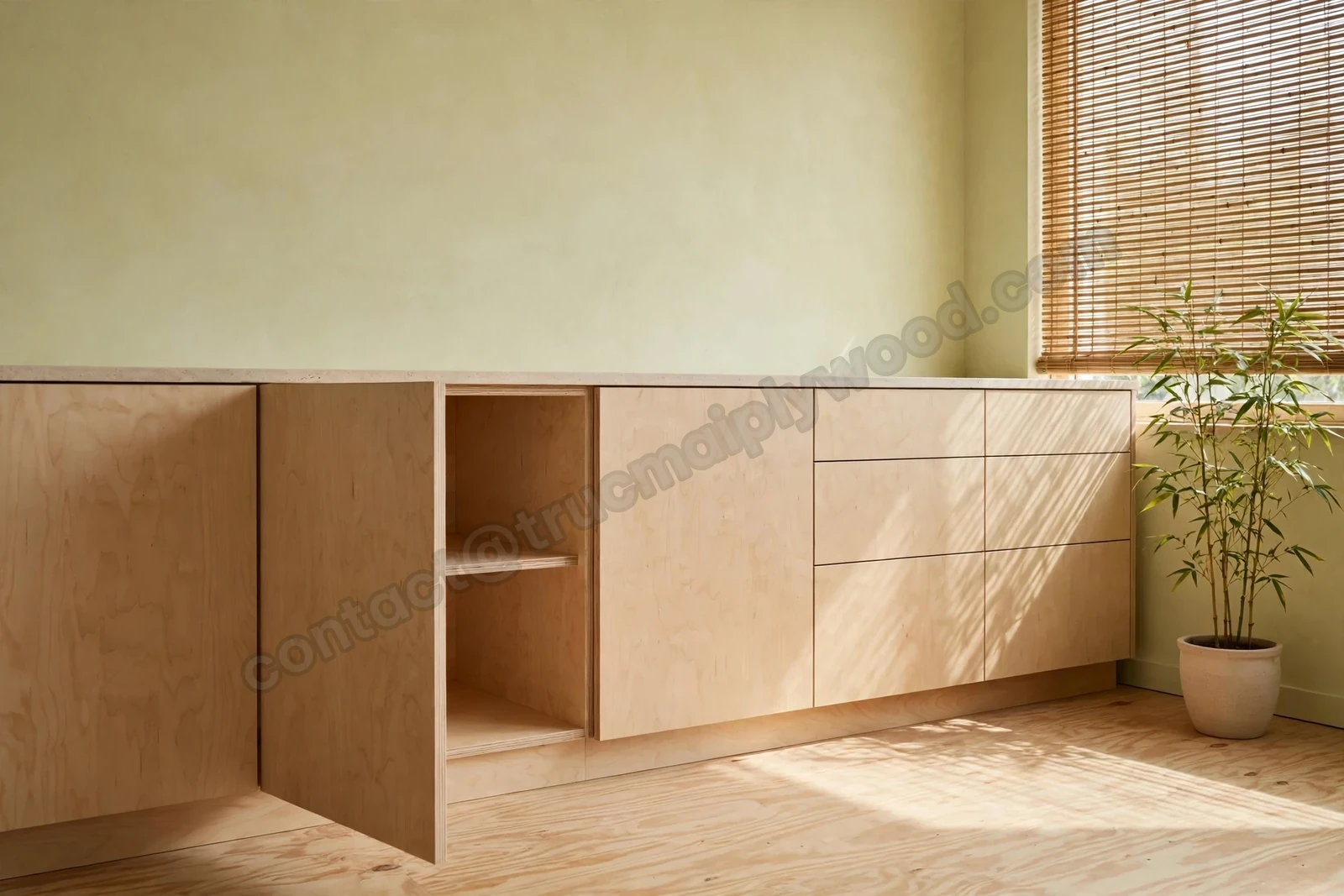
Yes, maple cabinet plywood is well suited to dry interior cabinets when the face, core and emission specification are selected for the job. Its smooth pale face works particularly well for visible end panels, drawer fronts and cabinet interiors that receive a clear or lightly tinted finish.
The cabinet maker still needs to inspect the edge. A good-looking face over a core with open joints creates problems when cutting, routing, applying edge banding or fastening fittings. For production cabinets, agree on core joining, face quality and a calibrated thickness. An 18 mm nominal panel is a familiar cabinet choice, but the purchase order should state the actual finished thickness and tolerance.
The kitchen cabinet plywood guide explains panel selection by application. Where the maple appearance is not essential, a consistent light face can meet the visual brief without specifying natural maple veneer for every component.
How do maple, birch, bleached poplar and engineered veneer compare?
Natural maple gives a recognisable fine-grained hardwood face; birch, bleached poplar and engineered veneer offer other pale looks for furniture panels. The right choice follows the approved finish sample, not the name alone.
| Face option | Visible appearance | Typical buyer priority | What to specify |
|---|---|---|---|
| Natural maple veneer | Pale cream, fine grain, natural figure | Authentic maple appearance under clear finish | Species, cut, matching and face grade |
| Birch veneer | Light hardwood appearance with its own grain and colour | Clean cabinet face with a natural veneer | Birch face, back grade and core |
| Bleached poplar veneer | Pale, relatively quiet face | Light appearance for repeat interior production | Bleaching and finish sample |
| Engineered veneer (EV) | Designed, repeatable light pattern | Matching colour and grain across repeat runs | Approved EV pattern and face sample |
The birch-faced plywood, bleached poplar plywood and engineered veneer plywood product pages describe the alternatives. These are comparisons of decorative faces, not statements that their strength or bond performance is identical. Core and adhesive specifications must be compared independently.
Which face grade should a maple veneer plywood buyer request?
Request an appearance grade for each face, supported by a physical sample and written defect limits. The ISO 2426-2:2020 hardwood plywood preview identifies appearance classes E, I, II, III and IV. Commercial shorthand such as A/B or B/BB needs the supplier’s own grade description.
An exposed cabinet end needs a different appearance decision from a concealed back. Specify permitted knots, patches, mineral marks, splits and colour variation on the face and back separately. If the buyer wants book-matched or slip-matched veneer, record that as an additional requirement rather than treating it as part of a generic grade.
Inspect a full-size reference panel. A small sample can demonstrate colour and finish but cannot show how defects are distributed across a sheet. The mill should keep the approved reference for the next order, so grading is repeatable even when the veneer lot changes.
What thickness and sheet size should be written on the order?
Write the finished thickness and sheet dimensions in millimetres, followed by the tolerance and sanding requirement. A nominal 3/4-inch maple plywood listing is a North American retail description; an import order should state its agreed metric thickness rather than assume the two descriptions are interchangeable.
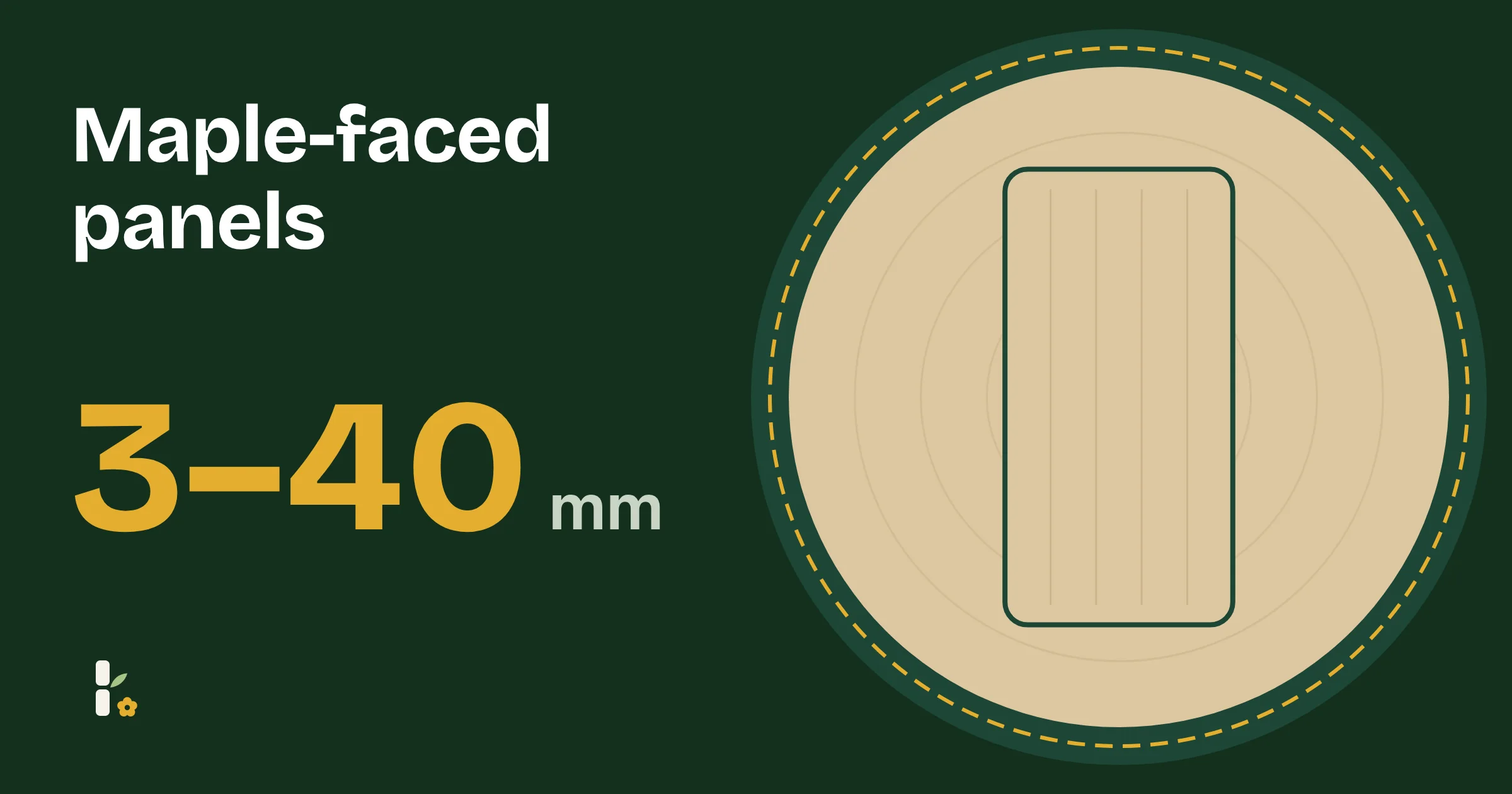
For Truc Mai furniture and commercial plywood, the regular range is 3–40 mm, with 1220 × 2440 mm, 1220 × 2280 mm and 1250 × 2500 mm formats. Sanded, calibrated furniture panels can be specified at ±0.3 mm thickness tolerance; other orders use the tolerance written into the specification. Natural maple veneer is requested as a face option, not treated as a stocked core species.
The 18 mm plywood specification shows how the finished dimension, core and packing line fit together. For cabinet components, add grain direction and any allowance the cutting shop needs for edging and trimming.
What should buyers check about the core and edge?
Check core species, jointing method, voids and the exposed edge before approving maple-faced sheets. A fine decorative veneer cannot hide a poor edge after the panel is ripped into cabinet parts.
The core options for this mill include Styrax, Eucalyptus, Acacia, Pine and combined veneers. Furniture panels use an A-grade stitched core and sanded faces as the normal build. Core stitching joins veneer across and along the sheet; the outer plies are commonly stitched to improve the surface beneath the decorative veneer. Ask to see both the edge of a full sheet and a freshly cut sample.
For drawer sides and exposed shelf edges, note whether the edge will be banded, painted or left visible. A denser core changes handling and container planning. A lighter core can help when the order is measured by container space. Choose from the finished component requirement rather than from a single species label.
Which glue and formaldehyde documents matter in Canada?
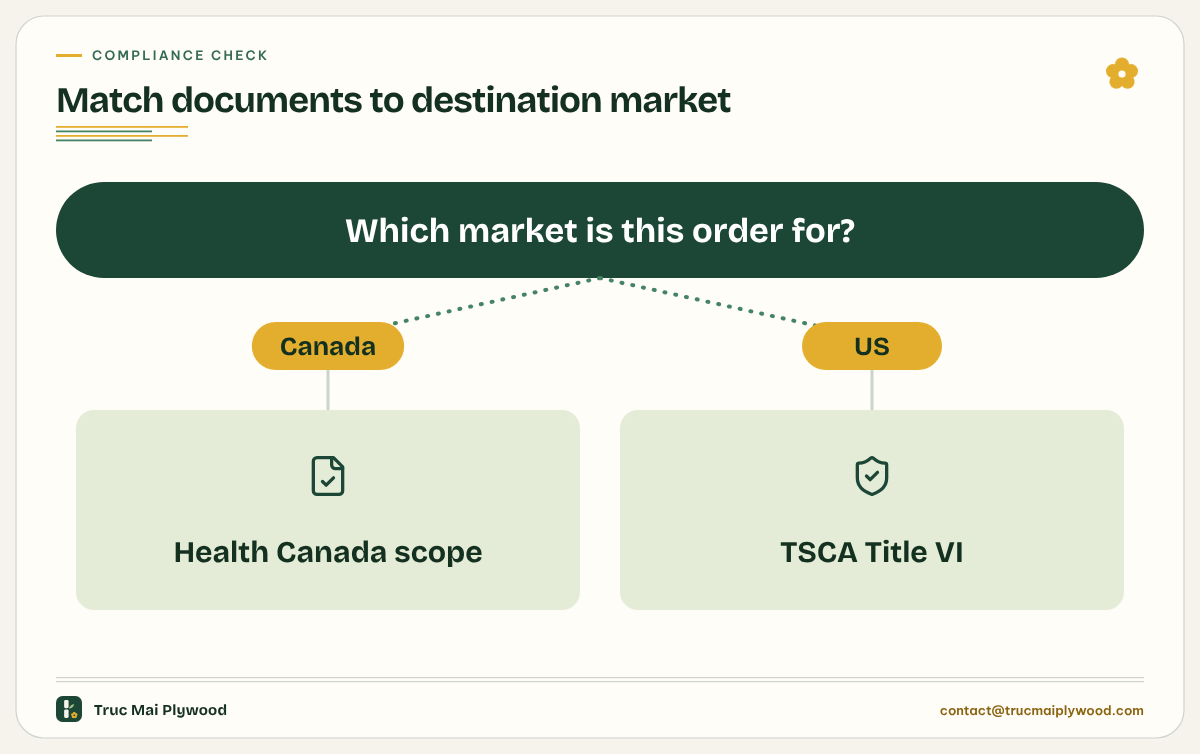
Canadian buyers of covered hardwood plywood should request emission documentation matching Canada’s Formaldehyde Emissions from Composite Wood Products Regulations. Health Canada’s guidance, applicable from 18 March 2025, explains that veneer-core hardwood plywood used in furniture and cabinetry falls within the regulated product categories.
Adhesive type and formaldehyde emission are separate specification lines. A supplier might quote UF adhesive at E0 emission under an agreed test method, but E0 alone is not a Canadian regulatory classification. Request the applicable test and certification paperwork for the exact panel construction, with product identity and thickness scope visible.
For US-bound orders, 40 CFR Part 770, section 770.10 sets a 0.05 ppm formaldehyde limit for hardwood plywood with veneer core under TSCA Title VI, as also stated in the US EPA formaldehyde standards FAQ. Truc Mai holds CARB Phase 2 and TSCA Title VI certification for hardwood plywood with veneer core in the 3–25 mm scope, certificate CARB/EPA 26053. The formaldehyde limits explainer separates the US and Canadian paperwork questions.
Where are the best places to buy maple plywood in Canada?
Canadian hardwood distributors, specialist sheet-goods yards and established building-material retailers are the first places to compare for single sheets of natural maple plywood. Cabinet shops ordering repeat volumes can also request a quotation from a plywood importer that supplies matched lots.
For a small purchase, ask whether the sheet is actually in the local branch, whether the listing is full-size or a cut panel, and whether both faces are maple. For production buying, ask the distributor for a written face grade, core description, lot consistency and delivery arrangements. A local retail listing is useful for checking formats, but it rarely provides the entire import specification.
A useful shortlist starts with three kinds of outlet: a local hardwood specialist that permits face inspection; a regional panel distributor that can reserve a production lot; and a retailer with a published stock-keeping code for a defined sheet. The best outlet is the one that can supply the same construction again, with the documents your customer requires.
How should I compare maple plywood suppliers Canada buy enquiries?
Compare suppliers using one written specification and an approved sample, then judge their ability to repeat it. The phrase maple plywood suppliers Canada buy often leads to mixed offers: decorative face veneers, prefinished panels, small craft sheets and full-size cabinet stock.
Send each supplier the same checklist: face species and grade; back grade; core construction; finished thickness; sheet size; coating; emission evidence; packing; and order quantity. Ask for photographs of the face and a clean-cut edge. If the order is for a factory, request the mill’s own construction description rather than accepting a retailer’s short product title.
For imported volume, compare the delivery basis as well. FOB Hai Phong, CFR and CIF describe different freight responsibilities; they do not change the panel specification. The supplier shortlist checklist and plywood RFQ guide help put offers on equal terms.
Where can I arrange a 3/4 maple plywood buy Canada order?
For a 3/4 maple plywood buy Canada order, start with a Canadian panel distributor or retailer offering a defined full-sheet maple veneer product, then verify actual thickness and stock before placing the order. For a container programme, give the importer the finished metric thickness and ask for a production sample.
Do not substitute a nominal inch label for the measured panel dimension. Ask whether the item is sanded or prefinished, whether the maple is on one face or both, and whether the back grade is suitable for a visible cabinet interior. A short panel, full sheet and prefinished sheet can share a similar retail title while serving different cutting plans.
When the requirement is a repeat light-coloured interior rather than natural maple specifically, request an alternate quotation for bleached poplar or engineered veneer on the same core. This preserves a fair comparison of colour, finish and machining without silently changing the requested material.
How do I inspect maple finish plywood before approving production?
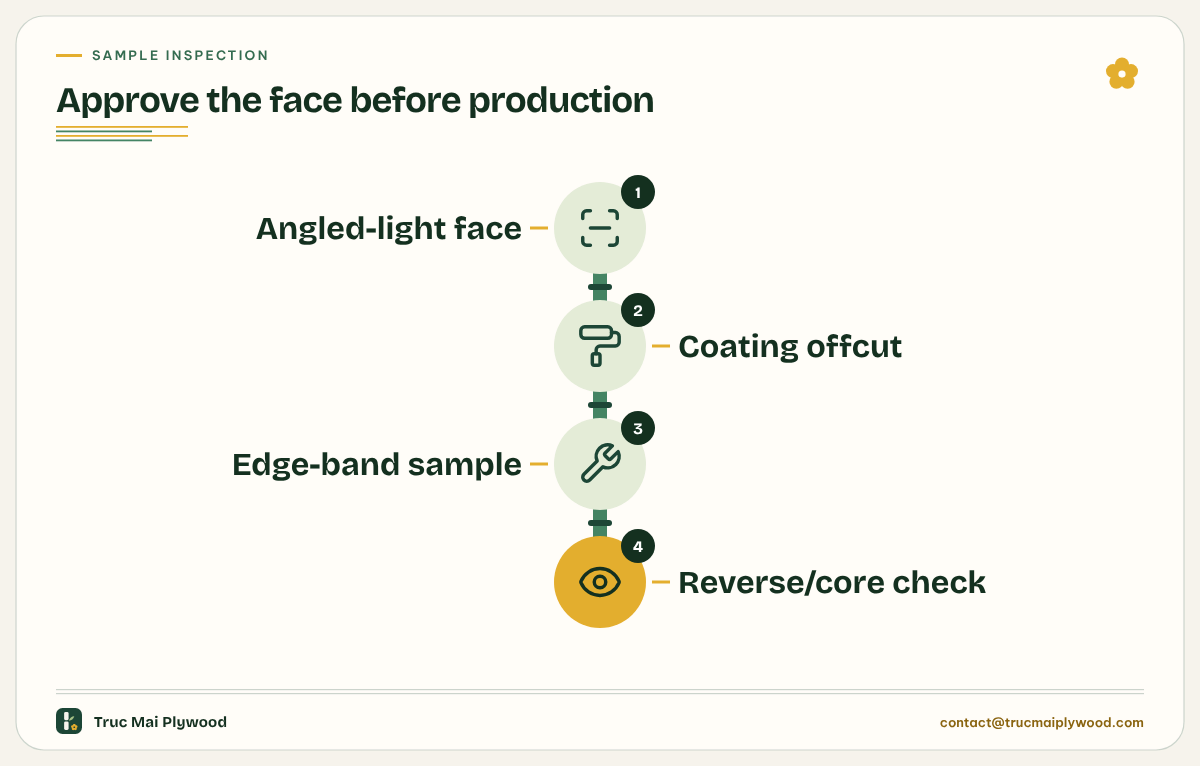
Approve a finished sample that shows the face under the intended clear coat or stain, together with an uncoated sample and a cut edge. A pale maple face can reveal sanding scratches, glue marks and uneven staining once a finish is applied.
- Inspect the face across the grain under angled light for sanding lines and repairs.
- Apply the intended coating to a representative offcut, then compare colour under the installation lighting.
- Cut and edge-band a sample using the production tooling and feed settings.
- Check the reverse face and core edge for the defects listed in the purchase specification.
- Sign off the face, back, core and finish together, retaining the reference for repeat orders.
If a factory supplies UV-ready panels, the faces are prepared for the buyer’s coating line; that term does not mean a UV coating has already been applied. The ordering samples page explains the sample route before a volume commitment.
What is different about buying a whole container of light-faced panels?
A container buyer needs a repeatable face and core construction, a packing plan and a specification that survives the next production run. The volume decision should begin with the furniture programme, not a generic request for pale plywood.
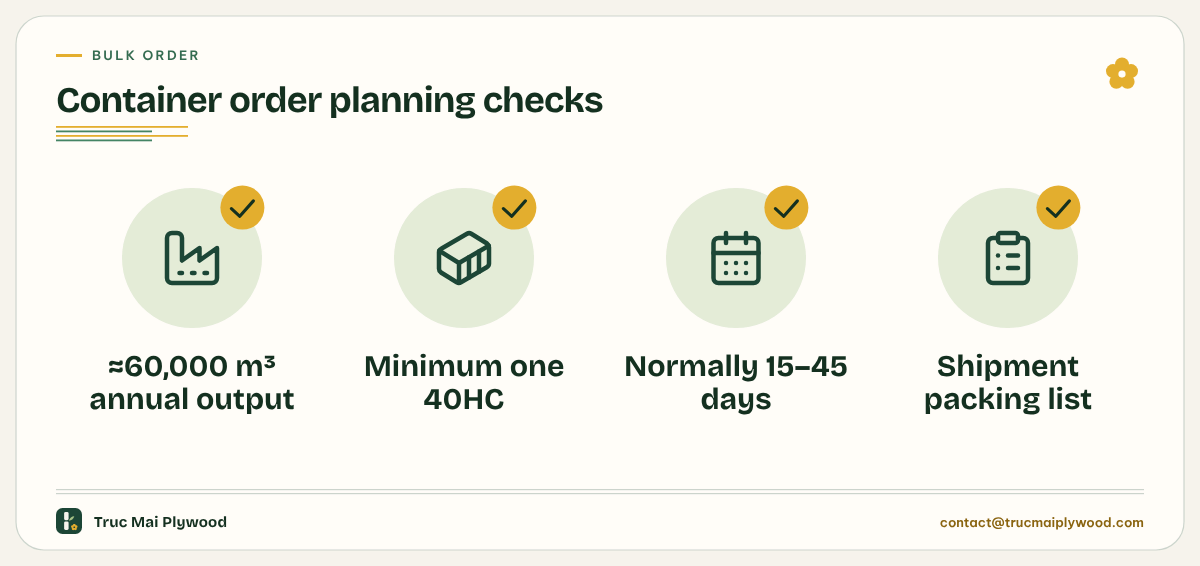
A mill producing around 60,000 m³ annually can discuss the same face-and-core specification across repeat orders. For a light appearance, bleached poplar and EV faces are established options; natural maple face veneer is an on-request option. Specify whether the finished pieces will be cut at the mill or in the buyer’s workshop. Standard sheets can be divided into halves, thirds, quarters or six pieces to an agreed cutting plan, with part labels for sorting.
For a first container, the standard minimum order is one 40HC. Production is normally scheduled 15–45 days after the deposit under the agreed terms. The m³ per 40HC planning article explains why core density matters to loading, while the order’s packing list records the actual goods.
What proof should accompany an FSC-labelled veneer order?
An FSC-labelled plywood order should carry the appropriate product claim and the seller’s certificate code on its sales documents. The FSC Chain of Custody standard, section 5.1 sets out those sales-document requirements.
The mill’s FSC licence is FSC-C196493 and its Chain of Custody certificate is SA-COC-014545, with FSC 100% as the available output claim for eligible products. The buyer should identify the intended face and core in the order, then match the certificate scope and documentary claim to the actual product line. A certificate held by a mill is different from the claim carried by a particular invoice line.
The FSC licence verification guide explains how to read the certificate and claim fields. Where a face veneer comes from another country, origin records should also identify that face separately from the Vietnamese core.
How do I send a quotation request for maple-faced or matching pale panels?
Send a specification with the application, natural maple or alternative face, core, adhesive and emission requirement, finished size, packing and quantity. The response can then distinguish a natural maple veneer request from a repeat-order light-face panel made with bleached poplar or EV.
Use this order-line structure: cabinet application; natural maple face or approved light-face alternative; face/back appearance grade; Styrax, Eucalyptus, Acacia, Pine or combined core; adhesive type and emission requirement; thickness and tolerance; sheet dimensions or labelled cut list; finish; packing; and quantity with destination port. Include the sample reference and the intended market so the document set is prepared for the order.
Send the details through the quotation contact page or to contact@trucmaiplywood.com. Ask for the construction drawing and sample that correspond to the written specification before authorising a production run.
Questions buyers ask
Is maple veneer the same as solid maple?
No. Maple veneer is a thin decorative layer over a plywood core; solid maple is wood throughout its section. Specify the core separately when ordering veneer-faced sheets.
Can a maple-faced panel have a different back veneer?
Yes. Specify the face and back as a pair, including appearance grade and finish, so the visible surface and reverse side meet their different duties.
Does a pale plywood face mean it is maple?
No. Birch, bleached poplar and engineered veneer can all appear pale. Identify the face species on the purchase specification and approve a physical sample.
Can I paint maple veneer plywood?
Yes. Sanded maple veneer takes suitable primer and paint, although a decorative natural veneer is often selected for a clear finish instead. Test the coating on the approved face sample.
What does prefinished maple plywood mean?
Prefinished means the surface coating has already been applied. Ask whether one or both faces are coated and how the edges will be finished after cutting.
Can I order panels cut to cabinet-part sizes?
Yes. Send a cut list showing finished dimensions, grain direction and labels; the mill can cut standard sheets into agreed pieces before packing.
Is a maple face enough to specify plywood for a kitchen?
No. Include the core, face and back grades, thickness tolerance, adhesive system, emission requirement and surface finish in the same specification.
How do I request a matching face for repeat orders?
Keep an approved reference sample and specify the acceptable colour and grain range, face grade and veneer construction on each repeat order.
Does an FSC certificate mean every panel is FSC-labelled?
No. The relevant product must be sold with its FSC claim and certificate code on the sales documents. Check the specified product against the supplier's current certificate scope.
Can maple plywood be used outdoors?
A decorative maple face alone does not establish suitability for outdoor exposure. Choose a panel and tested bond specification for the actual moisture conditions.