
The thickest plywood in Truc Mai Plywood’s regular furniture and commercial range is 40 mm, with 30 mm also offered. These thick sheets are built from bonded veneers for furniture components, shopfitting and packing applications. Buyers should specify the core, face, tolerance and sheet size before comparing quotations; container loading is governed by weight as well as space.

What is the thickest plywood in the regular panel range?
40 mm is the thickest plywood in Truc Mai Plywood’s regular furniture and commercial range; 30 mm is another thick option. The range starts at 3 mm. These are product specifications, not an industry-wide maximum. Buyers should choose thickness alongside the intended use, core construction, face and machining requirements.
A thick ply wood sheet is a manufactured assembly of veneer layers bonded into a board. Thickness describes the finished panel dimension, whereas the core species, veneer arrangement, face selection and adhesive system describe its construction. A nominal 40 mm board with a light core may handle and machine differently from a denser 30 mm board. The label alone says little about finish, edge quality or the weight of a full sheet.
For a purchasing specification, start with the intended furniture part or commercial component. A wide desk top, an exhibition plinth and a packing base impose different requirements on flatness, appearance and handling. Then decide whether the panel is supplied as a full sheet or cut to finished blanks. See choosing plywood thickness for the wider size decision and 25 mm plywood panels for the adjacent option.
The thickest plywood sheet that makes commercial sense is the one whose construction suits the machining plan. Increasing thickness solely to make a part appear substantial can increase shipping weight, edge finishing time and the amount of stock removed during routing. Where an edge remains visible, a properly made layered edge may be part of the design; where it is concealed, the face grade and machining yield can matter more.
How do 30 mm and 40 mm plywood compare?
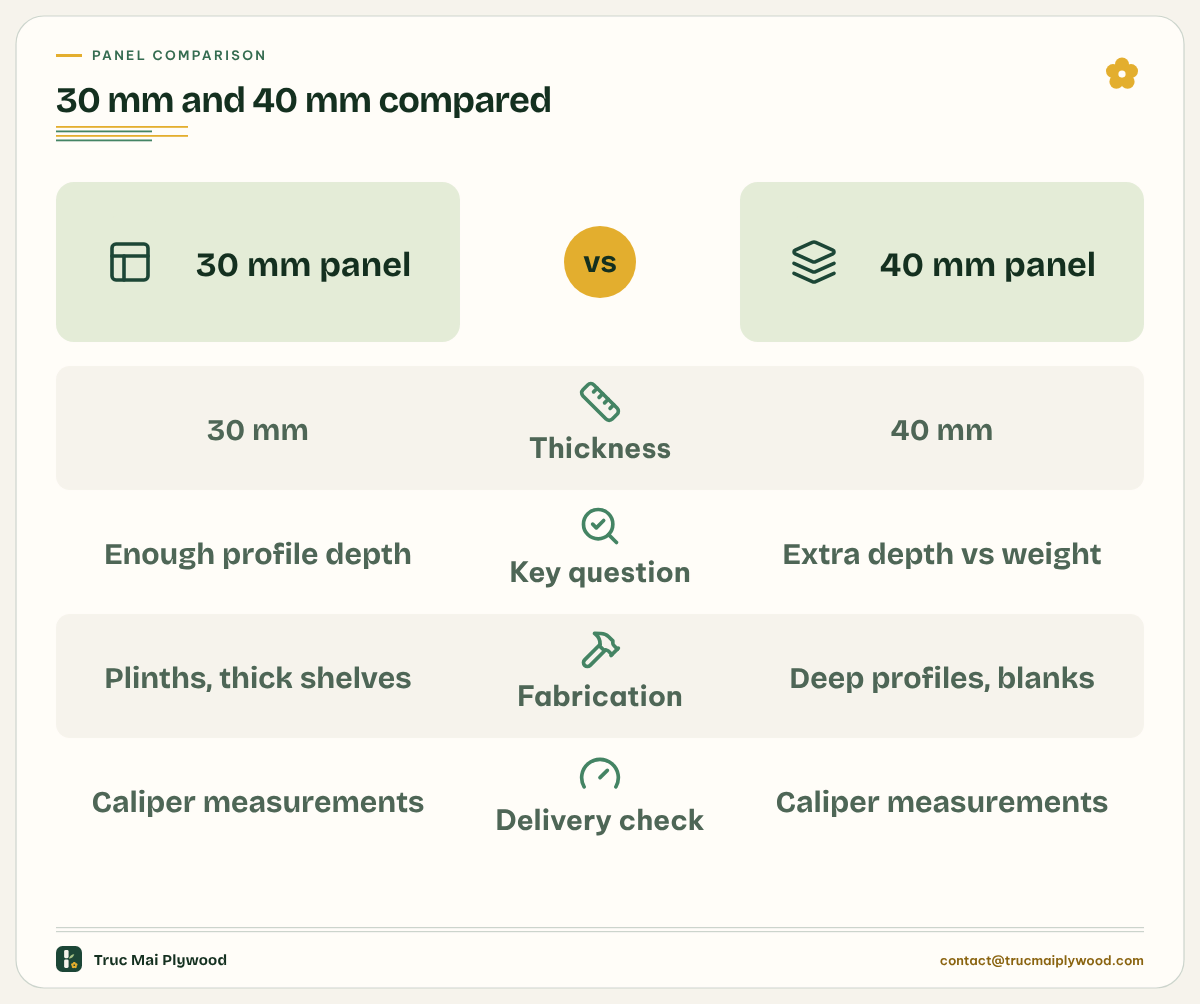
30 mm and 40 mm panels serve similar interior and commercial fabrication tasks, but the thicker board offers more material for deep profiles and creates a heavier piece for the same face area. The table identifies the decisions to record on the order rather than suggesting that one dimension is inherently stronger for every assembly.
| Specification point | 30 mm panel | 40 mm panel |
|---|---|---|
| Nominal finished thickness | 30 mm | 40 mm |
| Main purchasing question | Is the profile deep enough? | Does the extra depth justify handling weight? |
| Typical fabrication focus | Plinths, built-up-looking parts, thick shelves with appropriate support | Deep edge profiles, substantial furniture components, large commercial blanks |
| Core choice | Styrax, Acacia, Eucalyptus or specified blend | Styrax, Acacia, Eucalyptus or specified blend |
| Face choice | Approved decorative or commercial face | Approved decorative or commercial face |
| Delivery check | Caliper measurements across the sheet | Caliper measurements across the sheet |
A thicker sheet gives the router more depth for a recess or shaped edge. That does not determine the permissible span of a shelf. The actual support arrangement, loading direction, joint design and material properties still control the finished assembly. A heavy panel on narrow brackets can fail at the fixing rather than through the board. Ask the furniture designer to set the required support and deflection criteria.
The right comparison uses like-for-like constructions. Request the same face grade, core species, adhesive system and surface preparation for both options. Otherwise a change in appearance or weight may come from the build rather than the nominal thickness. A practical comparison can begin with a sample of each board machined using the intended cutter and edge treatment.
What makes thick plywood different from a solid timber slab?
Thick plywood is a cross-laminated veneer assembly; solid timber is continuous wood with grain running predominantly along the piece. Alternating veneer directions helps distribute movement across a sheet, while the number, orientation and quality of glue lines become central manufacturing considerations.
The visible edge tells a useful story. Inspect the continuity of individual plies, the regularity of the lay-up and the presence of voids near the line where the buyer plans to machine. An attractive face can conceal gaps in a core that will become visible after routing. A thick plywood board intended for a deep rebate therefore deserves an edge sample as well as a face sample.
Solid timber can be shaped with continuous grain, but it also has directional movement and grain variation. A veneer-built panel presents a more repeatable sheet format and can carry a decorative face unrelated to its core species. It is particularly useful when the buyer needs repeatable cabinet components from a defined cut list. The comparison is between fabrication systems, not merely materials with the same nominal depth.
If a design needs the look of a single timber slab, decide whether an edge band, a laminated solid-wood lipping or an exposed plywood edge is acceptable. That aesthetic choice should appear on the drawing before the mill prepares the face and core. It affects the acceptable edge gaps, routing sequence and finishing allowance.
How are 30 mm and 40 mm boards laid up and pressed?
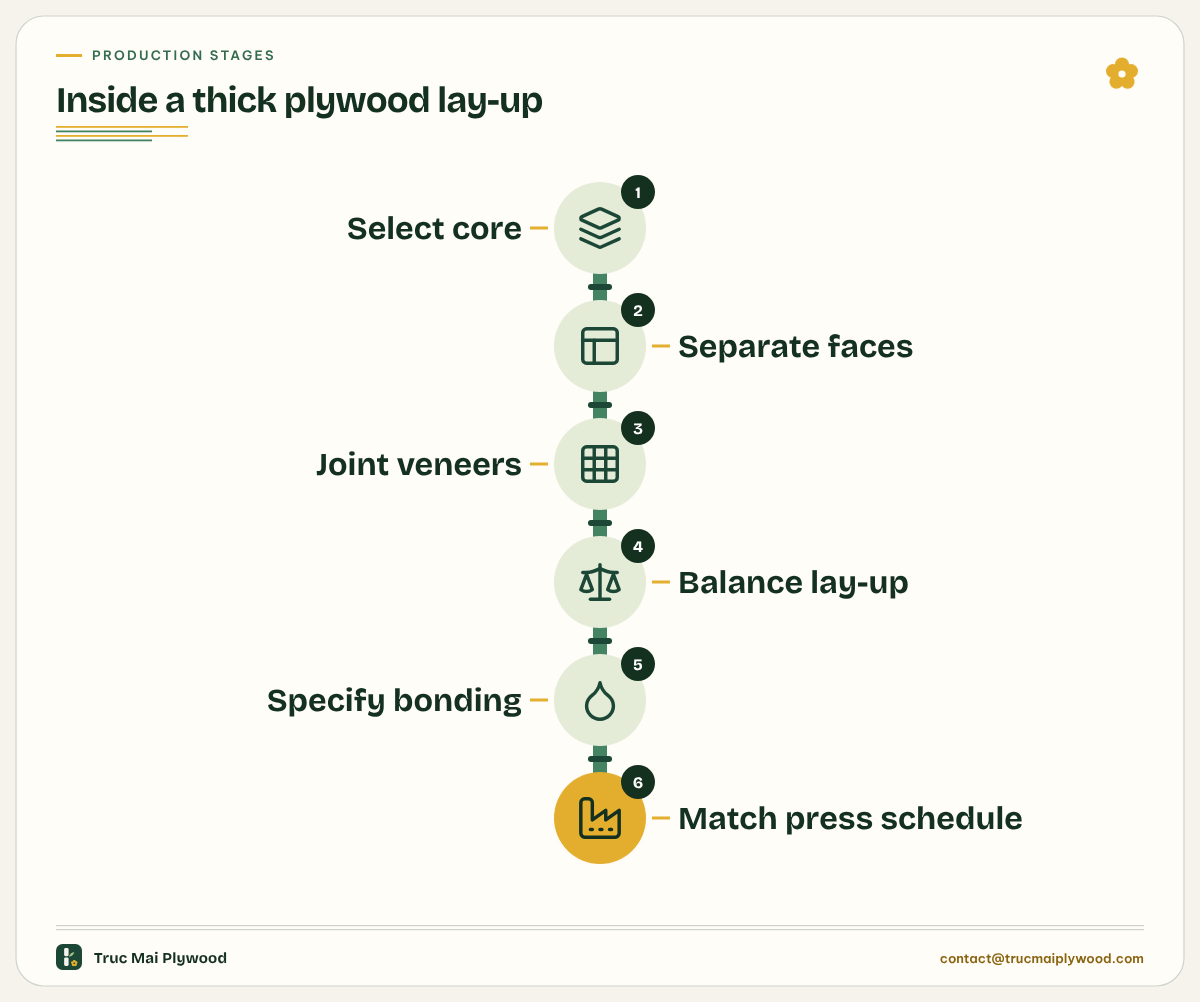
Thick boards are built by assembling more veneer material into the specified finished thickness, then bonding, pressing, trimming and calibrating the panel. The production target is a stable board with sound glue lines and a consistent face, not simply the greatest possible number of plies.
- Sort veneers by intended position. Core material is selected for the agreed construction; decorative face veneers are kept separate from internal layers.
- Prepare the core. Jointing or stitching improves continuity where the specification requires it, especially around machined edges.
- Build the lay-up. Veneer direction and distribution are planned to keep the construction balanced around the centre.
- Apply the specified adhesive. Bond system and emission requirement are recorded as separate order fields.
- Press the assembly. The press schedule is matched to the adhesive and the mass of the lay-up, with the aim of sound bonding through the thickness.
- Trim, sand and inspect. Finished thickness, faces and edges are checked against the approved order and sample.
For furniture/interior panels, Truc Mai normally uses an A-grade stitched core and sanded faces. Commercial panels use an AB core that may be loose-laid or jointed, with unsanded or lightly sanded faces. This difference can be decisive when a thick board is routed into an exposed component. A tight, carefully prepared core reduces the amount of filling and edge repair required after machining.
Thick material also changes the production conversation. A buyer should show the deepest routed detail, not only the outside dimensions. A panel with a perfect face but an unsuitable internal lay-up can waste time on the CNC line. An edge photograph and a cut sample from the approved construction are more informative than a generic catalogue picture.
Which core is best for a thick ply wood order?
Styrax is a useful lighter-core starting point for thick furniture panels; Acacia and Eucalyptus provide denser alternatives where the buyer wants a different balance of mass, appearance and machining response. Truc Mai also offers Pine and mixed-species cores, with the selected build written on the order.
Core species changes sheet weight before any packaging is added. A lighter core is attractive when large blanks must be carried around a workshop or loaded into a container. A denser core may be chosen for a particular machining preference, but density alone does not certify strength or screw-holding performance. Ask for a tested property if a design calculation depends on it.
Inspect the edge after a full-depth cut. Check for openings between strips, loose veneer fragments, irregular grain and glue-line separation. Then test the intended screw or connector in the actual panel configuration. The result is more useful than a species label without a core-grade description. For repeat orders, retain the signed edge sample as well as the face sample.
The face veneer is another decision. Birch, Okoume, Bintangor, Pine, Eucalyptus, Poplar, bleached Poplar, engineered veneer and other decorative faces can be selected for the surface. A birch-faced panel has birch on its face; the interior can still be Vietnamese plantation-wood veneer. For a visible, large-format furniture part, specify the face/back grade pair and the direction of the grain on the cutting diagram.
Which applications suit 30 mm ply board?
30 mm ply board suits substantial furniture components, interior joinery and commercial fabrication where a deep section is wanted without moving to the thickest regular option. Typical decisions concern the finished edge, support design and whether the panel is to be machined into smaller parts.
For a display plinth, the visible faces need a consistent decorative grade and the corners must accept the intended joining method. For a desk component, the maker may want an uninterrupted face with a rounded or bevelled edge. For packing equipment, appearance may matter less than reliable dimensions and sufficient support at the points where the load enters the panel. These are different purchase specifications even when the nominal thickness is identical.
A full sheet can be routed into shelves, rails, feet or blocks. The cutting plan should account for grain direction, machining allowances and the location of visible faces. A part that will receive laminate or another surface finish needs the appropriate face preparation rather than the decorative veneer intended for a clear coat. Truc Mai offers melamine- and HPL-faced panels as part of its broader interior range; the surface choice belongs in the RFQ.
For buyers considering whether a lighter panel would do the job, compare the design with 18 mm plywood specifications and 15 mm loading and specification. A framed assembly with a thinner skin may achieve the desired appearance with different handling characteristics. That is a design choice, not a substitution to make after the order has been placed.
When does a 40 mm plywood sheet make sense?
40 mm plywood makes sense when the finished component genuinely needs the deeper section, for example an exposed thick edge, a routed block-like profile or a substantial interior part. The benefit is available material for shaping; the buyer should weigh it against mass, handling and cutting time.
A deep bullnose or stepped rebate can remove a considerable amount of material near the edge. Specify the machining profile and ask to inspect a sample cut through the proposed lay-up. This reveals whether the decorative face remains supported and whether internal voids would appear in the finished contour. For painted furniture, a smooth edge can reduce filling and finishing work. For exposed-ply furniture, layer regularity is itself an appearance criterion.
Thick plywood sheets are also used as blanks from which smaller pieces are cut. The mill can label parts according to the buyer’s cutting list, allowing the receiving workshop to sort by component rather than by sheet. Where a large blank needs a recess for hardware, the drawing should show the depth and distance from the edge so the core can be evaluated at the actual machining location.
A 40 mm board is not a shortcut to a structural rating. The NIST PS 1-22 structural plywood standard covers a distinct graded and certified product system. Furniture and commercial plywood should be ordered for its specified interior or commercial application, with engineering design based on appropriate tested values where required.
What sheet sizes and cut-to-size patterns are available?
1220 × 2440 mm and 1250 × 2500 mm are the main full-sheet formats for these thick panels. Truc Mai also offers 1220 × 2280 mm for furniture parts, and the mill cuts standard sheets into labelled pieces to an agreed cutting list.
| Order format | Example dimension | Buyer decision |
|---|---|---|
| Full standard sheet | 1220 × 2440 mm | Standard workshop nesting |
| European-format sheet | 1250 × 2500 mm | European cutting plans |
| Shorter furniture sheet | 1220 × 2280 mm | Part lengths and transport |
| Two lengthwise pieces | 610 × 2440 mm | Long narrow blanks |
| Three pieces | 1200 × 800 mm | Repeated smaller parts |
| Four pieces | 1220 × 610 mm | Quarter-sheet format |
| Six pieces | Agreed cut list | Custom part layout |
The cutting pattern must fit the actual parent sheet and allow for the saw kerf. A buyer should send a drawing showing finished dimensions, cutting orientation, acceptable edge finish and how parts are to be labelled. A piece size quoted without its parent sheet can create an impossible nesting plan or excessive waste. The mill agrees exact dimensions by email before production.
Cut-to-size service is particularly useful for heavy panels because the receiving shop can avoid manoeuvring a full board through its machines. It also changes packing: smaller parts require stable bundling and clear labels so similar dimensions are not mixed. See panels cut at the mill for the order workflow. A sensible RFQ states whether each measurement is a finished dimension or a nominal cutting dimension.
How tight are thickness tolerances on thick plywood?
Truc Mai specifies thickness tolerance by order: calibrated furniture panels can be quoted at ±0.3 mm, commercial panels at ±0.5 mm, and packing-grade panels at ±0.5–1.0 mm. Length and width tolerance is ±2 mm. The buyer should put the required grade and measurement method on the order rather than assuming every thick panel has the same finish.
A caliper reading at the edge is useful, but it is only one measurement. A practical receiving plan measures several positions across each sample sheet, records the highest and lowest readings, and checks whether sanding has left a locally thin area. The operator should keep the instrument perpendicular to the face and avoid damaged corners. Where a machined part fits into a precise assembly, the final component drawing should control the acceptance decision.
European EN 315 defines a separate tolerance framework for plywood, including different thickness formulas for sanded and unsanded panels. It also specifies dimensional checks at a reference moisture condition. Buyers working to that system should name the edition and measurement criteria explicitly rather than replacing the contract tolerance with a casual trade description. The difference between a mill’s calibrated target and a standard’s allowable range is important during receiving inspection.
A thick panel may be intended for lamination, veneering or painting after arrival. In those cases, agree whether the stated thickness is measured before or after the buyer’s finishing operation. An approved physical sample, retained at both ends of the transaction, helps resolve questions about surface feel and machining allowance.
Which glue and emission specification should buyers request?
UF glue at E0 emission is the regular interior specification in Truc Mai’s range. Adhesive type and formaldehyde emission are separate entries on the purchase order: one describes the bonding system, while the other describes the agreed emissions classification and test evidence.
For furniture that will encounter greater humidity, the buyer should specify the intended exposure and request the appropriate adhesive construction. The mill can supply melamine-fortified glue for a more water-resistant build, with the associated emission specification written separately. Do not treat a boil-test duration as an emissions result. The tests measure different properties and cannot substitute for one another.
For the US market, 40 CFR Part 770 sets a 0.05 ppm formaldehyde limit for hardwood plywood with veneer core under the TSCA Title VI framework. Truc Mai holds CARB Phase 2 and TSCA Title VI certification for hardwood plywood with veneer core in the 3–25 mm range, so the 30 mm and 40 mm thicknesses sit outside that certificate’s product scope. If a US buyer needs a certified configuration, the certified thickness range belongs in the product selection from the outset.
For EU furniture and wood-based articles, the REACH formaldehyde restriction uses a chamber limit of 0.062 mg/m³ under its specified conditions. Those units and test conditions differ from the US framework. Keep the market, intended article, method and tested panel configuration together on the specification rather than translating a figure from one method into another. Buyers can review Phase 2 formaldehyde limits when comparing documentation.
How many thick plywood sheets fit in a 40HC container?
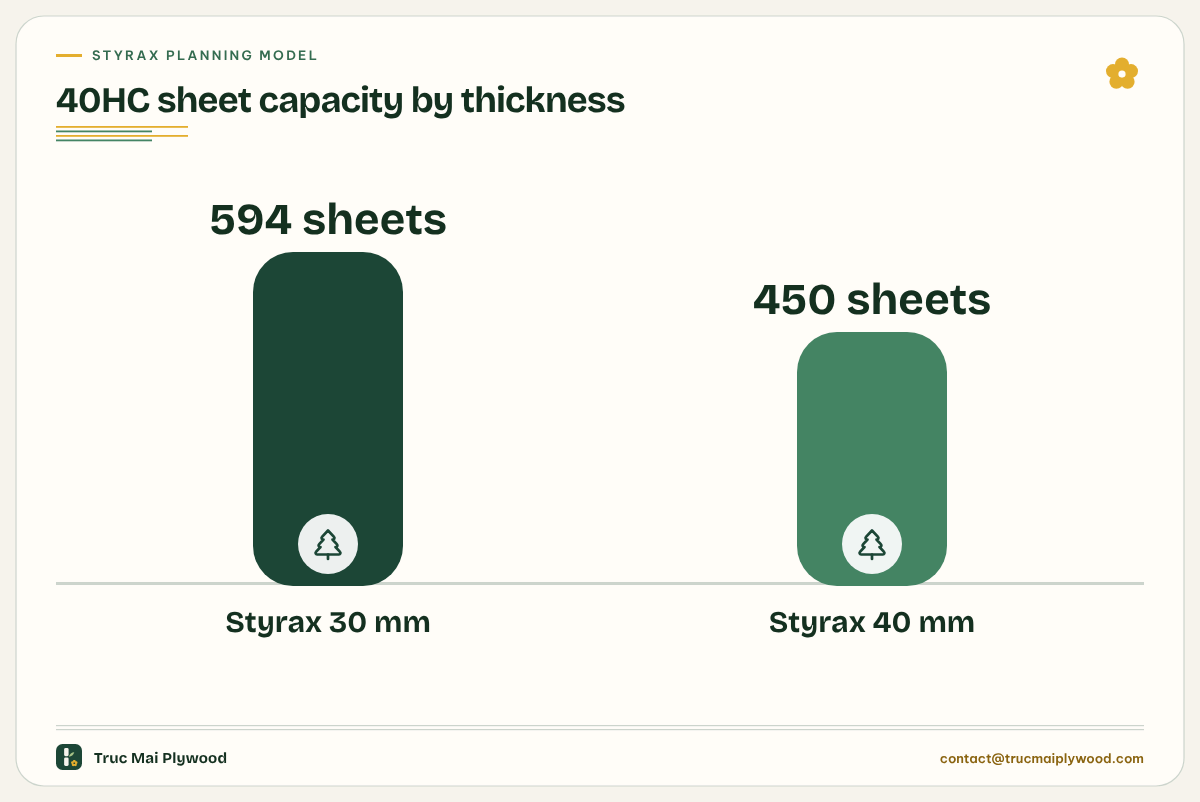
The 40HC planning model gives 594 Styrax-core sheets of 30 mm plywood and 450 Styrax-core sheets of 40 mm plywood at 1220 × 2440 mm. Denser cores carry fewer sheets. The complete calculated rows below preserve the model’s pack count, sheet count, cubic metres and mass values.
Calculation basis: 40HC planning model, panels only. Packs per core: Styrax 18, Acacia 16, Eucalyptus 15. Pack height is 1,000 mm; sheets per pack equal pack height divided by thickness, rounded down and then limited by the 28,000 kg planning cargo payload. Reference densities: Styrax 500 kg/m³, Acacia 580 kg/m³, Eucalyptus 650 kg/m³. The 28,000 kg payload is unconfirmed and the carrier and route set the booked limit; these are planning figures rather than loading records. Packaging weight must be included in the final weight check.
| Core | Thickness | Sheet size | Packs | Sheets/pack | Sheets | Volume (m³) | kg/sheet | Total panel kg | Weight capped |
|---|---|---|---|---|---|---|---|---|---|
| Styrax | 30 mm | 1220x2440 mm | 18 | 33 | 594 | 53.0 | 44.7 | 26520 | No |
| Acacia | 30 mm | 1220x2440 mm | 16 | 33 | 528 | 47.2 | 51.8 | 27350 | No |
| Eucalyptus | 30 mm | 1220x2440 mm | 15 | 32 | 480 | 42.9 | 58.0 | 27860 | Yes |
| Styrax | 40 mm | 1220x2440 mm | 18 | 25 | 450 | 53.6 | 59.5 | 26790 | No |
| Acacia | 40 mm | 1220x2440 mm | 16 | 25 | 400 | 47.6 | 69.1 | 27620 | No |
| Eucalyptus | 40 mm | 1220x2440 mm | 15 | 24 | 360 | 42.9 | 77.4 | 27860 | Yes |
The count is shaped by two constraints. First, the packing plan limits the number and height of bundles that fit into the container. Second, panel mass consumes the cargo allowance. Increasing thickness reduces the sheets in a bundle, while switching to a denser core can make weight the limiting factor before the container is physically full. The right comparison therefore uses sheet count and total mass together, not a cubic-metre figure alone.
The numbers are useful when comparing a 30mm ply board offer with a 40mm plywood offer. They help a buyer estimate the number of finished blanks available from a shipment and the workshop space needed to receive it. Before loading, weigh actual panels, add pallets and protective materials, and reconcile the plan with the carrier’s payload and verified gross mass. For other thicknesses, see cubic metres per 40HC by thickness.
Why does the core affect container weight more than thickness?
Core density determines the mass of each cubic metre of plywood in the planning model. Styrax, Acacia and Eucalyptus therefore fill the same container differently even when the sheet format and nominal thickness match. A heavy core consumes the planned payload faster, while a lighter core can allow more packs within the same box.
Thickness changes the count of sheets per bundle. If the bundle height stays close to the packing target, the total panel volume of a full set of bundles can remain broadly similar across several thicknesses. The buyer sees fewer, heavier individual sheets at the thick end. This matters for unloading equipment, rack capacity and the number of people or lifting aids required to move each blank safely.
Compare quotations on the core named in the order, not on the generic term hardwood plywood. Two sheets can have the same decorative face yet carry substantially different mass because their internal veneers differ. The packing list should identify the product build and actual shipped quantities. For mixed containers, calculate the weight of each line and its packaging rather than applying a single average density to the whole load.
Workshop planning begins at receipt. Decide whether the forklift can reach the unloading position, where the bundles will be placed, and whether the cutting machine can accept the full sheet. A cut-to-size order may reduce the amount of manual repositioning, but the receiving team still needs clear bundle identification and a safe lifting plan.
How should a buyer inspect a thick panel edge?
A thick panel edge should show continuous bonded layers, a balanced lay-up and a core suitable for the intended machining. Inspect the edge in good light before judging the decorative face; a full-depth routed profile exposes defects that remain hidden on an uncut board.
Start with a clean saw cut through a representative sample. Look along the glue lines for separation, then check the internal veneers for openings, overlaps or abrupt changes in thickness. Examine the same panel at more than one edge because veneer joints can fall in different positions. If the part will be drilled or rebated, make the actual operation on the sample and inspect the newly exposed surface.
A good quality-control conversation identifies the acceptance criteria. Ask whether the buyer permits filled gaps on a concealed edge, what edge finish will be applied, and whether the panel is to be clear-coated. A concealed packing base and an exposed furniture edge should not be judged against the same appearance sample. A photograph of the accepted edge, kept with the order specification, gives both parties a reference during production.
Face grading is another separate check. ISO 2426-2 uses appearance classes for hardwood plywood faces; familiar commercial combinations such as B/BB and BB/CC are trade descriptions whose meanings should be agreed against a supplier’s sample. See Vietnamese plywood quality by grade for the broader inspection approach. The buyer should record face and back requirements independently.
How do thick plywood sheets compare with other panel materials?
Thick plywood is a veneer-based panel, while MDF, particleboard and solid timber are different material systems. Compare them on the finished part, machining method, edge treatment and documentary requirements rather than selecting by nominal thickness alone.
A thick plywood edge displays layers, which can be an intentional design feature or something to conceal with lipping. MDF offers a more uniform fibre-based machining surface but has different edge finishing and fastening characteristics. Particleboard is another engineered option, often selected with a decorative overlay, and its edge and fixing behaviour needs to be checked for the proposed joint. Solid timber offers continuous grain and a different movement pattern. None of these descriptions substitutes for an application-specific performance test.
For a routed interior component, a sample can reveal which material gives the cleanest profile and shortest finishing sequence. Use the same cutter, tool condition, feed strategy and finish on each trial. Record chipping, exposed voids, coating absorption and the condition of the edge after handling. That workshop evidence can outweigh a catalogue comparison based only on density or the word ‘heavy-duty’.
If the part needs certified structural performance, source a rated structural product with the required design data. The NIST voluntary product standards programme identifies PS 1-22 as the current US structural plywood standard. A furniture panel may be thick and well bonded without belonging to that structural grading system.
What documents matter for a thick plywood import order?
The purchase order, approved sample, commercial invoice, packing list and bill of lading form the core document trail for a thick plywood shipment. Additional certificates and origin records should correspond to the actual product and destination market, with the exact thickness and construction visible in the paperwork.
Truc Mai holds FSC chain-of-custody certification, licence FSC-C196493 and certificate SA-COC-014545. FSC 100% is the available claim for eligible products covered by the certificate schedule, and the claim is recorded on the relevant sales documents. The buyer should match the certificate code, product description and invoice claim. See verifying an FSC licence code for the verification sequence.
For EU-bound plywood, the European Commission’s EUDR guidance describes the collection of production origin, legality and plot geolocation information. Truc Mai supplies an EUDR due-diligence file set with origin records and geolocation files for core and face veneer, allowing the EU importer to prepare the relevant submission. The Commission lists 30 December 2026 for large and medium operators and 30 June 2027 for other micro and small enterprises under the updated schedule. See EUDR dates for plywood buyers for the import sequence.
Keep product certificates separate from shipment documents. ISO 9001:2015 concerns the manufacturer’s quality management system, and ISO 14001:2015 its environmental management system; neither is a mechanical grade for a 40 mm sheet. Buyers can review the documents per container before approving the order’s file list.
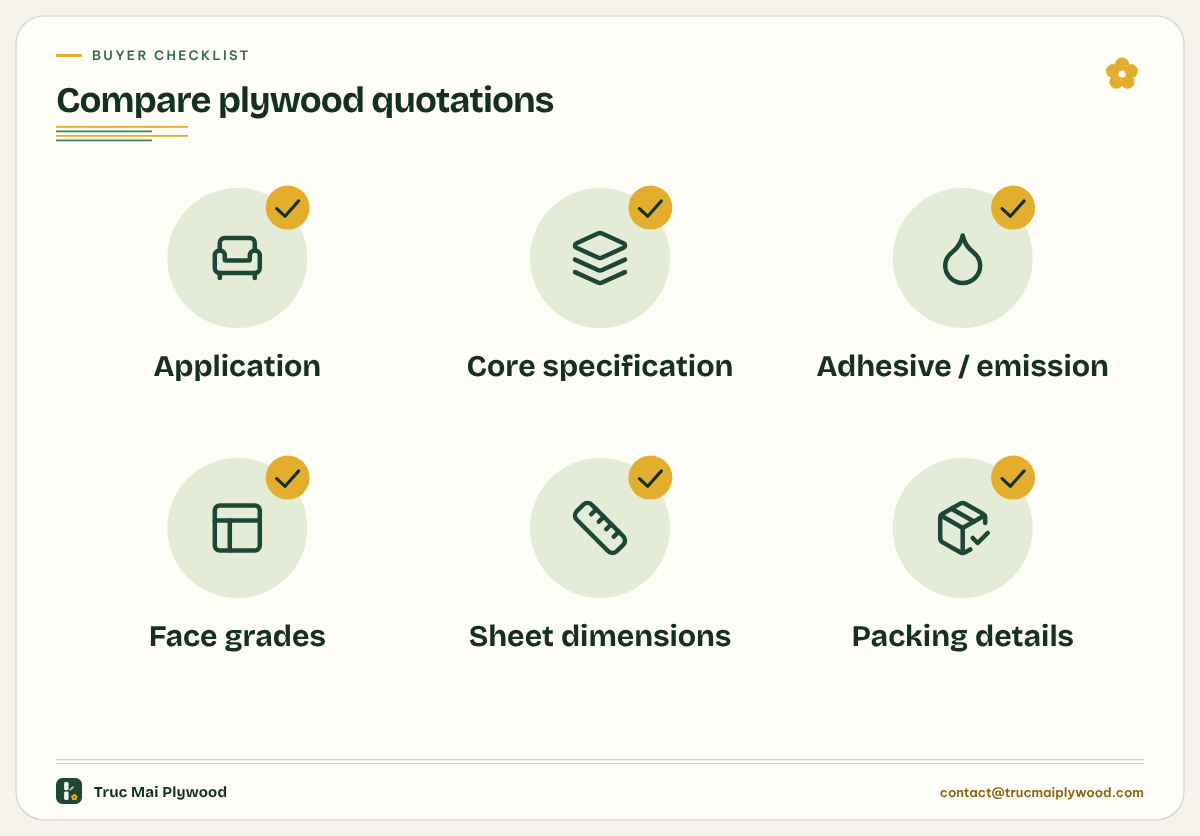
How should a buyer compare thick plywood quotations?
Compare thick plywood quotations using a single written construction schedule, not the product name alone. A 30 mm panel from one offer and another labelled 30 mm may differ in core joining, face veneer, calibration, adhesive and packing, all of which affect the delivered result.
- Application: state whether the sheet becomes visible furniture, concealed joinery, commercial packing or a machined blank.
- Core: specify species or permitted blend, joining method and the accepted edge sample.
- Adhesive and emission: write the bond requirement and emission requirement as separate lines.
- Faces: identify the face/back grade pair, decorative species and surface preparation.
- Dimensions: state nominal thickness, tolerance, parent sheet size and any cut list.
- Packing: state labelling, pack construction, quantity and destination port.
- Evidence: list the certificate and shipment documents that apply to the exact order.
For a repeat programme, agree the inspection sample before the first production run. A written schedule prevents a later switch from stitched to loose-laid core or from calibrated to unsanded faces from being treated as a minor change. It also helps the receiving warehouse decide which measurements and visual checks to perform when the container arrives.
Use writing a plywood RFQ as the structure for a comparable request, and verify a mill before deposit to check the supplier’s documentation and production capability. A detailed quote can be concise when every supplier receives the same drawing and sample requirements.
How do production and shipping terms work for thick panels?
The standard Truc Mai order starts at one 40HC container, with production scheduled for 15–45 days after a 30% deposit. The balance is 70% against the scanned bill of lading, with T/T or irrevocable letter of credit at sight available under the agreed terms. The shipment may be quoted FOB Hai Phong, CFR or CIF.
Production time is distinct from ocean transit. A buyer planning a shopfitting installation should allow for sample approval, manufacturing, booking, loading, sailing, customs clearance and onward transport as separate stages. The mill sends certificate files before the order is confirmed and draft shipping documents for buyer approval after loading. This gives the buyer an opportunity to compare the shipped description and quantity with the agreed order.
A container normally carries one or two products, although a larger mix can be agreed. For a programme that needs both thick boards and thinner cabinet components, mixing can align deliveries with workshop consumption. The packing plan must account for the combined mass and the different handling needs of each bundle. Labelling matters especially when similar-looking sheets carry different cores or surface grades.
For a first transaction, ordering plywood samples allows the buyer to test machining and finish before the container is booked. The deposit and balance terms page explains the commercial sequence. A sensible delivery schedule is built backwards from the date the workshop needs the material, not merely from the estimated sailing date.
What should go in the final 30 mm or 40 mm RFQ?
A complete RFQ names the intended part, the 30 mm or 40 mm thickness, the core, adhesive/emission specification, face grade, sheet size, packing and quantity. Attach a cutting drawing when the panels will be supplied as labelled blanks, and identify the destination port for freight terms.
Send a short schedule that distinguishes requirements from preferences. For example, a decorative face may be mandatory while the buyer may accept either of two core options. Identify which edges remain visible, whether the faces will be painted or laminated, and whether the cutting shop needs a calibrated panel. If a sample is already approved, cite its reference and photograph the machined edge that matters most.
Include the order’s receiving checks: thickness measurement points, permitted face defects against the sample, bundle identification and the document set. If the project uses multiple components, attach a table of part codes and quantities rather than describing them in free text. A clear schedule makes the quote more comparable and gives the production team a practical instruction sheet.
For the available furniture and interior plywood range, request a quotation with the application, core, glue/emission, face, dimensions, packing, quantity and destination port. The response can then specify the proposed construction and shipment plan against the actual order rather than a generic thick-plywood description.
Send your specification to contact@trucmaiplywood.com or through the quotation form.
Questions buyers ask
Is 30 mm ply board suitable for a painted cabinet plinth?
Yes. A calibrated furniture panel with a sound core and a face prepared for the specified finish makes a useful thick plinth blank; seal machined edges as part of finishing.
Can thick plywood be supplied with a birch appearance?
Yes. Birch-faced plywood uses birch face veneer over a specified Vietnamese core; it is not the same construction as all-birch plywood.
Does a 40 mm board need a different saw blade?
Select the blade diameter, tooth geometry and feed for the full cut depth and face finish. Make a sample cut before committing a production cutting schedule.
Can I order the same face on both sides?
Yes. Specify the face and back as a grade pair against an approved sample, particularly when both sides remain visible.
Is 40 mm plywood available in a European sheet format?
Yes. Truc Mai offers 1250 × 2500 mm sheets alongside 1220 × 2440 mm; specify the exact format on the order.
Can the factory label cut pieces?
Yes. Cut-to-size panels can be labelled to the buyer’s agreed cut list, with dimensions and bundle identification recorded before packing.
What is the minimum order for thick plywood?
The standard minimum order is one 40HC container. A container can include an agreed mix of products.
Are samples available before a container order?
Yes. Samples are free; new buyers arrange their courier, and the courier charge can be credited against an order.
Can I use a 40 mm plywood offcut as a load-bearing beam?
A furniture or commercial panel specification does not supply beam design values. Use a separately engineered, rated product where the application calls for structural performance.
What should be printed on the packing list?
The packing list should identify the agreed product, sheet size, thickness, number of packs and sheets, and actual shipment weights.