
For ply 25mm, specify the finished 25 mm thickness rather than treating it as exactly 1 inch: an inch is 25.4 mm. Core choice changes sheet weight and container count, while face grade, adhesive, tolerance and cut sizes determine whether the panel suits furniture production. Use the specification and loading tables to prepare an accurate order.
Is 1 inch plywood the same as 25 mm?
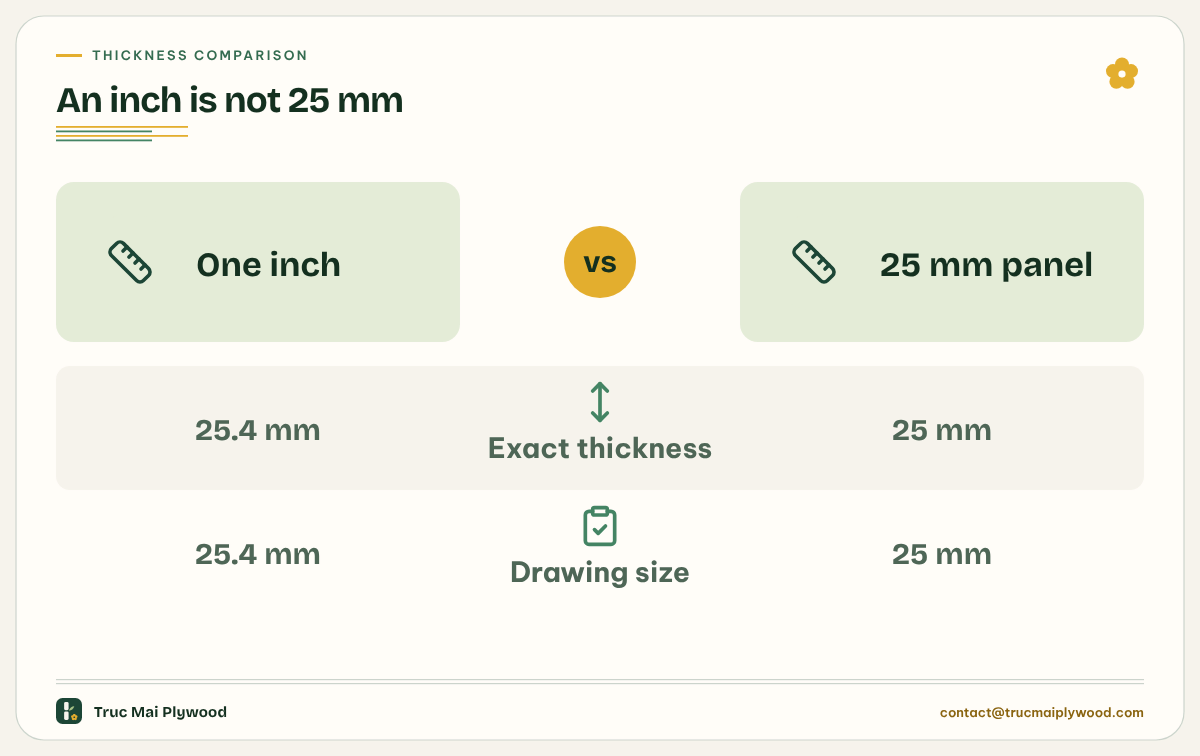
No. One inch is exactly 25.4 mm, while a nominal 25 mm panel is specified at 25 mm. That 0.4 mm difference matters for machined grooves, fitted components and repeat furniture orders. A trade description such as “one-inch plywood” does not establish the measured finished thickness. Specify the required millimetre dimension and tolerance on the purchase order.
For furniture factories, the question is practical: will a board enter a 25 mm groove, sit flush with adjacent parts, or align with pre-drilled hardware? A groove cut to the nominal board size leaves no allowance for the actual panel thickness. Set the clearance from the measured production sample, then approve the machining drawing. If the drawing calls for 25.4 mm, write that dimension rather than substituting 25 mm.
The NIST PS 1-22 structural plywood standard uses performance categories and thickness limits for structural plywood. Those categories are a different specification system from an order for 25 mm furniture plywood. For a commercial interior board, the agreed millimetre dimension and tolerance are the useful buying language.
What should a ply 25mm sheet specification include?
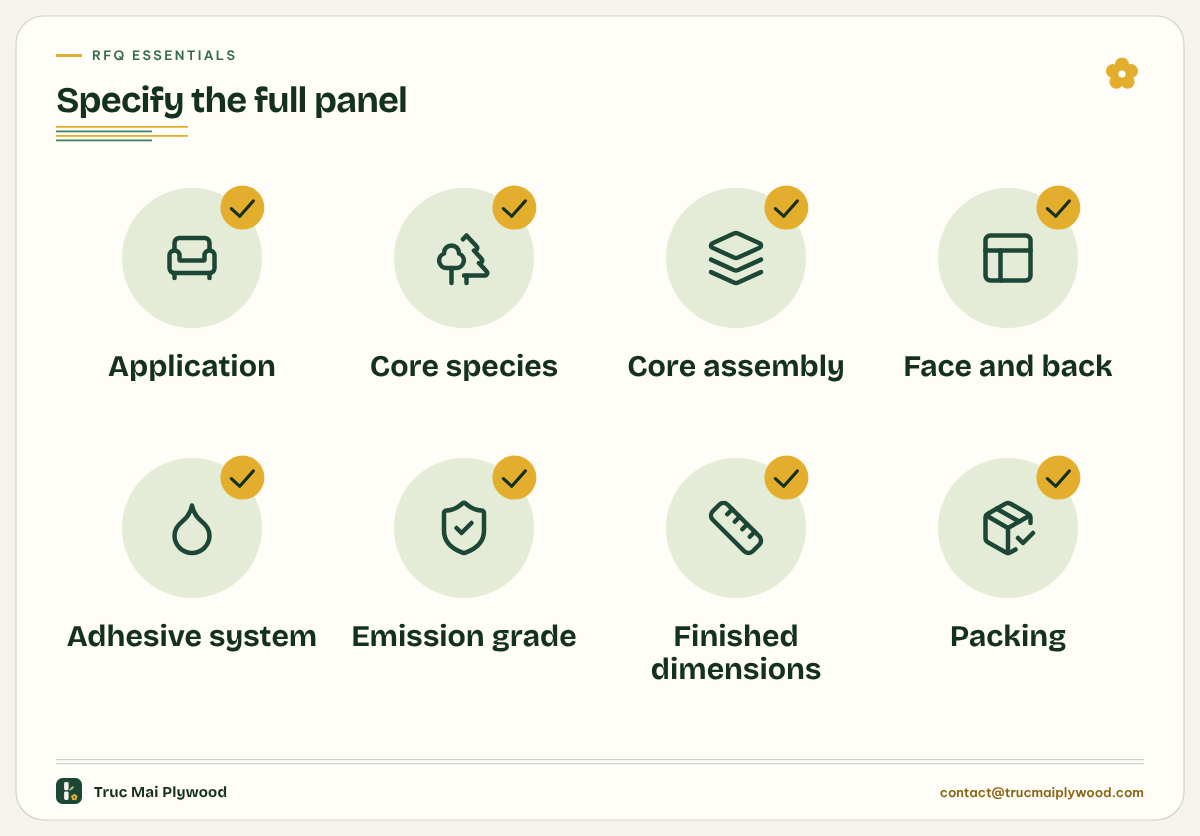
A useful 25 mm sheet specification names the application, core species, core assembly, face and back veneer, adhesive system, emission requirement, finished dimensions and packing. “25mm ply board” alone leaves most of the cost and manufacturing decisions unresolved. The same nominal thickness can conceal different face grades, inner-ply arrangements and densities.
| Order line | Example purchasing instruction | What the buyer checks |
|---|---|---|
| Product | Furniture and interior plywood | End use matches panel line |
| Thickness | 25 mm finished | Caliper readings on sample |
| Format | 1220 × 2440 mm | Cutting plan and machine feed |
| Core | Styrax, Acacia or Eucalyptus | Weight and edge appearance |
| Faces | Birch-faced, EV or Poplar | Approved face/back samples |
| Surface | Sanded and calibrated | Finish and flatness |
| Bond and emission | Separate glue and emission lines | Documents for the actual build |
| Packing | Labelled packs by cut list | Receiving and identification |
A 25mm plywood sheets enquiry should also specify whether the factory will process full boards or receive pre-cut blanks. A buyer ordering both panel and cut parts can write the full-sheet reference on the drawing, then assign each blank a part code. That reduces disputes when identical-looking boards are cut for different cabinets. For the broader checklist, use writing a plywood RFQ.
Which core makes the most sense at 25 mm?
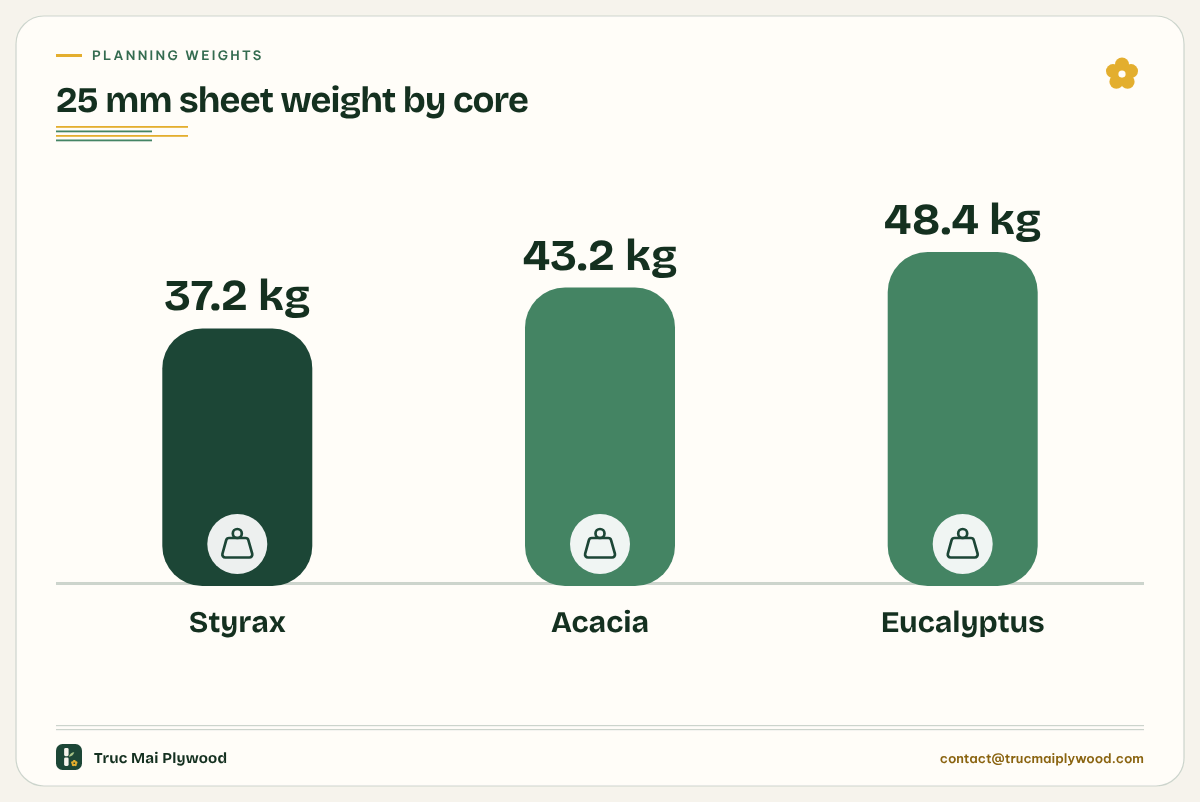
Styrax is the lighter reference core in Truc Mai’s planning model, followed by Acacia and Eucalyptus. The core decision affects handling weight, container utilisation, machining behaviour and the visible edge. It also affects the way a buyer should compare two offers that share a face veneer and nominal thickness.
Truc Mai offers Eucalyptus, Acacia, Styrax and Pine cores, including combined-species constructions. The core is specified by order rather than inferred from the face name. Birch-faced plywood, for example, describes the decorative face, not an all-birch core. See birch-faced plywood and Vietnamese plywood quality by grade for the separate face and core decisions.
How many plies are inside a 25 mm panel?
The ply count for a 25 mm commercial plywood panel is specified by the selected construction, not by a universal fixed number. Ply count follows the selected veneer thicknesses and construction, so a supplier must identify the actual lay-up rather than borrow a count from another thickness. More plies can change the distribution of glue lines and veneer defects, but the number by itself is not a substitute for a good core.
Ask for a cut-edge photograph alongside the construction description. Count the distinct veneer layers, inspect whether adjoining grain directions alternate as specified, and note any repaired joints. A factory can use a stitched core to hold veneer pieces in position before pressing; that is a different question from how many plies are present. Truc Mai commonly stitches the outer core plies for its furniture construction and can specify further stitching for the order.
A practical sample inspection has three steps: first, examine both faces under even light; second, examine a clean sawn edge for overlaps and openings; third, compare the edge with the signed reference sample. Keep the agreed count and core grade on the same specification sheet so the factory and receiving team inspect the same construction.
What sizes are offered for 25mm plywood sheets?
The principal full-sheet formats are 1220 × 2440 mm, 1220 × 2280 mm and 1250 × 2500 mm. The first is the familiar 4 × 8 ft trading format; the larger European format can suit layouts designed around metric machinery and cabinetry. Select the format by finished-part yield, not by the name used in a catalogue.
The 1220 × 2280 mm panel option suits some furniture-part plans. If your production system accepts several formats, compare usable yield from the cut list before selecting the base sheet. A longer sheet is valuable only when its extra area produces useful parts. Keep sheet format and thickness on separate order lines so the receiving team can identify mixed stacks.
Can the mill supply 25 mm plywood cut to size?
Yes. Truc Mai supplies labelled cut-to-size furniture panels from standard sheets, using the buyer’s approved cut list. Typical layouts divide a sheet lengthwise into two pieces, into three pieces for a furniture programme, or into four or six pieces. The final piece dimensions are agreed from the selected parent sheet and the cutting drawing.
For example, a lengthwise split of a 1220 × 2440 mm sheet gives the nominal 610 × 2440 mm format before the saw-cut allowance is addressed. A four-way pattern can yield nominal 1220 × 610 mm pieces. A three-way 1200 × 800 mm format is used for some furniture orders. Narrow cut parts can instead be planned from the 1250 × 2500 mm parent format. These are layout descriptions, not a substitute for a dimensioned cutting ticket.
Send a part schedule with quantity, finished length and width, face orientation, edge requirements and label text. Include which side will be visible after assembly. The mill can then agree the cut programme by email. The cut-to-size panel service explains how this fits into an order.
How heavy is 25mm plywood by core?
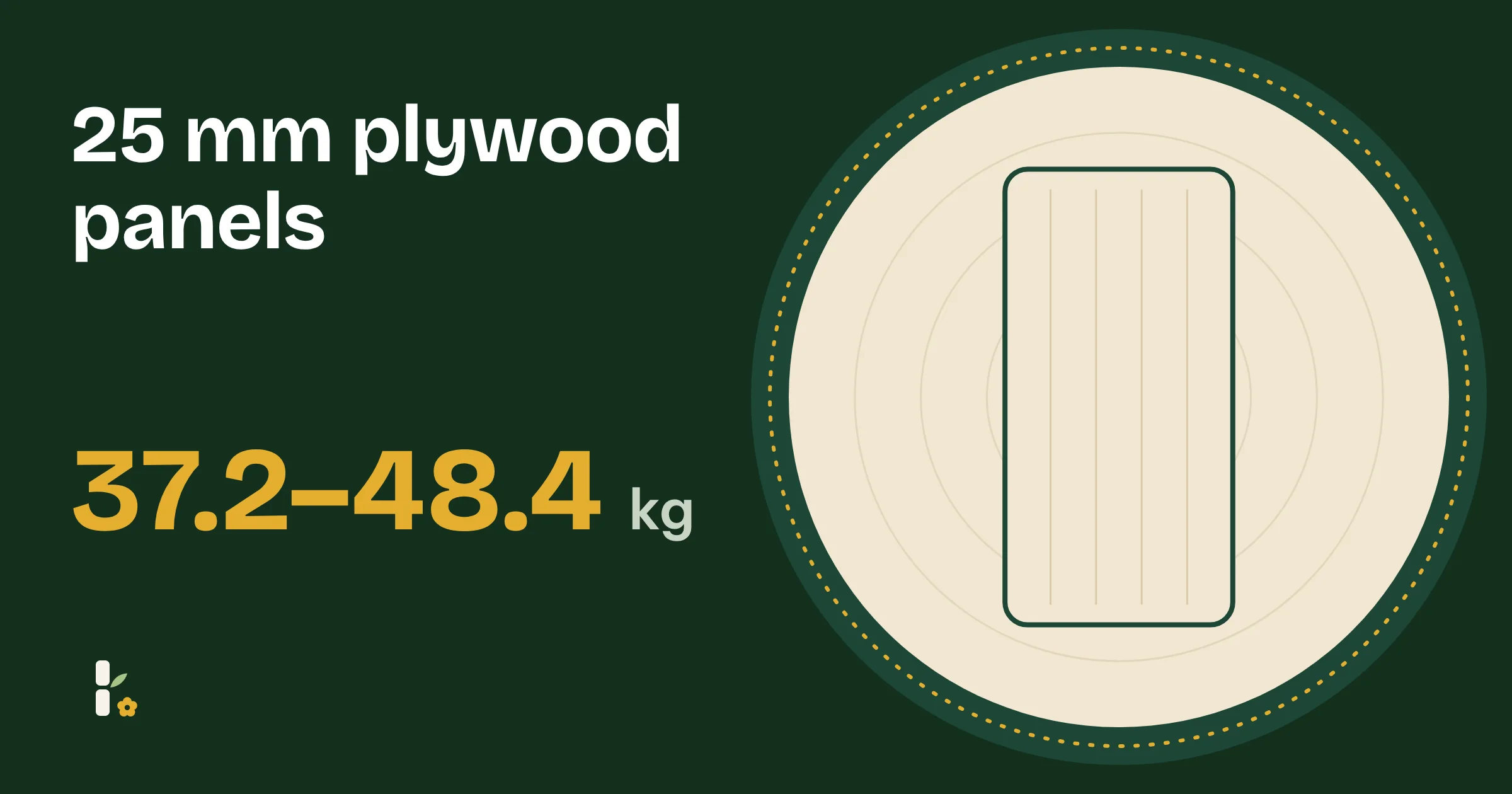
A 25 mm sheet weighs more when the core density rises. The 1220 × 2440 mm planning figures are 37.2 kg per Styrax sheet, 43.2 kg per Acacia sheet and 48.4 kg per Eucalyptus sheet. These are model values for handling and container planning, rather than scale readings from a finished production lot.
When comparing a 25mm board sample, weigh the whole panel and record its actual length, width and thickness. Keep the measured result with the order sample and packing specification. The number on the scale reflects the real construction, including veneers and adhesive, while the planning table below uses reference densities to compare cores consistently. Avoid comparing a wet or differently sized sample with a dry full-sheet reference.
How many 25 mm sheets fit in a 40HC container?
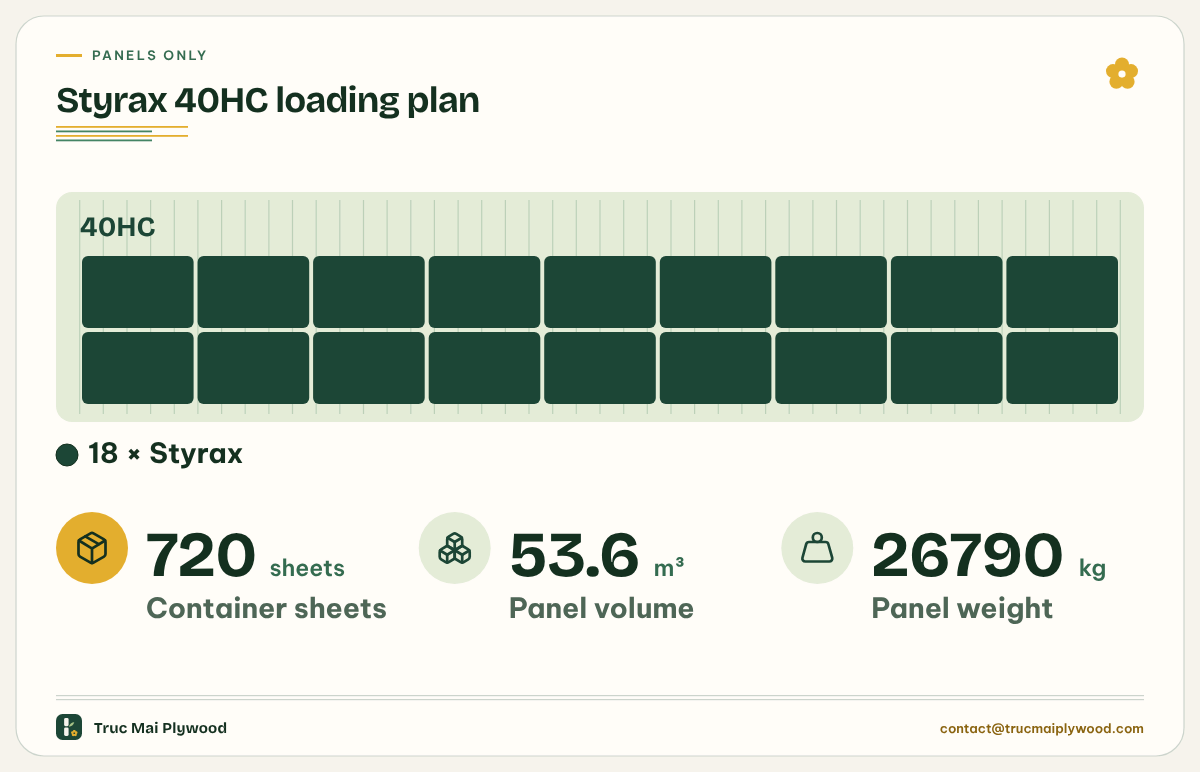
The 40HC planning model gives 720 Styrax sheets, 640 Acacia sheets or 570 Eucalyptus sheets at 1220 × 2440 × 25 mm. The table reproduces every supplied calculation without changing the inputs. The Eucalyptus row is capped by the model’s weight limit; the others use the modelled pack counts.
| Core | Thickness (mm) | Sheet size (mm) | Packs | Sheets per pack | Sheets | Volume (m³) | kg per sheet | Total panel kg | Weight capped |
|---|---|---|---|---|---|---|---|---|---|
| Styrax | 25 | 1220x2440 | 18 | 40 | 720 | 53.6 | 37.2 | 26790 | No |
| Acacia | 25 | 1220x2440 | 16 | 40 | 640 | 47.6 | 43.2 | 27620 | No |
| Eucalyptus | 25 | 1220x2440 | 15 | 38 | 570 | 42.4 | 48.4 | 27570 | Yes |
Calculation basis: 40HC planning model, panels only. Maximum packs by core: Styrax 18, Acacia 16, Eucalyptus 15. Pack height is 1,000 mm. Sheets per pack are the pack height divided by thickness, rounded down and capped by a 28,000 kg planning payload. Reference densities are Styrax 500 kg/m³, Acacia 580 kg/m³ and Eucalyptus 650 kg/m³. The carrier and route determine the booking limit. The table is a planning figure, not a loading record; packing materials are handled in the final loading plan.
The useful purchasing comparison is sheets per container, not cubic metres alone. If a furniture line needs a fixed number of finished parts, the sheet count connects the material plan to production. The m³ per 40HC by thickness page shows how the same model behaves across the wider thickness range.
Is 24 mm plywood interchangeable with 25 mm?
No. A 24 mm panel is thinner than a 25 mm panel on the nominal specification, and that difference can affect flush joints, hinges, edge bands and recesses. If a drawing calls for plywood 24mm, changing to a 25 mm board is a design change, even if the surface looks the same.
For an overlay or cabinet top, examine the complete assembly rather than the sheet alone. A finished laminate, veneer or edge band can change the final fit. A 24 mm core plus a surface finish should not be described as a 25 mm plywood sheet without stating the finished construction. In a routed component, the nominal stock thickness also determines how much material remains below the cut.
Where the buyer accepts either thickness, approve one dimensioned sample for each alternative. Use the same face grade and core specification in the comparison, then test the part in the actual fitting. This is especially important for repeat orders: a small change to a board that previously fitted well can force a new machining programme.
When would a buyer choose 28 mm instead?
A buyer chooses 28 mm when the part drawing, fitting or desired section calls for 28 mm rather than 25 mm. The extra nominal thickness changes the component geometry and increases the amount of material handled. It does not by itself establish a safe load or a structural span.
Ask whether the intended part is a single sheet, two bonded sheets, or a laminated assembly. These are different constructions and should be specified separately. If a 28 mm finished dimension is mandatory, request that thickness explicitly rather than ordering a 25 mm panel and expecting the surface treatment to supply the missing depth.
What tolerance should be written for a 25 mm board?
For a sanded and calibrated furniture panel, Truc Mai’s stated thickness tolerance is ±0.3 mm; commercial-grade panels use a wider agreed tolerance. Length and width are specified at ±2 mm. Put the tolerance beside the nominal 25 mm dimension on the purchase order, and agree how measurements will be sampled across a sheet.
Thickness is measured at several locations because a single reading near an edge does not describe the whole board. Calibrate the gauge, avoid damaged corners, and record the points used. A buyer with a close-fitting groove should test a representative sample from the intended production construction rather than rely on the nominal figure alone.
The European EN 315 dimensional standard has its own thickness and dimensional tolerance framework. A mill’s agreed order tolerance and a standard’s permitted range are separate references. State the one the contract requires, along with the test method and moisture condition where relevant.
Which faces and finishes suit thick interior panels?
For visible furniture components, select the face by the finish the buyer will apply and the appearance required in the finished room. Truc Mai offers engineered veneer (EV), Poplar, bleached Poplar, Birch, Okoume, Bintangor, Pine, Eucalyptus, Gurjan and other faces by agreement. The face is a thin surface layer on a separately specified Vietnamese core.
A natural veneer may be chosen for its grain and colour. An EV face gives a more controlled appearance for a repeat furniture programme. A panel intended for paint, melamine or high-pressure laminate needs the appropriate surface preparation and construction. For an exposed edge, the core’s appearance may matter as much as the face.
Truc Mai’s UV-ready panels have faces prepared for the buyer’s own UV coating; the mill does not apply that coating. That distinction belongs in the purchase description. Buyers ordering an overlay should specify whether they want the finished faced panel or a prepared substrate. See melamine-faced panels and HPL-faced plywood for two distinct finished-surface options.
How should glue and emission requirements be specified?
Glue type and formaldehyde emission are two separate purchasing requirements. Truc Mai’s interior default is UF glue at E0 emission, with the emission grade written as its own specification line. For a buyer’s technical file, record the actual adhesive system and the applicable emission test or certification scope rather than treating the word “E0” as a glue chemistry.
For the United States, 40 CFR Part 770 sets the TSCA Title VI hardwood-plywood emission limit at 0.05 ppm for veneer-core material, using the prescribed test framework. Truc Mai holds CARB Phase 2 and TSCA Title VI certification for veneer-core hardwood plywood in the 3–25 mm scope. A 25 mm order falls at that scope’s upper thickness boundary; the product construction and documentation must match the certified category.
For European orders, the buyer’s emission specification and applicable article requirements belong on the same technical sheet as the panel construction. A test for adhesive bond durability answers a different question from a chamber emission result. The Phase 2 formaldehyde limits page explains the US framework in more detail.
What documents should accompany a 25 mm plywood order?
A complete order file links the approved construction to the commercial and shipping documents. The invoice, packing list and bill of lading identify the goods; the relevant origin and test documents explain the specification and its market access. Buyers should request the certificate documents for the selected build before confirming the order.
For eligible FSC 100% goods, Truc Mai holds chain-of-custody licence FSC-C196493 and certificate SA-COC-014545. The FSC claim appears on the sales and shipping documents for eligible products. Check the product and claim against the agreed order, then retain the documents with the receiving records. The FSC licence verification guide explains the check.
For EU-bound plywood, the European Commission’s EUDR overview describes the due-diligence framework, including plot geolocation. Truc Mai supplies origin records and geolocation files for the core and face veneer so the importer can prepare its due-diligence statement. Keep the veneer origin distinct from the core origin when the face is imported. The face veneer origin files page covers that distinction.
How can buyers inspect a 25 mm plywood sample?
Inspect the sample against the intended use, not against a generic “premium” label. A thick panel for a visible cabinet side needs a sound face and a clean finished edge. A concealed substrate may prioritise dimensional consistency and machining. Ask the supplier to mark which face is the front and which grade is approved for the back.
Use a repeatable receiving sequence. First, check the label and compare the sheet format with the purchase order. Second, measure thickness at several positions and record the readings. Third, inspect both faces for defects outside the approved sample. Fourth, cut a test edge and inspect the core joins. Fifth, machine one representative part, including the actual groove, screw hole or edge band.
How does a buyer compare 25 mm plywood quotations?
Compare offers only after matching the construction. A quotation headed “25 mm plywood” can refer to different core species, joining methods, face grades, surface finishes and documentation. A lower sheet count per container may also change the logistics of a furniture programme even when the individual board description looks similar.
Build a comparison sheet with the agreed thickness and tolerance, base format, face/back pair, core, adhesive, emission requirement, cut list and packing. Then add the documents needed for the destination market and the sample approval method. Request that each supplier quote the same specification, rather than inviting an unspecified alternative under the same product name.
Truc Mai’s standard minimum order is one 40HC. Production is planned for 15–45 days after the deposit, according to the order and production conditions. Terms include FOB Hai Phong, CFR or CIF. A buyer comparing delivery schedules should keep production time separate from ocean transit. See deposit and balance terms for the commercial sequence.
What should go into the final 25 mm panel RFQ?
Send a complete part and panel specification, then ask for a quotation against that exact build. The buyer’s email should identify the finished product, core preference, glue and emission requirements, face and back, nominal thickness and tolerance, sheet format, cut schedule, packing quantity and destination port. Include the intended surface finish and a drawing where parts must fit machined hardware.
A useful RFQ has a simple order of decisions: application first, core second, glue and emission third, face and surface fourth, dimensions and cutting fifth, then packing and shipping. Attach a photograph of the desired face if appearance is important. For a repeat furniture line, include the existing part number so the supplier can match the approved sample.
Truc Mai Plywood manufactures furniture and commercial panels in Ha Hoa, Phu Tho, Vietnam, with a stated annual capacity of around 60,000 m³. To request a 25 mm specification and pack plan, use the quotation page and include the cut list and destination port. For a new programme, order plywood samples before approving the full production batch.
Questions buyers ask
Can 25 mm plywood be used for a cabinet worktop?
Yes, 25 mm furniture plywood can be specified as a cabinet worktop substrate. Select the face or overlay and confirm the support and edge detail for the finished assembly.
Is a 25 mm plywood panel always hardwood throughout?
No. A hardwood face describes the visible veneer, while the core can use another species or a combination. Specify face and core separately.
Can a buyer order birch-faced 25 mm plywood?
Yes. Birch-faced panels use birch as the face veneer on a separately specified core; the face description does not mean all-birch construction.
Are both faces of a 25 mm panel the same grade?
They can be specified as a matching pair or as different face and back grades. The approved sample and order should identify both sides.
Is a 25 mm panel suitable for UV coating?
A UV-ready panel has prepared faces for the buyer to apply the UV coating. Specify the surface preparation and the coating process separately.
Can 25 mm sheets be supplied with melamine?
Yes, melamine-faced plywood is an available finished-surface option. Identify the colour, face and back arrangement, and required edge treatment.
Can the mill label individual cut parts?
Yes. Cut-to-size furniture panels can be packed with buyer-agreed labels linked to the cut schedule and part numbers.
How should a buyer store thick plywood on arrival?
Store panels flat on sound, level supports in a dry, protected area. Keep packs identified and allow handling space for the heavier sheets.
Does a thicker sheet automatically support a longer span?
No. Span and load capacity require a design based on the actual panel construction, support arrangement and applicable structural specification.
Can one container contain more than one 25 mm core type?
Yes, mixed products can be arranged by agreement. Plan each pack and the total weight for the selected combination.
Which side of a veneer-faced sheet should be visible?
Use the face identified on the approved sample and packing label. The reverse face may have a different appearance grade.
Should a furniture buyer specify screw withdrawal strength?
Where fastener performance is critical, specify the required test and acceptance criteria for the chosen construction. A nominal 25 mm thickness alone does not provide that result.