
Plywood Indonesia and Vietnam both supply commercial and furniture panels, but a fair comparison starts with core species, face veneer, bond, emission evidence and the packed order. Truc Mai Plywood manufactures Vietnamese panels with selectable plantation cores and decorative faces. Compare two written specifications before judging appearance, shipment efficiency or the final buying decision.

What is plywood indonesia, and what is actually being compared?
Plywood Indonesia means plywood manufactured in Indonesia, rather than a single species, grade or standard. A listing with that origin can describe a decorative joinery sheet, a light plantation-core board or a heavier hardwood construction. The country name does not tell an importer the glue system, the back’s appearance, the density of the core or the test evidence.
For a buying comparison, begin with the intended application. Cabinet sides need flat, clean surfaces and predictable machining. Packing panels are judged more by useful strength, handling and consistent dimensions. A veneered door skin needs a face that matches the approved colour and grain. An origin-only offer cannot answer those questions. Request the construction sheet before evaluating an offer, and use the supplier shortlist checklist to record missing fields.
A distributor stocking several panel types should compare like-for-like SKUs. Separate decorative veneer-faced plywood from plain commercial plywood, and separate each thickness and core. A single supplier may excel in one line while offering a different construction in another. This avoids transferring a good result from one sample to a different panel.
Vietnam vs Indonesia plywood: quality and price differences
Vietnamese and Indonesian plywood quality is determined by the specified construction and its inspection, while commercial differences arise from the materials, processing, usable yield and shipment plan. A country-wide price ranking would conceal those differences. Compare the same application and acceptance criteria before treating either quotation as an alternative.
| Buyer measure | Vietnamese panel offer | Indonesian panel offer | Evidence to compare |
|---|---|---|---|
| Core | Specify Styrax, Acacia, Eucalyptus, Pine or combined veneers | Ask the mill to identify every core species | Edge sample and construction schedule |
| Face | Select the agreed decorative or utility veneer | State the offered face species and grade | Paired face/back sample |
| Bond | Specify adhesive and required service condition separately | Specify the same bond performance | Test method and report for the build |
| Emission | Request the required market test evidence | Request the same market test evidence | Product scope and laboratory method |
| Thickness | Write nominal and accepted tolerance | Apply the same nominal and tolerance | Measurements across sampled sheets |
| Logistics | Quote a defined packing plan and shipment term | Request an equivalent packing plan and term | Pack list and loading assumptions |
A pale surface can hide an open core, and a dense core can be useful where handling demands it. Neither observation is a substitute for inspecting the edge and checking the specification. The Vietnamese plywood grading reference explains why trade grade labels need a sample and written defect limits.
Which core species change weight and machining behaviour?
Styrax, Acacia and Eucalyptus are three distinct Vietnamese core options with different weights and appearances. Truc Mai also offers Pine and combined-species cores. The core is an order-line decision, not a characteristic guaranteed by the words “Vietnam plywood”.
Styrax gives a pale core suited to light furniture panels and visible edges. Acacia offers a denser alternative for commercial applications. Eucalyptus can be chosen for a heavier panel, with weight and machining checked against the buyer’s equipment. Combined cores balance the material specification for the target application. Each option needs an approved edge sample showing the lay-up and the quality of the veneer joins.
Indonesian mills also work with different timber resources and panel constructions. Rather than assign a species to every Indonesian manufacturer, request the botanical or trade name, whether the veneers are mixed, and whether the species is present throughout the core. Ask whether any core substitutions are permitted on repeat orders. That last question matters when an importer needs the same machining settings across successive deliveries.
How should buyers compare face veneers and surface grades?
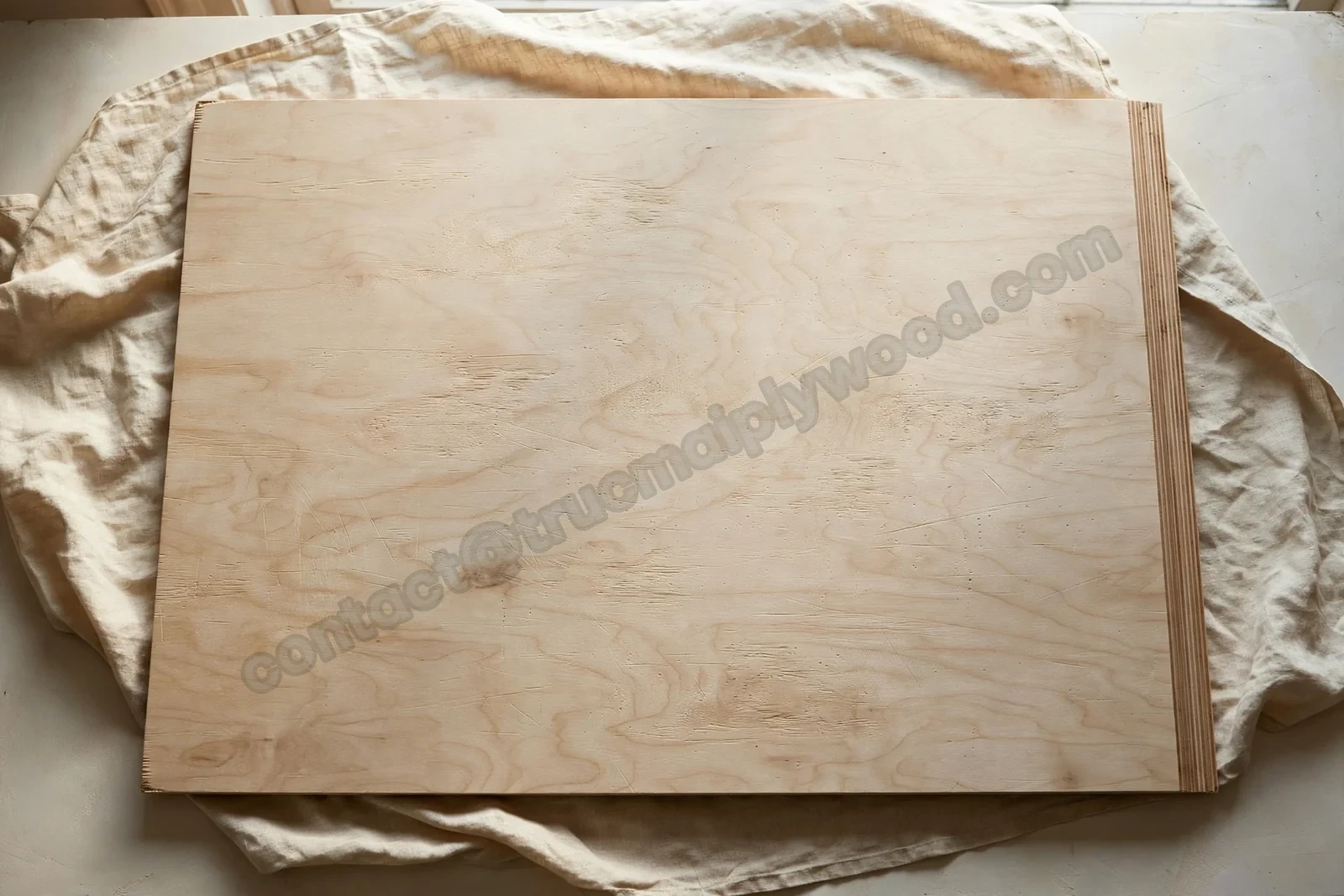
Face veneer should be compared by species, usable appearance and the agreed face/back pair. For a furniture order, an attractive face without an acceptable back can still create waste in the cabinet shop. Request full-sheet photographs, a physical sample and written acceptance rules for knots, patches, colour variation and sanding marks.
Truc Mai’s range includes engineered veneer, Poplar and bleached Poplar, Birch, Okoume, Bintangor, Pine, Eucalyptus, Gurjan and Sapele faces. Birch-faced plywood refers to the face, not an all-birch core. For imported face veneers, the buyer should distinguish the veneer origin from the country where the plywood is manufactured. The face veneer origin files show the documentary questions behind that distinction.
Trade labels such as A/B or BB/CC can be useful shorthand, but their defect allowances need to be written down. The ISO 2426-2 hardwood plywood appearance classification uses its own appearance classes. Do not assume that a supplier’s trade label maps directly onto an ISO class. Agree the sample first and use the same face/back description on every purchase order.
Which country is the better fit for cabinet and interior plywood?
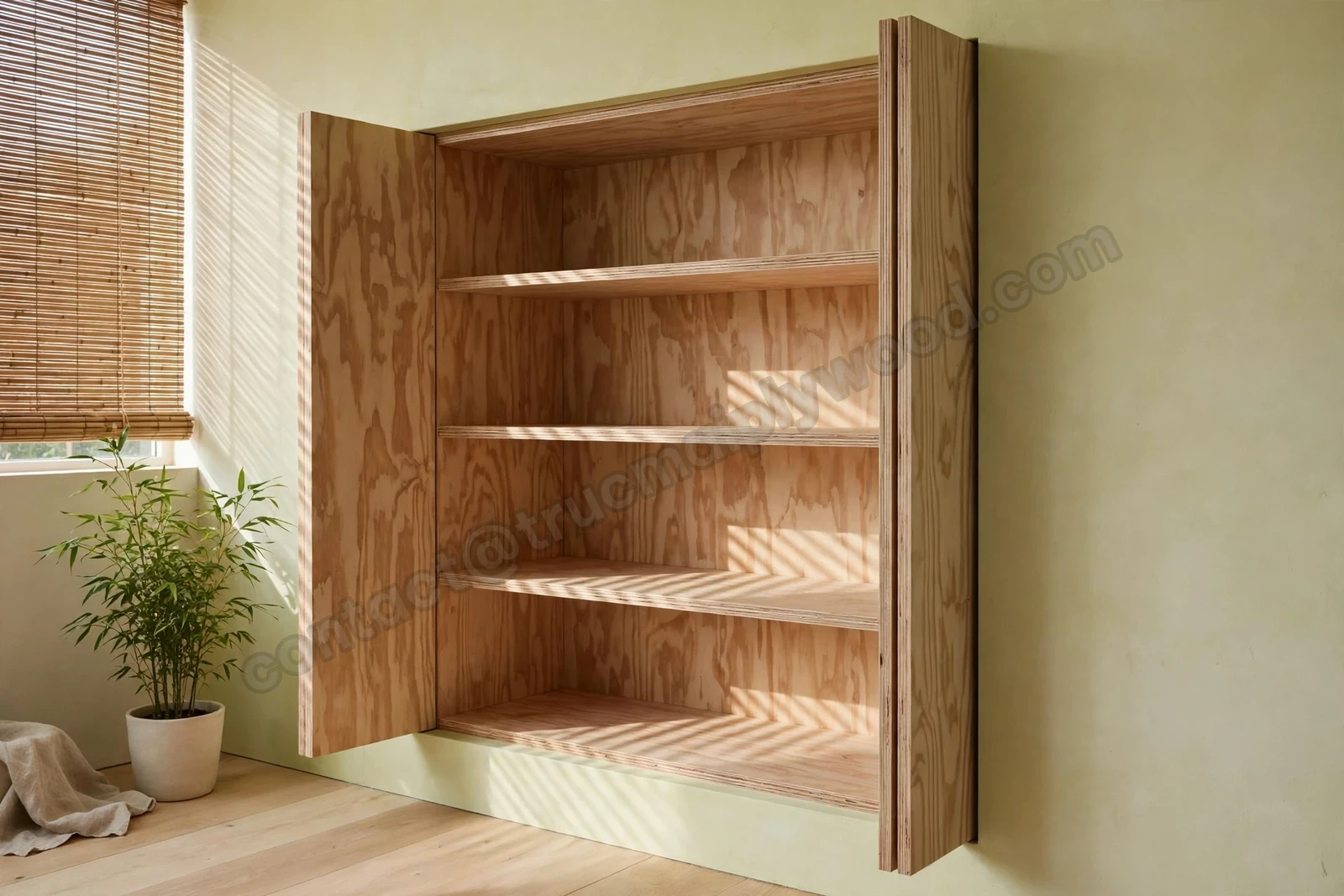
For cabinets and interior furniture, choose the panel that meets the machining, appearance and emission specification, regardless of origin. A calibrated furniture panel with a stitched core and sanded faces is easier to assess against a factory’s cutting and edge-banding workflow than a generic commercial sheet.
Truc Mai’s furniture construction uses an A-grade stitched core and prepared faces. Its normal thickness range is 3–40 mm, with 1220 × 2440, 1220 × 2280 and 1250 × 2500 mm formats. Sanded and calibrated furniture orders can specify ±0.3 mm thickness tolerance. The approved sample sets the face grade; the order sets the tolerance and the core. A buyer should ask an Indonesian supplier for the same particulars and test both samples on the same cutting and finishing equipment.
Consider the visible edge after machining, not only the face before cutting. Core voids, veneer overlap and inconsistent thickness can affect edging and drilling. Check several sheets from a pack, rather than treating a carefully selected display sample as the whole lot. For application choices, see best plywood for interiors.
What makes commercial plywood offers genuinely comparable?
Commercial plywood offers become comparable when the core grade, veneer joining, sanding level and tolerance are specified on the same sheet. The term “commercial” describes a broad buying category, not a single measurable grade.
A commercial Truc Mai build uses an AB core, loose-laid or jointed veneers and unsanded or lightly sanded faces. A furniture build is more tightly prepared. Packing plywood uses a separate construction intended for handling and protection. Buyers should not compare a lightly sanded utility panel against a calibrated furniture panel and attribute the entire difference to the producing country.
Ask for photographs of the panel edges and both surfaces from production samples. Mark the permitted repairs and visible defects in a signed specification. If the order will be cut into smaller pieces, inspect the pieces after cutting because a defect hidden in the middle of a large sheet can become an exposed edge on a finished component. Compare the reject criteria before discussing commercial terms.
How do glue, bond testing and emission requirements differ?
Glue type, bond performance and formaldehyde emission are three separate specification fields. A buyer can request an interior adhesive system and a particular emission result without treating the two as interchangeable. Specify the intended exposure, the test method and the accepted result for the actual panel construction.
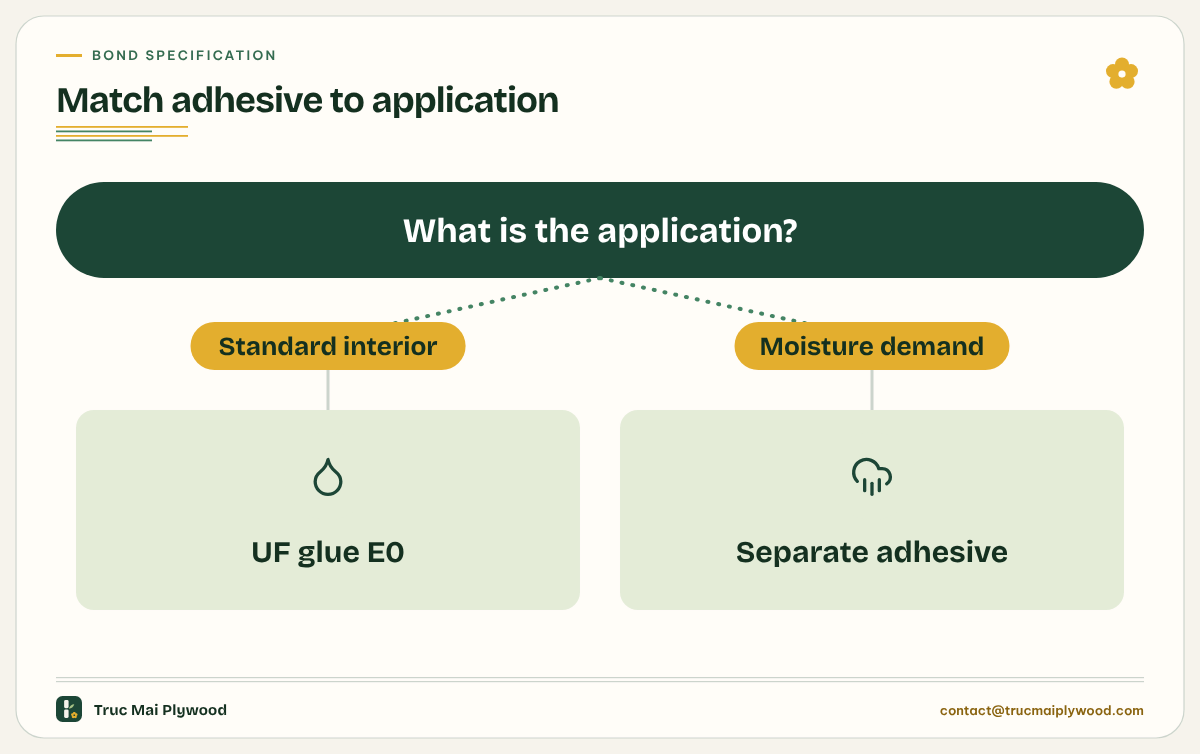
Truc Mai’s standard interior specification uses UF glue at E0 emission; for a moisture-demanding application, the adhesive construction is specified separately. For the United States, 40 CFR Part 770 sets a 0.05 ppm formaldehyde emission limit for hardwood plywood with veneer core under the relevant test regime. Truc Mai’s CARB P2 and TSCA Title VI certificate CARB/EPA 26053 covers hardwood plywood with veneer core at 3–25 mm, within its stated product scope.
For Europe, buyers should identify the applicable product requirement and method, rather than equate an American ppm result with a European chamber measurement. An adhesive bond test answers a durability question; an emission test answers a different question. Write both on the RFQ and check the laboratory report against the offered thickness, core and surface treatment.
What do the two origins need to provide for EU traceability?
Both origins need traceable wood-origin information for plywood covered by the EU Deforestation Regulation. The European Commission’s EUDR overview identifies deforestation-free production, legality and due diligence information including harvest-plot geolocation as central requirements.
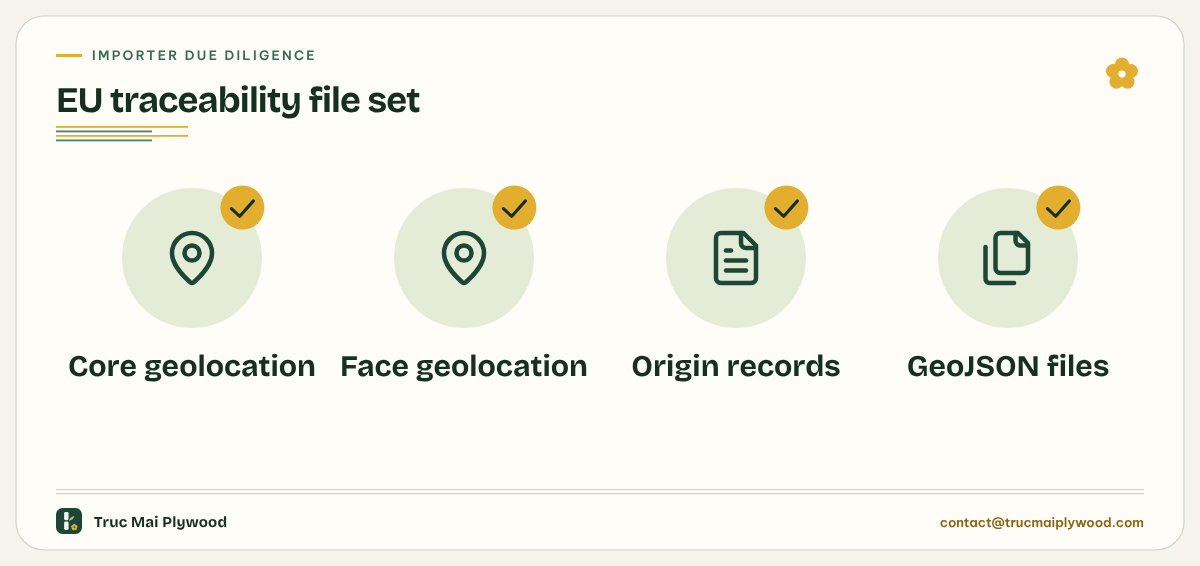
A plywood sheet can combine domestic core wood with imported face veneer. The importer therefore needs the origin trail for each relevant wood component, not merely the country of final pressing. Truc Mai supplies origin records and geolocation files for both core and face veneer. The supplier’s dossier supports the importer’s due-diligence work; the operator uses the applicable EU system for its statement or declaration.
Request a species list, countries of production, plot information, chain-of-custody records where applicable and links between those records and the purchased lot. A missing face-veneer trail can be as significant as a missing core trail. Put the document list into the purchase-order annex so that the required files travel with the shipment record rather than being sought after arrival.
How can an importer verify an FSC plywood offer?
An FSC offer should identify the certified seller, eligible product and exact claim on the sales documents. The FSC chain-of-custody standard requires the seller’s certificate code and the FSC claim for certified products on its sales documentation.
Truc Mai holds FSC licence FSC-C196493 and chain-of-custody certificate SA-COC-014545. Eligible products can be sold with an FSC 100% claim. Ask for the claim on the relevant invoice line and check the product against the certificate scope. A certificate held by a mill is useful evidence, but the purchase line still needs its own documented claim.
The same principle applies when comparing an Indonesian mill: check the issuing body, certificate status, product schedule and transaction paperwork. Do not substitute a marketing logo for a product-level claim. Record the code before placing the order, then compare it with the shipping documents received for that consignment.
How should importers assess lead time and repeat supply?
Lead time should be compared from the same start event to the same shipment milestone. Truc Mai’s standard production window is 15–45 days after the deposit, with the actual order specification and quantity written into the sales agreement. An Indonesian offer should identify its own production start, approval steps and dispatch point in the same way.
For a repeat programme, ask whether the mill reserves the approved core construction, face grade and packing method across orders. The first sample should become a reference for subsequent lots. Ask who records any change in veneer source, adhesive system or sanding specification, and how revised samples are approved before production.
The key distinction is between manufacturing time and ocean transit. A short production estimate cannot be compared with a delivered-to-port estimate. Use a dated schedule showing sample approval, deposit, production, inspection, loading and document release. The first-order to monthly supply process gives a useful order of decisions.
What does container efficiency change in the comparison?
Container efficiency changes how many usable panels reach the buyer in one shipment, so compare the packing plan alongside the panel specification. Heavier cores can reach the payload limit before the container’s internal space is fully occupied. Different sheet sizes and pack heights also change handling.
Truc Mai plans 40HC loads by core, sheet dimensions and thickness, then weighs the real panels before final loading. The plywood volume per 40HC table separates planning values from a completed packing list. Use the same distinction for an Indonesian offer. Request sheets per pack, packs per container, gross cargo weight and the carrier’s permitted payload.
Packaging deserves its own line in the comparison. Ask whether pallets, battens and edge protection are included in the stated weights. A large number of sheets is of little value if the pack cannot be handled without damage. A useful offer gives the buyer a clear loading plan that can be checked against the arrival packing list.
Can cut-to-size production change the origin decision?
Yes. Factory cutting can reduce the buyer’s handling and preparation work when the pieces match a repeatable cutting list. Compare the finished piece dimensions, labelling and acceptable cutting tolerance, not just the nominal size of the parent sheet.
Truc Mai offers labelled cut-to-size panels from standard sheets. Options include two lengthwise pieces of 610 × 2440 mm, three pieces in a 1200 × 800 mm pattern, four pieces of 1220 × 610 mm and six-piece layouts. Other requested component sizes can be planned from a 1250 × 2500 mm sheet. The mill agrees the exact cut list by email before production.
For either origin, send a drawing showing the direction of the face grain, piece identification and the finished dimensions. Ask how the pieces will be bundled and whether the face and back remain identifiable after cutting. A label on every pack helps the receiving warehouse sort components without reopening the entire shipment. See cut-to-size plywood panels for the product route.
What should a supplier comparison sample contain?
A useful comparison set contains matched specimens from both suppliers, with the same thickness, surface requirement and declared core. Request an uncoated edge view, both faces, a calibrated thickness reading and a clearly identified sample code. Keep a reference specimen for incoming inspection.
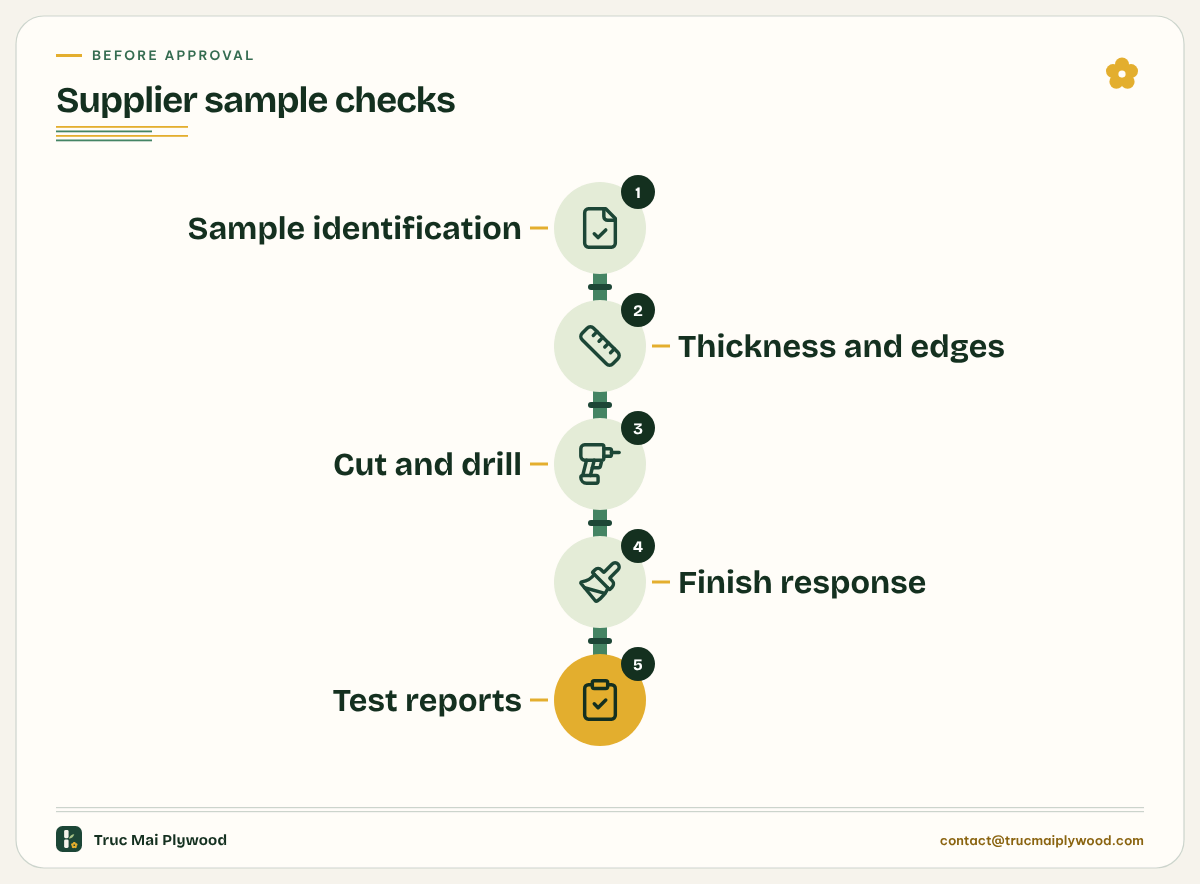
Use a repeatable review sequence:
- Check the sample identification against the written construction and face/back grade.
- Measure thickness at several points and inspect edge gaps or veneer overlaps.
- Cut and drill a test piece using the buyer’s production settings.
- Compare surface preparation and finishing response for the intended use.
- Review the relevant test reports and certificate scope against the sample code.
- Sign off the approved sample and attach its description to the order.
A single attractive face is insufficient for a repeat manufacturing programme. For a first order, ordering plywood samples is the practical starting point. Keep the accepted defect limits and measurement method alongside the physical sample so purchasing and production use the same reference.
How do you compare the two offers without a misleading price headline?
Compare offers on the same finished specification, delivery term and acceptance basis. An apparent commercial difference can disappear when one quote includes a prepared face, tighter tolerance, documented emission scope or a more efficient pack, while the other describes a basic utility board.
Prepare a comparison sheet with columns for core, face/back, adhesive, emission requirement, thickness, sheet size, surface finish, packing, inspection and delivery term. Mark each field as matched, different or unanswered. Ask each supplier to revise the unanswered fields before choosing. For FOB offers, keep the named loading port visible; for CFR or CIF offers, keep the destination and included services visible.
Separate the unit being purchased from the unit being handled. A buyer using pre-cut components should compare the usable pieces delivered to the assembly line. A distributor selling full sheets should compare the approved sheet count and damage allowance. This method gives purchasing a clear reason for the decision without relying on an unsupported country-wide price ranking.
What should go into the final plywood RFQ?
The final RFQ should name the application, core, glue and emission requirement, face/back, size, packing and quantity. State the destination and shipment term as well, then attach the accepted sample or drawing. This produces a comparable response from each mill.
For a furniture programme, write the surface finish and machining expectations next to the nominal thickness. For a distributor, include the mix of products in the container and the label text. For a repeat order, refer to the approved sample code and ask for the same construction. Request the production window, inspection point and shipping-document list in the offer.
Use the plywood RFQ writing checklist to prepare the specification, and verify the mill before the deposit before committing to the order. Send the completed specification through the quotation desk at /get-a-quotation/ or email contact@trucmaiplywood.com. The reply can be built around the actual panel and loading requirements rather than the country name alone.
Questions buyers ask
Can Indonesian plywood be used for cabinet carcasses?
Yes. Specify a stable core, calibrated thickness, a suitable face and the required emission evidence for the finished cabinet panel.
Is birch-faced plywood the same as all-birch plywood?
No. Birch-faced plywood describes the surface veneer; the inner plies can be another species. Ask for the core species on the order.
Can I request a mixed-specification container?
Yes. Truc Mai normally loads one or two products and can agree a mix of three to six products with a packing plan.
Do I need a face and back grade on the purchase order?
Yes. State the face and back separately and approve a physical reference sample for appearance.
What is the minimum shipment for Truc Mai?
The standard minimum order is one 40HC container.
Can a mill cut sheets into labelled parts?
Yes. Truc Mai offers cut-to-size panels from standard sheets with sizes and labels agreed from the buyer’s cut list.
What should an independent inspection check?
Check the approved sample against face appearance, thickness, edge quality, pack identification and the agreed tests. Record findings by product line and pack.
Does FSC chain of custody apply to every panel from a certified mill?
No. Check the eligible product and its FSC claim on the sales documents, alongside the seller’s certificate code.
Can I order a sample before booking a container?
Yes. Samples are available; new buyers arrange the courier and the courier charge can be credited against an order.
Which port is used for Vietnamese shipments?
Truc Mai offers FOB Hai Phong, as well as CFR and CIF terms for agreed destinations.