
Plywood thickness tolerance is the permitted difference between the ordered nominal thickness and the measured sheet. For Truc Mai furniture panels, the written tolerance is typically ±0.3 mm when sanded and calibrated, while commercial and packing panels use wider bands. Put the tolerance and inspection method on each purchase-order line.

What is plywood thickness tolerance?
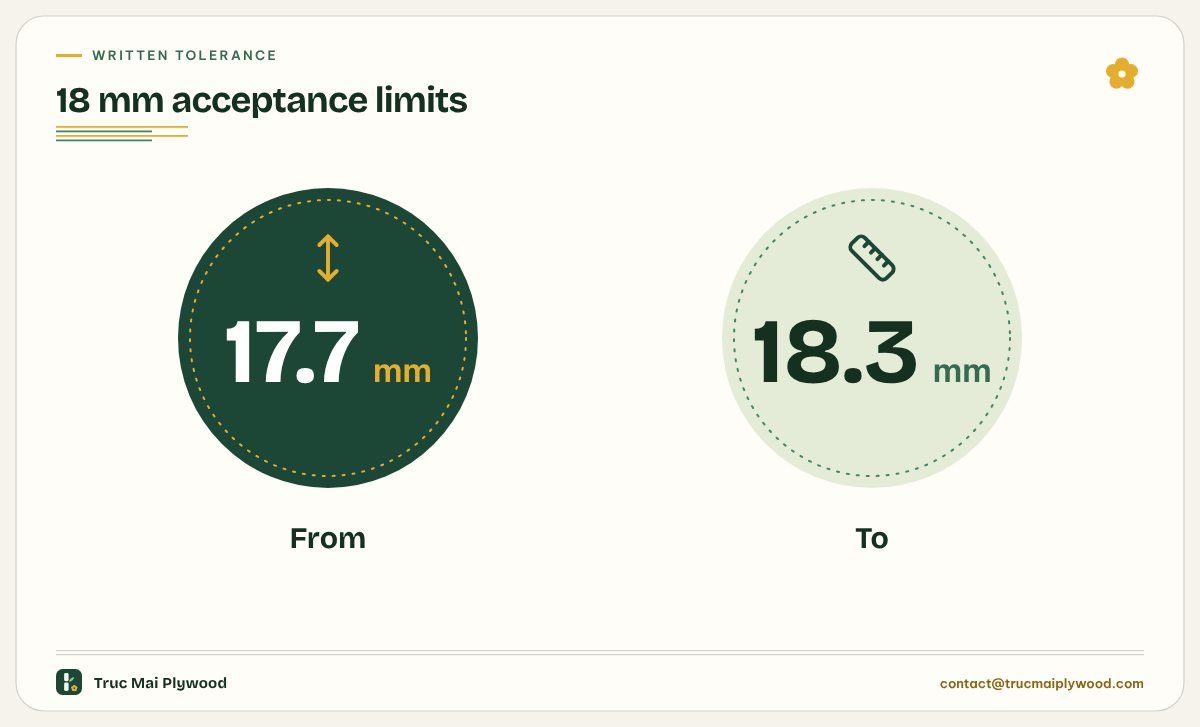
Plywood thickness tolerance is the permitted difference between a panel’s specified thickness and the thickness measured on the delivered sheet. A buyer ordering an 18 mm panel with a written ±0.3 mm tolerance accepts measurements from 17.7 to 18.3 mm. The range belongs on the order, alongside the nominal thickness, sanding requirement and inspection method.
Nominal thickness names the product. Actual thickness is the reading from a measuring instrument. A tolerance is an acceptance band, not an alternative name for a thinner nominal sheet. For machining, it matters whether the entire panel sits near one end of the band or whether the reading changes as the instrument moves across the sheet. Both questions should be addressed in the purchase specification.
A tolerance is useful because it turns a descriptive product name into a measurable receiving criterion. A purchasing team can compare offers, a production team can select a suitable calibration setting, and a workshop can set its machining process from the same written dimension. Without that shared number, a supplier might quote a nominal sheet and a buyer might assume that every board will fit a precision-cut component. The disagreement then appears only after the panels have reached the cutting table.
When reviewing a specification, look for the plus and minus signs and the units. A symmetric tolerance permits the same deviation above and below nominal. An asymmetric tolerance permits different upper and lower deviations. These are not interchangeable: the exact upper and lower limits matter more than a single description such as “industry standard”. If the purchase order names a standard, its product scope and edition matter too.
The useful distinction is between deviation from nominal and variation within one panel. A sheet can meet its nominal tolerance at each checked point yet have enough variation across its surface to affect a tight cabinet joint. Conversely, a very even panel can be consistently too thick for the intended slot. Specify both requirements for precision furniture work.
The guide to writing a plywood RFQ gives the purchasing context. A tolerance line is effective only when the face, core, finish and intended machining process are described with it.
What thickness tolerance should I expect from Vietnamese furniture plywood?
For Truc Mai furniture plywood, the order tolerance is typically ±0.3–0.5 mm, with ±0.3 mm on sanded, calibrated furniture panels. Commercial panels use ±0.5 mm; packing-grade panels use ±0.5–1.0 mm. These are distinct product-line specifications, rather than a single national tolerance that applies to all Vietnamese plywood.
| Product line | Written thickness tolerance | Typical preparation | Buyer priority |
|---|---|---|---|
| Sanded, calibrated furniture/interior | ±0.3 mm | Sanded faces, calibrated thickness | Cabinet fit and consistent machining |
| Commercial plywood | ±0.5 mm | Unsanded or lightly sanded | General panel fabrication |
| Packing plywood | ±0.5–1.0 mm | Utility finish | Packaging construction |
The grade determines the preparation, while the pro forma invoice records the acceptance range. A furniture buyer should put the tighter figure against the precise thickness and finish ordered rather than assume that the word furniture makes every supplier’s panel interchangeable. The cabinet-grade plywood overview explains the surface and core choices that sit beside the thickness specification.
Ask for the tolerance in millimetres, not a vague assurance that a board is calibrated. The contract should also say whether the number applies to individual measurement points or a batch average. Individual-piece acceptance is the more useful basis for parts that must fit an existing groove or assembly.
Do the panels have uniform thickness over the whole sheet?
A calibrated sheet is designed for a more even thickness across its face, but uniformity must be checked at multiple points. One edge reading cannot describe the centre, the opposite edge and the corners of the same panel.
For a practical inspection, lay the sheet flat on a clean support, identify the measurement positions and take readings away from damaged edges or visible local defects. Compare the highest and lowest reading as well as each reading against the nominal band. Record the instrument, units, sample identification and positions. The acceptance record then tells a workshop whether variation is local or consistent throughout the sheet.
Sanding reduces surface irregularity and helps achieve the calibrated thickness. It does not replace core construction: overlaps, gaps, uneven veneer lay-up and pressing behaviour can still influence the final geometry. Truc Mai furniture panels use an A-grade stitched core and sanded faces, while commercial panels can use a different core build and finish. Buyers evaluating Vietnamese plywood grades should therefore compare construction as well as the final calliper reading.
For routed doors, long shelves or laminated assemblies, sample measurements from the centre and each working area. For a small component cut from a large sheet, the measurements near the intended cutting region are particularly informative. Record those positions before the cutting plan is approved.
Which plywood thickness tolerance standard applies to a UK or European order?
EN 315:2000 is the European dimensional-tolerance reference for plywood, while a tighter agreed mill tolerance can be written on a furniture purchase order. EN 636:2012+A1:2015 refers to EN 315 for dimensional tolerances. A UK buyer should name the required edition and the acceptance criteria rather than assume that a trade grade such as AB has one universal dimensional meaning.
Under EN 315, thickness limits distinguish sanded from unsanded panels and depend on nominal thickness. For nominal thickness t from 3 to 25 mm, the sanded limits are +(0.2 + 0.03t) and −(0.4 + 0.03t) mm; unsanded limits are +(0.8 + 0.03t) and −(0.4 + 0.03t) mm. The same standard addresses variation within a panel, width, length, squareness and edge straightness. Its dimensional rules use a specified moisture-content basis.
The published EN 315 standards preview identifies the dimensional standard. Buyers using the complete standard should specify its applicable provisions in the contract. A tolerance agreed specifically for a calibrated furniture order can be tighter than a general dimensional standard; the agreed tolerance is what the mill should manufacture and inspect against.
A claim of compliance with a dimensional standard is different from a statement about emission, bond durability or appearance grade. Keep these on separate specification lines. That makes a failed dimension easier to resolve without confusing it with an unrelated laboratory result.
How do sanded and unsanded plywood tolerances compare?
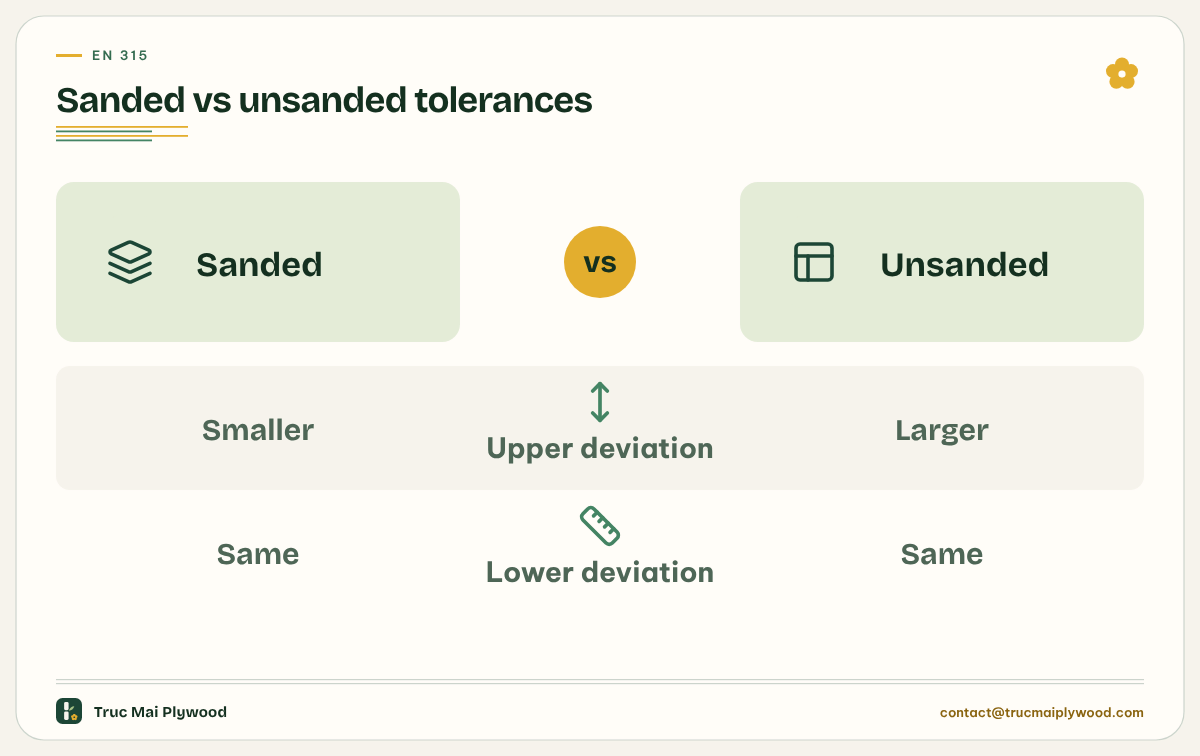
Sanded plywood has a tighter thickness allowance in EN 315 than unsanded plywood at the same nominal thickness. At 18 mm, the standard’s formula gives a smaller upper deviation for sanded panels than for unsanded panels, with the same lower deviation. These are asymmetric standard allowances, not Truc Mai’s tighter order-specific ±0.3 mm furniture specification.
| EN 315 example at 18 mm | Upper deviation | Lower deviation | Meaning |
|---|---|---|---|
| Sanded | Lower upper allowance | Same lower allowance | Thickness after sanding |
| Unsanded | Higher upper allowance | Same lower allowance | Thickness without final sanding |
The distinction matters when comparing quotations. A buyer can receive two nominally identical 18 mm sheets whose surfaces and allowable deviations are different. A supplier offering a tighter calibrated tolerance is describing a more specific manufacturing target than the broad standard allowance.
For visible furniture panels, sanding also affects surface readiness. For panels intended for subsequent overlay or coating, specify whether both faces are sanded, whether the surface is UV-ready and whether the final coating is applied by the buyer. Truc Mai supplies UV-ready faces for the buyer’s coating process; the finish specification should say that plainly.
Do not combine the face grade and thickness tolerance into one shorthand code. The face can look excellent while the board is outside the machining allowance, or the thickness can be excellent while the appearance grade differs from the approved sample.
How should 4×8 plywood thickness tolerance be specified for a Vietnamese mill?
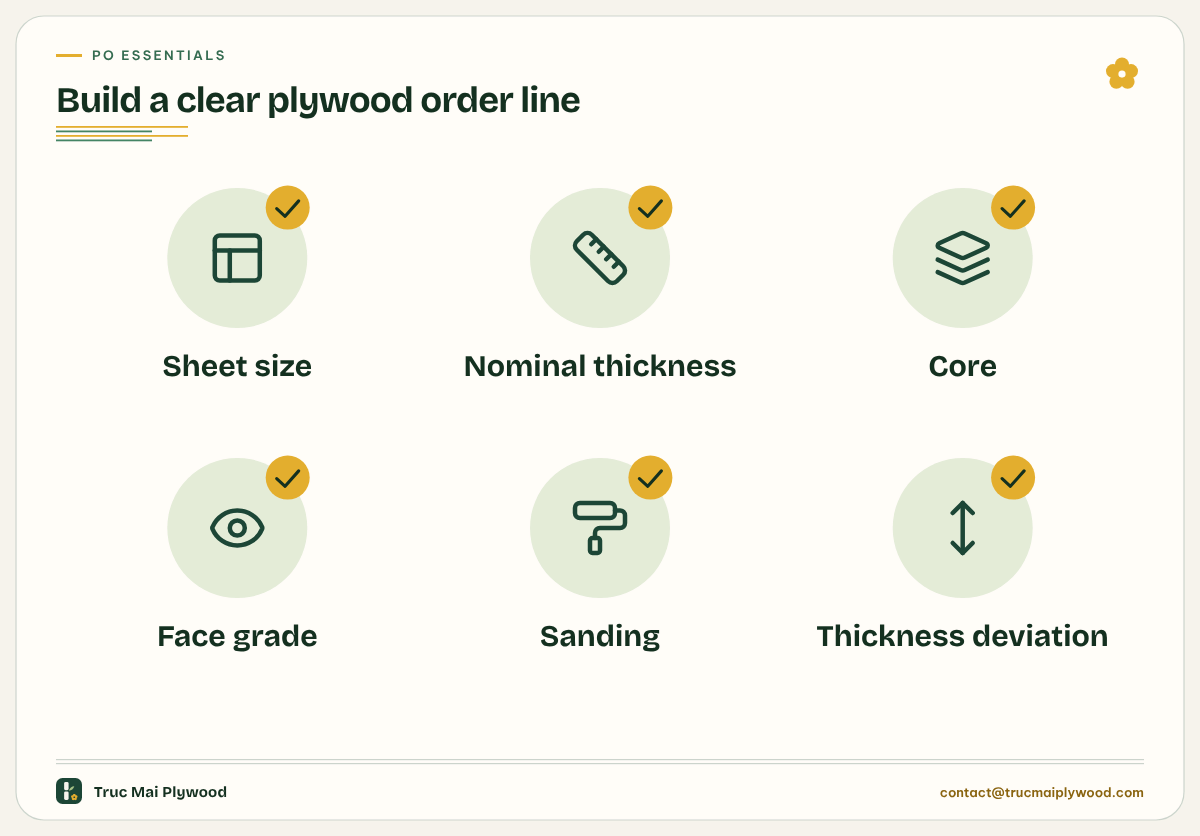
Specify the 1220 × 2440 mm sheet, nominal thickness, core, face, sanding and permitted thickness deviation on one purchase-order line. The familiar 4 × 8 ft name describes the nominal sheet format, not a thickness tolerance or a guarantee about finished edges.
A usable order line reads: “Furniture plywood, 1220 × 2440 × 18 mm, Styrax core, sanded and calibrated, thickness ±0.3 mm, face/back grade to approved sample.” The adhesive and emission class, packing arrangement and quantity follow as separate fields. This wording gives production and loading inspectors the same acceptance target.
Truc Mai also offers 1220 × 2280 mm and 1250 × 2500 mm sheet formats. Length and width tolerance is ±2 mm for its panel orders. The buyer should state whether the dimensions refer to the full factory sheet or the finished cut piece. See 1220 × 2280 mm panels for the shorter furniture format.
A purchase order for mixed sheet sizes needs separate line items. Otherwise a supplier may apply one dimensional note to a group of products that will be cut on different equipment. The same principle applies when one container combines a sanded furniture line and an unsanded commercial line.
What does a Vietnamese furniture plywood thickness tolerance standard actually mean?
A Vietnamese furniture plywood specification is an agreed manufacturing and acceptance document, not automatically an EN 315 or US PS 1 certification. The useful document identifies the nominal dimension, allowable deviation, finish, sampling positions and acceptance rule.
A buyer may request EN 315 dimensional testing for an applicable European project, but a supplier’s ordinary commercial specification can be more precise for a particular furniture order. Treat the order-specific number as a contractual requirement and keep any referenced standard beside it. For a cabinet programme, an approved reference sample and the written purchase specification should agree on the finished panel thickness.
NIST identifies PS 1-22 as a standard for structural plywood, including dimensional tolerances and performance categories. It is not a generic tolerance certificate for all furniture plywood. The NIST standards programme lists PS 1-22 as current and PS 1-19 as superseded. A non-structural furniture purchase should not borrow a structural grade stamp to imply an unrelated product qualification.
For a mill comparison, request an actual measured sample of the proposed construction, not only a table copied from a standard. A signed order line plus sample data is far more actionable when the cutting workshop later reports an unexpected fit.
How is plywood thickness tolerance controlled during manufacturing?
Thickness is controlled through veneer preparation, lay-up, pressing, sanding and final measurement. Each stage affects the finished sheet, so a single final sanding pass cannot correct every construction problem.
- Prepare veneers. Select and sort core veneers by thickness and condition; keep the face veneer specification separate from the core build.
- Lay up the core. Arrange plies and joints to avoid local overlaps or open gaps that produce uneven finished thickness.
- Press the assembly. Control pressing so the adhesive bond and panel geometry develop consistently across the sheet.
- Sand and calibrate. Bring the furniture panel towards its written finished thickness and prepare the surface for the specified finish.
- Inspect and record. Check a defined sample across the face and compare each reading with the purchase-order tolerance.
For Truc Mai, furniture cores are stitched across and along the sheet; the outer core plies are usually stitched, with all plies available by request. Thin panels require careful veneer selection. The mill’s 3–5 mm range uses five plies, while an 18 mm sheet commonly uses 11–13 plies, most often 11. Ply count and nominal thickness are related construction choices, but ply count alone does not determine final tolerance.
This sequence also explains why comparing thin plywood panels with a thicker cabinet panel needs more than a shared tolerance symbol. Different veneer assemblies demand different handling and calibration settings. An inspection sheet should identify the product construction that was actually measured.
How should thickness be measured at loading and on receipt?
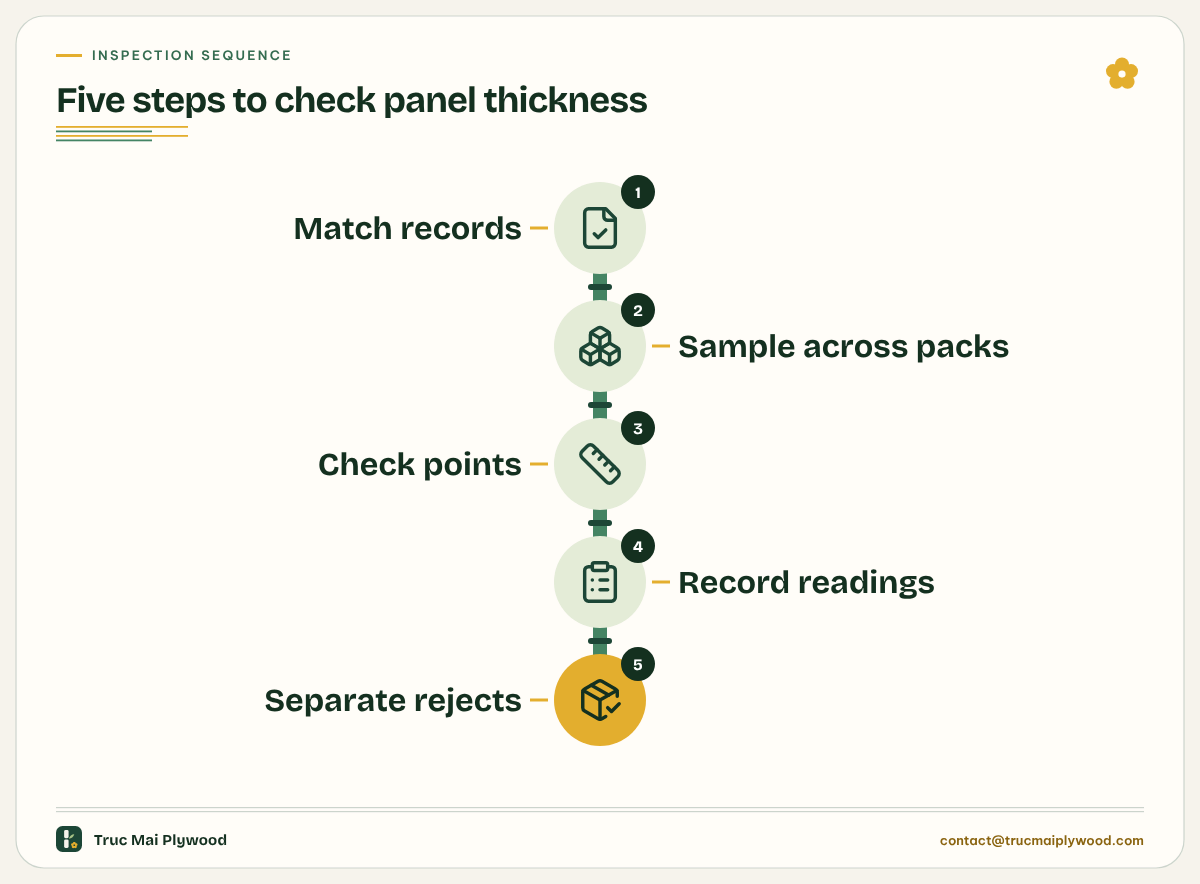
Measure the finished panel with a suitable calibrated instrument at agreed positions and record the readings against the order tolerance. A loading inspection should identify the batch, nominal thickness, instrument and number of sheets checked.
- Match the pack label and production record to the purchase-order line.
- Select sheets across the available packs rather than taking all samples from one convenient stack.
- Place each panel on a clean, stable support and check the prescribed points.
- Record the individual readings and the highest and lowest values for each sheet.
- Mark any rejected sheets, preserve the measurement record and separate them before packing.
- Retain the approved record with the shipment documents for comparison at receipt.
For a disputed reading, check the instrument’s zero and contact surfaces, remove debris and repeat the measurement at the same marked location. The inspection agreement should identify whether an edge setback is required. Repeatability matters: two inspectors using different positions or instruments can report different numbers on the same sheet.
A buyer receiving containerised plywood can repeat the agreed method on representative packs before cutting. Keep the panel labels and pack identifiers intact until the check is complete. For shipment paperwork and inspection coordination, see documents per container.
How does thickness tolerance affect cabinet machining and CNC work?
A tighter and more uniform panel thickness makes cabinet grooves, rebates, edge banding and assembly clearances easier to control. The critical dimension is the finished panel that enters the machine, not the nominal value printed in a catalogue.
A CNC programme that assumes one board thickness may leave a groove too tight for a panel near the upper acceptance limit or too loose for a panel near the lower limit. For repeat production, measure representative sheets before setting the toolpath, then set the groove and machining allowance from the approved material specification. The same approach applies to dado joints, concealed hinges, drawer components and laminated furniture parts.
Face finish also changes the sequence. If the buyer will laminate or coat the sheet, the required final assembly thickness should be distinguished from the supplied plywood thickness. Specify whether the purchase tolerance applies before or after the buyer’s finishing operation. A dimension taken before a subsequent overlay is not the same measurement as the finished component.
The best plywood for kitchen cabinets comparison addresses construction choices. For tight assembly work, order a calibrated furniture panel with an explicit deviation band and use the first received pack to verify the machine setup before committing the whole batch.

How should 12 mm and 18 mm plywood thickness tolerances be written?
Write a separate nominal thickness and tolerance for each line: “12 mm ±0.3 mm” and “18 mm ±0.3 mm” for the sanded, calibrated furniture configuration. These are Truc Mai’s furniture-order figures, rather than a universal allowance for every sheet carrying those nominal names.
The 12 mm panel and 18 mm panel may use different veneer assemblies and serve different parts of a cabinet. That does not change the basic acceptance method: each measured point is compared with its own ordered nominal thickness. Avoid a quotation that lists several thicknesses under one vague statement such as “standard tolerance”.
For an 18 mm panel, the buyer may also need a specification for core species, number of plies, face preparation and finished sheet size. The 18 mm plywood specification covers that broader purchasing decision. For thinner shelves or drawer components, ask whether the workshop requires the same deviation band or a different one based on the joint design.
Use a consistent unit on the invoice, inspection record and drawing. Mixing fractional-inch names with millimetre acceptance bands without identifying the nominal basis creates avoidable disputes, especially when the buyer’s machining programme is metric.
What should buyers do with a “Vietnam 2021 PDF” thickness tolerance file?
Use the document only after identifying its issuing organisation, edition, product scope and actual tolerance table. A file labelled “plywood thickness tolerance Vietnam 2021 PDF” or “download” is a search phrase, not a standard designation.
A useful document has a recognisable title, publication date, scope, measurement conditions and normative table. Check whether it covers plywood generally, structural panels, furniture panels or a particular supplier’s product. Then compare the document’s tolerance method with the purchase order. A PDF from an unknown host can reproduce a table without its original notes or applicability limits.
For European dimensional specifications, use the named EN 315 edition. For US structural plywood, consult the NIST PS 1 publication linked above. For a Truc Mai furniture order, the agreed tolerance is written on the pro forma invoice. Those three documents serve different purposes; one should not be substituted for another merely because it is available as a download.
Keep the PDF version and the accepted order line in the same purchasing record. If a later dispute arises, both sides can see the exact edition and tolerance language used when the order was placed. This is more reliable than a filename that happens to contain a year.
Do the years 2021, 2022, 2023, 2024 and 2025 change the tolerance?
No: a year in a filename or query does not change a plywood thickness tolerance. A change occurs when a named standard is revised or when the buyer and mill agree a different acceptance band for the order.
A document described as “Vietnam 2021 2022”, “Vietnam 2021 2023”, “Vietnam 2021 2024” or “Vietnam 2021 2025” needs the same verification: title, issuing body, edition and scope. The year 2021 alone is not a recognised thickness class. A copy uploaded in 2025 may contain an older standard, while a recently written supplier guide may use its own commercial figures.
A revision history should be read at the issuing body, not inferred from a blog publication date. NIST’s current and superseded standards list is an example of how editions can be checked. Where a contract names an edition, the parties can inspect against the same requirements without debating which website version appeared first.
For long-running furniture programmes, store the specification revision with the product drawing and approved sample. When the design changes, issue a new revision deliberately. That avoids an old purchase order silently controlling a new CNC design.
What should a buyer ask a Vietnamese plywood company before approving tolerance?
Ask for the exact nominal thickness, measured acceptance band, sanding status and sample inspection method before approving the production specification. A supplier comparison is strongest when each company quotes the same build and the same inspection rules.
| Request | What the response should identify |
|---|---|
| Panel construction | Core species, joining method, face and back veneer |
| Dimension | Nominal thickness, sheet length and width |
| Surface | Sanded, calibrated or unsanded; overlay preparation |
| Tolerance | Upper and lower deviation in millimetres |
| Inspection | Sampling locations, instrument and rejection rule |
| Shipment | Pack identification and records for the agreed line |
An apparently attractive tolerance figure is less useful without the measurement basis. Ask whether the supplier reports readings from a complete panel, cut pieces or a sample taken from a different product line. The supplier shortlist checklist provides a broader purchasing framework, while verifying a mill before deposit covers supplier evidence.
For an ongoing programme, keep one approved sample and one written specification per panel build. A change of core species or face preparation should be treated as a new construction to evaluate, even when the nominal thickness remains unchanged.
How does thickness tolerance interact with cut-to-size orders?
The finished cut-piece dimensions and the plywood thickness are separate acceptance measurements. A panel can be correctly calibrated but cut to the wrong length, or cut accurately while its thickness falls outside the agreed band.
Truc Mai can split standard sheets into labelled pieces using an agreed cut list, including lengthwise halves, thirds, quarters or six-piece layouts. The mill sets the final piece dimensions from the buyer’s starting sheet and drawing. State the finished length and width, cut orientation, edge finish, label scheme and thickness tolerance on the same order schedule, but inspect each characteristic separately.
For a cabinet component, confirm whether the cutting drawing assumes the full nominal sheet or the trimmed working area. Mark the grain or face direction where appearance matters. For matched doors or visible cabinet fronts, a consistent cutting orientation can be as important as the millimetre tolerance.
The cut-to-size plywood panel range explains the order option. A clear cutting schedule helps avoid mixing nominal panel dimensions, saw-cut dimensions and final assembled dimensions into one ambiguous number.
How does panel thickness affect a 40HC loading plan?
Thickness changes the sheet count in a container, while core density changes the weight-limited packing plan. The following figures are script-derived planning values for 1220 × 2440 mm sheets, not actual shipment measurements. They are included here to show why the thickness on the order must match the packing schedule.
| Core | Thickness | Size | Packs | Sheets/pack | Weight capped | Total sheets | m³ | kg/sheet | Total kg |
|---|---|---|---|---|---|---|---|---|---|
| Styrax | 12 mm | 1220x2440 | 18 | 83 | No | 1494 | 53.4 | 17.9 | 26680 |
| Acacia | 12 mm | 1220x2440 | 16 | 83 | No | 1328 | 47.4 | 20.7 | 27510 |
| Eucalyptus | 12 mm | 1220x2440 | 15 | 80 | Yes | 1200 | 42.9 | 23.2 | 27860 |
| Styrax | 18 mm | 1220x2440 | 18 | 55 | No | 990 | 53.0 | 26.8 | 26520 |
| Acacia | 18 mm | 1220x2440 | 16 | 55 | No | 880 | 47.2 | 31.1 | 27350 |
| Eucalyptus | 18 mm | 1220x2440 | 15 | 53 | Yes | 795 | 42.6 | 34.8 | 27690 |
The basis is the planning model supplied with this article: panels only, reference densities and pack-height limits, with the stated weight cap applied. Real loading is set against the booking and verified gross mass, including packaging. The table is a planning aid for the purchasing discussion, not a record of dispatched goods.
A thickness tolerance does not change the nominal thickness used to describe the purchase line. For the loading plan, however, actual sheet weight and packing materials matter. The 40HC volume guide covers the broader planning method. Keep the inspection record and the packing schedule aligned to the same product code.
How do thickness, glue and emissions appear on the same specification?
Thickness, adhesive system and formaldehyde emission are three separate specification fields. A board that meets a dimensional tolerance has not thereby demonstrated any particular bond durability or emission result.
Truc Mai’s default interior system is UF glue at E0 emission, with the actual buyer specification written separately. Its CARB Phase 2 and EPA TSCA Title VI certification covers hardwood plywood with veneer core from 3–25 mm within the stated certificate scope. For US hardwood plywood, 40 CFR §770.10 gives a formaldehyde emission limit of 0.05 ppm for veneer-core hardwood plywood, using the prescribed test framework. That legal emission figure is not a thickness tolerance.
The distinction also matters for Europe: an emission requirement expressed in mg/m³ should not be translated into an ASTM ppm result. For the buyer’s product specification, list the applicable emission class and evidence separately from nominal thickness and dimensional inspection. The Phase 2 formaldehyde limits article covers that regulatory topic in detail.
A clean specification table allows production, quality control and the importing team to read the same document without treating a single test result as evidence for unrelated characteristics.
What details should go into the final tolerance RFQ?
Send the application, core, adhesive and emission requirement, face, nominal sheet size, thickness tolerance, finish, cut list, packing arrangement and quantity. These fields let the mill price and inspect the same panel construction that the buyer will machine.
Use a separate line for each distinct build. For example, a sanded furniture panel and an unsanded packing panel need different thickness allowances even if their nominal dimensions match. Add the approved sample reference, inspection positions and the requested loading record to the order schedule. If the panels will be laminated, identify whether the specified thickness is measured before the buyer applies the laminate.
The furniture and interior plywood range is the product starting point. The quotation request can carry the application, core, glue/emission, face, dimensions, packing and destination port. Include the drawing revision where CNC parts are involved. The result is an actionable manufacturing specification rather than a tolerance number isolated from the intended use.
Questions buyers ask
Is the nominal thickness the same as a measured thickness?
No. Nominal thickness names the ordered panel, while measured thickness is the reading taken on the finished sheet.
Can I request different tolerances for two products in one container?
Yes. Put each panel build on its own order line with its own acceptance band and inspection method.
Should I measure plywood before cutting cabinet parts?
Yes. Check representative sheets against the approved specification before setting the machining programme.
Does sanding alter the finished thickness?
Yes. Sanding removes material and is part of the calibration process for a finished furniture panel.
Is a face grade the same as a thickness grade?
No. Face grade describes appearance; thickness tolerance describes the permitted dimensional deviation.
Can I use a digital calliper for an incoming check?
A suitable calibrated calliper can be used when its contact geometry and the agreed measurement method fit the panel and inspection requirement.
Should the inspection report identify the pack?
Yes. Pack and batch identifiers connect measured sheets to the delivered product line.
Can a supplier use one approved sample for every core species?
Use an approved sample for the actual construction ordered, including the core and surface preparation.
Is E0 a dimensional tolerance?
No. E0 refers to an emission specification, while thickness tolerance is expressed as a dimensional deviation in millimetres.
Should I write the tolerance on the pro forma invoice?
Yes. The pro forma invoice should carry the agreed nominal thickness and allowable deviation for each product line.