
Plywood prices south africa comparisons start with matching thickness, core, face grade and sheet size. Retail listings describe available stock; container imports require freight, customs, tax and handling to be added. Compare like-for-like interior plywood specifications, then use the 40HC sheet-count table to plan a repeat manufacturing order.
What do plywood prices south africa quotations actually compare?
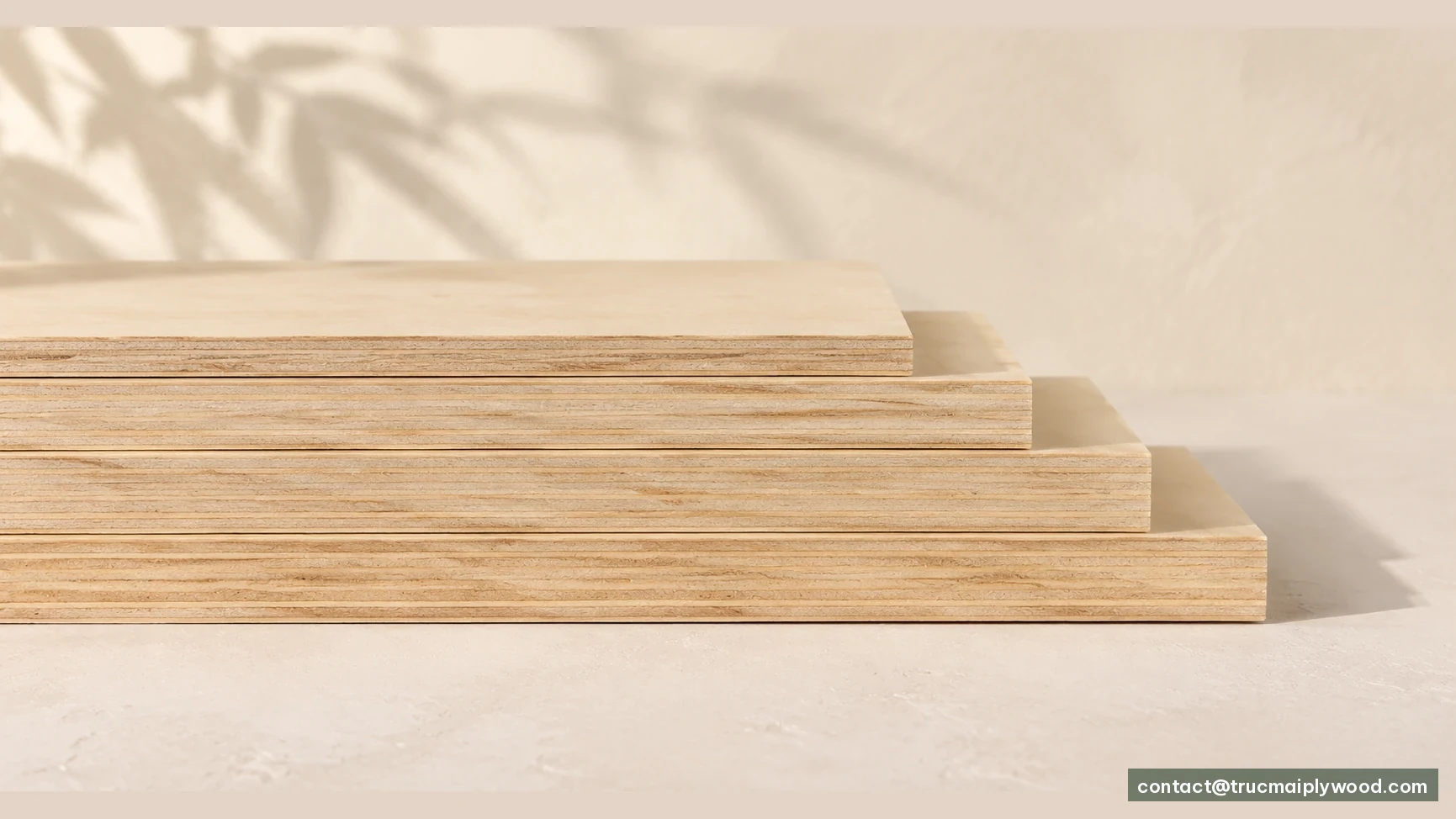
A usable comparison starts with the same application, thickness, face, core, dimensions and tax basis. A shop shelf label describes an available board; a mill quotation describes a specified production run. Those are different buying situations, even when both say plywood. For cabinet production, start with interior veneer-core panels rather than comparing every board carrying the plywood name.
South African merchants commonly organise boards by use, including interior pine, commercial, shuttering and marine categories. A board sold for concrete work is a different purchasing decision from a sanded furniture panel. For a repeat manufacturing programme, record the approved face/back pair and the edge appearance alongside the thickness. For a one-off repair, the local stock position and cutting service can outweigh a theoretical bulk advantage.
Use the plywood pricing method to separate construction choices before looking at freight. A clear specification also lets a merchant quote an equivalent board instead of silently substituting a different core or finish.
What did plywood prices south africa 2024 listings describe?
The useful answer to a 2024 plywood listing is its historical product specification, not a present-day purchasing figure. Archive the sheet dimensions, grade description, whether VAT was included and the date on which the offer was available. A past catalogue entry cannot describe today’s freight booking, stock, tax treatment or factory specification.
What did plywood price south africa 2024 listings group together?
No: 2024 retail categories did not describe one comparable specification. The phrase plywood price south africa 2024 often points to retail listings that bundle different sizes and applications into a single product family. An archived category page might include shuttering, pine, decorative hardwood and moisture-resistant boards. Before comparing it with a new offer, determine whether the historical item was a whole sheet, a cut piece or a special-order panel.
For a purchasing record, capture the product identifier, nominal thickness, face/back description, size, unit of sale, VAT basis and location. That record is more useful than an isolated headline figure. A new enquiry can then request the same specification and identify precisely what has changed.
How should plywood board prices be compared across grades?
Yes: compare plywood board prices by the board that will pass your incoming inspection, not by the grade nickname alone. A/B, BB/CC and similar trade labels need an approved sample or a written appearance description. The name on the merchant’s shelf does not specify every permissible patch, knot, colour variation or core opening.
| Comparison line | Record for each offer | Why it matters |
|---|---|---|
| Application | Cabinet, display, door blank or packing | Sets the performance and finish needed |
| Face and back | Veneer species, appearance pair, approved sample | Controls visible finish and yield |
| Core | Styrax, Acacia, Eucalyptus or other specified species | Changes weight and edge appearance |
| Surface | Sanded, calibrated, overlay or UV-ready | Determines the next finishing operation |
| Adhesive and emissions | Resin system and emission requirement separately | Avoids confusing bond with emissions |
| Dimensions | Nominal thickness, length, width, tolerance | Controls machining and sheet yield |
| Delivery | Stock collection or named import term | Defines the cost boundary |
ISO 2426-2:2020 uses appearance classes E, I, II, III and IV for hardwood plywood faces; commercial shorthand is a separate contract language. See the quality-by-grade explanation before approving a substitution.
What construction and calibration determine the 18mm plywood price south africa buyers receive?
For 18 mm furniture plywood, the decisive specification is the core construction and the prepared face. Cabinet carcasses, shelving and joinery components often use this thickness, but the required span and load still belong to the furniture design. An unsanded commercial sheet and a calibrated, sanded panel create different machining work even at the same nominal thickness.
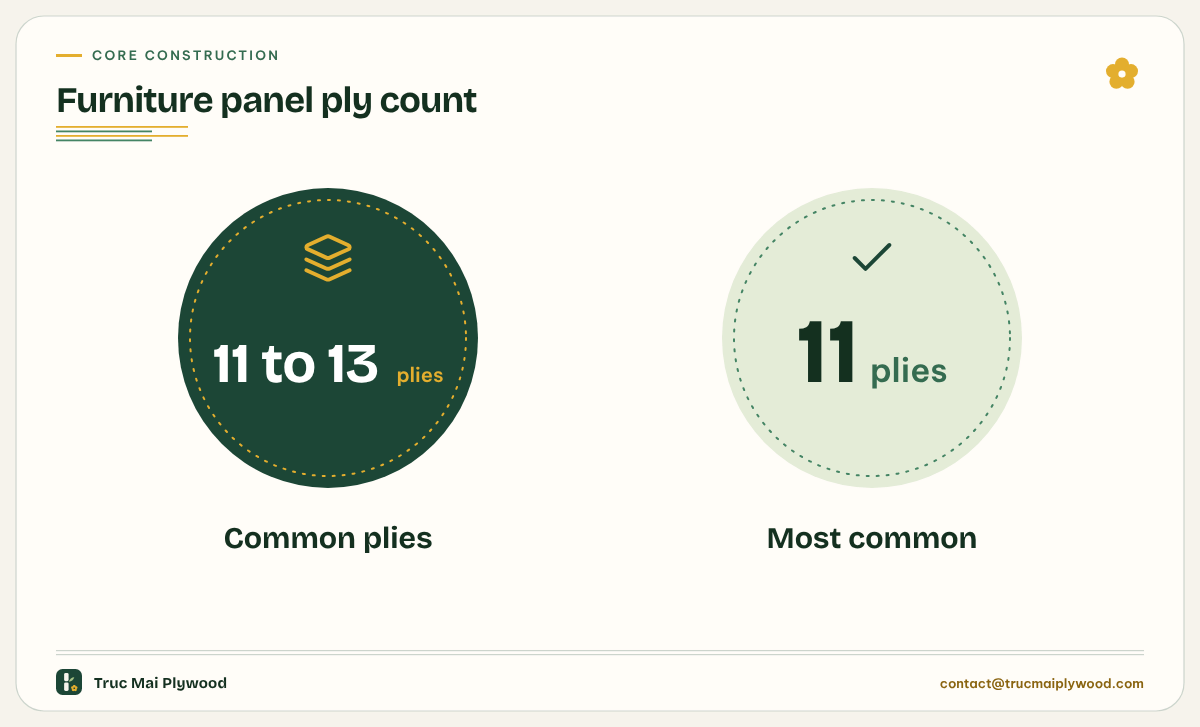
An 18 mm furniture panel at this mill commonly uses 11 to 13 plies, most often 11. The furniture build uses a stitched A-grade core and sanded faces. A commercial build can instead use an AB core with loose-laid or jointed veneers and a less prepared surface. That construction difference is a more reliable explanation of differing offers than the word hardwood.
Write the thickness tolerance into the order. Sanded, calibrated furniture panels can be specified at ±0.3 mm, whereas commercial-grade panels use ±0.5 mm. The 18 mm panel specification gives the questions to settle before a production run. Inspect edges and face sanding on the sample rather than relying on a thickness label alone.
How does five-ply construction affect the 3mm plywood price south africa buyers receive?
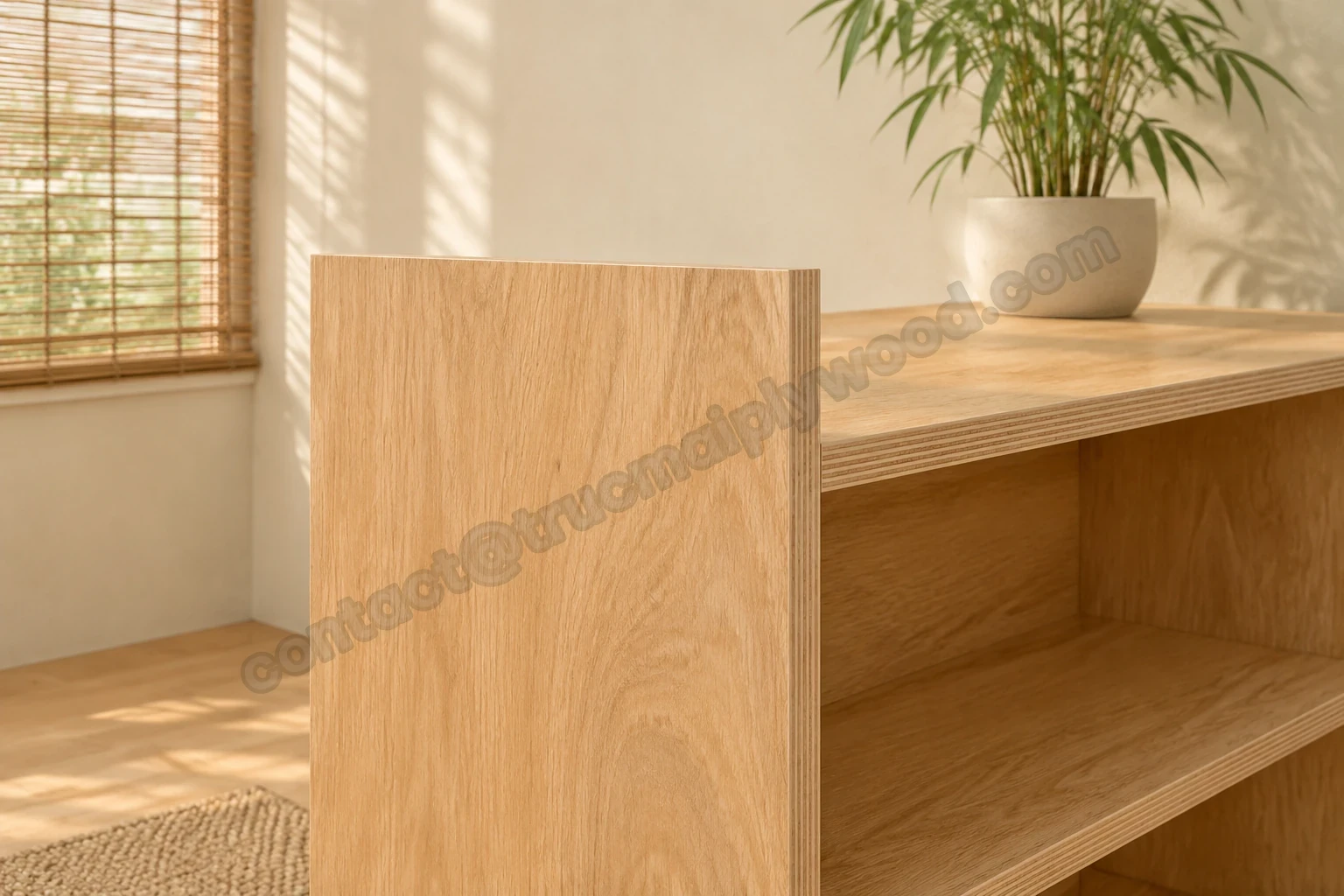
For 3 mm plywood, start with the intended facing or backing operation and a five-ply construction. Thin panels are useful for drawer bottoms, cabinet backs and decorative components where a heavier board would add unnecessary weight. The face finish, flatness and cutting plan are particularly visible when the sheet is thin.
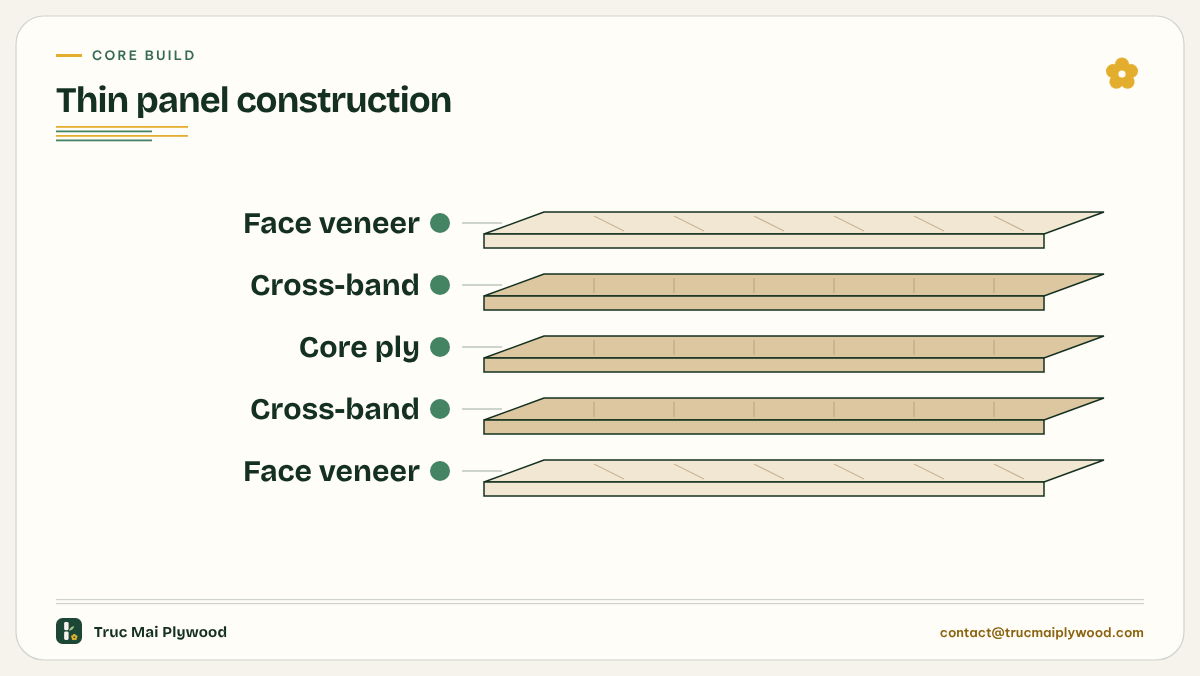
The mill’s 3 mm construction uses one core ply, two cross-bands and two faces. That build differs from thicker panels in which the core accounts for more layers. A buyer should therefore compare thin-panel samples on their own terms rather than extrapolating from a supplier’s 18 mm sheet.
Ask whether the panel is delivered as a full sheet or cut pieces, and specify the edge finish needed for assembly. Thin material can be packed in high sheet counts, which makes count accuracy and pack identification important. The thin plywood range covers the corresponding furniture uses.
Which backing applications shape the 6mm plywood price south africa buyers receive?
For 6 mm plywood, the answer is a light panel for backing, partitions and decorative furniture work, with the ply count specified on the order. It is a useful intermediate thickness when 3 mm feels too flexible for the part but a heavier cabinet component is unnecessary.
Check the intended span, fixing method and whether the visible surface will be painted, laminated or left as veneer. The face specification may matter more than the small thickness change. An order for UV-ready panels means both faces are prepared for the buyer’s subsequent coating operation; the mill does not apply that coating.
A 6 mm panel can be quoted with different cores. Compare samples at the same size and surface finish, then check how they machine and fasten in your own assembly. Do not assume a fixed ply count for this thickness. Include the exact required construction in the RFQ so the production quotation and the local merchant alternative describe the same article.
Which face and cutting requirements shape the 12mm plywood price south africa buyers receive?
For 12 mm plywood, the most useful comparison is a cabinet or display component with a defined face grade and tolerance. This thickness is often selected for furniture partitions, shelves with suitable support and shopfitting parts. Its suitability for a particular span is a design decision, not a consequence of the nominal thickness alone.
A face veneer intended for staining needs a different visual inspection from a panel that will be fully overlaid. Where an exposed edge is part of the design, inspect the core jointing and any voids. Where the sheet will be cut into repeated components, calculate usable pieces after the cutting pattern and saw kerf rather than dividing the gross area by a nominal part size.
Request matching samples from each source. Record whether the face and back grades are paired, whether the panel is calibrated and how the pieces are labelled. For a production programme, repeatability across packs matters more than the appearance of one selected board.
How should birch plywood price south africa comparisons be made?
No: birch-faced plywood is not necessarily an all-birch construction. A birch veneer can provide the desired pale face while the underlying panel uses a different core. A quote for birch-faced plywood and a quote for an imported multi-ply birch-core board describe different materials.
Specify the face species, face thickness, back veneer, core species and finishing method. The Vietnamese manufacturing range here uses imported birch face veneer on a Vietnamese core. Available cores include Styrax, Eucalyptus, Acacia and Pine; the birch appearance does not identify the core. A buyer seeking a clear finish should approve a physical face sample for colour and grain distribution.
For paint-grade work, an engineered veneer or another prepared face may suit the application. For a visible natural grain, ask for the actual veneer pairing and acceptable repairs. The birch-faced plywood product details and birch alternative discussion separate face appearance from structural expectations.
Can a plywood sheet price south africa 2024 listing be used today?
No: a 2024 sheet listing is a dated reference, not a current landed-cost comparison. Keep it as a record of what type of board was offered, then request a fresh merchant quotation with an exact size, finish, delivery address and VAT treatment.
The distinction is particularly important for listings that show a range across several thicknesses. A category-level figure may describe the smallest or least finished variant, whereas the buyer needs a particular face grade and thickness. A stock photograph does not resolve that difference. The same problem occurs when a local retailer advertises a sheet but the factory offer is expressed for a full container.
A useful comparison sheet has one row per genuinely equivalent product. Mark the quote date, stock or production lead time, dimensions, core, face and delivery basis. Keep merchant collection and delivered import terms in separate columns until the complete destination costs are available.
How do South African import taxes affect the landed comparison?
South African import VAT is calculated using the SARS duties and taxes guide for importers, and customs duty treatment follows the goods’ tariff classification and origin. For goods from outside the Southern African Customs Union, SARS applies a customs-value uplift plus non-rebated duties when calculating the VAT base.
For customs valuation, SARS describes transaction value as the primary method, with the free-on-board basis and relevant adjustments. See its customs valuation guidance. This matters when a buyer compares a factory FOB offer with a merchant’s delivered stock: the two quotations stop at different points in the supply chain.
Build the comparison in sequence: factory goods, origin-side charges, ocean freight, insurance, import duty, import VAT, port and clearance charges, inland transport, then storage and handling. Identify whether recoverable VAT is a cash-flow item for the business. The container landed-cost walkthrough explains the worksheet structure without confusing landed and retail offers.
How many sheets fit in a planned 40HC load?
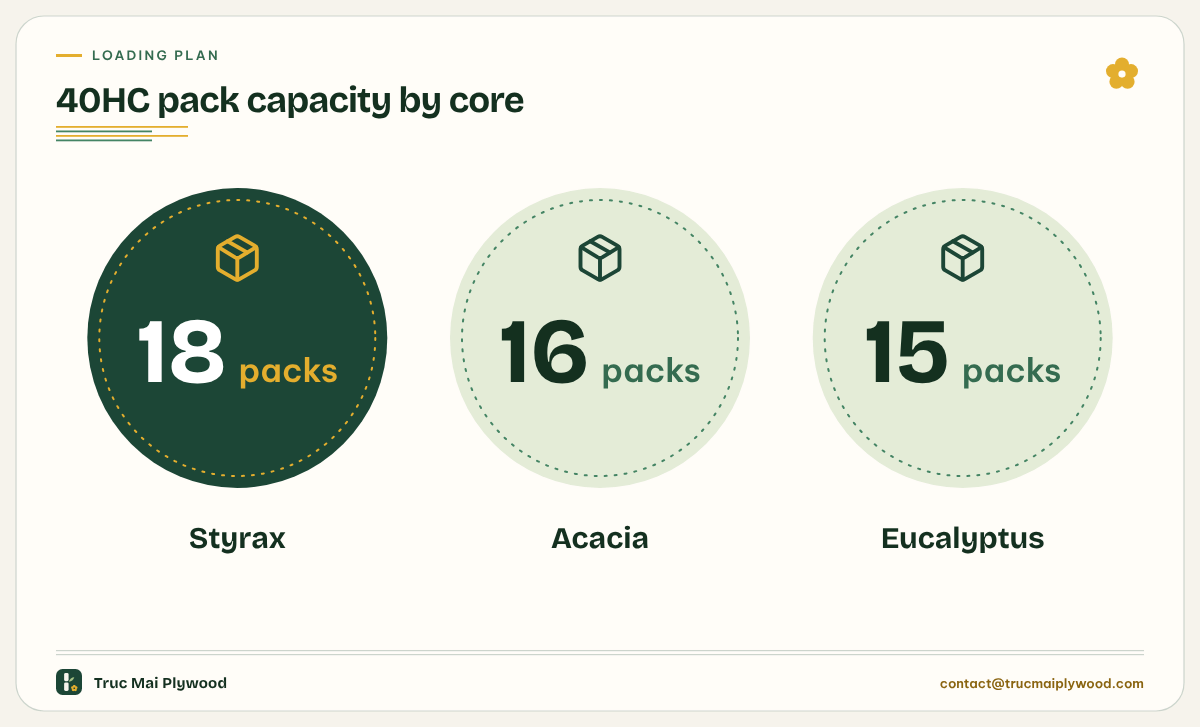
A planned 40HC load of 18 mm, 1220 × 2440 mm panels contains 990 Styrax-core sheets, 880 Acacia-core sheets or 795 Eucalyptus-core sheets under the supplied planning model. Core density changes the payload-limited count. The table also shows 3, 6 and 12 mm configurations so the reader can compare full-container purchasing across thicknesses.
Model basis: 40HC planning model, panels only; 18 packs for Styrax, 16 for Acacia and 15 for Eucalyptus; pack height 1,000 mm; sheets per pack rounded down from pack height divided by thickness, then capped by a 28,000 kg planning payload. Reference densities are Styrax 500 kg/m³, Acacia 580 kg/m³ and Eucalyptus 650 kg/m³. These are planning figures rather than measured loading records; carrier and route set the booked payload.
| Core | Thickness (mm) | Size (mm) | Packs | Sheets/pack | Weight-capped | Sheets | m³ | kg/sheet | Total kg |
|---|---|---|---|---|---|---|---|---|---|
| Styrax | 3 | 1220 × 2440 | 18 | 333 | No | 5994 | 53.5 | 4.5 | 26760 |
| Acacia | 3 | 1220 × 2440 | 16 | 333 | No | 5328 | 47.6 | 5.2 | 27600 |
| Eucalyptus | 3 | 1220 × 2440 | 15 | 321 | Yes | 4815 | 43.0 | 5.8 | 27950 |
| Styrax | 6 | 1220 × 2440 | 18 | 166 | No | 2988 | 53.4 | 8.9 | 26680 |
| Acacia | 6 | 1220 × 2440 | 16 | 166 | No | 2656 | 47.4 | 10.4 | 27510 |
| Eucalyptus | 6 | 1220 × 2440 | 15 | 160 | Yes | 2400 | 42.9 | 11.6 | 27860 |
| Styrax | 12 | 1220 × 2440 | 18 | 83 | No | 1494 | 53.4 | 17.9 | 26680 |
| Acacia | 12 | 1220 × 2440 | 16 | 83 | No | 1328 | 47.4 | 20.7 | 27510 |
| Eucalyptus | 12 | 1220 × 2440 | 15 | 80 | Yes | 1200 | 42.9 | 23.2 | 27860 |
| Styrax | 18 | 1220 × 2440 | 18 | 55 | No | 990 | 53.0 | 26.8 | 26520 |
| Acacia | 18 | 1220 × 2440 | 16 | 55 | No | 880 | 47.2 | 31.1 | 27350 |
| Eucalyptus | 18 | 1220 × 2440 | 15 | 53 | Yes | 795 | 42.6 | 34.8 | 27690 |
The model’s total mass column is the supplied calculation, while actual dispatch uses weighed sheets and the agreed packaging. The mix of panel types also changes how packs are arranged. A full-container buyer can use these counts to frame a quantity enquiry, then request the final packing plan with the order. The container loading guide explains why a denser core may use less of the container’s volume.
Which surface and core specifications change the comparison?
A furniture buyer can specify sanded veneer, UV-ready surfaces, melamine faces or high-pressure laminate (HPL) faces according to the finishing process. The appearance requirement comes first: a clear-finished face is inspected differently from a fully covered substrate. A buyer planning an in-house laminating line may prefer a prepared substrate over a finished panel.
Core construction affects machining and weight. Styrax can make a lighter sheet, while Acacia and Eucalyptus are alternative core choices for the agreed application. A combined-species core can also be designed to balance appearance, weight and manufacturing requirements. Ask for the core species to be named rather than accepting an undefined hardwood description.
The mill’s face veneer is generally 0.2–0.5 mm, with 0.3 mm common for European-facing orders. Face and back appearance are agreed as a pair against a sample. For a batch of cabinet doors, compare surface uniformity, sanding and edges across several sheets, not only the top sheet of a pack.
How should a South African furniture buyer assess the panel sample?
Assess the sample by machining it into the intended component. Inspect the face under the lighting used for finishing, cut a representative edge and check the thickness at several points. A decorative sheet that looks acceptable on a pallet can behave differently after routing, drilling or applying an overlay.
A practical receiving check follows four steps:
- Match the pack label to the purchase order’s face/back pair, core, thickness and dimensions.
- Check panel flatness and measure thickness at positions relevant to the cutting plan.
- Cut an edge and inspect the continuity of the veneers, jointing and any open core gaps.
- Run the intended finish or fastening operation on a representative offcut and retain the approved reference.
For a repeat supply programme, record any agreed acceptance criteria in writing before production. Compare the first delivered batch with the approved sample, then keep the same inspection method for subsequent containers. The supplier verification checklist provides a complementary document check.
Which paperwork should accompany an imported plywood order?
An imported plywood order needs commercial, packing and transport documents matched to the actual goods. The usual shipment file includes a commercial invoice, packing list, bill of lading and origin documentation, with other papers according to the route and contract. Buyers should reconcile product description, package count, gross weight and consignee details before clearance.
For regulated product claims, the document must match the relevant panel construction. Truc Mai Plywood holds CARB Phase 2 and US EPA TSCA Title VI third-party certification for hardwood plywood with veneer core in the 3–25 mm scope. The US rule sets a 0.05 ppm formaldehyde limit for hardwood plywood under 40 CFR Part 770. This is a US product-scope reference, not a South African import duty rule.
FSC 100% claims for eligible products appear on sales and shipping documents under the chain-of-custody certificate, rather than being inferred from a mill’s general certificate. Request the relevant shipment documents before agreeing the final specification. The documents-per-container guide lists the paperwork to reconcile with a packing list.
When does local merchant supply beat direct container sourcing?
Local merchant supply is the better operational choice for small quantities, immediate cutting and mixed one-off jobs. A direct container is a different purchasing model suited to repeatable specifications, warehouse capacity and a predictable manufacturing schedule. The comparison should include the buyer’s stockholding cost, not just the transport invoice.
A cabinet workshop buying several sheets may benefit from local selection, rapid replacement and collection. A manufacturer consuming repeated packs of one approved face and thickness can instead plan a container around a stable bill of materials. A mixed container can carry one or two products as a normal arrangement, with more product lines agreed when needed.
A direct mill order here starts at one 40HC. Production is normally 15–45 days after the deposit; sea transport and local clearance are separate stages. A buyer should match that schedule to production demand and available storage. For procurement teams comparing repeated deliveries, the first-order-to-monthly-supply process is a useful starting point.
How do you write a comparable plywood RFQ?
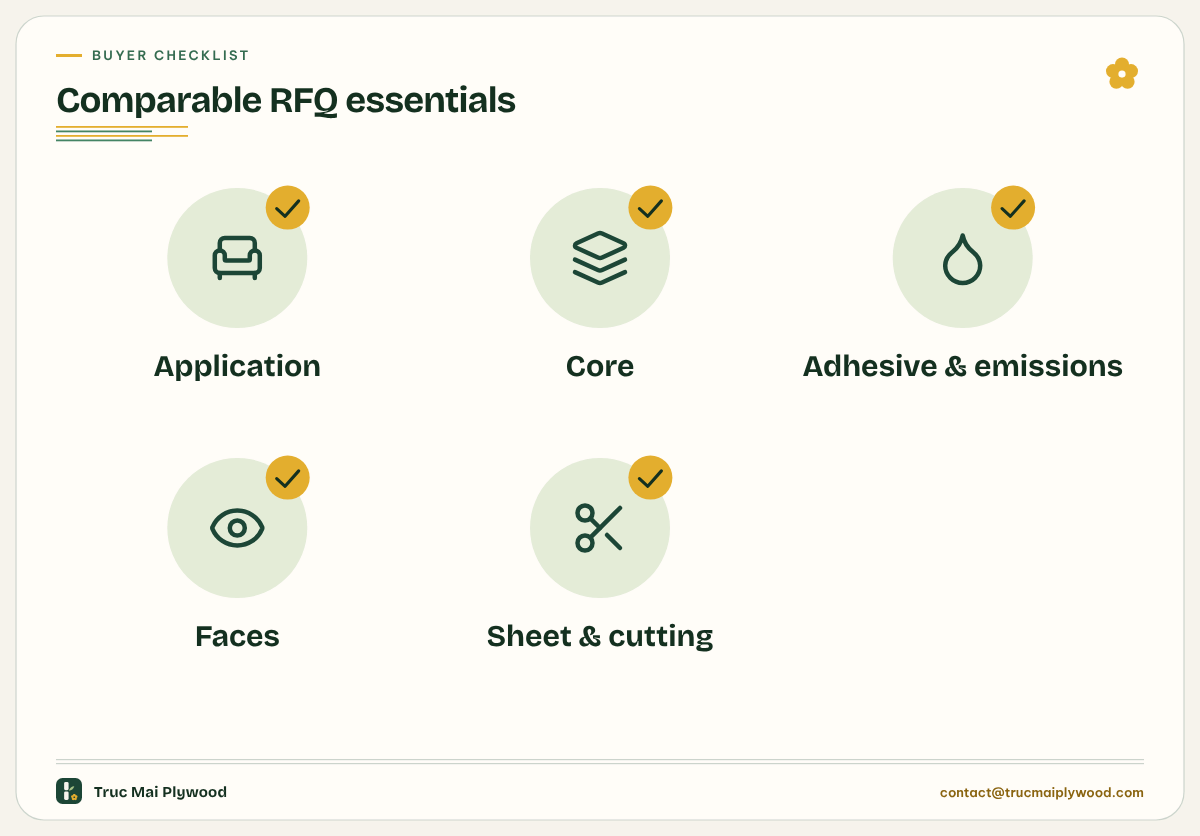
Write the RFQ around one finished application and one measurable panel specification. That makes merchant and factory responses comparable and reduces later disputes over an apparently similar product. State the port or delivery location, because a freight-inclusive quote has a different boundary from a factory quotation.
- Application: cabinet carcass, visible door face, interior fit-out or packing.
- Core: named species and required jointing or stitching.
- Adhesive and emissions: separate resin system and emission specification, with any required test document.
- Faces: species, face/back appearance pair, approved sample and surface preparation.
- Sheet and cutting: thickness, full-sheet size, tolerance, piece schedule and labels.
- Packing and quantity: packs, total sheets, container mix and destination.
Cut-to-size orders can divide a standard sheet into two, three, four or six labelled panels, with the exact pieces agreed from the cutting list. The RFQ writing guide gives a structured format. Send the completed specification through the quotation page with the intended application and delivery basis so the response describes the same product you will inspect.
Questions buyers ask
Does a shop quote normally include VAT?
Check whether the merchant quote is VAT-inclusive and whether collection or delivery is included. Compare the same tax and delivery basis across offers.
Can a South African buyer order cut-to-size plywood?
Yes. Specify the parent sheet, cutting list, piece labels and quantities so the mill can plan the cutting pattern.
Is birch-faced plywood the same as all-birch plywood?
No. Birch-faced plywood describes the outer veneer; the core must be specified separately.
Which plywood face is suitable for painting?
Choose a prepared, sanded face and approve a painted sample. Surface preparation and the selected coating system govern the final appearance.
Should a plywood quote specify both face and back?
Yes. A face/back appearance pair avoids ambiguity when one side is visible and the reverse is concealed.
Can different plywood thicknesses share a container?
Yes, a mixed container can be arranged with separately identified packs. The load plan accounts for the weight and count of each specification.
What is the minimum direct-mill order?
The standard minimum is one 40HC container. Specify the product mix before production planning.
Is UV-ready plywood already UV-coated?
No. UV-ready means the faces are prepared for the buyer to apply the coating.
What is the difference between an emission grade and a glue type?
The glue type identifies the adhesive system; the emission grade identifies a separate formaldehyde requirement. Record both in the order.
What should I inspect on a plywood delivery?
Match labels to the order, measure thickness, inspect faces and edges, and test a representative piece in the intended operation.