
The best plywood for outdoor signs is exterior-bond MDO signboard with a paintable overlay, sealed edges and a compatible exterior coating. For protected signs, smooth exterior-bond plywood can work; indoor graphics can use prepared poplar, EV or laminated commercial panels. Truc Mai Plywood supplies configurable commercial faces and cores for sign and display makers.

What is the best plywood for outdoor signs?
For permanently exposed painted signs, exterior-bond medium-density-overlay (MDO) signboard is the preferred plywood: its resin-treated face accepts paint, and its plywood core provides a rigid backing. Specify a marked signboard grade and seal all cut edges. Sheltered signs can use coated exterior-bond smooth plywood; indoor graphics can use prepared commercial plywood.
The distinction matters because a smooth face alone says little about the bond between veneers. A decorative paper overlay is also different from an MDO face manufactured under the US structural plywood standard. The NIST PS 1-22 standard places MDO-General in its Exterior grade table and describes a resin-treated facing suitable for painting. That is a useful procurement benchmark, rather than a label to assume for every paper-faced panel.
A buyer comparing sign board plywood should separate three decisions: the weather exposure, the print or paint surface, and the core construction. Only then should thickness and sheet dimensions be chosen. The table below gives a starting specification for each job. The final selection belongs to the sign designer, who knows the frame, fixing points and local wind requirements.
Which sign board plywood suits each location?
Choose the panel by its exposure and the finish system. A sign fixed inside a retail store is a different purchase from a freestanding board beside a road. In the first case, appearance, machining and graphic adhesion dominate. In the second, water movement, edge exposure and fixing design become central.
| Sign location | Starting substrate | Face and finish | Purchase check |
|---|---|---|---|
| Fully exposed outdoor painted sign | Exterior-bond MDO signboard | Paintable MDO face, exterior primer and topcoat | Exterior bond designation and overlay type |
| Outdoor sign beneath a roof | Exterior-bond smooth plywood | Prepared veneer or suitable overlay, coated edges | Shelter details and coating compatibility |
| Indoor wall graphic | Sanded commercial plywood | Poplar, EV or birch-faced surface, painted or laminated | Flatness, face grade and emission specification |
| Indoor exhibition display | Lightweight commercial plywood | Prepared face for printed film or laminate | Weight, router finish and repeat dimensions |
| Reusable retail display | Commercial plywood with decorative face | Melamine or HPL as specified | Edge treatment and attachment method |
Do not treat the location column as a universal thickness schedule. A small wall-mounted sign has different support from a large suspended sign even when both use the same board. Ask for the mounting drawing before ordering a container of identical blanks. A plywood grade specification helps separate appearance from the properties that affect use.
What makes MDO signboard different from ordinary plywood?
MDO has a resin-impregnated cellulose-fibre overlay bonded to a plywood panel. Ordinary sanded plywood exposes wood veneer, including its grain and any permitted repairs. The overlay reduces the amount of visible grain in a painted finish and gives sign painters a more uniform starting surface.
PS 1-22 distinguishes MDO-General from MDO-Concrete Form. That difference is worth putting on the purchase order. A product made for repeated concrete release is not automatically the preferred face for lettering or adhesive graphics. For a sign, ask whether the supplied face is intended for paint, which side carries the overlay, and whether the backing has the same weather protection as the face. The APA technical explanation of MDO and HDO describes the exterior bond classification and the need to prime and coat MDO used outdoors.
A paper-overlay commercial panel can look similar in a catalogue photograph. Request the overlay construction, bonding evidence and a physical painted sample instead of accepting a generic description. Truc Mai Plywood supplies paper-overlay and laminate-faced commercial panels; those products should be specified by their actual construction rather than represented as PS 1 MDO signboard without corresponding evidence.
When is smooth veneer-faced plywood the better choice?
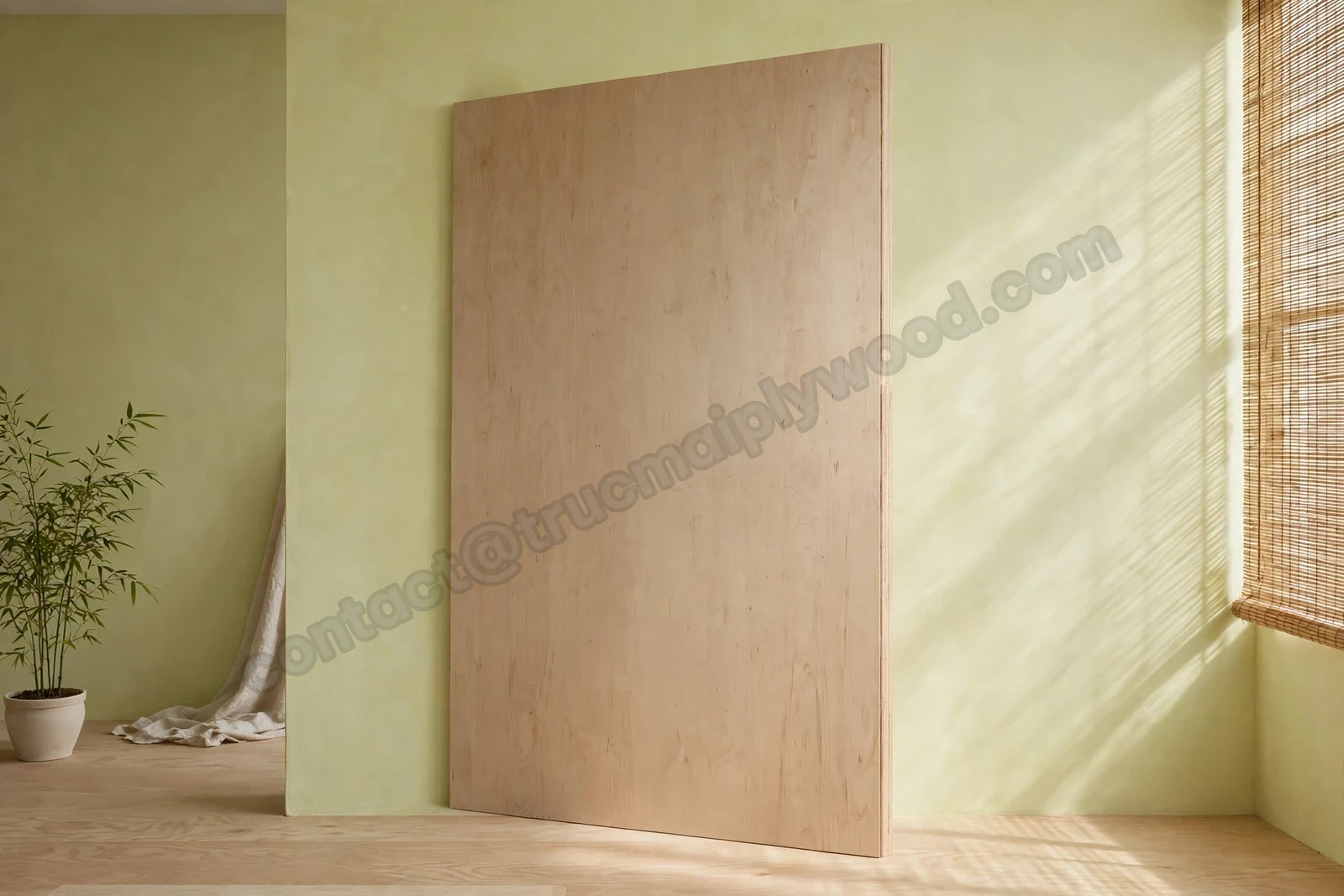
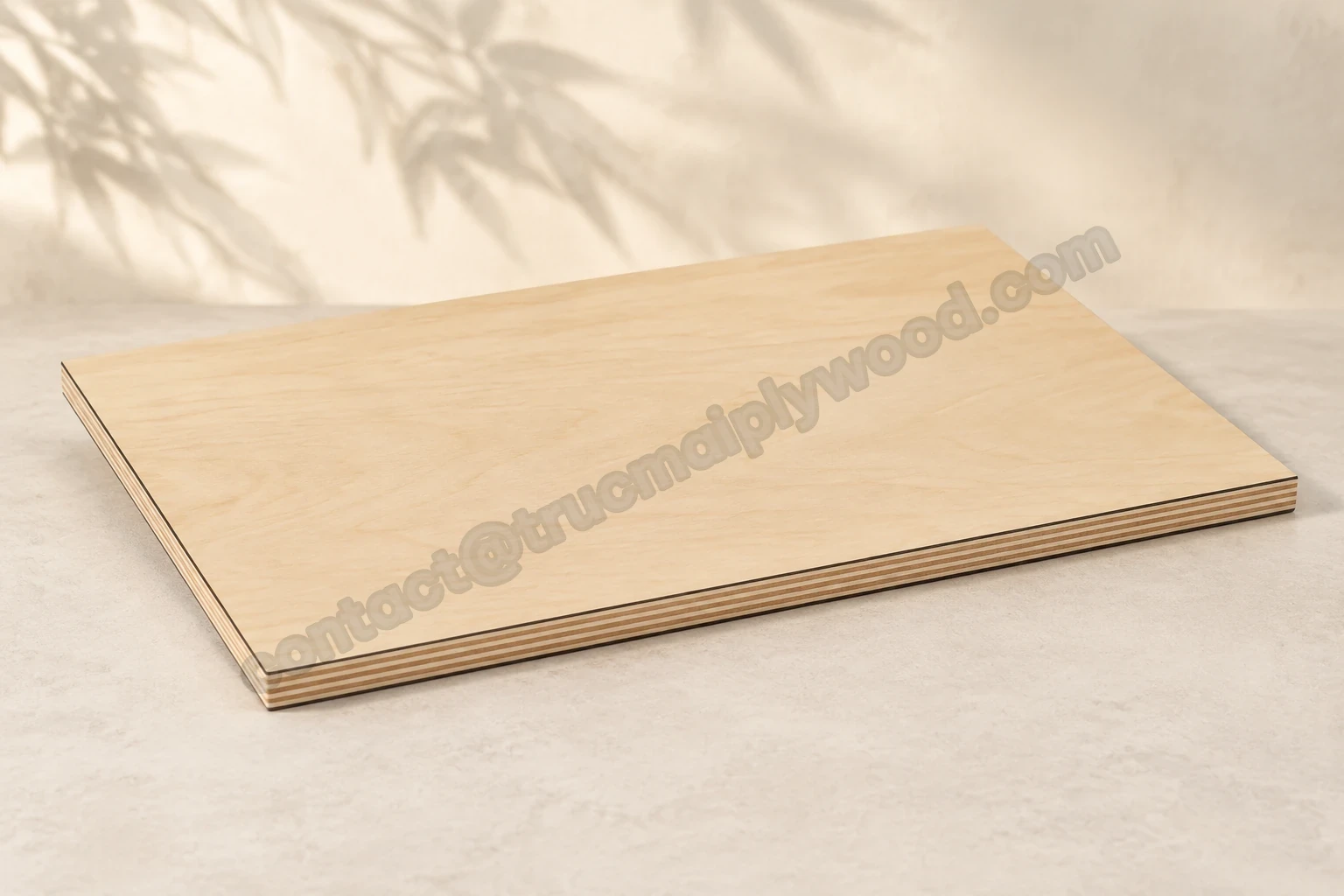
Smooth veneer-faced plywood is a useful substrate for indoor signs, short-run displays and protected installations where the buyer wants to paint, print or apply a film. Poplar and bleached-poplar faces offer a pale, even background; engineered veneer (EV) provides a repeatable decorative appearance; birch-faced plywood gives a different visual character. The face chosen for graphics should match the intended finishing process, not merely the timber name.
For a painted indoor panel, specify sanding and calibration, then approve the primer and coating on the same face construction that will be ordered. For a decorative sign, retain the veneer appearance and test the clear finish on a sample. For adhesive film, test adhesion and removal on the finished surface, including corners and routed edges. The poplar-faced plywood range and engineered-veneer panels illustrate two face choices for commercial orders.
A veneer can be visually clean yet contain natural variation. If colour matching across many signs matters, agree a face sample and a face/back grade pair. A mill can stitch outer core plies to reduce open joints beneath a fine face, but the approved sample remains the practical acceptance reference. The buyer should describe whether the graphic will cover the whole panel or leave a visible timber border.
Which glue and bond classification should an exterior sign use?
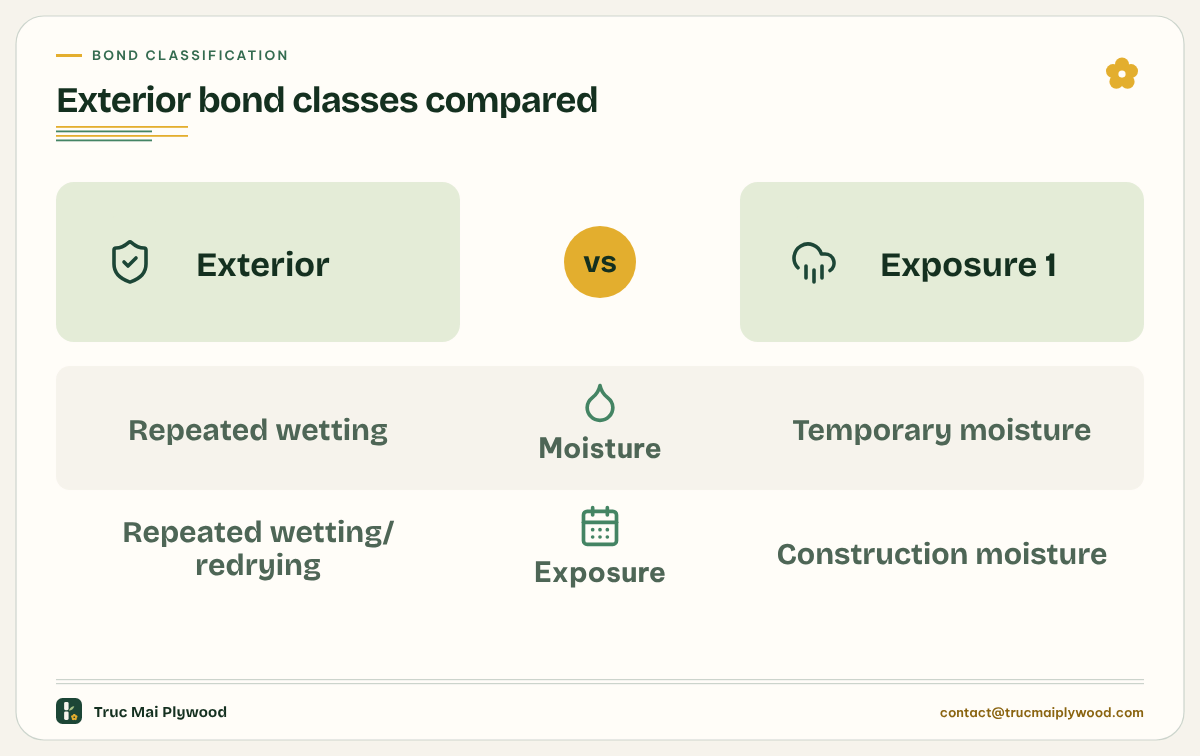
An exposed sign should use an Exterior bond classification supported by evidence for the specified panel. In US PS 1-22, Exterior is designed for repeated wetting and redrying or long-term weather exposure; Exposure 1 addresses temporary moisture encountered during construction. The names are distinct and should not be substituted in a purchase specification.
For European specifications, EN 636-3 describes exterior service conditions and EN 314-2 Class 3 addresses exterior bond performance. A manufacturer must show test evidence for the requested construction before that class appears on an order. The test is about the adhesive bond, not the appearance of the overlay. A smooth sheet with an interior adhesive is a poor substitution for an exposed sign, regardless of how well it takes paint.
For commercial panels, the adhesive system can be written separately from the emission class. UF glue at E0 emission is a mill configuration for interior use; a melamine-fortified system can be specified for increased moisture resistance. Neither the glue name nor a short boil description should be converted into a claimed PS 1 or EN 314 class. The exterior-glue panel range is a starting point for discussing a weather-exposed order and its actual test documents.
How do paint, primer and edge sealing affect outdoor life?
A complete exterior paint system covers the front, back, edges, cut-outs and fastener penetrations. Water entering a cut edge can change the moisture content of the inner veneers even while the visible face looks sound. Edge preparation therefore belongs in the signmaker’s production instructions, not as an optional cosmetic step.
The US Forest Service’s 2021 wood-finishing chapter identifies water, sunlight and weathering as major concerns for exterior wood finishes. APA advises a compatible primer and topcoat for MDO and heavy primer coats on exposed edges. These recommendations explain why a well-chosen substrate can still fail early when finishing is incomplete.
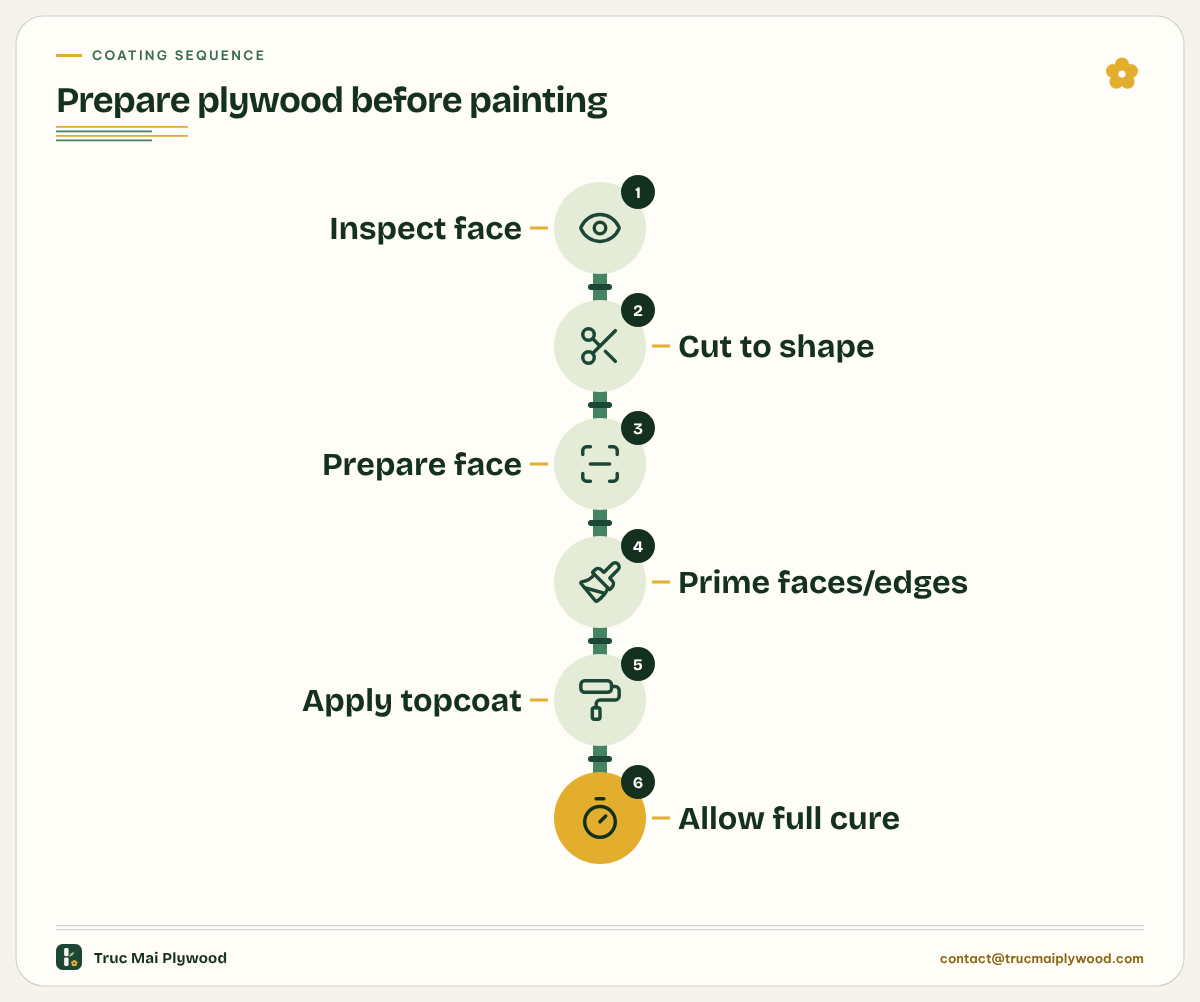
A practical finishing sequence is:
- Inspect the delivered face for contamination, dents and damaged corners; separate defective blanks.
- Cut and route the board to the final sign shape before applying the complete coating system.
- Clean and prepare the face according to the coating maker’s instructions; make a test patch where adhesion is uncertain.
- Prime the faces and every exposed edge, including letter cut-outs and drilled holes.
- Apply the specified exterior topcoat and allow the stated cure before fitting hardware or graphics.
- Inspect the finished edge after installation, particularly where a bracket or screw breaks the coating.
Avoid painting over wet, dirty or sun-weathered wood. The coating supplier’s instructions determine the compatible primer, film build and drying interval. A panel order can request a prepared face, while the sign workshop controls the finished paint system.
What thickness works for wall signs and freestanding boards?
For a supported indoor graphic, 6–12 mm commercial plywood is a useful starting range; 18 mm is a common specification when the board needs greater handling stiffness. These are purchasing examples, not span ratings. A large freestanding outdoor sign needs a design based on its frame, support spacing, fasteners and wind exposure rather than a thickness selected from a catalogue.
A wall-mounted panel supported continuously can be thinner than a sign fixed only at its corners. A projecting sign adds bending and vibration at the bracket. A double-sided pavement board adds hinge and edge-impact demands. Specify the assembly before asking the mill to choose a thickness. A drawing showing the unsupported span is more informative than the words ‘heavy duty’.
Truc Mai offers panels from 3–40 mm and writes the thickness tolerance on the order. Sanded, calibrated furniture panels can be ordered at ±0.3 mm; commercial grade commonly uses ±0.5 mm. Thickness is measured on the agreed panel construction. The 18 mm panel specification gives buyers a reference for a commonly requested sheet, while the actual sign assembly still needs its own design review.
How should a signmaker choose the core and face together?
Choose a core that matches the required panel weight, edge quality and finishing method, then pair it with a face that accepts the chosen graphic. The core and face are separate specification lines. A pale veneer face does not tell the buyer whether the middle plies are Styrax, Acacia, Eucalyptus, Pine or a combination.
A lightweight interior display can favour Styrax core where easier handling is valuable. A buyer seeking a denser panel can ask for Acacia or Eucalyptus. Where routed edges remain visible, request a clean cross-section and inspect any internal gaps. Where the sign is fully painted, the most valuable face property may be evenness rather than decorative grain.
At the mill, furniture/interior constructions use an A-grade stitched core with sanded faces; commercial builds can use an AB core with loose-laid or jointed veneers. For a printed face, stitching the outer plies helps create a more consistent backing. Ask for an edge photograph, a full-face photograph and a finished sample of the same build. The cabinet-grade plywood explanation shows why core construction matters even when the decorative face looks identical.
Are paper overlay, melamine and HPL suitable for signs?
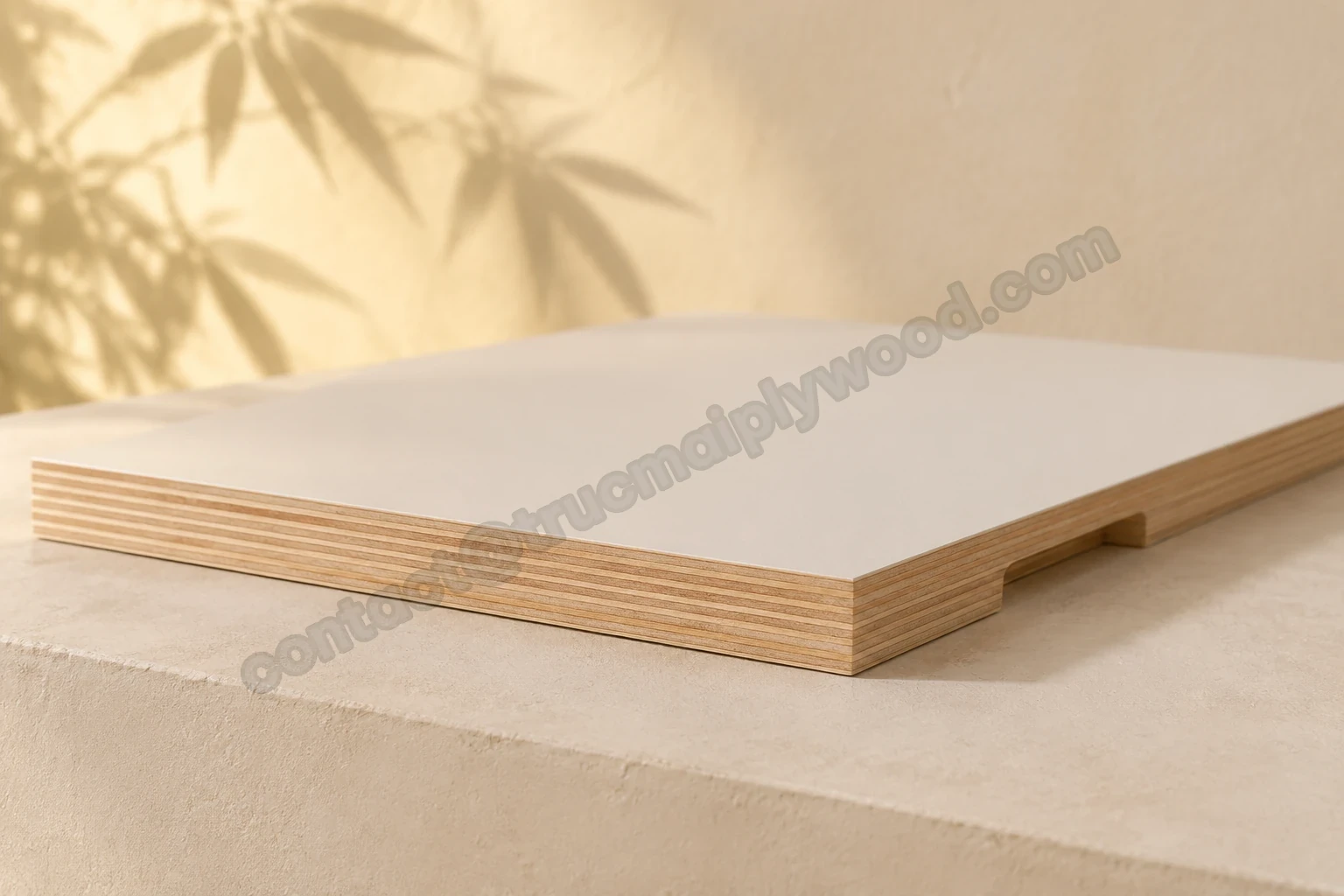
Paper overlay, melamine and high-pressure laminate (HPL) are different surface systems, and each needs its own adhesion and exposure specification. For indoor shop signs, melamine or HPL can give a finished decorative face with limited additional painting. For a printed display, the buyer should test the selected film or ink on the exact overlay surface.
For exposed signs, start with the proven exterior substrate and a coating or graphics system intended for that exposure. A decorative paper-overlay face alone does not make the plywood an exterior signboard. The supplier should state the overlay material, whether it is applied to one or both sides, the substrate adhesive, and the expected machining operations. Adhesive film applied over an unsuitable face can release at edges long before the panel loses strength.
When comparing HPL-faced plywood with melamine-faced panels, ask for a sample after routing and edge treatment. Check whether the intended print process requires a primer or surface activation. A clean face photograph is helpful for appearance, but a physical sample is the correct way to approve adhesion and colour.
How should plywood be prepared for vinyl and printed graphics?
A graphic-ready plywood blank has a flat, clean, dry face with a surface that the selected ink, adhesive or laminate can bond to. The finish schedule belongs to the print shop. The mill supplies the specified face preparation and panel construction; the printer proves compatibility with its own materials.
Begin with the sign’s intended finish. For opaque paint, inspect sanding marks and veneer repairs under raking light. For pressure-sensitive vinyl, prepare the face using the film maker’s specified primer or coating and conduct a small adhesion test. For direct printing, test colour, cure and scratch resistance on the actual face rather than on a different board. For routed lettering, inspect the edges after the cutting tool has passed through both face and core.
If a panel will receive a UV-cured coating at the buyer’s facility, request a UV-ready face. This means the faces have been prepared for the customer’s coating process; it does not mean the plywood arrives UV-coated. The laminates for plywood article provides a useful companion when the graphic is a separate bonded surface.
What dimensions and cut-to-size options should go on the order?
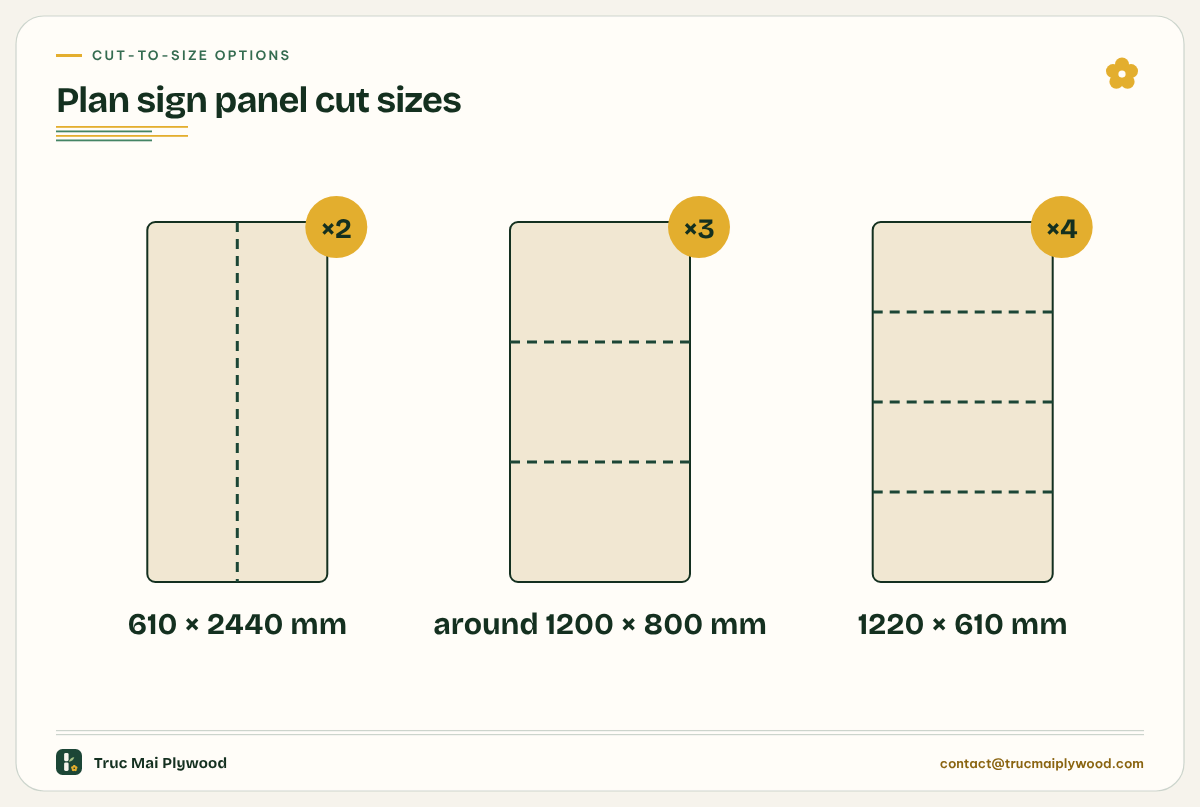
Order the finished sign blank size and cutting layout, not just the parent sheet size. Standard supply formats include 1220 × 2440 mm, 1220 × 2280 mm and 1250 × 2500 mm. A cut-to-size order can use a standard sheet divided into two lengthwise pieces of 610 × 2440 mm, three pieces around 1200 × 800 mm, four pieces of 1220 × 610 mm, or six pieces to an agreed drawing.
The precise finished size is set from the parent sheet and the buyer’s cut list. For example, a requested 1220 × 610 mm blank can be cut from a 1220 × 2440 mm parent sheet. The mill and buyer agree the cutting plan by email, including the direction of the face grain, labels, and permitted edge trim. A cut sheet should identify the good face, particularly where only one face will carry a graphic.
For signs with a printed border, state whether dimensions refer to the bare blank or the finished coated panel. Leave allowance for the sign workshop’s routing and finishing process in its own drawing. The cut-to-size plywood panels page describes the production option. A clear cut list also helps the mill pack repeat batches by job rather than mixing blanks of similar sizes.
How can a buyer reduce warping in a large sign?
Use balanced panel construction, appropriate thickness, a compatible finish on both faces and a mounting system that supports the sheet without trapping water. A face-only coating leaves the back exposed to a different moisture cycle. A rigid frame can also concentrate stress when a panel expands or contracts with changing conditions.
Flatness begins with veneer lay-up and pressing. At the mill, the buyer can specify a stitched core, sanding and calibration, and a sample inspected on a flat reference surface. At the sign shop, keep blanks flat during storage and coat the back and edges before installation. A panel leaning against a wall during humid storage can arrive at the printer with a different shape from the inspected mill sample.
The installation drawing should show how water drains, where the fasteners sit and whether movement is accommodated. Inspect the sign after the first wet season for edge swelling, loosened hardware and coating cracks. The best prevention is a coordinated panel, finish and frame specification rather than asking the plywood supplier alone to solve an installation problem.
When is plywood the wrong sign substrate?
Choose a different substrate when the job demands very low weight, complex curves, prolonged direct water exposure without maintenance, or a surface finish that cannot be achieved reliably on wood. Aluminium composite, metal and suitable plastics are common categories for sign fabricators to evaluate, each with its own fire, fastening and recycling considerations.
Plywood remains useful where a rigid, machinable timber panel suits the design and the workshop can apply a complete protective finish. It is particularly attractive for painted lettering, decorative interior boards and routed display pieces. A very large sign mounted high above pedestrians should be engineered as an assembly, with the frame and fasteners selected for the actual site.
Compare substrate alternatives against the same brief: sign area, support locations, wind exposure, edge detail, intended service and maintenance plan. A supplier’s catalogue can establish available panel constructions, but it cannot replace a project-specific installation design. This distinction also prevents a buyer from specifying a heavy panel simply because it feels solid in a small sample.
How long can a painted plywood sign last outdoors?
The service life of a painted plywood sign is governed by exposure, coating maintenance, edge protection and installation details. No single number describes every site. A sheltered sign under a roof and a fully exposed roadside panel experience different wetting and sunlight cycles even when made from the same substrate.
Inspect the edges and fastener holes first. Early coating damage there can admit moisture to the veneer layers, creating local swelling that spreads beneath a graphic. Check for peeling paint, checking, movement at brackets and water held against the back. Repairing a small damaged area before it grows can preserve a sound panel and avoid a full sign replacement.
The USDA finishing research cited above explains the physical reasons: exterior wood faces experience moisture movement and weathering, while the coating system provides the primary protective barrier. When evaluating suppliers, request the substrate and coating specifications separately. A service-life statement without a defined exposure and maintenance schedule is not a useful purchasing metric.
Which documents matter for US and European sign-board orders?
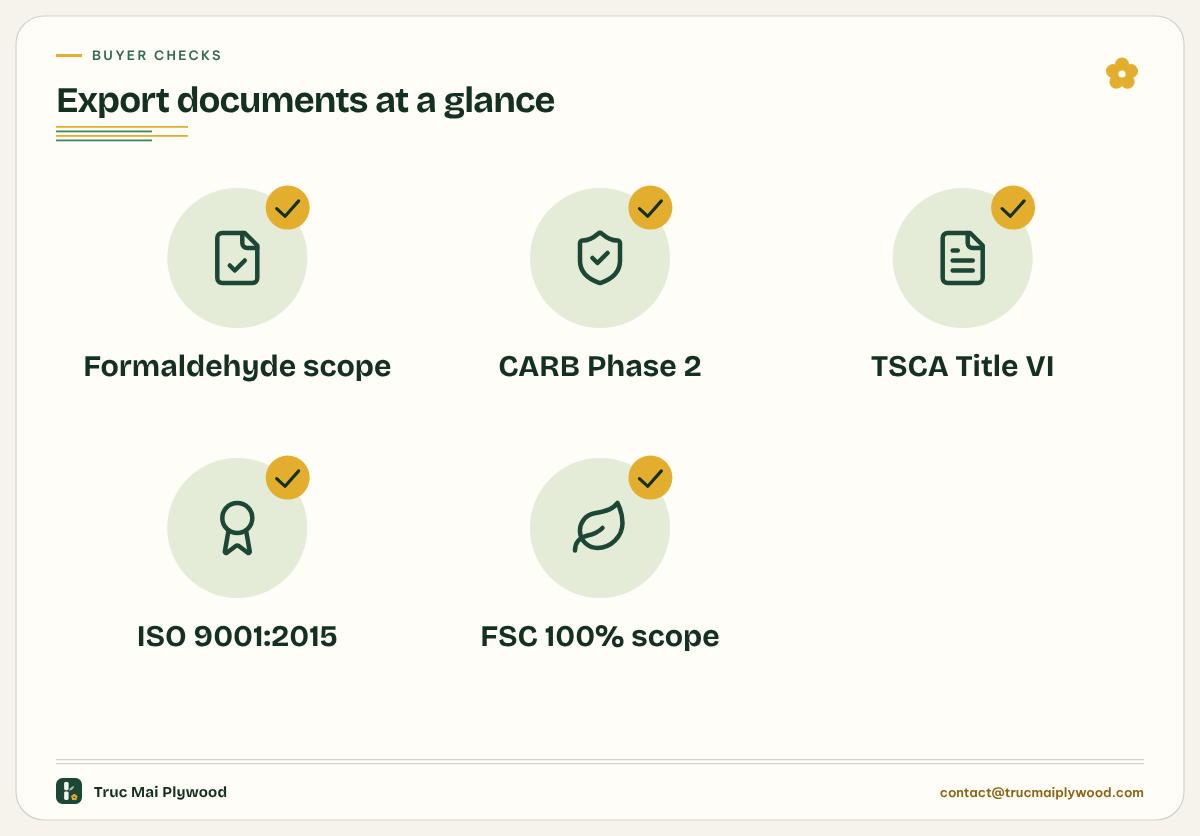
For US-bound hardwood plywood with veneer core, the buyer should check the relevant formaldehyde documentation and the product’s certified scope. 40 CFR Part 770 sets a 0.05 ppm formaldehyde limit for hardwood plywood with veneer core under TSCA Title VI. This emissions requirement is separate from the outdoor adhesive bond and the sign’s paint system.
Truc Mai Plywood holds CARB Phase 2 and TSCA Title VI certification for hardwood plywood with veneer core in the 3–25 mm scope, certificate CARB/EPA 26053. The factory also holds ISO 9001:2015 for plywood manufacturing. Buyers should specify the exact panel build and request the documents for that configuration. For FSC 100% orders, the eligible product and the sales document claim must match the chain-of-custody scope, licence FSC-C196493 and certificate SA-COC-014545.
For European importers, the EUDR file set can include wood-origin records and geolocation for both core and face veneer. The importer uses those records in its own due-diligence workflow. The face veneer origin files page explains the distinction between face and core tracing; the formaldehyde limits page addresses emissions independently of weather resistance.
How should a distributor compare two sign-board quotations?
Compare quotations against one written construction schedule. Two panels described as ‘exterior sign plywood’ can differ in overlay type, veneer grade, adhesive system, face preparation, thickness tolerance and packing. The lowest-detail quotation is often the hardest to assess because it leaves these differences unstated.
Ask each supplier for the same evidence: a face sample, an edge sample, the overlay specification, the bond test basis, a dimensioned drawing and the intended finish. State whether the board is for direct paint, vinyl or a laminate. A single-sided sign can use a different appearance specification on the back, but the coating plan still needs to protect it from moisture.
For a repeat programme, approve a labelled reference sample and retain its construction schedule. At receiving, compare thickness, face appearance, edge condition and packing labels against that reference. The supplier shortlist checklist and plywood RFQ instructions help purchasing teams standardise their questions before a deposit is paid.
What should the first container order specify?
Write one complete sign-board specification before requesting a production slot: application, core, adhesive and emission requirement, face or overlay, sheet size, finish preparation, packing and quantity. Add the destination port and any required certification documents. A buyer who needs cut blanks should attach the drawing and the label sequence.
A workable enquiry reads: ‘Indoor printed sign panels, Styrax core, sanded poplar face, UF glue at E0 emission, 12 mm, 1220 × 2440 mm parent sheets, cut and labelled to attached list, packed by blank size, one 40HC, FOB Hai Phong.’ For a permanently exposed sign, replace the indoor construction with an exterior-bond signboard specification supported by the requested bond and overlay evidence. This separates the two product duties without making an unsupported equivalence.
The standard minimum order is one 40HC, with production scheduled after the deposit. Buyers can request samples to approve the face and cutting quality before committing to repeat shipments. Use the quotation page or email contact@trucmaiplywood.com with the full specification and the destination port. The quotation can then be assessed against the same physical sample and drawing.
Questions buyers ask
Can I paint directly on a sanded poplar face?
Yes, after cleaning and using a primer compatible with the chosen paint. Test the complete finish on a sample from the intended production construction.
Should both sides of a sign have the same decorative veneer?
No. A single-sided graphic can use different face and back appearance grades, while the finishing plan should still protect both sides.
Can plywood sign blanks be supplied with identification labels?
Yes. Cut-to-size orders can be labelled to the buyer’s cut list so workshops can separate sizes and artwork jobs.
Does UV-ready mean the factory has applied UV lacquer?
No. UV-ready means the plywood face is prepared for the buyer to apply its own UV coating.
Can I order a birch appearance on a Vietnamese core?
Yes. Birch-faced plywood uses a birch face veneer over a specified Vietnamese core; it is not an all-birch construction.
What is the minimum export order for sign panels?
The standard minimum order is one 40HC. Buyers can agree the mix of panel constructions before the loading plan is prepared.
Can several sign sizes be packed in one shipment?
Yes. Cut blanks can be grouped and labelled by size, with the mix written on the packing list.
Are free samples available for checking print adhesion?
Yes. Request a sample of the intended face construction and run the actual printing or lamination process before approving the production specification.
Is a formaldehyde certificate the same as an exterior bond report?
No. Formaldehyde testing addresses emissions, while exterior bond testing evaluates the plywood adhesive performance after specified conditioning.
What information should accompany a printed sign drawing?
Send the finished dimensions, parent sheet preference, face direction, routing details, hole positions, labels and the finish system. These details allow the mill to prepare a matching cut list.