
Buy plywood from Vietnam for three reasons a buyer can check: plantation core wood grown close to the mills, a cost per m³ that holds on a full container, and certificate files that travel with each lot. The catches are real too, from US duties to quotes that hide a weaker build. Truc Mai, in Ha Hoa, Phu Tho, sets out both sides.
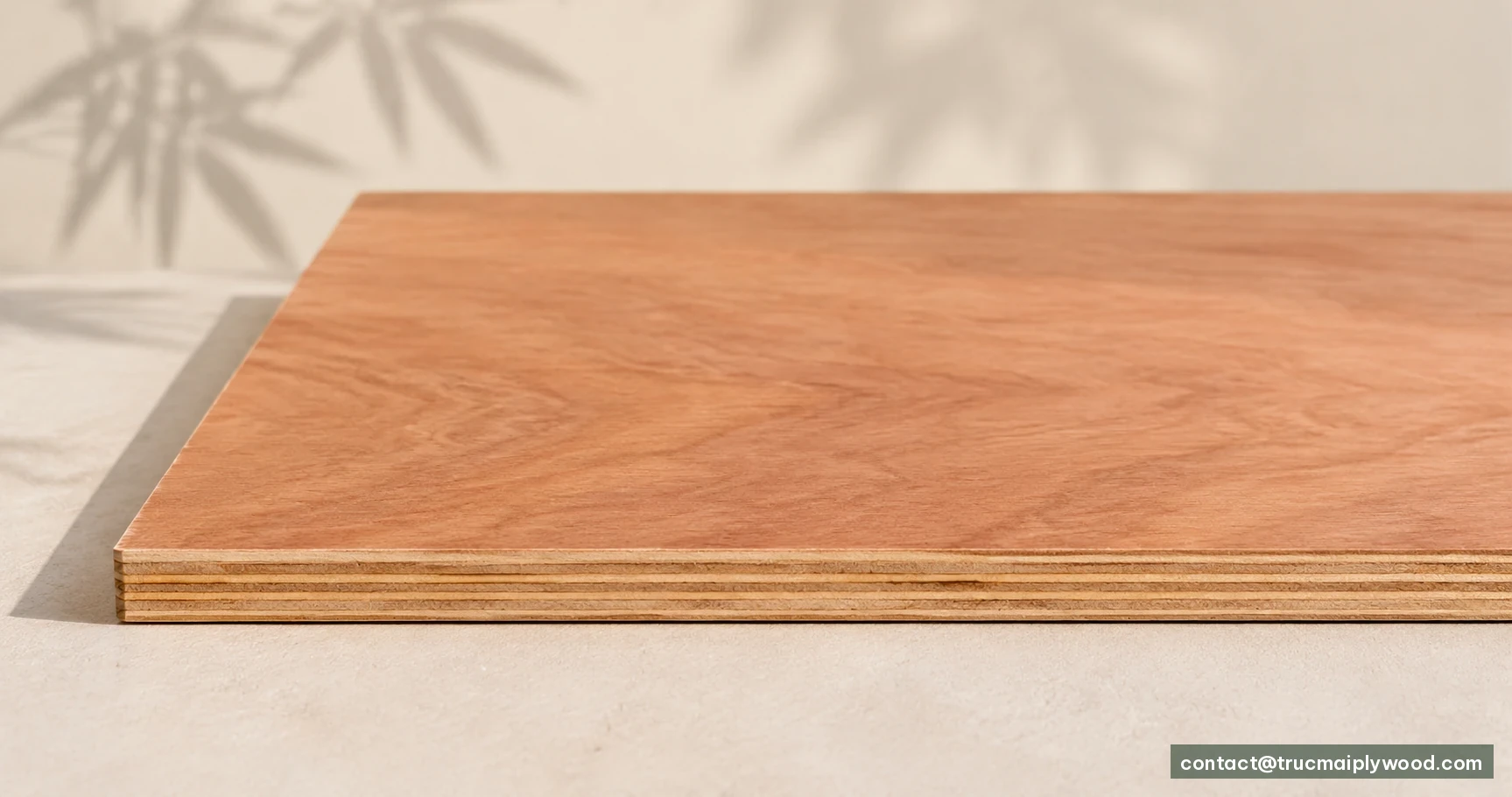
Why buy plywood from Vietnam?
Buy plywood from Vietnam when you need furniture or commercial panels by the full container, at a steady cost per m³, with certificate files you can check. Vietnamese mills peel plantation hardwood grown nearby, press it close to the forest and load at Hai Phong. What a buyer must still verify is the build behind each quote.
That is the honest summary, and both halves matter. The case for Vietnam rests on wood supply, cost structure and paperwork that already exists, not on a promise that every Vietnamese sheet is good. Plenty of panels from any origin fail on arrival because nobody wrote the core grade or the tolerance on the order.
Truc Mai Plywood is a Vietnamese manufacturer of furniture, interior and commercial plywood in Ha Hoa, Phu Tho, with an output of around 60,000 m³ a year and around 5,000 m³ in an average month. The reasons below are argued from that mill’s own numbers, and each catch is written next to the reason it qualifies.
| Reason | What it means for the buyer | The catch to check |
|---|---|---|
| Plantation core wood close to the mill | Short log transport, steady core supply | Core species and grade must be written on the order |
| Lower wood and labour cost | The same build can be quoted lower | Two quotes with one name are not one construction |
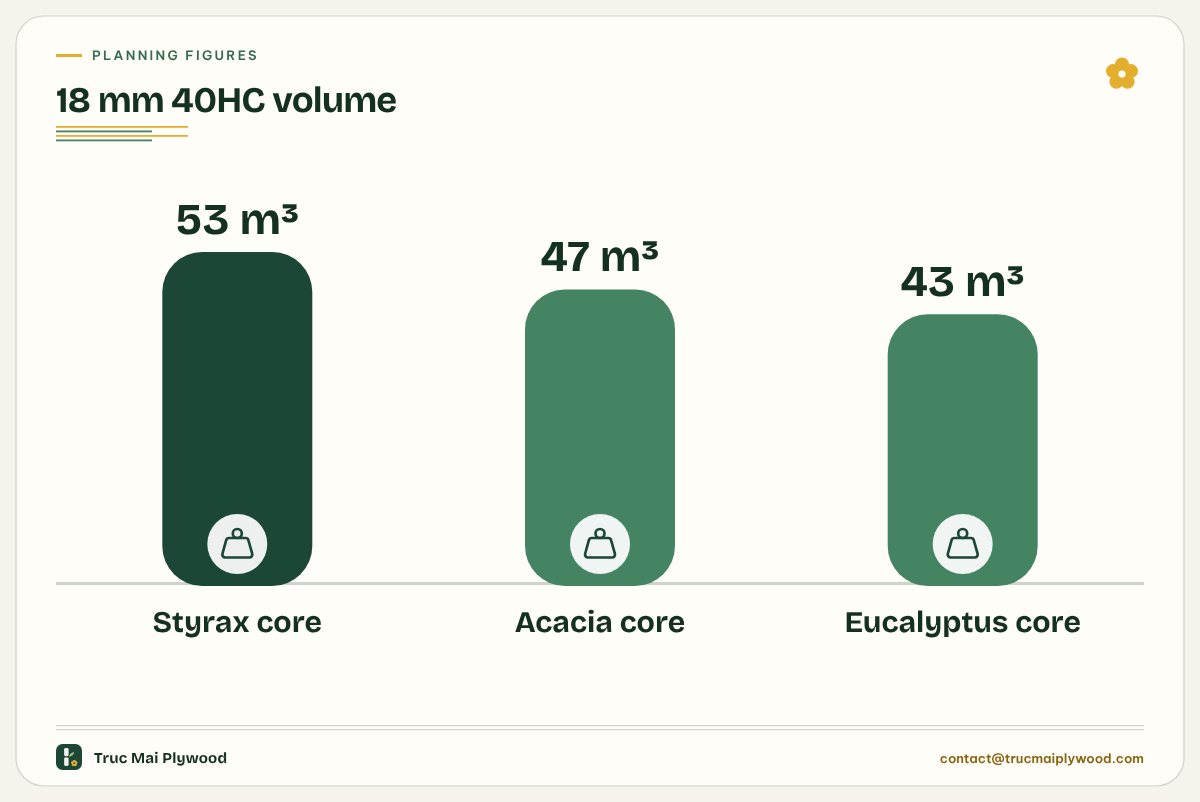
| Full container of 18 mm panels | About 53 m³ of Styrax-core panels per 40HC, planning figure | Heavier cores fill the weight limit first |
| Certificates in the mill’s name | FSC 100%, CARB P2 and TSCA Title VI, ISO 9001 | Each certificate has a scope; read it |
| EU file set | EUDR plot data for core and face | The face origin decides simplified due diligence |
| Sea route from Hai Phong | 30–40 days to Northern Europe | Production plus sea time is the real lead time |
Why can a Vietnam plywood manufacturer offer the same quality at a lower cost?
A Vietnam plywood manufacturer such as the Truc Mai mill in Ha Hoa, Phu Tho buys core wood from plantation forest nearby, and skilled labour in the district costs less than in the big industrial zones. Lower input costs let the same build be priced lower without cutting the build.
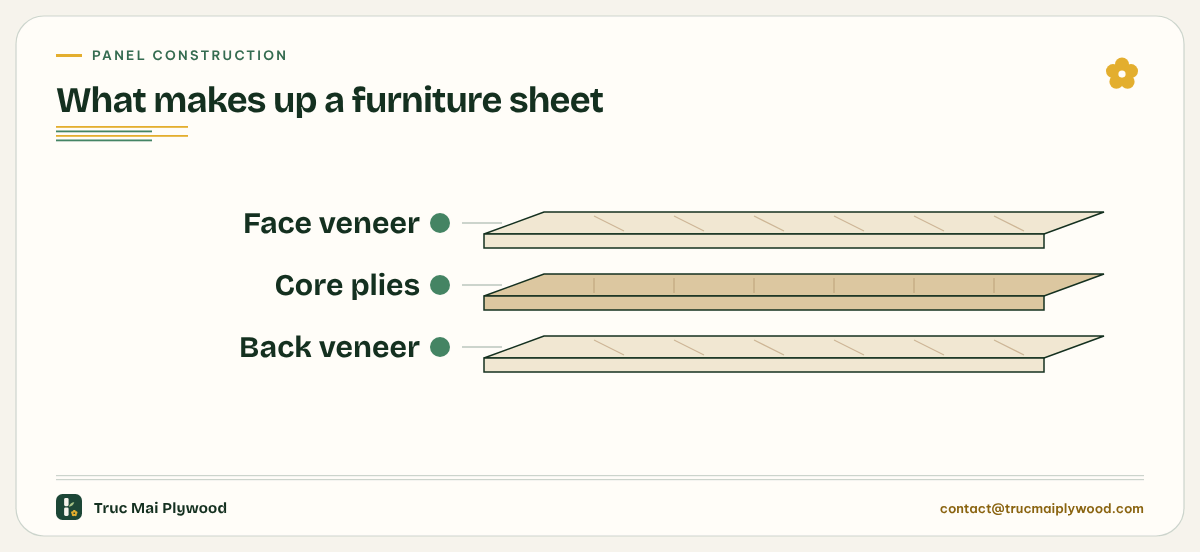
Core veneer is the bulk of a panel. In an 18 mm furniture sheet, the face and back are thin veneers of 0.2–0.5 mm and the rest is core, peeled at 1.4–2.0 mm per ply. When the logs for that core come from plantations around the mill, the cost of moving round wood, which is heavy and low in value, stays small.
Labour enters at every step that a machine does not finish: patching core veneer, laying plies, sorting faces, sanding, grading and packing. A district mill with experienced crews pays less per hour for that work than a mill in a city zone. That is the second part of the price.
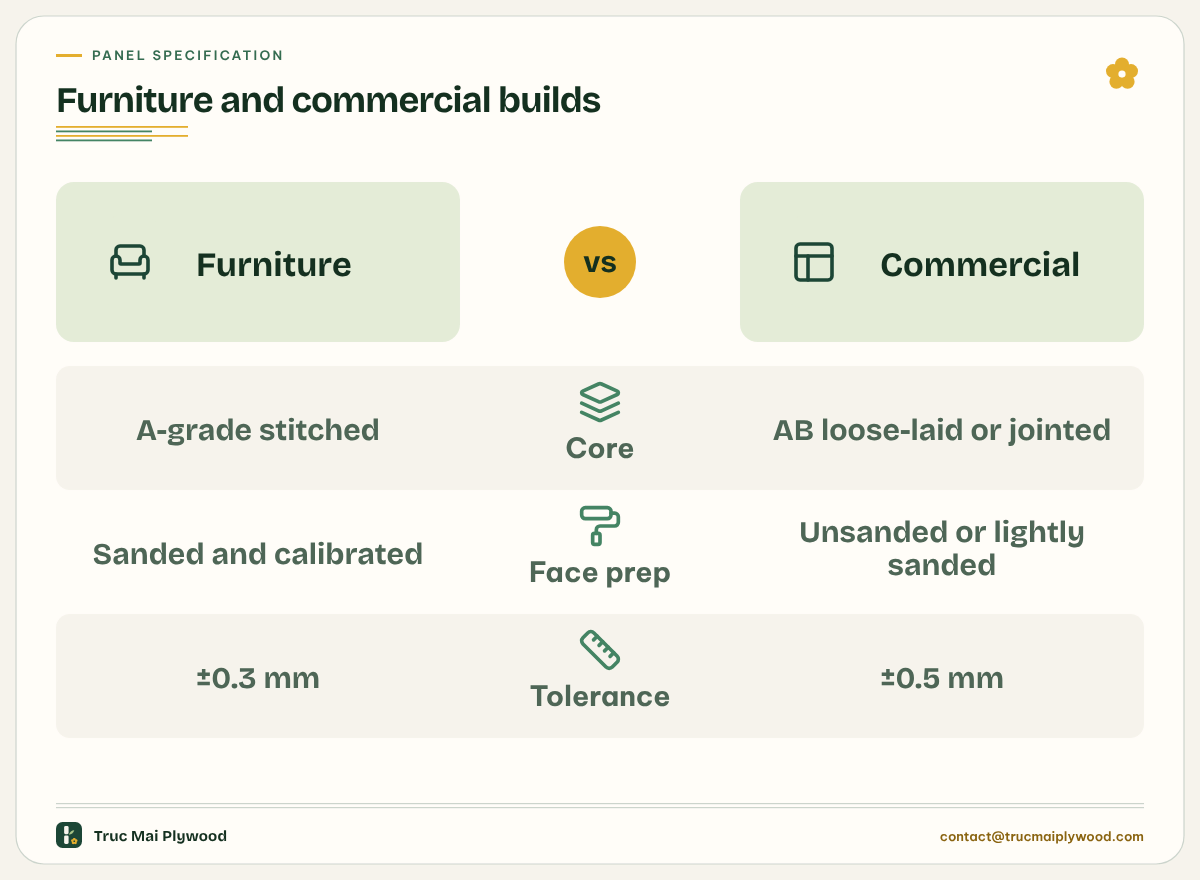
What lower cost does not buy is a different panel. A furniture panel from Truc Mai still uses an A-grade, stitched core with sanded faces; a commercial panel an AB core, loose-laid or jointed. The saving belongs in the price line, not in the core grade. If a quote is low because the core changed, the buyer has bought a different product.
The plywood pricing guide breaks a quote into core, face, glue, packing and container fill, so a buyer can see which line moved.
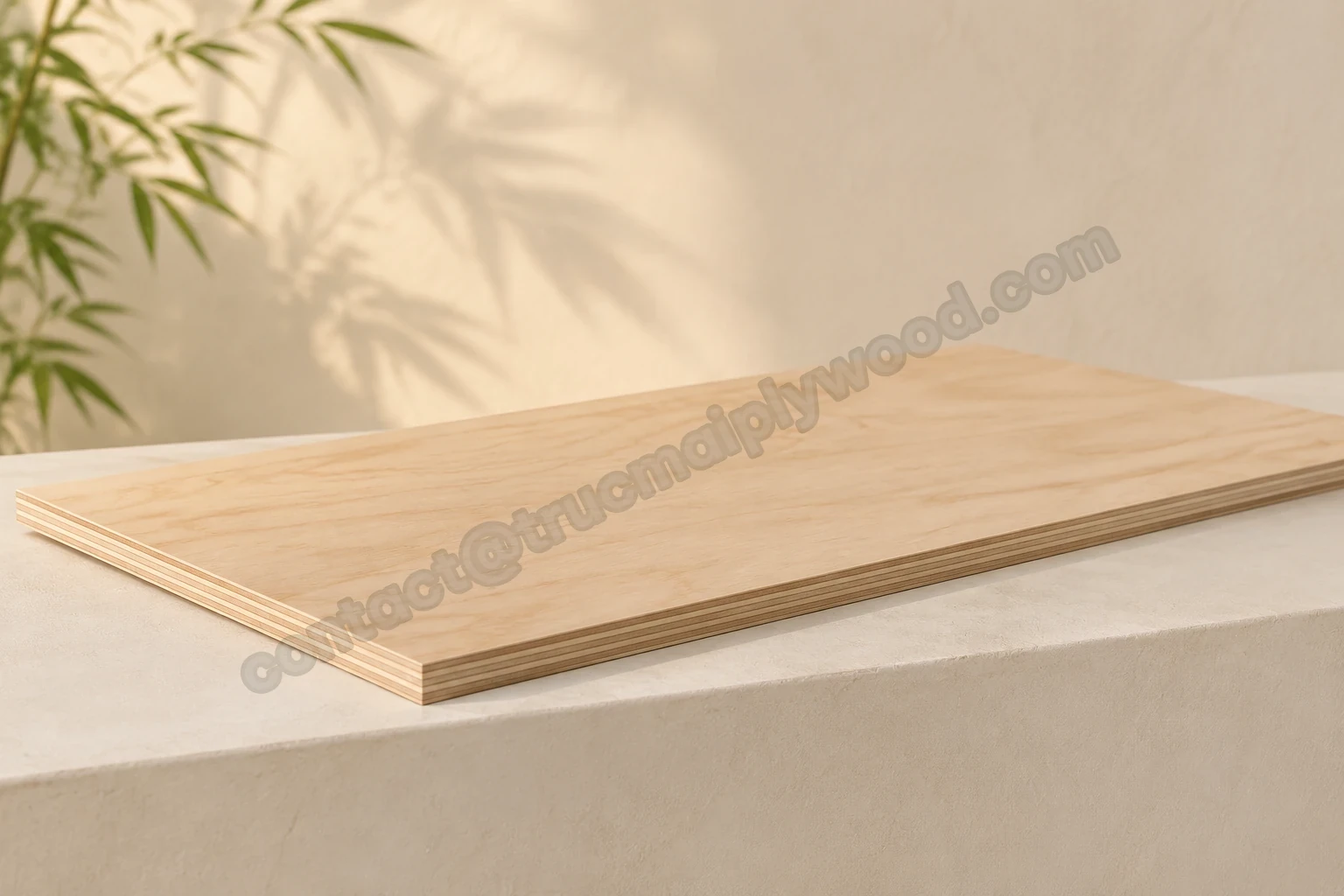
How much plantation forest stands behind Vietnamese plywood?
Vietnam’s forest area has grown for three decades. World Bank data show forest at 28.8% of the country’s land area in 1990 and 47.0% in 2023, much of the gain from planted forest. Plywood cores come from those plantations, which are harvested and replanted on short rotations.
The series is published by the World Bank forest-area indicator for Viet Nam, from FAO forest resource data. The figure is a land-cover share, not a statement about any one mill, but it explains why core logs are available in volume.
For a buyer, plantation wood changes two things. It keeps the core supply steady through the year, because plantations are planted to be cut. And it makes the origin traceable at plot level, which the EU now requires. One sample core dossier from the mill’s supply shows an FSC 100% Acacia mangium plot in a smallholder plantation, planted in 2019 and clear-felled in July 2025 at the end of its rotation.
Plantation does not mean any species. Vietnamese plywood has no poplar or birch cores; the cores are eucalyptus, acacia, Styrax or pine, alone or laid together to balance price, weight and appearance. Birch, okoume, bintangor and gurjan arrive as face veneers on a Vietnamese core. A buyer who wants an all-birch panel needs a different origin; a buyer who wants a birch face on a light core can buy it here.
How large is Vietnam’s plywood export trade?
Vietnam exported plywood, veneered panels and similar laminated wood worth about US$880 million in 2023, under HS heading 4412. The trade runs at that scale because mills, veneer peelers, glue suppliers and container lines around the northern ports already work together.
The World Bank WITS table for Vietnam’s HS 4412 exports gives the 2023 world total as 880,340.83 thousand US dollars. The table is built from UN Comtrade reporting and lists the partner countries one by one.
What the figure means for a monthly buyer is depth of supply. When peelers, glue makers, packing yards and truck fleets already serve many mills, a single order line does not depend on one sawmill or one truck. Spare veneer, a replacement press day or an extra truck to Hai Phong are easier to find.
What the figure does not mean is that the buyer can skip the mill check. Trade statistics count customs value by country; they say nothing about which mill pressed which sheet. The supplier shortlist checklist turns a national number into questions for one factory.
Is Vietnamese plywood good enough for furniture and cabinet factories?
Yes, when the order specifies a furniture build: an A-grade, stitched core, sanded and calibrated faces, UF glue at E0 emission and a written tolerance of ±0.3 mm. Vietnamese mills make both furniture and commercial grades, and the grade, not the country, decides whether a panel suits a cabinet line.
The difference between the two grades is the core. Furniture and interior panels at Truc Mai use an A-grade core, stitched across and along the sheet, usually on the outer 2–4 plies, with all plies stitched on request. Commercial panels use an AB core, loose-laid or jointed, with faces unsanded or lightly sanded and a tolerance of ±0.5 mm.
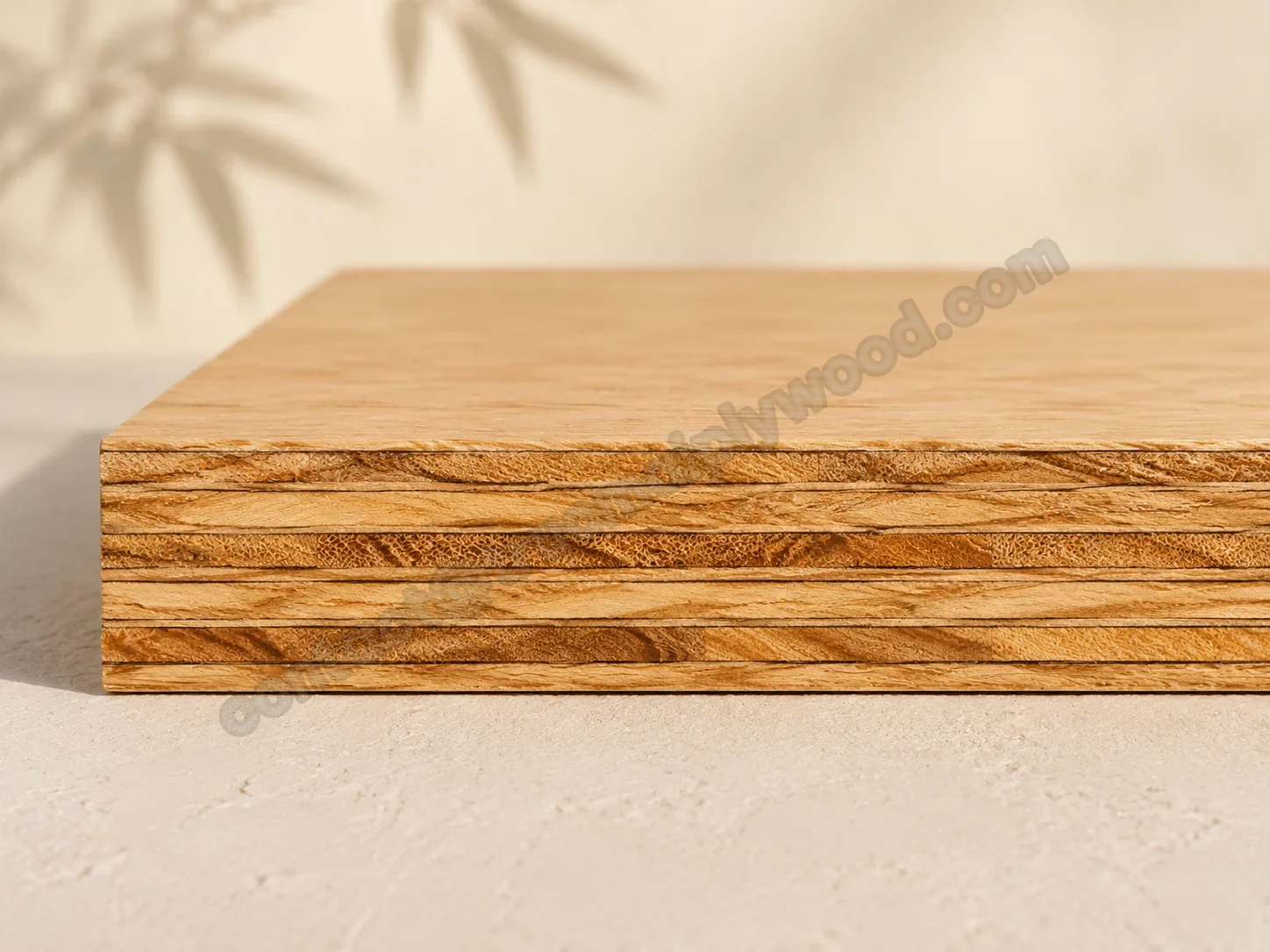
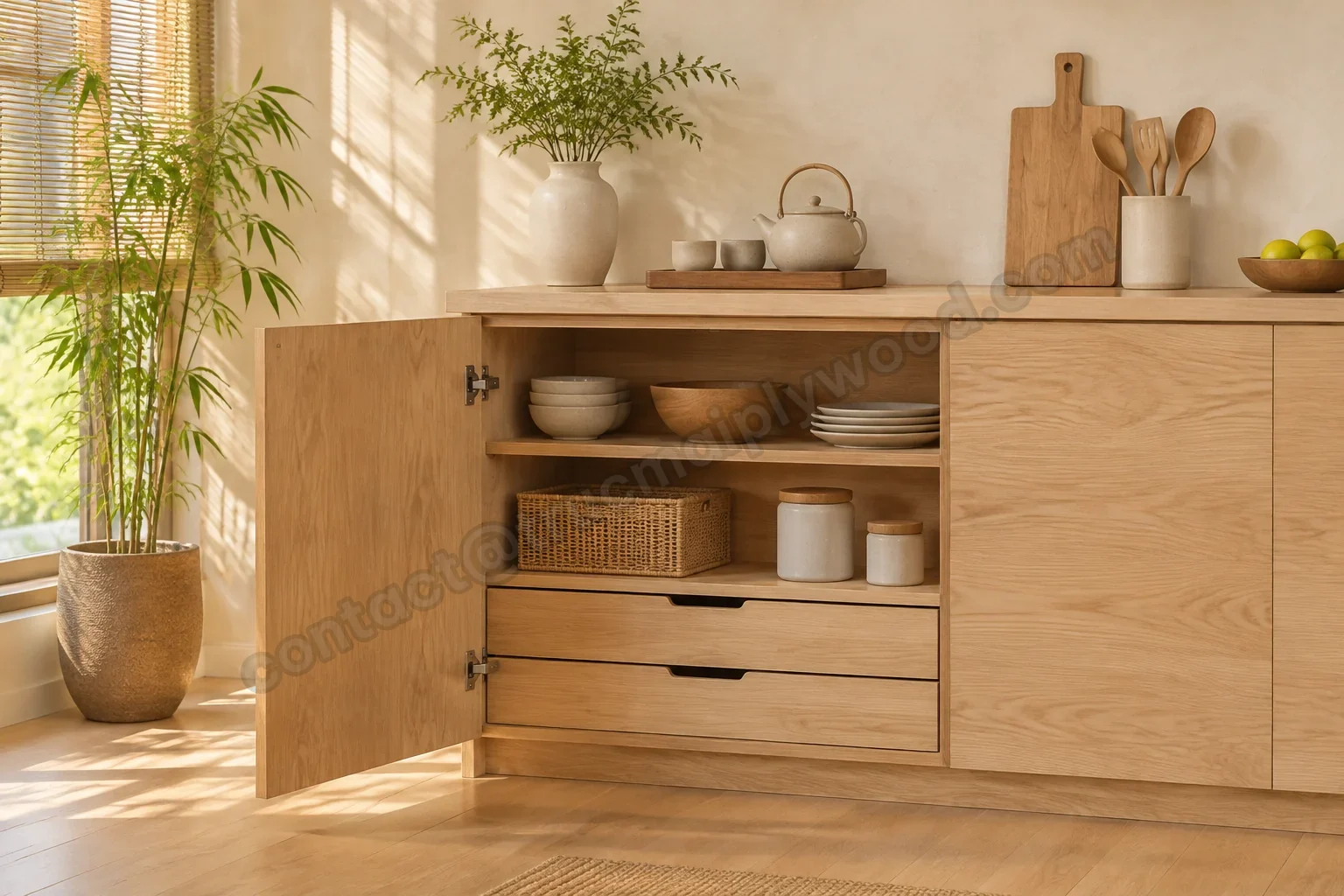
A cabinet factory feels the grade in three places. The CNC router needs a sheet that is flat and the same thickness from edge to edge, which is what calibrated sanding gives. The edge-banding line needs a core without voids at the cut. The finishing line needs a face that takes stain or lacquer evenly, which is why the face grade is agreed against an approved sample and written as a face-and-back pair.
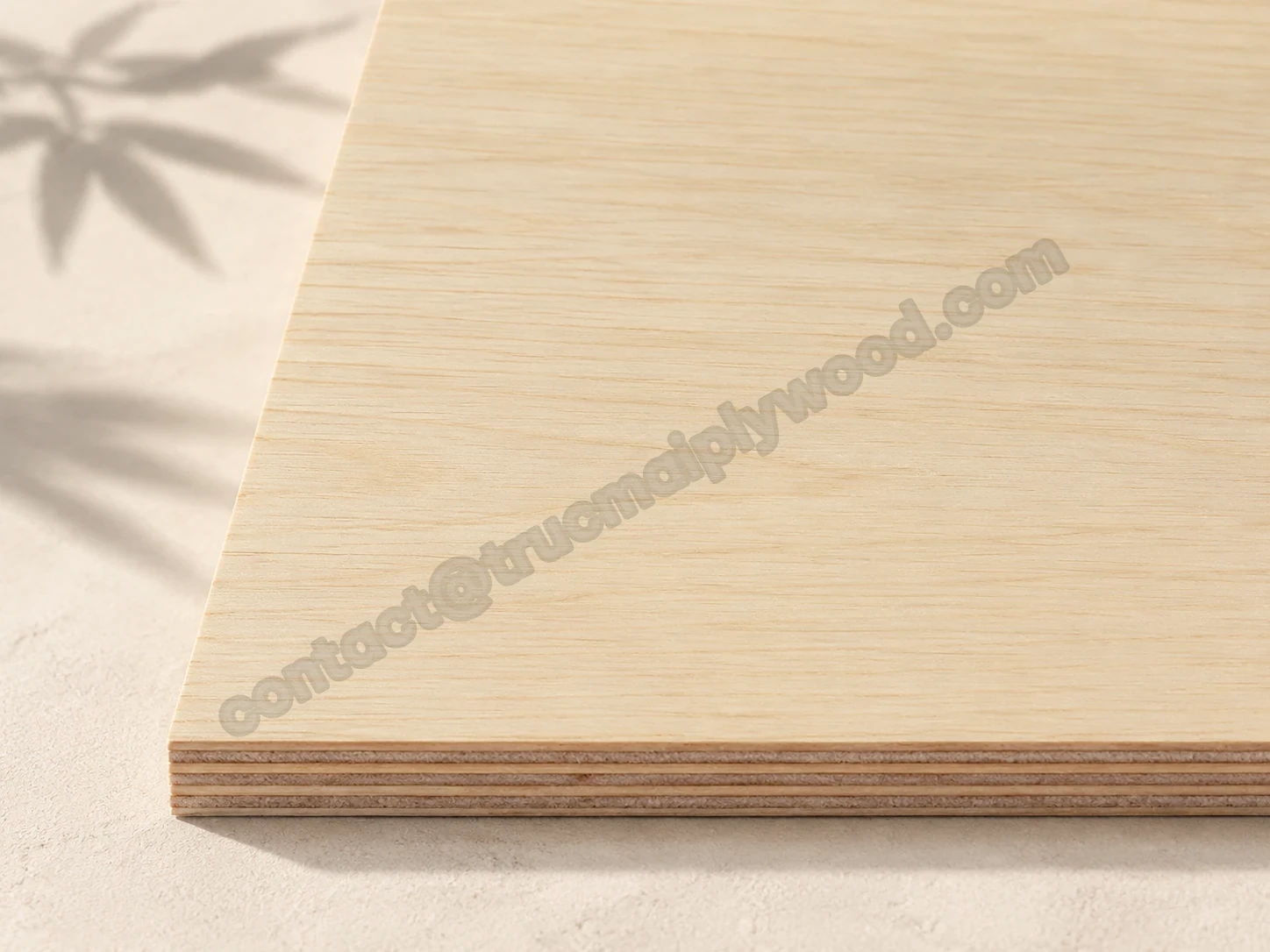
The faces cover what furniture makers ask for: EV, poplar and bleached poplar, birch, okoume, bintangor, pine, eucalyptus, gurjan and sapele, with others on request. The white poplar EV face is a reconstituted veneer from plantation poplar, imported in 2500 × 1300 mm sheets at 0.3 or 0.4 mm. The Vietnamese plywood quality by grade page shows each grade on the cut edge.
Which certificates come with Vietnamese plywood for EU and US buyers?
The certificates that matter are held by the mill, not by the country. Truc Mai holds FSC chain of custody under licence FSC-C196493, FSC 100% only; CARB Phase 2 and TSCA Title VI certification, certificate CARB/EPA 26053, for hardwood plywood with veneer core from 3–25 mm; and ISO 9001:2015, certificate W2012.
Each certificate has a scope, and the scope is the part buyers skip.
| Certificate | Number | Scope a buyer should read |
|---|---|---|
| FSC chain of custody | FSC-C196493, SA-COC-014545 | FSC 100% only; the claim is printed on sales documents for products on the current product schedule |
| CARB Phase 2 and TSCA Title VI | CARB/EPA 26053, mill ICTT-26053, certifier TPC-43 | Hardwood plywood with veneer core, 3–25 mm, 3–15 plies; 30 and 40 mm panels are outside it |
| ISO 9001:2015 | W2012 (WCERT) | Quality management for plywood manufacturing |
| ISO 14001:2015 | W2012E (WCERT) | Environmental management system, not a product claim |
| EUDR file set | Per EU lot | Plot geolocation for the Vietnamese core and for the face veneer |
| PPWR packaging test | Per packing type | The packing materials tested, not the panel |
The FSC licence code can be checked in the public FSC database in a minute; the FSC licence check guide shows how. The CARB and TSCA number can be checked against the certifier’s list. A certificate that cannot be found under the mill’s own name is the first warning sign on any shortlist.
The US federal limit behind the CARB and TSCA line is set in 40 CFR 770.10: 0.05 ppm of formaldehyde for hardwood plywood made with a veneer core or a composite core. Truc Mai’s default glue is UF at E0 emission, written as two separate lines on the order.
Truc Mai does not make film-faced, formwork, structural or marine plywood.
What do EU trade rules mean for plywood from Vietnam?
Three EU rules shape the order: the EU–Vietnam trade agreement, the EUDR with Vietnam classed low risk, and the REACH formaldehyde limit. Together they mean the buyer gets a preferential origin document, files a due-diligence statement with plot data, and writes an emission line on each order.
The EU–Vietnam Free Trade Agreement entered into force on 1 August 2020. For a plywood importer the practical piece is the certificate of origin: EU-bound lots from Truc Mai travel with an EUR.1, which the importer’s broker uses to claim the preferential rate where the tariff schedule gives one.
Under Regulation (EU) 2025/2650, the deforestation rules “shall apply from 30 December 2026” for plywood importers.
The country list in Implementing Regulation (EU) 2025/1093 places Vietnam among the low-risk countries, which allows simplified due diligence only when every wood in the panel comes from a low-risk country. A Vietnamese core with a face from a standard-risk country needs the full process.
That is why Truc Mai sends plot geolocation for both layers. Each EU-bound lot carries origin records and GeoJSON files for the core logs and for the face veneer, so the importer can file its own statement. The EU import steps place the statement among the other papers.
The REACH limit is separate again: Regulation (EU) 2023/1464 bars furniture and wood-based articles from the EU market after 6 August 2026 if their formaldehyde release exceeds 0.062 mg/m³ in the chamber test. It is written as its own line on the order.
What should US buyers weigh before buying plywood from Vietnam?
A US buyer weighs two lines before the price: the formaldehyde certification, which Truc Mai holds for 3–25 mm veneer-core panels, and the antidumping and countervailing duties on hardwood and decorative plywood from Vietnam. The duty line can outweigh every saving in the mill price.
Commerce’s final antidumping notice, Federal Register document 2026-14614, lists 90.12 and 84.95 for the Vietnam-wide entity and the cash deposit instruction. The countervailing notice sets 47.68% for all other producers. Individual company rates can differ, so the importer’s broker checks the rate for the exact producer.
The scope matters as much as the rate. Structural plywood stamped to the PS 1 and PS 2 standards is excluded, as are some other products named in the notices. Furniture and interior plywood with a hardwood or decorative face is the core of what the case covers, so a US buyer of cabinet panels should assume the duty applies until the broker confirms otherwise.
This is a catch, stated plainly: for many US buyers of hardwood plywood, the duty decides the origin before the mill does. The US import steps set out the entry papers, the CARB and TSCA label, the Lacey Act declaration and the duty lines in order.
How many m³ of 18 mm plywood fit in one 40HC from Vietnam?
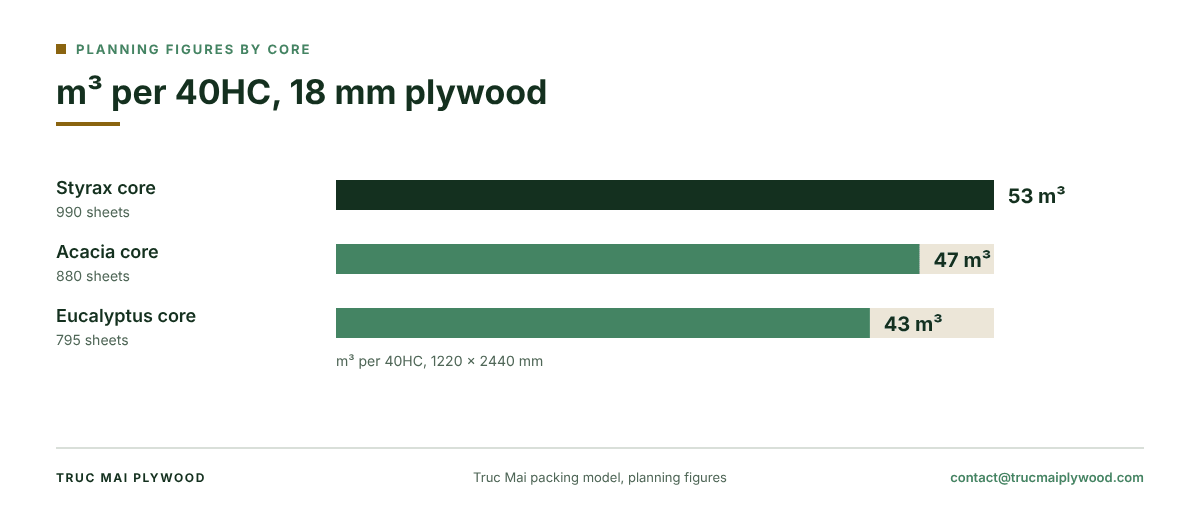
About 53 m³ of 18 mm Styrax-core panels in 1220 × 2440 mm fill one 40HC, as a planning figure: 990 sheets in 18 packs of 55. Acacia core fills about 47 m³ and eucalyptus about 43 m³, because heavier cores reach the payload before the space runs out.
| 18 mm, 1220 × 2440 mm | Sheets per 40HC | Volume | Weight per sheet |
|---|---|---|---|
| Styrax core | 990 sheets (18 × 55) | 53 m³ | 26.8 kg |
| Acacia core | 880 sheets (16 × 55) | 47 m³ | 31.1 kg |
| Eucalyptus core | 795 sheets (15 × 53) | 43 m³ | 34.8 kg |
All three rows are planning figures from the mill’s packing model, panels only, at a 28,000 kg planning payload; the carrier and route decide the real limit. Real sheets are weighed before final loading.
The point for the buyer is cost per m³, not cost per sheet. A lighter Styrax core puts more panel into the same freight, so a furniture buyer moving from an acacia to a Styrax core usually gets a better face, a lighter sheet and more m³ per container. The m³ per 40HC table gives every thickness, and the 40HC load calculator works out a mixed load.
How many days at sea is Hai Phong from Northern Europe and the US East Coast?
Typical sailing from Hai Phong takes 30–40 days to Northern Europe and 35–45 days to the US East Coast. The US West Coast is closer at 20–30 days, the Mediterranean 25–35 days and the Middle East 15–25 days. Each range varies by carrier, route and transhipment.
| Region | Example ports | Typical days at sea from Hai Phong |
|---|---|---|
| Northern Europe | Rotterdam, Hamburg | 30–40 days |
| Mediterranean | Valencia, Genoa | 25–35 days |
| US East Coast | New York, Savannah | 35–45 days |
| US West Coast | Los Angeles, Long Beach | 20–30 days |
| Middle East | Jebel Ali | 15–25 days |
| West Africa | Lagos, Tema | 35–50 days |
| South-East Asia | Laem Chabang | 5–12 days |
The sea leg is half of the real lead time. Production at Truc Mai takes 15–45 days after the 30% deposit, depending on quantity, production conditions and agreement. A buyer in Rotterdam or Hamburg who orders on day one should plan on panels arriving roughly two to three months later, then set the reorder rhythm from that.
On a monthly programme the two legs overlap. Once the first container is at sea, the second is in production, so a buyer receives one container a month after the pipeline fills. The sea freight per m³ page turns the freight quote into a cost per m³ of panel.
What are the catches of buying plywood from Vietnam?
The catches are the lead time, the US duty, the scarcity of good thin veneer, and quotes that look the same but are not. None of them is a reason to avoid Vietnam; each is a reason to write a tighter order and to check the mill before the deposit.
- Lead time. Production plus sea time is two to three months to Europe. A buyer who runs out of stock cannot fix it with a Vietnamese container; the programme has to run ahead of demand.
- US duties. Hardwood and decorative plywood from Vietnam carries the antidumping and countervailing rates set out above. For a US buyer, that line comes first.
- Thin panels. Good thin veneer is scarce. A 4 mm panel uses 1.3 mm core veneer, and finding enough of it can stretch the schedule. Thin 3–5 mm panels are always 5 plies.
- Look-alike quotes. Two offers with the same product name are often not the same construction; the difference sits in the core grade, the joining method, the face preparation, the glue and the tolerance.
- Scope of certificates. A CARB and TSCA certificate covers a thickness range and a product type. At Truc Mai, 30 and 40 mm panels are outside the 3–25 mm scope, so they are never sold as CARB or TSCA certified.
- Size limits. Standard sheets stop at 1250 × 2500 mm. Larger panels are cut from standard sheets, not pressed whole.
A buyer who knows these six points can plan around them. A buyer who learns them on the first container pays for them.
What should a buyer check before ordering plywood from Vietnam?
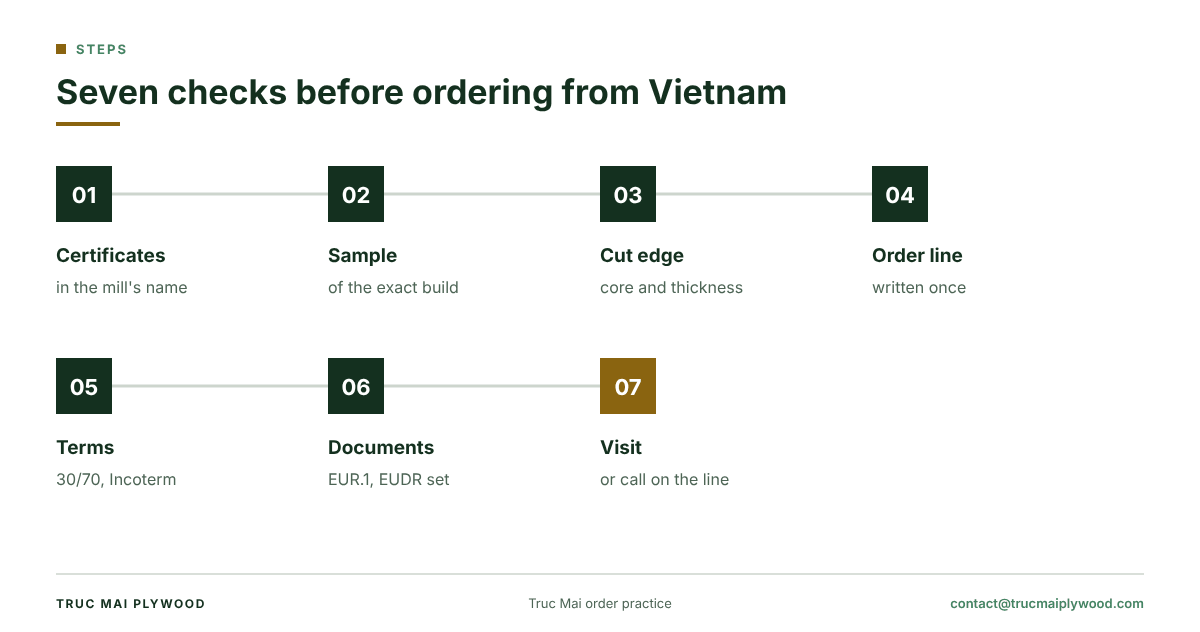
Check the mill’s own certificates in the public databases, a sample panel cut on site or on arrival, the written order line with core, glue, emission, face, size, tolerance and packing, and the terms: deposit, balance, Incoterm and documents. Each check takes minutes and saves a disputed container.
- Certificates in the mill’s name. Look up the FSC licence code and the CARB/EPA certificate number. A trading company’s certificate is not the mill’s.
- A sample against the order line. Ask for a sample of the exact build. New buyers receive free samples and book their own courier; the courier cost can be credited against a real order.
- The cut edge. Cut the sample and look at the core for gaps, overlaps and voids. Measure the thickness at several points against the written tolerance.
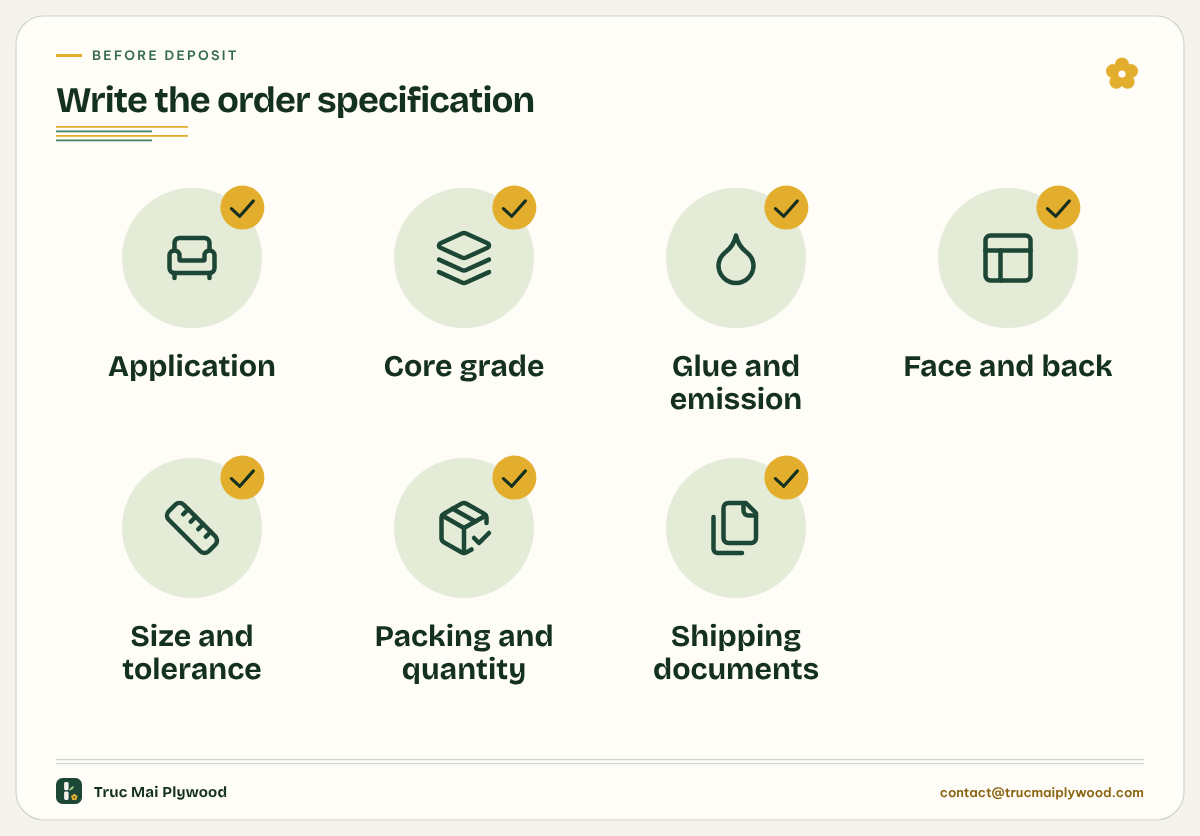
- The order line. Application, core, glue and emission, face and back grade, sheet size, thickness and tolerance, packing and quantity, all written once and copied onto each repeat.
- The terms. Truc Mai works with a 30% deposit and the 70% balance against the scanned B/L, by T/T or irrevocable L/C at sight, FOB Hai Phong, CFR or CIF.
- The documents. Commercial invoice, packing list, B/L, certificate of origin (EUR.1 for EU lots), phytosanitary and fumigation papers, plus the certificate documents and the EUDR file set for EU lots.
- A visit or a video call on the line. Seeing the press, the face sorting and the packing yard tells a buyer more than a brochure. The visit page explains how a day in Ha Hoa is arranged.
How do two Vietnamese quotes for the same panel differ?
Two quotes for “18 mm furniture plywood” can differ in core grade, core joining, face preparation, glue system and tolerance, and each difference moves the price. Start the comparison from the application, then core, glue and emission, face, sheet, packing and quantity, line by line.
| Line | Quote A | Quote B | Why it matters |
|---|---|---|---|
| Core grade | A-grade | AB | Voids show at the edge-banded cut |
| Core joining | Stitched | Loose-laid | Flatness and stability on the CNC table |
| Faces | Sanded and calibrated | Unsanded | Finishing and thickness consistency |
| Glue and emission | UF glue at E0 emission | Not stated | Market access and indoor-air rules |
| Tolerance | ±0.3 mm | ±0.5 mm | Machining and assembly gaps |
| Packing | Export packing | Not stated | Damage on the sea leg |
A quote that leaves a line blank is not cheaper; it is unfinished. Ask the mill to fill every line, then compare the totals per m³ delivered, not per sheet at the gate. The RFQ guide gives a template that makes every quote answer the same lines.
Which plywood manufacturers in Vietnam fit which buyer?
Plywood manufacturers in Vietnam run several builds side by side, and the buyer picks the build, not the country. Furniture and cabinet makers fit the A-grade, stitched, sanded furniture build; distributors and wholesalers of general panels fit the commercial build; exporters of crates and pallets fit packing-grade panels. Each build has its own tolerance, core and price step, so the buyer starts from the end use.
| Buyer | Build | Tolerance | Typical face |
|---|---|---|---|
| Furniture and cabinet factory | A-grade stitched core, sanded and calibrated | ±0.3 mm | EV, poplar, birch, okoume |
| Panel distributor | AB core, loose-laid or jointed | ±0.5 mm | Bintangor, okoume, eucalyptus |
| Crate and packing maker | AB loose-laid core, usually E2 emission | ±0.5–1.0 mm | Plain mixed hardwood |
| Furniture line using overlays | Prepared core for melamine, HPL or paper overlay | ±0.3–0.5 mm, per order | Pressed laminate face |
The same mill can serve all four, which is useful for a buyer who wants carcass panels and packing panels in one container. Three to six products can be combined in a 40HC by agreement; one or two is the usual mix.
How does a first order from Vietnam start?
A first order starts with one written specification line, a sample of that exact build, and one 40HC. Once the sample is approved and the 30% deposit is paid, the mill presses to the agreed schedule, sends draft documents for approval after loading, and the balance follows the scanned B/L.
18 mm plywood, furniture interior. Styrax core, A-grade, stitched. UF glue at E0 emission. White poplar EV face / poplar back. 1220 × 2440 mm, ±0.3 mm sanded and calibrated. FSC 100% claim. Export packing. 1×40HC, FOB Hai Phong. EU file set with core and face geolocation.
Send that line, or your own version of it, to the quotation desk or to contact@trucmaiplywood.com. The import guide follows the same order from the first email to customs, and the furniture and interior plywood range lists the faces and cores the line can carry.
Questions buyers ask
Is plywood from Vietnam cheaper than from other origins?
Often yes for the same build. A Vietnamese mill near its plantations pays less for core wood and labour, so the same construction can be quoted lower, but only a like-for-like specification shows the real difference.
What wood is Vietnamese plywood made from?
The cores are plantation hardwoods: eucalyptus, acacia, Styrax or pine, alone or combined. Faces range from EV and poplar to birch, okoume, bintangor, pine, gurjan and sapele.
Does plywood from Vietnam pay EU anti-dumping duty?
No. The EU anti-dumping duty on hardwood plywood under Regulation (EU) 2025/2333 applies to plywood from China, not to plywood made in Vietnam.
Does plywood from Vietnam pay US anti-dumping duty?
Hardwood and decorative plywood from Vietnam is subject to US antidumping and countervailing proceedings. Commerce's final determinations set a Vietnam-wide rate of 90.12% and a countervailing all-others rate of 47.68%, so a US buyer prices this in before ordering.
How long does a Vietnamese plywood order take?
Production at Truc Mai takes 15–45 days after the 30% deposit, depending on quantity and agreement, then 30–40 days at sea to Northern Europe or 35–45 days to the US East Coast.
What is the minimum order from a Vietnamese plywood mill?
At Truc Mai the minimum is one 40HC. A container usually carries one or two products, and three to six can be combined by agreement.
Can I visit a plywood mill in Ha Hoa before ordering?
Yes. A visit to the mill in Ha Hoa, Phu Tho can be arranged before the first order, and the sample panels can be checked on the line.
Which thickness range does a Vietnamese furniture plywood mill cover?
Truc Mai lists 3, 4, 5, 6, 9, 12, 15, 18, 21, 25, 30 and 40 mm, in 1220 × 2440 mm, 1220 × 2280 mm and 1250 × 2500 mm sheets.
Is Vietnam a low-risk country under the EUDR?
Yes. Implementing Regulation (EU) 2025/1093 lists Vietnam as low risk. The importer still collects plot geolocation, and simplified due diligence works only when the face veneer also comes from a low-risk country.
What thickness tolerance should a buyer write on a Vietnamese order?
Write it per order: ±0.3 mm on sanded and calibrated furniture panels, ±0.5 mm on commercial grade. A quote without a written tolerance cannot be compared.