
1/4 inch plywood is a nominal thickness category, not a promise that every sheet measures exactly 6.35 mm. Truc Mai supplies 6 mm furniture and commercial plywood in 1220 × 2440 mm sheets, with face, core, tolerance and cut-piece requirements set by the buyer. This guide explains how to specify the panel and plan a container order.
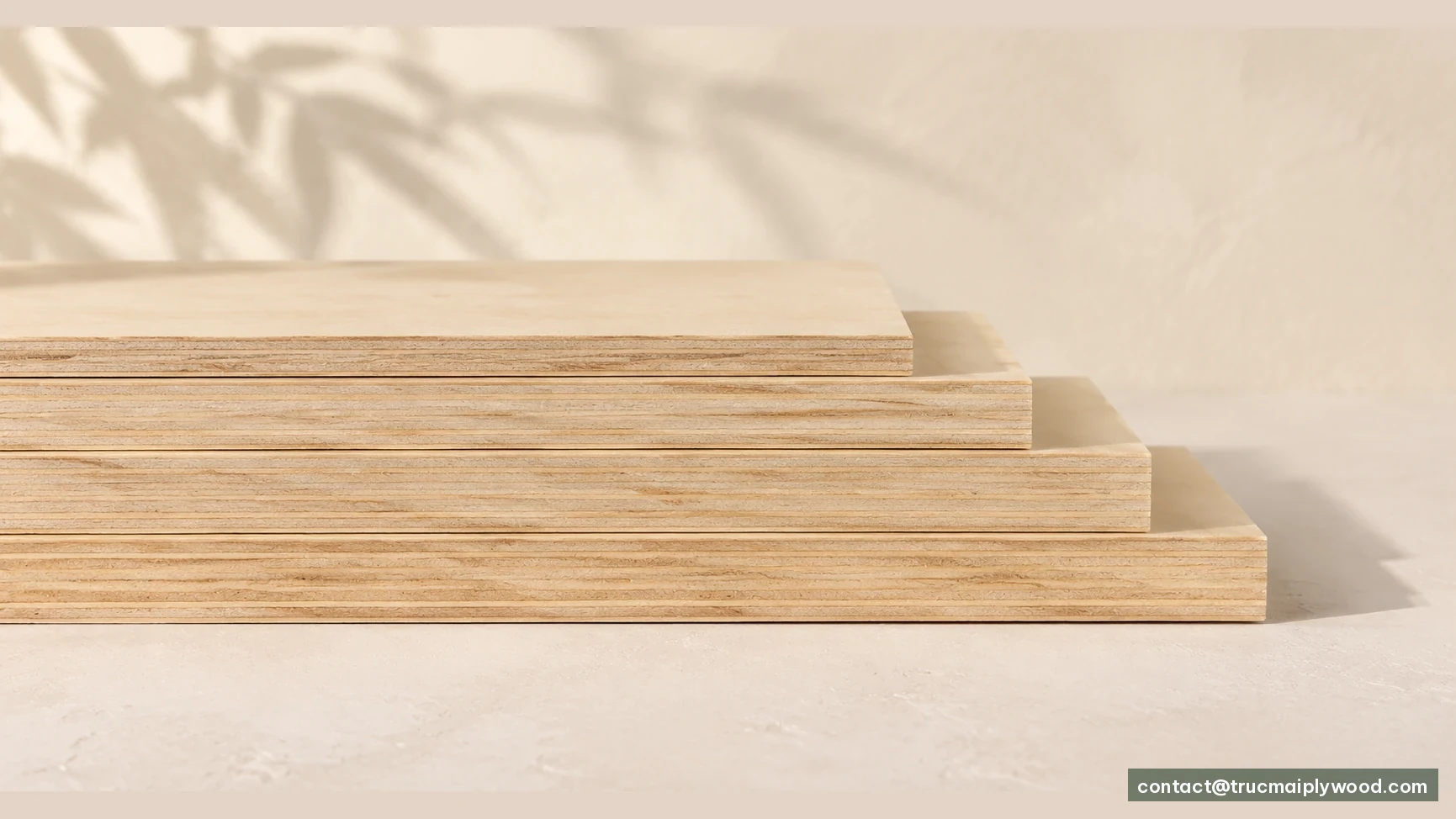
What plywood is actually 1/4 inch thick, in millimetres?
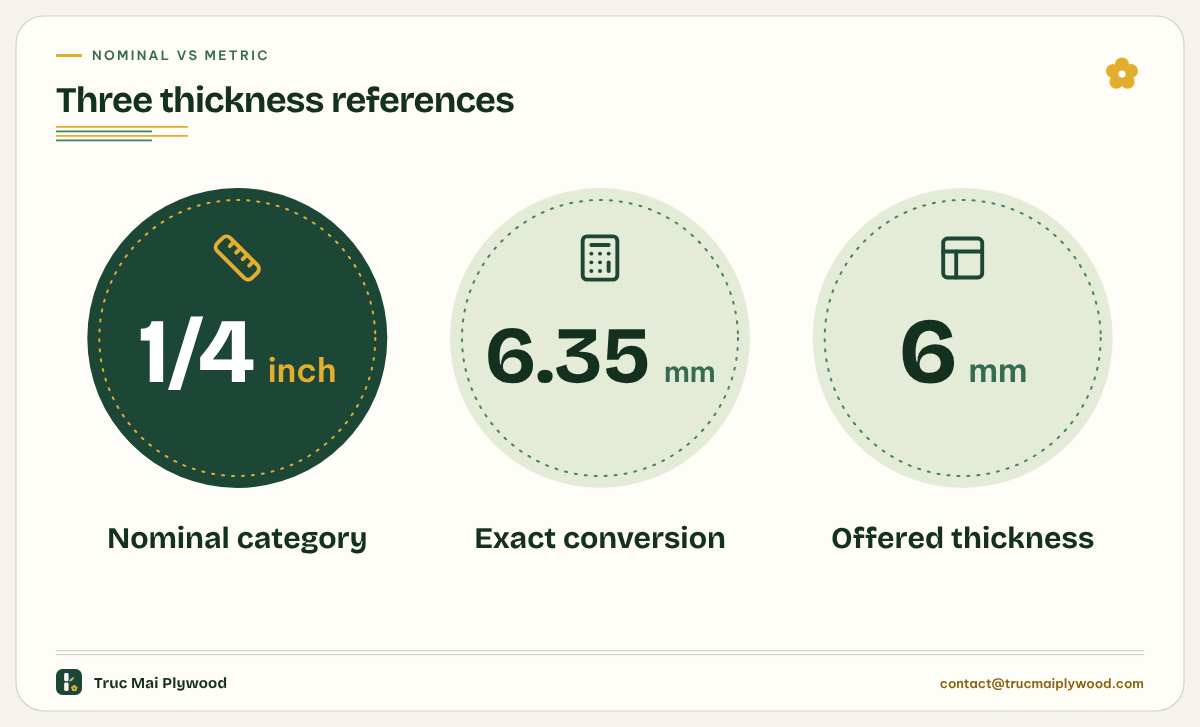
One quarter inch equals 6.35 mm, but nominal quarter-inch plywood does not necessarily measure 6.35 mm. Truc Mai Plywood supplies 6 mm furniture and commercial panels for this size category. Specify the finished thickness in millimetres on the purchase order so the sheet fits the intended cabinet groove or drawer assembly.
That difference matters when a panel slides into a pre-machined cabinet groove, sits flush against a frame, or forms a drawer bottom captured on several sides. If the buyer’s drawings use inches, add the required finished thickness in millimetres rather than relying on the catalogue description alone. The thin plywood panel range covers the mill’s relevant thin-sheet options.
The distinction becomes especially important when a project mixes sheets purchased from different suppliers. Two invoices can both say quarter-inch plywood even though the physical boards are not interchangeable in a tight-fitting assembly. Check the actual thickness of the approved sample and use that dimension when setting the machining programme. A router groove cut for a nominal size may be too loose for a thinner panel or too tight for a thicker one. The resulting adjustment affects assembly time as well as the finished appearance.
| Dimension on the enquiry | What it tells the buyer | What to put on the order |
|---|---|---|
| 1/4 inch | Nominal imperial thickness category | State the required finished thickness |
| 6.35 mm | Exact mathematical conversion of 1/4 inch | Use only if the drawing requires that dimension |
| 6 mm | Millimetre thickness offered in this range | Specify 6 mm and the agreed tolerance |
The NIST PS 1-22 structural plywood standard illustrates why a performance category, a nominal designation and a measured panel dimension should not be treated as interchangeable terms. PS 1-22 addresses structural plywood, whereas the panels discussed here are furniture and commercial products. Its terminology is useful for understanding the naming problem, not for assigning a structural grade to an interior sheet.
A workable specification records the intended use, finished thickness, face and back appearance, core, surface preparation and permissible variation. Truc Mai’s sanded and calibrated furniture panels can be specified at ±0.3 mm thickness tolerance; other furniture orders are written at ±0.3–0.5 mm. The tolerance belongs alongside the nominal thickness on the purchase order. It should also appear on the inspection sheet so the receiving team checks the same requirement the purchasing team approved.
Which thin-panel construction suits backs and drawers?
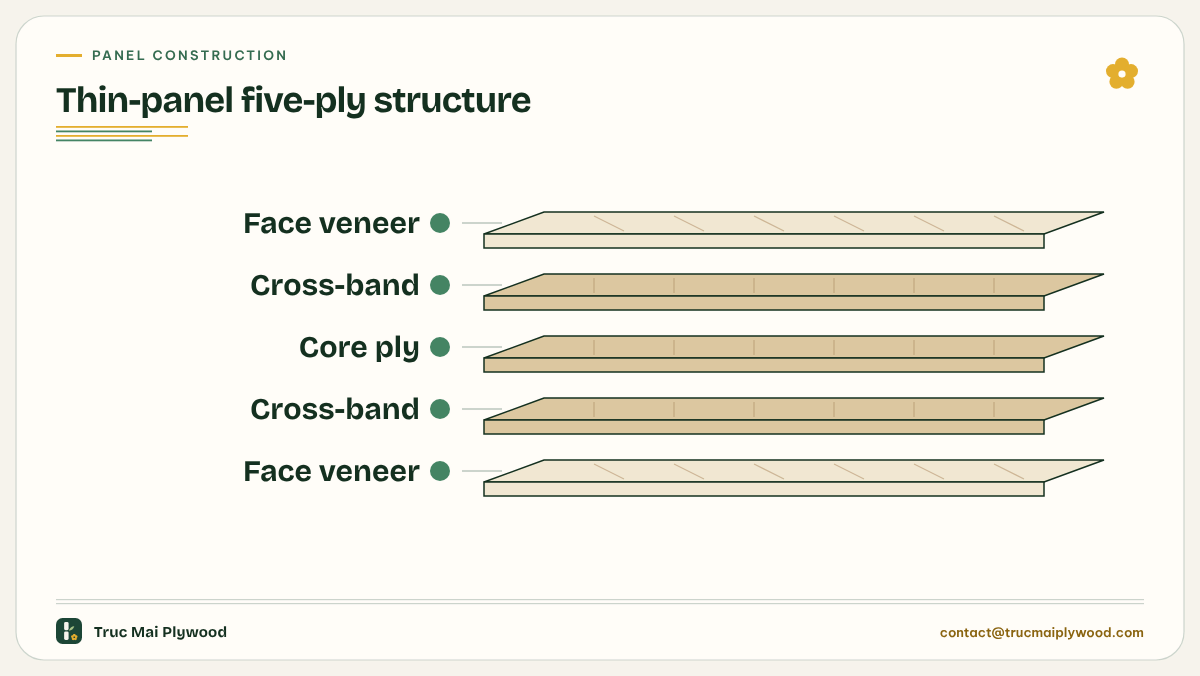
Truc Mai builds its 3–5 mm furniture panels with five plies; the ply count for 6 mm is specified by order. Ply count describes how many veneer layers make up the sheet, but it is only one part of a useful construction specification. For a cabinet back or drawer bottom, the quality and arrangement of the inner veneers also affect how consistently the panel can be machined and fitted.
The mill’s furniture/interior construction uses an A-grade core with stitched inner veneers and sanded faces. Stitching joins core veneer pieces across and along the sheet before pressing. It helps produce a more continuous lay-up, which is valuable when a thin panel will be cut into narrow furniture components. The buyer can ask for the construction to be recorded with the sample rather than treating the surface veneer as a complete description of the board.
For 3 mm panels, the five-ply arrangement comprises a core ply, two cross-bands and two face veneers. The 4 mm and 5 mm panels also use five plies, with three core plies and two faces. These details are specific to those thin builds. They should not be carried over automatically to 6 mm, where the construction is set for the order. A supplier comparison that assumes every thin sheet has the same number of layers can miss a significant difference in what is actually being purchased.
A cabinet back typically works as a thin closure panel supported by the surrounding carcass. Its requirements are different from those of a free-spanning shelf. The back needs to fit the groove or fixing arrangement, present the required appearance on its visible side and remain easy to handle during assembly. Drawer bottoms have a similar need for controlled thickness, but the groove fit and the way the bottom is supported deserve particular attention. Neither use should be selected solely by the phrase “quarter-inch”.
For a visible furniture back, specify the face and back grades as a pair. A decorative face may be important on one side, while the other side can be selected for its actual visibility in the finished unit. For a concealed component, spend the specification effort on core continuity, surface preparation and dimensional consistency. Grade names should be tied to an approved sample, since an appearance description alone does not show which knots, colour changes or repairs the buyer will accept.
The core choices are Eucalyptus, Acacia, Styrax and Pine, including combinations of these species. This lets the buyer balance weight and handling independently of the finished surface. A heavier core is not automatically a better choice for a thin cabinet back. What matters is the required assembly, the way the panel is supported and the construction the factory can reproduce against the agreed sample.
A useful sample review follows the actual production sequence. Cut a representative strip, check the exposed edge for obvious gaps, test it in the intended groove and examine both faces under the lighting used at assembly. Then record the accepted thickness, core construction and appearance together. The kitchen cabinet plywood guide provides the wider application context; this specification focuses on the thin back or drawer-bottom component itself.
How do poplar, okoume and engineered veneer faces compare?
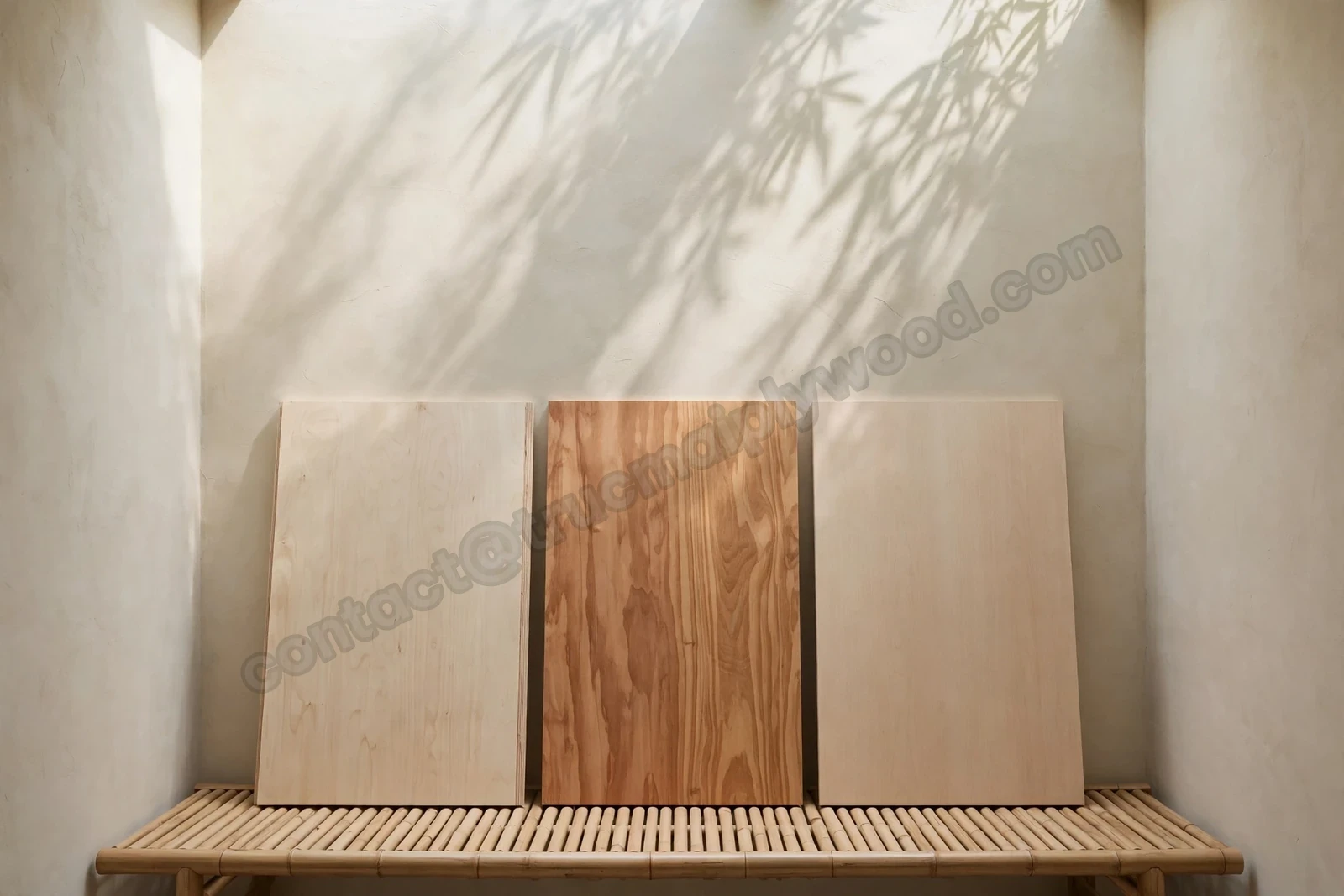
Poplar, okoume and engineered veneer are face options, while the core species is a separate purchase specification. This separation gives buyers more control over the visible surface without assuming that the wood seen on the outside also fills the inside of the sheet. For a quarter-inch interior panel, describe the face and the core on separate lines of the enquiry.
Poplar is an option when the design calls for a light-looking timber face. It is useful to compare actual samples rather than rely on a species name, because colour, grain and the acceptable appearance grade must be agreed for the finished furniture part. Truc Mai also offers bleached Poplar faces. A buyer specifying a pale interior should say whether a natural Poplar appearance or a bleached face is required, then approve the relevant face and back pair. The Poplar plywood range shows this option in the product family.
Okoume provides another appearance choice for interior components. Its face veneer can be specified over a Vietnamese core, so an okoume-faced panel should not be mistaken for a sheet made entirely from okoume. The face species answers a visual and surface-selection question; the core line answers a construction question. When comparing samples, place them beside the intended furniture finish and inspect the grain, colour and repairs that will remain visible after cutting. See the okoume-faced plywood range for the corresponding panel option.
Engineered veneer, abbreviated EV, is a reconstituted face veneer made to provide a more controlled visual pattern. Truc Mai’s white Poplar EV face is made from plantation Poplar (Populus deltoides). It is a face material rather than a description of the inner plies. Buyers considering a repeated furniture programme can compare EV samples for pattern consistency and choose the approved appearance as the reference for production. The engineered veneer panel range covers that face choice.
| Face option | Main selection question | Specification detail to approve |
|---|---|---|
| Poplar | Does the natural light timber appearance suit the part? | Face and back grade against samples |
| Okoume | Does the grain and colour fit the interior design? | Face veneer and separately named core |
| Engineered veneer (EV) | Is a controlled, repeated decorative pattern required? | Approved pattern and face/back appearance |
The approved sample should establish the acceptable colour range, grain character, surface repairs and difference between face and back. Inspecting a cut edge also distinguishes the decorative face from the underlying construction.
A practical comparison uses identical intended parts. Lay out the samples under the same lighting, mark which side will be exposed, then compare them after the same cutting and surface preparation steps. If a panel is destined for a cabinet interior, check the actual viewing distance and lighting rather than choosing solely from a small photograph. If a drawer bottom will be largely concealed, a decorative pattern may contribute less value than a well-defined core and a consistent fit.
Which 4 × 8 sheet dimensions and tolerances should buyers specify?
Truc Mai offers 1220 × 2440 mm sheets with thickness and length-width tolerances written into the order. This is the familiar 4 × 8 ft format used for many cabinet and furniture cutting plans. The buyer should nevertheless state the dimensions in millimetres, because a cutting programme needs the specified sheet size rather than an approximate imperial description.
The standard furniture sheet is 1220 × 2440 mm. Other available formats include 1220 × 2280 mm and 1250 × 2500 mm. The shorter format can suit furniture-part layouts that do not need the full standard length, while the larger European format may suit a different nesting plan. Choose the parent sheet from the parts to be made, the grain direction required on visible faces and the equipment used to handle and cut the material.
| Order field | Example for a quarter-inch-category interior sheet | Why it matters |
|---|---|---|
| Finished thickness | 6 mm | Sets groove and component fit |
| Parent sheet | 1220 × 2440 mm | Establishes the cutting layout |
| Thickness tolerance | ±0.3 mm for sanded, calibrated furniture panels | Defines the accepted thickness variation |
| Length and width tolerance | ±2 mm | Sets the receiving and cutting allowance |
| Surface | Sanded and calibrated | Defines preparation before further finishing |
| Face and back | Approved grade pair | Defines visible appearance on each side |
A tolerance is a purchasing requirement, not a substitute for the target dimension. If the order says 6 mm with ±0.3 mm tolerance, both values are needed to assess the delivered panel. The same principle applies to length and width: the nominal 1220 × 2440 mm sheet and the ±2 mm size tolerance should be read together. Record these requirements before a factory prepares the sample, particularly when the panel must fit a fixed assembly line.
The NIST Voluntary Product Standards programme explains the role of product standards in establishing shared requirements for buyers and manufacturers. Its PS 1 structural plywood standard is not the purchase specification for these non-structural furniture panels. The relevant contract here is the agreed panel build, dimensions, surface and inspection criteria. A buyer should not substitute a structural standard’s tolerance table for a separately agreed furniture-panel tolerance.
When evaluating sheet dimensions, begin with the finished component drawing. Mark the direction of the visible face grain and any edges that will remain exposed. Then arrange the parts within the available parent-sheet formats, allowing for the cutting process. The number of nominal rectangles that fit on paper is not always the number of usable finished parts: saw kerf, grain direction and any rejected edge area affect the layout. The detailed cut patterns belong in the cutting plan rather than being hidden inside the sheet-size description.
The next step is a cut list that turns those full sheets into the parts the furniture line actually needs.
How are thin sheets cut into two, three, four or six pieces?
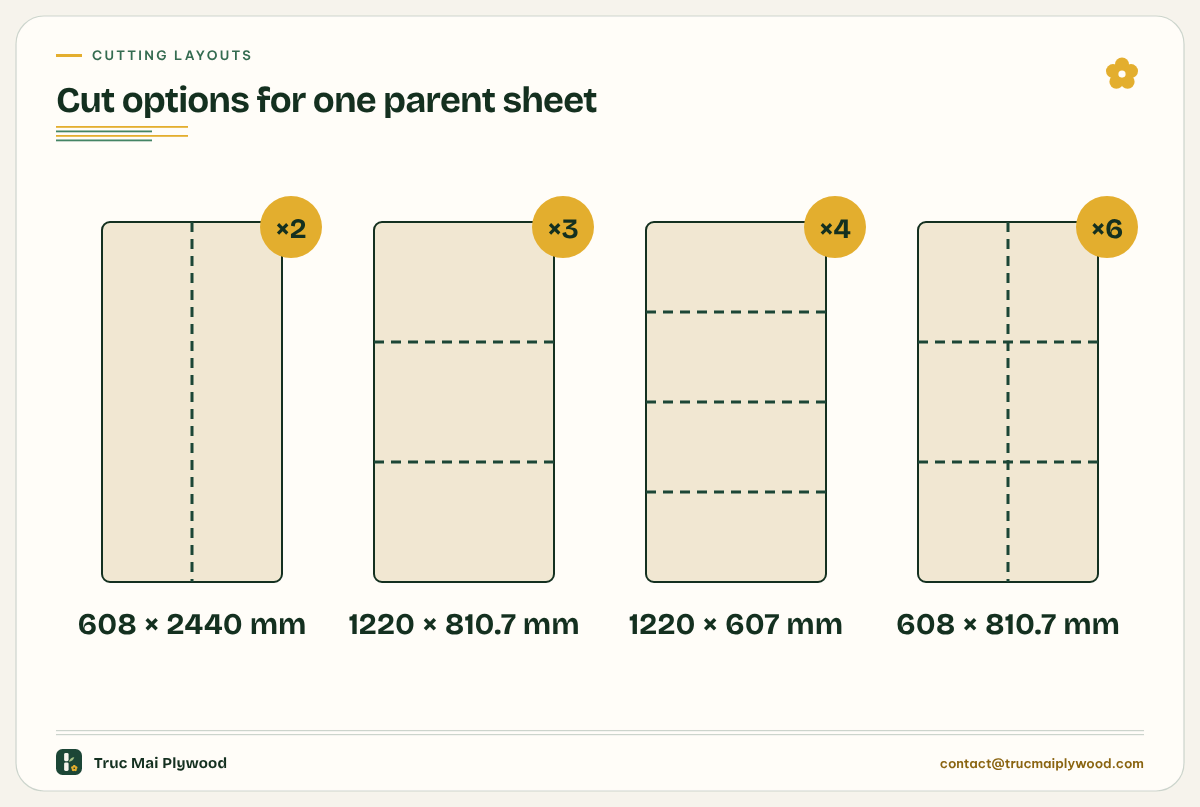
The cut plan can divide a parent sheet into two, three, four or six labelled pieces, with saw-kerf deductions shown in a table. For furniture production, this turns a broad sheet specification into a repeatable supply of parts that can be counted, stored and sent directly to the next operation.
A cut list should distinguish the theoretical division of a sheet from the usable size after the saw passes through it. In the following plan, each cut removes a 4 mm strip of material. The nominal dimensions describe an equal division before that loss; the actual dimensions allow for the cuts. This distinction matters when a component must fit into a groove, between cabinet sides or against another prefabricated part.
| Pieces per parent sheet | Cutting direction | Saw cuts | Nominal piece (mm) | Piece after kerf (mm) |
|---|---|---|---|---|
| 2 | Lengthwise | 1 | 610 × 2440 | 608 × 2440 |
| 3 | Across the length | 2 | 1220 × 813.3 | 1220 × 810.7 |
| 4 | Across the length | 3 | 1220 × 610 | 1220 × 607 |
| 6 | Lengthwise and across | 3 | 610 × 813.3 | 608 × 810.7 |
Calculation basis: one 1220 × 2440 mm parent sheet; 4 mm kerf per saw cut; equal-sized divisions. Two pieces use one lengthwise cut, three use two crosscuts, four use three crosscuts and six use one lengthwise cut plus two crosscuts. These are cutting-layout figures, not finished-part machining allowances.
For two long strips, the saw travels parallel to the long edge. This arrangement suits continuous backing strips and long furniture inserts. The three-piece arrangement keeps the full parent width and creates shorter rectangles. Four pieces produce a narrower length dimension without first dividing the width. Six pieces combine the two directions and produce smaller rectangles that are easier to handle at an assembly station.
A furniture cut list should specify the finished part width and length, grain or face orientation, quantity per part code, and the permitted edge condition. If the buyer needs exact finished dimensions after machining, the cutting plan must include that finishing step rather than treating the saw-cut result as the finished component. Keep the approved face visible on the cutting drawing so operators know which surface must be protected during stacking.
Part labels are useful where a container carries similar-looking panels for several furniture models. A label can identify the order, part code, dimensions, face orientation and pack number without relying on workers to distinguish parts by eye. Grouping identical pieces into their own packs also reduces sorting at the destination. For an order containing both full sheets and cut parts, separate the quantities in the packing list.
The cut-to-size plywood panels specification is the natural place to agree the layout, labels and stacking sequence before production. Send the cutting drawing with the purchase specification, rather than adding a cutting instruction only after the sheets have been pressed.
What can a 40HC carry after cutting 6 mm plywood?
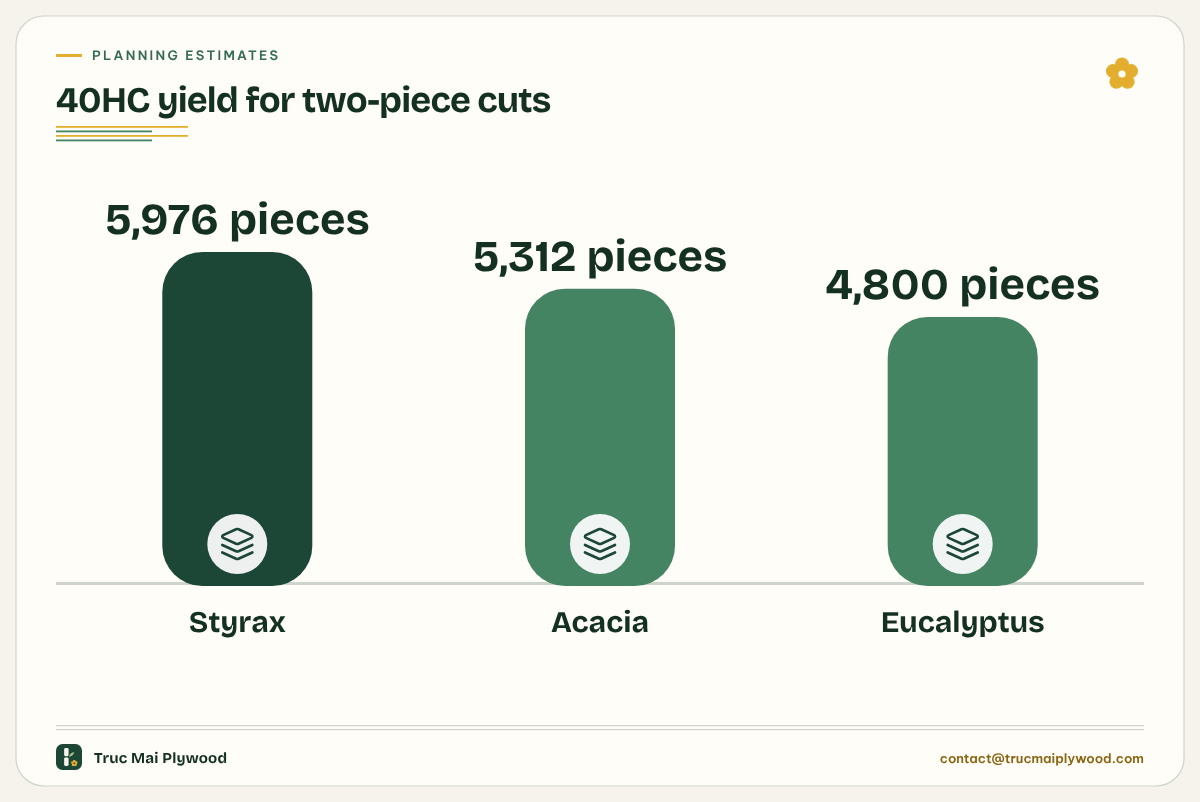
A 40HC cut-piece plan starts from whole-sheet counts and multiplies by pieces per sheet; the figures are planning estimates, not verified loading records. The core choice changes the weight of the original sheets, so the same cutting pattern can produce different container piece counts.
The table uses the specified 6 mm sheet and the packing model’s parent-sheet allowances for Styrax, Acacia and Eucalyptus cores. It assumes all the parent sheets are cut in the same pattern, with no rejected pieces or mixed sizes. Cutting changes the number of individual pieces, but does not create additional wood volume. A shipment of small panels still needs a loading plan for the actual packs.
| Core | Parent sheets per 40HC | Pieces per sheet | Calculated cut pieces per 40HC |
|---|---|---|---|
| Styrax | 2,988 | 2 | 5,976 |
| Styrax | 2,988 | 3 | 8,964 |
| Styrax | 2,988 | 4 | 11,952 |
| Styrax | 2,988 | 6 | 17,928 |
| Acacia | 2,656 | 2 | 5,312 |
| Acacia | 2,656 | 3 | 7,968 |
| Acacia | 2,656 | 4 | 10,624 |
| Acacia | 2,656 | 6 | 15,936 |
| Eucalyptus | 2,400 | 2 | 4,800 |
| Eucalyptus | 2,400 | 3 | 7,200 |
| Eucalyptus | 2,400 | 4 | 9,600 |
| Eucalyptus | 2,400 | 6 | 14,400 |
40HC model basis: the 40HC model uses 1220 × 2440 × 6 mm parent sheets, a planning cargo payload of 28,000 kg, reference core densities and pack-height and pack-count limits. Each cut-piece total equals the modelled parent-sheet count multiplied by the number of pieces cut from each sheet. The figures represent panels only; packing materials and the booked transport limits must be checked in the final loading plan.
The practical decision is not simply which row contains the largest piece count. A higher number of smaller pieces also means more edges to protect, more labels to reconcile and more handling operations. If the destination factory feeds long strips into a machine, the two-piece format can be operationally better than a larger count of short rectangles. If it assembles many identical small cabinet backs, the six-piece format may save a cutting operation at destination.
The reference densities used in the model are 500 kg/m³ for Styrax, 580 kg/m³ for Acacia and 650 kg/m³ for Eucalyptus. They explain why the same parent size and thickness produces different estimated parent-sheet counts. The final shipment should use the actual measured sheet mass and a pack arrangement that respects support points, access and unloading equipment. A cut-piece total alone does not describe how a container will be loaded.
Ask for a packing breakdown by part code and pack rather than a single overall piece number. This makes the container plan usable for receiving: the importer can match the shipment documents to physical packs, and the furniture plant can direct each pack to the correct work area. The 40HC loading guide provides the wider thickness and core comparison behind these planning figures.
How should 6 mm plywood be packed to protect corners and faces?
Protecting the faces, edges and pack supports matters more than maximising the number of sheets per pack. Thin furniture panels are easy to handle individually, yet a poorly supported bundle can place concentrated pressure on corners and on the exposed face of the bottom sheet.
Start with the condition in which the panels will be used. A sanded furniture face needs protection against rubbing, trapped grit and marks from strapping. A commercial panel may have a different surface specification, but it still benefits from stable, square stacking. Keep the same orientation within a pack so the approved face is consistently protected and easy to inspect at the destination.
A sound packing arrangement uses a flat base, aligned edges and supports that carry the bundle without leaving unsupported spans. Protect corners where strapping or handling equipment could crush the edge. Use suitable protective sheets between the exposed plywood and rough packing materials. Where parts have been cut, keep like dimensions together and prevent short pieces from shifting sideways within a larger pack footprint.
The packing model uses packs around 1,000 mm high. This is a planning input for the sheet-count calculation, not a reason to stack every cut-piece configuration to that height. The relevant packing height and support spacing should follow the actual piece geometry and handling route. A narrow strip pack, for example, needs a support layout suited to long pieces; a pack of short rectangles needs restraint against sliding.
Before loading, check the underside as carefully as the top. Feet and battens must support the load without creating pressure points. Strapping should restrain the stack while corner protectors keep it away from exposed plywood edges. If the pack will be lifted by forklift, the fork-entry points must match the actual base design. The loader should be able to move each pack without dragging it over the container floor or another pack.
For mixed cut lists, pack identification is part of damage prevention. Clear part-code labels reduce unnecessary opening and restacking at the destination. Number the packs and show the piece quantity on each label; then mirror those identifiers in the packing list. Where a face direction matters to subsequent finishing, show that direction on the label or the agreed drawing.
A useful pre-dispatch check includes face cleanliness, edge condition, square stacking, restraint and readable labels. Record any special handling instruction on the packing specification so it travels with the order rather than remaining only in correspondence. The documents per container guide explains how packing information fits alongside the other shipment paperwork.
Which interior applications benefit from quarter-inch panels?
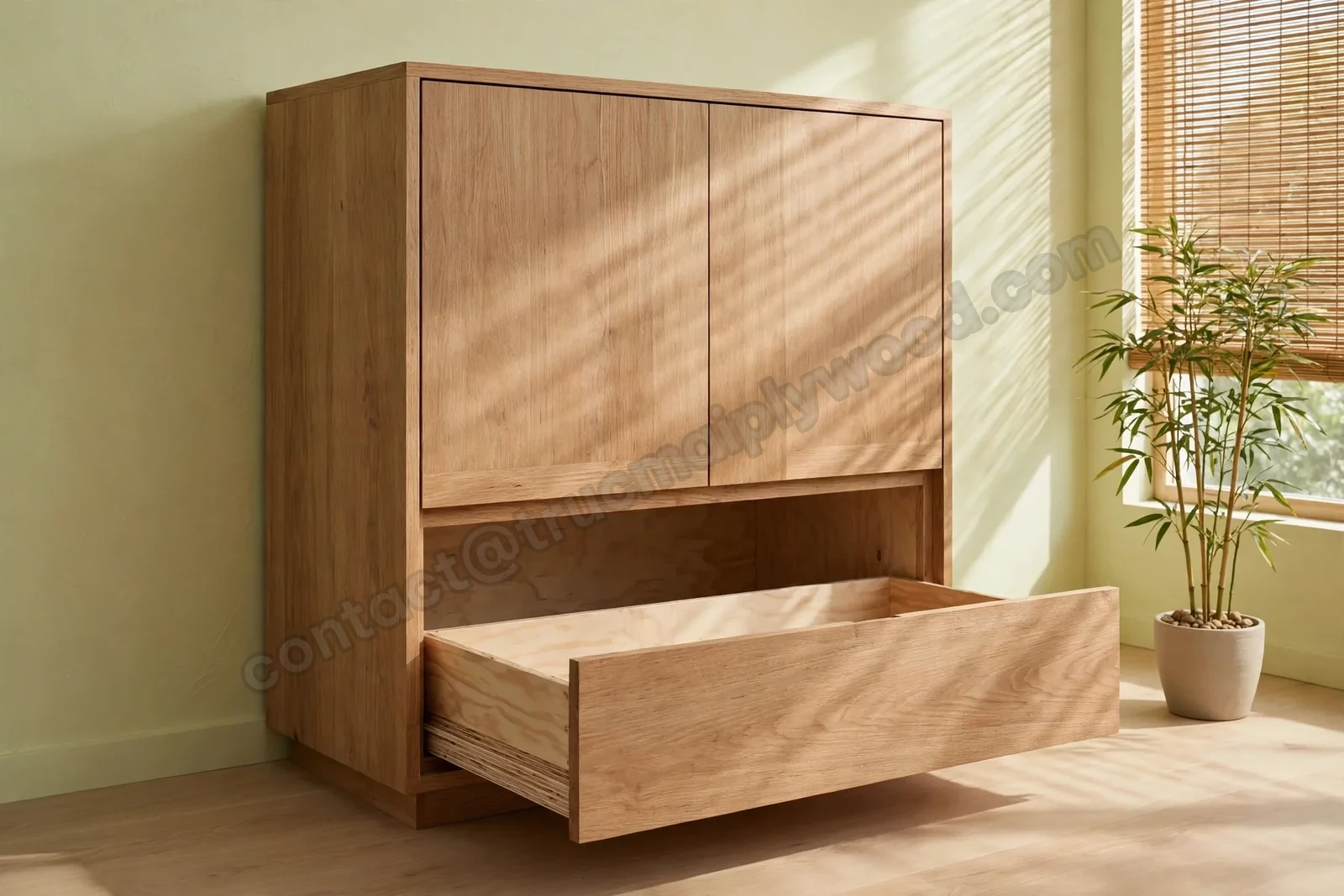
Thin plywood is suited to cabinet backs, drawer bottoms, furniture inserts and other non-structural interior parts. Its main advantage is that it provides a wood-veneer panel in a small section where a thicker board would add bulk without improving the intended furniture detail.
Cabinet backs are a common example. A back panel may sit in a groove, be fixed against a cabinet frame or be supported around its perimeter. The furniture design determines the support and fastening arrangement. For a visible interior, specify the face appearance and sanding level as well as the thickness. A concealed back can be selected against a different appearance sample while keeping the same functional dimensions.
Drawer bottoms need a clear fit with the drawer-side grooves and the expected contents. A panel intended for a shallow, lightly loaded drawer should not automatically be copied into a larger drawer design. The buyer’s drawing should identify the unsupported span, groove depth and how the bottom is retained. A factory can then make the panel to the agreed dimensions and face specification, rather than guessing the joinery from the term ‘drawer bottom’.
Furniture inserts include partition pieces, backing strips and internal components used in cabinets, wardrobes and other fitted interiors. Cut-to-size supply is especially useful when repeated parts are needed for a production run. Matching the cut labels to the furniture bill of materials makes it easier to receive and count components without measuring every piece again.
For a visible decorative panel, surface preparation may be the deciding factor. Truc Mai Plywood offers sanded and calibrated furniture faces and UV-ready panels prepared for the buyer’s own coating operation. The mill does not apply the UV coating. The buyer should identify which side will be visible and whether both sides require the same preparation. Face appearance should be agreed against an approved sample, with the face and back grades written as a pair.
Core selection also matters to the furniture maker. Styrax can be useful where a lighter panel is wanted, while Acacia and Eucalyptus offer other weight and construction choices. The face veneer remains a separate specification from the core. This lets a buyer keep a consistent visible appearance across furniture parts while selecting a core for the handling and fabrication requirements of each part.
For interior parts, a good drawing does more than state thickness. It identifies the installed orientation, supported edges, finished dimensions and any subsequent machining or surface treatment. Where a panel will be fixed close to hardware, include the hole or rebate locations in the component drawing rather than relying on a general sheet description. The interior plywood selection guide gives a broader view of panel choices for furniture projects.
How do glue choice and emission certification affect an order?
Glue formulation, bond performance and formaldehyde emissions are separate specifications, with Truc Mai’s CARB P2 and TSCA Title VI scope covering veneer-core hardwood plywood from 3 to 25 mm.
For a furniture programme, write the adhesive system and the emissions requirement on different lines of the purchase specification. A buyer may need a clean, sanded face for finishing, a bond suited to the intended service conditions and emissions evidence for the destination market. Those requirements are checked in different ways. An attractive face veneer tells the buyer little about the adhesive beneath it; similarly, an emissions certificate does not describe how a glue line behaves after wetting.
The standard interior formulation is UF glue at E0 emission. Where an order calls for greater water resistance, a melamine-fortified formulation can be specified, usually with E1 emission. The selected construction should be matched to the furniture’s actual exposure: a dry cabinet interior presents a different demand from a component likely to encounter repeated humidity during service. Buyers should describe the exposure in the RFQ rather than substitute a familiar adhesive abbreviation for a performance requirement.
The term E0 needs a defined testing basis in the buyer’s specification. It is not a universal class under the European EN 13986 system. A useful emissions line identifies the required test method, limit and applicable product construction. For US-bound veneer-core hardwood plywood, 40 CFR Part 770 specifies a formaldehyde emission limit of 0.05 ppm under the relevant testing framework. The corresponding Phase 2 formaldehyde limits guide explains the regulatory distinction in greater detail.
Truc Mai Plywood holds third-party CARB Phase 2 and EPA TSCA Title VI certification for hardwood plywood with veneer core, covering the specified thickness range. Its certificate is CARB/EPA 26053, mill identifier ICTT-26053, with ICTT Corporation as third-party certifier TPC-43. Include the exact panel build and thickness on the document request so the certificate and ordered product can be compared without relying on the general description “quarter-inch plywood”.
Quality management is another separate layer. ISO 9001:2015 certification covers the management system for plywood manufacturing; it is useful when assessing process control and document handling, but the buyer should still approve a sample and an order specification for the finished panel. A practical acceptance file contains the face and back grade pair, core construction, adhesive designation, emission requirement, dimensions and the agreed inspection method. This allows a receiving team to inspect the delivered material against the same requirements used by purchasing.
What is the price of 1/4 inch plywood for 4x8 feet?
Truc Mai does not publish a fixed price for a 4 × 8 quarter-inch sheet. The price of 1/4 inch plywood in a 1220 × 2440 mm sheet is quoted per order and depends on the specified core, face, glue and emission class, thickness tolerance, packing and order volume, so compare quotations against one specification.
A web listing often describes only a nominal thickness and a sheet footprint. For an importer, that is too little information to compare factory offers. A furniture-grade panel with a prepared decorative face, selected core and calibrated thickness is a different purchase from an unsanded commercial panel intended for concealed work. Even where the dimensions match, different construction details change the work required at the buyer’s cutting, edging and finishing stations.
Start with the intended use. For a visible furniture insert, identify the face veneer, back appearance and finishing process. For a concealed component, decide whether appearance or a particular machining characteristic matters more. The guide to how plywood is priced sets out the construction variables behind an offer. Buyers can then request like-for-like quotations rather than comparing product names alone.
A quotation comparison sheet should give each supplier the same fields:
| RFQ field | What the buyer should write | Why it affects comparison |
|---|---|---|
| Application | Cabinet back, drawer component or furniture insert | Establishes the required panel build |
| Core | Named species or agreed combination | Changes weight and machining behaviour |
| Face and back | Veneer species and approved grade pair | Defines visible appearance and sorting |
| Adhesive | Formulation and intended service conditions | Defines the bond requirement |
| Emissions | Destination-market requirement and evidence | Identifies the applicable compliance file |
| Dimensions | Ordered sheet thickness and format | Prevents nominal-size substitution |
| Finish | Sanding, calibration and surface preparation | Affects downstream processing |
| Packing | Full sheets or labelled cut pieces | Changes handling and pack design |
| Volume | Order quantity and product mix | Establishes the production and loading plan |
| Delivery | Named destination port and trade term | Keeps freight scope comparable |
The buyer should also distinguish factory supply terms from delivered-cost comparisons. Truc Mai offers FOB Hai Phong, CFR and CIF terms. A CFR quotation includes the agreed sea freight element, while CIF also includes insurance under the selected trade term. Comparing an FOB offer against a CIF offer without separating those components produces a misleading purchasing decision.
For a first container, identify whether the programme uses one panel configuration or a mixture. A container normally carries one or two products, with broader mixes agreed for the order. A mix of faces or cut patterns can help consolidate a furniture programme, but each variant needs its own specification and quantity line. The plywood RFQ checklist provides a format that purchasing, production and shipping teams can all use.
Finally, request the quotation against an approved sample or a clear reference specification. A sample resolves appearance and surface questions before they become a receiving dispute. It also helps the buyer identify whether a cheaper-looking offer actually omits calibration, face selection or protective packing.
Which documents accompany US and EU plywood shipments?
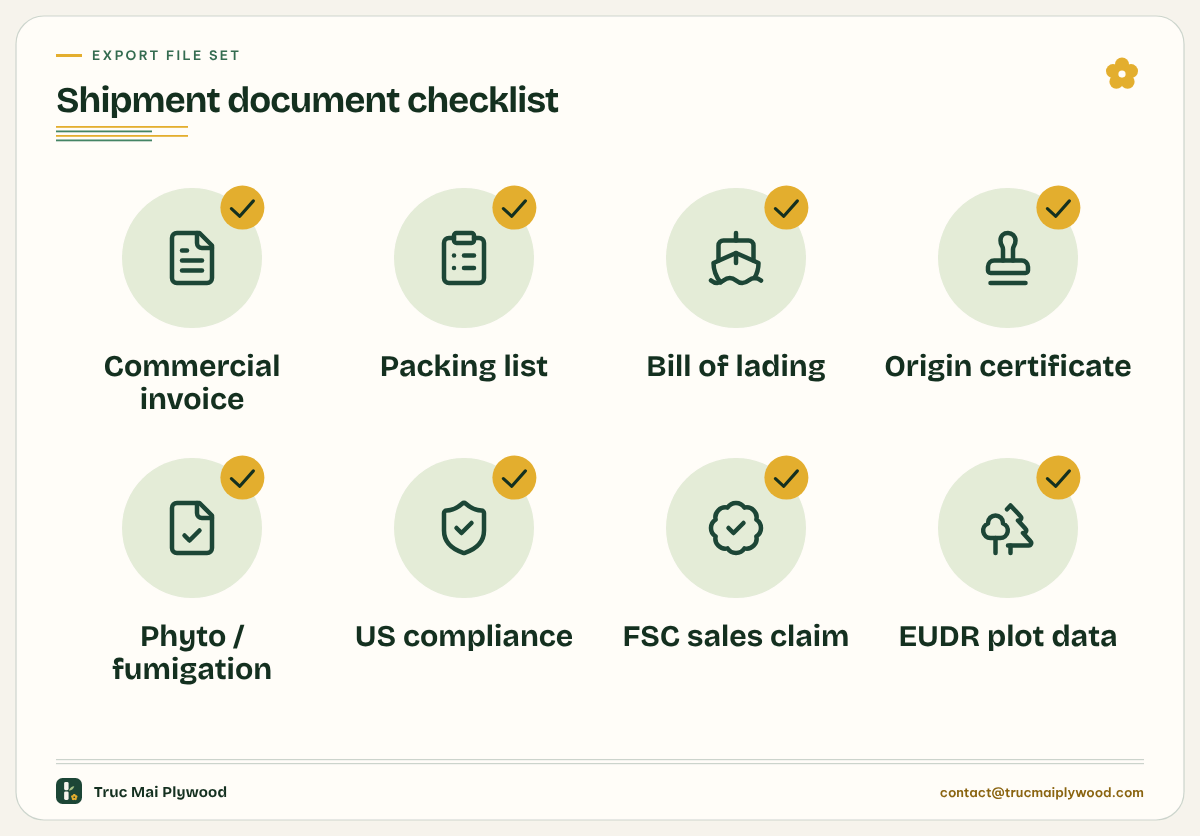
A shipment file includes the commercial documents and the product-specific evidence agreed for the destination market.
The commercial set normally comprises the invoice, packing list, bill of lading and certificate of origin. Phytosanitary and fumigation papers are supplied as applicable to the shipment, and CIF shipments include the insurance documentation. These papers serve different purposes: the invoice describes the sale, the packing list identifies what was loaded, and the bill of lading records the carriage arrangement. A useful packing list separates panel specifications and quantities so the importer can reconcile the shipment with the purchase order.
For US imports, the product compliance file should identify the relevant hardwood plywood construction and its CARB Phase 2 and TSCA Title VI evidence. The US rule addresses certification, records and labelling as well as emission limits. The regulation cited above is the primary reference for the importer and supplier. Match the certificate scope to the ordered veneer-core panel and keep the product identifiers consistent between the order, packing list and compliance documents. The US plywood import steps guide covers the wider entry workflow.
For EU-bound orders, the buyer’s file can include emissions evidence, relevant origin documentation and the EUDR due-diligence dossier. Truc Mai supplies origin records and geolocation files for both Vietnamese core wood and imported face veneer. Keeping the face and core trails separate matters when the species and countries of production differ. The EU importer can use the dossier in its own due-diligence process and due-diligence statement submission.
The European Commission’s EUDR implementation update sets out the applicable timetable and the Information System used for statements. A purchase file should connect the product description, species, production origin and relevant geolocation records to the shipped goods. The EU plywood import steps guide explains how these materials fit into the buyer’s entry preparations.
Where FSC 100% material is ordered, the sales documentation identifies the applicable FSC claim for the eligible product and the seller’s chain-of-custody certificate code. Truc Mai’s FSC licence code is FSC-C196493 and its chain-of-custody certificate is SA-COC-014545. Specify FSC 100% as a distinct order line so the claimed material and commercial documents remain aligned. The claim applies to products covered by the certificate’s product schedule, rather than to every plywood configuration in the catalogue.
A sensible document workflow starts before production. Request the product certificates and agreed evidence with the specification, then check the draft shipping documents after loading. Compare the face, core, thickness, sheet format, package count and consignee details against the order. Catching a description mismatch at the draft stage is considerably easier than correcting it after the goods reach the destination port.
How do buyers order samples and issue a complete RFQ?
A useful RFQ states application, core, adhesive and emission, face, size, packing, quantity and destination port.
Begin with the part that the plywood will become. A cabinet manufacturer may need a back panel that machines cleanly and accepts its chosen finish; a furniture component buyer may care more about repeatable cutting dimensions and face consistency. Send a drawing or cut list when the order contains parts rather than whole sheets. The drawing should show finished dimensions, grain direction where appearance matters, piece labels and any required separation between different part types.
Next, specify the panel construction. Name the core species, face veneer and approved face/back grade pair. State whether the surfaces will be sanded and calibrated and describe the downstream coating or laminating process. If a finish sample is available, include it with the reference panel. The written specification should record the approved appearance so purchasing and receiving teams work from the same standard.
Write adhesive and emissions requirements independently. The RFQ should state the intended interior service conditions, requested glue formulation, destination market and required evidence. If the order needs US-certified veneer-core hardwood plywood, identify that requirement directly rather than asking for a generic low-emission sheet. This is also the point to state whether FSC 100% material and its sales-document claim are required.
For cut-to-size supply, attach a piece schedule alongside the sheet specification. Give each part a code, required quantity, finished dimensions and packing group. Indicate whether pieces from different furniture models can share a pack. Labels should correspond to the receiving warehouse’s own identifiers, not merely to a saw operator’s temporary marks. See the cut-plan and 40HC tables above for yield and packing arrangements.
A complete request can follow this sequence:
- Application: identify the furniture component and whether the face remains visible.
- Construction: state the core, face, back grade pair and surface preparation.
- Adhesive and emissions: give the intended service conditions and market-specific documentation requirement.
- Dimensions: list sheet or finished-part sizes, tolerance and grain orientation.
- Packing: specify protection, piece labels, pack grouping and any warehouse handling needs.
- Quantity and destination: state the product mix, requested shipment volume, port and trade term.
Truc Mai Plywood offers free samples. New buyers arrange their own courier, and that courier cost can be credited against an actual order. Use the sample to assess the face and back, edge quality, surface preparation and suitability for the intended machining operation. Record the sample identifier on the RFQ so the production specification has a tangible reference.
The standard minimum order is one 40HC container. Production is normally scheduled for 15–45 days after receipt of the 30% deposit, according to the agreed order. Standard settlement is the remaining 70% against a scanned bill of lading, by telegraphic transfer, or an irrevocable letter of credit at sight. Put the agreed payment method and delivery term on the purchase order rather than leaving them in an email thread.
Before issuing the order, check that the sample approval, written specification, cut schedule and requested certificates describe the same configuration. The sample-ordering guide covers the initial evaluation, while the RFQ writing guide helps turn the approved details into a factory-ready enquiry.
Send your specification to contact@trucmaiplywood.com or through the quotation form.
Questions buyers ask
Is quarter-inch plywood exactly 6 mm?
No. One quarter inch is 6.35 mm; nominal quarter-inch products may have different actual thicknesses. Specify the millimetre thickness in the order.
Can 6 mm plywood be used for a cabinet back?
Yes. A 6 mm interior plywood panel can be specified for cabinet backs where the cabinet design provides appropriate support.
Is 6 mm plywood always five-ply?
No. Truc Mai specifies the ply construction for 6 mm panels by order; its 3–5 mm panels use five plies.
Can I request an okoume face on a Vietnamese core?
Yes. Okoume is a face veneer option, and the core species is specified separately.
Are birch-faced panels made entirely of birch?
No. Truc Mai offers birch-faced plywood on Vietnamese core species rather than all-birch plywood.
Can cut panels be labelled by furniture part?
Yes. Cut-to-size orders can specify labelled pieces against the agreed cut list.
Does a cut-piece count equal a guaranteed container load?
No. Cut-piece counts are derived from a planning model; actual packing, gross cargo mass and the carrier booking govern loading.
Can I request sanded and calibrated faces?
Yes. Truc Mai supplies sanded and calibrated furniture panels, with the surface preparation written in the specification.
Does a low-emission grade establish water resistance?
No. Emission class and adhesive bond performance are different specifications and require separate evidence.
Is FSC 100% available on every sheet?
FSC 100% claims apply to eligible products within the certificate schedule and must appear on the relevant sales documents.
What is the minimum order?
Truc Mai’s standard minimum order is one 40HC container, with product mixes agreed for the order.
Can I obtain a sample before ordering?
Yes. Truc Mai offers free samples; new buyers arrange their courier.