
Particle board is a panel pressed from wood particles and resin, usually urea-formaldehyde, with fine faces over a coarser core. EN 312 sorts it into types P1 to P7, from dry-use furniture board to heavy-duty load-bearing board. Its specific gravity runs 0.6 to 0.8, against 0.4 to 0.6 for plywood, which changes strength, screw loads and container weight.
What is particle board, and what is it made of?
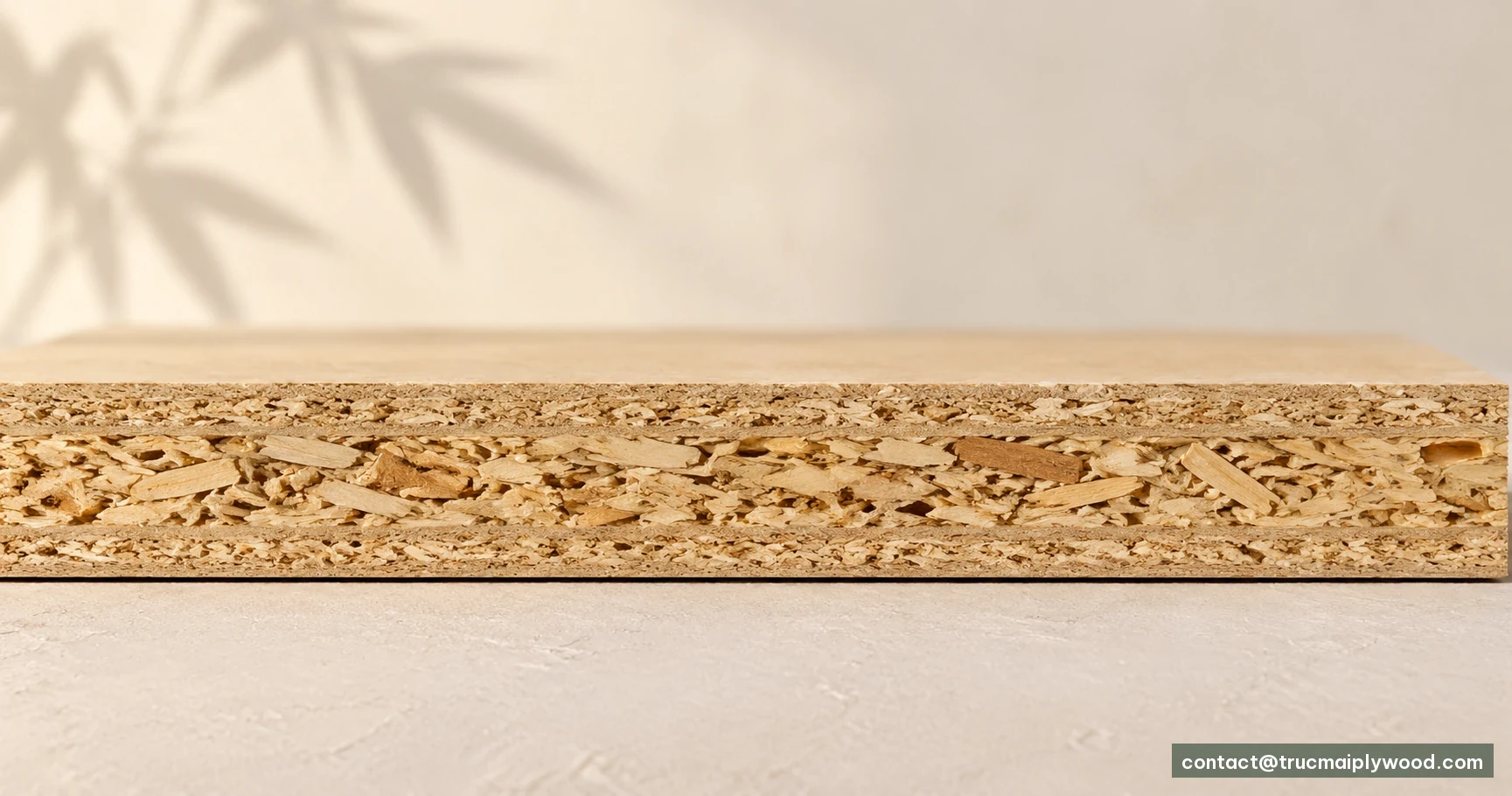
Particle board is a wood-based sheet made by pressing discrete wood particles together with resin. Unlike plywood, it contains no continuous veneer layers. The US Environmental Protection Agency distinguishes its particles from fibres, flakes and strands (EPA definition). European standard EN 312 specifies particleboards for different uses (EN 312 preview).
The wood element is the major component. The US Forest Products Laboratory describes wood as the main constituent of conventional wood-based composites, with resin and additives making up the rest (Wood Handbook, chapter 11). The raw material can be sawdust, planer shavings and other mill residues as well as cut flakes, so the panel turns by-products of other wood processing into sheets.
Three features set it apart from plywood. It has no veneers and no grain direction, so a sheet behaves the same along and across its length. It is made in layers of different particle size, so the faces are dense and smooth while the core is open. And it is usually bonded with urea-formaldehyde resin, which the Wood Handbook describes as dominating the interior panel market.
Particle board is the predominant material in ready-to-assemble furniture, and most of it is sold with a decorative overlay rather than bare. The sections below follow the questions a buyer asks in order: names, manufacture, types, strength, density, moisture, formaldehyde, uses, overlays, tolerances, neighbouring panels, and the comparison with plywood on a container basis.
Is chipboard the same as particle board, and what are pressed wood and presswood?
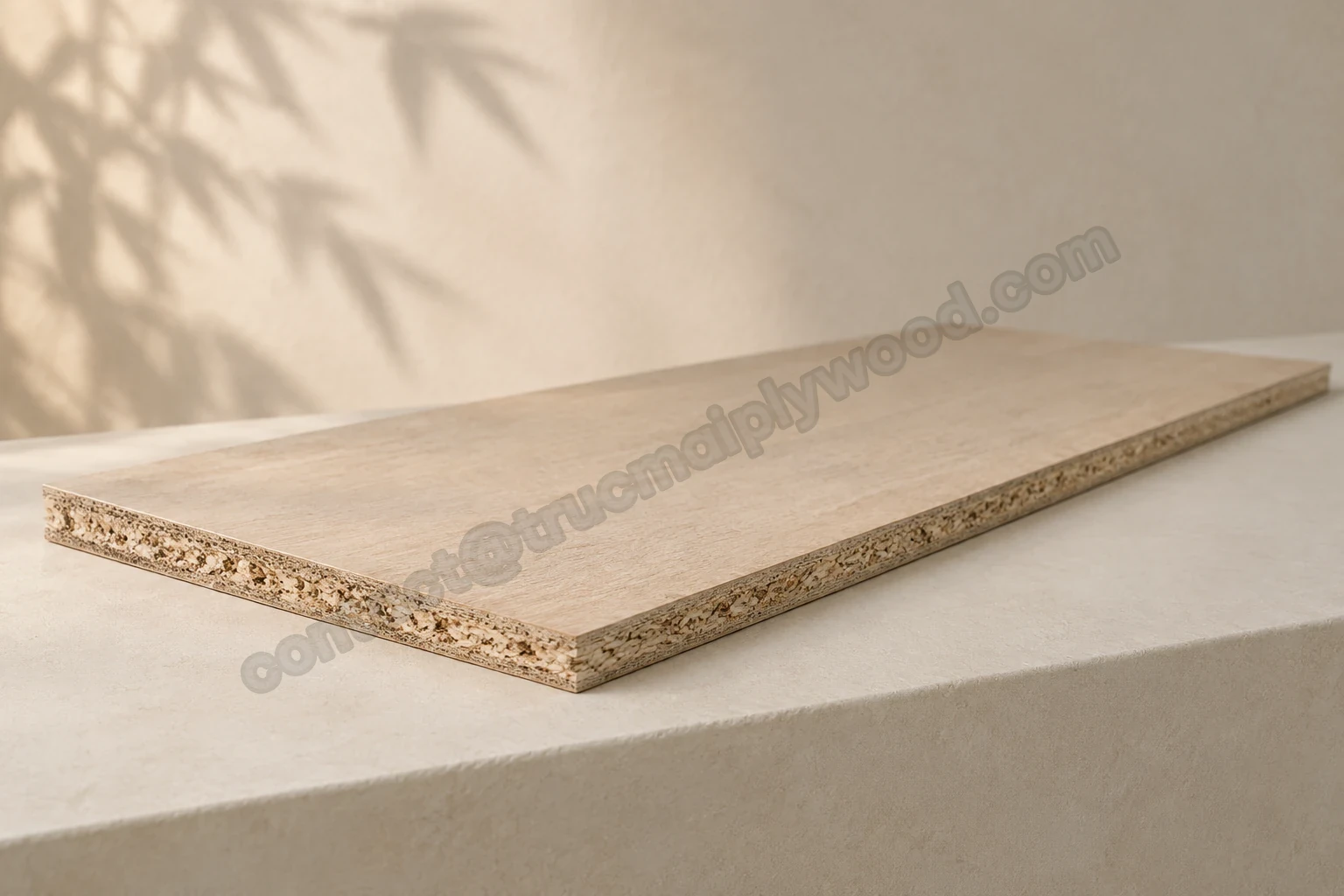
Yes: chipboard and particle board name the same panel, and the standards use only the second term. Chipboard is the older trade word and particleboard the word used by the standards and in North America, and the standards define one product under the name particleboard. So “chipboard sheets” and “chip board sheets” in a catalogue mean particle board sheets.
Other names cause real confusion because they cover more than one panel. The table sorts them.
| Name in a catalogue | What it means | Check on the order |
|---|---|---|
| Particle board, particleboard | Pressed from discrete wood particles and resin | The EN 312 type (P1 to P7) or the ANSI grade |
| Chipboard, chipboard sheets | Same panel, trade term | The EN 312 type and the emission class |
| Pressed wood, presswood | Informal umbrella term, used for particle board, MDF and sometimes hardboard | Ask which panel is meant, and the density |
| Particle wood | Informal, seen in listings for particle board | Treat as particle board and ask for the type |
| Laminated particle board | Particle board with a melamine, HPL or paper overlay | The overlay, the core type and the edge treatment |
| MDF | Pressed from dry-formed fibres, not particles | A different panel; see the comparison below |
The reason to keep the names straight is the formaldehyde and strength rules. US law treats particleboard and medium-density fiberboard as two products with different limits. The Wood Handbook says particle board is generally not as strong as fibreboard, because the high aspect ratio of wood fibre is exploited less well in a particle. A buyer who accepts “pressed wood” on a quote has not yet been told which of the two is coming.
How is particle board manufactured, step by step?
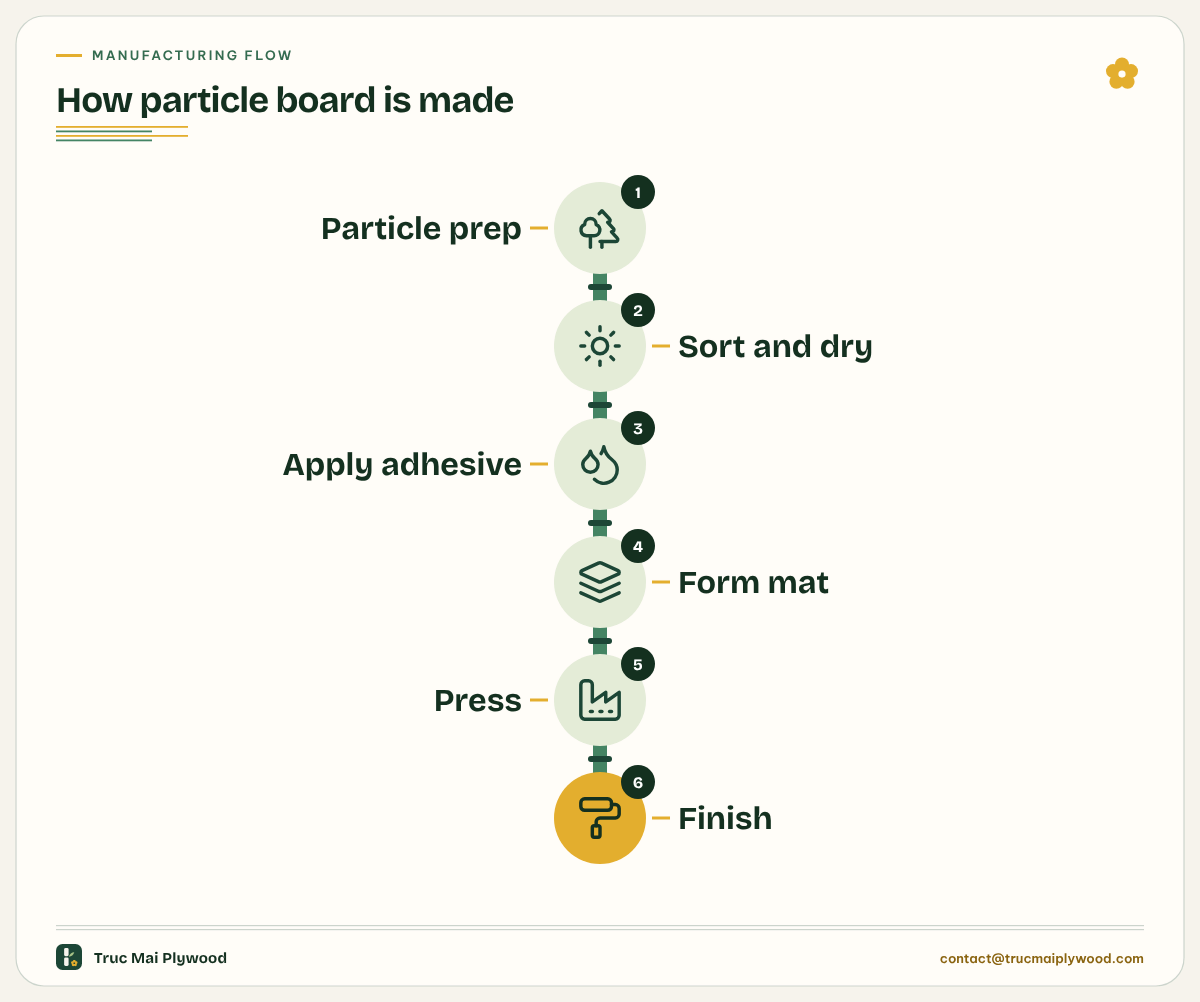
Particle board is made dry, in six steps, and the Wood Handbook names them: particle preparation, particle classification and drying, adhesive application, mat formation, pressing and finishing (Wood Handbook, chapter 11). The numbers inside those steps are what separate one board from another.
- Particle preparation. Hogs, chippers, hammermills, ring flakers and attrition mills reduce logs, shavings and residues to particles. Desirable particles are long and thin, with no oversize pieces, no splinters and no dust, because fines raise the resin demand and oversize pieces leave flaws inside the board.
- Classification and drying. Screens separate coarse from fine material. Dryers reduce furnish moisture before the resin is applied.
- Adhesive application. Resin coats the particles before mat formation. Face and core furnish can receive different amounts. Wax can improve short-term moisture resistance.
- Mat formation. The particles are laid in an even mat, in one or several layers. A common three-layer board has coarser, longer core particles and shorter, thinner surface particles. A five-layer board adds long, thin particles in the intermediate layer, which gives high bending strength and stiffness and carries the fine surface.
- Pressing. The mat is pre-pressed and hot-pressed. Factories use multi-opening or continuous presses.
- Finishing. Panels are trimmed to length, width and squareness, then sanded or planed before packing. They may be veneered or overlaid, or finished with lacquer or paint.
Two points carry over to the order. The fine-face, coarse-core build explains why the faces take an overlay or paint well and why the core edge is rough. And since the resin share is only a few per cent, the density and the particle shape, not the glue, decide most of the strength.
Plywood is built the other way round: whole veneers glued in crossing layers. That difference, covered in cores, glue and plies, is why the two panels diverge on strength, moisture and weight in the sections that follow.
What are particle board types P1 to P7?
EN 312 defines seven types of particle board, P1 to P7, and the choice between them is a choice between dry and humid service and between furniture and structure (EN 312 preview). The BSI record shows the standard as published on 30 November 2010 and currently under review (BSI).
| Type | EN 312 description | Conditions | Typical buyer |
|---|---|---|---|
| P1 | General purpose boards | Dry | Non-load-bearing fitments, packaging parts |
| P2 | Boards for interior fitments, including furniture | Dry | Furniture and cabinet factories |
| P3 | Non load-bearing boards | Humid | Kitchen and bathroom furniture parts |
| P4 | Load-bearing boards | Dry | Building elements |
| P5 | Load-bearing boards | Humid | Building elements |
| P6 | Heavy duty load-bearing boards | Dry | Building elements |
| P7 | Heavy duty load-bearing boards | Humid | Building elements |
“Dry” and “humid” are defined by service classes. Dry conditions correspond to service class 1 of EN 1995-1-1: a controlled indoor climate. Humid conditions correspond to service class 2: a more humid service climate. EN 312 notes that types P4 to P7 are intended for load-bearing or stiffening building elements such as walls, flooring, roofing and I-beams.
A furniture or cabinet buyer is therefore choosing between P2 and P3. P1 is the general-purpose grade for dry, non-load-bearing work, and P4 to P7 belong to construction, which is outside what a furniture line buys.
Type P3 adds requirements P2 does not have: a limit on swelling in thickness after 24 hours in water, and a moisture-resistance test by either a cyclic test or a boil test. The numbers sit in the moisture section below. The practical consequence for a quotation is short: write the type, not just “particle board”, because P2 and P3 are different products on the same dimensions.
Which tests sit behind an EN 312 particle board type?
Ten test methods sit behind the EN 312 tables, and a test report that names none of them says little about the board (EN 312 preview). The table lists the method for each property, so a buyer can match a report line to a requirement.
| Property | Test method | What it measures |
|---|---|---|
| Bending strength and modulus of elasticity | EN 310 | Bending test on a strip cut from the panel |
| Internal bond | EN 319 | Tensile strength across the thickness |
| Surface soundness | EN 311 | Hold of the surface layer against the core |
| Swelling in thickness, 24 h | EN 317 | Thickness gain after soaking in water |
| Internal bond and swelling after cyclic test | EN 321 | Ageing by wetting, freezing and drying |
| Internal bond after boil test | EN 1087-1 | Ageing in boiling water |
| Moisture content | EN 322 | Water share of the board at dispatch |
| Thickness, length and width | EN 324-1 | Dimensions against the nominal size |
| Edge straightness and squareness | EN 324-2 | Shape of the cut edges and corners |
| Mean density within a board | EN 323 | Density spread across one board |
| Formaldehyde release and content | EN 717-1, EN 120 | Chamber release and perforator content |
Three rules in the standard change how a report is read. The standard assesses characteristic values, rather than accepting a batch average alone. Bending strength and modulus values apply in the weakest direction in the plane of the panel, although the maker may test only the main direction if that direction is marked on the finished panel. EN 312 also adjusts perforator measurements for the moisture content of the tested board.
The factory-control note is worth a line of its own. EN 312 also describes factory monitoring using rolling EN 120 measurements. A supplier who runs this control can show the running figure, and a buyer who asks for it learns how close to the limit the production sits.
How strong is particle board against plywood?
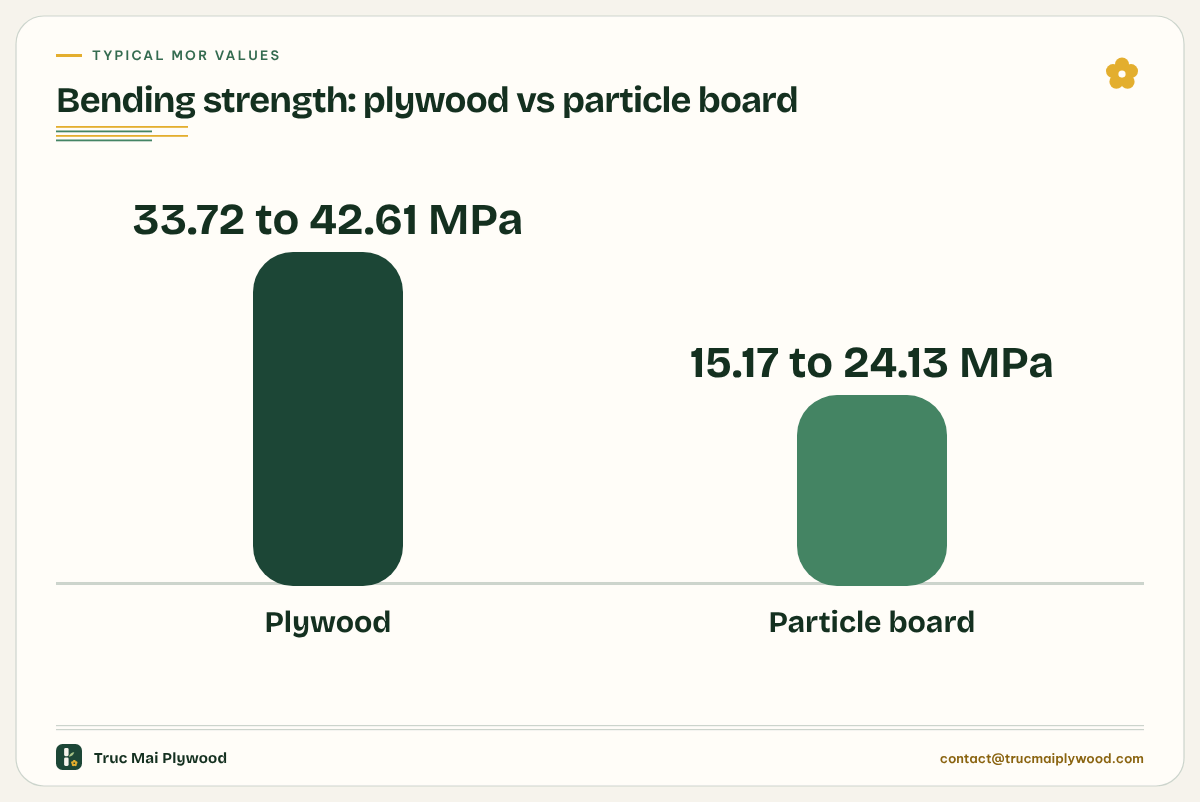
Plywood is the stiffer and stronger panel in bending, by the US Forest Products Laboratory figures for panel products (Wood Handbook, chapter 12). The Wood Handbook gives the reason for the lower chipboard properties: the high aspect ratio of wood fibre is exploited less well in a particle than in a fibre or a veneer.
| Panel | Specific gravity | Bending stiffness (MOE), GPa | Bending strength (MOR), MPa |
|---|---|---|---|
| Hardboard | 0.9 to 1.0 | 3.10 to 5.52 | 31.02 to 56.54 |
| Medium-density fibreboard | 0.7 to 0.9 | 3.59 | 35.85 |
| Particle board | 0.6 to 0.8 | 2.76 to 4.14 | 15.17 to 24.13 |
| Oriented strandboard | 0.5 to 0.8 | 4.41 to 6.28 | 21.80 to 34.70 |
| Plywood | 0.4 to 0.6 | 6.96 to 8.55 | 33.72 to 42.61 |
Source: Wood Handbook, chapter 12, Table 12-1. MOE is the modulus of elasticity and MOR the modulus of rupture.
EN 312 sets minimum values, not typical ones, and they fall with thickness. For type P2 the bending strength is the specified minimum bending strength for boards above 6 mm up to 13 mm, the specified minimum bending strength above 13 mm up to 20 mm, the specified minimum bending strength above 20 mm up to 25 mm, and the specified minimum bending strength above 3the stated squareness tolerance up to 40 mm. The table gives all P2 minima by thickness band.
| Nominal thickness, mm | Bending strength, N/mm² | Modulus of elasticity, N/mm² | Internal bond, N/mm² | Surface soundness, N/mm² |
|---|---|---|---|---|
| Under 3 | specified by EN 312 | specified by EN 312 | specified by EN 312 | specified by EN 312 |
| 3 to 4 | specified by EN 312 | specified by EN 312 | specified by EN 312 | specified by EN 312 |
| Over 4 to 6 | specified by EN 312 | specified by EN 312 | specified by EN 312 | specified by EN 312 |
| Over 6 to 13 | specified by EN 312 | specified by EN 312 | specified by EN 312 | specified by EN 312 |
| Over 13 to 20 | specified by EN 312 | specified by EN 312 | specified by EN 312 | specified by EN 312 |
| Over 20 to 25 | specified by EN 312 | specified by EN 312 | specified by EN 312 | specified by EN 312 |
| Over 25 to 32 | specified by EN 312 | specified by EN 312 | specified by EN 312 | specified by EN 312 |
| Over 32 to 40 | specified by EN 312 | specified by EN 312 | specified by EN 312 | specified by EN 312 |
| Over 40 | specified by EN 312 | specified by EN 312 | specified by EN 312 | specified by EN 312 |
| Source: EN 312:2010, Table 3, type P2, under the standard conditioning conditions. The values are 5 percentile values and apply in the weakest direction of the panel. |
Internal bond is the property that matters most for furniture. It measures how well the core holds together when pulled apart at right angles to the face, and it governs hinge, screw and cam-lock fixings that pull on the core. The required value falls as the board gets thicker, from the specified internal-bond minimum under 6 mm to the specified internal-bond minimum above 3the stated squareness tolerance.
One difference does not appear in the standards: plywood has a strong direction along its face grain, while particle board has near-equal properties in both directions. For a shelf that spans a wide opening, the lower stiffness in the table means more deflection at the same thickness and span.
What density does particle board have?
Particle board has a specific gravity of 0.6 to 0.8, which is a density of 0.6 to 0.8 times that of water (Wood Handbook, chapter 12). Plywood sits at 0.4 to 0.6 in the same table, so for the same thickness and size a particle board sheet is the heavier sheet.
The same chapter lists measured values for nine industrial boards (Table 12-4). The spread inside the “particle board” label is wide, and strength follows density.
| Mill | Moisture content, % | Specific gravity | Bending strength (MOR), MPa | Internal bond, MPa |
|---|---|---|---|---|
| A | 8.7 | 0.71 | 16.8 | 0.79 |
| B | 9.1 | 0.72 | 20.6 | 1.07 |
| C | 9.8 | 0.76 | 18.9 | 1.00 |
| H | 8.0 | 0.77 | 22.8 | measured |
| J | 8.5 | 0.72 | 17.2 | 0.45 |
| K | 9.1 | 0.68 | 15.2 | 0.31 |
| L | 9.3 | 0.62 | 17.0 | measured |
| M | 9.7 | 0.65 | 18.9 | 0.69 |
| N | 8.3 | 0.60 | 17.0 | 0.31 |
Source: Wood Handbook, chapter 12, Table 12-4, from McNatt (1973).
Two readings matter for a buyer. First, two boards with the same nominal thickness and the same name can differ widely in internal bond, from 0.31 to the upper measured internal-bond result, so a type or a test report is the only way to compare them. Second, density is not a quality mark by itself: mill N at 0.60 and mill H at 0.77 both pass as particle board, and the heavier board is not stronger in every property.
EN 312 does not set a density for any type. It sets a tolerance on the mean density within a board of plus or minus the permitted density variation. If a project needs a density, such as for hinge fixing or weight limits in transport, it goes on the order as a number with a tolerance. The supplier gives a measured value.
How does particle board cope with moisture?
Particle board is a dry-use panel, and its binder explains why: the Wood Handbook rates urea-formaldehyde as moderately durable under damp atmospheres, with moderate to low resistance to wetting and to temperatures above elevated temperatures (Wood Handbook, chapter 10). The same table says it dominates the interior panel market, including particleboard.
The chapter 11 text adds the manufacturing side: since most applications are interior, particle board is usually bonded with urea-formaldehyde, though phenol-formaldehyde and melamine-formaldehyde resins are sometimes used where more moisture resistance is needed, and wax improves short-term moisture resistance only.
EN 312 turns that into numbers for type P3, the humid-use type for non-load-bearing boards. Swelling in thickness after 24 hours in water may not exceed the following, depending on nominal thickness.
| Nominal thickness, mm | Maximum swelling in thickness after 24 h, % | Internal bond after cyclic test, N/mm² |
|---|---|---|
| Under 3 | EN 312 thickness-band limit | 0.18 |
| 3 to 4 | EN 312 thickness-band limit | 0.18 |
| Over 4 to 6 | EN 312 thickness-band limit | 0.18 |
| Over 6 to 13 | EN 312 thickness-band limit | 0.15 |
| Over 13 to 20 | EN 312 thickness-band limit | 0.13 |
| Over 20 to 25 | EN 312 thickness-band limit | 0.12 |
| Over 25 to 32 | EN 312 thickness-band limit | 0.10 |
| Over 32 to 40 | EN 312 thickness-band limit | 0.09 |
| Over 40 | EN 312 thickness-band limit | 0.08 |
| Source: EN 312:2010, Tables 4 and 5, type P3, cyclic-test option. The standard also offers a boil test, with internal bond limits from 0.09 down to the lower specified internal-bond threshold. |
The table is the honest answer to “is particle board waterproof”: no type is, and even P3 is allowed to swell by the lower swelling threshold to the upper swelling threshold in 24 hours depending on thickness. Swelling is permanent, since the particles do not spring back, and it shows first at edges and screw holes. This is the main reason furniture makers who work on kitchen and bathroom parts look at plywood or sealed edges, a choice taken up in the comparison section.
Moisture content at delivery is a separate control. EN 312 requires the lower factory moisture threshold to the upper factory moisture threshold when the board leaves the factory, and a board stored in a humid warehouse will leave that range before it reaches the line.
How much formaldehyde can particle board release?
Particle board sold in the United States may not exceed the applicable particleboard emission limit formaldehyde in the ASTM E1333 chamber test (40 CFR 770.10). The limit applies to composite wood products sold, supplied, offered for sale or manufactured, imported ones included, on or after 1 June 2018.
| Product | US federal limit (TSCA Title VI), ppm | California limit (CARB Phase 2), ppm | CARB date |
|---|---|---|---|
| Particleboard | 0.09 | 0.09 | January 2011 |
| Medium-density fibreboard | 0.11 | 0.11 | January 2011 |
| Thin MDF (8 mm or less) | 0.13 | 0.13 | January 2012 |
| Hardwood plywood, veneer core | 0.05 | 0.05 | January 2010 |
| Hardwood plywood, composite core | 0.05 | 0.05 | July 2012 |
Sources: US EPA emission standards and product definitions and EPA panel-producer guidance. Values are ppm by ASTM E1333; CARB dates are historical context.
A composite core, in the federal definition, is a core of particleboard, medium-density fibreboard or a combination. A hardwood plywood panel built on such a core therefore meets the 0.05 ppm plywood limit in the table, not the the applicable particleboard emission limit particleboard limit. The plywood limit applies the same way to a veneer core.
Europe works on different units. EN 312 sets two classes by the EN 717-1 chamber test: class E1 at a release of 0.124 mg/m³ of air or less, and class E2 above that, up to 0.3 mg/m³. The factory-control alternative is the perforator value of EN 120: E1 at 8 mg per 100 g of oven-dry board or less, E2 above 8 and up to 20 mg per 100 g. EN 312 adds that in certain countries only E1 products are allowed.
From 6 August 2026, the EU restricts formaldehyde in wood-based articles and furniture placed on its market to 0.062 mg/m³ in indoor air, after a transition of 36 months for producers (Regulation (EU) 2023/1464, Annex, entry 77). The test conditions differ from EN 717-1, and ppm and mg/m³ results are not interchangeable, so none of the figures in this section converts into another. For the plywood side of the same rules see Phase 2 formaldehyde limits.
The order line should name the regime the panel is sold under: the emission class for Europe, or the TSCA Title VI and CARB statement and the certifier for the United States.
Where is particle board used, and where is it a poor choice?
Particle board is used first for furniture: the Wood Handbook calls it the predominant material in ready-to-assemble furniture, where it is overlaid with other materials for decorative purposes. Particle board uses, according to the same chapter, also include flooring systems, manufactured houses, underlayment, and, in thin panels, a substrate for paneling.
| Use | Type or build | Why particle board is chosen |
|---|---|---|
| Ready-to-assemble furniture, carcasses | P2, melamine-faced | Flat, smooth face for overlay; low cost per sheet |
| Furniture parts in humid rooms | P3, edge-sealed | Swelling limit and moisture test of EN 312 type P3 |
| Shelving, wardrobe carcasses | P2 | Dry interior, short spans |
| Underlayment, flooring systems | North American grades (ANSI A208.1) | Flat, uniform thickness |
| Load-bearing floors, walls, roofs | P4 to P7 | EN 312 structural types, designed to EN 1995-1-1 |
The first three rows cover most of what a furniture or cabinet factory buys. The standard that governs them is EN 312 type P2 or P3 in Europe, and ANSI A208.1 in North America; the Wood Handbook names ANSI A208.1 as the American standard for particleboard and notes that the test requirements give some indication of product quality, but were not developed to correlate with the performance of whole panels in specific uses.
Where particle board is a poor choice follows from the earlier sections. It is poor wherever a panel sees liquid water or sits on a damp wall, wherever a long span needs stiffness, and wherever a joint must be reopened many times, because fixings that pull on the core depend on its internal bond. These are uses where plywood or a plywood-cored panel replaces it, covered in plywood for kitchen cabinets.
What does laminated particle board add to the core?
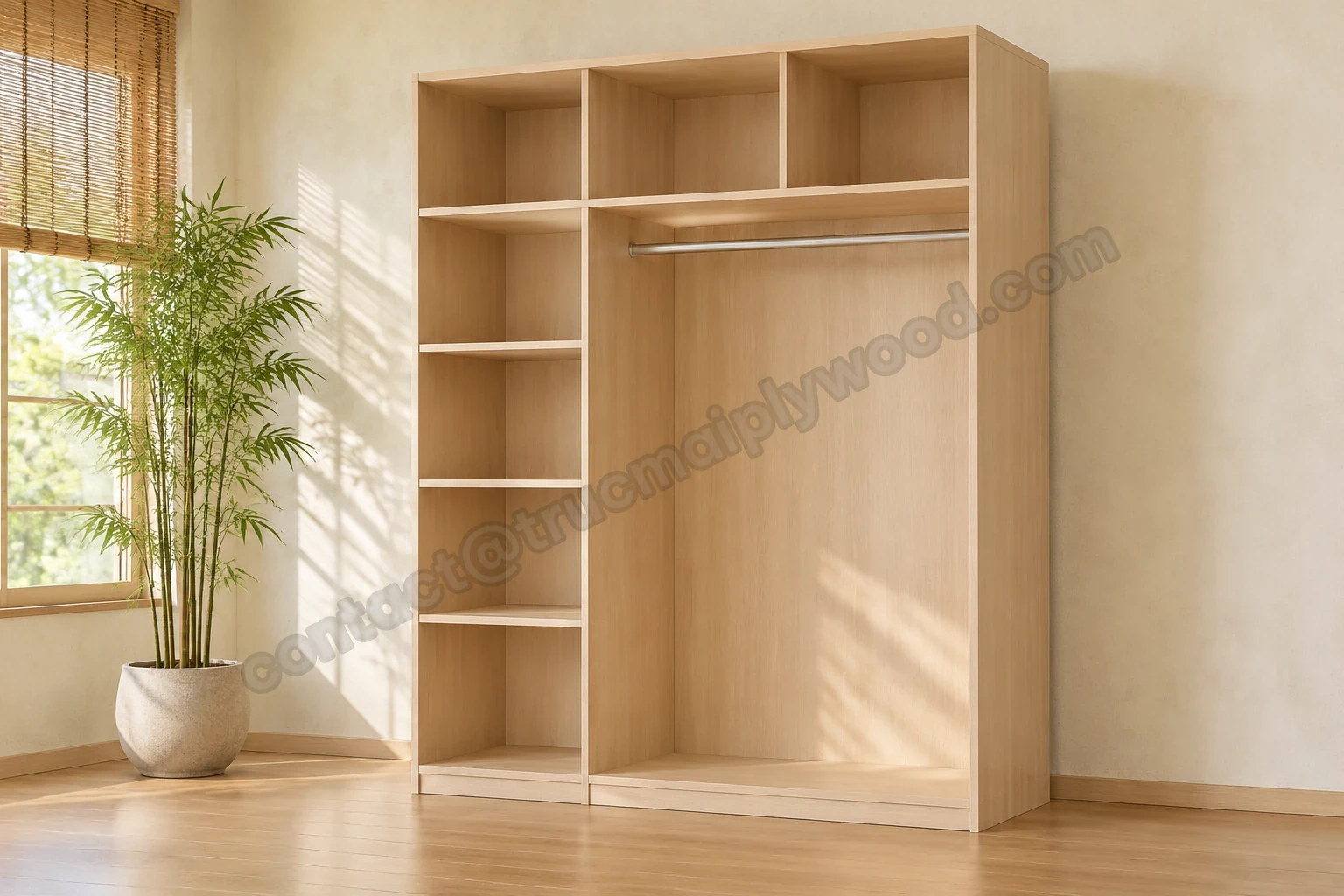
Laminated particle board is particle board with a decorative surface bonded to both faces, most often melamine-impregnated paper, high-pressure laminate (HPL) or wood veneer. The Wood Handbook describes the process: after sanding, particleboards may be veneered or overlaid with other materials to provide a decorative surface, or finished with lacquer or paint.
Particle board suits overlays because of the fine-particle surface layers described in the manufacturing section. A smoother surface for laminating, overlaying, painting or veneering is the stated reason for the fine faces over a coarse core. The overlay, not the core, decides the look, the scratch resistance and the cleanability, and the core decides the weight, the edge and the screw hold.
Three details govern a laminated panel order.
- The overlay type. Melamine paper is usually bonded in the press, which makes it a common choice for carcasses, while HPL is a separate laminate that is glued on. The same overlay choices exist on plywood; see melamine faced plywood and laminates for plywood.
- The emission statement. Ask for the formaldehyde class or certificate of the panel that will be delivered, overlay included, not of the bare core board.
- The edge. A particle board core edge is open and rough, and the unsealed edge absorbs water first. Furniture makers cover it with edge banding. A plywood core shows a clean layered edge that can be left visible or lightly sealed, which is a design choice as well as a cost.
Which standards and grade marks apply to particle board?
Six sets of rules apply to a particle board shipment, and they answer different questions: what the board is, how strong it is, how much formaldehyde it releases, and whether it can be sold in the market. The table lists them without repeating the limits given above.
| Rule | Body | Question it answers | Where it applies |
|---|---|---|---|
| EN 309 | CEN | Definition and classification of particleboards | Europe |
| EN 312 | CEN | Requirements for types P1 to P7 | Europe; called up in EN 13986 for construction, where its boards are named resin-bonded particleboards |
| ANSI A208.1 | Composite Panel Association, as an American National Standard | Grades, properties and emission of particleboard | North America |
| 40 CFR Part 770 | US EPA, TSCA Title VI | Formaldehyde limit for composite wood products | United States, including imports |
| CARB composite wood rule | California Air Resources Board | Phase 2 formaldehyde limit | California |
| Regulation (EU) 2023/1464 | European Union | Formaldehyde restriction in wood-based articles and furniture | EU market |
The Wood Handbook explains what a grade mark means in North America: a mark on particleboard shows the product has been periodically tested for compliance with voluntary industry product standards, and that the quality-control system of the plant meets set criteria. It adds that the tests give some indication of product quality, but were not developed to correlate with the performance of whole panels in specific uses (Wood Handbook, chapter 11).
For a buyer outside both regions, the working rule is simple. Ask for the standard that the destination market recognises, and for the report on the delivered board, not on a similar one. A panel quoted “to EN 312” with no type letter, or “CARB” with no certifier named, has not been described.
What sizes and tolerances does particle board come in?
EN 312 sets length and width tolerances of plus or minus 5 mm and a sanded-thickness tolerance of plus or minus 0.3 mm for every type of particle board. The table puts these dispatch values next to the plywood tolerances in EN 315, so that a buyer who moves a line between the two panels sees what changes.
| Property | Particle board, EN 312 Table 1 | Plywood, EN 315 |
|---|---|---|
| Thickness, sanded | ± 0.3 mm, within and between boards | + (0.2 + 0.03t) / − (0.4 + 0.03t) mm, 3 to 25 mm |
| Thickness, unsanded | − 0.3 mm to + the upper unsanded tolerance | + (0.8 + 0.03t) / − (0.4 + 0.03t) mm, 3 to 25 mm |
| Length and width | ± 5 mm | ± 3.5 mm |
| Edge straightness | the stated straightness tolerance per m | the stated straightness tolerance per m |
| Squareness | the stated squareness tolerance per m | the stated straightness tolerance per m |
| Moisture content | the lower factory moisture threshold to the upper factory moisture threshold | 10 ± the specified moisture-conditioning variation at which the tolerances apply |
| Density within a board | ± the permitted density variation of the mean | Not specified |
In the plywood column, t is the nominal thickness in millimetres. At 18 mm that gives plus 0.74 and minus the calculated lower plywood tolerance for sanded plywood, against plus or minus 0.3 mm for sanded particle board. The sanded particle board tolerance is tighter than the plywood one in the thickness rows, while the plywood tolerance is tighter on length, width, straightness and squareness.
Truc Mai’s range is plywood, and the mill writes thickness tolerance per order for it: plus or minus 0.3 to 0.5 mm, and length and width plus or minus the stated squareness tolerance. A buyer comparing a particle board quote with a plywood quote should compare these numbers in the same columns, with the tolerance named on the order rather than assumed from the standard.
EN 312 allows special tolerances for thickness, length and width when boards are dispatched in cut sizes, and for further machined boards such as tongued and grooved panels. The sizes themselves are agreed per mill; EN 312 does not fix a sheet format.
How does particle board differ from MDF and OSB?
Particle board differs from MDF and OSB in the shape of the wood element: particles for particle board, fibres for MDF and long strands for OSB. The US Forest Products Laboratory classes all three as conventional wood-based composites made from wood plus a few per cent of resin.
| Panel | Wood element | Specific gravity | MOR, MPa | US formaldehyde limit, ppm | Main use |
|---|---|---|---|---|---|
| Particle board | Particles, fine faces and coarse core | 0.6 to 0.8 | 15.17 to 24.13 | 0.09 | Furniture, underlayment |
| MDF | Dry-formed fibres | 0.7 to 0.9 | 35.85 | 0.11 | Furniture, door skins, trim |
| OSB | Oriented strands | 0.5 to 0.8 | 21.80 to 34.70 | Not in 40 CFR 770 | Sheathing, structural panels |
Sources: Wood Handbook chapters 11 and 12; 40 CFR 770.10. OSB is outside the TSCA Title VI list, and its structural grades fall under PS 2.
MDF is the closest neighbour. It is made by dry forming and pressing a resinated fibre mat. The Wood Handbook says it is frequently used in place of solid wood, plywood and particle board in many furniture applications, including interior door skins, mouldings and trim. The Wood Handbook adds that particle board for quality furniture uses much smaller core particles, which gives a better edge and lets it compete more favourably with MDF. The US formaldehyde limit for MDF is higher, the applicable MDF emission limit against the applicable particleboard emission limit. For the moisture-resistant variety, see MR MDF against plywood.
OSB is a structural sheet. It is made from strands 0.6 to the stated strand thickness thick in oriented layers, the Wood Handbook says, and the US structural performance standard PS 2 covers it. The US formaldehyde rule excludes products specified in PS 2 from the definition of particleboard, so OSB is not a particle board in law either.
For furniture buyers, particle board suits flat, dry, overlaid parts. MDF suits machined or profiled edges. Plywood suits applications needing stronger screw holding or better moisture tolerance.
Particle board or plywood: which suits a furniture line?
Plywood suits the line where the panel carries load, takes screws repeatedly or meets moisture; particle board suits the line where the panel is flat, dry, overlaid and cost-driven. Both are accepted for furniture in the standards, and the decision is made on the properties set out in the earlier sections.
| Question | Particle board | Plywood |
|---|---|---|
| Bending strength, typical | 15.17 to the upper particleboard bending result | 33.72 to the upper plywood bending result |
| Bending stiffness, typical | 2.76 to 4.14 GPa | 6.96 to 8.55 GPa |
| Specific gravity | 0.6 to 0.8 | 0.4 to 0.6 |
| Moisture | Dry type P2; humid type P3 swells the lower swelling threshold to the upper swelling threshold in 24 h | Bond classes 1 to 3 in EN 314-2, tested by water and boil cycles |
| Bond to the core | UF resin, the stated resin proportion to 9 % of particle weight | Resin laminated between whole veneers |
| Emission, US | the applicable particleboard emission limit (particleboard) | 0.05 ppm (hardwood plywood, veneer or composite core) |
| Thickness tolerance, sanded | ± 0.3 mm | + (0.2 + 0.03t) / − (0.4 + 0.03t) mm |
| Edge | Open, rough; needs banding | Layered, can be left visible |
| Surface | Fine particle faces, overlay-ready | Real veneer, or overlay |
Two cautions apply. The first is that the typical values in the table come from the US Forest Products Laboratory and the minimum values come from EN 312, and the two are not the same kind of number, so the table compares typical ranges only. The second is that plywood in this table means hardwood plywood bonded to the interior or exterior classes of the standards; the quality range inside plywood is itself wide, as Vietnamese plywood quality by grade sets out.
The buyer’s usual question is cost. The answer is in the container section below: a panel is bought by the sheet, but freight, duty and handling are driven by volume and weight, so the cheaper sheet does not always make the cheaper delivered cubic metre.
The plywood cores are compared on core choices compared, for readers who are moving a furniture line from particle board to plywood or the other way round.
How do container loads compare between particle board and plywood?
A 40ft high cube holds 53.0 m³ of 18 mm plywood on a Styrax core, 47.2 m³ on Acacia and 42.6 m³ on Eucalyptus, at 1220 × 2440 mm on the Truc Mai planning model. The table gives every row of the model, with the pack plan and the weight. It is a planning figure, panels only, built from the pack height, a density per core and a 28,000 kg payload; it is not a loading record.
| Core | Thickness, mm | Sheet size, mm | Packs | Sheets per pack | Sheets | m³ | kg per sheet | Total kg | Weight-capped |
|---|---|---|---|---|---|---|---|---|---|
| Styrax | specified | 1220 × 2440 | 18 | 83 | 1,494 | 53.4 | 17.9 | 26,680 | no |
| Acacia | specified | 1220 × 2440 | 16 | 83 | 1,328 | 47.4 | 20.7 | 27,510 | no |
| Eucalyptus | specified | 1220 × 2440 | 15 | 80 | 1,200 | 42.9 | 23.2 | 27,860 | yes |
| Styrax | 15 | 1220 × 2440 | 18 | 66 | 1,188 | 53.0 | 22.3 | 26,520 | no |
| Acacia | 15 | 1220 × 2440 | 16 | 66 | 1,056 | 47.2 | 25.9 | 27,350 | no |
| Eucalyptus | 15 | 1220 × 2440 | 15 | 64 | 960 | 42.9 | 29.0 | 27,860 | yes |
| Styrax | 18 | 1220 × 2440 | 18 | 55 | 990 | 53.0 | 26.8 | 26,520 | no |
| Acacia | 18 | 1220 × 2440 | 16 | 55 | 880 | 47.2 | 31.1 | 27,350 | no |
| Eucalyptus | 18 | 1220 × 2440 | 15 | 53 | 795 | 42.6 | 34.8 | 27,690 | yes |
| Styrax | 21 | 1220 × 2440 | 18 | 47 | 846 | 52.9 | 31.3 | 26,440 | no |
| Acacia | 21 | 1220 × 2440 | 16 | 47 | 752 | 47.0 | 36.3 | 27,270 | no |
| Eucalyptus | 21 | 1220 × 2440 | 15 | 45 | 675 | 42.2 | 40.6 | 27,430 | yes |
Source: 40HC planning model, panels only, basis in the next paragraph.
The basis of the model is stated in the data: packs stacked about 1,000 mm high, 18 packs on Styrax, 16 on Acacia and 15 on Eucalyptus, sheets per pack equal to the pack height divided by the thickness, rounded down, capped by the payload. Planning densities are 500 kg/m³ for Styrax, 580 for Acacia and 650 for Eucalyptus. The rows marked yes in the weight-capped column reach the payload before the box is full.
The comparison with particle board follows from density. Particle board has a specific gravity of 0.6 to 0.8, so across the upper part of that range it is at or above the Eucalyptus planning density of 650 kg/m³. For particle board the weight limit, not the space in the box, can therefore set the load, as in the weight-capped rows above. The same thing happens to plywood: the lighter Styrax core is the one that fills the volume.
The comparison between two quotes should therefore be made on three columns, not one. The first is the sheets per container at the order thickness. The second is the cubic metres per container at the order density. The third is the weight per sheet, because handling, pallet loading and the payload all follow it. The full method for plywood is in m³ per 40HC by thickness, and the freight side in sea freight per m³ and how plywood is priced.
What should a particle board order say, and how is a delivery checked?
A particle board order line carries seven items, and each one closes a gap that a supplier would otherwise fill in the way that suits the supplier. Write them in this order, as with any panel RFQ (writing a plywood RFQ uses the same sequence).
- Application and conditions: furniture carcass, kitchen part or underlayment, dry or humid.
- EN 312 type: P2, P3 or another, and for North America the ANSI A208.1 grade.
- Thickness and size, with sanded or unsanded stated, since EN 312 tolerates minus 0.3 to plus the upper unsanded tolerance on unsanded boards.
- Density, as a number with a tolerance if the project needs one; EN 312 itself only limits the density spread inside a board to plus or minus the permitted density variation.
- Emission class: E1 or E2 for the EU, or the TSCA Title VI and CARB statement for the United States, with the certifier named.
- Face: raw sanded, melamine, HPL or veneer, and the edge treatment.
- Packing and quantity: pack size, pallet type and the number of sheets or cubic metres.
On delivery, four checks need only a tape, a calliper, a moisture gauge and a scale.
- Thickness. Measure at the corners and the middle of the edges of a sample of sheets and compare with the stated tolerance, sanded or unsanded.
- Squareness and edge straightness. EN 312 allows the stated squareness tolerance per m and the stated straightness tolerance per m.
- Moisture content. The EN 312 range at the factory gate is the lower factory moisture threshold to the upper factory moisture threshold, and a reading outside that range on arrival points to storage or transport, not to the board.
- Weight. Weigh a sample sheet and compare it with the density on the order; the Wood Handbook figures show that a spread within the type is normal, so use the supplier’s stated density, not a table value.
Emission cannot be checked on site: it needs a chamber, so the certificate and the batch reference are the check. Send the specification lines through the quotation form and the reply returns the plywood alternatives built to the same line, so the two panels can be priced on the same page.
Send the specification lines to contact@trucmaiplywood.com or through the quotation page, and ask for a free sample of the same build.
Questions buyers ask
Is particle board waterproof?
No. Standard particle board is made for dry use, and even the humid-use type P3 in EN 312 allows up to the upper swelling threshold swelling in thickness after 24 hours in water for panels under 3 mm. Edges and cut-outs take up water first.
Which is stronger, plywood or particle board?
Plywood. The US Forest Products Laboratory lists a bending modulus of rupture of 33.72 to the upper plywood bending result for plywood and 15.17 to the upper particleboard bending result for particle board, and a stiffness of 6.96 to 8.55 GPa against 2.76 to 4.14 GPa.
Is particle board the same as MDF?
No. Particle board is pressed from discrete particles, while MDF is pressed from dry-formed fibres. US rules also set different formaldehyde limits: the applicable particleboard emission limit for particleboard and the applicable MDF emission limit for MDF.
What does P2 mean on a particle board?
P2 is the EN 312 type for interior fitments, including furniture, in dry conditions. It is the type most furniture and cabinet panels are specified to.
What is the standard thickness tolerance of particle board?
EN 312 allows plus or minus 0.3 mm on sanded boards and minus 0.3 to plus the upper unsanded tolerance on unsanded boards, within and between boards.
How much moisture should a particle board contain on delivery?
EN 312 requires the lower factory moisture threshold to the upper factory moisture threshold moisture content when the board leaves the factory, measured to EN 322.
What is the formaldehyde limit for particle board in the United States?
40 CFR 770.10 sets the applicable particleboard emission limit for particleboard, tested to ASTM E1333, for products sold, supplied, offered for sale or manufactured, imported ones included, on or after 1 June 2018.
Can particle board be dispatched in cut sizes?
Yes. EN 312 says special tolerances for thickness, length and width may be agreed when panels are dispatched in cut sizes. State the cut list and the tolerance on the order.
What does the internal bond value of a particle board tell a buyer?
Internal bond is the tensile strength across the thickness of the board, tested to EN 319. EN 312 type P2 requires the specified internal-bond minimum under 6 mm and the specified internal-bond minimum above 3the stated squareness tolerance.
What does a 40HC of plywood hold, to compare with a particle board load?
On the planning model, a 40HC holds 53.0 m³ of 18 mm plywood on a Styrax core, 47.2 m³ on Acacia and 42.6 m³ on Eucalyptus, at 1220 × 2440 mm. These are panels-only planning figures, not a loading record.