
A plywood core is the inner material beneath a panel’s face veneers. Veneer core is a practical choice for cabinet and furniture parts, lumber core uses wood strips, and MDF core provides a fine, uniform substrate. For volume orders, compare the core’s joining quality, screw performance, sheet weight and machining behaviour before selecting a species.
What is a plywood core and why does its construction matter?
A plywood core is the material between the outer face and back veneers. It determines much of a panel’s weight, edge quality, machining behaviour and response to fasteners. Two sheets with identical decorative faces can behave differently when the inner layers change. That is why a useful order identifies the core rather than simply calling the product hardwood plywood.
Start with the finished use. A cabinet side needs clean machining and predictable fixing; a door skin needs a smooth, light substrate; a transport crate calls for a different balance of surface finish and handling strength. The face grade alone cannot answer those questions. Cabinet-grade plywood is a useful companion when appearance and fit are the priorities.
Core is also different from species of face veneer. A birch-faced sheet can have a Vietnamese plantation-wood core, while a white decorative face may cover a different species underneath. Compare the cross-section and the written construction, not just the product photograph.
What is hardwood core plywood?
Yes, hardwood core plywood uses hardwood species within its inner construction, often as cross-laid veneers. The term describes wood type rather than a universal performance grade. Acacia and eucalyptus are hardwoods, yet their density and machining characteristics differ; a buyer should name the species and core preparation.
For furniture production, the useful distinction is between a close, joined core and a loose-laid core. Gaps concealed by the face can later appear as local depressions or weak edges when panels are cut into narrow strips. An A-grade stitched core is a practical specification for visible cabinet components, whereas an AB loose-laid build can suit commercial or packing uses.
Hardwood does not automatically mean every ply is the same species. Face veneer, cross-bands and inner plies can be different woods. Ask for the ply schedule and an edge sample before approving the production sample. The Vietnamese plywood quality-by-grade guide explains why a grade name must be tied to the actual build.
What is veneer core plywood?
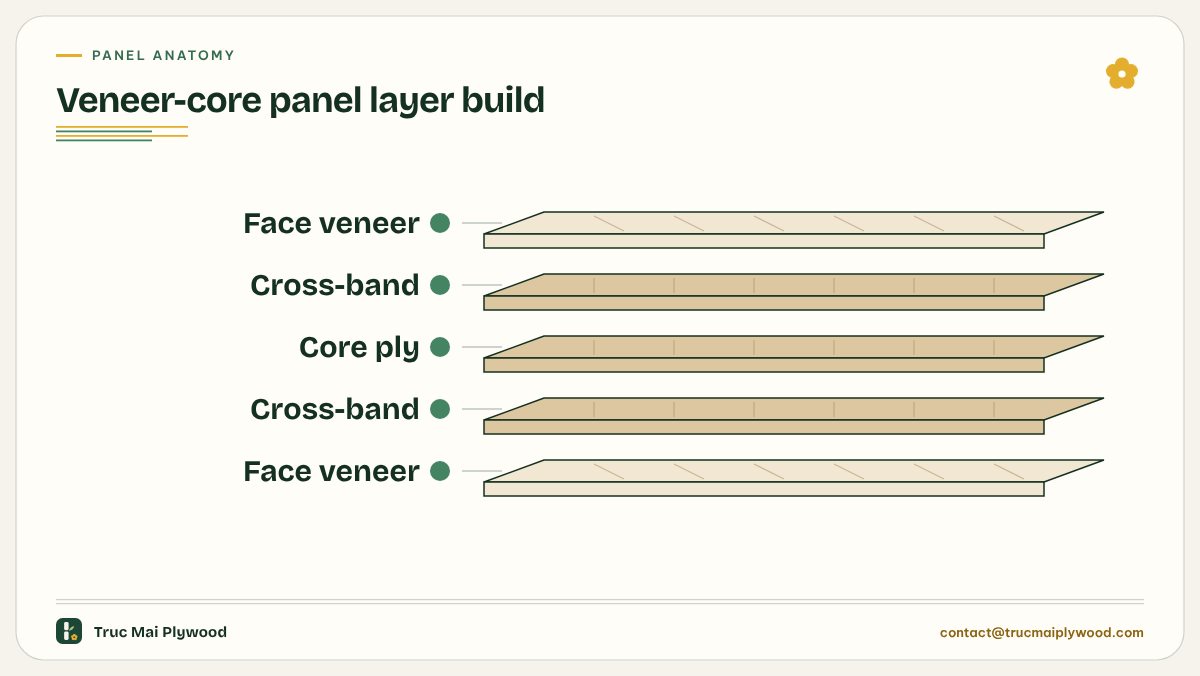
Veneer core plywood has thin wood veneers stacked with adjacent grain directions generally crossing; Truc Mai 3–5 mm panels use five plies. The resulting assembly provides a useful strength-to-weight balance and a familiar edge made of visible wood layers. It is a common choice for furniture panels, cabinet boxes, shelves and interior joinery.
A veneer-core specification should name the wood species, whether core veneers are stitched, the number of plies where relevant, and the face preparation. Thin panels and thick panels need different lay-ups. In the Truc Mai range, 3–5 mm sheets use five plies, while an 18 mm sheet commonly uses 11–13. A description such as ‘veneer core, 18 mm’ is therefore only a starting point.
Look at the edge after trimming. Continuous, closely fitted veneers give the cutter a more consistent path than scattered gaps. A sample should be inspected at several positions, including near both ends, because one clean corner cannot describe the full sheet. Thin plywood panels illustrate where ply construction becomes especially important.
Lumber core vs veneer core: what changes?
Lumber core places strips of sawn wood between outer layers; veneer core builds the centre from thin cross-laid sheets. Choose lumber core when the design and machining process are built around a strip core; choose veneer core for conventional multi-ply cabinet components and a consistently layered cut edge.
Lumber strips can introduce local differences in grain, movement and edge behaviour. Their width, seasoning and joints matter. Veneer core distributes those variations across more thin layers. Neither name is a substitute for measuring panel flatness after conditioning or testing the intended joint.
| Buying point | Lumber core | Veneer core |
|---|---|---|
| Internal construction | Sawn strips | Cross-laid thin veneers |
| Edge appearance | Wide wood sections | Repeating ply lines |
| Inspection focus | Strip joints and movement | Veneer gaps and overlap |
| Typical enquiry | Door or joinery substrate | Cabinet and general furniture sheet |
Ask the supplier for an uncoated cross-section and a sample of the finished edge profile. If a panel will receive a thin decorative overlay, local core irregularities matter more than the trade label.
MDF core vs veneer core: which should you order?
MDF core offers a fine, uniform fibre substrate for smooth surface machining; veneer core offers a lighter, layered wood construction for many cabinet and joinery uses. For routed decorative faces, an MDF-core product can be attractive. For furniture carcasses where handling weight and edge fasteners matter, veneer core is often the better starting specification.
MDF means medium-density fibreboard. In an MDF-core plywood panel, the outer veneers cover a fibreboard centre rather than a stack of veneer plies. Its fine structure makes shallow surface finishing predictable, but screw behaviour at a cut edge should be tested with the actual screw and pilot-hole arrangement. Moisture exposure and the adhesive system also belong in the order.
| Test on the buyer’s part | MDF core | Veneer core |
|---|---|---|
| Routing | Uniform fibre beneath face | Cutter encounters wood layers |
| Cut-edge finish | Fine, homogeneous texture | Visible ply bands |
| Handling | Often heavier at comparable build | Species-dependent weight |
| Edge screw test | Pilot-hole and withdrawal test | Pilot-hole and ply-integrity test |
Do not confuse MDF core with a separate MDF board. The panel’s face veneer and construction still need their own specification.
Which core holds screws best?
Yes, veneer core is a strong first choice for edge screws in cabinet construction when well-made and void-free; for a face screw, both veneer and composite cores can perform well with suitable fixing details. The answer changes with screw diameter, penetration, pilot hole, distance from the edge and the direction of loading.
Test the joint that will actually be built. Drive the specified screw into a cut edge, assemble the fitting, then assess splitting, pull-out and repeat installation. A core with gaps can fail locally even when the wood species is relatively dense. A dense core can also split if the pilot hole is too small.
The USDA Forest Service Wood Handbook treats fastenings as a separate engineering topic. For a production decision, request a trial using the same hinges, connectors and edge distances as the furniture drawing. Record whether the failure occurs in the fastener, a veneer layer or the surrounding wood.
What is foam or honeycomb core plywood?
Foam and honeycomb core plywood use a cellular or foamed centre and wood-based outer skins. It is chosen where low mass and panel thickness matter more than conventional solid edge machining. These constructions differ from ordinary multi-ply veneer-core plywood.
Honeycomb interiors create open cells; foam cores use a continuous lightweight material. Both need edge treatment when a fitting must anchor into the panel. Hardware may require a solid insert, local reinforcement or a purpose-designed fastening system. A visually thick panel can therefore have a very different fixing capacity from a thick veneer-core sheet.
Specify the complete sandwich build, skin material, core material, thickness and insert positions. For large doors or partitions, test stiffness and hinge performance on a full-size assembly. A small sample may conceal deflection across a wide span. These 2 specialist constructions should be compared as assemblies, not treated as interchangeable species options.
What are the three types of plywood cores?
3 broad core families most buyers compare are veneer core, lumber core and composite core. Composite core includes fibreboard or particleboard centres; lightweight honeycomb and foam panels are further specialist constructions. This grouping is a buying framework, not a claim that every standard recognises only three categories.
US rules use a more specific distinction for regulated hardwood plywood: veneer core and composite core. Under 40 CFR Part 770, composite core refers to particleboard, MDF or their combination. That regulatory terminology should not be stretched to describe lumber strips or honeycomb cells.
A buyer comparing offers should separate the structural description of the core from the decorative face, the adhesive and the emission test. A supplier might call a sheet ‘hardwood plywood’ while quoting a composite centre. The purchase order should state the construction plainly.
Is veneer core plywood suitable for cabinet furniture?
Yes, veneer core plywood is good for cabinet carcasses, interior furniture and many commercial panels when the core is joined cleanly and matched to the machining job. Its value comes from the whole lay-up, including veneer quality, glue lines, pressing and calibration, rather than from the word veneer alone.
The USDA Wood Handbook chapter on wood-based panels describes the benefits of cross-laminated plywood, including dimensional stability and resistance to splitting. That makes veneer core a useful baseline for parts that need fasteners near an edge. The actual fixing and loading still deserve a sample test.
Buyers can compare two suppliers by cutting the same narrow strip from each approved sample and checking for open core joints, overlapping veneers and uneven sanding. For cabinet work, face flatness after finishing matters as much as the raw edge. See plywood for kitchen cabinets for the application-side specification.
Acacia, eucalyptus or styrax core: which suits furniture and which suits packing?
Styrax core is a useful lighter option for furniture with visible faces; Acacia balances handling weight and a firmer wood build; Eucalyptus suits commercial and packing applications where a denser sheet is acceptable. The final choice follows the component and the approved core sample, not a species ranking.
Truc Mai Plywood uses Styrax, Acacia, Eucalyptus, Pine and combinations in furniture and commercial plywood. Furniture construction typically uses an A-grade stitched core and sanded faces. Commercial and packing builds commonly use an AB core with a looser lay-up. Core stitching can run across and along the sheet, with the outer plies stitched as the normal practice.
For an exposed furniture edge, request the cleanest core assembly and inspect the edge after cutting. For a concealed packing panel, a more economical construction can be sensible. For decorative faces, specify the face species separately: birch-faced plywood is not a promise of birch throughout. The packing plywood range serves a different appearance requirement.
How do combination and finger-jointed cores differ?
Combination core mixes selected wood species in the lay-up; finger-jointed core joins shorter wood pieces end to end before they form a layer. One describes species selection, the other describes a joining method. They can occur in the same panel, but they answer different questions.
A combined core can tune weight and surface support by placing selected veneers at different positions. It is important to ask which layers use which species and whether the outer core plies are stitched. A finger joint should be checked for alignment and bonding, particularly if narrow furniture components will cross it.
For a repeat order, retain a labelled cross-section beside the approved face sample. Photographs of both sides alone will miss the differences that matter when the buyer cuts the sheet. Compare combined-core plywood and Acacia against Eucalyptus cores as separate construction choices.
How does core selection change weight and container loading?
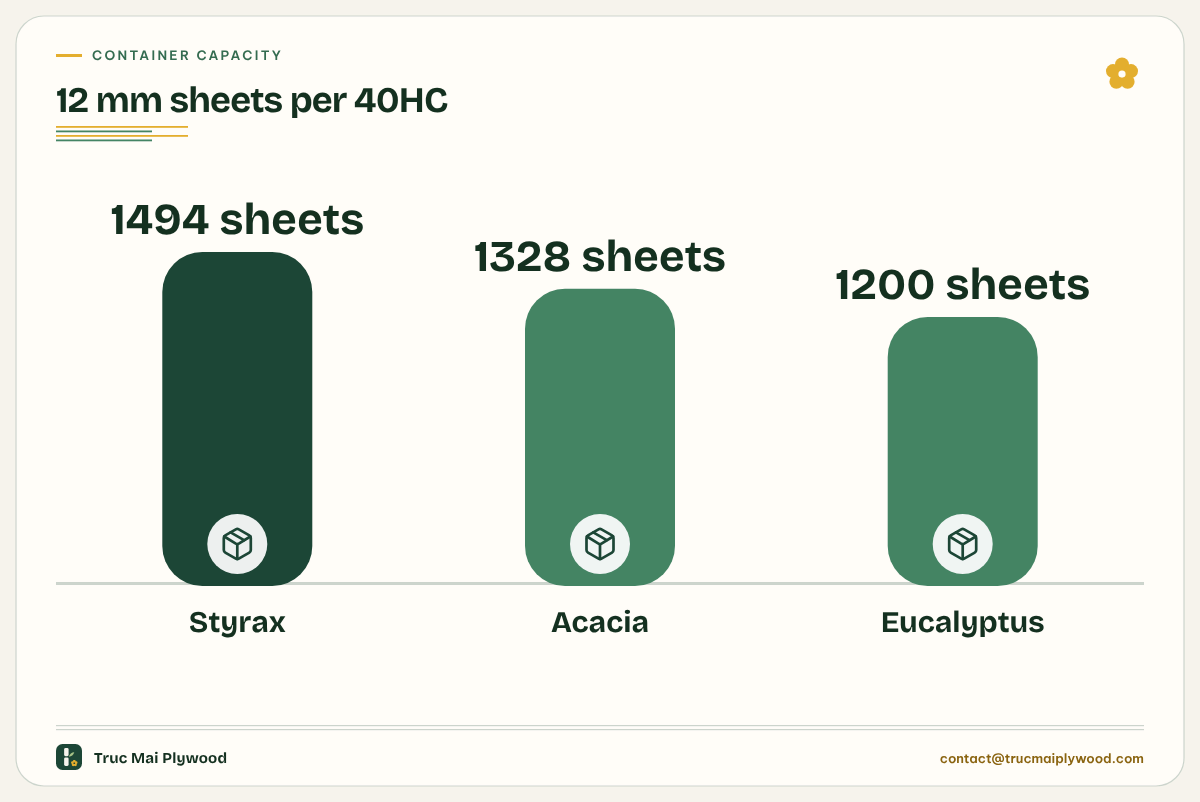
Core density changes how many panels fit within a container’s cargo-weight plan. The following are calculated 40HC planning figures, panels only, for 1220 × 2440 mm sheets. They are based on a 1,000 mm pack height, a 28,000 kg planning payload and reference densities of Styrax 500 kg/m³, Acacia 580 kg/m³ and Eucalyptus 650 kg/m³. The model allows 18, 16 and 15 packs respectively, with sheets per pack limited by height and payload. Actual booking and packed weight set the loading plan.
A buyer comparing a lighter and a denser core should therefore ask for both sheet count and total shipment weight. A nominally identical panel thickness can produce a materially different container mix. The 40HC volume by thickness guide explains the wider model.
| Core | Thickness | Size (mm) | Packs | Sheets/pack | Weight-capped | Sheets | m³ | kg/sheet | Total kg |
|---|---|---|---|---|---|---|---|---|---|
| Styrax | 12 mm | 1220x2440 | 18 | 83 | No | 1494 | 53.4 | 17.9 | 26680 |
| Acacia | 12 mm | 1220x2440 | 16 | 83 | No | 1328 | 47.4 | 20.7 | 27510 |
| Eucalyptus | 12 mm | 1220x2440 | 15 | 80 | Yes | 1200 | 42.9 | 23.2 | 27860 |
| Styrax | 15 mm | 1220x2440 | 18 | 66 | No | 1188 | 53.0 | 22.3 | 26520 |
| Acacia | 15 mm | 1220x2440 | 16 | 66 | No | 1056 | 47.2 | 25.9 | 27350 |
| Eucalyptus | 15 mm | 1220x2440 | 15 | 64 | Yes | 960 | 42.9 | 29.0 | 27860 |
| Styrax | 18 mm | 1220x2440 | 18 | 55 | No | 990 | 53.0 | 26.8 | 26520 |
| Acacia | 18 mm | 1220x2440 | 16 | 55 | No | 880 | 47.2 | 31.1 | 27350 |
| Eucalyptus | 18 mm | 1220x2440 | 15 | 53 | Yes | 795 | 42.6 | 34.8 | 27690 |
| Styrax | 21 mm | 1220x2440 | 18 | 47 | No | 846 | 52.9 | 31.3 | 26440 |
| Acacia | 21 mm | 1220x2440 | 16 | 47 | No | 752 | 47.0 | 36.3 | 27270 |
| Eucalyptus | 21 mm | 1220x2440 | 15 | 45 | Yes | 675 | 42.2 | 40.6 | 27430 |
These figures are computed model outputs rather than mill loading records. The packing list records the loaded quantities; weighing actual sheets and packing materials is part of final load planning.
What should the buyer inspect at the cut edge?
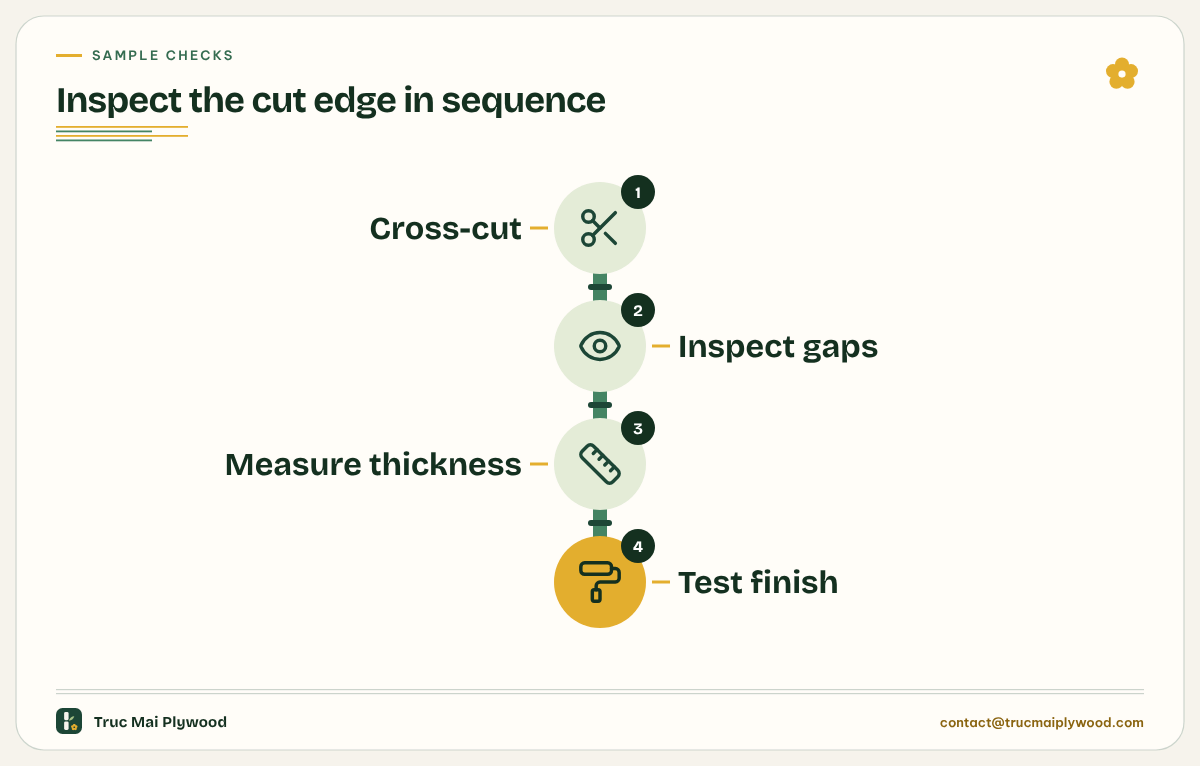
A clean edge should show well-aligned plies, close joints and an even thickness. Inspect both long and short edges because the grain direction and veneer joints can change what a saw exposes. Check a sample after the same cutting operation planned for production.
- Cut across the sheet and along the sheet using the intended blade.
- Mark visible gaps, overlaps and glue-line openings on each sample.
- Measure thickness at several points and compare the result with the written order tolerance.
- Apply the planned edge band or surface finish and check for telegraphing.
- Drill the actual fixing pattern and inspect for splitting.
For sanded and calibrated furniture panels, the Truc Mai order specification can use ±0.3 mm thickness tolerance; other constructions use their agreed tolerance. Keep measurement conditions and acceptance criteria on the purchase order. The supplier verification checklist helps connect sample approval to shipment inspection.
How should glue, emissions and face veneer be specified?
Specify glue type, bond performance and formaldehyde emission as separate lines. Urea-formaldehyde (UF) is widely used for interior panels; the USDA adhesive reference explains why adhesive choice matters to wetting and service conditions. A low-emission designation is not a water-resistance test.
For US-bound hardwood plywood with veneer core, 40 CFR 770.10 sets a formaldehyde limit of 0.05 ppm using the applicable chamber-testing framework. Truc Mai’s CARB Phase 2 and TSCA Title VI certification covers veneer-core hardwood plywood within its certified 3–25 mm scope. Ask for the certificate documents associated with the specified configuration.
For EU procurement, emission evidence and origin documentation serve different purposes. The European Commission EUDR page describes due diligence and plot geolocation. The mill supplies origin records and geolocation files for core and face veneer so the importer can prepare the relevant filing. Read face veneer origin files when a decorative face comes from a different source country.
What should an importer write in the plywood core RFQ?
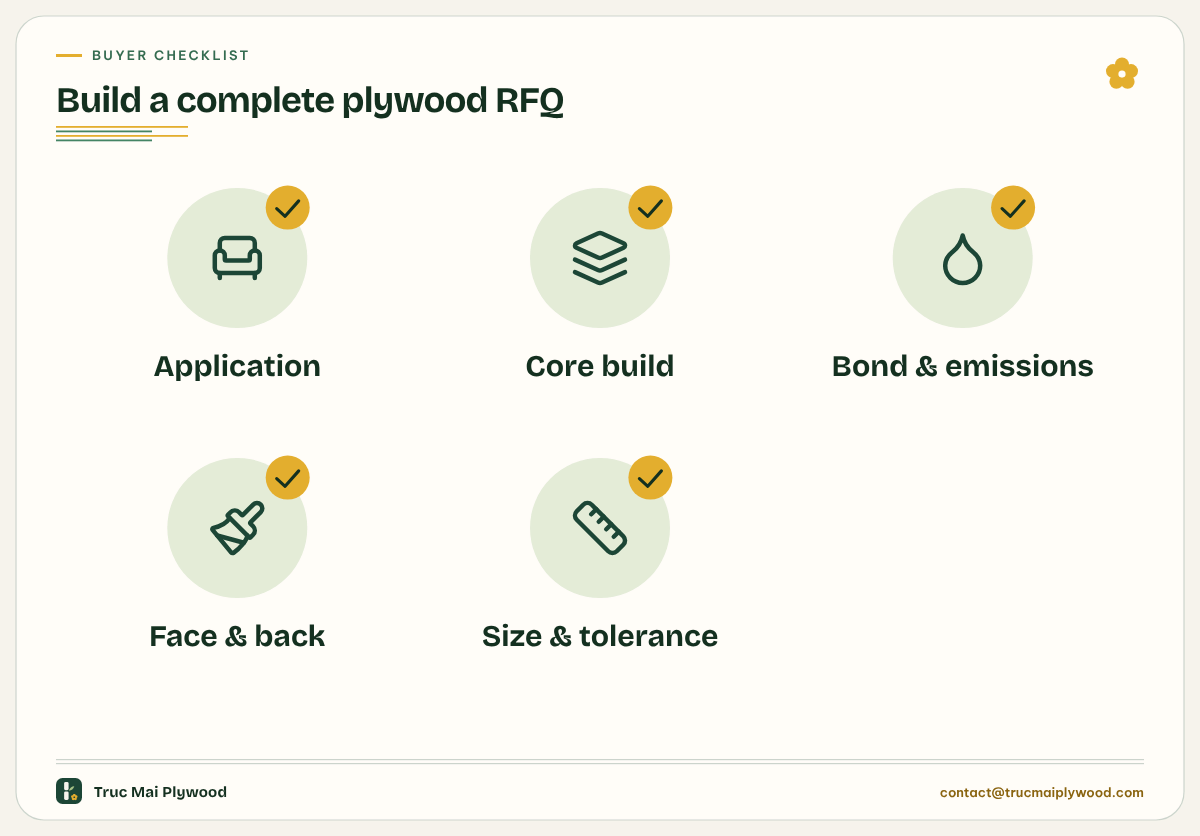
Write a core-specific RFQ with the intended finished part first, then the physical construction. The more precise the drawing and approved sample, the easier it is to compare competing offers on equivalent material. Writing a plywood RFQ provides the broader purchasing sequence.
- Application: cabinet side, drawer component, door skin, shelf or packing part, including the intended machining.
- Core: species or combination, joined or loose-laid, required edge quality and any ply schedule.
- Bond and emission: adhesive system, exposure conditions, emission class and required test or certificate file.
- Face and back: veneer species, paired appearance grades, sanding and any overlay.
- Size: sheet dimensions, thickness, tolerance and cut list.
- Packing: labelled packs, quantities, destination port and documents.
Available sheet formats include 1220 × 2440, 1220 × 2280 and 1250 × 2500 mm. Cut-to-size orders can divide a standard sheet into two, three, four or six labelled pieces, with the actual dimensions agreed from the cut list. Ask for an approved sample before repeating a configuration across a full container.
A practical next step is to request a quotation with the core, face and application on the same line. Include a cut-edge photograph if an existing part is being matched; it often communicates the required build more clearly than a grade name.
Questions buyers ask
Can I order a different face veneer on the same core?
Yes. Face and back veneer are specified separately from the core species, with appearance grades agreed against the approved sample.
Does a thicker sheet always have more plies?
Not necessarily. Ply count follows veneer thickness and the approved lay-up, so request the construction schedule for the ordered thickness.
Can the mill cut sheets before packing?
Yes. A standard sheet can be divided into two, three, four or six labelled pieces according to the agreed cutting list.
Is a birch face the same as an all-birch core?
No. Birch-faced plywood identifies the decorative face; the internal veneers can be other species.
What should a sample label show?
Record the face and back grades, core species, thickness, adhesive specification and intended application beside the sample.
Can a container include different panel constructions?
Yes. A mixed load can combine agreed products, with packing and total cargo weight planned for the actual mix.
What is the difference between an A-grade and AB core?
These are supplier construction descriptions. Compare the approved core sample, joining method and acceptance criteria rather than relying on the letters alone.
Do I need the same emission documents for every destination?
Use the documents applicable to the destination and product configuration. US hardwood plywood requirements and EU documentation should be specified separately.
Can I order panels ready for my own UV finish?
Yes. UV-ready means the surfaces are prepared for the buyer to apply the finish, rather than coated at the mill.
How do I compare two quotes that use the same core name?
Compare core joining, veneer quality, face preparation, thickness tolerance, adhesive system and packing on the same specification sheet.