
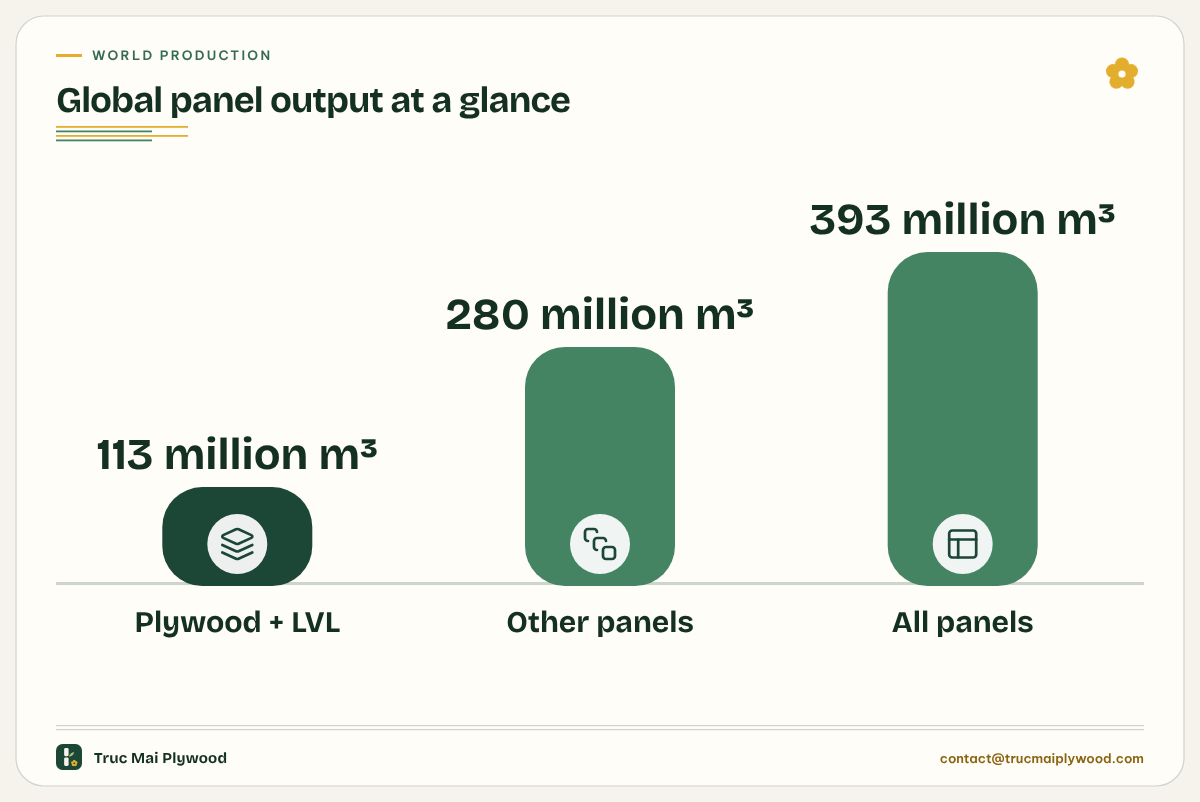
Plywood market size is best measured first in physical output: FAO reports 113 million m³ of plywood and laminated veneer lumber production worldwide in 2024, within 393 million m³ of all wood-based panels. For importers, available capacity, panel specification, shipping routes and delivery windows matter more than a single market valuation.

What is the plywood market size in physical terms?
The Food and Agriculture Organization (FAO) reports 113 million m³ of plywood and laminated veneer lumber (LVL) produced globally in 2024. The broader wood-based panel category reached 393 million m³. These figures come from the FAO forest product data, accessed 15 November 2026. They measure production, not sales revenue.
| FAO category, 2024 | World production | What the buyer is counting |
|---|---|---|
| Plywood and LVL | 113 million m³ | Veneer-based panels and laminated veneer lumber together |
| Other wood-based panels | 280 million m³ | Particleboard, oriented strand board and fibreboard |
| All wood-based panels | 393 million m³ | Both groups combined |
A plywood market report may use a different product boundary, particularly when it excludes LVL, includes decorative overlays or counts only traded panels. Read the definition beneath the headline before comparing reports. FAO’s joint collection process combines national returns with estimates when a country has not reported; its methodology and database description explain why revisions occur. For procurement, cubic metres are useful because they connect directly to panel thickness, order quantities and shipping capacity.
Why do market valuations disagree?
Market valuations disagree because research firms define products, geographies and sales stages differently. A value assigned to plywood leaving a mill is not directly comparable with retail sales of finished decorative boards, and neither is equivalent to the value of panels crossing a border. The calculation also changes with exchange rates, product mix and whether the market includes LVL.
Treat any headline growth rate as a scenario rather than an order forecast. Ask whether the study measures production, consumption, imports or revenue, which year it uses as the base, and whether its category contains other engineered wood products. A nominal increase can reflect a shift towards thicker or more heavily finished panels even when physical output is flat.
A buyer who purchases commercial plywood should follow the actual sheet specifications and landed logistics rather than infer availability from a headline valuation. The separate explanation of plywood pricing shows which construction choices change a quotation without requiring a market-wide estimate.
Which regions drive plywood production and demand?
Production and demand are geographically uneven. The FAO 2024 producer and consumer tables identify China as a major centre of wood-based panel production and consumption; the United States is also a major consumer. However, the broad panel category includes fibreboard and particleboard, so its country shares cannot be presented as plywood-only rankings.
Demand is also fragmented by end use. A furniture manufacturer needs a calibrated surface and reliable veneer appearance; a packaging buyer may prioritise an economical core and handling strength; a structural building-panel buyer follows a different specification system. Counting all three as interchangeable demand gives importers a misleading picture of substitutable supply.
The United Nations Economic Commission for Europe (UNECE) reported that regional wood-based panel markets rebounded in 2024, while other forest product categories moved differently. Its 2025 market statement draws on country submissions for the reference year 2024. That is a better basis for interpreting regional supply than extrapolating a single factory’s order book across the world.
Is there a plywood shortage?
There is no evidence in the cited global production totals of a universal plywood shortage: combined plywood and LVL output rose in 2024. A shortage can still occur for a particular face veneer, thickness, emission specification or delivery month. A worldwide total cannot tell a UK cabinet maker whether matching panels can be delivered to its port in time.
The useful shortage question is narrower: can two qualified mills quote the same specification for the same loading window, with the required documentary file? Ask each for a production slot, available veneer, approved face/back pairing, core construction and packing plan. If only one supplier can meet the exact combination, the risk is concentration in that specification rather than a worldwide lack of wood.
For repeat purchasing, separate temporary vessel congestion from production constraints. A completed container waiting at port is a logistics delay; a mill waiting for thin face veneer is a material bottleneck. The corrective actions are different, and the purchase schedule should show which stage owns the delay.
What moves plywood supply before it reaches a mill?
Log availability, veneer recovery, adhesive inputs and finishing capacity are the main upstream variables. A plywood factory needs usable veneers in the required thickness and species, not merely access to standing timber. Plantation harvesting patterns affect core wood, while imported decorative veneers add another sourcing route.
A shortage of uniform face veneer can limit cabinet-grade output even when there is enough core material for commercial panels. Thin sheets require careful handling and grading. Veneer defects and core gaps can become visible only after pressing and sanding, making yield and rejection rates important capacity questions.
The International Tropical Timber Organization’s 2023–2024 biennial review separates primary-product production and trade from secondary processing. That distinction matters: a change in log exports does not translate one-for-one into finished plywood availability. Ask the mill which material is constraining your approved construction, rather than assuming all delays originate in timber harvesting.
How do freight disruptions affect the plywood industry?
Freight disruption changes delivery reliability first, then the usable purchasing window. Rerouting, transhipment, vessel omissions, equipment availability and port congestion can all separate a mill’s completion date from the buyer’s warehouse receipt date. These pressures can affect two orders of identical panels differently if their destination ports and sailing connections differ.
Build the schedule backwards from the date panels are needed in production. Allow for final inspection, loading, draft-document approval, sailing and inland receipt. Distinguish days at sea from the time between a deposit and production completion. For the freight component, see sea freight per cubic metre; for the paper trail, use the documents per container checklist.
When a route changes, revise the arrival plan rather than rewriting the plywood specification. A well-documented, already packed order can be transferred to a later sailing more easily than a shipment whose grade and package count are still unresolved.
How do buyers interpret price pressure without a price forecast?
Price pressure should be separated into material, conversion and logistics components. Core species, veneer grade, glue system, sanding, overlay, inspection and packing each change what is being purchased. Freight, destination charges and currency movement change the delivered result without changing the panel itself.
A mill quote for a sanded furniture panel and one for an unsanded commercial panel should never be treated as two observations of a single commodity. First normalise the specification; then compare the delivery term, production window and packing method. The RFQ writing guide gives the order of information a mill needs to quote like-for-like.
Instead of asking whether the market is rising or falling, identify the next decision: secure a veneer allocation, reserve a production window, change the core to an approved alternative or adjust the shipment cadence. Each decision has a measurable operational effect that a broad market forecast does not capture.
How does the laminated veneer lumber market differ?
The laminated veneer lumber market serves a different mix of applications from decorative plywood. LVL aligns veneers primarily to build long or repeatable sections, while conventional plywood cross-laminates layers to make sheets. Combining the two in a production statistic is useful for understanding veneer-processing activity, but not for predicting demand for a particular furniture-panel grade.
For purchasing, classify LVL by its intended use and evidence. Non-structural sections for door and frame stock, furniture components and bed slats require dimensional and finish specifications. Structural LVL requires its own design and conformity route and should not be inferred from a general LVL market report.
Truc Mai Plywood supplies non-structural LVL as well as furniture and commercial plywood. Buyers can review LVL sizes and LVL door and frame stock when the application calls for sections rather than full sheet panels.
What does a 40HC container plan reveal about supply?
A 40-foot high-cube container plan translates an abstract capacity discussion into sheets, packs, panel volume and mass. The following figures are from the supplied Truc Mai packing model, planning calculations rather than shipment records. All rows use 1220 × 2440 mm sheets and the model’s stated pack and weight assumptions; the model uses a 28,000 kg planning payload for cargo, with final loading checked against the booking and actual packed weight.
| Core | Thickness | Packs | Sheets per pack | Sheets total | Panel volume | kg per sheet | Total panel kg | Weight-capped |
|---|---|---|---|---|---|---|---|---|
| Styrax | 12 mm | 18 | 83 | 1494 | 53.4 m³ | 17.9 | 26680 | No |
| Acacia | 12 mm | 16 | 83 | 1328 | 47.4 m³ | 20.7 | 27510 | No |
| Eucalyptus | 12 mm | 15 | 80 | 1200 | 42.9 m³ | 23.2 | 27860 | Yes |
| Styrax | 15 mm | 18 | 66 | 1188 | 53.0 m³ | 22.3 | 26520 | No |
| Acacia | 15 mm | 16 | 66 | 1056 | 47.2 m³ | 25.9 | 27350 | No |
| Eucalyptus | 15 mm | 15 | 64 | 960 | 42.9 m³ | 29.0 | 27860 | Yes |
| Styrax | 18 mm | 18 | 55 | 990 | 53.0 m³ | 26.8 | 26520 | No |
| Acacia | 18 mm | 16 | 55 | 880 | 47.2 m³ | 31.1 | 27350 | No |
| Eucalyptus | 18 mm | 15 | 53 | 795 | 42.6 m³ | 34.8 | 27690 | Yes |
| Styrax | 21 mm | 18 | 47 | 846 | 52.9 m³ | 31.3 | 26440 | No |
| Acacia | 21 mm | 16 | 47 | 752 | 47.0 m³ | 36.3 | 27270 | No |
| Eucalyptus | 21 mm | 15 | 45 | 675 | 42.2 m³ | 40.6 | 27430 | Yes |
The table preserves each supplied calculation, including its original rounding and kilogram totals. The source model assumes packs roughly 1,000 mm high and different pack counts by core. Actual sheet weight, pallet material, container limits and the carrier’s permitted payload govern the final load. Compare the full 40HC thickness guide when planning another thickness or sheet format.
The operational insight is that nominal sheet count is only half the supply question. If the core changes, the usable container volume changes too. Ask suppliers to show their proposed pack configuration on the pro forma documents before treating a monthly cubic-metre target as a fixed number of containers.
What factory capacity can support monthly container orders?
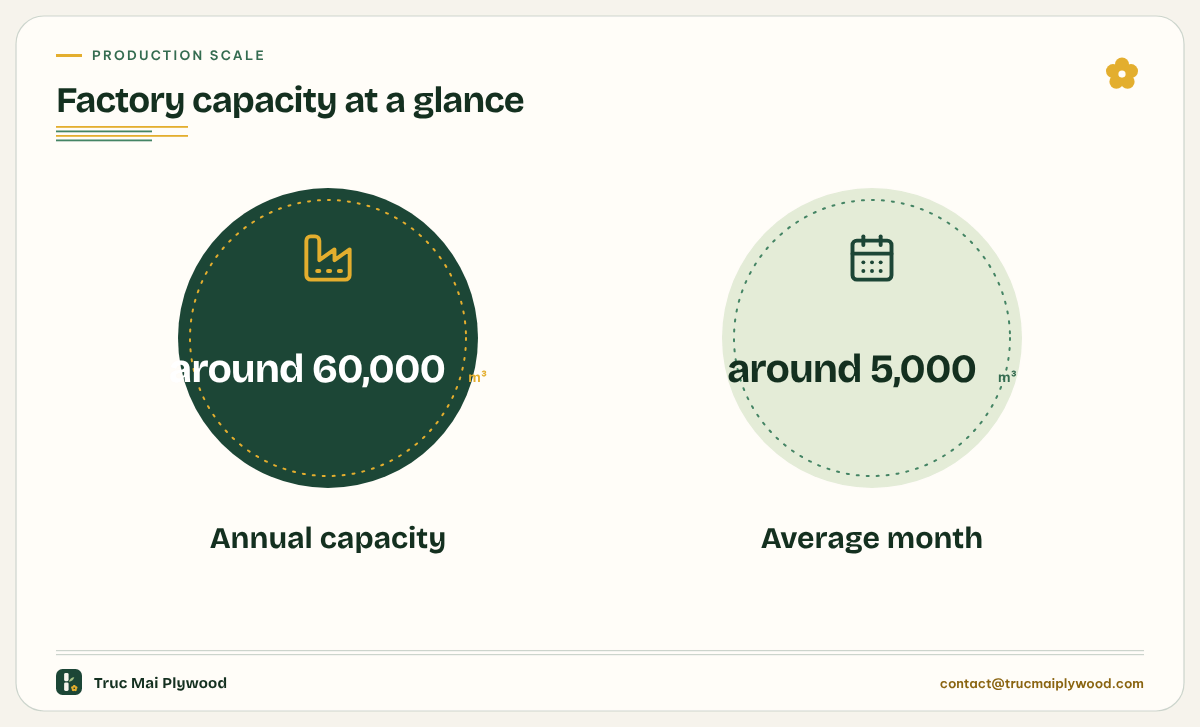
Monthly supply is governed by capacity for the specific construction, not the mill’s annual headline. Truc Mai Plywood’s stated capacity is around 60,000 m³ annually, or around 5,000 m³ in an average month, at Ha Hoa, Phu Tho, Vietnam. That figure describes overall production, not reserved capacity for a buyer’s particular veneer or finishing line.
The factory’s interior range includes poplar, engineered veneer, birch-faced and other decorative faces on Styrax, Eucalyptus, Acacia, Pine or mixed cores. Birch-faced means an imported birch face on a Vietnamese core, not all-birch construction. UV-ready panels are prepared for the buyer’s coating process; melamine and HPL faced options are separate finished surfaces.
For a repeat programme, provide the monthly mix in advance. A thin decorative face, an overlay line and a calibrated thickness may draw on different process stages. Ask for the production allocation by specification and the sequence in which mixed orders will be pressed, finished, inspected and packed.
How should importers forecast a rolling purchase programme?
Use a rolling forecast with one firm order window and later indicative windows. A simple process separates the buyer’s demand plan from the supplier’s capacity plan:
- List applications. Separate cabinet carcasses, visible doors, packing and non-structural components.
- Freeze construction. Record face/back grade, core species, adhesive and emission requirements, size, thickness and tolerance.
- Translate demand. Convert required pieces into full-sheet equivalents and planned container loads.
- Reserve production. Match the required completion week to veneer, pressing and finishing availability.
- Review shipping. Reconcile the booking, inspection release, packing list and destination receipt window.
- Refresh monthly. Carry forward actual consumption and revise only the open forecast periods.
The first-order to monthly-supply process covers how to move from an approved sample to repeat shipments. A forecast is most useful when it shows the exact point at which the buyer must confirm the next production batch.

Which quality and compliance files influence availability?
Required documentation can determine which stock is commercially usable in a destination market. A physically suitable panel may still need the agreed emission evidence, origin records, invoice claims and shipping documents. This is especially important when a buyer changes destinations after production has begun.
For the United States, 40 CFR Part 770 sets a 0.05 ppm formaldehyde emission standard for hardwood plywood with veneer core under TSCA Title VI. Truc Mai’s CARB Phase 2 and TSCA Title VI third-party certification covers hardwood plywood with veneer core in the documented 3–25 mm scope. Other thicknesses must be specified and assessed separately.
For EU supply, the factory provides origin and geolocation records for core and face veneer to support the importer’s due-diligence file. FSC 100% claims are made for eligible products on the applicable certificate schedule, with the claim on sales documentation. See EUDR dates for plywood buyers and FSC licence verification when setting the document checklist.
What should buyers compare between mills?
Compare mills against a common sample, specification and delivery calendar. A useful comparison is a documented ability to repeat the approved build, rather than a generic annual production total.
| Comparison item | Request from each mill | Decision it supports |
|---|---|---|
| Face and back | Approved physical sample and grade pair | Visible finish consistency |
| Core | Species, joining and lay-up | Weight and machining suitability |
| Bond and emission | Separate adhesive and emission specifications | Destination and application fit |
| Calibration | Thickness tolerance and measurement method | Assembly fit |
| Production | Slot by specification and month | Repeat-order continuity |
| Packing | Pack count, gross mass and protection | Container planning |
| Documents | Draft file list before confirmation | Import clearance preparation |
Use the supplier shortlist checklist to record comparable answers. For a mill inspection, request photographs of panel edges, sanding and packing from the proposed build. A sample that looks good is useful only when the repeat order records the same construction.
How can buyers respond to a sudden supply shock?
Respond to a supply shock by identifying which constraint changed and preserving the approved performance requirement. A freight delay, veneer interruption and compliance-document gap each require a different action. Changing everything at once makes it difficult to know whether the replacement panel will work in the intended application.
For freight disruption, shift the booking and update the receiving schedule. For veneer interruption, ask whether an already approved face alternative is available. For core supply pressure, compare the weight, appearance and machining implications of a documented substitute. For document delays, agree the file list before allocating the shipment to a destination market.
Keep a short exception register for each open order: original specification, proposed change, sample approval, revised completion date and person authorised to accept it. This protects continuity without treating a substitute as identical merely because the trade name is similar.
What information should go into the next plywood RFQ?
A useful plywood request for quotation identifies the application, panel construction and shipment programme on one page. Send the intended furniture or commercial use; face and back; core species; adhesive and emission requirement; thickness, size and tolerance; surface finish; packaging; quantity; and destination port.
State whether the order is a trial container or part of a monthly call-off schedule. Include the sample approval method and the week by which goods must be ready for inspection. If panels are cut to size, attach a cutting list with the labelled piece dimensions and packing instructions.
For a direct discussion of specification and order preparation, use writing a plywood RFQ. A clear request lets the mill respond with a coherent construction and production plan instead of a quotation that hides material differences behind a familiar product name.
Send your specification to contact@trucmaiplywood.com or through the quotation form.
Questions buyers ask
Does a global production increase mean my grade is available?
No. Global output combines different species, constructions and destinations. Ask for capacity against the exact face, core, thickness and shipment month.
Should I reserve a container before agreeing the specification?
Agree the panel construction and pack plan first, then coordinate the shipping booking with the production slot.
What is a useful supplier capacity question?
Ask how many containers of your precise specification can be completed in each requested month, including the veneer and finishing constraints.
Can a lighter core change shipping efficiency?
Yes. Lower sheet weight can allow more panel volume within a container payload, as the planning table shows.
Is an annual market forecast the same as a purchase order forecast?
No. Market forecasts aggregate demand across uses and regions, while a purchase forecast identifies the grades, quantities and delivery windows you will buy.
Which shipping document confirms the actual loaded quantity?
The packing list identifies the loaded packs and sheets; reconcile it with the commercial invoice and bill of lading.
Should I compare plywood quotations by face name alone?
No. Specify the core species, face/back grades, bonding and emission requirements, tolerance and packing alongside the face name.
How do I reduce supply risk for repeat cabinet-panel orders?
Approve a physical reference sample, establish a monthly call-off schedule and agree inspection points and substitute constructions in writing.
Does a market report prove a plywood shortage?
No. A shortage needs evidence for the relevant grade, market and delivery period, such as extended production queues or unavailable quotations.
Can an importer order several specifications in one container?
Yes. Mixed loads can be agreed, with a separate pack and weight calculation for each specification.