
Mahogany plywood is a decorative veneer-faced panel, but the name can refer to different woods, including Khaya and Swietenia. For furniture orders, identify the face species, back grade and core separately. Truc Mai Plywood offers reddish okoume and bintangor faces as practical appearance-led alternatives for repeat interior-panel production.
What does mahogany plywood actually mean?
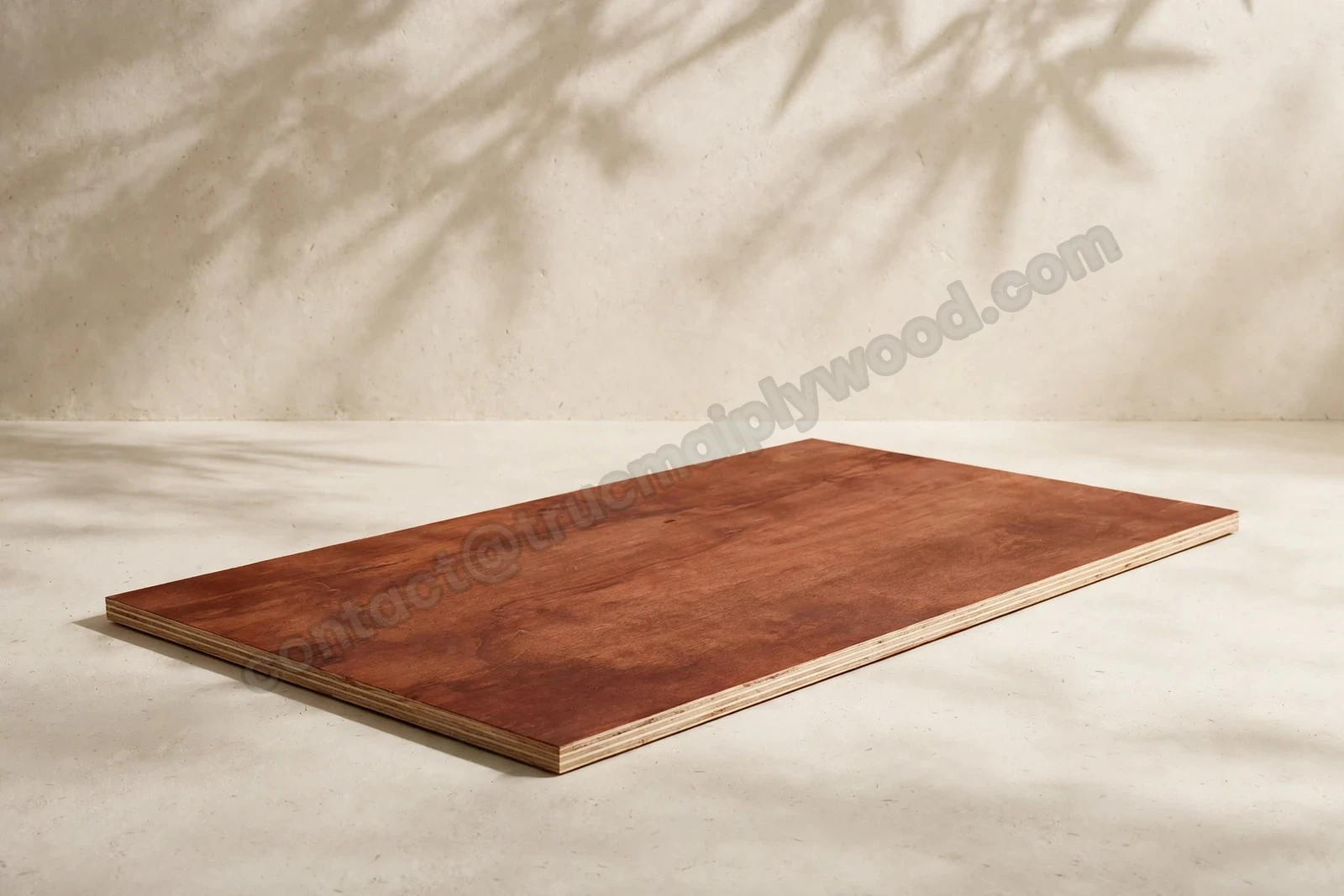
Mahogany plywood is a decorative panel described by its visible veneer, rather than a single guaranteed botanical species or core construction. A buyer should distinguish genuine mahogany (Swietenia), African mahogany (Khaya) and timber sold under the Philippine mahogany name, commonly Shorea. The US Forest Products Laboratory documents these distinct commercial groups. A reddish appearance alone cannot identify the timber.
For a repeat furniture programme, write the scientific or commercial species, face and back requirements, and core construction on separate lines. The word mahogany can describe the look a customer wants without describing the wood actually supplied. An approved face sample is therefore the starting point for a colour-sensitive order. It also makes purchasing discussions more precise when a retailer calls a panel mahogny plywood in Swedish.
A veneer-faced sheet is assembled from a visible decorative layer bonded to a multi-ply base. The face gives the cabinet its appearance; the core determines much of its weight, machining behaviour and suitability for the intended assembly.
Which mahogany species appear in plywood specifications?
Three botanical groups regularly sit behind the commercial name. Swietenia is the American group associated with genuine mahogany. Khaya is sold as African mahogany. Shorea appears under the Philippine mahogany name, although it is botanically different. The USDA Wood Handbook describes the groups and their uses in furniture, cabinetry and veneer.
The species field matters when the architect specifies a particular grain, when a purchasing team compares substitute veneers, or when an importer prepares timber-origin records. Ask for the scientific name where species identity is material. A trade name can remain on a retail label, while the purchase specification records the wood identity.
An order for an African mahogany plywood face should say Khaya rather than merely reddish hardwood. Sapele is another decorative African hardwood, but it is not a synonym for Khaya. Likewise, a mahogany-coloured engineered veneer is a colour and pattern selection, not an assertion that the face comes from a mahogany tree.
How does mahogany plywood compare with okoume and bintangor?
Okoume and bintangor are useful alternative reddish decorative faces when a buyer wants an interior panel rather than a particular mahogany species. The decision starts with the approved colour and grain reference, then moves to the core, finish and order continuity.
| Buyer criterion | Species-specified mahogany veneer | Okoume face | Bintangor face |
|---|---|---|---|
| Identity on RFQ | State Swietenia or Khaya | State okoume | State bintangor |
| Appearance decision | Match actual veneer sample | Match actual veneer sample | Match actual veneer sample |
| Core decision | Specify separately | Specify separately | Specify separately |
| Repeat-order control | Retain approved reference | Retain approved reference | Retain approved reference |
| Best buying route | Species-led decorative brief | Appearance-led interior brief | Appearance-led interior brief |
For an interior cabinet order, okoume-faced plywood and bintangor-faced plywood are existing catalogue routes. The comparison is between faces, not between finished panel performance ratings. A common core can be specified under different faces, making a sample-based comparison more meaningful than comparing names alone.
A factory that buys veneer in successive lots should keep a signed reference board. Compare the next batch under the same lighting and finish before accepting a new shade. The face/back pair belongs on the order, since a visible front and a concealed back serve different purposes.
Is sapele the same as African mahogany?
No. Sapele is Entandrophragma cylindricum, while African mahogany commonly refers to Khaya. Both can provide reddish decorative veneer, and both are used in interior joinery. The US Forest Service wood reference describes sapele veneer and its distinctive figure.
For matched cabinet doors, ask for a full-size sample showing the direction and regularity of the grain. A small offcut can hide a broad ribbon pattern that becomes obvious across a tall door. Match adjacent fronts before production cutting, especially where several panels form one elevation.
A buyer seeking the appearance rather than a named botanical species can compare sapele with okoume and bintangor. A buyer whose project document explicitly names Khaya should retain that name in the purchase specification and provenance file.
What applications suit mahogany-faced decorative panels?
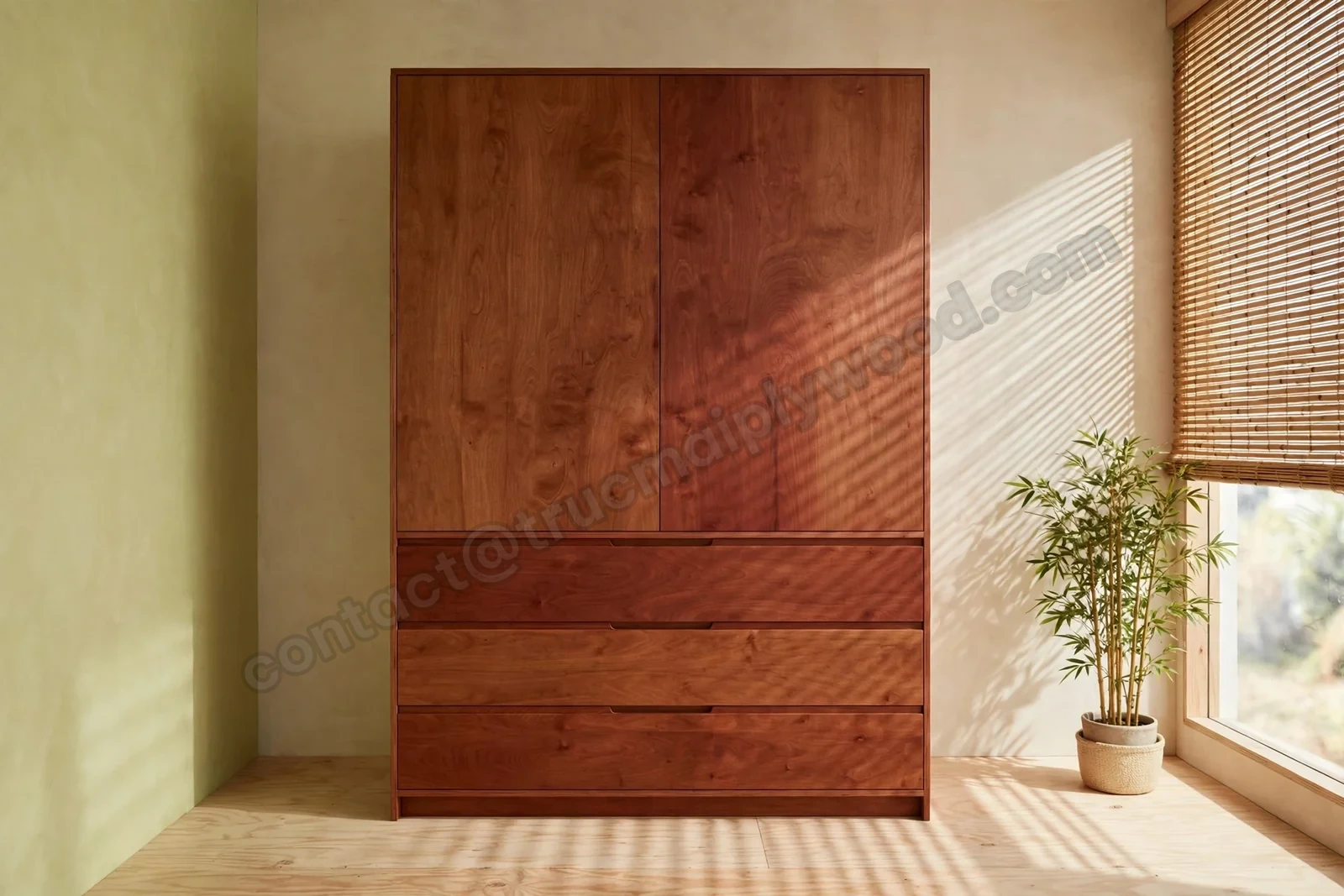
Furniture fronts, cabinet doors, wall linings, shelving faces and interior joinery are the principal applications for decorative mahogany veneer plywood. The face gives a visible wood surface while the plywood base provides a practical panel for cutting and assembly.
A cabinet factory should separate exposed fronts from hidden carcass parts. Use a selected decorative face where the grain is visible and a simpler surface where the panel is concealed. Cabinet-grade plywood covers the other specification choices behind a finished cabinet.
For a door skin, specify the final coating, flatness expectations and cutting plan together. A panel that looks right before finishing can appear different once stain or clear lacquer is applied. The production sample should carry the actual finish intended for the furniture range.
The same approach works for wall panelling. Adjacent sheets are selected as a set, with grain orientation marked before cutting. An order for separate shelves needs less visual continuity than an uninterrupted reception wall.
Which core should sit behind a reddish veneer?
Styrax, eucalyptus, acacia, pine and combined veneer cores offer different buying choices for interior panels. The visible face and the internal construction are separate decisions. A buyer should request a section sample alongside the face sample to examine core joints, gaps and the finished edge.
At Truc Mai Plywood, furniture panels can use an A-grade stitched core with sanded faces; commercial panels use an AB construction with different joining and surface preparation. Core stitching across and along the sheet helps control openings between strips. The outer plies can be stitched, with additional stitching specified for the order.
Choose the core against the final process. For CNC-cut cabinet components, inspect the cut edge and screw locations. For painted parts, look at the face preparation and whether core irregularities telegraph through the finish. For a decorative clear finish, face selection remains the first visual test.
A purchasing team comparing core choices can consult plywood quality by grade and ask for one build sheet per option rather than treating the veneer species as a complete specification.
What thickness and sheet size should a buyer request?
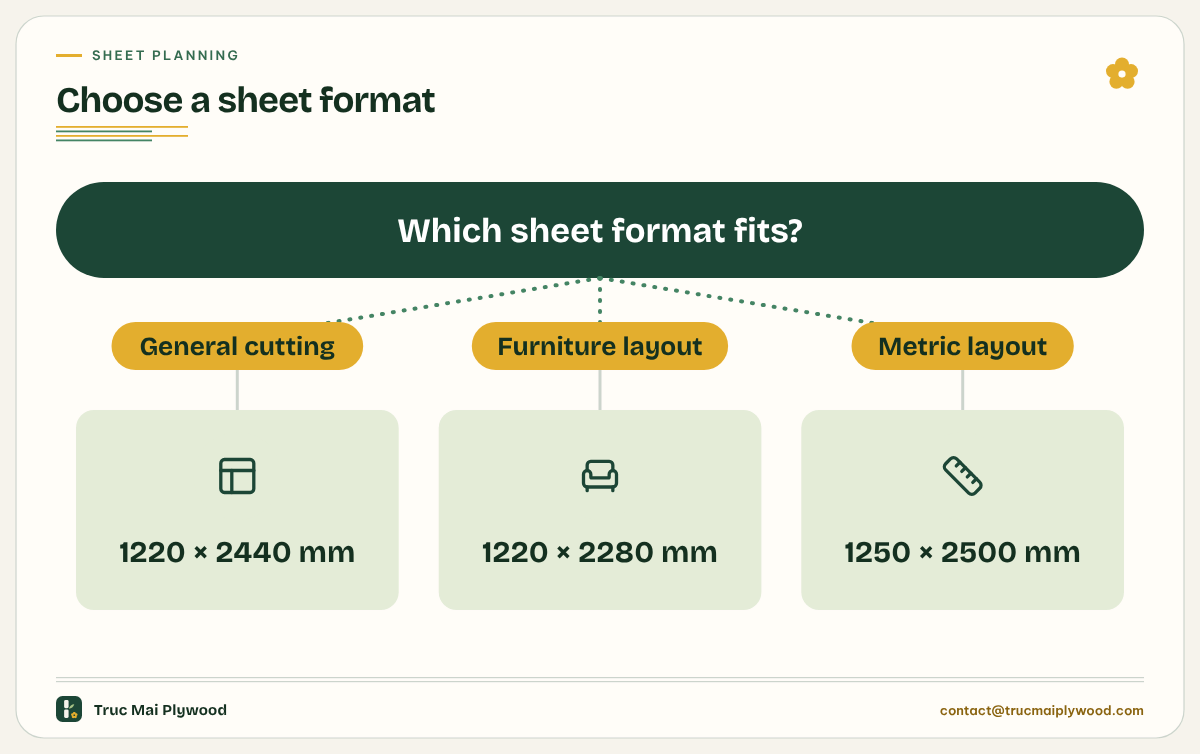
The standard interior range runs from 3 to 40 mm, with 1220 × 2440 mm, 1220 × 2280 mm and 1250 × 2500 mm sheet formats. Select thickness from the furniture component design, then choose the sheet that gives a workable cutting pattern.
| Specification line | Available planning choice | Buyer decision |
|---|---|---|
| Thickness | 3–40 mm | Component design and machining |
| Standard sheet | 1220 × 2440 mm | General panel cutting |
| Shorter sheet | 1220 × 2280 mm | Furniture-part layout |
| European sheet | 1250 × 2500 mm | Metric production layout |
| Furniture tolerance | ±0.3 mm on calibrated panels | Written order tolerance |
| Commercial tolerance | ±0.5 mm | Written order tolerance |
The nominal thickness alone does not tell a machining department what it will receive. State whether the panel is calibrated and sanded, and record the thickness tolerance on the order. A decorative face can be thin even when the finished panel is thick. The machine programme should be based on the finished sheet, not the name of the veneer.
For repeat runs, the 18 mm panel specification gives a separate reference for a common furniture thickness.
How are face and back grades agreed?
Agree the face and back against an approved physical sample and record the two grades as a pair. Trade labels such as A/B and BB/CC do not by themselves provide an internationally uniform defect schedule. The ISO 2426-2 appearance classification uses hardwood appearance classes E, I, II, III and IV.
The inspection sample should show acceptable colour change, repairs, knots, grain direction and visible joins. Ask the mill to mark which side is the show face. For a set of doors, ask whether adjacent pieces should be visually matched; for carcass panels, the back can have a different appearance requirement.
A practical acceptance process is to compare a finished panel with the reference in consistent lighting, inspect the face for surface defects, turn it over to inspect the back, and then examine the edges. Keep the approved reference with the repeat-order specification so the next shipment is judged against the same target.
What glue and emission specification belongs on the order?
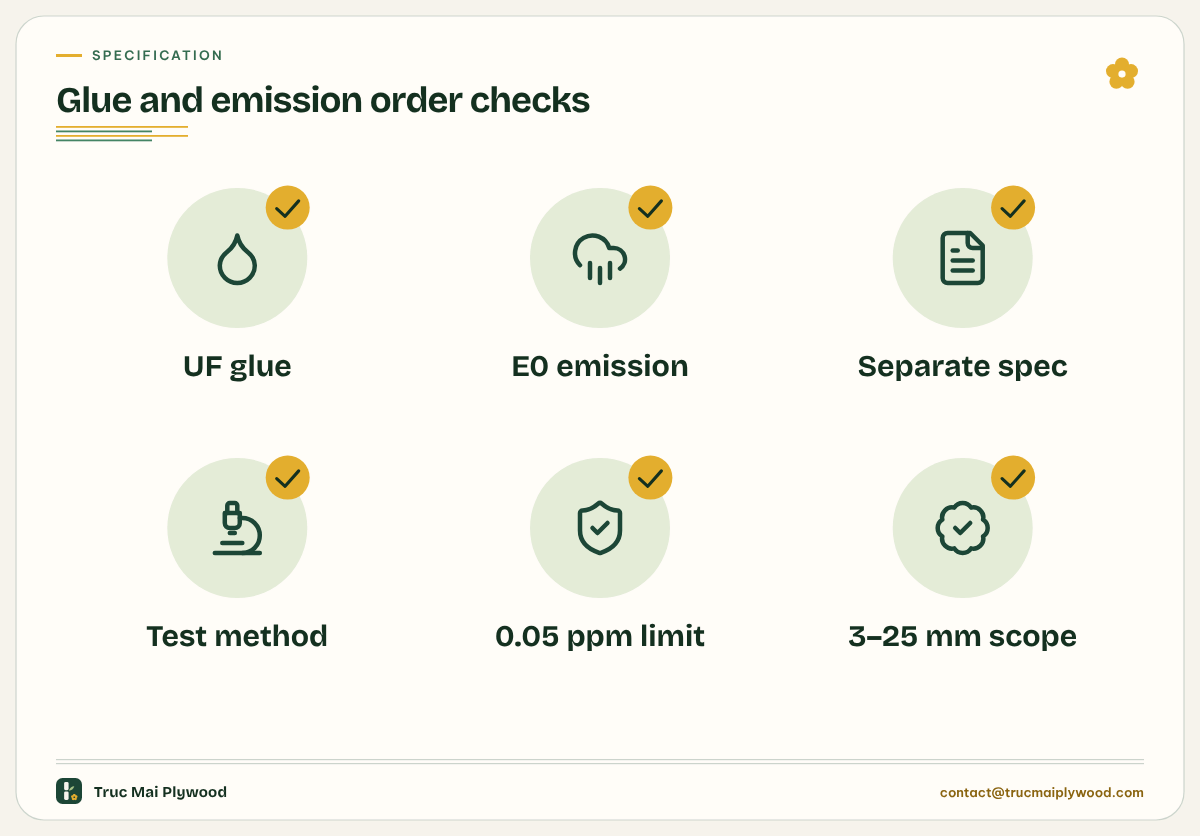
Glue system, moisture exposure and formaldehyde emission are three distinct specification decisions. For dry interior furniture, UF resin is commonly used; the USDA Wood Handbook adhesives chapter describes its interior-panel use and moisture limitations.
Truc Mai’s standard interior specification uses UF glue at E0 emission. Write the emission requirement separately from the adhesive, and attach the agreed test method when the buyer uses an E0 designation. An E0 label alone does not identify a harmonised European emission class.
For US-bound veneer-core hardwood plywood, 40 CFR 770.10 specifies a formaldehyde limit of 0.05 ppm under TSCA Title VI. The brand’s CARB Phase 2 and TSCA Title VI certification covers veneer-core hardwood plywood from 3 to 25 mm, under certificate CARB/EPA26053. Phase 2 formaldehyde limits explains the regulatory distinction.
Do not substitute a glue-bond test for an emission test. The buyer should receive a specification that identifies both the panel construction and the intended market’s documentation.
How should the surface be prepared for finishing?
A sanded, calibrated veneer face is the starting surface for a clear lacquer, stain or the buyer’s own UV coating. Finish trials should use the actual veneer and the planned coating system. Wood colour, grain and absorbency affect the result seen after finishing.
For a furniture line, run the same stain schedule on each candidate face. Compare colour in daylight and under the lighting used in the final showroom. Check whether the selected veneer needs filling before a smooth clear coat. The test board should include an edge and a corner, where finishing defects can be easier to notice.
A UV-ready panel means the surface is prepared for the customer’s UV process; the mill does not apply that coating. Buyers who want an already decorative overlay should consider a separate laminate-faced panel specification.
Record the approved finishing sample beside the face grade. A repeat order then has two references: what the bare veneer looks like and what the coated panel must look like.
Can the mill cut mahogany-look panels to furniture sizes?
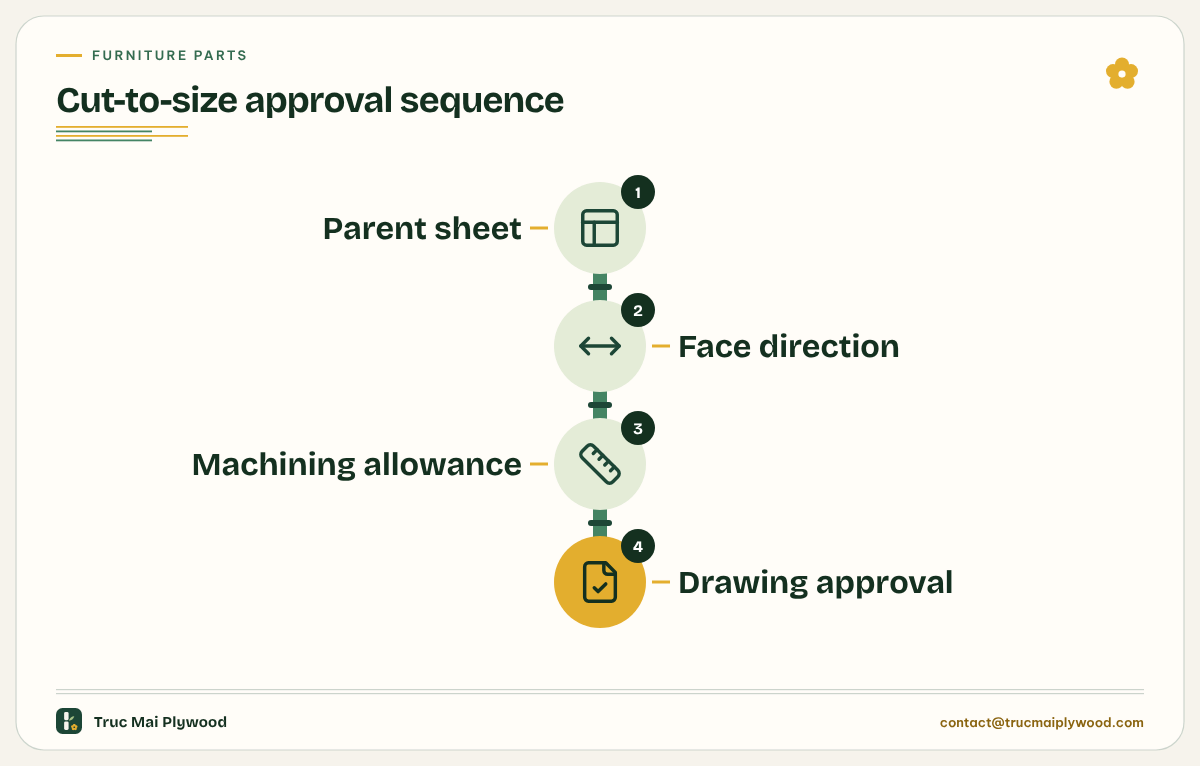
Yes. Cut-to-size production can divide standard sheets into labelled furniture components, with the final dimensions agreed from the buyer’s cut list. Common layouts include two long pieces, three shorter pieces, four pieces or six pieces from a sheet.
The order should identify finished dimensions, grain direction, edge allowance and label sequence. Cutting a panel before shipping can reduce handling at the furniture plant, but the buyer should check the nesting layout against its own machining plan.
- Send the parent-sheet format and required finished parts.
- Mark the face orientation and grain direction for every part.
- Specify any machining allowance and required labels.
- Approve the cut drawing and reference sample.
- Match the packing list to the labelled bundles at receipt.
The cut-to-size plywood panels route explains the manufacturing option. A cutting drawing is particularly useful for doors and tall panels, where rotating a part can change the visible grain relationship.
Which documents matter for a European or US order?
A European order should identify the veneer and core origin records; a US order should identify the applicable emission certificate and the product scope. Documentation follows the actual construction, including both decorative face and internal plies.
For European Union timber due diligence, the European Commission guidance describes information about origin and geolocation. The mill supplies core and face provenance records, including geolocation files for the relevant production plots. The face veneer origin file is useful when the visible veneer comes from a different country than the core.
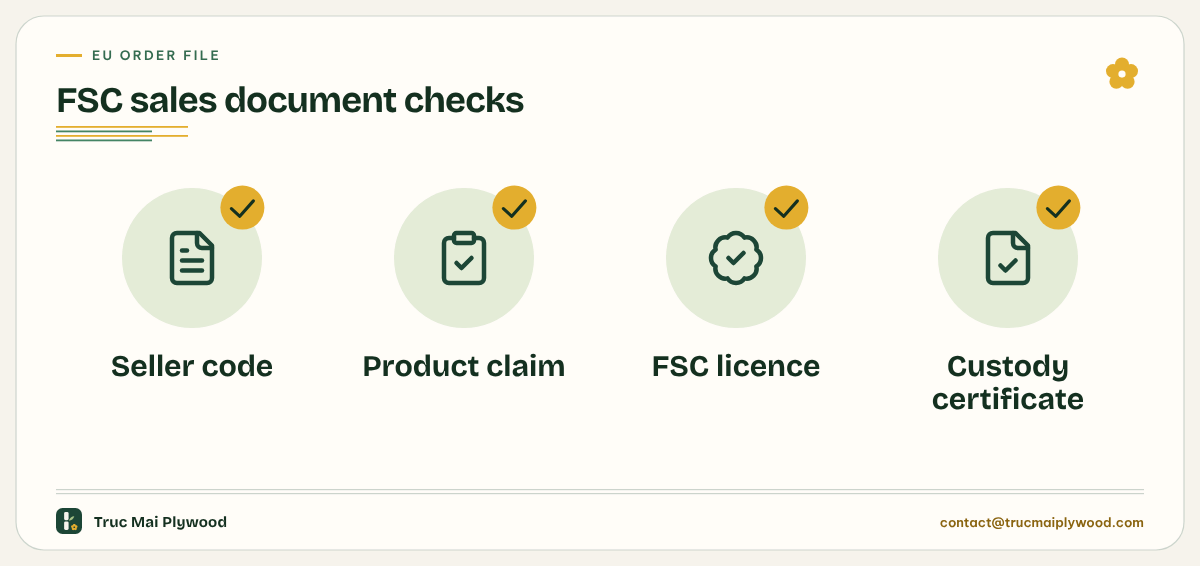
FSC chain-of-custody sales documents identify the seller’s certificate code and the product claim under FSC-STD-40-004. Truc Mai holds FSC licence FSC-C196493 and chain-of-custody certificate SA-COC-014545, with FSC 100% for eligible products. Request the claim on the sales line for the ordered configuration.
For importing, match the species and construction in the quotation, invoice, packing list and relevant supporting documents. EU import steps provides the shipment workflow.
How should a buyer compare samples from different mills?
Compare samples against the same written build specification, with face species, core, glue, finish and tolerance held constant. Two panels with a similar reddish face can differ substantially inside. The first comparison should therefore be between complete constructions rather than photographs.
Ask for a full-face view, an edge photograph and a physical cut sample. Check the face under the intended finish, then inspect the edge for joints and gaps. Confirm the reverse face and label the sample with its build description. Keep one reference for procurement and another at the production line.
A first order should use a signed sample schedule: decorative face, backing grade, core, thickness, adhesive, emission requirement, cut list and packing. For a repeat programme, the factory should use that same schedule as the control document. Ordering plywood samples explains the sample route.
Supplier comparisons are more useful when each bidder answers the same RFQ. A generic label such as mahogany veneer plywood leaves too much room for differing interpretations.
What belongs in a container-scale RFQ?
A container-scale RFQ should name the application, core, adhesive and emission requirement, decorative face, sheet dimensions, packing and quantity. Include the destination port and whether the quotation is FOB Hai Phong, CFR or CIF.
For a furniture manufacturer, the useful request is a bill of materials rather than a colour name alone. List the visible parts, hidden parts and their different face/back requirements. Attach the sample photograph and note the physical reference being approved. If cut pieces are ordered, send the part labels and grain-direction drawing.
Truc Mai Plywood manufactures commercial and furniture/interior plywood in Ha Hoa, Phu Tho, Vietnam, with annual capacity around 60,000 m³. Its standard minimum is one 40HC, with production typically 15–45 days after deposit under agreed order terms. Writing a plywood RFQ offers a field-by-field checklist.
Send the completed specification through the quotation route and request a sample matching the chosen face and core before approving the production order.
Send your specification to contact@trucmaiplywood.com or through the quotation form.
Questions buyers ask
Is mahogany veneer plywood solid mahogany?
No. The decorative veneer forms the visible surface, while the base is plywood with its own specified core construction.
Can a panel have mahogany on one face only?
Yes. Specify the show face and the back separately, including the approved appearance sample for each.
What does mahogny plywood mean on a Swedish listing?
Mahogny plywood is the Swedish retail term for mahogany plywood. Ask for the botanical face species and the core build when comparing listings.
Is a reddish face proof that a sheet is Khaya?
No. Species identification needs the supplier’s declared veneer identity and supporting origin information.
Can a furniture factory stain okoume to a darker tone?
A finishing trial can establish the desired colour on an approved okoume sample. Use the actual production coating sequence.
Should cabinet doors use matching veneer grain?
For adjacent visible doors, specify grain direction and the matching requirement in the approved sample schedule.
Can the reverse face have a different grade?
Yes. Record the face and back as a grade pair, with the reverse-face acceptance sample.
What should appear on a cut-panel label?
Use the part identifier, dimensions and grain direction agreed in the cut drawing.
Can FSC be specified for a decorative plywood order?
Yes, for an eligible FSC 100% configuration with the correct claim on sales documentation.
Are samples useful before a repeat container order?
Yes. A retained sample fixes the appearance and construction reference for subsequent production.