
Sapele plywood is a decorative panel with sapele hardwood veneer on the visible face and a cross-laminated plywood core. For furniture, doors and interior joinery, specify the veneer cut and matching, face grade, core species, thickness and finish together. Vietnamese production offers a choice of eucalyptus, acacia, Styrax and pine cores for repeat orders.
What is sapele plywood, and what does its face look like?
Sapele plywood is a veneered plywood panel whose visible surface is cut from sapele, Entandrophragma cylindricum, rather than a panel made entirely from sapele timber. The face provides the decorative colour and figure; the cross-laid core supplies the panel format and the characteristics selected for its intended furniture or interior application.
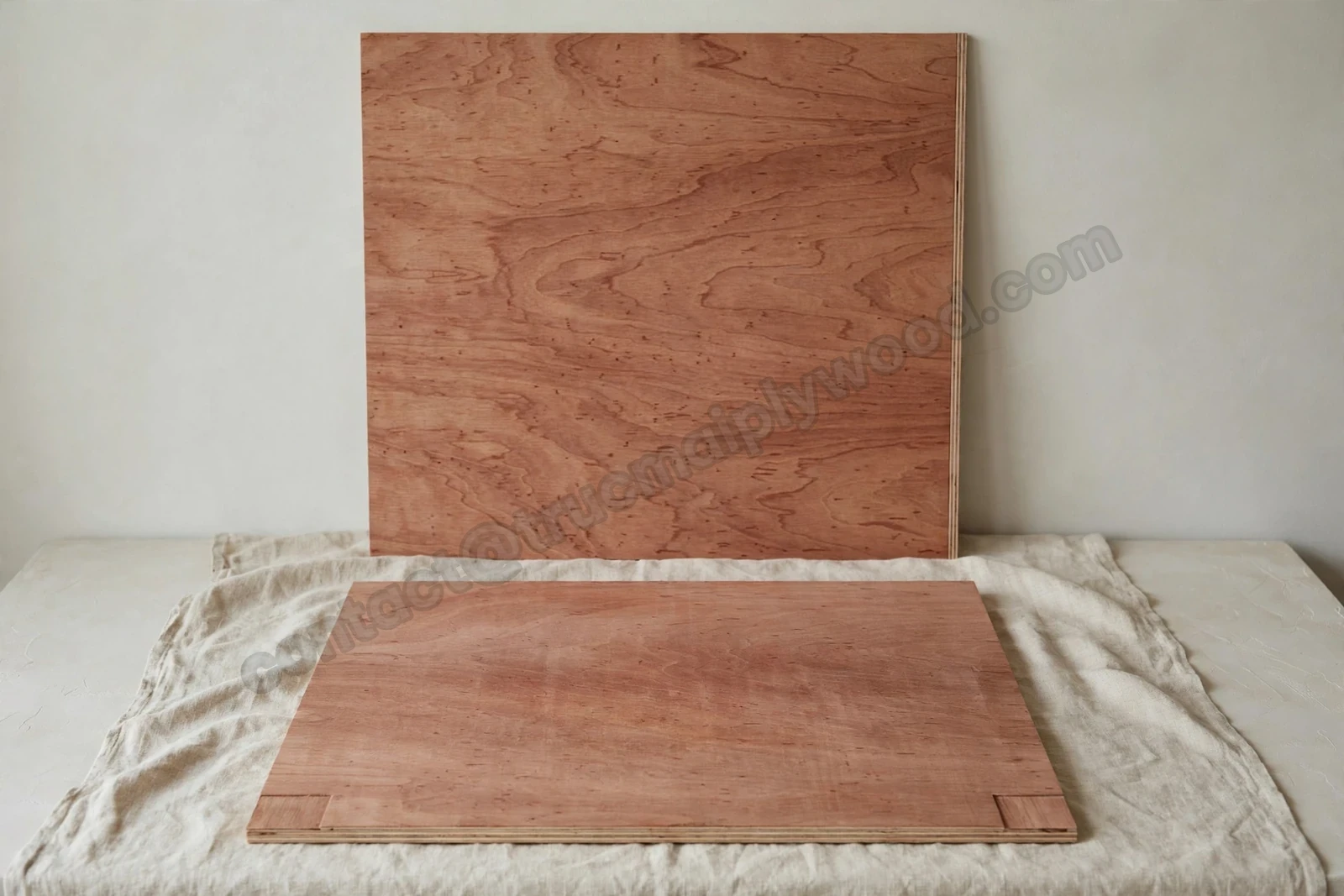
Sapele heartwood ranges from reddish brown to deeper purplish brown. Its interlocked grain can produce alternating light and dark ribbon stripes, especially on quarter-cut veneer. Flat-cut material gives a different, broader figure. The USDA Forest Products Laboratory describes the species in its Wood Handbook. The botanical name is useful on purchasing documents because the expression sapele mahogany is a commercial name, not an instruction to substitute another mahogany species.
The face changes appearance with viewing angle and finish. Ask for a sample showing the intended grain direction under the actual clear coat or stain, rather than choosing solely from an unfinished photograph. A small veneer swatch tells you the colour; a full-width laid-up sample reveals whether the figure will read evenly across a cabinet elevation or door leaf.
Which furniture and interior applications suit sapele veneer?
Sapele veneer is suited to decorative cabinet doors, furniture faces, wall panelling, reception joinery and interior door components where the visible wood pattern matters. The panel specification should follow the finished component: a wide door needs a controlled grain arrangement, while a small drawer front may be cut from a broader sheet with less emphasis on continuous figure.
For tall vertical elements, state whether the grain runs with the panel’s long dimension. For adjoining cupboard doors, agree how the veneer leaves will be matched before the panels are pressed. For modular furniture, the important question is often repeatability across a later shipment, not merely whether the first sheet looks attractive.
A buyer choosing among decorative hardwood faces can start with hardwood-faced plywood options and then compare real samples under the same lighting. Cabinet components also need consistent machining allowance, edge treatment and a back face suitable for the finishing process. The visible veneer should be selected alongside those production requirements.
How does sapele compare with okoume and bintangor faces?
Sapele is the choice when its reddish-brown colour and potentially pronounced ribbon figure are the design target; okoume and bintangor offer different reddish-face appearances. The decision is visual and specification-led, not a universal ranking of strength or quality. A face species name alone says little about the core or glue beneath it.
| Buyer decision | Sapele face | Okoume face | Bintangor face |
|---|---|---|---|
| Main design brief | Reddish-brown figure, including ribbon effects | Warm, comparatively even-looking face | Reddish decorative face |
| Sampling priority | Cut, stripe contrast, leaf matching | Tone and face uniformity | Tone, grain and face grade |
| What to hold constant | Core, thickness, glue, grade | Same comparison construction | Same comparison construction |
| Best comparison method | Finished reference panel | Finished reference panel | Finished reference panel |
The okoume-faced plywood and bintangor-faced plywood pages show the alternative face families. For thin door components, the okoume door skins discussion is also relevant. Request comparable face/back pairs and identical finishing conditions. Comparing an unfinished sapele sheet with a lacquered alternative would confuse the coating effect with the wood’s own colour.
What veneer cut, matching and face grade should buyers specify?
Specify the veneer cut, matching pattern and approved face/back grade as three distinct items. A quarter-cut sapele face can emphasise ribbon stripe, whereas a flat-cut face may display wider cathedral-like movement. Adjacent leaves can be slip-matched for repeated direction or book-matched for mirrored figure. The supplier’s sample should show the intended pattern over the useful component area.
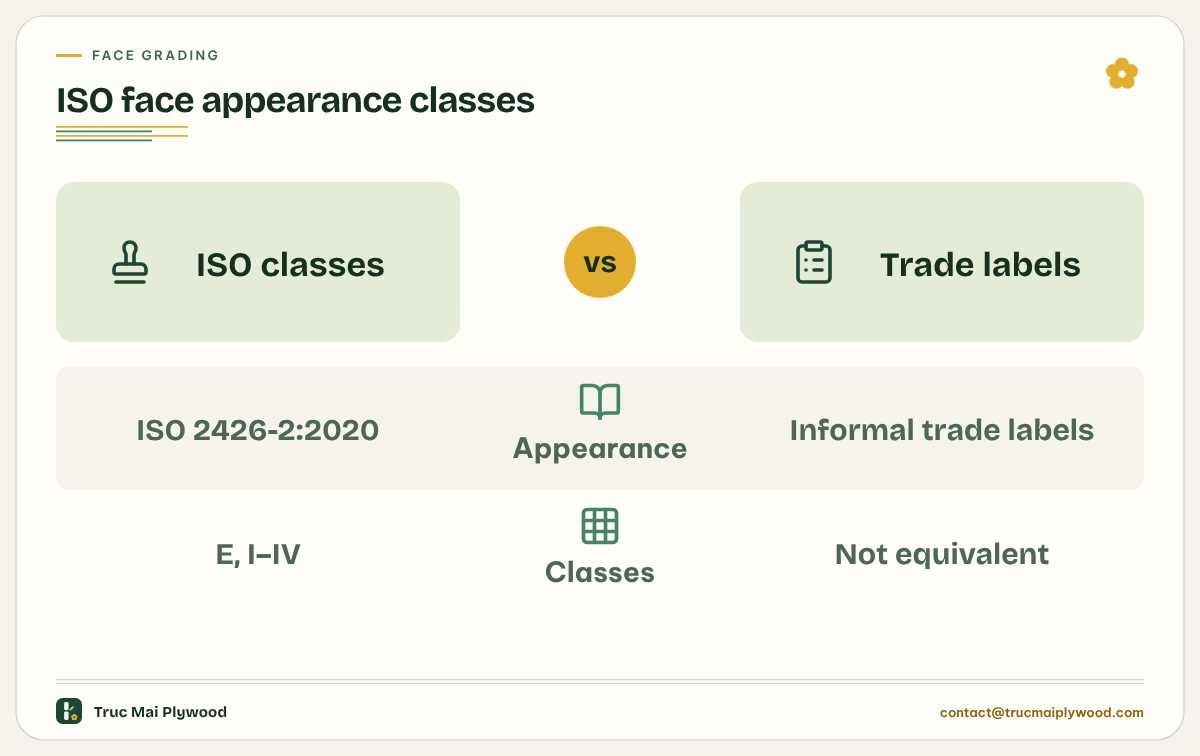
A grade name such as A/B or B/BB is only useful when paired with the supplier’s written appearance criteria. Define acceptable knots, repairs, discolouration, open joints and figure variation through an approved sample. ISO 2426-2:2020 identifies hardwood plywood surface appearance classes E, I, II, III and IV; those classes should not be silently equated with informal trade labels.
A furniture factory should record which face is outward, the back grade and whether leaves must continue across adjacent components. If the finished panel is to receive a clear coat, the sample approval needs to cover natural colour variation. For painted components, a decorative sapele face may offer little benefit over a less figured substrate. Write the actual intended finish on the order rather than relying on a product name.
Which plywood core should sit beneath a sapele face?
Eucalyptus, Acacia, Styrax and Pine are the core options for this Vietnamese furniture and commercial plywood range, with combined-species construction available. They are distinct from the decorative sapele face. Core selection affects panel weight, machining behaviour, construction and the amount that can be packed into a container.
An A-grade stitched core is used for furniture and interior work where an even surface and dependable edges are important. Stitching can run along and across the sheet, with the outer plies joined to control gaps. A commercial-grade construction may use jointed or loose-laid core veneer and a less demanding face preparation. The quote should state the core assembly method, not simply describe the panel as hardwood plywood.
Choose the core with the end use in mind. A lightweight cabinet component has different handling priorities from a heavily machined counter panel. For a veneered door, examine the balance of both faces and the condition of the core near the edges. A sample section can reveal gaps that are invisible on a decorative surface. The cabinet-grade plywood article explains the wider buying logic for furniture joinery.
What sheet sizes, thicknesses and tolerances can be ordered?
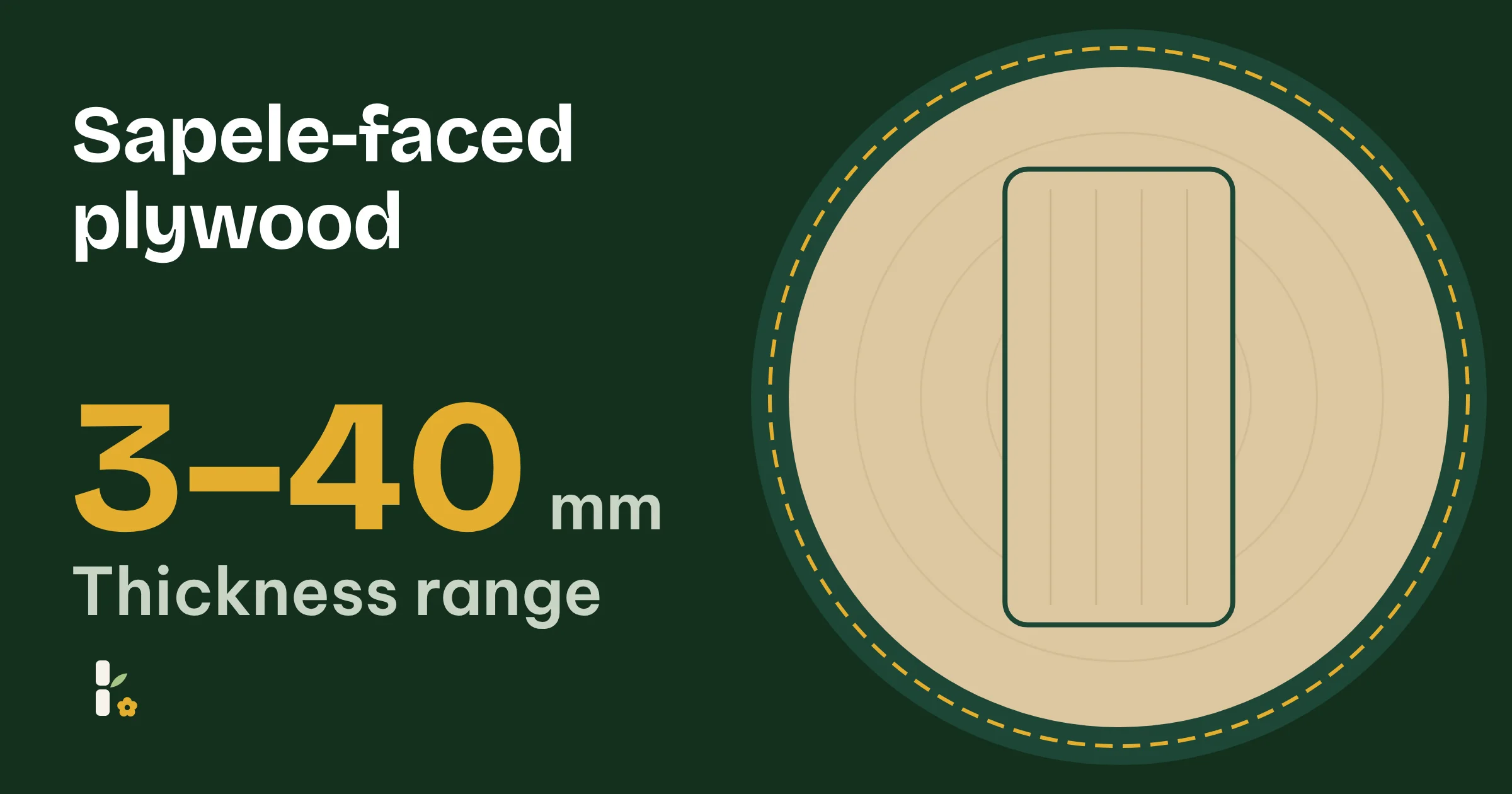
The standard panel range is 3–40 mm thick, with 1220 × 2440 mm, 1220 × 2280 mm and 1250 × 2500 mm sheet formats. Common ordered thicknesses include 3, 4, 5, 6, 9, 12, 15, 18, 21, 25, 30 and 40 mm. The size and thickness are recorded independently of the sapele veneer selection.
| Specification line | Order description |
|---|---|
| Face | Sapele veneer, cut and approved face/back pair |
| Core | Styrax, Acacia, Eucalyptus, Pine or agreed mixed core |
| Sheet formats | 1220 × 2440; 1220 × 2280; 1250 × 2500 mm |
| Thickness | 3–40 mm range |
| Furniture panel thickness tolerance | ±0.3 mm for sanded, calibrated work |
| Commercial thickness tolerance | ±0.5 mm |
| Length and width tolerance | ±2 mm |
| Surface | Sanded and calibrated; polishing on request |
Tolerance is a purchase-order requirement, not a property implied by the veneer species. The European EN 315 dimensional standard describes a separate system of plywood dimensional tolerances. When a cabinet factory uses calibrated thickness for routing or concealed fittings, state the agreed mill tolerance directly in the drawing and inspection sheet.
Can sapele-faced sheets be cut and labelled before shipment?
Yes. Cut-to-size plywood is an order option: the mill divides standard sheets to the approved cutting list and labels the resulting panels for the buyer’s assembly sequence. A 1220 × 2440 mm sheet can be divided lengthwise into two 610 × 2440 mm pieces, or into four 1220 × 610 mm pieces. Three-piece 1200 × 800 mm patterns and six-piece layouts are also available by agreement.
The final cut list should name the parent sheet, finished piece dimensions, grain direction, piece count and label text. A cabinet producer may need a matching face sequence across two doors, whereas a packing or commercial customer may prioritise nesting efficiency. The cut-to-size plywood panels page provides the ordering context.
Saw kerf and trimming allowance belong in the cutting drawing. The supplier and buyer should agree the usable finished dimension by email before production. A face layout that looks economical on a spreadsheet can be wasteful if the required grain direction forces pieces to be rotated or if book-matched pairs are separated.
Which adhesive and emission specification belongs on the order?
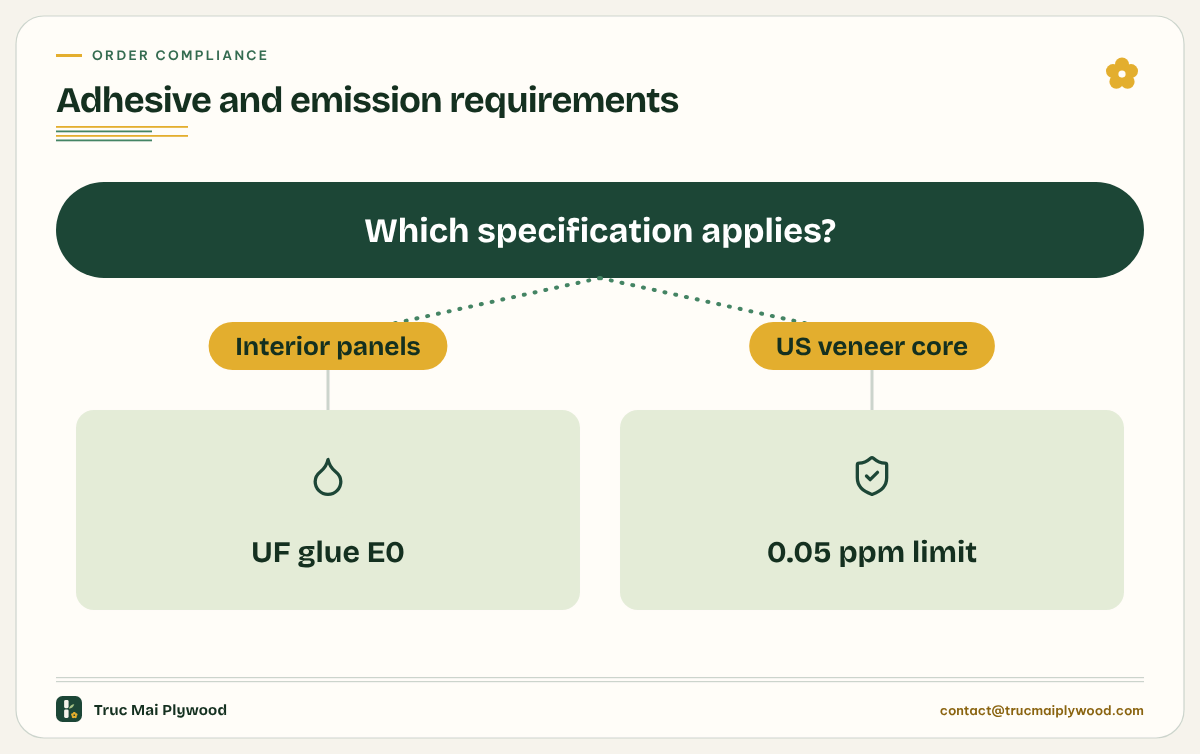
Write the adhesive system and the emission requirement as separate lines. For interior panels, the mill’s standard specification is UF glue at E0 emission; the emission designation is not a description of the glue itself. A buyer specifying an exposure condition should also state the relevant bond-test requirement for that exact construction.
The USDA Forest Products Laboratory’s wood adhesives chapter explains why urea-formaldehyde adhesives are widely used in interior panels and why moisture resistance differs among adhesive families. A bond test measures the glue line’s behaviour after defined conditioning. An emission test measures formaldehyde released from a tested panel assembly. Neither substitutes for the other.
For US hardwood plywood with veneer core, 40 CFR 770.10 sets the TSCA Title VI formaldehyde limit at 0.05 ppm under the specified test framework. The certified Truc Mai hardwood plywood veneer-core scope covers 3–25 mm under CARB Phase 2 and TSCA Title VI, certificate CARB/EPA 26053. Match the shipment’s construction and thickness to the certificate scope when preparing the purchase file.
What does a repeatable sapele-face specification look like?
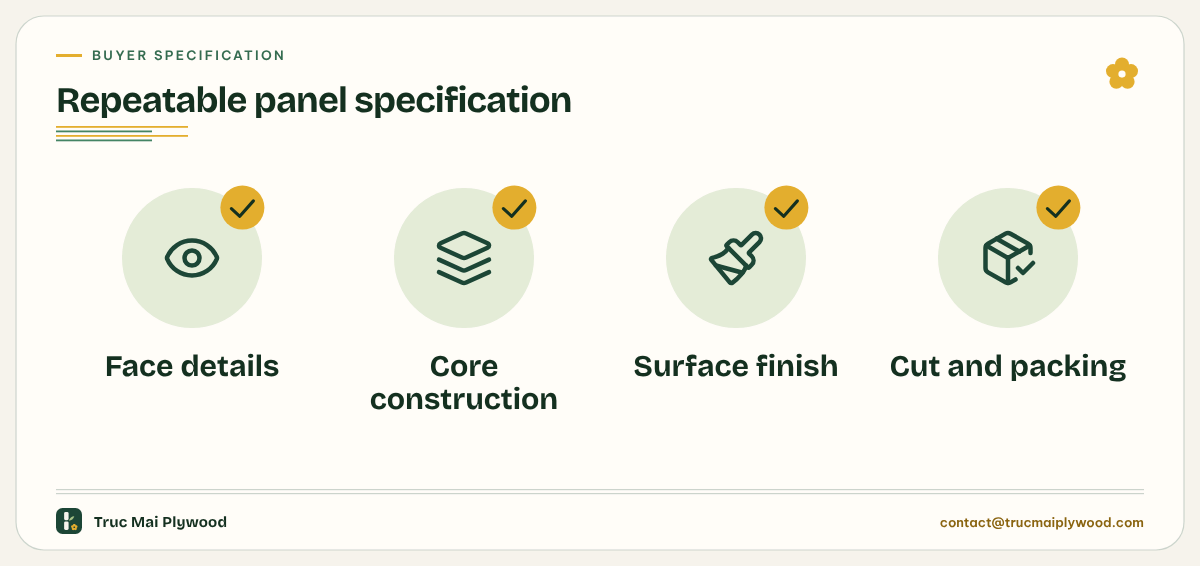
A repeatable specification is a signed panel description with an approved face sample, core construction and inspection method. It gives purchasing and factory teams a common reference when the same furniture range is reordered months later. The decorative face is particularly important because acceptable natural variation cannot be captured by a single colour word.
- Approve the face. Record sapele species, veneer cut, grain direction, matching method and face/back grade against labelled samples.
- Fix the build. State core species, joining method, thickness, number of plies where needed and adhesive/emission requirements.
- Fix the finish. State whether the surface is sanded, calibrated or prepared for the buyer’s own coating process.
- Fix the drawing. Give the parent sheet, cut pieces, label references and packaging sequence.
- Fix the evidence. List inspection records and certificate documents required for the intended market.
This sequence makes two supplier quotations comparable. The plywood RFQ checklist gives the fields to send before a mill prepares a commercial offer. Keep the same approved sample reference on the order and inspection report. A later colour dispute is much easier to resolve when the accepted variation was established at the sampling stage.
How many sapele-faced panels fit into a 40HC container?
A 40HC load is planned from the panel core, thickness and sheet dimensions; the thin decorative face does not determine the loading figure. The following figures are the supplied planning model for 1220 × 2440 mm sheets. They are model outputs for panels, with a planning cargo payload of 28,000 kg, and are not a shipment loading record.
| Core | Thickness (mm) | Sheet size (mm) | Packs | Sheets/pack | Sheets | Volume (m³) | kg/sheet | Total kg | Weight-capped |
|---|---|---|---|---|---|---|---|---|---|
| Styrax | 12 | 1220 × 2440 | 18 | 83 | 1494 | 53.4 | 17.9 | 26680 | No |
| Acacia | 12 | 1220 × 2440 | 16 | 83 | 1328 | 47.4 | 20.7 | 27510 | No |
| Eucalyptus | 12 | 1220 × 2440 | 15 | 80 | 1200 | 42.9 | 23.2 | 27860 | Yes |
| Styrax | 15 | 1220 × 2440 | 18 | 66 | 1188 | 53.0 | 22.3 | 26520 | No |
| Acacia | 15 | 1220 × 2440 | 16 | 66 | 1056 | 47.2 | 25.9 | 27350 | No |
| Eucalyptus | 15 | 1220 × 2440 | 15 | 64 | 960 | 42.9 | 29.0 | 27860 | Yes |
| Styrax | 18 | 1220 × 2440 | 18 | 55 | 990 | 53.0 | 26.8 | 26520 | No |
| Acacia | 18 | 1220 × 2440 | 16 | 55 | 880 | 47.2 | 31.1 | 27350 | No |
| Eucalyptus | 18 | 1220 × 2440 | 15 | 53 | 795 | 42.6 | 34.8 | 27690 | Yes |
| Styrax | 21 | 1220 × 2440 | 18 | 47 | 846 | 52.9 | 31.3 | 26440 | No |
| Acacia | 21 | 1220 × 2440 | 16 | 47 | 752 | 47.0 | 36.3 | 27270 | No |
| Eucalyptus | 21 | 1220 × 2440 | 15 | 45 | 675 | 42.2 | 40.6 | 27430 | Yes |
Model basis: 40HC planning model, panels only; 18 packs for Styrax, 16 for Acacia and 15 for Eucalyptus. Pack height is 1,000 mm; sheets per pack are the rounded-down height divided by panel thickness, then capped by the 28,000 kg planning payload. Reference densities are 500 kg/m³ for Styrax, 580 kg/m³ for Acacia and 650 kg/m³ for Eucalyptus. Carrier and route determine the permitted payload; weigh the finished sheets and include packaging in the final loading plan.
This comparison explains why identical sheet dimensions do not mean identical container quantities. When reviewing a quotation, compare the declared core with the sheet count, total cargo weight and pack plan. The 40HC loading-by-thickness reference places the calculation in the wider range of available panel dimensions.
What documents should accompany a sapele-faced plywood order?
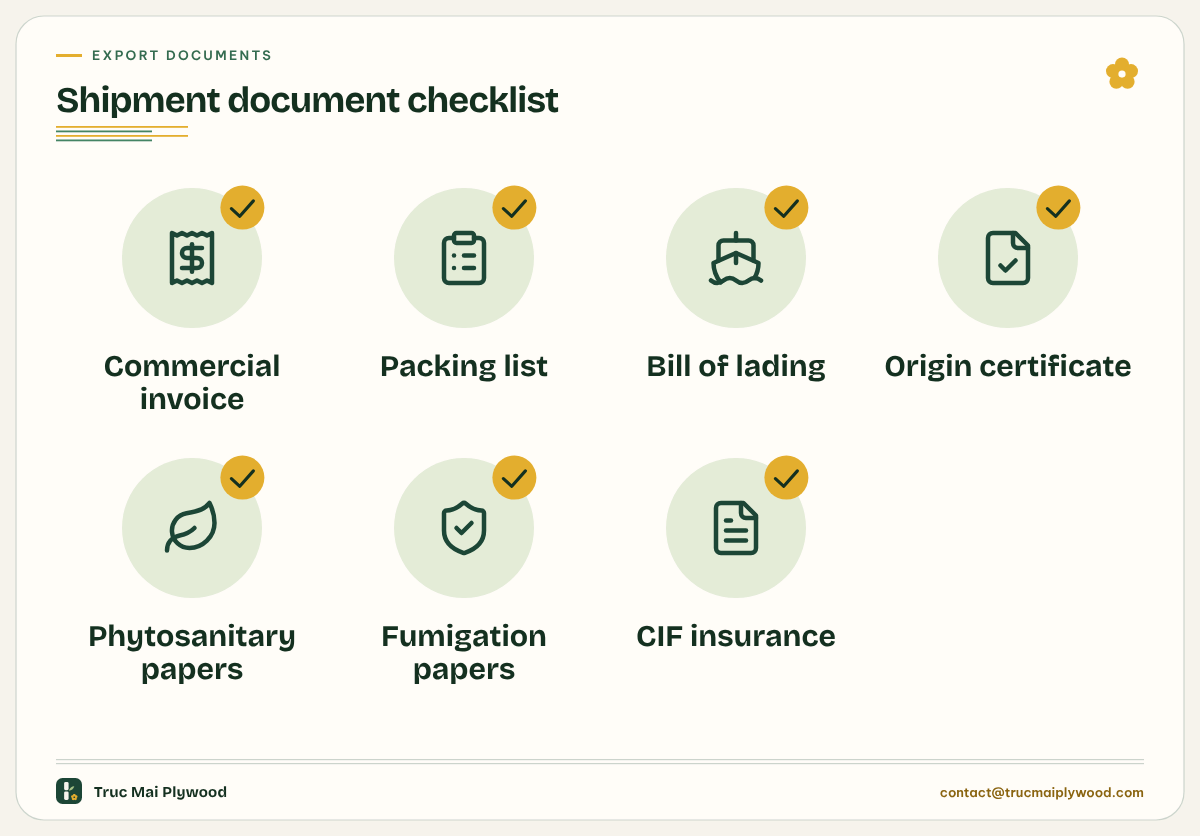
The file should include the commercial invoice, packing list, bill of lading, certificate of origin and the certificate or test documents named on the order. The exact bundle also reflects destination and agreed shipment terms. The invoice description should identify the decorative face and actual plywood construction, rather than use a generic hardwood label.
For eligible FSC 100% products, the mill holds chain-of-custody certificate SA-COC-014545 and licence FSC-C196493. FSC-STD-40-004 requires the relevant FSC claim and certificate code on sales documents. Buyers can follow the FSC licence verification procedure when assembling their supplier records.
For EU shipments, the origin dossier includes records and geolocation files for both the Vietnamese core and the imported face veneer. The European Commission’s EUDR overview explains the due-diligence framework and its application dates. The face veneer origin-file guide explains why a face species should be documented independently from the core. Preserve the botanical name, origin and supplier traceability reference in the buying file.
How should an importer assess a Vietnam sapele plywood exporter company?
A Vietnam sapele-faced plywood exporter should be assessed by its ability to reproduce the approved face and core construction, supply the required destination-market documents and pack the agreed panel mix. Truc Mai Plywood manufactures furniture and commercial plywood in Ha Hoa, Phu Tho, Vietnam, with annual production capacity of around 60,000 m³ and sapele among its available decorative face options.
Start with a real panel sample and a cross-section. Check the veneer species and matching, inspect the back face, then compare the core against the written order. Ask how the mill records calibration, core joining and final pack labels. A decorative sample without a defined core is insufficient for comparing two repeat quotations.
Check company and certificate identity against the actual sales documents. The mill’s ISO 9001:2015 quality management certification covers plywood manufacturing; ISO 14001:2015 covers its environmental management system for plywood manufacturing. These are management-system credentials and should be read alongside the panel’s actual order specification.
The mill verification checklist provides a practical sequence before a deposit is sent. A strong supplier assessment also asks whether the sample and inspection criteria can be carried unchanged into the next production order. That matters more for matching furniture fronts than a generic catalogue photograph.
How are samples, production terms and packing agreed?
A sample-led order begins with the finished application and a labelled veneer reference. New buyers can receive free samples while arranging their courier; repeat buyers and buyers with an order receive free samples. Once the sample is approved, the order records the face, core, adhesive, thickness, sheet or cut sizes and packing labels.
The standard minimum order is one 40HC. Production is scheduled over 15–45 days after a 30% deposit, with the 70% balance against the scanned bill of lading. T/T or an irrevocable letter of credit at sight can be agreed; shipment terms are FOB Hai Phong, CFR or CIF. One or two products normally share a container, with larger mixed assortments arranged by agreement.
Use the sample ordering guide to prepare the first approval set. Ask for a reference face that represents the agreed colour range, a representative edge section and a written cutting or packing drawing. The goal is to turn an attractive veneer into a component specification that can be inspected and reordered without renegotiating its meaning.
What should go into the final sapele plywood RFQ?
Send one clear specification line for each distinct panel build, followed by the destination port and required documents. An actionable request identifies the finished use, sapele veneer cut and matching, face/back grade, core, glue and emission requirement, thickness, sheet size, cutting layout, packing and container quantity.
For a cabinet-door programme, include the grain direction and whether adjacent fronts must match. For a decorative wall installation, include the visual sample reference and the planned finish. For machined furniture parts, include the finished thickness tolerance and the cutting drawing. If the shipment mixes different panels, give a separate quantity and label reference for each build.
Send the completed specification to contact@trucmaiplywood.com and request a quotation with the sample reference attached. The mill can then price the defined construction and prepare a production and packing plan around the actual components rather than an ambiguous product name.
Send your specification to contact@trucmaiplywood.com or through the quotation form.
Questions buyers ask
Is sapele the same species as genuine mahogany?
No. Sapele is Entandrophragma cylindricum, a distinct hardwood species. Sapele mahogany is a trade description, so identify the botanical species in a veneer order.
Can sapele veneer be book-matched?
Yes. Adjacent leaves can be opened like a book to create mirrored grain, with the sequence and joint pattern agreed against a sample.
What is the difference between a face grade and a core grade?
Face grade describes the visible veneer appearance. Core grade describes the internal veneer quality and assembly; specify both separately.
Can I request a darker reddish-brown appearance?
Yes. Select the approved veneer sample and a finish sample together, because the final colour depends on the natural face and coating system.
Are the two faces necessarily identical?
No. A decorative front can be paired with a different back grade. Record the face/back pair and any balancing requirements in the purchase specification.
Can a sapele panel be supplied ready for the buyer to apply UV coating?
Yes. A sanded, calibrated UV-ready face can be supplied for the buyer to coat; UV-ready does not mean a factory-applied UV finish.
How should samples be approved?
Approve a labelled face sample and a representative panel cross-section, then retain the same reference for production inspection.
Can several face veneers share one shipment?
Yes. Mixed products can be agreed for a container; list each face, core and packing quantity on its own order line.
What is the difference between FSC chain of custody and a product claim?
Chain of custody is the certified management system. An eligible product is sold with its specific FSC claim and seller certificate code on sales documents.
Does sapele veneer determine formaldehyde emissions?
No. Formaldehyde emissions are assessed for the complete panel construction and adhesive system, not from the decorative species name alone.