
Cherry plywood is a layered wood panel finished with a decorative cherry veneer, commonly selected for furniture, cabinetry and wall interiors. Natural cherry offers distinctive grain and a colour that deepens with light exposure. Truc Mai Plywood offers natural cherry faces on request; repeat-volume buyers can also compare warm-toned okoume and engineered veneer faces.
What is cherry plywood?
Cherry plywood is plywood with a decorative cherry-wood face veneer bonded to a layered panel. The visible face supplies the grain and reddish-brown colour; the inner veneers supply the bulk of the panel. A specification saying only “cherry ply” therefore leaves the core, back face, adhesive and surface grade undecided.
American black cherry, Prunus serotina, is the familiar reference species for natural cherry veneer. The USDA Forest Service description of black cherry identifies straight grain, reddish-brown heartwood and a lustrous finish. A buyer selecting a decorative face should request the botanical name rather than accept “cherry colour” as proof of species.
In a furniture programme, the practical choice is between a genuine cherry face, specified by species and approved veneer sample, and a cherry-look surface chosen for repeatable colour. The engineered veneer panel range is the relevant alternative when a regular pattern matters more than natural species identity.
What does natural cherry veneer look like?
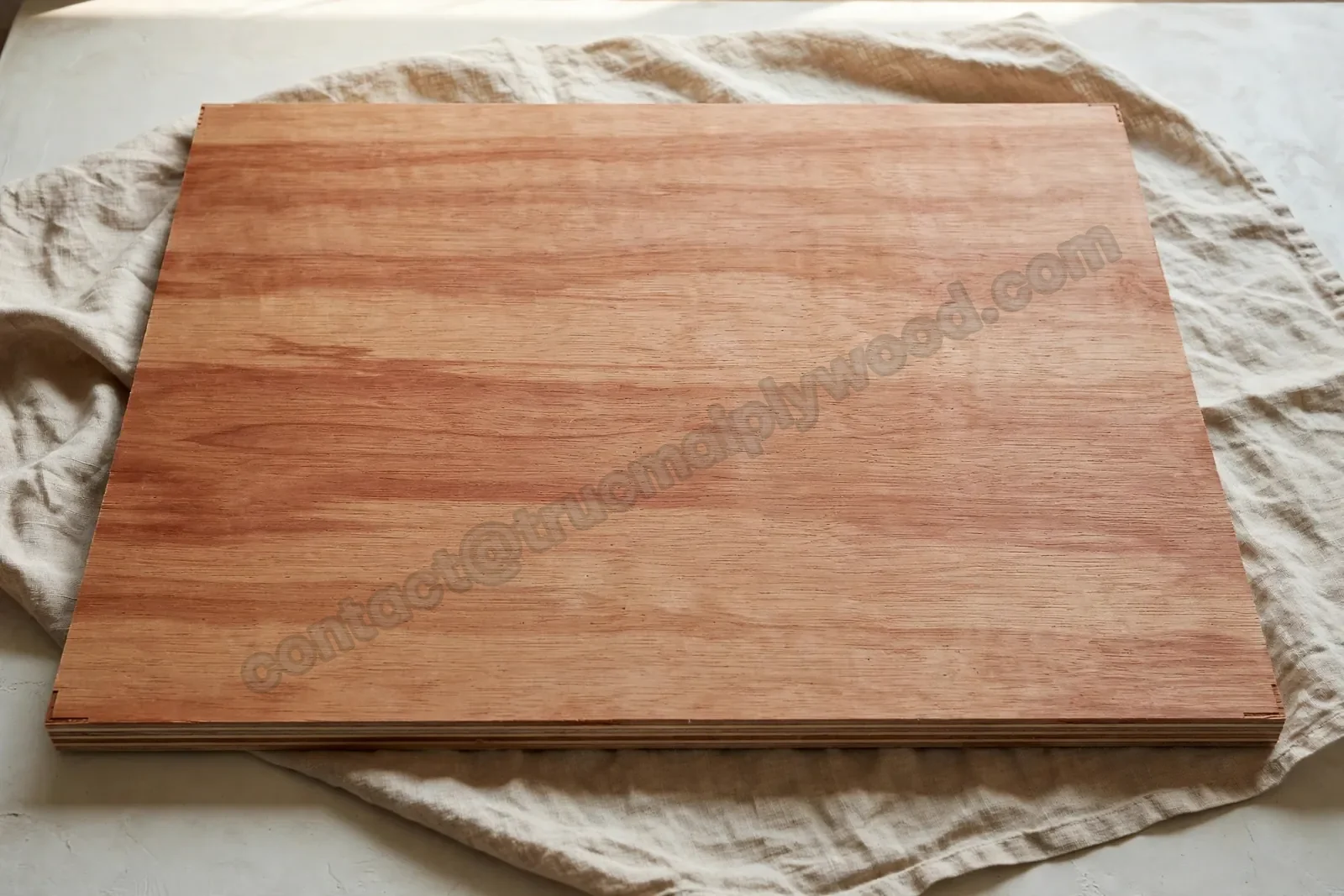
Natural cherry has a fine, usually straight grain and a warm heartwood colour that ranges from lighter reddish brown to deeper red-brown. Sapwood is paler. Colour selection matters because two sheets from different logs can look noticeably different even when both are genuine cherry.
The USDA’s veneer species research describes gum spots and streaks as characteristic defects of cherry veneer logs. Buyers should decide whether small natural marks contribute to the intended appearance or should be excluded from the approved face. A photograph of one selected sheet is a weak basis for a large cabinet run; an agreed sample range is more useful.
Specify whether the visible furniture fronts should show a quiet, consistent grain or deliberate natural variation. For paired doors, request a matching plan. For long wall panels, inspect the grain direction across adjoining sheets. These decisions belong in the veneer approval, before the cutting schedule is fixed.
Why does cherry plywood change colour after installation?
Cherry heartwood generally darkens as it ages, and light exposure accelerates the change. A cabinet door exposed to daylight can develop a different tone from a covered or shaded component made from the same original veneer.
The USDA Forest Products Laboratory account of cherry records the colour change with age. For a showroom or a repeat-order furniture line, approve a finished reference and retain a protected control sample. Compare both newly finished material and an aged display sample where the installation has strong daylight.
The finish schedule also matters. A clear coating reveals the wood’s own change; a pigmented system changes the starting colour. Discuss coating type, sheen and expected exposure with the finishing contractor before agreeing on a face colour. Where colour matching between shipments is the overriding requirement, a controlled engineered pattern deserves a side-by-side trial.
Where does cherry-faced plywood work best?
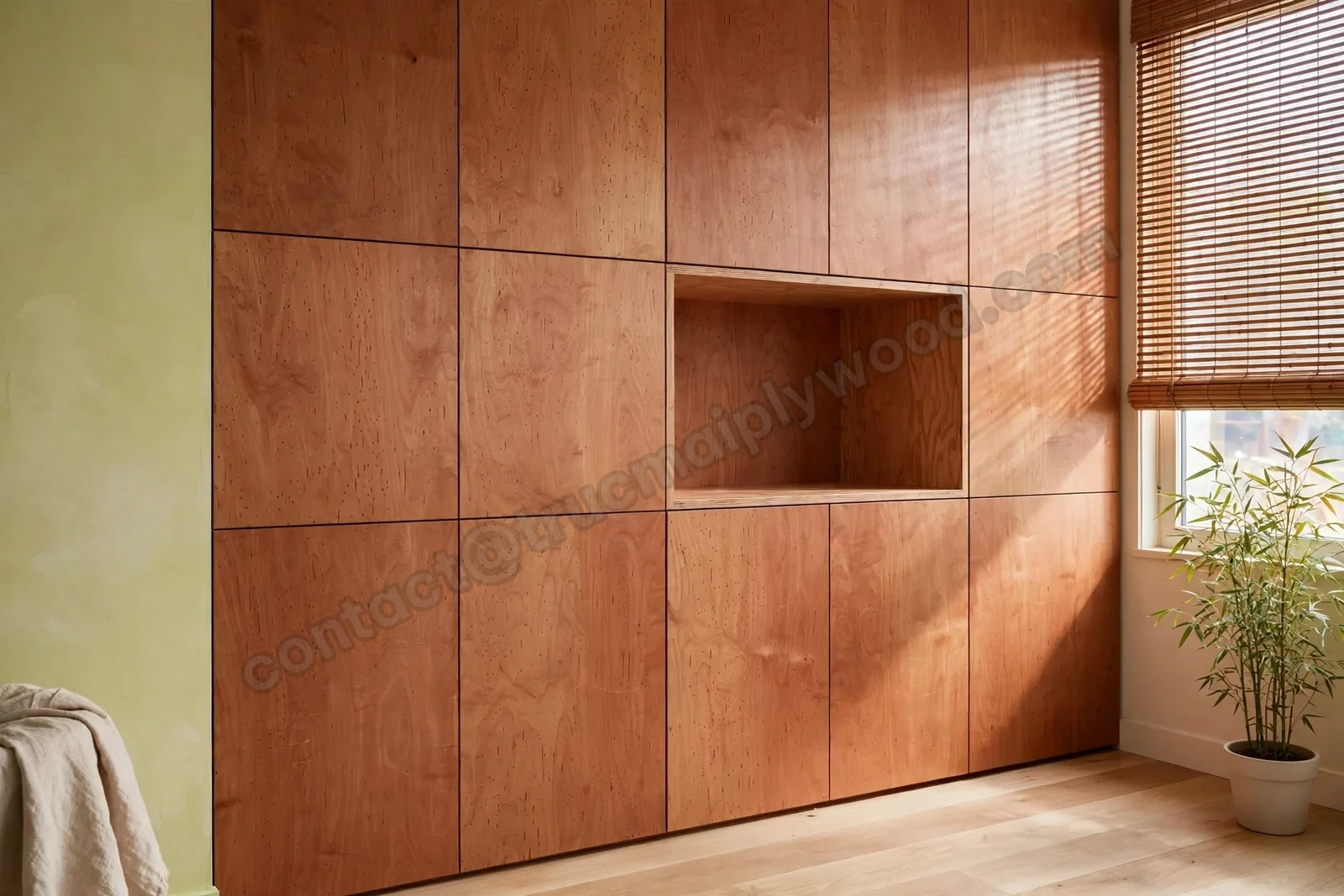
Cherry-faced plywood suits visible indoor furniture surfaces: cabinet doors, furniture sides, decorative shelving, reception joinery and wall panelling. The face is selected for appearance, while the core and thickness are chosen for machining, fixing and the finished component’s dimensions.
A cabinet maker may put a decorative cherry face on the outward side and a coordinated back on the inside. A wall-panel producer may care more about veneer sequencing and consistent light reflection. A drawer-component buyer may prefer a less decorative face because the panel will be concealed. The cabinet-grade plywood specification explains how the core and surface work together.
Treat the application as an indoor furniture or interior-panel requirement. A face species alone does not determine a bond classification, load-bearing capacity or moisture exposure rating. The buyer’s drawings should identify the visible faces and the surfaces that receive a coating, laminate or edge band.
Natural cherry, okoume or engineered veneer: which face wins?
Natural cherry is the choice for authentic cherry grain; okoume is a warm-toned wood-face alternative; engineered veneer is the choice for a specified repeat pattern. None is interchangeable without a sample approval.
| Buyer criterion | Natural cherry face | Okoume face | Engineered veneer face |
|---|---|---|---|
| Appearance | Natural cherry grain and colour variation | Warm wood appearance with its own grain | Designed, repeatable grain pattern |
| Species declaration | State cherry botanical species | State okoume species | State actual veneer material |
| Colour matching | Approve a natural range | Approve face selection | Approve pattern and colour master |
| Repeat furniture fronts | Match veneer batches | Match selected faces | Match the agreed pattern |
| Order priority | Species authenticity | Warm decorative appearance | Visual consistency across runs |
For a recurring cabinet programme, ask for samples of okoume-faced plywood and engineered veneer alongside natural cherry. Compare the samples after the same finish is applied, not as uncoated pieces from unrelated lighting conditions. The chosen core can remain the same while the face specification changes.
What core belongs beneath a cherry veneer face?
Styrax, Eucalyptus, Acacia, Pine and combined-species veneer cores are available for furniture and commercial panels. The correct choice follows the required weight, machining behaviour, core appearance and packing plan, rather than the name of the decorative face.
For a visible cabinet edge, the buyer may want a stitched A-grade core with fewer open joints. For a concealed commercial component, a different joining method may be suitable. The face and core should appear as separate entries in the purchase specification. A natural cherry face does not imply a cherry core.
At the mill, core stitching can run both along and across the sheet; the outer 2–4 plies are commonly stitched, with all-ply stitching available on request. Request a cut-edge sample and inspect core gaps at the points where hinges, screws or routed profiles will be fitted. A smooth face cannot compensate for an unsuitable core build.
Which sheet sizes and thicknesses can be ordered?
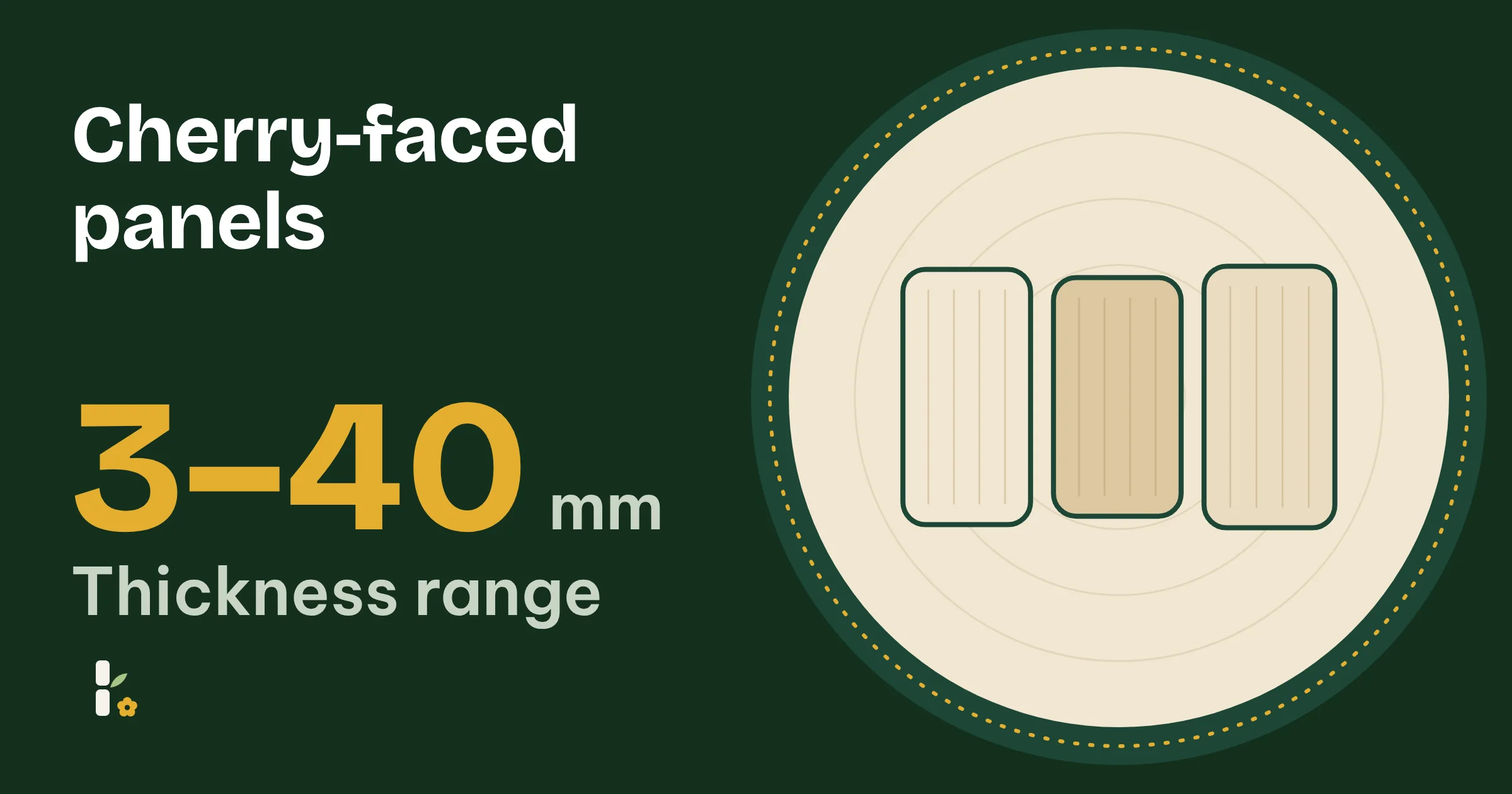
The furniture and commercial range covers 3–40 mm thickness and regular sheets of 1220 × 2440, 1220 × 2280 and 1250 × 2500 mm. The 1220 × 2280 mm format serves furniture components where a shorter blank improves the cutting plan.
| Specification field | Available selection | What the buyer should record |
|---|---|---|
| Thickness | 3–40 mm | Nominal thickness and agreed tolerance |
| Standard sheet | 1220 × 2440 mm | Sheet orientation and grain direction |
| Short furniture sheet | 1220 × 2280 mm | Cut list and usable length |
| European format | 1250 × 2500 mm | Finished component layout |
| Face | Natural cherry on request | Species, appearance sample and finish |
| Core | Styrax, Eucalyptus, Acacia, Pine or combined | Core grade and joining method |
A furniture buyer specifying 18 mm panels should write the nominal thickness and the face/back arrangement, then approve the core edge. For a repeat programme, retain the same order line across shipments. The 18 mm plywood specification gives the broader purchasing context.
How should face and back grades be written?
Write the face and back as a pair, then attach approved samples. A shorthand grade without a visual reference can conceal differences in knots, repairs, colour variation, mineral marks and veneer matching.
The ISO 2426-2 hardwood plywood appearance classification uses appearance classes E, I, II, III and IV. Trade labels such as A/B or B/BB belong to a supplier’s own grading schedule rather than a universal conversion to those classes. For natural cherry, the approved sample should show the permitted sapwood and gum marks as well as the preferred heartwood tone.
Write whether both faces remain visible after assembly. A decorative front with a utility back is a different order from a two-sided cabinet divider. Photograph the approved pair under neutral lighting, label the face and back, and record whether book matching or slip matching is requested.
How are cherry veneer panels pressed and finished?
The panel is assembled from core veneers, bonded, pressed, trimmed and surface-prepared before the decorative finish is applied by the furniture producer. For a cherry face, the finished surface must remain flat enough for an even clear coating and free of telegraphed core joints.
The mill’s furniture line uses stitched A-grade cores and sanded, calibrated faces. Face veneer is generally 0.2–0.5 mm, with 0.3 mm a common European specification. Those figures describe the face layer, not the entire plywood thickness. The buyer should inspect the face after sanding, especially around patches, joints and thin veneer areas.
The USDA Forest Service guide to surface distortions explains how moisture changes can lead to veneer buckling or finish cracks. That makes conditioning, balanced construction and consistent finishing schedules practical purchasing topics, not merely workshop details. A finished sample is the strongest basis for approving appearance.
What adhesive and emission specification should an importer request?
Specify the adhesive system and formaldehyde emission requirement as separate lines. For indoor furniture panels, UF glue at E0 emission is a common mill specification; the buyer should also name the applicable destination-market test and documentation requirement.
For US-bound hardwood plywood with veneer core, 40 CFR 770.10 sets the TSCA Title VI formaldehyde limit at 0.05 ppm. The brand’s CARB Phase 2 and TSCA Title VI third-party certification covers hardwood plywood with veneer core in the 3–25 mm range, under certificate CARB/EPA 26053. Phase 2 formaldehyde limits explains the test basis.
The intended use also controls bond selection. An indoor decorative face does not itself establish a humid-service bond class. Put the adhesive, emission test, end use and required documents in the RFQ so the mill quotes a defined construction rather than a decorative veneer name alone.
How can a buyer assess a sample before ordering?
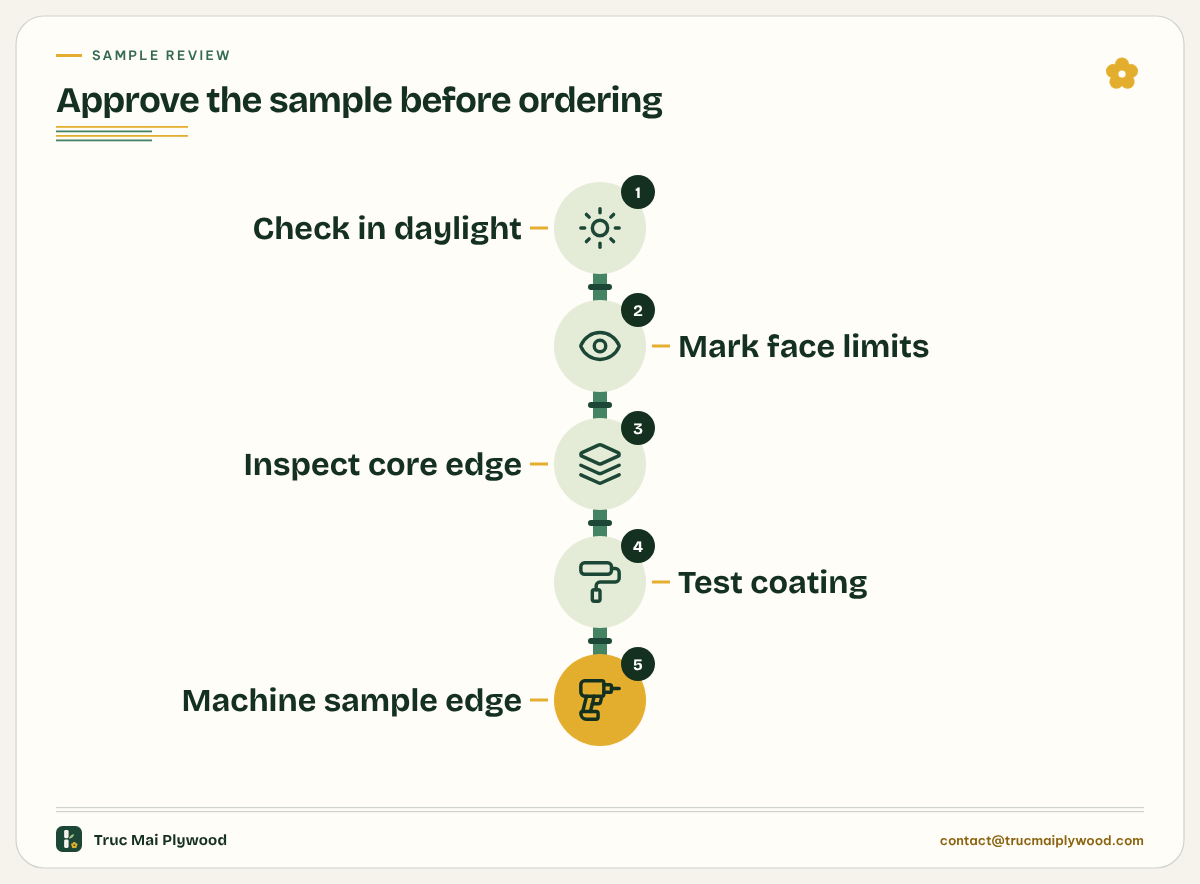
Approve a face sample, a cut-edge sample and a finished sample before releasing a repeat furniture specification. Each answers a different question: colour, core build and the appearance after coating.
- Examine the face in daylight and under the intended interior lighting.
- Mark acceptable grain variation, sapwood, repairs and natural marks on the sample approval.
- Cut the sample to expose veneer joints and check the core edge.
- Apply the intended coating and compare sheen, stain uptake and colour.
- Machine a representative edge or hinge location and inspect the result.
- Record the sample reference in the RFQ and purchase order.
The sample ordering process is a useful starting point for first-time importers. New buyers can request free samples and arrange courier collection. When several face options are under consideration, ask for them on the same core so the comparison isolates the decorative surface.
Can a mill cut cherry-look panels to furniture dimensions?
Yes. Cut-to-size labelled panels can be prepared from standard sheets, with the exact component dimensions set from the buyer’s cut list and confirmed by email. The programme can split a sheet into two, three, four or six parts.
Examples include a lengthwise half at 610 × 2440 mm, a three-part format at 1200 × 800 mm used for furniture work in Poland, and a four-part format at 1220 × 610 mm. These are cut-list examples, not automatic yields for every grain direction or saw layout.
The purchasing file should identify face orientation, finished size, edge treatment, part code and packing order. Grain direction becomes particularly important on cherry-look cabinet doors: rotating a piece to improve sheet yield can change the visible grain relationship between adjoining fronts. Labelled components simplify the assembly sequence at the receiving factory.
How should cherry veneer plywood be packed for export?
Pack the panels by agreed face, size and component code, with protected decorative surfaces and a packing list that identifies each product line. For a furniture programme, face scratches and mixed component labels can cause more disruption than a small difference in sheet count.
The standard commercial minimum is one 40HC container. A shipment normally carries one or two products, with mixed specifications possible by agreement. Before loading, agree how different face selections and cut components will be separated in the container. Keep the decorative side protected during handling and mark the outside of each pack with the corresponding order line.
The container-volume planning article explains how core choice affects the loading model. Cherry veneer itself is a thin face layer; the core construction and the final pack weights drive the transport plan. The shipping record should reflect the actual packed quantity.
Which origin and certification documents belong with the order?
The document set should identify the panel construction, face-veneer origin, core origin and any certification claim requested for that shipment. A decorative species description is insufficient for a buyer who needs traceability through both layers.
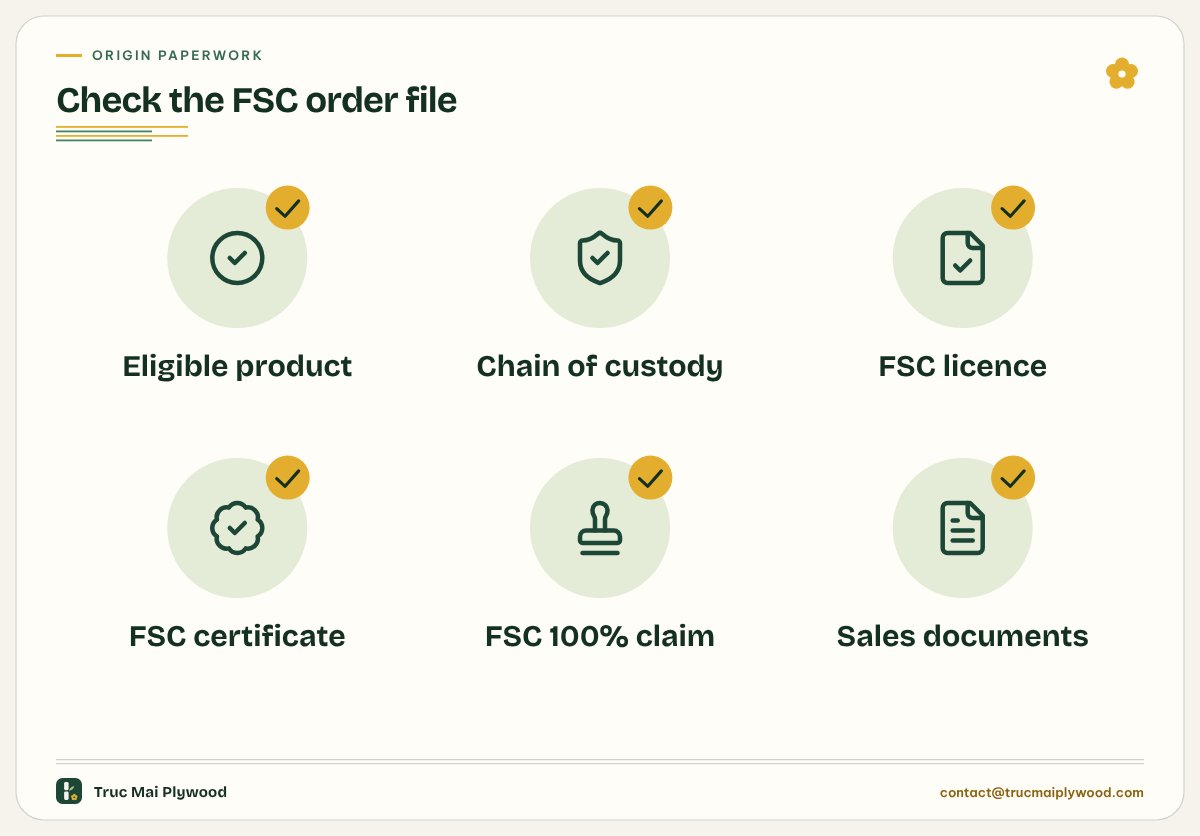
For eligible products, the mill holds FSC chain-of-custody licence FSC-C196493 and certificate SA-COC-014545, with FSC 100% claims recorded on the relevant sales documents. The FSC licence verification page explains the checking route. The FSC claim applies to the certified product line, so the purchase order should name it explicitly.
EU buyers can request EUDR due-diligence information including geolocation for core timber and face veneer. The face veneer origin file explains why an imported decorative face requires its own origin trail. For a natural cherry request, state the species and the requested provenance before production is agreed.
How should two cherry plywood quotations be compared?
Compare two offers only after aligning face species, core, thickness, face/back grade, adhesive, emission requirement and packing. A quotation labelled “cherry plywood” can describe a natural cherry face, a stained alternative or an engineered pattern, each serving a different visual requirement.
Ask both suppliers to quote against the same approved face sample. Then compare core joining, sanding, nominal thickness, tolerance and the proposed packing plan. A lower-cost appearance option is useful only if it meets the furniture maker’s finished-face requirement. The plywood RFQ checklist helps keep these fields consistent.
The practical commercial decision is often a choice between species identity and repeat appearance. Natural cherry deserves its own veneer selection and sample approval. A controlled engineered face may suit a long-running cabinet line with matching replacement fronts. Put the intended outcome in writing rather than ask the supplier to infer it from the word “cherry”.
What should go into a first cherry-faced panel RFQ?
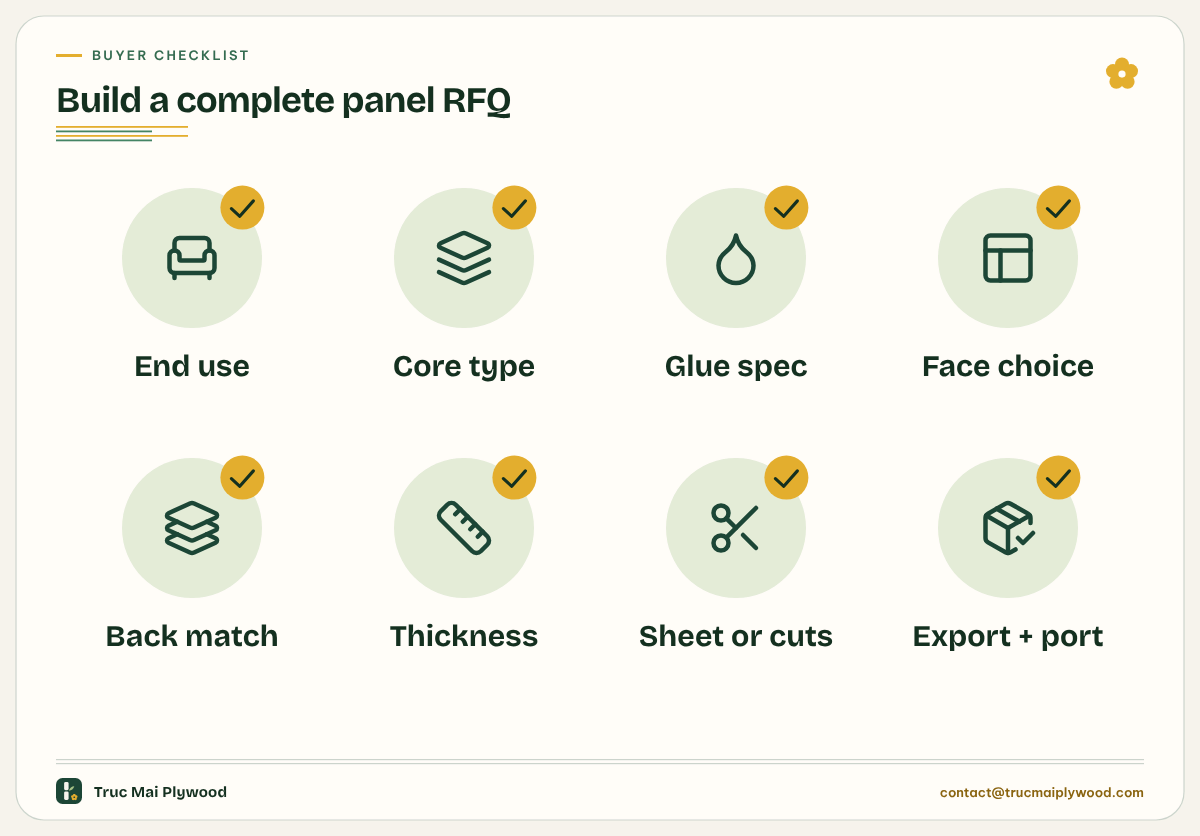
Send the application, core, glue and emission specification, face/back requirement, sheet or component dimensions, packing and quantity. A complete RFQ gives the mill enough information to offer the right panel construction and sample set.
For a furniture importer, a usable request reads: “Indoor cabinet fronts; stitched Styrax core; UF glue at E0 emission; natural cherry face on request or approved cherry-look engineered veneer; coordinated back; 18 mm nominal; 1220 × 2440 mm sheets or labelled cut components; protected export packs; one 40HC; destination port stated.” Attach the finish reference, the cut list and any origin-file requirement.
Truc Mai Plywood manufactures furniture and commercial plywood in Ha Hoa, Phu Tho, Vietnam, with annual capacity around 60,000 m³. Its regular face range includes okoume and engineered veneer, while natural cherry is a request-led face selection. Send the complete specification through the quotation route or to contact@trucmaiplywood.com so the sample and order line describe the same product.
Questions buyers ask
Is cherry veneer plywood made entirely from cherry wood?
No. Cherry veneer plywood usually has a cherry decorative face over a separately specified plywood core. The core species should be written on the order.
Can cherry plywood be stained darker?
Yes. Ask for a finished sample because stain absorption, existing heartwood colour and veneer selection affect the final appearance.
Is cherry-faced plywood suitable for painted cabinet interiors?
A paint-grade face is generally a more practical specification where the grain will be hidden. Reserve a decorative cherry face for surfaces where its appearance matters.
Can I order a different grade on the back?
Yes. Specify face and back separately, with an approved sample for each visible surface.
Do cherry veneer panels need edge banding?
Exposed plywood edges normally need a specified edge treatment if the design calls for a continuous cherry appearance. Match the edge-band colour against the finished face sample.
Is an engineered cherry-look face the same species as natural cherry?
No. An engineered veneer can reproduce a cherry-like colour and grain pattern while using a different wood species. The veneer material and appearance description should be separate order fields.
Can cherry-faced plywood be supplied as cabinet components?
Cut-to-size labelled panels can be ordered from standard sheets. Send the nesting or cut list, edge treatment and part labels with the RFQ.
Should a buyer approve raw or finished veneer samples?
Approve a finished sample when colour matching matters. Raw veneer alone does not show the final coating colour or sheen.
Can an importer request veneer-origin documents?
Yes. Include the face species, origin documents and core traceability requirements in the purchasing specification.
Is cherry plywood available with a smooth surface for clear finishing?
Specify a sanded and calibrated decorative face, the acceptable repair level and a finished control sample. Inspect the grain and surface under the intended lighting.