
Birch wood is a pale, fine-textured hardwood used for furniture and decorative veneer. Species differ in hardness and colour. Truc Mai Plywood supplies birch-faced panels with imported birch veneer over Vietnamese cores, allowing buyers to specify the appearance separately from the panel construction, dimensions and export documentation.
What is birch wood and why do panel buyers choose it?
Birch wood is timber from Betula hardwood trees, prized in plywood purchasing for its fine, pale decorative face. In a furniture-panel specification, the word birch can describe the visible veneer without describing the timber inside the panel. That distinction matters when an importer compares samples, cutting performance and repeat orders.
The USDA Forest Products Laboratory’s birch technical sheet describes a fine, uniform texture across the birches it examines. Yellow and sweet birch are relatively hard and heavy; paper birch is lighter and softer. The appearance of a selected veneer is therefore a more useful starting point for a cabinet buyer than a generic promise about birch timber.
A veneer is a thin sheet of wood cut from a log and used as the visible surface of a panel. A birch face gives a cabinet manufacturer a real-wood grain to display, stain or coat. The plywood construction underneath can be selected for a different purpose: weight, machining, edge appearance or the demands of the finished furniture. Buyers should describe those decisions separately rather than assuming that the species named on the face determines the whole sheet.
Truc Mai Plywood manufactures furniture/interior and commercial plywood in Ha Hoa, Phu Tho, Vietnam, and offers imported birch face veneer on Vietnamese-core panels. Its birch-faced plywood is relevant to purchasers who want a recognisable birch surface alongside a specified core construction. The face and back appearance are agreed against a sample, so a production order can identify what the end customer will actually see.
For an importer, the practical buying questions are straightforward. Is the birch face intended to remain visible? Will the furniture maker stain it, clear-coat it or paint it? Is the edge exposed, or hidden by edging? Does the buyer need the same colour distribution across cabinet doors made in successive runs? These questions lead to an actionable face specification, whereas the label birch plywood alone leaves several material choices unresolved.
Birch wood is also used as solid timber in furniture and interior woodwork. Solid timber and decorative veneer share the species’ appearance, but their uses in a purchase order differ. Solid timber is selected as a shaped component; face veneer is selected as a surface on a manufactured sheet. For repeat panel orders, record the veneer species and approved face appearance alongside the core and finish requirements.
Is birch a hardwood or a softwood?
Yes, birch is a botanical hardwood from broadleaf Betula trees; the classification does not mean every birch species has the same hardness. Birch belongs to the broadleaf group traditionally called hardwoods, rather than the conifer group traditionally called softwoods. This is a classification of the source tree, not a pass-or-fail test for a furniture surface.
The difference becomes clearer when a buyer compares yellow birch with paper birch. Both are hardwoods, yet their measured resistance to indentation differs substantially. Calling either one hardwood tells the importer the botanical family but not how the surface will behave when pressed by a concentrated load. The species name and the test condition carry that information.
Birchwood is simply another way of writing birch wood. It is not a separate species, veneer grade or plywood construction. The same distinction applies when someone asks, “Is birch wood a hardwood?”: yes, but the answer is only the beginning of a useful material specification.
In woodworking, hardness usually means resistance to a local indentation, whereas strength can refer to bending, compression or other loading. These are different measurements. A wood may resist a dent well yet move noticeably as its moisture content changes. A decorative face may also be thin enough that the substrate affects the performance of the finished panel. A species-level hardness number cannot stand in for a test of a complete plywood build.
The USDA birch technical sheet distinguishes the physical properties of yellow, sweet and paper birch rather than assigning a single number to the genus. It also describes their generally fine texture, a reason birch appears in furniture and veneer work. That texture is a visual and machining characteristic; it is not the same property as indentation resistance.
For a cabinet order, the term hardwood face is useful for describing material type, but it does not establish the finished surface grade. Specify the visible colour, acceptable natural marks, repairs and finish sample separately. This keeps the discussion centred on the part the furniture customer touches and sees, while allowing the panel construction to be selected for the intended application.
Which birch species and origins matter for veneer?
Yellow, sweet, paper and silver birch are distinct species; a veneer order should name the species and production origin rather than just birch. The trade name alone can conceal meaningful differences in wood colour, density and documented source. An importer buying for a repeat furniture range needs the same material description on the sample approval and the subsequent order.
| Common name | Scientific name | Purchasing distinction |
|---|---|---|
| Yellow birch | Betula alleghaniensis | North American birch with pale sapwood and light reddish-brown heartwood |
| Sweet birch | Betula lenta | North American birch with light sapwood and darker, reddish-brown heartwood |
| Paper birch | Betula papyrifera | North American birch that is lighter and softer than yellow or sweet birch |
| Silver birch | Betula pendula | A separate Eurasian species; request its own veneer sample and origin description |
The USDA Forest Products Laboratory identifies the North American species and their timber characteristics. Silver birch should not be treated as another name for paper birch. For a buyer, scientific names help prevent an apparently identical trade description from concealing a change in the supplied veneer species.
Origin is a different question from species. The place where a plywood sheet is pressed is not necessarily where its decorative veneer trees grew. An imported birch face can be combined with a Vietnamese core and manufactured into a finished plywood panel in Vietnam. The order therefore needs separate origin descriptions for the face and the core. The relevant records follow the actual timber sources, rather than relying on the finished panel’s manufacturing address.
For EU purchasing, the European Commission’s due-diligence guidance calls for the common and scientific wood-species names, country of production and geolocation of the plots where the relevant wood was produced. This makes the species entry in a purchasing specification useful for both material control and origin documentation. A change in veneer supply should be reflected in the associated records as well as in the sample.
A practical origin request identifies the birch species, the country where the birch was grown and the supporting plot information for that veneer. The core species and its origin are recorded separately. Truc Mai supplies face and core origin records and geolocation files for EU-bound plywood orders. The face veneer origin files page explains the documentation trail that sits behind a finished panel description.
If a later shipment has a different colour balance, the buyer can check whether the veneer species or source has changed before treating the issue as a finishing fault. The approved appearance sample remains the immediate visual reference; the species and origin records explain what material the sample represents.
How hard is birch wood by species?
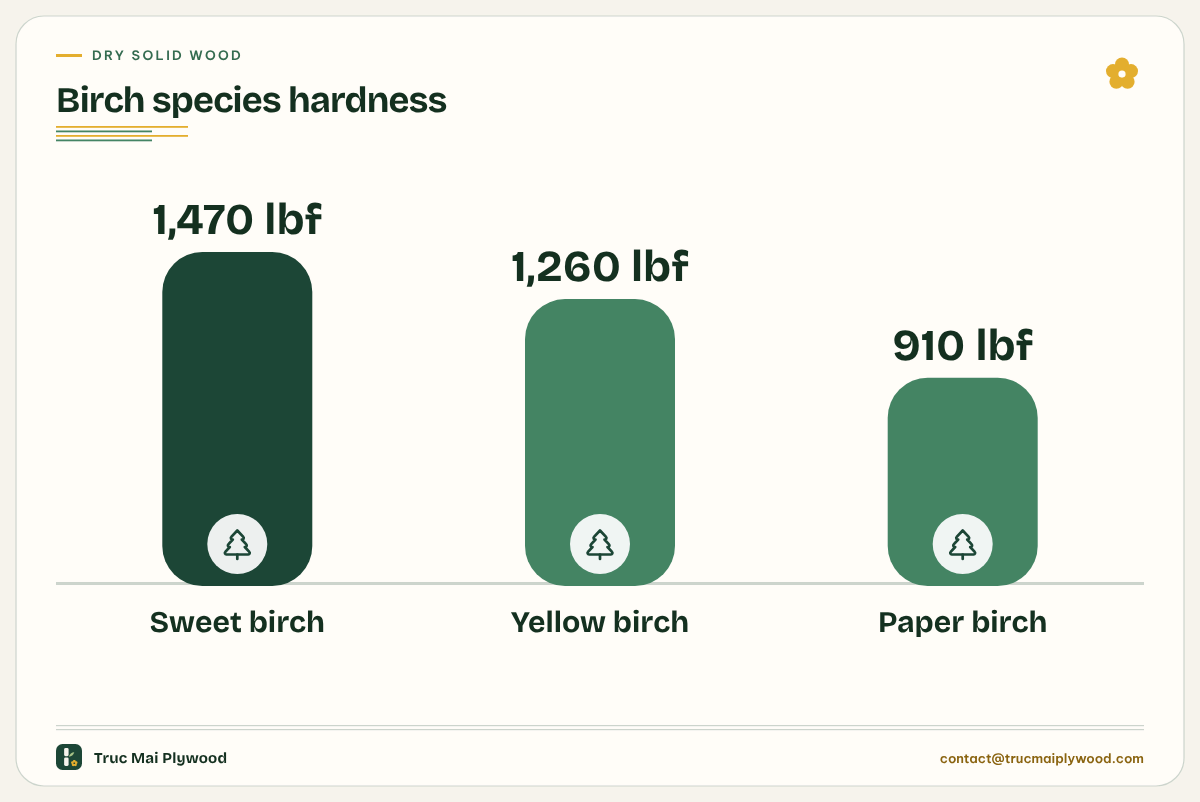
USDA dry-wood hardness figures are 1,260 lbf for yellow birch, 1,470 lbf for sweet birch and 910 lbf for paper birch, measured on solid wood. The figures are side-hardness measurements for dry specimens, not test results for a thin birch veneer bonded to a plywood core.
| Birch species | Scientific name | Dry-wood side hardness | Measurement basis |
|---|---|---|---|
| Yellow birch | Betula alleghaniensis | 1,260 lbf | USDA solid-wood specimen, dry |
| Sweet birch | Betula lenta | 1,470 lbf | USDA solid-wood specimen, dry |
| Paper birch | Betula papyrifera | 910 lbf | USDA solid-wood specimen, dry |
Source: USDA Forest Products Laboratory, Betula spp., mechanical properties table. The USDA Forest Service comparison of commercial birches also reports these side-hardness figures for conditioned wood specimens.
The pound-force unit, abbreviated lbf, describes the force recorded in the indentation test. It is not a sheet weight, a bending load or a permissible cabinet-door load. A larger value in this table means greater resistance to that particular indentation test on the solid timber specimen. It says nothing by itself about the adhesion of a veneer to its substrate.
Sweet birch records the highest figure of these three species; paper birch records the lowest. When a technical drawing or procurement sheet needs a hardness figure, pair it with the scientific name, dry-wood condition and source. Otherwise, use the approved surface sample to make the finishing decision.
A cabinet maker may care about surface denting at door edges, wear around handles or marking during assembly. Those are legitimate reasons to ask about hardness, but a veneer-faced plywood surface is a manufactured assembly. The veneer thickness, underlying ply, coating and treatment of the finished part affect the outcome. For this reason, testing a representative finished panel or component gives the buyer more relevant information than extrapolating from a solid-wood reference number.
A pale sample of paper birch can look appropriate for a cabinet range even though its dry-wood hardness is lower than that of sweet birch. Conversely, choosing the highest figure does not automatically deliver the most even pale face. Decide the visual specification from samples and the mechanical requirements from the actual part design.
What colour and grain does a birch veneer face show?
Birch veneer typically shows a pale, fine and even texture, with visible colour variation between sapwood and heartwood. A sheet can include creamy or near-white areas alongside warmer yellow, pink or light brown tones. Those differences are part of the material selection process for exposed furniture faces.
The USDA birch technical sheet describes white sapwood and light reddish-brown heartwood in yellow birch, and light sapwood with darker brown, reddish-toned heartwood in sweet birch. Its account of fine, uniform texture explains why birch is useful for a relatively quiet decorative surface. A uniform texture does not mean identical colour from one veneer leaf to the next.
For cabinet doors, compare the face under the lighting and finish planned for the furniture. Clear coating can make a warm heartwood streak more apparent, while staining can change the contrast between areas that initially look similar. The buyer should inspect a finished trial sample rather than approving only an unfinished, freshly sanded face. The same principle applies to a pale natural finish: agree how much tonal contrast is acceptable before production begins.
A face grade is an appearance agreement, not a synonym for a particular birch species. A grade decision can address colour distribution, natural marks, patches, repairs and the presentation of the grain. Truc Mai agrees face and back grades as a pair against the approved sample. The cabinet-grade plywood guide provides a related framework for describing the visible surface of furniture panels.
When the end use is a bank of adjacent doors, lay several sample pieces side by side. Inspect them both across the grain and along it, then repeat the check after the intended coating is applied. This reveals whether a small difference that seems harmless on one sheet becomes conspicuous across a complete run of furniture. For less visible carcass faces, the buyer may approve a broader colour distribution while retaining the same basic birch texture.
Record the approved colour range in words and with the physical reference sample. Name the face and back separately, and identify which side will remain exposed in the finished furniture. These details are more useful to a veneer supplier than an unsupported instruction such as “perfect white birch”. The goal is a reproducible visible finish that can be checked against the sample at incoming inspection and again after finishing.
What wood is similar to birch for furniture panels?
Maple and pale poplar-faced panels are practical appearance alternatives to birch, but the buyer must compare actual samples and the underlying core.
A buyer replacing a birch wood face should first decide which part of its appearance matters: the pale background, the fine grain, the degree of natural colour movement or the way a selected coating changes the surface. Two veneer lots from the same species can look different once they are placed beside a painted frame or under warm showroom lighting.
Maple is a useful visual comparison where the design calls for a light hardwood with restrained figure. It is a comparison material, rather than an automatic equivalent in cost, machining or availability. A maple sample should be judged beside the actual birch control under the proposed finish. In particular, compare adjoining sheets rather than isolated attractive pieces: a furniture run needs a repeatable overall appearance.
Pale poplar veneer offers another direction for light-coloured interiors. Poplar-faced plywood can be specified where the design accepts a different grain character. Bleached poplar and engineered veneer (EV) also give buyers options for controlling the look of repeated panels. The choice between a natural veneer and a reconstituted face is visible in how consistently the pattern repeats across a large group of doors.
For a practical substitution trial, place three full-size samples side by side, with the same surface preparation and finish. Look at them upright, not only flat on a bench. Check the face under daylight and the lighting planned for the room. Compare the edge separately: a similar face over a different core can behave differently during sawing, edge-banding and fitting.
The purchasing decision should record which visual differences are acceptable. If the furniture range needs matching doors and end panels, approve the face against a reference panel and retain that reference for the next order. If the face will be hidden by an opaque coating, surface preparation and the panel build deserve more attention than the natural grain. This gives a clearer substitute specification than ordering another species simply because its photograph resembles birch.
How does birch-faced plywood differ from all-birch plywood?
Truc Mai birch-faced plywood uses imported birch face veneer over Vietnamese Styrax, Eucalyptus, Acacia, Pine or combined cores, rather than an all-birch lay-up.
The distinction is visible at a freshly cut edge. The outer decorative layer is birch; the inner veneers are specified independently. An all-birch construction instead uses birch throughout its veneer layers. One identifies the visible timber surface; the other identifies the material through the panel thickness.
For a cabinet door with a covered edge, the decorative face often drives the initial material choice. For an exposed-edge drawer box, shelving detail or routed profile, the inner layers become part of the design. A buyer expecting the repeating light layers of all-birch plywood should therefore ask for a core cross-section before approving a birch-faced alternative.
| Purchasing point | Birch-faced panel with Vietnamese core | All-birch panel |
|---|---|---|
| Visible face | Imported birch veneer | Birch veneer |
| Inner layers | Named Vietnamese core species or agreed combination | Birch veneers throughout |
| Exposed edge | Shows the selected core lay-up | Shows a birch lay-up |
| Specification focus | Face grade, core build and bond | Birch lay-up, grade and bond |
| Appropriate comparison | Finished face plus edge sample | Finished face plus edge sample |
Neither name by itself states the glue system, face grade, emissions or permissible load. Those are separate lines in the purchasing specification. A birch-faced panel can be a sound furniture choice without pretending to be a direct structural or exposed-edge replacement for all-birch stock.
The Baltic birch alternative guide explores the distinction for buyers reviewing an existing panel drawing. For a substitution, send the drawing, identify which edges remain visible and state whether the original all-birch appearance is a design requirement. Ask for both a face photograph and a labelled edge sample. That prevents a quotation based on a matching surface from being mistaken for a matching internal construction.
Which plywood core works behind a birch face?
Styrax and Eucalyptus are the lead core options for Truc Mai birch-faced furniture panels, with Acacia, Pine and combined cores specified for other order needs.
Choose the core by what the finished part must do, not by the birch colour seen on the surface. The core influences panel weight, the appearance of a cut edge, handling during fabrication and the construction that the mill can repeat. The decorative face is specified on its own line, so a buyer can retain the approved birch appearance while comparing core options.
Styrax is a useful starting point for furniture programmes where a lighter panel and efficient container loading matter. Eucalyptus is an alternative where the buyer prefers a denser construction. Acacia, Pine and combined lay-ups offer further ways to define the panel for a particular cutting, handling or appearance requirement. A combined core should be written as an agreed construction, rather than left as the vague description “mixed hardwood”.
Core quality matters within each species choice. For furniture and interior panels, the standard construction uses an A-grade core, stitched core veneers and sanded faces. Stitched layers help control openings in the lay-up. A buyer should inspect the edge for gaps, overlaps and uneven layers, especially where a part will be drilled or machined close to its edge. An attractive birch face cannot show these details.
A useful comparison holds the face grade, thickness and finish preparation constant, then tests different cores in the intended part. Cut the same cabinet side, drill the same fixing positions and apply the intended edge treatment. Compare handling and finished appearance rather than relying on a species label as a performance rating.
For a common furniture thickness, the 18 mm hardwood plywood specification provides a starting point for discussing the panel build. State the core on the purchase order and retain a cross-section from the approved sample. This makes a repeat order reproducible even when the decorative birch veneer looks identical from the front.
Where is birch-faced plywood used in interiors?
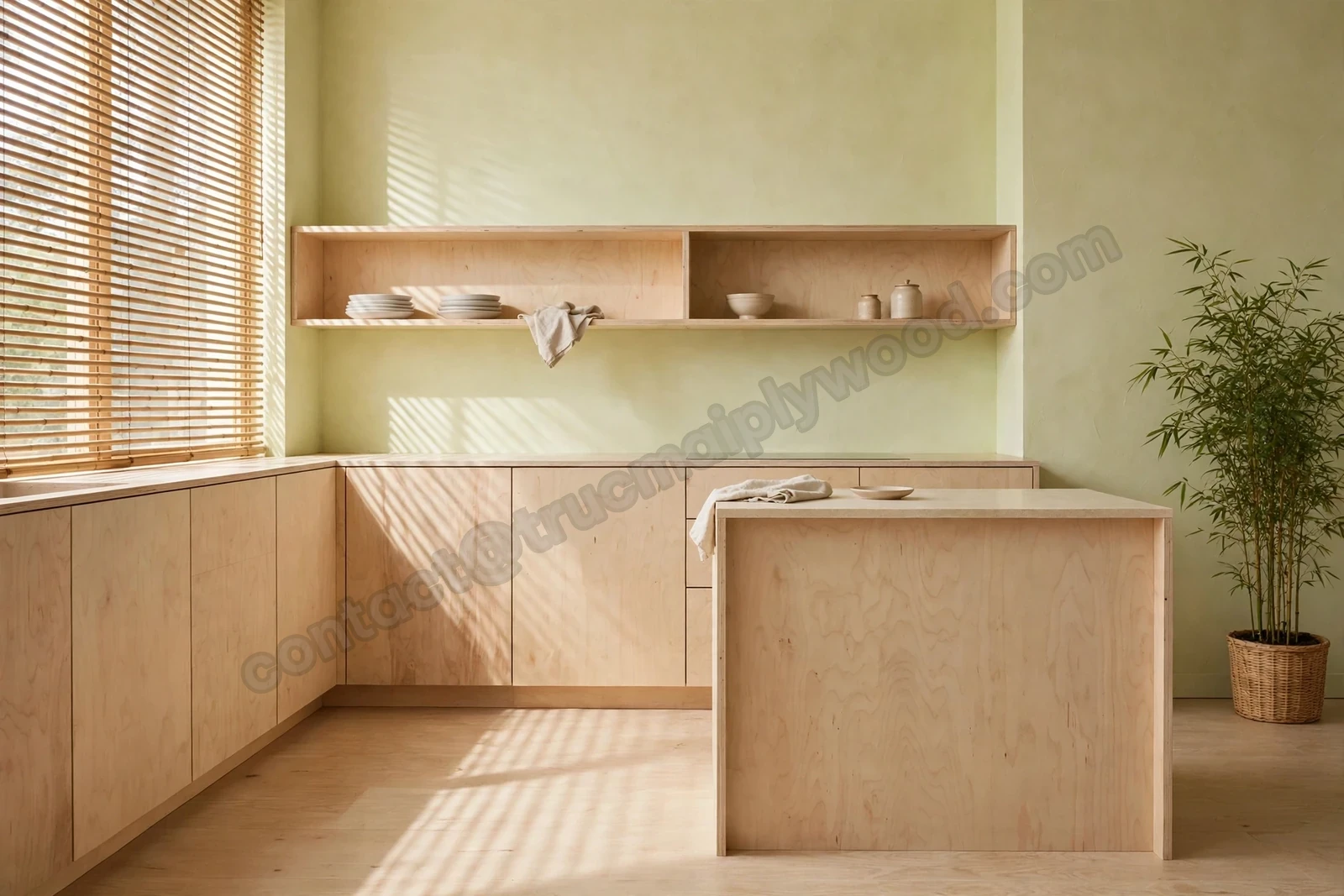
Birch-faced plywood is a suitable decorative surface for cabinet doors, carcass faces, furniture and interior joinery where the approved sample defines the visible finish.
Cabinet doors show the face across a broad, uninterrupted area, so colour matching and the direction of the veneer are immediately noticeable. Specify whether adjacent doors should be selected for a coordinated appearance. A single small sample cannot demonstrate how a full run of doors will look together. For a kitchen programme, compare the face after the proposed coating and beside the actual handle, worktop and frame materials.
Carcass faces present a different problem. The face may be visible only when a door opens, but the edge, drill positions and alignment matter throughout assembly. The buyer can use the same birch appearance on exposed ends while specifying the core and face/back combination to suit each component. See the kitchen cabinet plywood guide for the wider selection of panel constructions.
In freestanding furniture, birch veneer works well on visible panels, drawer fronts and other broad surfaces that benefit from a pale timber appearance. For fitted joinery, the visual result depends on how the veneer meets neighbouring materials and whether the grain runs consistently across panels. Drawings should identify the show faces and any edges that remain exposed after installation.
Surface preparation belongs in the application specification. Sanded and calibrated faces can be supplied ready for the buyer’s finishing process. “UV-ready” means the panel faces are prepared for the buyer to apply a UV coating; it is not a description of a factory-applied UV finish. A finishing trial should use the actual coating system, since clear and coloured finishes can change the apparent tone and emphasise differences between adjacent veneers.
Birch veneer is also an option for panels that will receive further decorative treatment, but it should be chosen for the intended result rather than simply because it is a hardwood. Where a completely opaque finish hides the timber figure, the buyer may find another face specification more appropriate. The sensible sequence is to approve the finished appearance, check the machined part and then settle the repeatable panel construction.
How should buyers specify face grades and finishing?
Specify birch face and back grades as a pair against an approved sample, then record sanding and whether the panel is supplied UV-ready.
The face is the side intended for display; the back may have a different visual requirement. Writing only “birch A grade” leaves open which side the grade applies to, what repairs are accepted and how much colour movement the buyer expects. Instead, mark the display side on the sample, identify the reverse and attach a written acceptance description for both surfaces.
Inspect the full sample for veneer joins, patches, filled areas, sanding marks, open defects and the distribution of colour. Record which characteristics are acceptable on a cabinet door and which can be placed on a concealed back. A face/back pair lets the mill quote the appropriate construction without assuming that both sides need identical decorative selection.
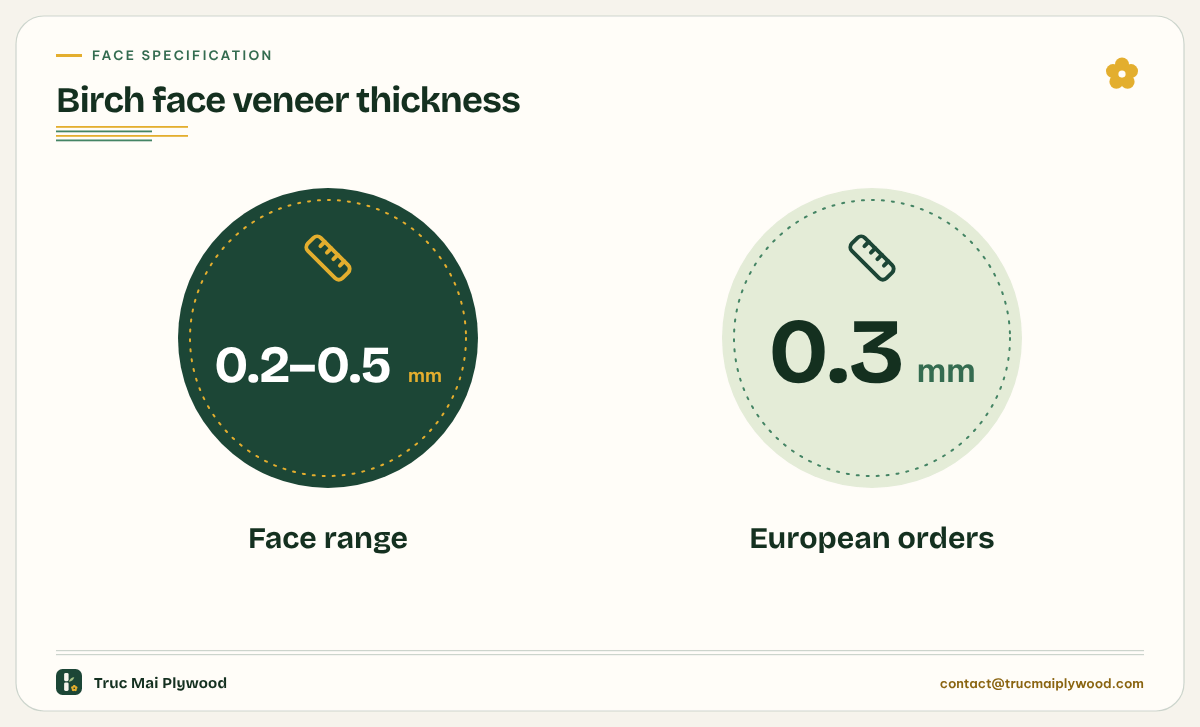
The veneer thickness is another order line. Truc Mai’s face veneer range is 0.2–0.5 mm, with 0.3 mm commonly specified for European orders. State the selected veneer thickness with the face grade and the finish process. The veneer is the decorative layer, so the drawing should also identify any deep routing, heavy sanding or exposed machining that might affect the appearance of that layer.
Sanding and calibration should be written explicitly. The buyer can ask for sanded faces and a calibrated panel thickness, then inspect the sample with the intended primer, stain or clear coat. A pale veneer can reveal uneven sanding after finishing even when the uncoated panel looks uniform. For stain work, approve a finished control rather than only a raw veneer chip.
| Item to approve | What to record |
|---|---|
| Display face | Grade, colour range, grain direction and accepted repairs |
| Back | Separate grade and acceptable visible defects |
| Veneer | Birch face and selected thickness |
| Surface | Sanded and calibrated preparation; UV-ready where requested |
| Finish trial | Coating system, colour reference and signed-off finished sample |
| Repeat supply | Reference sample and matching criteria for later production |
The plywood quality-by-grade guide gives additional context for discussing face and core workmanship. For this birch-faced order, the decisive document is the approved sample paired with the written specification. Keep one control panel in the buyer’s finishing room and one in the production reference set, so later deliveries can be checked against the same visible standard.
Which sheet sizes and thicknesses can be ordered?
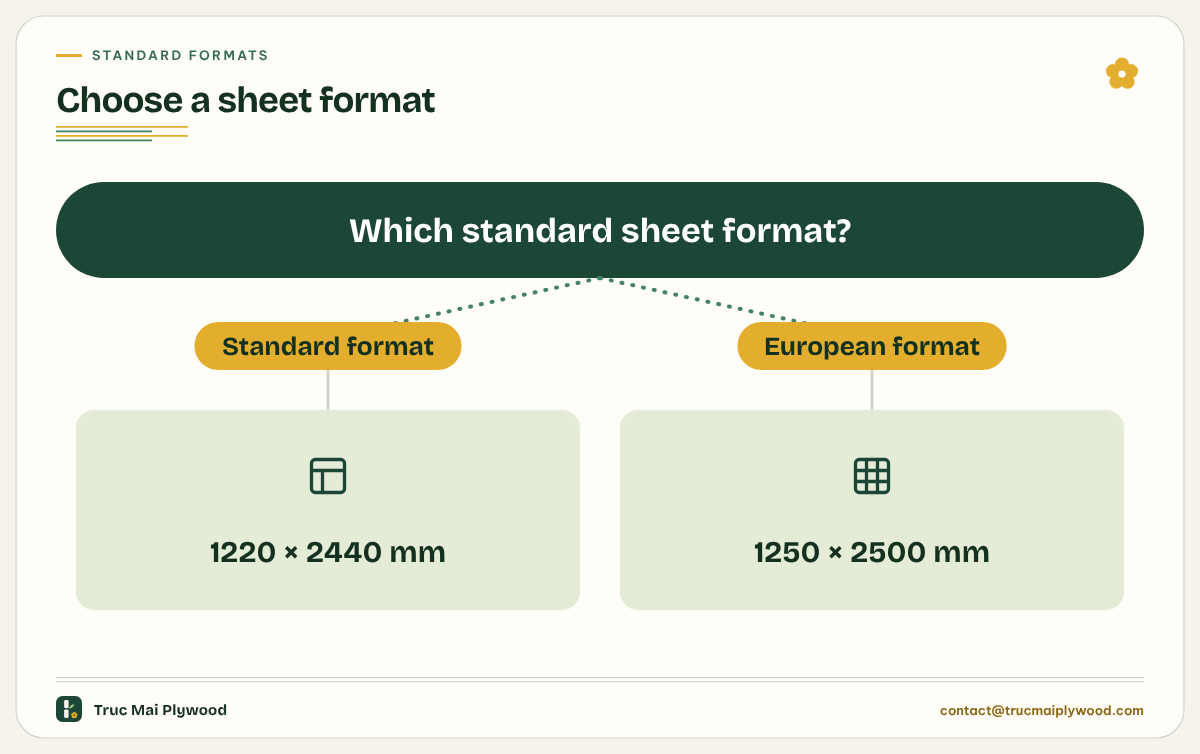
Truc Mai supplies birch-faced furniture and commercial plywood from 3–40 mm in standard 1220 × 2440 and 1250 × 2500 mm formats, with cut-to-size pieces agreed from the cut list.
The starting decision is whether the buyer needs full sheets for further processing or components prepared for a particular furniture programme. Full sheets leave nesting and machining with the receiving workshop. Cut-to-size supply shifts the initial breakdown into the panel order, so the drawing, grain direction and identification of each piece need to be settled before cutting begins. The cut-to-size panel service is relevant when a buyer wants to receive identified components rather than organise the first cutting stage after delivery.
A cutting list should give the finished length and width of each component, the required thickness, quantity and intended visible face. Include the direction in which the birch grain should run on cabinet fronts or other exposed pieces. Grain direction is particularly important when adjoining doors must look consistent: rotating a rectangular part to improve sheet yield may change the appearance of the assembled run. Mark pieces requiring matched orientation rather than leaving the cutting operator to infer it from the drawing.
The two standard sheet formats also affect purchasing and workshop planning. A buyer already using one format can retain familiar storage racks, panel saw settings and nesting templates. The other format may suit a different cutting schedule. Compare the actual component list against each source format before selecting one; the format with the larger nominal area is not automatically the most economical for a particular set of parts.
Thickness is an order specification, not simply a catalogue description. Record the nominal thickness and the agreed production tolerance on the same drawing or purchase line. Where components will meet purchased fittings, rebates or machined grooves, tell the supplier which dimensions control assembly. The order tolerance is agreed for the selected product rather than assumed from a separate plywood standard. The receiving team can then measure production panels against the purchase specification without confusing nominal thickness with the dimensions needed for a fitted component.
For mixed components, keep a separate quantity for each distinct size and thickness. That makes the cutting list useful for quotation, packing identification and receipt inspection. It also prevents a substitution of full-sheet quantities for actual finished-piece counts when the purchase order is checked.
How do glue, emission and bond requirements differ?
Glue chemistry, moisture bond performance and formaldehyde emissions are separate specifications that buyers should put on separate order lines.
Glue chemistry describes the adhesive system used to join the veneers. Moisture bond performance describes how the assembled panel’s glue lines behave under a defined exposure and test procedure. Formaldehyde emission describes a measured release from the panel under a specified laboratory method. A buyer who writes only “water-resistant, low-emission glue” leaves two different performance questions unresolved.
For interior furniture, start with the conditions the completed article will face. A dry cabinet carcass, a kitchen door exposed to intermittent humidity and a component intended for more demanding moisture conditions do not present the same bond requirement. State the use environment and any specified bond test separately from the requested adhesive. This lets purchasing and quality teams compare offers on the performance of the finished panel rather than on a resin name alone.
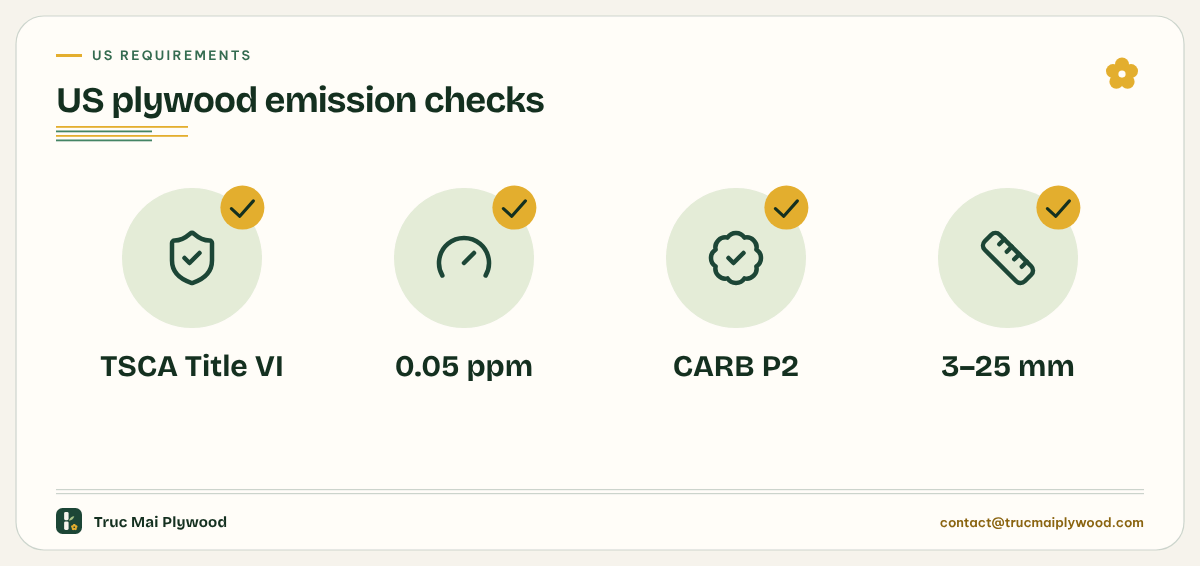
The same separation matters for US furniture orders. Under 40 CFR Part 770, the TSCA Title VI emission standard for hardwood plywood with a veneer core is 0.05 ppm under the applicable test framework. The stated CARB P2 and TSCA Title VI certification scope for Truc Mai’s veneer-core hardwood plywood covers 3–25 mm. A purchase specification should identify the product construction and thickness being ordered alongside the US emission requirement. The Phase 2 formaldehyde limits guide gives buyers a dedicated reference when assembling those order requirements.
For moisture performance, specify a named bond requirement and the associated test report where the application calls for one. The reported result belongs to the tested panel construction, including its veneers and glue lines. Changing the core or adhesive is therefore a material change to the order specification, even when the decorative birch face appears identical. A supplier comparison should place the bond evidence beside the construction it covers.
Emissions need their own evidence trail. Record the emission scheme requested by the destination market, the product category, the laboratory method and the documentation required with the shipment. Avoid using a surface grade, veneer species or a glue trade name as a substitute for an emissions specification. Those describe different attributes of the panel.
In the final order, a compact technical schedule works well: intended interior use, named core, adhesive selection, moisture bond requirement and emission requirement each have their own field. This format also helps the receiving team check that the production paperwork refers to the same construction as the approved sample.
What documents trace imported birch face veneer?
For EU orders Truc Mai supplies face and core origin records and geolocation data to support the importer’s EUDR due diligence.
The imported birch face and the Vietnamese core have distinct supply histories. A shipment file should preserve that distinction rather than recording only the country in which the plywood was manufactured. The buyer needs to connect the wood species and production locations to the material incorporated into the ordered panels. The EUDR dates for plywood buyers explain the application timetable separately from the documents needed for a particular consignment.
The European Commission’s due diligence guidance identifies information such as the product description, wood species, country of production, plot geolocation and evidence of lawful production. For a birch-faced panel, this means recording the face veneer as a distinct wood input and maintaining the corresponding records for the core species. The document trail should allow the buyer to follow each input through the supplier’s records to the plywood consignment.
A practical file index begins with the purchase order and product description. It then connects the approved construction to face veneer origin records, core origin records and the relevant geolocation information. Shipment identifiers should be consistent across the packing list and supporting material records. This arrangement reduces time spent matching an origin document to the correct panel specification when several constructions travel in the same consignment.
The EU Deforestation Regulation concerns the origin and legal production of relevant commodities, not the appearance of the finished surface. A pale birch face cannot reveal the harvest plot, and a factory location does not replace the origin of the wood used in the panel. Documentation is therefore prepared at the input level as well as at the finished-product level.
The Commission’s July 2026 implementation update sets application dates of 30 December 2026 for large and medium operators and certain smaller operators already covered by the EU Timber Regulation, and 30 June 2027 for other micro and small operators. These dates help buyers plan when to assemble and review shipment records for the relevant market route.
When requesting documents, give the supplier the exact order reference, intended EU destination and the list of wood inputs shown on the approved construction. Ask for records indexed to that consignment, not an unrelated generic species statement. This creates a clearer handover between purchasing, customs documentation and the team handling the importer’s due diligence process.
How should an importer inspect birch-faced samples?
Compare a signed-off birch face sample with production panels for colour, repairs, sanding, thickness and visible edge construction before approving a repeat specification.
The sample is most useful when it represents the finish and construction that purchasing has actually selected. Ask for a clearly identified face and back, and keep the sample reference with the quotation and purchase order. The plywood sample ordering guide provides a useful starting point for arranging this approval stage. A photograph can help record the selection, but physical comparison under the intended lighting is more useful for judging a pale decorative surface.
Begin the inspection with the visible face. Place the production panel beside the approved sample and compare overall tone, grain character and the distribution of natural features. Look across the surface rather than examining only a small corner. Cabinet doors placed together in a finished room can make differences between neighbouring faces more noticeable than they appeared when individual sheets were checked in isolation.
Next inspect repairs and surface preparation. Note the position and appearance of patches or filled areas against the accepted sample. Run the inspection under oblique light to reveal sanding marks, raised fibres or local changes in sheen. Where the panels will be stained or finished later, use the approved finishing trial to assess how those features will appear after processing. The incoming inspection should use the same appearance criteria as the sample approval rather than introducing a new informal grading rule.
Check the edges to verify the ordered core construction. The face tells the buyer little about the interior lay-up, whereas the exposed edge shows the veneer layers and allows visible gaps or irregularities to be identified. Compare that edge with the construction approved for the order. Record the location of any observed issue so the supplier can distinguish a repeated production pattern from an isolated handling defect.
Measure thickness at agreed positions using a suitable gauge and record the readings against the purchase tolerance. The measuring method should be consistent across the sample and incoming production. For cut components, check length, width and orientation against the drawing as well. Keep surface inspection and dimensional inspection as separate results: an attractive face does not answer whether the component fits the assembly.
Finally, retain a short inspection record linking the sample reference, production lot, observed characteristics and disposition. An approved repeat specification should say what was accepted, rather than relying on the phrase “same as last time”.
What belongs in a birch-faced plywood quotation request?
A useful birch-faced plywood RFQ lists application, core, glue and emission requirement, face and back grade, thickness, size, packing, quantity and destination port.
Start with the intended product, such as cabinet doors, furniture faces or interior joinery. Application gives the supplier context for the remaining specifications without replacing them. Follow with the selected core and a reference to the approved face sample. This keeps the decorative birch requirement separate from the construction beneath it, which is especially important when buyers compare offers for panels that look similar in photographs.
The technical portion should name the adhesive, required bond performance and emission requirement in distinct fields. Give the requested face and back grades as a pair, with the agreed appearance sample as the acceptance reference. Add nominal thickness, tolerance, full-sheet format or finished cut sizes, and any grain-direction instruction. If the buyer needs a particular surface preparation for later finishing, put that operation on the same order line as the appearance requirements.
The commercial portion should show the quantity by specification, packing arrangement and destination port. For a mixed container, identify the quantities of each construction and thickness rather than giving only an aggregate sheet count. The standard minimum shipment is one 40HC container, with the agreed product mix and packing plan. A buyer can use the container volume by thickness guide to organise a preliminary mix, then request the actual packing arrangement for the selected sheets and components.
A clear RFQ also states how the panels should be identified on arrival. If the warehouse receives several sizes or constructions together, labels and packing references should distinguish them without opening every bundle. For cut-to-size orders, include the cutting list identifier and the piece counts expected within each pack. These details help the receiving team reconcile the packing list with the purchasing schedule.
For export documentation, state the destination market and request the corresponding shipment records alongside the product specification. EU-bound orders should identify the face and core origin file requirements. US-bound furniture orders should identify the applicable formaldehyde emission documentation and the construction covered. This prevents a generic document request from becoming detached from the actual panels being quoted.
Use the plywood RFQ guide to assemble the request in a format that suppliers can answer line by line. Attach the approved sample reference, drawings and packing instructions. Ask for each quoted option to repeat the specified core, surface, dimensions and documentation, so differences between offers are visible before a purchase order is issued. A precise request makes the eventual production check more straightforward because the same fields can be used at quotation, approval and receipt.
Send your specification to contact@trucmaiplywood.com or through the quotation form.
Questions buyers ask
Is birch wood good for kitchen cabinet doors?
Yes. Specify the face grade, approved colour sample, core and surface preparation for the intended cabinet design.
Can birch veneer be stained darker?
Yes. Test the selected finish on an approved birch-faced sample before setting the production colour.
Does birch veneer have visible colour variation?
Yes. Birch sapwood and heartwood differ in tone, so the approved sample sets the acceptable appearance.
Can I order a birch face with a different back veneer?
Yes. Face and back are specified as a pair on the order, with the selected construction and sample.
Does a birch face determine the plywood core species?
No. Truc Mai uses imported birch veneer over Vietnamese core species, which must be named separately.
Can birch-faced plywood be supplied for a US furniture order?
Yes. Truc Mai offers birch-faced veneer-core plywood within its CARB P2 and TSCA Title VI certification scope of 3–25 mm.
Are 30 mm birch-faced panels covered by the stated CARB certificate?
No. The stated CARB P2 and TSCA Title VI certificate covers veneer-core hardwood plywood from 3–25 mm.
What is the minimum shipment for a birch-faced order?
The standard minimum order is one 40HC container, with the agreed product mix and packing plan.
Can birch-faced sheets arrive cut and labelled?
Yes. Cut-to-size panels and labels are agreed from the buyer’s cutting list and source sheet size.
Which documents accompany an EU-bound birch-faced order?
The shipment file includes commercial documents and the agreed face and core origin and geolocation records for EU due diligence.