
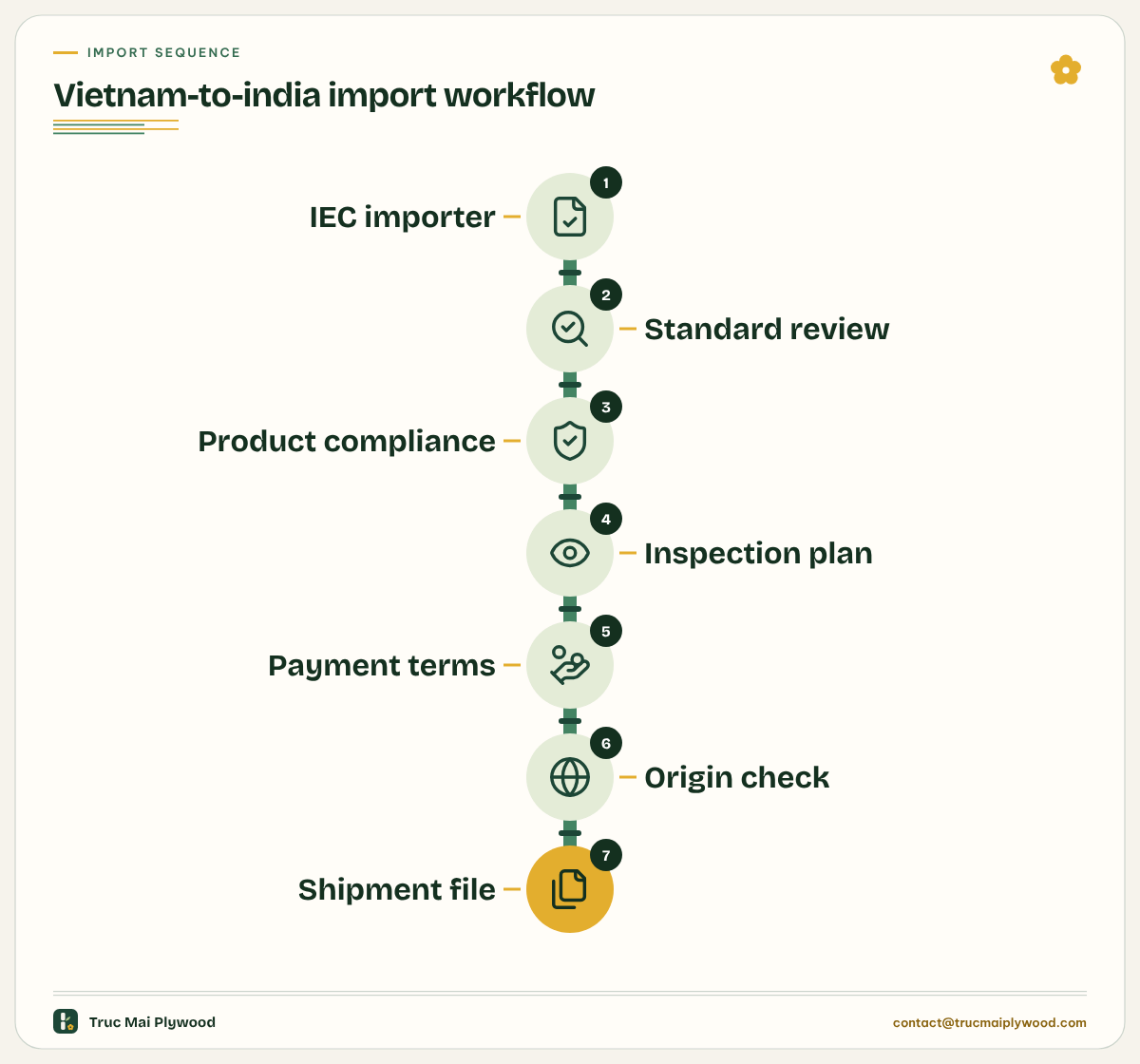
To import plywood from vietnam to india, obtain an Indian Importer Exporter Code, check the exact product against applicable Indian Standards authority controls, approve the panel specification, prepare origin and shipping documents, then file the customs Bill of Entry. Indonesia, Thailand and Taiwan follow different national clearance routes, so check the destination before loading.

India: How do I import plywood from vietnam to india, step by step?
8 steps take plywood from Vietnam to India through an Indian importer holding an Importer Exporter Code (IEC), a product-specific compliance review, a matched shipping file and a customs Bill of Entry. The order of these checks matters: deciding whether the product can enter India comes before paying the mill or booking the vessel.
- Identify the exact panel. Describe furniture plywood, commercial plywood, veneered decorative plywood or non-structural laminated veneer lumber (LVL) by construction and intended use. Record face species, core species, adhesive, emission requirement, thickness, dimensions and surface finish. A label such as “hardwood ply” alone does not identify the applicable Indian standard.
- Check the Indian importer. Obtain or verify the IEC and appoint a customs broker familiar with timber products. The Directorate General of Foreign Trade explains IEC registration and the import sequence in its official customs procedures document.
- Determine the regulatory route. Match the product against the current Directorate General of Foreign Trade import policy, the Bureau of Indian Standards (Indian Standards authority) compulsory-certification list and the exact scope of any exemption. The Indian Standards authority Scheme I list identifies plywood-related Indian Standards and the associated quality-control orders. A generic factory quality certificate is a different document from a product certification required by an Indian order.
- Approve a sample and specification. Compare the face and back against a retained sample. Specify measured thickness, permissible surface defects, core gaps, edge condition, glue system and packing. Ask for a written inspection plan before production.
- Agree the order and shipment terms. Record the Incoterm, named port, shipment document set, payment milestone, packaging and destination clearance contact. A practical deposit and balance terms checklist prevents the invoice, contract and banking documents from describing different goods.
- Check origin evidence. Ask the exporter for the applicable certificate of origin and supporting origin information. Have the broker test whether the product satisfies the relevant preferential rules of origin before claiming an agreement benefit.
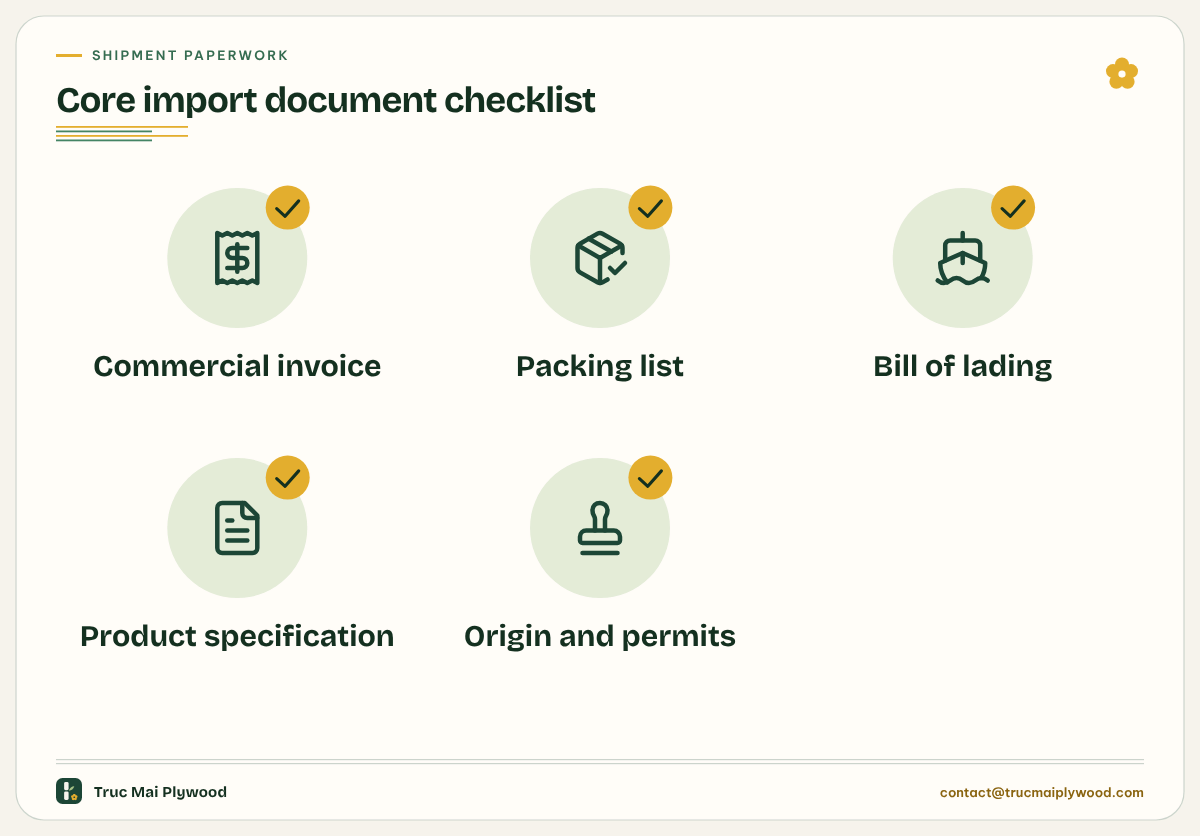
- Review draft shipping documents. Reconcile commercial invoice, packing list, bill of lading, origin evidence and any required permits against the purchase order. The documents per container checklist is a useful line-by-line control.
- File and release. The Indian importer or broker files the Bill of Entry, completes customs assessment, handles any inspection and arranges delivery after clearance. Keep the declared product description consistent with the physical panels.
For a first order, use the mill verification before deposit process and send the broker a sample technical data sheet before committing. This avoids finding out at the discharge port that a decorative face, intended use or certification route was misunderstood.
Indonesia: Import registration, restrictions and customs release
6 steps take an Indonesian business importing Vietnamese plywood through establishing its importer registration, checking timber-product restrictions, lodging the import declaration and arranging customs release. The most important early decision is the tariff classification and whether the particular wood product needs an additional approval.
- Identify the importing entity and its business registration, then appoint an Indonesian customs representative if needed.
- Classify the plywood by its actual layers, face species, construction and intended use. Check the Indonesian tariff schedule rather than borrowing a code from an Indian or Thai invoice.
- Review the relevant import restrictions and approvals for wood products. Indonesia’s Directorate General of Customs and Excise provides an official import services portal with links to customs registration, tariff references, restrictions and the CEISA electronic service.
- Ask the Vietnamese supplier for a signed technical specification, commercial invoice, packing list, transport document and the agreed origin documentation.
- Check whether an ASEAN preferential origin route applies to this exact shipment and obtain the proper origin proof when eligible.
- Lodge the customs declaration through the prescribed Indonesian channel, complete assessment and examination, then collect the released goods.
The specification should separate an interior cabinet panel from packing plywood or LVL. Indonesian buyers frequently need the finished panel described in a way that lets both the customs broker and the receiving factory identify it without opening every bundle. Put the face grade, core, adhesive and sheet dimensions on the purchase order, and reproduce those identifiers on the packing list.
For a mixed load, create a separate invoice line for each construction and a separate pack reference for each thickness. The container can carry visually similar sheets with different faces or glue systems; a single generic description invites warehouse errors. A packing photograph and a pack-by-pack count give the receiving team an independent check against the transport papers.
The import route is country-specific even when the export side starts at the same Vietnamese port. Treat Indonesian customs registration, product controls and origin rules as their own workflow, not as a copy of India’s IEC and Indian Standards authority requirements.
Thailand: Customs declarations and ASEAN origin evidence
6 steps in Thailand require an import declaration, supporting commercial documents and customs release for a plywood shipment arriving from Vietnam. The Thai buyer should decide the product classification and any permit requirements before instructing the exporter to load.
- Register the importer or appointed customs agent for the relevant Thai electronic customs process.
- Specify the goods by panel construction, face and core species, adhesive, thickness and quantity.
- Check import restrictions, product controls and the relevant tariff classification with the Thai customs agent.
- Prepare the invoice, packing list, bill of lading and insurance information where applicable; add any permit or origin evidence required for the selected entry.
- Assess eligibility for preferential ASEAN origin treatment and request the corresponding proof of origin where the rules are met.
- Submit the import declaration, complete customs assessment and arrange examination and release.
Thailand’s Laem Chabang Port Customs Office import procedure describes the declaration and accompanying documents, including the invoice, packing list and bill of lading. The same official guidance distinguishes customs clearance from approvals that may be required by another authority.
A buyer ordering melamine-faced plywood should describe the decorative overlay and the underlying veneer-core panel separately. A buyer ordering plain commercial plywood should identify the face grade and whether the faces are sanded. This helps the agent classify the goods and gives the warehouse a usable acceptance specification.
The port of discharge also belongs in the purchase order. The supplier’s quotation and the buyer’s inland delivery arrangements must refer to the same port and Incoterm. When a shipment is split among customers, request pack labels showing the buyer’s product code and sheet count rather than relying on colour or bundle position.
For purchasers comparing ASEAN markets, Thailand’s customs procedure is the reference for Thailand; Indonesia’s electronic system and India’s IEC registration are separate processes. Start from the destination authority, then align the Vietnamese export file to it.
Taiwan: Business cargo clearance and product inspection
6 steps take Taiwanese businesses importing Vietnamese plywood through a registered importer and customs declaration supported by a consistent invoice, packing list and transport document. Product classification and any applicable import inspection or quarantine requirement should be established before dispatch.
- Establish the importing company and its customs filing arrangements in Taiwan.
- Describe the panel precisely: veneer species, number and type of layers, thickness, face treatment and whether it is plywood or LVL.
- Check Taiwan’s commodity classification and any applicable inspection, quarantine or trade restrictions for that product.
- Agree the commercial specification and receive the supplier’s draft invoice, packing list and bill of lading details.
- Lodge the declaration through the authorised customs process, provide any required supporting documents and respond to inspection requests.
- Arrange delivery to the buyer’s warehouse and inspect the packaging and panel identification before releasing the goods into production.
Taiwan Customs publishes its official import cargo information and links to import-clearance services. Commercial container importers should follow the business cargo process rather than the personal-parcel instructions on that page.
A common specification mistake is to treat “birch plywood” as a complete description. Birch-faced plywood can have a Vietnamese plantation-wood core, and the invoice should say so. The face veneer affects appearance; the core species and construction affect weight, machining and the panel’s behaviour in use. Ask for a cross-section photograph with the approved sample.
Taiwan is outside ASEAN preferential origin arrangements. Do not attach an ASEAN form by habit or assume the preference available to a Thai consignee transfers to a Taiwanese consignee. Ask the local broker which origin proof the declared goods require.
A Taiwan-bound furniture order benefits from clearly written face/back grades, sanding requirements and piece labels. The same order controls the receiving inspection and any subsequent claim about misidentified bundles.
Which documents and origin forms should an Asian plywood importer request?
5 core documents an Asian plywood importer should request include a commercial invoice, packing list, bill of lading, agreed product specification and the destination-specific origin or regulatory papers. The right origin form follows the importing country and applicable trade agreement, not the port where the ship happens to stop.
| Destination | First customs control | Origin question to resolve | Practical file check |
|---|---|---|---|
| India | IEC, Bill of Entry and product-control review | Does the shipment meet the relevant preferential origin rule? | Match goods description and required product certification |
| Indonesia | Importer registration and electronic declaration | Is an ASEAN preference available for the actual origin? | Check restrictions and pack-level product descriptions |
| Thailand | Import declaration and supporting documents | Is preferential ASEAN origin treatment supported? | Compare invoice, origin proof and packing list |
| Taiwan | Business cargo declaration and local product controls | Which origin evidence is required for this entry? | Avoid using an ASEAN form automatically |
| Philippines | Importer accreditation and goods declaration | Is preferential treatment available with valid proof? | Check permits and declaration data before arrival |
| Malaysia | Local importer and customs entry | Which ASEAN origin rule applies to this panel? | Keep invoice and product classification aligned |
| Singapore | Import permit through the applicable customs channel | Is preferential origin claimed, and on what basis? | Check consignee and shipment details agree |
For Philippine shipments, the Bureau of Customs import guidelines list the commercial invoice, packing list, transport document, origin certificate when applicable and regulatory clearances when required. They also direct importers to the national trade repository to check regulated goods. This is a useful model for checking the completeness of a shipping file without treating Philippine rules as universal.
For Malaysia and Singapore, ask the local broker to identify the applicable national customs system and current tariff line before the exporter prepares the final origin document. ASEAN membership does not mean that every Vietnamese plywood shipment automatically receives a preferential rate. Origin criteria, document format and the declared classification must agree.
A certificate of origin is about the origin of the finished goods under the applicable rules. It is distinct from a forest-origin dossier, a phytosanitary document, an FSC sales claim and a factory quality-management certificate. File each under its own heading. For a shipment containing imported decorative face veneer on a Vietnamese-made core, obtain the bill of materials and processing evidence needed for the selected origin rule.
The cleanest workflow is to approve a draft document pack before the exporter issues the final originals or electronic records. Compare product description, pack count, gross and net weight, consignee, vessel information and destination port against the same purchase order. The Vietnam plywood import guide gives the broader ordering sequence.
plywood suppliers in india
4 supplier categories in India include domestic panel manufacturers, importers, distributors and specialist stockists; buyers should shortlist them by product construction, traceability and the ability to supply the same specification repeatedly. A wholesale market listing or an online catalogue is a starting point, not a factory qualification.
Begin by deciding whether the requirement is for an Indian-made sheet delivered locally or a Vietnamese-made sheet imported directly. A local dealer can provide mixed small quantities and faster replenishment from stock. A direct mill order is more suitable when the buyer can write a repeatable specification and manage container purchasing. A distributor may combine several origins and constructions under a familiar trade grade, so insist on a data sheet for the actual lot.
Ask each candidate for a recent sample, face/back grading criteria, core construction, glue and emission declaration, thickness tolerance, edge photographs and packaging details. Compare sheets side by side under the same lighting and check the edge after machining. The supplier shortlist checklist offers a consistent scoring approach.
Indian trade terms such as MR, BWR and BWP are often used in sales conversations. Ask which Indian Standard and product test evidence the supplier means, because a marketing grade and a documented certification are different. The Indian Standards authority list includes IS 303 for general-purpose plywood and other standards for separate products. Match the proposed sheet to its application instead of accepting a higher-sounding grade name.
A furniture buyer can compare an imported birch-faced panel with a locally sourced decorative plywood sheet on surface uniformity, core gaps, calibration, screw-holding requirements and the finish to be applied. A packing buyer should focus on handling strength, bundle protection and dimensional consistency. A cabinet workshop needs reliable machining and matching replacement lots more than an elaborate label.
For repeat purchases, retain one signed sample and a written tolerance table. Request a lot identifier on each pack so a later delivery can be compared with the approved sample. This gives the buyer a way to distinguish a material change from normal appearance variation without relying on brand reputation alone.
who are the importers of vietnam plywood in india
3 importer types for Vietnamese plywood in India are Indian businesses that act as the consignee or importer of record for qualifying shipments, including distributors, panel wholesalers and manufacturers buying material for their own production. A trustworthy current list of individual companies requires verified public filings or direct confirmation, not a copied shipment-data ranking.
To identify potential importers, use the supplier shortlist checklist and start with companies that openly describe their imported-panel range and publish a business address, product specifications and contact details. Check whether they are a stocking distributor, a direct importing manufacturer or a sales agent. Those roles imply different minimum quantities, lead times and responsibilities for compliance.
Ask an importing business to explain its customs documentation route, the product standards applicable to its goods, how it handles claims after arrival and whether it can show a consistent technical specification across consignments. If it advertises several core types, ask which one is actually in stock. An importer that sells furniture panels and shuttering boards under the same broad plywood heading should be able to distinguish the two categories clearly.
Do not infer a supplier relationship from a historic shipping record. A bill of lading may name a logistics party, a trading intermediary or a consignee that no longer buys the product. An old record also says little about the quality of the latest batch. For a new relationship, use a current quotation, an approved sample and documentary evidence for the exact proposed goods.
A Vietnamese mill can also serve an Indian buyer directly when the regulatory route and order quantity fit. The buyer then arranges the Indian import function and clearance. For a smaller programme, an established Indian distributor may be the more practical route because it already holds local stock and handles domestic delivery.
When assessing a potential partner, request its current company registration details privately, verify the named contracting party and establish who signs the purchase order. Separate the commercial seller from the importer of record in the document file. This prevents the supplier, customs broker and receiving warehouse from assuming that another party owns a missing task.
Which grade of Vietnamese commercial plywood is right for construction and general building use in India?
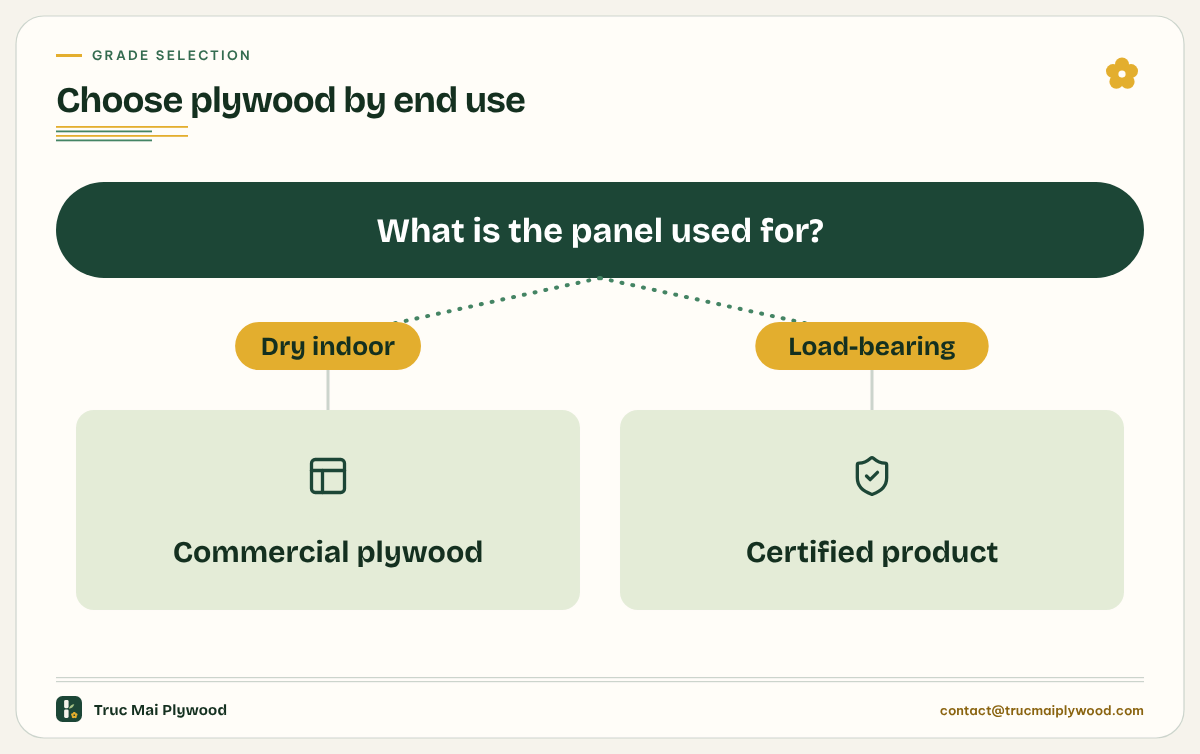
For 4 non-structural uses in India, choose a commercial plywood construction specified for dry indoor use; for load-bearing building work or concrete shuttering, choose a separately certified product designed for that use. Vietnamese furniture and commercial plywood should not be substituted for structural or formwork panels on the strength of a trade grade alone.
The term “commercial grade” describes a sales category rather than one universal engineering standard. It may cover unsanded or lightly sanded faces, an AB loose-laid or jointed core and a wider thickness tolerance than calibrated furniture plywood. The buyer should inspect the actual face/back pair and edge construction rather than translating an Asian A/B label directly into an Indian or European grade.
| Intended use | Suitable specification question | Acceptance evidence |
|---|---|---|
| Interior wall lining and dry fit-out | Face appearance, flatness, fastening and adhesive | Approved sample and order-specific test documents |
| Cabinet or wardrobe carcass | Calibrated thickness, core joining and finish preparation | Edge section, sanding inspection and dimensional checks |
| Decorative panelling | Veneer species, face/back pair and finish compatibility | Large face sample under production lighting |
| Packing and protective lining | Core continuity, handling resistance and pack dimensions | Physical inspection and packing specification |
| Load-bearing structural member | Applicable structural design standard and certified grade | Product-specific structural certification |
| Concrete shuttering | Formwork design and certified panel specification | Formwork product evidence and engineering design |
The Indian Standards authority compulsory-certification scheme lists IS 303 general-purpose plywood, IS 4990 concrete-shuttering plywood and IS 10701 structural plywood as distinct standards. These are not interchangeable labels. The current quality-control order and any exemption must be checked for the actual import before dispatch.
For an interior application, specify the environment first, then the surface finish and panel construction. UF adhesive and emission grade belong on separate lines. If the board will be laminated, state whether the face is sanded for the buyer’s adhesive or supplied with an applied decorative overlay. For painted furniture, face smoothness and consistent thickness may matter more than an expensive decorative veneer.
For Truc Mai’s furniture/interior line, sanded and calibrated panels can be ordered at ±0.3 mm thickness tolerance; commercial-grade orders are typically written at ±0.5 mm. These are order specifications, not Indian structural ratings. The cabinet-grade plywood page shows the additional choices relevant to joinery.
What LVL (laminated veneer lumber) specification (face, core, glue, thickness) do buyers in India usually order from Vietnam?
For 3 Indian furniture or packaging uses, specify non-structural LVL by end use, veneer species, adhesive and emission class, section dimensions, surface condition and machining tolerance. There is no single verified national “usual” LVL build that should be assigned to all Indian buyers.
Laminated veneer lumber is made from bonded veneers with the grain predominantly aligned along the member’s length. Its appearance and performance depend on the lay-up and adhesive as well as the veneer species. An LVL quotation needs a section drawing or dimension schedule rather than only a sheet name.
For door and frame stock, ask for the finished section width, depth, length, surface preparation and machining allowance. For bed slats, add the slat span and the furniture manufacturer’s own load requirement. For packing members, define how the member will be fixed and whether it will be cut again after delivery. These are separate applications and may require different construction and testing.
Truc Mai offers non-structural LVL for furniture components, door and frame stock, bed slats and packing. Its available core woods include Styrax, Eucalyptus, Acacia and Pine; the final LVL lay-up, adhesive and section are written against the order. The LVL door and frame stock and LVL slats for beds pages separate the two purchasing cases.
Do not transfer a plywood thickness tolerance automatically to an LVL section. Specify tolerances for the finished member and identify whether dimensions refer to rough or machined stock. Ask for an edge or end-grain photograph and a sample that represents the proposed veneer lay-up. An LVL buyer also needs a packing plan that protects straightness and prevents mixed lengths from being mistaken for one size.
Furniture and packing LVL is sold against a non-structural specification.
How should a buyer specify faces, cores and tolerances before requesting a quote?
A usable plywood request for quotation identifies the application, face/back combination, core species, adhesive and emission class, thickness, sheet dimensions, packing and quantity. This is more effective than asking several mills for a generic “high-grade” sheet and comparing the resulting product names.
For interior work, decide whether the buyer needs a decorative face, a substrate for lamination or a pre-faced panel. Poplar, bleached Poplar, engineered veneer (EV), Birch, Okoume, Bintangor, Pine, Eucalyptus and Gurjan are face options in the range. A birch face on a Vietnamese core should be described as birch-faced plywood, not all-birch plywood. The birch-faced plywood specification is a useful example.
The core affects weight, machining and the visible edge. Styrax can make a lighter furniture panel; Acacia and Eucalyptus are other options. A combined-species core can be specified where the buyer wants to balance appearance and handling characteristics. Record the core species or agreed mix explicitly so the production sample and the final consignment refer to the same construction.
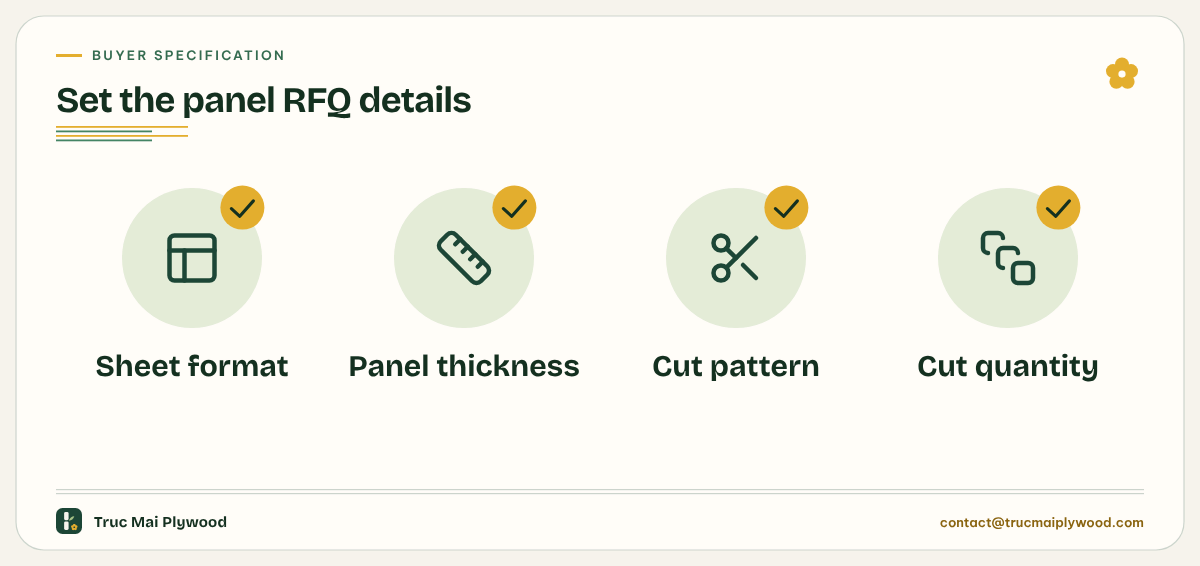
Standard sheet options include 1220 × 2440 mm, 1220 × 2280 mm and 1250 × 2500 mm. Available panel thicknesses run from 3 to 40 mm. The mill can cut a standard sheet lengthwise into 610 × 2440 mm halves, into 1200 × 800 mm thirds, or into 1220 × 610 mm quarters; six-piece cutting is also an option. The exact cut dimensions and labels are agreed from the buyer’s sheet and cutting list. For an unusual finished piece, send a cutting diagram showing grain direction and edge allowance.
State thickness and length/width tolerances separately. A tight cabinet fit may justify a sanded calibrated panel; a protective packing application can use a different tolerance. Ask the supplier to write the permitted variation into the pro forma invoice and inspection sheet. A sample is most useful when the sample’s grade, finish and measured thickness are recorded beside it.
Use the plywood RFQ writing guide to organise these choices into one repeatable purchase specification. It makes later offers comparable without assuming that identical face names mean identical panel builds.
What do FSC and emission certificates tell an importer?
An FSC chain-of-custody claim identifies eligible certified material through the documented sales chain, while an emission certificate concerns a specified product and test scope. Neither substitutes for the destination country’s customs declaration or a separate mandatory product approval.
Truc Mai Plywood holds FSC chain-of-custody licence FSC-C196493 and certificate SA-COC-014545 for eligible FSC 100% products. The FSC claim is shown on the relevant sales and shipping documents. Buyers can follow the FSC licence verification procedure and check the claim printed for their specific order.
The mill also holds CARB Phase 2 and EPA TSCA Title VI certification for hardwood plywood with veneer core in the 3–25 mm scope, with certificate CARB/EPA 26053 and mill identifier ICTT-26053. Those are US product-compliance credentials, not a replacement for Indian Standards authority approval where an Indian product control applies. The US formaldehyde regulation defines the hardwood plywood emission category and its testing framework.
For interior panel selection, ask for the adhesive type, the emission requirement, the exact product construction and the supporting test document. “UF glue at E0 emission” states two different specification items; a glue name alone is not an emission test. Likewise, a bond-resistance statement should not be treated as proof of an emissions class.
When a buyer needs certified material, put the certificate requirement on the purchase order before manufacturing begins. Check the certificate holder, the covered product family and the identification of the goods in the sales paperwork. This is especially important when a shipment mixes standard commercial plywood, decorative faced panels and different thicknesses.
How do shipping terms, packing and inspection fit the import plan?
For a Vietnam-to-Asia plywood order, write the named Incoterm, shipment documents, payment milestones, pack identification and arrival inspection procedure into the contract. The buyer’s customs broker should see the draft file while the goods are still at the mill.
The Truc Mai standard order minimum is one 40HC container. Production is generally 15–45 days after a 30% deposit, with the remaining 70% against the scanned bill of lading. Available trade terms are FOB Hai Phong, CFR or CIF. These are production and commercial terms, not an estimate of customs clearance time in India or another destination.
A typical container carries one or two products, while a larger assortment can be agreed. Mixed containers should use distinct pack marks for every product and a packing list that ties each mark to the face, core, thickness and sheet count. For buyers receiving both cabinet panels and packing-grade boards, separate identification prevents material being sent to the wrong production line.
Ask for photographs of the packed edges, corners, pallet feet and container loading. Check that the goods are dry and protected before sealing and that any solid-wood packaging meets the destination’s treatment rules. Processed plywood is outside ISPM 15, while solid-wood pallets and dunnage used with the shipment are within its scope.
At arrival, photograph the seal, container floor, package condition and any wet or crushed corners before unpacking. Reconcile the pack count against the packing list, then sample thickness, face condition and edge construction against the approved order. The container arrival checks page is a planned follow-on; the one-container costed delivery workflow helps buyers keep freight and inland delivery responsibilities distinct.
A buyer who wants a repeat monthly programme should keep the first shipment’s approved specification, sample photographs and receiving measurements together. That record makes the next order easier to inspect and reduces disputes about what was originally agreed.
How should importers compare the final offers and place a first order?
Compare final offers only after every supplier has priced the same construction, delivery term and document requirement. A lower quotation for a loose core, different face or wider tolerance is a different product, even when both offers say “commercial plywood”.
Build a comparison sheet with columns for application, face/back grade, core species, adhesive, emission class, thickness tolerance, sheet size, pack count, origin proof, required certifications and named Incoterm. Add a column for the approved physical sample. Leave any unverified claim out of the comparison until the supplier supplies the corresponding document.
For a first container, choose a small number of distinct specifications that the receiving factory can identify easily. Order samples early, record the accepted face grade and edge construction, and send the broker the proposed invoice description. If the intended destination is India, resolve Indian Standards authority and any other applicable import control before issuing the production instruction.
Ask the mill to issue a pro forma invoice using the agreed specification and commercial terms. Have the importer and broker check the consignee, destination port and documentary requirements before the deposit. During production, inspect the agreed checkpoints and request the draft packing list. Before loading, compare the final labels and counts with the approved order.
The next practical step is a quotation request containing the intended application, core, glue and emission requirement, face/back, sheet or cut size, packing plan, quantity and destination port. Use ordering plywood samples before approving the first production run, then keep the approved sample as the receiving standard. This turns an initial import into a repeatable purchasing specification.
Send your specification to contact@trucmaiplywood.com or through the quotation form.
Questions buyers ask
Can an Indian company import one container of Vietnamese plywood?
Yes. An Indian importer with the required registration can arrange a container purchase after checking the product-specific import controls and customs documentation.
Does an IEC replace a plywood product certificate?
No. The Importer Exporter Code identifies the Indian importer; a mandatory product certification, where applicable, is a separate requirement.
Does a certificate of origin identify the face veneer species?
A certificate of origin addresses the origin of goods under the relevant rules. The technical specification should separately identify face veneer, core species and construction.
Can a Vietnamese mill supply plywood cut to size?
Yes. A mill can cut agreed pieces from standard sheets and label the packs to the buyer’s cutting list.
What should a first-time importer inspect in a sample?
Check the face/back appearance, visible core layers, thickness, flatness, sanding and the specified adhesive and emission documents.
Should a broker review the purchase order before loading?
Yes. A broker can compare the goods description, destination controls, origin evidence and intended customs declaration before shipment.
Are Indian BWR and BWP names enough to specify a panel?
No. Identify the applicable Indian Standard and the required test or certification evidence, along with the actual panel construction.
Can furniture plywood be used for concrete formwork?
Specify a purpose-made formwork product for concrete shuttering. Furniture plywood is purchased for a different application and set of requirements.
What information belongs on each plywood pack label?
Use the buyer’s product code, panel dimensions, face/core specification and sheet count so the warehouse can reconcile the packs with the packing list.
Is a bill of lading the same as a packing list?
No. The bill of lading is a transport document; the packing list identifies the goods and packages shipped.
Can a mixed container contain different plywood faces?
Yes, when agreed in the order. Separate pack marks and invoice lines help identify each face, core and thickness.
What is the first step after a container reaches the warehouse?
Record the container and pack condition, compare quantities with the packing list and inspect representative sheets against the approved sample.