
Digital product passport furniture requirements will be set through EU product-specific rules. Truc Mai Plywood can supply plywood specifications, core and face veneer origin records, EUDR geolocation files and eligible FSC chain-of-custody documents. Furniture makers can organise those inputs now without treating a supplier dossier as an issued passport.

What does digital product passport furniture mean for panel buyers?
A digital product passport for furniture is an electronic product record governed by EU product-specific rules, not yet a universal furniture requirement. Under the EU Ecodesign Regulation (ESPR), it links product information to a data carrier and identifier. Panel buyers can prepare by connecting plywood specifications and origin evidence to finished furniture components.
A plywood invoice describes what was bought. A furniture passport may need to explain what went into the finished article, how its relevant properties were documented and where authorised users can find the supporting information. These are different levels of description. A cabinet model may use plywood for its carcass, drawer bottoms and backs, with different panel specifications for each application. Treating all three as simply “plywood” loses the distinction between their actual constructions.
Truc Mai Plywood manufactures furniture and interior plywood and commercial plywood in Ha Hoa, Phu Tho, Vietnam. Its range includes veneer-faced panels, UV-ready panels, melamine-faced and HPL-faced panels, packing plywood and non-structural laminated veneer lumber. A furniture maker should first identify which supplied component belongs to the finished furniture product. A packing panel used only to transport the furniture should not be confused with a permanent furniture component.
The ESPR’s passport provisions establish a framework rather than a universal furniture spreadsheet. A sensible preparation file can therefore be detailed without presenting its columns as legally final. It can connect a component reference to the supplier’s product description, the purchase-order line, the approved panel construction and the available evidence.
For example, an interior cabinet panel can be described by its face veneer, core species, supplied surface condition and dimensions. A buyer can then distinguish it from a different panel used behind the cabinet, even if both arrived in the same shipment.
The broader quality and compliance file should remain organised around identifiable products and documents. The digital product passport furniture discussion starts with trustworthy component information, not with the label printed on the finished item.
When does ESPR apply to wood products and furniture?
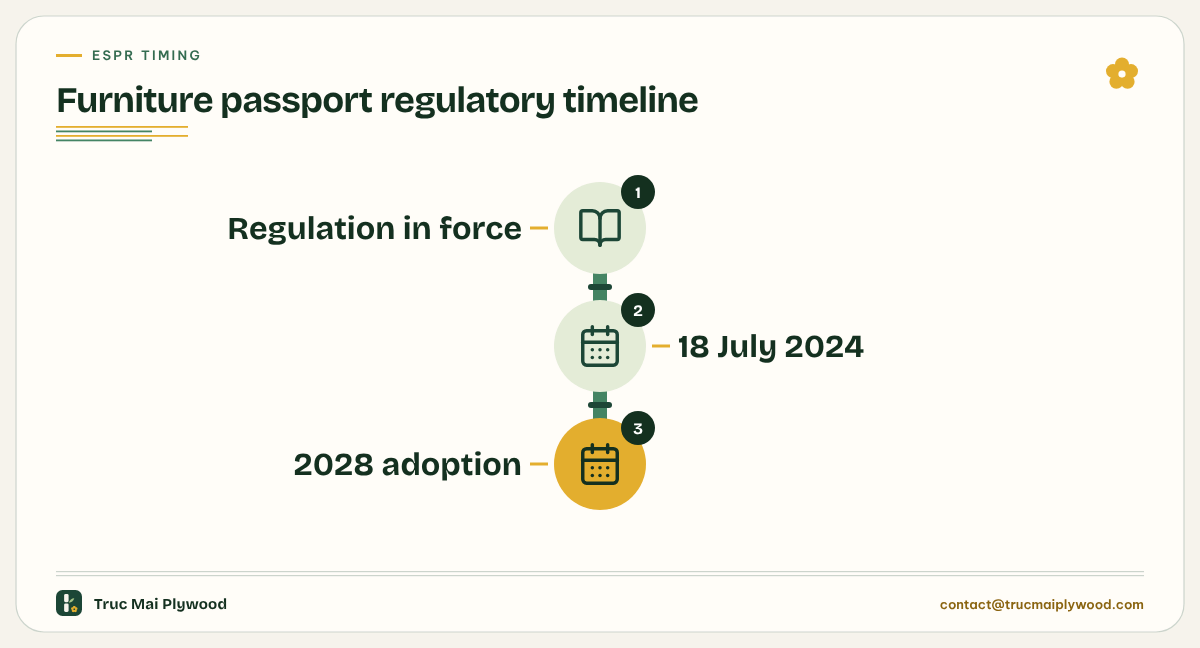
The ESPR is in force, but a furniture passport obligation awaits product-specific rules; the Commission working plan indicates adoption of furniture measures in 2028. The regulation entered into force on 18 July 2024. That date is the beginning of the EU framework, rather than the date on which every furniture maker must publish a passport.
The distinction matters when a purchasing team is deciding what to put into a supplier contract. The Commission’s 2025–2030 working plan places furniture among the prioritised product groups and gives 2028 as the indicative year for adoption of its measures. An indicative adoption year is not a product launch deadline or an automatic compliance date for a cabinet already on sale. The final furniture measure will set its own scope, obligations and implementation provisions within the ESPR framework.
Wood is a material used across several products, from interior panels to assembled furniture. The ESPR covers a broad range of physical goods and can address intermediate products and components. It does not follow that every plywood sheet already has an identical passport requirement. A buyer needs to identify the product group being regulated and the specific delegated act applying to that product. A sheet supplied to a furniture maker and the finished wardrobe incorporating that sheet occupy different positions in the production chain.
This creates two useful planning horizons. The immediate task is to preserve reliable panel specifications and source documents. The later task is to map those records to the exact furniture passport fields and identifiers once the delegated act is available. Preparing the first does not require guessing the second. A consistent purchasing record can be reused across product lines and updated when the legal data structure is settled.
Do not confuse this timetable with the separate EUDR application dates for plywood buyers. The EU Deforestation Regulation addresses timber origin and due diligence through its own legal process. The ESPR furniture timetable concerns prospective ecodesign and product-information measures. A procurement team may need to manage both, but each has its own trigger, records and legal purpose.
What data will a plywood supplier have to provide?
Five supplier-data categories form a practical starting point: material identity, origin, dimensions, construction and supporting test or chain-of-custody records; final mandatory fields depend on the furniture delegated act. This is a practical supplier-data package aligned with the ESPR’s product-information framework, not a fixed list of statutory furniture passport fields.
Begin with a stable panel description. “Birch plywood” is too broad when the actual product has a birch face veneer over a different timber core. A precise record says “birch-faced plywood”, identifies the selected core and keeps the face and core as separate material entries. The same discipline applies to engineered veneer, poplar, bleached poplar, okoume, bintangor, pine, eucalyptus, gurjan and other requested faces.
Truc Mai’s core options include eucalyptus, acacia, styrax and pine, as well as combinations of these species. The combination matters because two panels with the same face appearance can contain different core constructions. A furniture manufacturer planning a repeat order needs the core description carried forward with the component record, rather than relying on a product nickname that refers only to the visible surface.
The size record should capture the dimensions delivered, not merely the nominal sheet family. Standard formats include 1220 × 2440 mm, 1220 × 2280 mm and 1250 × 2500 mm. When a buyer orders cut pieces, the record should distinguish the original sheet specification from the finished cut dimensions. This helps reconcile incoming quantities with the furniture bill of materials and the cutting plan.
A practical handover table can use the following fields. These are recommended procurement fields rather than a declaration of the eventual legal passport schema.
| Supplier-data field | What the buyer records | Why it matters |
|---|---|---|
| Panel reference | Agreed product description and purchase-order line | Links the supplied material to the furniture component |
| Face veneer | Actual face material and approved appearance | Distinguishes visual finish from the core |
| Core | Species or agreed combination | Identifies the material inside the panel |
| Construction | Agreed layer arrangement and joining description | Preserves the build behind the product name |
| Dimensions | Delivered sheet or cut-piece measurements | Connects procurement with cutting and assembly |
| Supporting documents | Applicable origin and product records | Keeps evidence associated with the correct specification |
The buyer can request source information through the face veneer origin records process. A single country label for the finished panel can hide material origins that the buyer needs to track individually.
The ESPR allows future requirements to address material composition, technical performance and other product characteristics. Record what is known from the approved order and its documents. Keep optional explanatory information in clearly named fields so that it can be mapped to the eventual furniture rules without changing the underlying facts.
Which ESPR fields are fixed and which remain undecided?
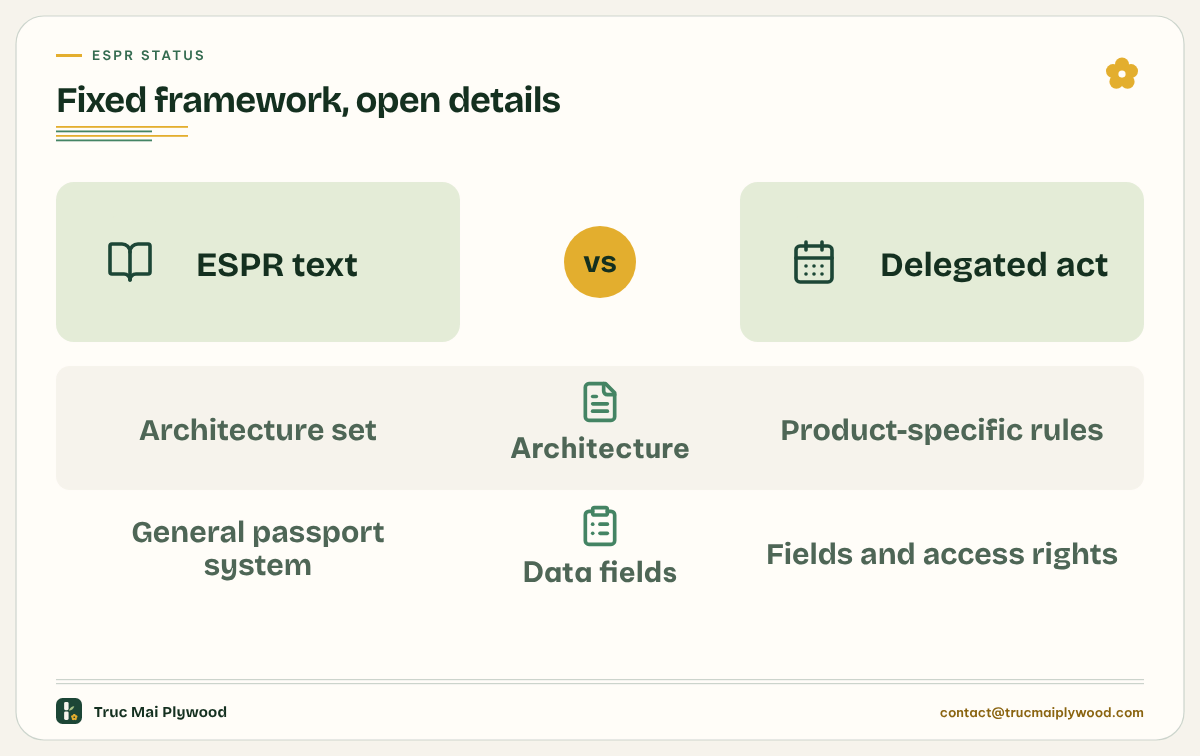
Articles 9 and 10 set the passport architecture, while the delegated act will decide data fields, access rights and model, batch or item granularity. The legal text of Regulation (EU) 2024/1781 separates the general passport system from the product-specific decisions that give that system practical meaning.
The framework establishes the idea of electronically accessible product information linked to a data carrier and unique identifiers. It also provides for differentiated access to information. A buyer should therefore think about information governance as well as data collection.
The undecided part is the furniture-specific content. It would be premature to insist that every plywood component needs a particular public QR code, that every sheet needs its own passport, or that a specific supplier field must be visible to all users. The furniture delegated act will identify the relevant information and determine how the passport provisions apply to that product group.
| Question | Framework position | Buyer preparation |
|---|---|---|
| Is there a passport system? | The ESPR provides its legal architecture | Keep structured, retrievable product records |
| Which fields are compulsory for furniture? | Product-specific requirements are to be set | Preserve accurate component and source data |
| Who may view each field? | Access is governed through the applicable rules | Separate shared information from restricted evidence |
| Is the identifier per model, batch or item? | Granularity is determined for the product group | Maintain links between specifications, orders and lots |
| What appears on a data carrier? | The applicable requirements govern its use | Avoid fixing a label format prematurely |
An effective internal system can already distinguish a furniture model from the panel lots used to manufacture it. For example, the same cabinet design may be assembled using successive deliveries of the same approved panel specification. The furniture model reference stays constant while the purchasing and lot references record which delivery was used.
Access control deserves particular care. Supplier origin evidence can include detailed documents intended for authorised due-diligence review. Public-facing product information and restricted supporting files can be stored separately while remaining connected through controlled references. A buyer can organise its EUDR geolocation data alongside the component record without copying every source document into a public product description.
It preserves the identity of the supplied plywood, the furniture component in which it is used and the documentary trail supporting that component.
How do plywood components map into a furniture bill of materials?
A furniture maker can map each plywood panel to its core species, face veneer, adhesive system, surface finish and component reference. In a bill of materials, the panel should appear as a specified input to a particular part of the finished furniture, rather than as an anonymous quantity of board.
Start with the finished furniture model and list the parts cut from plywood. A cabinet side, shelf and back panel can each carry a component code. Connect that code to the approved panel specification, then connect the specification to the relevant purchase-order line. The cutting record can preserve the relationship between the delivered sheet and the parts made from it.
The visible face is one attribute of the component, not the entire material identity. A poplar-faced panel on a styrax core and an engineered-veneer-faced panel on a eucalyptus core need different descriptions even if they serve similar furniture functions. Keeping the face and core in distinct fields helps the manufacturer compare approved substitutions and identify which component specification was used for a production run.
Surface preparation should also be recorded accurately. A UV-ready panel has faces prepared for the buyer’s subsequent coating process. It is not the same as a panel supplied with a finished UV coating. If the furniture maker applies a coating after delivery, that operation belongs in its own manufacturing record. Likewise, a factory-supplied decorative surface should be described as part of the incoming panel specification rather than attributed to a later furniture-finishing step.
A compact component mapping could look like this:
| Furniture component | Incoming panel description | Manufacturing connection |
|---|---|---|
| Cabinet side | Approved veneer face, specified core and supplied surface | Component code and cutting reference |
| Shelf | Approved panel build for the shelf application | Component code and purchase-order line |
| Back panel | Separately approved face and core specification | Component code and delivered sheet reference |
When a design changes, the manufacturer can revise the affected component specification while preserving the records for earlier production.
The ESPR framework supports product-specific information requirements. A well-maintained bill of materials gives the furniture maker a sound starting point for answering future questions about constituent materials. It also makes procurement discussions more precise: a request to change a visible veneer need not silently change the core or supplied surface condition.
For a practical panel starting point, use the furniture and interior plywood specification as the purchasing reference, then attach the actual approved construction to each component code. The finished furniture record can retain the material link as the design moves from purchasing through cutting, assembly and subsequent documentation.
How does EUDR plot evidence feed the furniture data file?
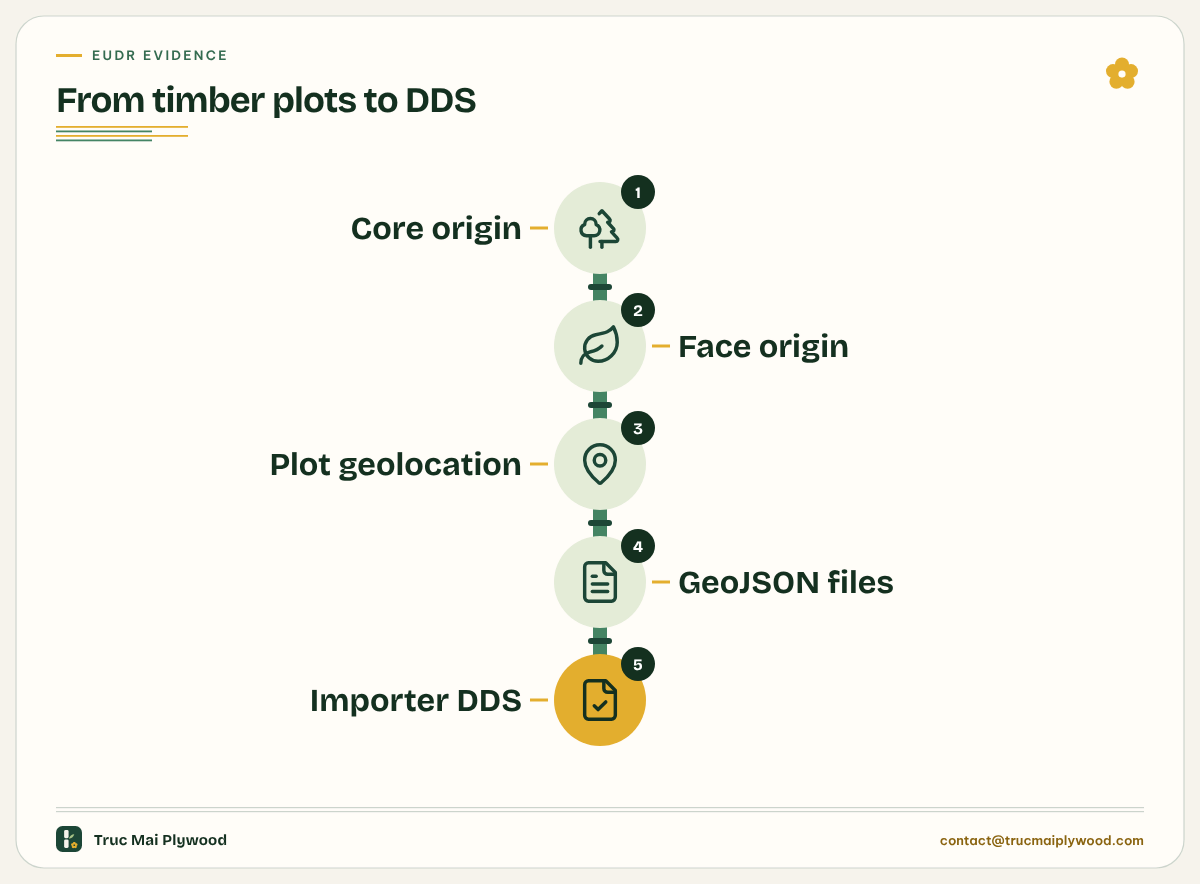
Truc Mai supplies plot-origin and geolocation records for both core timber and face veneer, giving EU buyers source evidence for their own EUDR work. The practical handover begins by keeping those two timber streams identifiable in the same component record, rather than filing all wood inputs under a single country-of-origin label.
A furniture maker buying veneered plywood needs to know which source record belongs to the core and which belongs to the decorative face. Those materials can have different supply histories even when they arrive as one finished panel. The procurement file should therefore carry a component reference, the corresponding timber stream, the origin documents supplied for that stream and a reference to the relevant production or purchase lot. This structure makes it easier to retrieve the correct documents when the buyer reviews a particular furniture order.
The European Commission’s EUDR overview describes geolocation of the plot of harvest as information used in the due-diligence process. It also identifies the central questions: whether relevant products are deforestation-free and legally produced. Plot information is an input to that assessment, rather than a substitute for examining the full supply chain.
For an importer, a useful working file has two layers. The commercial layer identifies the supplied panel and the furniture component using it. The origin layer connects the timber inputs to the corresponding supporting evidence. Keeping the layers linked helps a purchasing team change a finish or component design without losing track of the wood source associated with the original material specification.
Consider a cabinet door with a decorative veneer and a separate core construction. The door’s bill of materials can point to the approved plywood specification, while the origin register points to the face veneer and core records for the material actually ordered. If a subsequent order uses another face veneer, its record can be updated without rewriting the entire cabinet specification. The aim is an auditable connection between purchased materials and the buyer’s documentation, not a public display of every plot coordinate.
Buyers preparing their files can use the face veneer origin records guide to identify which questions to settle before production. Ask for the origin evidence in a format that can be matched to purchase-order lines, and retain the supplied files alongside the order history.
Where do FSC chain-of-custody records fit?
Truc Mai holds FSC chain-of-custody licence FSC-C196493, and eligible FSC 100% sales require the product claim and certificate code on sales documents. The useful distinction for furniture procurement is between a supplier’s certification identity and the FSC claim attached to the particular material purchased.
An FSC chain-of-custody record follows certified material through organisations that source, process and sell it. The FSC Chain of Custody standard, FSC-STD-40-004 V3-1, sets out how certified organisations control material records and product claims. Its sales-document requirements mean that buyers should examine the claim on the actual transaction, not merely store a general certificate image in the supplier folder.
For a furniture panel order, the purchasing record can capture the supplier’s certificate code, the relevant sales-document reference, the product description and the FSC claim shown for that product. These fields should sit beside the panel specification and quantity, so that an accounts team or production planner can trace the claimed input to the purchase. A certificate number in a supplier master record is useful for identification; the line-level claim tells the buyer what was sold.
The difference matters when a furniture maker sources several panel constructions. A veneer-faced panel, a melamine-faced panel and a different core option should each be associated with their own sales line and claim where applicable. The purchasing system should preserve the original invoice or other qualifying sales document as evidence, rather than replacing it with a manually typed summary that may omit the exact product claim.
FSC records also help the furniture maker manage material substitutions. If the approved face or core changes, procurement can check the new product’s claim and update the bill of materials before the furniture order is released. This keeps the record tied to the component that production actually uses. It avoids treating all items from a certified supplier as though they necessarily carry the same claim.
For an initial check, use the guide to verifying an FSC licence code. For the ongoing data file, keep a consistent place for the certificate identity, product claim and sales reference.
What is the difference between an EUDR file and a product passport?
EUDR due diligence and an ESPR digital product passport are separate legal workflows with different responsible actors and information requirements. A furniture maker may use some of the same supplier records in both workflows, but should organise each file around its own purpose and applicable rules.
The EUDR concerns relevant commodities and products entering or leaving the EU market. For covered wood products, its due-diligence process addresses the source of the material, legality of production and deforestation criteria. The Commission’s EUDR guidance describes the information and declaration process used by economic operators. The work is directed at establishing the status of the relevant product and its underlying supply chain.
The ESPR, by contrast, creates a framework for product-specific information requirements, including digital product passports where the relevant delegated rules prescribe them. A future furniture passport could draw on material composition, product identification and other fields defined for the furniture category. The legal architecture appears in Regulation (EU) 2024/1781. A timber-origin dossier is therefore one potential source of data for a broader product information system.
For buyers, the operational distinction is straightforward. The EUDR working file follows the wood and the evidence supporting the due-diligence assessment. The furniture product-data file follows the finished product model and its component specifications. A single purchase-order line can connect the two without collapsing them into one document. This is particularly helpful where several furniture models use a shared plywood specification but are assembled or finished differently.
A sensible data architecture stores original evidence once and creates controlled references to it. The origin record remains attached to the material lot; the furniture model record identifies which material lot or approved specification it uses. When a panel construction changes, the product team updates the component link. When new origin evidence is received, the compliance team updates the source record. Both teams can then work from a consistent purchasing reference.
Keep the current EUDR application dates for panel buyers in the import compliance calendar. That calendar is separate from any timetable for future furniture-specific passport requirements. Treating the schedules separately prevents a purchasing team from confusing a live timber due-diligence obligation with a future product-information measure.
Which panel specifications belong in the data handover?
The handover should identify thickness, sheet dimensions, core construction, face and back, adhesive and emission specification, with tolerances stated on the order. These are the fields that let a furniture buyer match the supplier’s panel to the actual cabinet, door, shelf or interior component being made.
A practical specification register uses one row per approved panel construction. It identifies the material by the buyer’s part number and the supplier’s description, then records the agreed dimensions and construction. The face and back should be described separately where they differ. Core species and construction should also be stated clearly, particularly when the same visible face is offered on different core builds.
| Handover field | What the buyer should record | Why it matters downstream |
|---|---|---|
| Panel reference | Approved product or component code | Connects purchasing to the furniture bill of materials |
| Thickness | Ordered nominal thickness and agreed tolerance | Supports machining and fit checks |
| Sheet format | Ordered length and width or approved cut list | Connects supply to nesting and production planning |
| Core | Species and construction specified for the order | Distinguishes panels with similar-looking faces |
| Face and back | Veneer or facing on each side | Supports visible-surface and orientation decisions |
| Adhesive | Agreed adhesive system | Preserves the construction specification |
| Emission | Named classification and relevant evidence | Connects the ordered build to the required emission documentation |
| Order reference | Purchase-order line and production lot where supplied | Connects the specification to the delivered material |
A table like this is an internal handover tool, not a claim about the final fields that EU furniture rules will require. It gives the buyer a stable foundation while the formal product-specific information model is developed under the ESPR framework.
The tolerance entry deserves attention. A nominal thickness alone does not tell a furniture factory which variation it has ordered. A buyer using close-fitting grooves, concealed hardware or repeatable edge finishing should put the agreed tolerance in the purchase order and retain it with the approved sample.
For cut-to-size supply, identify the parent panel specification and attach the approved cut list. Each cut piece can then inherit the correct core, face, adhesive and emission fields while retaining its own finished dimensions. This avoids creating a disconnected record for every piece of the same construction. It also makes revisions easier when a furniture maker changes its component dimensions without changing the panel material.
The plywood RFQ guide provides a starting point for expressing these requirements before the order is agreed. Send the specification in a structured form and keep the approved version alongside the order documents.
How should coatings, laminates and adhesives be recorded?
Record the supplied finish separately from the underlying plywood build, and distinguish adhesive chemistry from emission classification. This allows a furniture manufacturer to describe the visible surface, the structural panel construction and the relevant emissions evidence without confusing one attribute with another.
The first distinction is between the base panel and its surface treatment. A plywood sheet can have a specified face veneer, while a further finish changes its appearance or intended processing route. A laminate adds another material layer. In a furniture bill of materials, the base panel should keep its own identifier, with the finish or laminate recorded as an additional attribute of the supplied component.
A useful surface record names the finish type, the treated side or sides, the specified appearance and any agreed processing requirement. If a buyer orders a high-pressure laminate facing, the laminate should be identified as the facing rather than entered as the wood species. If a panel is supplied ready for subsequent finishing, the record should describe that supplied condition instead of assuming a coating was already applied.
The adhesive field belongs to the panel construction. It tells the purchasing team what bonding system was specified. The emission field belongs to a separate performance requirement and its supporting test or certification evidence. For example, an adhesive name alone is not an emission test result, and an emission classification does not identify the adhesive chemistry. Recording both fields makes the specification useful when buyers compare alternative panel builds.
The same separation should continue through revisions. If a furniture maker changes from an unfinished veneer face to a laminate-faced panel, the surface entry and component identifier should be reviewed. If the core or adhesive specification also changes, those fields should be revised explicitly. A purchasing system that records only a marketing product name can hide such differences; a component register exposes them to the production team.
The ESPR regulation provides the framework under which future product-specific information requirements will be set. Until those furniture fields are specified, a buyer can still organise accurate material descriptions using the existing procurement and technical records. For a concrete surface option, see the HPL-faced plywood range, then record the chosen facing and underlying plywood construction on the order as separate entries.
What emission and management certificates can support the record?
Truc Mai can supply its applicable CARB P2 and TSCA Title VI veneer-core certification for 3–25 mm panels alongside its ISO management-system credentials.
For a furniture procurement team, the useful starting point is a document index tied to the purchased panel specification. Put the certificate name, issuing or certification reference, product scope, covered thickness and document version in separate columns. Then link the actual file rather than transcribing a badge into a furniture bill of materials. This helps teams find evidence without confusing product and management records.
The manufacturer’s CARB P2 and TSCA Title VI reference is CARB/EPA26053. The relevant product scope is veneer-core hardwood plywood in the stated thickness range. An importer buying a panel outside that scope should identify its applicable evidence independently instead of attaching the veneer-core document to every catalogue entry. The Phase 2 formaldehyde limits guide explains the emissions context for buyers comparing specifications.
Under 40 CFR Part 770, US formaldehyde requirements distinguish regulated composite wood product categories and their testing and certification arrangements. Keep the test method, product category and certificate reference together. In a furniture data system, the field for an emission requirement should point to the supporting report or certification record, rather than contain a generic statement that every construction and finish has identical performance.
ISO 9001:2015 and ISO 14001:2015 are management-system credentials held by the manufacturer. They can be recorded under a supplier-qualification heading with their respective certificate references. They are different in purpose from product emission evidence: the former addresses quality management and the latter environmental management. A furniture maker may use these credentials when qualifying its supplier, while reserving component-specific entries for the panel supplied on the order.
A practical evidence index can have three distinct folders: supplier management credentials, panel emission documents, and purchase-order specifications. Within the panel folder, name files by the approved specification reference and relevant product category. This avoids the common problem of a buyer finding an impressive certificate but having no straightforward way to match it to the material received. It also gives the furniture producer a clean route to the evidence it chooses to reference when future passport fields are finalised under the EU Ecodesign Regulation.
How can an importer organise model and batch identifiers?
A buyer can link the approved panel specification to each purchase-order line and production lot, while leaving the formal passport identifier design to the applicable EU rules.
Start with the identifiers the business already uses. A furniture model code describes the finished design; a component code identifies the particular shelf, side, drawer part or door; a panel specification reference describes the material approved for that component. A purchase-order line then identifies what was ordered, and a production lot provides a bridge to the material received. These identifiers perform different jobs, so keeping them in separate fields makes the records easier to search.
For example, a cabinet programme might use the same approved plywood build for several components but different cut lists for each model. The component record can reference the shared panel specification and the relevant cut list. The receiving record can identify which delivery and production lot supplied that component run. When a furniture design changes its face material or finish, issue a revised specification reference rather than silently overwriting the old one. That preserves the historical link between earlier furniture models and the material actually purchased.
A simple internal register can use the following structure:
| Register field | What the buyer records | Operational use |
|---|---|---|
| Furniture model | Internal finished-product code and revision | Identifies the design using the component |
| Component | Part code and approved cut-list revision | Connects a physical part to the design |
| Panel specification | Approved construction and finish reference | Keeps material requirements consistent |
| Purchase-order line | Order and line reference | Connects the specification to the commercial transaction |
| Production lot | Supplier’s lot reference as supplied | Connects incoming material to its source record |
| Receipt | Delivery and receiving reference | Shows which stock was accepted for production |
| Evidence pointer | Controlled document reference | Retrieves the relevant origin or test file |
This is an internal traceability design, not a proposed EU passport schema. The ESPR provides a framework for product information and identification, with the eventual furniture rules determining which identifiers must appear in the passport and at what level. Buyers can therefore build useful joins between their own systems without printing speculative passport labels on incoming sheets.
Keep the register close to goods-receipt practice. If a shipment contains several approved specifications, the receiving team should capture the correct order line and lot for each group. If stock is divided across manufacturing runs, record the stock movement against the component run. The documents per container guide offers a useful companion checklist for connecting commercial shipment references to the incoming material record.
The payoff is practical: when engineering asks which panel build went into a model revision, purchasing can answer from a controlled record. When a buyer requests supporting documents for an identified lot, the team can retrieve the relevant files without searching an entire shipment archive.
Who prepares, publishes and updates the eventual passport?
The economic operator placing a covered furniture product on the EU market has the passport duties specified by the delegated act, while the plywood mill supplies component records.
A furniture producer or importer should separate ownership of the finished-product record from ownership of the underlying supplier evidence. The finished-product operator knows the model configuration, assembly, components, intended market and revisions. The plywood supplier knows the supplied panel build, its production references and the supporting material documents. Combining those records is a controlled handover between businesses, not a transfer of the entire finished-product information task to the mill.
The ESPR legal text establishes the framework for passports and for obligations associated with products covered by future delegated acts. A buyer designing its workflow now can nominate a passport-data owner within the furniture business and a document owner for each material supplier. This avoids a shared spreadsheet in which nobody can tell who approved the final model record.
Use a change workflow that follows the product rather than the certificate folder. A change to a component’s plywood construction should trigger a review of the furniture model’s material references. A new supplier document that covers an unchanged specification can be added to the evidence register without pretending that the furniture design itself has changed. Conversely, a revised furniture model may need a new component mapping even if the panel certificates remain the same.
An effective handover has identifiable checkpoints. Purchasing captures the approved panel specification and shipment reference. Goods receiving associates the delivered lot with that order. Engineering maintains the model-to-component mapping. The team designated to manage EU product information selects the required fields and publication process once the relevant legal requirements are established. Each checkpoint can be audited from a source record rather than a recollection of an email exchange.
Access also matters. Commercial specifications may be suitable for exchange with customers, while source documents containing detailed supply-chain information belong in a controlled evidence workflow. The future furniture requirements will specify the applicable passport information and access arrangements. Until then, distinguish a buyer-facing summary from the full supplier dossier and give each a clear document owner.
For the wider import workflow, see importing plywood into the EU. Keeping import paperwork, product specifications and eventual passport publication in their respective workflows helps the furniture business retrieve information quickly while maintaining a reliable connection between them.
What should a furniture buyer request before the first shipment?
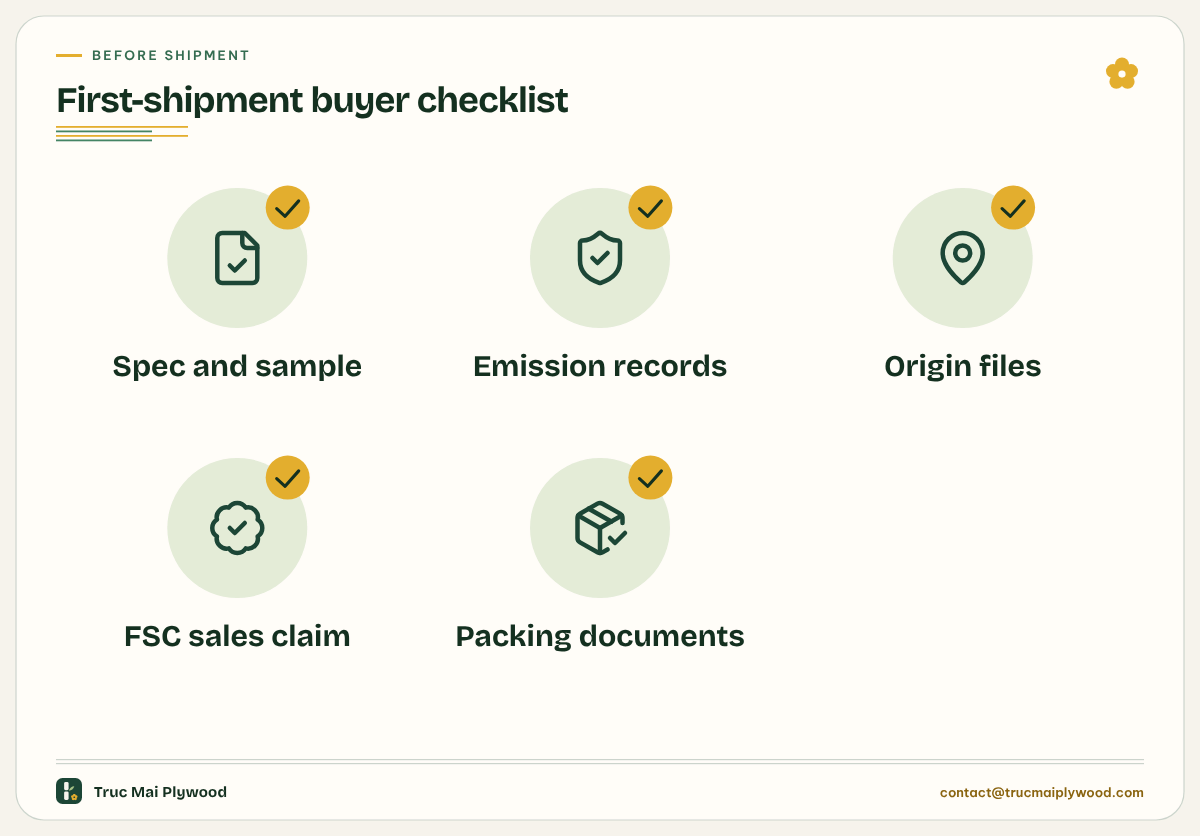
Request the agreed panel build, core and face origin files, certificate scope, sample approval and shipping-document list before locking the purchase order.
The first purchase order is the best opportunity to agree on how evidence will travel with the material. Send the furniture application and the proposed component specification to the supplier before discussing the document pack. Include the core species or combination, face and back requirements, adhesive and emission specification, thickness, sheet or cut dimensions, finish, packing arrangement and order quantity. The supplier can then assemble records against a defined product rather than an informal description such as “furniture plywood”.
Ask for a sample that represents the build you intend to order, and give that sample an approval reference. Check the visible face, edge construction, finish and dimensional fit against the intended furniture component. Retain the approval reference on the purchase order and in the component specification register. The ordering plywood samples guide provides the steps for turning a sample into a usable purchasing reference.
For EU sourcing, request the origin information for both the core timber and face veneer streams. The European Commission’s EUDR guidance explains the due-diligence framework and the importance of plot geolocation information. Organise the supplied files by order and source stream so the buyer can match them to the material transaction. Keep the original evidence available in the designated compliance records rather than pasting detailed plot information into a general product description.
If an FSC claim is specified for the purchase, put the required claim on the order and check that the sales documents carry the appropriate claim and seller certificate code. FSC-STD-40-004 sets out the sales-document requirements. This should be handled as a transaction-level document check, alongside the agreed panel identity, rather than a marketing description added after shipment.
Before authorising production, use a short acceptance checklist:
- Match the quotation and purchase order to one approved panel specification and sample reference.
- Confirm which emission or other product records apply to that specification and retain their document references.
- List the core and face origin files required for the EU buyer’s due-diligence records.
- Record any FSC sales claim required on the order and the corresponding document fields.
- Agree the packing description, lot references and commercial shipping documents to be provided.
- Assign a recipient for the electronic evidence pack and a contact for resolving mismatched references.
The mill-verification checklist helps buyers organise the supplier and document review before payment and production proceed.
How can Truc Mai prepare a repeat-order data pack?
Truc Mai can align a repeat furniture-panel order around one approved specification, its supporting origin documents and the shipment references the buyer needs.
A repeat order should begin with the previously approved specification reference, not a fresh description of the panel in each email. The buyer can provide the existing component programme, the quantity required and any revised cut list or finish instruction. Purchasing can then distinguish a genuine specification change from an unchanged repeat.
A useful repeat-order pack has a stable specification record and an order-specific evidence index. The stable record describes the approved plywood build and sample reference. The order-specific index identifies the purchase order, relevant production lots, origin files and shipping documents. Certificate references can be linked from the specification record where their scope fits. If the approved panel changes, create a new specification revision and link the next order to that revision. Earlier orders remain connected to the version actually purchased.
For a furniture factory running several product models, the same panel specification may feed multiple component lists. The buyer can retain one controlled material record and associate it with each model’s component codes. Production planning can then compare the combined panel demand with the purchase-order quantity, while receiving maintains the lot references that distinguish deliveries.
The manufacturer’s furniture and commercial plywood range includes different face choices, core constructions and finishes. A repeat-order register should therefore preserve the selected build rather than assume that a familiar trade name identifies every relevant detail. Record an approved change to face veneer or surface treatment as a specification revision. Keep the evidence pointers with the relevant revision, so a later enquiry can be answered using the documents that accompanied the material.
The ESPR’s product-passport framework gives furniture businesses a reason to make these links dependable now. It does not require a buyer to guess the final furniture passport fields. A well-organised supplier handover can be mapped into the applicable future information model once those requirements are published, while continuing to support normal purchasing and traceability in the meantime.
For an established programme, the first-order to monthly-supply workflow helps organise recurring purchase references. For a new programme, send the furniture application, approved or proposed panel build, face and finish, dimensions, packing format, quantity and destination details through the quotation request. Include the EU origin-document requirements in the same request so the specification and evidence pack can be prepared together.
Questions buyers ask
Is a digital product passport already mandatory for every furniture item?
No. The ESPR provides the framework, while furniture-specific obligations await a delegated act.
When are EU furniture ecodesign measures expected?
The Commission working plan indicates 2028 for adoption of furniture measures, not an automatic passport compliance deadline.
Does a plywood mill issue the finished furniture passport?
No. The finished-product operator manages its applicable passport obligations; the plywood supplier provides component evidence.
Which plywood details should a buyer record?
Record face and core species, construction, dimensions, adhesive, emission specification and the approved order reference.
Can EUDR plot records replace a product passport?
No. EUDR due diligence and ESPR product information are separate processes, although supplier records may support both.
Should face veneer and core origins be kept separately?
Yes. Link each timber stream's origin evidence to the purchased panel specification and lot.
Does an FSC-certified supplier make every panel FSC certified?
No. Check the eligible product and its FSC claim and seller certificate code on sales documents.
Should a buyer print a passport QR code on each plywood sheet now?
No. The applicable delegated act will determine passport information and identifier granularity.