
In the pine board vs plywood comparison, for wide shelves, cabinet sides and repeatable furniture parts, pine-faced plywood usually offers better dimensional stability and sheet yield than solid pine boards. Solid pine is useful for exposed edges, profiles and repairs. Compare stiffness at the actual span, surface finish, core construction and cutting waste before selecting either material.
Pine board vs plywood: what changes in a furniture part?
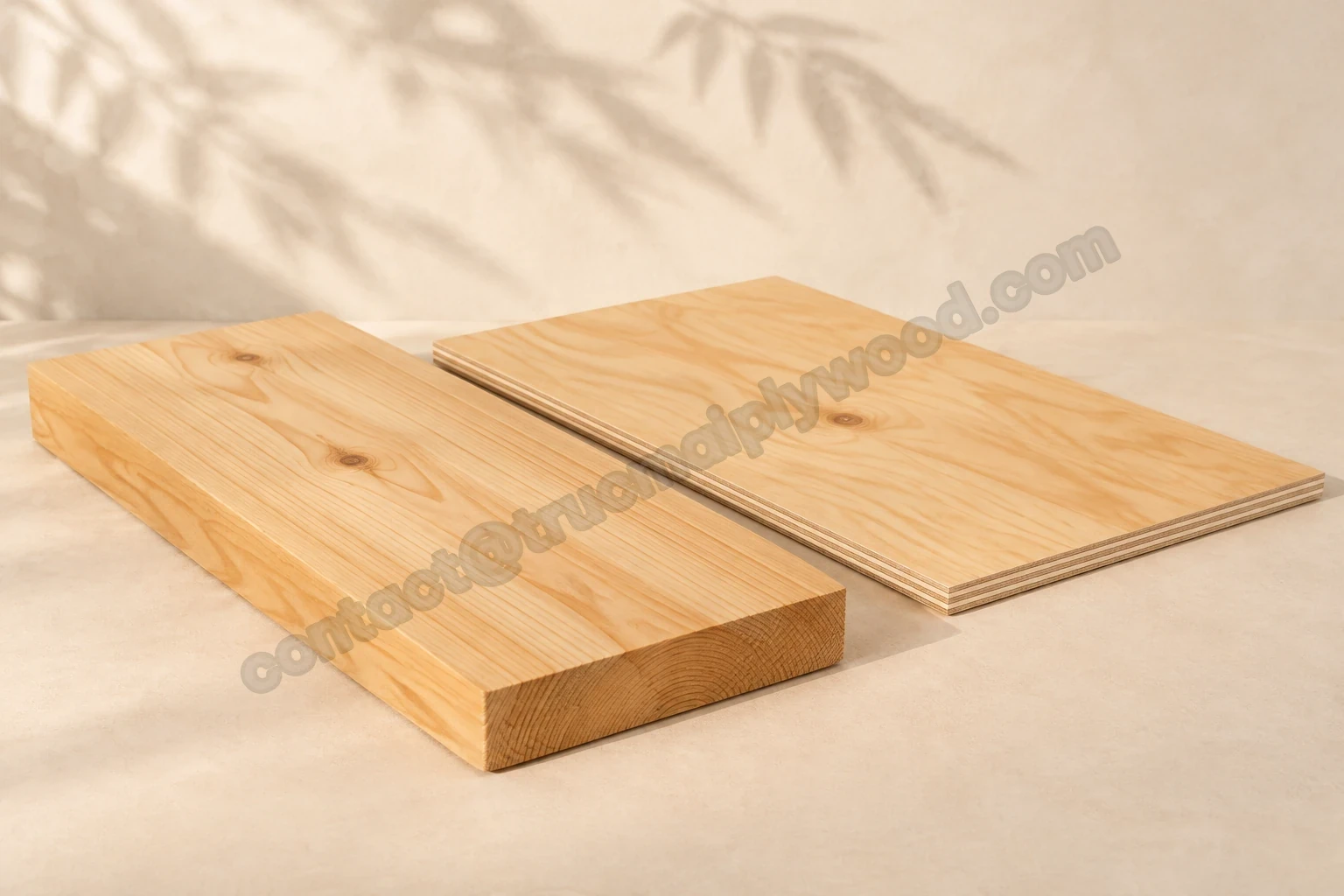
Pine board vs plywood is a comparison between solid sawn or edge-glued timber and a manufactured panel of bonded wood veneers. Pine is a species group; plywood describes a construction. A pine-faced plywood sheet can have a pine surface over a different wood core. The face alone therefore tells a buyer little about the weight, bending behaviour or screw performance of the finished panel.
For a narrow rail with a visible shaped edge, solid pine is often the straightforward choice. For a broad cabinet side or a row of matching shelf blanks, plywood brings the benefit of a factory-made sheet. Veneers laid with alternating grain directions reduce the directional swelling and shrinkage found in solid boards. The US Forest Products Laboratory’s Wood Handbook explains why cross-grain bonding changes the way sheet products respond to humidity.
| Buyer criterion | Solid or edge-glued pine board | Pine-faced plywood | Practical choice |
|---|---|---|---|
| Construction | Timber along the grain; edge joints if laminated | Cross-laid veneer core with pine face | Check the edge, not the sales name |
| Wide cabinet sides | May need joining, allowance for movement | Broad, uniform sheet | Plywood for repeat blanks |
| Exposed shaped edge | Continuous timber can be profiled | Layers remain visible unless edged | Solid pine for a natural profile |
| Surface | Grain, knots and colour vary by board | Pine appearance selected by face grade | Approve a face sample |
| Fasteners | Behaviour varies with grain and position | Edge and face holding depend on core | Test the intended joint |
| Moisture response | Greater movement across grain | Cross-lamination moderates movement | Specify the service environment |
| Production yield | Board width and defect trimming matter | Nesting and sheet layout matter | Compare usable finished parts |
The distinction matters when an order simply says “pine ply board”. A factory may quote a decorative pine face over a mixed-species core while a local timber yard quotes solid pine planks. Both can be suitable, but they are not interchangeable purchasing descriptions.
Is pine as strong as plywood?
No, pine is not always as strong as plywood. Solid pine may perform better along its grain, while plywood distributes stiffness across both sheet directions. For shelves, compare equal thicknesses at the intended span and load. For cabinet sides, plywood’s cross-laminated construction helps limit movement across the panel width.
A useful comparison starts with a fixed geometry. Test two pieces at the same thickness, width and clear span, then measure deflection under the intended load. If one is thicker or has a different core, a simple “pine versus plywood” result is misleading. Ask for the panel’s bending properties in the direction of use and the relevant test method rather than a generic strength adjective.
Structural plywood is a separate regulated product category. NIST’s PS 1-22 structural plywood standard addresses graded structural panels, bond classifications and performance requirements. Furniture plywood should be specified for its furniture application rather than presented as PS 1 sheathing. Truc Mai’s range here is furniture and commercial plywood, including pine-faced decorative sheets.
For a cabinetmaker, the test can be practical: make a trial shelf with the chosen edge treatment and supports, place the design load on it and inspect the centre deflection and joint behaviour.
Is pine cheaper than plywood?
Yes, pine can be cheaper for narrow, short parts cut from readily available boards; plywood often uses material more efficiently for wide, repeated panels. The useful comparison is cost per accepted finished component, not the ticket price of a board against the price of a sheet.
Start with the actual cut list. A tall cabinet side needs a continuous broad blank. If solid boards must be edge-glued, the buyer must account for matching, machining, gluing, clamping and later flattening. A plywood side can be nested directly from a sheet and edged afterwards. Conversely, a small trim strip may be cut cleanly from stock pine without paying for a broad panel or decorative back face.
Compare quotations on identical requirements: delivered material, grade, moisture condition, surface preparation, expected reject allowance, machining and finishing. The guide to how plywood is priced is useful for separating construction choices from commercial terms.
For importers, packing density and the number of usable parts per shipment also affect the result. The loading table later in this article uses a fixed planning model; it is a way to understand how core density changes freight utilisation, not a comparison of quoted selling prices.
What are the disadvantages of pinewood?
Yes, pinewood has disadvantages for wide furniture parts: movement across the grain, visible knots or resin features, denting on softer stock and variation between boards.
A wide solid pine door needs room to expand and contract across its grain. If a designer fixes the whole width rigidly, seasonal humidity changes can cause distortion or joint stress. Edge-glued boards improve the available width, but they retain solid timber’s grain-direction behaviour. The Forest Products Laboratory describes the relationship between wood moisture changes and adhesive-bonded construction.
Pine also presents an appearance decision. A clear finish can make knots, colour differences and grain reversal prominent. A painted part may need knot sealing and careful preparation to avoid visible patches. A soft surface may pick up dents in busy shelving or work areas. Buyers should therefore select the face grade and finish against a physical sample rather than assume that “pine” means one appearance.
The manufacturing response is to assign materials by part. Keep solid pine where a shaped or repairable timber edge is valuable. Use a calibrated plywood panel where broad, repeatable flat blanks are needed. The most reliable bill of materials often contains both.
How are solid pine boards and pine-faced plywood made?
Solid pine boards are sawn from timber, dried and machined; wide panels may be assembled by edge-gluing narrower pieces. Pine-faced plywood is assembled from veneers with cross-oriented layers, pressed and then trimmed and sanded. The distinction determines where a joint appears and how the finished piece behaves.
A plywood face is not necessarily the core species. Truc Mai offers pine faces over Styrax, Eucalyptus, Acacia, Pine or combined cores. Furniture panels use selected stitched cores and sanded faces; commercial panels can use a different core joining and surface preparation. This is why a factory drawing should call out both the visible face and the inner construction.
A buyer can inspect a sample by looking at its broad surface, then turning it to expose a fresh cut edge. The face shows knots, colour and grain. The edge shows ply count, core joints and the quality of veneer lay-up.
For related face options, compare pine-faced plywood with pine and poplar face options. They solve different visual requirements even when the panel dimensions are the same.
Which material makes a flatter, wider shelf?
Pine-faced plywood is generally the more practical starting point for a wide shelf or cabinet side because it arrives as a cross-laminated sheet. A solid pine shelf can work well, especially when its grain is oriented correctly and the design accommodates movement.
Flatness is not the same as load capacity. A panel can arrive flat and still deflect under a heavy row of books. A shelf designer should define the clear span, support method, expected load and acceptable deflection, then select thickness and edge reinforcement. A solid pine shelf may be stiff along the grain, while a plywood shelf may gain stiffness from an applied front lipping or a shorter span.
Where the edge is visible, a solid pine lipping can deliver the desired timber appearance without making the entire panel from edge-glued boards.
For broader material selection, see best plywood for interiors and the cabinet-grade plywood specification. Both address applications in which face quality and core construction need to be specified together.
Which is better for cabinet doors and joinery?
Pine-faced plywood is often better for flat slab doors, cabinet sides and broad interior joinery; solid pine is useful for framed doors, mouldings and shaped components. The right choice follows the joint design rather than a universal preference for one material.
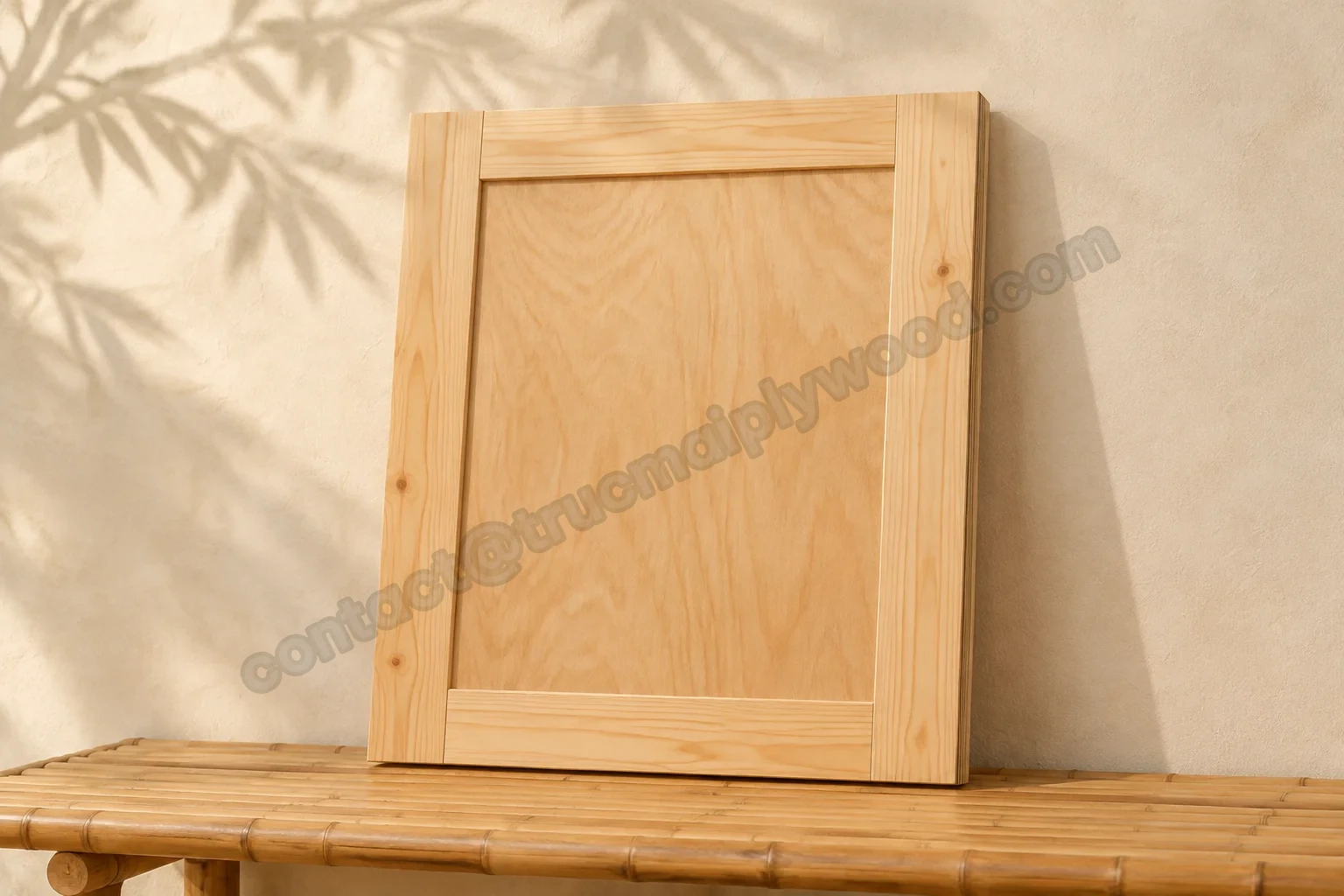
A flat door places a premium on a stable broad panel and predictable finishing. Plywood’s veneer construction helps limit the cross-grain movement that can trouble solid slabs. A frame-and-panel door instead uses timber rails and stiles around a floating centre panel, deliberately allowing the materials to move.
Machining changes the decision. A deep round-over or carved profile exposes plywood layers, so a solid timber member is usually more convenient. A straight-edged cabinet part can receive lipping or edge banding. For drilled hardware, test the actual hinge plate, screw size and edge distance in the chosen core before approving the production drawing.
For kitchens, the choice also involves cleaning, finish durability and installation conditions. The kitchen cabinet plywood guide explains the cabinet-specific questions to settle before purchasing.
What does pine plywood board mean on a quotation?
“Pine plywood board” should identify a plywood panel with a pine face, plus a separately stated core and adhesive specification. The term alone does not establish whether the core is pine, which veneer grades are used or whether the board is intended for a humid room.
A complete line item records the face/back grade pair, the core species, the joining method, thickness, sheet size, surface preparation and the adhesive and emission requirements. A supplier’s label such as A/B or BB/CC is a trade description; the approved sample and written grade limits decide what that label means in the order.
Truc Mai’s furniture and commercial plywood range includes pine-faced panels, with calibrated furniture surfaces available at an agreed thickness tolerance of ±0.3 mm. The broader order tolerance is specified by construction. The buyer should put the target finished thickness on the cutting drawing and the tolerance on the purchase order.
If the quotation covers a pine-looking panel rather than natural pine veneer, request a sample and identify the face material explicitly. Engineered veneer and natural pine veneer can give different grain repetition and colour patterns.
How should buyers specify thickness, size and face quality?
Specify thickness, size and face quality as separate acceptance points. For Truc Mai’s furniture and commercial plywood, the published thickness range is 3–40 mm, and standard sheet formats include 1220 × 2440 mm, 1220 × 2280 mm and 1250 × 2500 mm. A drawing should state which dimension is the finished dimension after cutting.
| Specification field | What to put on the order | What to inspect on a sample |
|---|---|---|
| Application | Shelf, door skin, cabinet side or packing part | Intended finish and edge detail |
| Face/back | Pine face grade pair against approved sample | Knots, repairs, grain and colour |
| Core | Styrax, Eucalyptus, Acacia, Pine or agreed combination | Cut edge, joints and gaps |
| Thickness | Nominal thickness and written tolerance | Several points across the panel |
| Sheet | Exact length and width | Squareness and trimming |
| Surface | Sanded, calibrated or specified preparation | Flatness, sanding marks and finish |
| Bond/emission | Adhesive system and separate emission specification | Documents for the selected build |
European buyers may encounter EN 315 dimensional tolerances, which defines its own test conditions and tolerance framework. A supplier’s tighter order tolerance should be written explicitly rather than inferred from a standard’s title.
Can plywood replace edge-glued pine in a factory cut list?
Yes, plywood can replace edge-glued pine for many flat furniture blanks when the design accepts a veneered face and an edged core. The replacement should be assessed at the part level, with attention to drilling, edge detail, finish and load direction.
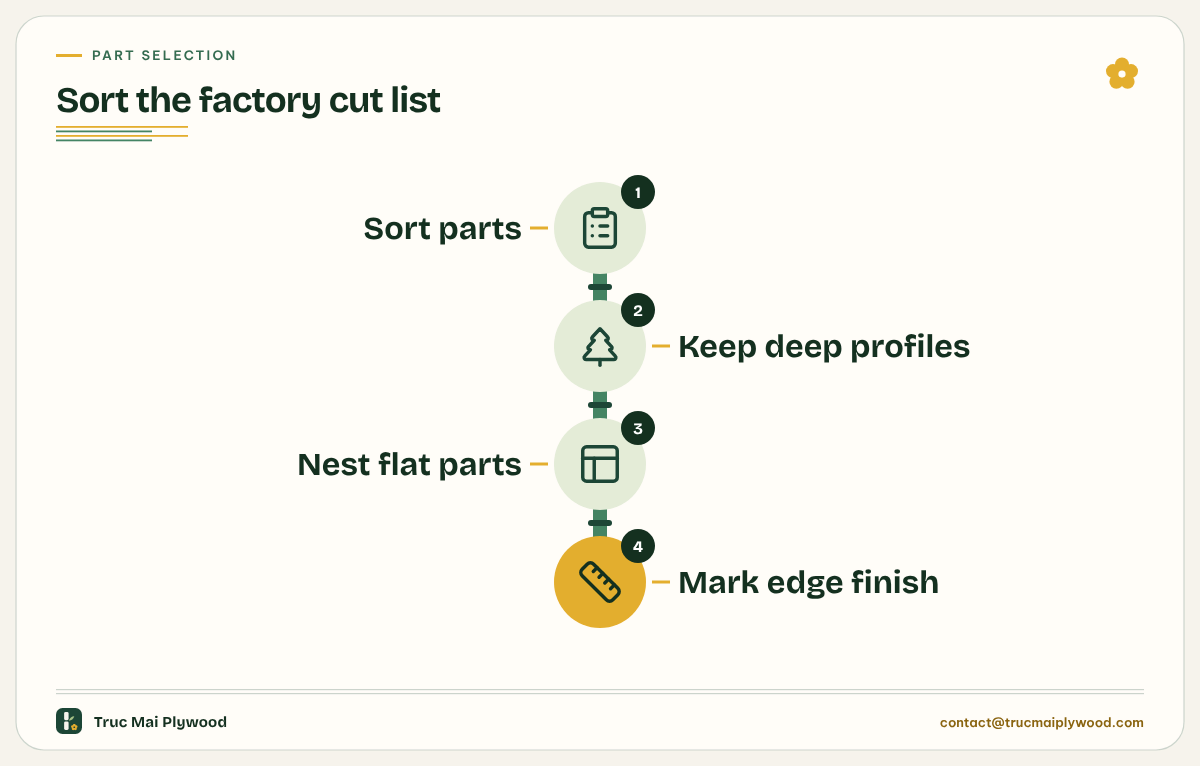
- Sort the cut list into broad flat panels, narrow rails and shaped components.
- Keep parts requiring deep exposed timber profiles in the solid-pine group.
- Nest flat parts on the chosen plywood sheet format, allowing for saw kerf and face-grain direction.
- Mark which edges need lipping, banding or a visible plywood edge.
- Trial-assemble hardware and finish the sample before releasing the cutting programme.
Grain orientation also matters: a pine face may need to run vertically on a door and horizontally on a shelf to match the furniture design.
Truc Mai offers cut-to-size plywood panels with labels agreed from the buyer’s cut list. Common patterns include halves, thirds, quarters and six-piece cuts. The exact finished piece size follows the source sheet, saw kerf and approved cutting layout.
What does core species change in pine-faced plywood?
Core species changes weight, machining response and the volume a shipment can carry, even when every sheet has the same pine face. The 40HC loading guide compares the core options. A decorative surface should therefore be quoted with its core species stated explicitly.
Styrax is a lighter reference core in Truc Mai’s planning model, Acacia is intermediate and Eucalyptus is denser. A denser panel can alter handling and the freight-weight limit before the container is full. The core also affects how a cut edge looks after routing and how screws perform in a specific joint. Test the actual panel rather than treating species density as a substitute for a fastener test.
If the factory will expose a routed edge, request a representative cross-section. If it will apply banding, check the edge preparation and bonding process instead.
How many pine-faced plywood sheets fit in a 40HC?
The following figures are a 40HC planning model for plywood panels, not a shipment record. They cover the specified core, thickness and 1220 × 2440 mm sheet size. The model uses 18 packs for Styrax, 16 for Acacia and 15 for Eucalyptus, with packs about 1,000 mm high and a 28,000 kg planning payload. Reference densities are 500, 580 and 650 kg/m³ respectively. Sheets per pack are rounded down from pack height and capped by the planning payload; the carrier and route determine the booked load.
| Core | Thickness (mm) | Sheet size (mm) | Packs | Sheets/pack | Sheets | Volume (m³) | kg/sheet | Total kg | Weight-capped |
|---|---|---|---|---|---|---|---|---|---|
| Styrax | 12 | 1220 × 2440 | 18 | 83 | 1494 | 53.4 | 17.9 | 26680 | No |
| Acacia | 12 | 1220 × 2440 | 16 | 83 | 1328 | 47.4 | 20.7 | 27510 | No |
| Eucalyptus | 12 | 1220 × 2440 | 15 | 80 | 1200 | 42.9 | 23.2 | 27860 | Yes |
| Styrax | 15 | 1220 × 2440 | 18 | 66 | 1188 | 53.0 | 22.3 | 26520 | No |
| Acacia | 15 | 1220 × 2440 | 16 | 66 | 1056 | 47.2 | 25.9 | 27350 | No |
| Eucalyptus | 15 | 1220 × 2440 | 15 | 64 | 960 | 42.9 | 29.0 | 27860 | Yes |
| Styrax | 18 | 1220 × 2440 | 18 | 55 | 990 | 53.0 | 26.8 | 26520 | No |
| Acacia | 18 | 1220 × 2440 | 16 | 55 | 880 | 47.2 | 31.1 | 27350 | No |
| Eucalyptus | 18 | 1220 × 2440 | 15 | 53 | 795 | 42.6 | 34.8 | 27690 | Yes |
| Styrax | 21 | 1220 × 2440 | 18 | 47 | 846 | 52.9 | 31.3 | 26440 | No |
| Acacia | 21 | 1220 × 2440 | 16 | 47 | 752 | 47.0 | 36.3 | 27270 | No |
| Eucalyptus | 21 | 1220 × 2440 | 15 | 45 | 675 | 42.2 | 40.6 | 27430 | Yes |
These are panel-only model figures. A final load plan also accounts for packing material, actual weighed sheets and the carrier’s payload allowance. Use the 40HC loading guide when comparing a heavier core with a lighter one. The practical purchasing lesson is that identical face veneer and thickness do not mean identical shipment utilisation.
Which finish works best on pine boards and pine plywood?
A clear finish suits both when natural grain is desired; a painted finish can reduce the importance of face colour variation. Compare the pine-faced plywood specification before approving a finish. Pine-faced plywood offers a selected decorative surface, while solid pine can expose natural timber through the edge and profile.
Pine’s earlywood and latewood can absorb colour differently, and knots may create darker areas. Prepare a sample using the exact sanding sequence, stain and coating that the production line will use. Approve the final colour on the finished sample rather than on bare timber.
Seal end grain and exposed plywood edges, then inspect the surface after primer. A smooth plywood face does not remove the need to prepare an edge band or lipping. On solid pine, check knots and resin features before choosing a primer system.
The face can also be supplied prepared for the buyer’s own coating process. In Truc Mai’s terminology, UV-ready means prepared surfaces for the buyer to coat; it does not mean the plywood arrives with a UV coating already applied. This distinction belongs on the purchase order.
How do moisture and adhesive choices affect the comparison?
For dry indoor furniture, specify an interior adhesive system and the required emission performance as separate lines. For humid interiors, select the plywood construction and tested bond performance for the service conditions; solid pine also needs a design that allows moisture movement.
The USDA Wood Handbook chapter on adhesives describes urea-formaldehyde adhesive as primarily used for interior panels and explains the higher moisture resistance of other resin systems. A resin name is useful information, but the panel’s tested bond performance is the purchasing criterion. Truc Mai’s default furniture option is UF glue at E0 emission; the order identifies the required glue and emission specification separately.
For European projects, EN 636 distinguishes dry, humid and exterior service conditions. Do not infer an EN 636 class solely from a marketing term such as “waterproof plywood”. The buyer should specify the intended exposure and obtain the relevant construction and test evidence.
In a kitchen carcass, the most exposed details may be sink cut-outs, unsealed edges and drilled penetrations. Design and finish those details deliberately. A more resistant adhesive cannot compensate for a poorly detailed assembly.
What compliance documents matter for imported furniture plywood?
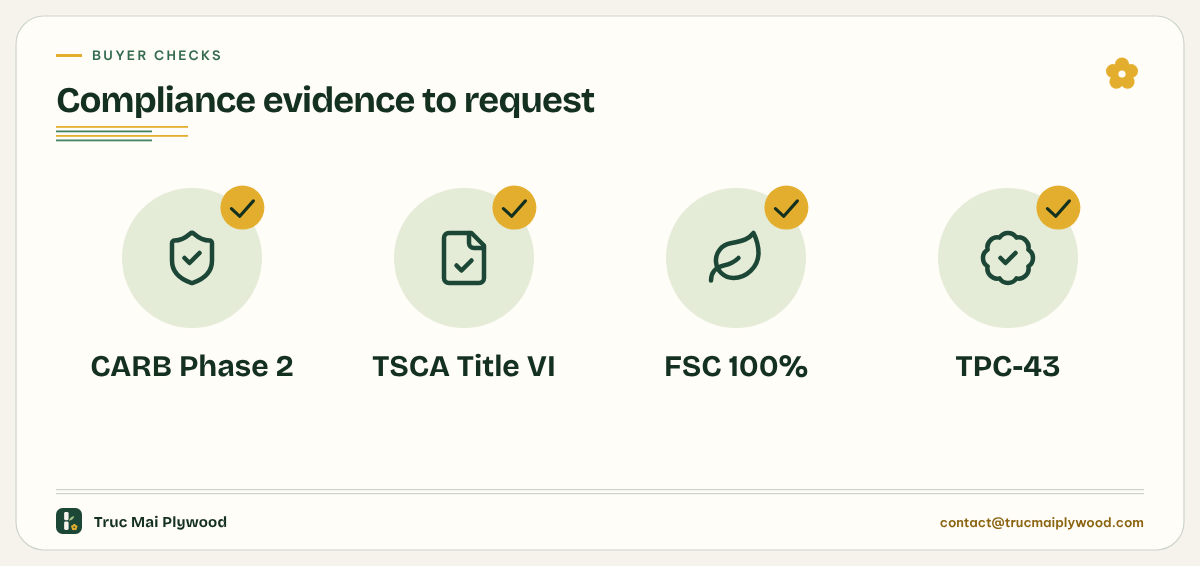
For US-bound regulated hardwood plywood, request the applicable TSCA Title VI certification and shipment information. The US Environmental Protection Agency’s 40 CFR Part 770 sets a 0.05 ppm formaldehyde limit for hardwood plywood with veneer core under the specified test framework.
Truc Mai holds CARB Phase 2 and TSCA Title VI third-party certification for veneer-core hardwood plywood in the 3–25 mm scope, certificate CARB/EPA 26053, mill ICTT-26053, through TPC-43. Its thicker catalogue panels sit outside that certificate scope. This is a specification distinction: the buyer should match the ordered thickness and panel type to the document.
For eligible FSC 100% orders, Truc Mai’s chain-of-custody licence is FSC-C196493 and certificate SA-COC-014545. The FSC claim belongs on the sales and shipping documents for eligible products. For EU import files, the mill supplies origin records and geolocation data for the core and face veneer so the importer can prepare the relevant due-diligence documentation.
The Phase 2 formaldehyde limits page provides a useful companion to a product specification.
How should a buyer compare suppliers and request samples?
Compare suppliers using the same physical sample, written construction and finished-part drawing. A quotation for “pine plywood” is not equivalent to a quotation for a specified pine face, named core, calibrated thickness and approved back grade.
A useful sample request includes the intended application, whether the edge will remain visible, the surface finish and the destination market. Ask the mill to identify the face species, core construction, adhesive and emission class on the sample label. Cut a test strip to inspect core gaps and joining, then machine the intended hardware or profile. Keep one approved piece as the reference for production acceptance.
Lay samples side by side, inspect grain and colour under the same light, measure thickness at several points and check the surface after the proposed finish. If the programme contains many identical doors, examine whether the face matching is suitable across the batch.
The sample ordering process and plywood RFQ checklist can turn the test result into a complete purchasing line. The supplier that makes the comparison easiest is often the one that provides the clearest specification and matching evidence.
What should the final order specification include?
Send a part-led specification: application, pine face and back grade, core species, adhesive and emission requirements, sheet thickness and size, packing, quantity and destination port. Include the approved face sample and the cutting drawing where finished blanks are required.
For a flat cabinet component, state the visible side, grain direction, edge treatment and finish. For a shelf, add support spacing and expected load so the buyer’s engineering team can approve the thickness and edge detail. For a profiled rail, keep solid pine as a separate material line rather than forcing every part into the plywood specification.
Truc Mai supplies furniture and commercial plywood from Ha Hoa, Phu Tho, Vietnam, with an annual manufacturing capacity of around 60,000 m³. The standard commercial minimum is one 40HC, and production is planned over 15–45 days after the deposit according to the agreed order. A mixed container can be discussed when the bill of materials contains different panel specifications.
Use the pine plywood product specification as the product starting point, then send the cut list, approved sample reference and delivery details for a quotation. The final purchase order should be precise enough that the cutting room, quality team and shipping team all work from the same description.
Send your specification to contact@trucmaiplywood.com or through the quotation form.
Questions buyers ask
Can pine-faced plywood be stained?
Yes. A pine veneer face accepts stain, although sample boards help reveal colour variation and grain contrast before finishing a production run.
Can I paint pine plywood?
Yes. Specify a sanded face, seal exposed edges and test the primer and topcoat on the actual panel construction.
Which panel is easier to edge-band?
Calibrated plywood provides a consistent edge for banding; solid pine can also be banded or left with its natural edge exposed. Match banding adhesive and edge preparation to the selected substrate.
Can I order a pine face with an Acacia core?
Yes. Truc Mai offers pine-faced plywood over Acacia, Styrax, Eucalyptus, Pine or combined veneer cores; name the required core in the order.
Is a pine veneer the same as solid pine?
No. Pine veneer is a thin decorative face bonded to a plywood core, whereas a solid pine board is timber throughout its thickness.
Should I specify both face and back grades?
Yes. Record a face/back grade pair against an approved sample so the visible surface and concealed surface are both defined.
Can a factory supply smaller cabinet blanks?
Yes. Truc Mai can cut standard plywood sheets into labelled panels to an agreed cut list, including halves, thirds, quarters or six-piece patterns.
Does a smooth face mean the core has no gaps?
No. Inspect a representative cut edge and agree the core construction separately from the face grade.
What documents should a US furniture importer request?
For regulated hardwood plywood, request the applicable TSCA Title VI third-party certification information and shipment documents for the specified panel configuration.
What should I send with a sample request?
Send the intended application, face appearance, core, thickness, sheet size, finish and delivery market so the sample represents the proposed order.