
In a poplar vs pine comparison, poplar-faced plywood offers a restrained, pale surface; for visible grain and a warm timber look, pine-faced plywood is the stronger design choice. Compare the faces on the same core, thickness and adhesive specification. Knot allowance, veneer matching and finish samples matter more than the species name alone.
Poplar vs pine: is poplar or pine plywood better for furniture?
Poplar-faced plywood is the practical starting point for painted furniture; pine-faced plywood is the better starting point when the timber grain should remain visible. That decision assumes the same core, thickness, adhesive and face preparation. A pine face is not automatically a stronger panel, and a poplar face does not automatically mean a poplar core.
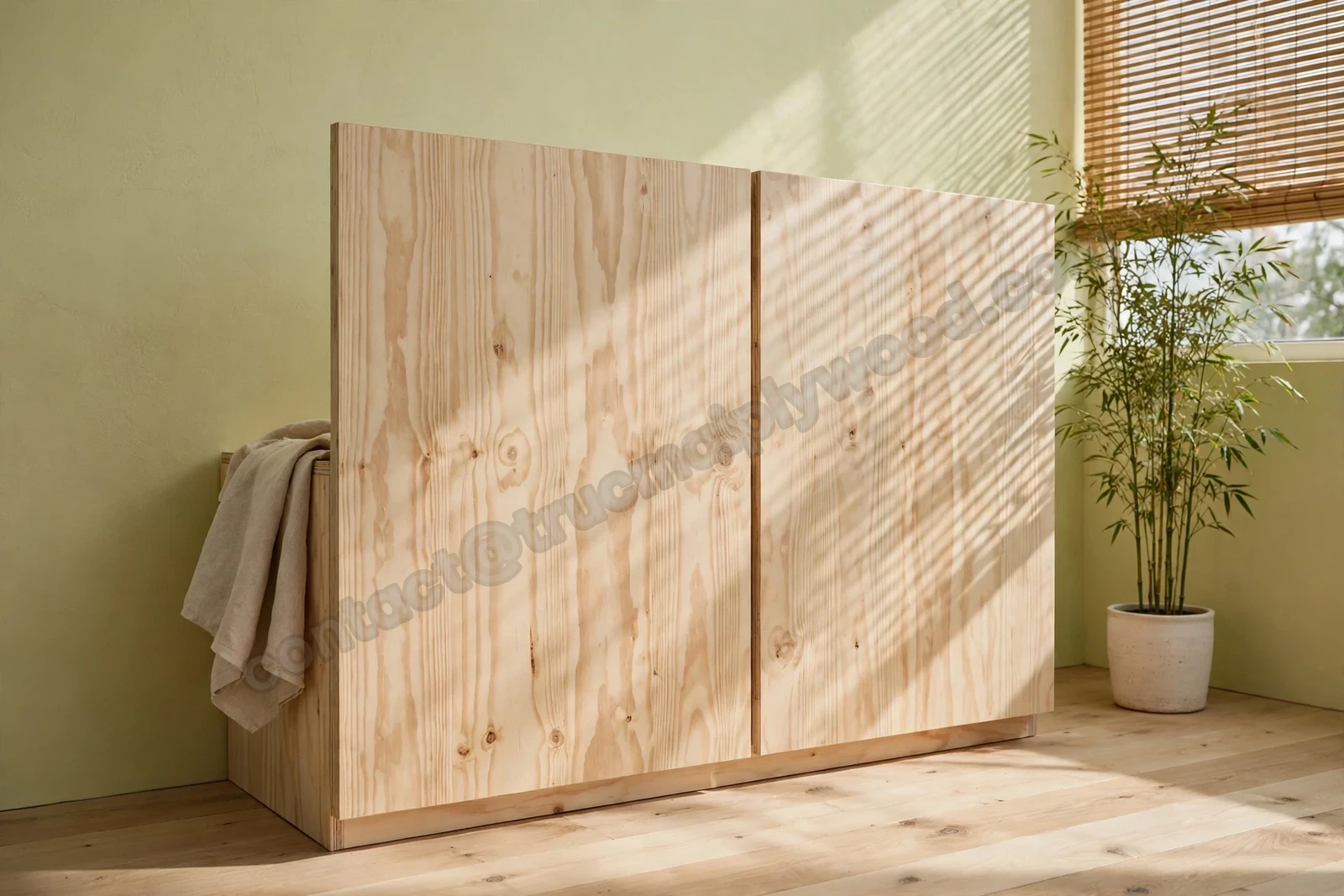
The buyer is choosing the visible veneer, not the entire panel structure. Poplar plywood gives designers a quiet pale base for cabinet doors, drawer fronts and painted shelving. Pine plywood gives a more expressive grain for shelves, shop fittings and furniture with a natural timber character. Both can be used for interior joinery when the underlying panel specification is appropriate.
| Buying criterion | Poplar face | Pine face | What to specify |
|---|---|---|---|
| Visual character | Generally pale, subdued grain | More pronounced growth-ring contrast | Approved front-face sample |
| Knots | Often selected for a quiet surface | Knots may be a design feature | Maximum knot size and location |
| Paint finish | Suits opaque finishes | Grain can remain apparent beneath paint | Primer and topcoat sample |
| Clear finish | Light, understated appearance | Stronger natural grain | Clear-coated control sample |
| Stain | Can show uneven colour uptake | Earlywood and latewood can colour differently | Finished stain sample |
| Panel weight | Set chiefly by the core | Set chiefly by the core | Core species and actual sheet weight |
| Face grade | Sample-based agreement | Sample-based agreement | Front/back grade pair |
For a cabinet run, compare poplar-faced and pine-faced sheets built on identical cores. The cabinet grade plywood guide explains how the face and inner construction work together.
Which is lighter, poplar or pine-faced ply?
Neither face guarantees a lighter plywood sheet: core species and thickness dominate finished panel weight. A face veneer is a thin surface layer, whereas most of the panel volume sits in the cross-laminated core. A seller describing a panel as “poplar plywood” might mean its face, its core or both, so the purchase specification must name each separately.
Truc Mai Plywood offers poplar and pine faces over Styrax, Acacia, Eucalyptus, Pine or combined-species cores. Its usual face veneer thickness is 0.2–0.5 mm. Holding the core and panel dimensions fixed makes the visual comparison meaningful; switching cores changes handling and shipping calculations substantially.
The US Department of Agriculture’s Wood Handbook, chapter on commercial woods distinguishes wood species by their physical characteristics and notes variation even within pine groups. A timber species name is therefore a poor substitute for weighing the actual finished sheet.
Ask for the actual sheet mass; calculate container loading from core density and arrangement, then check the carrier’s cargo limit. The container planning guide gives the method behind the following example.
Is pine plywood good?
Yes, pine-faced plywood is a sound choice for interior furniture where visible grain, a warm colour and a natural timber effect are wanted. It works particularly well for shelving, decorative wall panels, display furniture and doors intended for a clear or translucent finish. The result depends on how the face is selected, jointed, sanded and coated.
A clear finish highlights the growth-ring pattern and any knots. That can be attractive in rustic furniture but distracting in a minimal kitchen. Pine can also show local changes in absorption across earlywood and latewood. A sample panel with the intended finish is more informative than a species photograph.
Pine face veneer should be evaluated for open knots, loose knots, filled repairs, splits and colour matching. Write the allowable defects into the order rather than relying on an undefined “A” or “B” label. The US NIST PS 1-22 standard uses defined structural veneer grades, illustrating why a grade label must be tied to its actual specification; those structural grades are not a shortcut for specifying decorative faces.
Is poplar plywood cheap?
Poplar-faced plywood is often selected for cost-conscious painted furniture, but its value is determined by the complete panel construction rather than the face name. The useful comparison is an identical core, thickness, veneer grade, adhesive system, finish preparation and packing method. A smoother face can reduce finishing work; a more expensive face can still make sense when it prevents rejected parts.
For opaque furniture finishes, poplar’s restrained figure is a useful starting point. A buyer may instead choose bleached poplar plywood when a more uniform light appearance is required. The approved sample should show the intended coating, because a pale uncoated face is not the same as a finished painted cabinet.
A factory quotation should separate face specification from core construction. If two quotations differ in sanding, veneer thickness or inner ply joining, a direct comparison of their headline product names hides the important manufacturing differences. See how plywood is priced for the specification factors behind a quote.
What does “pine-faced” or “poplar-faced” actually mean?
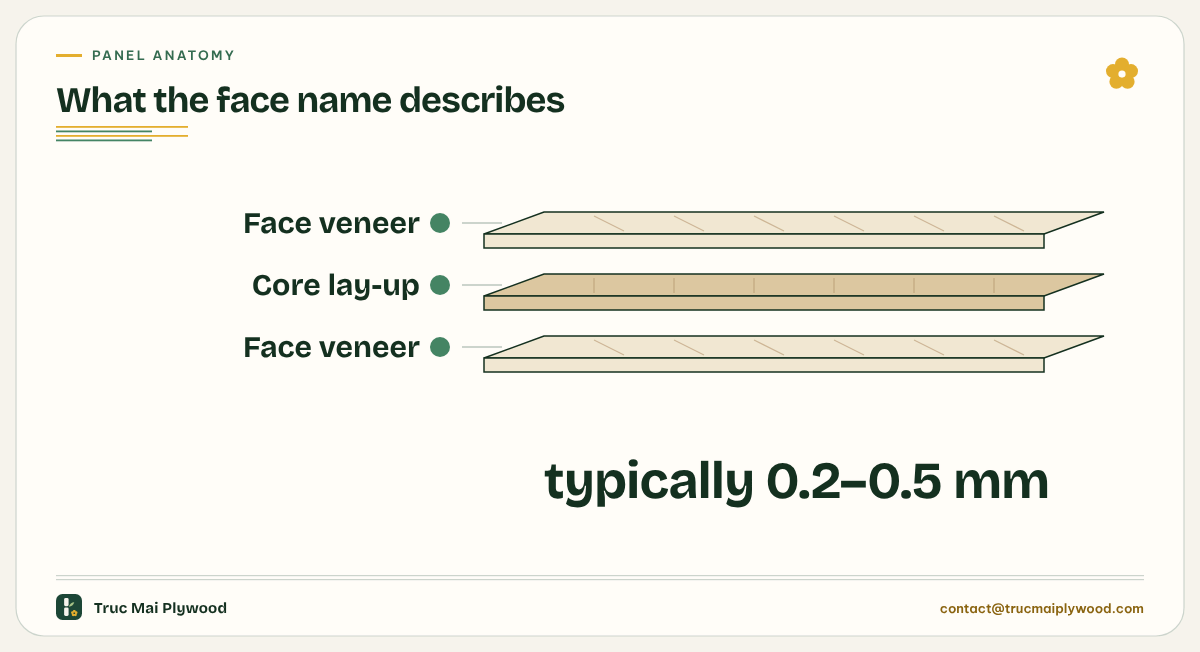
A face is the visible outer veneer, typically 0.2–0.5 mm on Truc Mai panels; the core is the inner lay-up that provides most of the thickness. The back veneer is another specified surface, often with a different appearance grade. Calling a panel “pine plywood” without saying which layers are pine leaves the buyer with an incomplete specification.
Furniture panels are assembled from cross-oriented veneers and bonded under pressure. The face governs appearance and finishing response, while the core arrangement influences stability, machining and fastener behaviour. A stitched core can help keep inner veneers aligned and reduce open joints beneath a thin decorative surface.
Ask for the face species, back species, core species and inner joining method as separate lines. That information makes a production sample repeatable and helps a purchasing team compare the next shipment with the first.
How should knots be graded on pine faces?
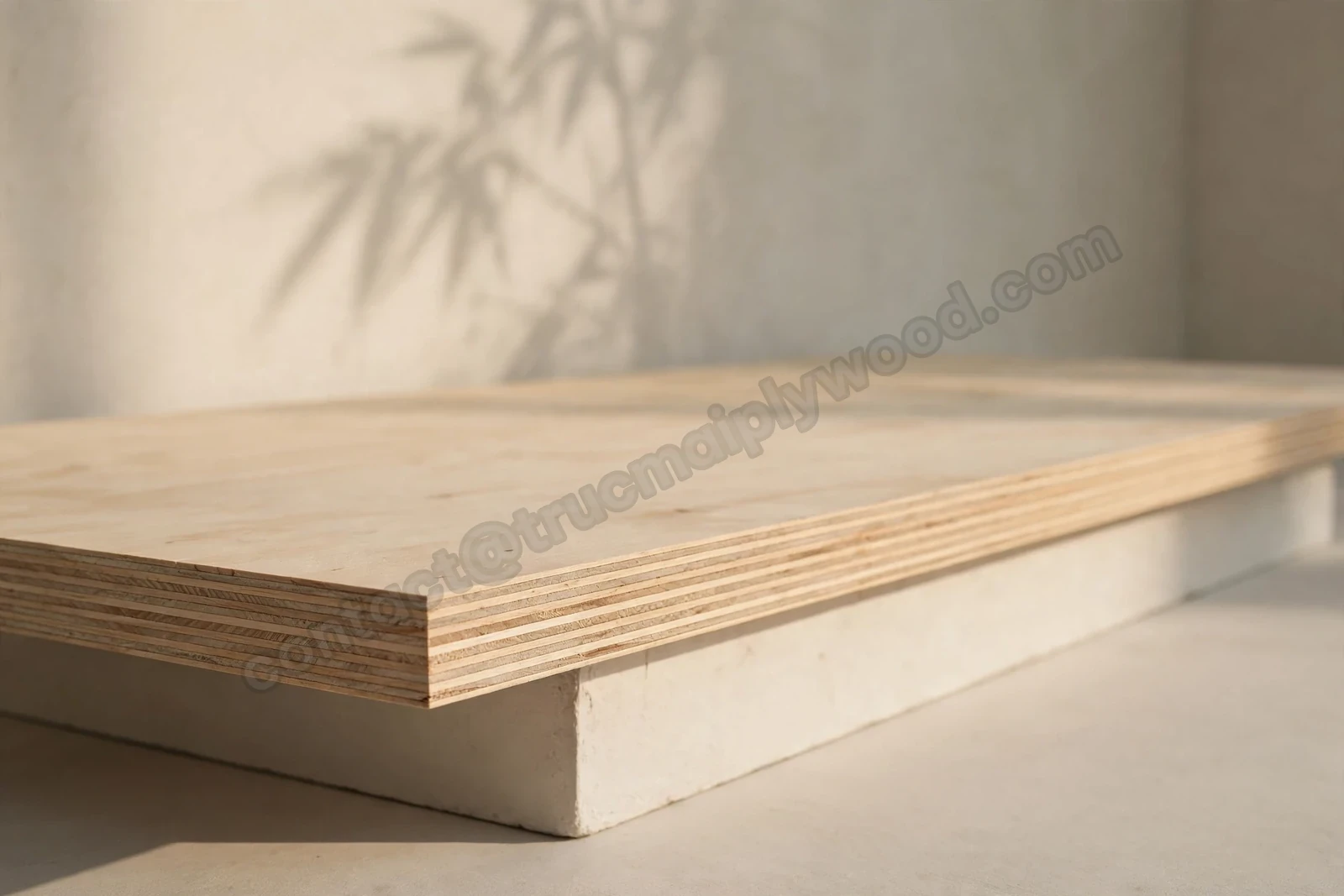
Grade knots by soundness, diameter, number and position, then approve a physical reference panel. A sound knot near the centre of a shelf may be acceptable in a natural design; a loose knot beside a hinge cup is a different manufacturing risk. Knot rules belong in the face specification, not in a vague instruction to supply “good quality”.
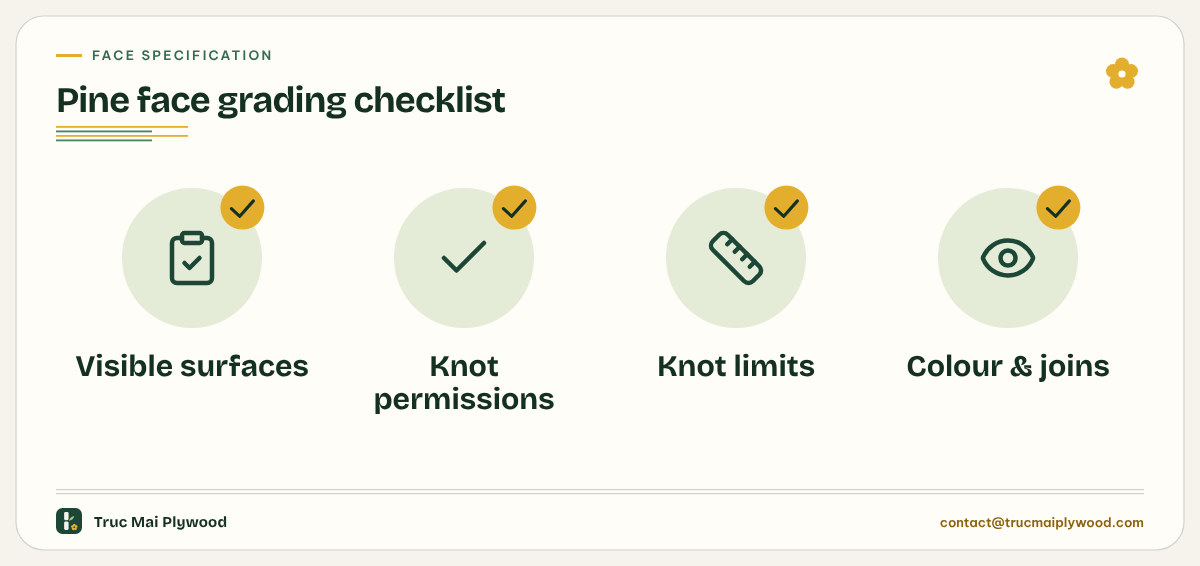
- Mark the visible furniture surfaces on a drawing.
- State whether sound knots, filled knots and knot holes are permitted.
- Define the largest acceptable knot and its distance from machined edges.
- Agree the acceptable colour variation and veneer joins.
- Sign off a representative finished sample for production comparison.
The same logic applies to poplar: even a visually quiet veneer can contain colour bands, repairs and joints. A front/back grade pair should identify which side will be seen after assembly.
Which face takes paint more evenly?
Poplar is usually the simpler visual base for an opaque painted cabinet, provided the face is properly sanded and primed. Pine’s stronger growth-ring contrast can remain visible through a thin coating system. Neither species eliminates the need to test primer adhesion, surface absorption and the final sheen.
Run the same primer, sanding sequence and topcoat on two finished plywood samples. Inspect them under the lighting used in the final installation. Check whether grain telegraphs through the coating, whether joints remain visible and whether edge finishing is acceptable.
The USDA Wood Adhesives chapter explains how surface condition and moisture influence bonding. Those manufacturing principles reinforce the value of controlling veneer preparation before applying subsequent finishes.
What happens under clear lacquer or stain?
Pine produces the more prominent natural grain; poplar produces the quieter pale surface. A clear lacquer often makes both grain and repairs more noticeable. Stain can exaggerate local differences in absorption, so the target colour should be approved on the actual veneer and coating system.
A stained pine door may look deliberately varied across its width. A stained poplar panel may need extra colour control where the face includes darker natural streaks. Do not approve a small loose veneer strip and assume the same appearance across a full door: inspect a large finished sample and the agreed face matching pattern.
For repeated cabinet fronts, photograph the approved sample beside a neutral colour reference and retain the physical panel. Written notes should describe what variation is acceptable across a production run. Compare the finished sample with bleached poplar plywood when a paler appearance is required.
How do core and glue affect the comparison?
Specify core and adhesive independently of the decorative face. A buyer can order the same pine face on different cores, with different sheet weights and machining behaviour. Likewise, a poplar face can be used on a panel built for dry interior use or on a separately specified moisture-resistant construction.
Truc Mai’s furniture/interior build typically uses an A-grade stitched core and sanded faces. The standard interior adhesive is UF glue at E0 emission, with the adhesive and emission requirement written as separate order lines. A moisture-resistant adhesive option is a distinct specification decision.
The USDA adhesive performance reference describes urea-formaldehyde adhesives as predominantly interior-panel systems with limited wetting resistance. Do not infer water resistance or emission performance from the face species. State the application and request the relevant tested panel configuration.
Which dimensions and surface tolerances should buyers request?
Specify the finished sheet format, nominal thickness and calibrated surface requirement before discussing the veneer. Common Truc Mai sheet formats include 1220 × 2440 mm, 1220 × 2280 mm and 1250 × 2500 mm. The standard thickness range is 3–40 mm; the final thickness tolerance is agreed by order, with ±0.3 mm available for sanded and calibrated furniture panels.
For cabinet nesting, the usable face area and trimming allowance matter as much as the nominal size. A grain-direction requirement may reduce the number of doors cut from a sheet. Indicate the intended grain orientation on the drawing, particularly where adjacent doors must visually match.
The mill can supply labelled cut-to-size pieces. A sheet can be divided lengthwise into halves, into thirds or into quarters or six pieces according to an agreed cut list. Send exact piece dimensions and label positions rather than assuming that a nominal division automatically allows for saw kerf. The cut-to-size panel page explains this ordering option.
How do container calculations change with the core?
A heavier core reduces the number of panels that fit within a cargo-weight planning limit, even when the face is unchanged. The table below reproduces every supplied planning-model row for 1220 × 2440 mm panels; it is a core comparison, not a separate pine-versus-poplar face test.
Model basis: 40HC, panels only; Styrax 18 packs, Acacia 16 packs, Eucalyptus 15 packs; pack height 1,000 mm; sheets per pack rounded down from pack height divided by thickness, then capped by a 28,000 kg planning payload. Reference core densities: Styrax 500 kg/m³, Acacia 580 kg/m³, Eucalyptus 650 kg/m³. The carrier and route determine the applicable cargo limit.
| Core | Thickness (mm) | Sheet size (mm) | Packs | Sheets/pack | Weight-capped | Sheets | Volume (m³) | kg/sheet | Total kg |
|---|---|---|---|---|---|---|---|---|---|
| Styrax | 12 | 1220x2440 | 18 | 83 | No | 1494 | 53.4 | 17.9 | 26680 |
| Acacia | 12 | 1220x2440 | 16 | 83 | No | 1328 | 47.4 | 20.7 | 27510 |
| Eucalyptus | 12 | 1220x2440 | 15 | 80 | Yes | 1200 | 42.9 | 23.2 | 27860 |
| Styrax | 15 | 1220x2440 | 18 | 66 | No | 1188 | 53.0 | 22.3 | 26520 |
| Acacia | 15 | 1220x2440 | 16 | 66 | No | 1056 | 47.2 | 25.9 | 27350 |
| Eucalyptus | 15 | 1220x2440 | 15 | 64 | Yes | 960 | 42.9 | 29.0 | 27860 |
| Styrax | 18 | 1220x2440 | 18 | 55 | No | 990 | 53.0 | 26.8 | 26520 |
| Acacia | 18 | 1220x2440 | 16 | 55 | No | 880 | 47.2 | 31.1 | 27350 |
| Eucalyptus | 18 | 1220x2440 | 15 | 53 | Yes | 795 | 42.6 | 34.8 | 27690 |
| Styrax | 21 | 1220x2440 | 18 | 47 | No | 846 | 52.9 | 31.3 | 26440 |
| Acacia | 21 | 1220x2440 | 16 | 47 | No | 752 | 47.0 | 36.3 | 27270 |
| Eucalyptus | 21 | 1220x2440 | 15 | 45 | Yes | 675 | 42.2 | 40.6 | 27430 |
Read the table by holding thickness fixed and moving across the three core types. It demonstrates why an importer should not choose a face veneer on the assumption that its name determines the container yield. Actual sheet weights and packing materials are checked for the shipment plan.
What should a sample approval contain?
Approve the face, core, finish and machining result on one labelled reference panel. Loose veneer swatches do not show how the veneer behaves after sanding, bonding, cutting and coating.
Request a pair built to the same core specification. Check the front and back, cross-section, sanding marks, filled defects and the edge after machining. Apply the intended paint, stain or lacquer to both. Record the grade and sample reference on the purchase order.
New buyers can request free samples and arrange their courier. The sample ordering page covers the process. A reference sample should travel with a short written defect schedule so procurement and factory quality control judge the same result.
Which compliance documents belong with the order?
Choose documentation for the destination market and the exact panel build, not for the decorative veneer alone. For US-bound hardwood plywood within its certified scope, Truc Mai holds CARB Phase 2 and EPA TSCA Title VI third-party certification for veneer-core hardwood plywood in the 3–25 mm range. The US 40 CFR Part 770 sets the hardwood-plywood formaldehyde emission standard at 0.05 ppm under its specified testing framework.
For FSC 100% products in the certified schedule, the chain-of-custody claim is recorded on the relevant sales documents. The mill also supplies EU due-diligence information covering origin records and geolocation files for both core wood and face veneer. These records help importers connect the decorative face choice to the correct material-origin file set.
If the face species or its source changes, check that the origin file and the approved veneer sample still describe the same order. The face veneer origin files guide sets out the document categories.
How should buyers compare two factory quotations?
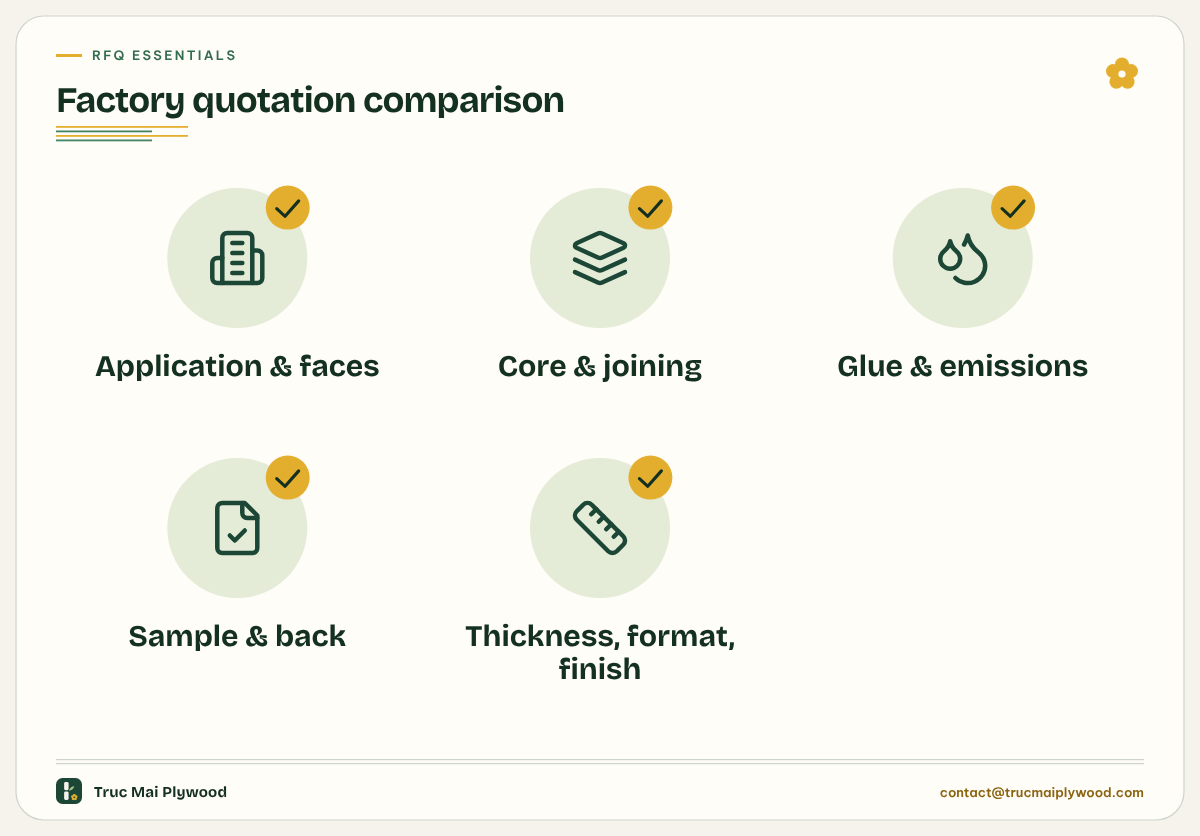
Send both suppliers one identical bill of specification and compare the returned constructions line by line. A difference in veneer selection or core joining can matter more than the word “pine” or “poplar” at the top of the offer.
- Name the furniture application and visible surfaces.
- Fix the core species and joining requirement.
- Specify the adhesive system and emission requirement separately.
- Attach the approved pine or poplar face sample and back grade.
- State thickness, sheet format, machining and finish preparation.
- Define packing, labels, quantity and destination port.
Compare the sample against the order specification before treating an alternative as equivalent. The plywood RFQ checklist provides a reusable structure for this request.
What should go into the first purchase order?
Write the selected face as one line in a complete manufacturing specification. State whether the order is for painted cabinet doors, clear-coated shelving or another furniture component; then give the core, adhesive and emission requirements, face/back grade pair, sheet dimensions, surface preparation and packing plan.
For a first order, include the approved reference sample number and a cutting drawing where parts are pre-cut. Mark grain direction and which face is outward on the finished product. Include quantity and destination port so the mill can prepare the appropriate production and shipping documents.
Request a quotation using the supplier specification checklist and attach the two finish samples if the face choice is still open. The decision then rests on a comparable panel and an agreed appearance standard rather than an ambiguous species label.
Send your specification to contact@trucmaiplywood.com or through the quotation form.
Questions buyers ask
Can pine veneer be stained dark?
Yes. Prepare a sample with the intended stain and topcoat because earlywood and latewood can absorb colour differently.
Can poplar veneer be left clear coated?
Yes. A clear coat retains the pale appearance but makes natural colour variation and veneer joints more visible.
Do face veneer species determine plywood screw holding?
No. Core construction, panel thickness, screw geometry and edge distance are the main specification points for fastener performance.
Are pine knots acceptable on cabinet doors?
Knots are acceptable when the approved face sample and written grade allow them; specify maximum size, soundness and placement for visible doors.
Is bleached poplar the same as engineered veneer?
No. Bleached poplar is a treated natural veneer, while engineered veneer is reconstructed for a more controlled visual pattern.
Can I request different faces on the front and back?
Yes. Specify the front and back veneer grades separately, together with any balancing requirements for the finished panel.
What panel size works for European cabinet production?
1250 × 2500 mm is a common European sheet format; 1220 × 2440 mm is another available format. Select the size from your nesting layout.
Should I approve a finished panel or a loose veneer sample?
Approve a finished panel with the intended core and coating system so the sample shows grain, joints and surface preparation together.
Does FSC certification apply to every face option?
FSC 100% applies to eligible products in the certified scope and is identified on the relevant sales documents. Check the exact product claim on the order paperwork.
Can sheets be supplied already cut and labelled?
Yes. Send the cutting diagram, piece dimensions and labels with the sheet specification for a cut-to-size quotation.