
Plywood price in philippines quotations starts with the sheet specification, not a single national rate. Ordinary, laminated and cabinet-grade panels carry different faces, cores and thicknesses. Local shops sell individual sheets; a Vietnamese mill quotes a container against a written specification. Compare both on the same delivered, usable-sheet basis.

What does plywood price in philippines mean for a buyer?
Three details define a plywood quotation in the Philippines: the sheet, purchase quantity and delivery point. A hardware-store ticket normally describes an individual board; a wholesale offer can cover bundles; an overseas factory quotation covers a specified shipment under a named trade term. Those are different commercial units.
Start by writing the application on the enquiry: cabinet carcass, decorative door, shop fitting, wall lining or packing. Then name the face, core, adhesive, emission requirement, nominal thickness, finished dimensions and order quantity. A supplier can otherwise substitute a different construction while keeping the same product description.
The method for comparing plywood quotations begins with these physical details. A useful comparison sheet has one row per offer, the same destination and a separate column for local delivery or international freight. This lets a buyer decide whether convenience, finish quality or a repeatable factory specification matters most.
| Purchase route | Unit on the offer | What the buyer receives | Main comparison question |
|---|---|---|---|
| Local hardware | Individual sheet | Available stock and local collection or delivery | Is the displayed sheet the required construction? |
| Local distributor | Bundle or project lot | Selected stock with local distribution | Are all bundles from the same approved specification? |
| Overseas manufacturer | Factory shipment | Production against an agreed specification | What is the landed cost per accepted sheet? |
Where can current plywood prices in the Philippines be checked?
Two sources for current Philippine plywood quotations are local retailers and distributors; request dated offers for the specified thickness and collection or delivery location. There is no single checkout figure covering every ordinary, decorative and laminated panel throughout the country. A dated supplier quotation is more useful than an undated list because it identifies the stock being sold.
For a local purchase, obtain the exact product code, size, thickness and finish from a retailer or distributor. Request the same information from another outlet and compare collection with delivered terms. Record the date and city, especially when the project has separate deliveries to Luzon, Visayas or Mindanao.
For a factory shipment, obtain a pro forma specification and a named port basis. The buyer then adds freight, insurance where applicable, import charges, customs clearance, local handling and inland transport. Keep each charge in its own line rather than calling the factory offer a Philippine delivered price.
The single-container costing workflow helps buyers collect those inputs before comparing a local purchase with a shipment. Ask both channels to quote the same approved face grade and tolerance; otherwise the comparison only measures different products.
How is laminated plywood price philippines compared with ordinary plywood?
Yes, laminated plywood requires a separate quotation from ordinary plywood when the decorative surface is an additional specified component. In Philippine trade usage, laminated may describe melamine-faced plywood, high-pressure laminate (HPL) on plywood, or another overlay. Those surfaces are not interchangeable.
For a cabinet programme, first decide whether the decorative layer must arrive factory-applied or whether the workshop will laminate a bare panel. Factory-facing can reduce downstream handling, while locally applied laminates allow a shop to choose its own colour and edge treatment. The comparison needs the same finished appearance, not just the same plywood thickness.
A melamine-faced panel needs a colour or pattern code, face/back arrangement and edge-treatment plan. HPL adds a laminate specification, surface texture and intended use. A bare UV-ready panel has sanded, prepared faces for the buyer’s own coating; it is a different product from a factory-finished decorative sheet.
For a like-for-like request, use the melamine-faced plywood specifications as a starting point and identify which surface is visible. Include any matching offcuts and edge-banding requirement in the cutting list. The cost of an attractive face is wasted if the job calls for an opaque coating and the buyer could have specified a simpler finish.
What is the 1/2 ordinary plywood price philippines specification?
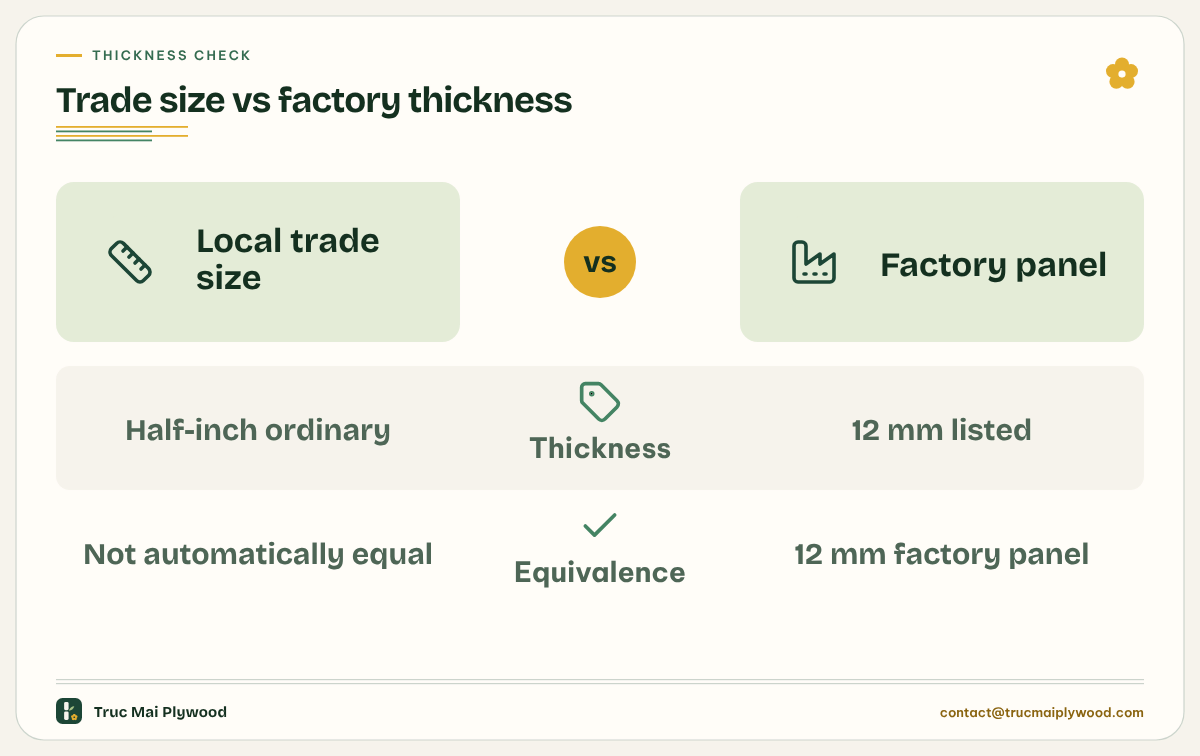
12 mm is a listed factory thickness to compare against a locally advertised half-inch ordinary plywood sheet; specify the actual thickness in millimetres. A seller’s nominal 1/2-inch description is a trade size, while a cabinet drawing needs the finished panel thickness. Ask for the measured dimension before using the board in a groove, hinge layout or machine programme.
An ordinary plywood quotation should identify whether the sheet is unsanded, lightly sanded or calibrated. These surfaces change the amount of preparation a cabinet shop must perform. A loose-laid commercial core and a stitched furniture core also produce different edge appearances and machining behaviour. A sheet that looks acceptable at the face can reveal gaps after a narrow strip is cut.
When comparing half-inch stock, request an edge photograph, a small cut sample and the agreed thickness tolerance. The core species matters because it changes weight and may change how the panel behaves under cutting and handling. For repeat orders, the buyer should approve one physical sample and specify the face/back grade pair on the order.
The factory range includes 12 mm as a listed thickness, but that does not make every locally advertised half-inch sheet equivalent to a 12 mm factory panel. Quote and machine to the written millimetre dimension.
How should a buyer compare plywood price 1/2 offers?
Compare plywood price 1/2 offers by the actual finished thickness, sheet area and usable cut yield. Two sheets can have the same nominal trade label but different usable material after trimming, rejected faces and cutting allowances. A cabinet maker purchasing for a repeated cut list should compare completed components, not merely full boards received.
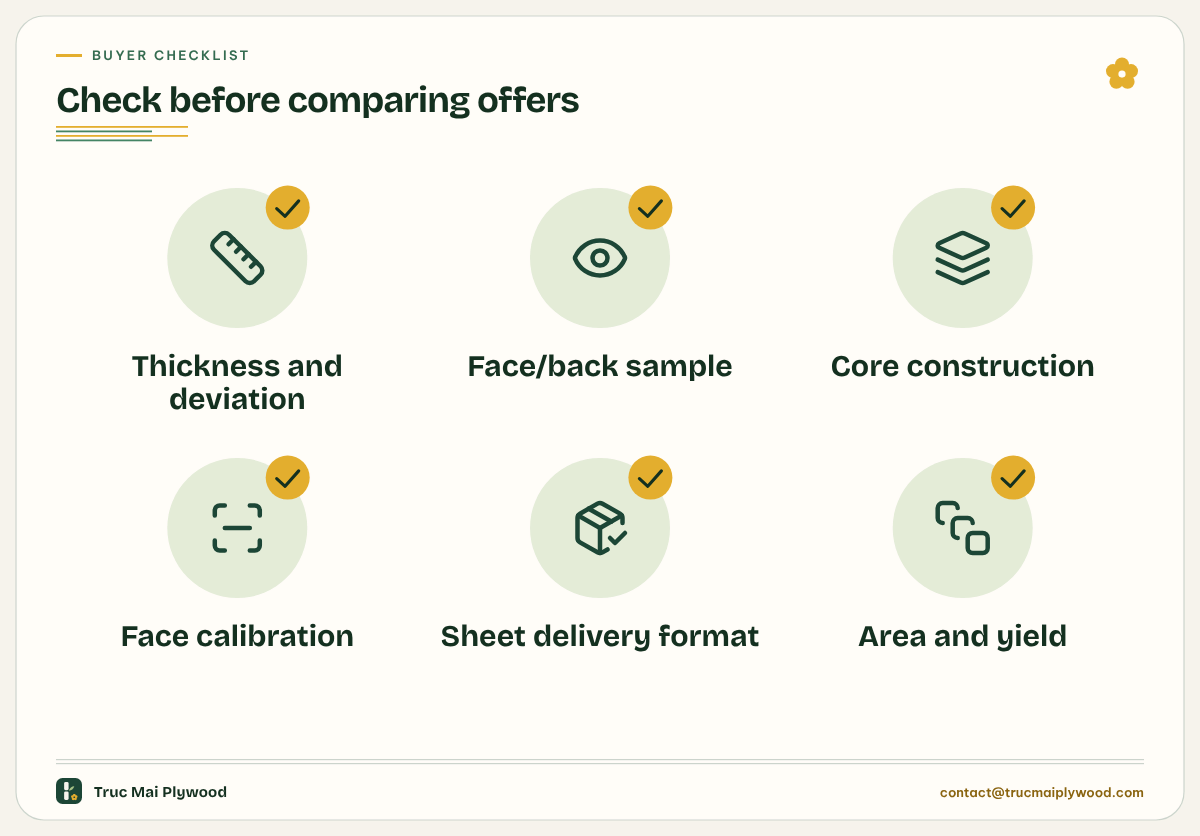
The most useful procedure is to send each seller one drawing and request the same sample acceptance criteria:
- Identify the actual thickness and the allowed deviation on the order.
- Specify face and back appearance against an approved sample.
- Ask for the core construction and whether the faces are calibrated.
- Confirm whether sheets arrive whole or labelled for the cutting plan.
- Count the accepted components produced from the sample sheet.
A shop with its own CNC nesting may prefer full sheets. A buyer assembling standardised furniture parts may prefer the mill to cut and label panels. Those decisions shift handling and scrap between supplier and buyer. They should be recorded beside the quotation, not hidden inside a broad description such as commercial ply.
Which details matter for 1/4 ordinary plywood price philippines?
1/4-inch ordinary plywood is usually purchased for thin interior applications such as furniture backs, drawer bottoms and light lining. The decisive specification is the measured thickness and the number and quality of veneers, rather than the fractional name alone.
Thin panels need attention to flatness, face damage and the intended fastening method. A back panel captured in a groove has different requirements from a free-standing partition. Request a sample in the actual support arrangement and inspect the edge after cutting. A clean surface does not reveal whether the inner veneers are sound.
Truc Mai’s 3–5 mm thin panels use five plies; its 6 mm construction is specified per order. That distinction matters when comparing a thin factory panel with locally stocked boards carrying a fractional thickness label. Do not infer the ply count from the name on the rack.
For interior joinery, ask whether the sheet will be painted, overlaid or left with a visible wood face. Surface preparation can matter more than decorative veneer when the finished board sits behind a cabinet. Specify the intended use first and select the lowest-complexity construction that meets it.
How can plywood price 1/4 quotations be compared fairly?
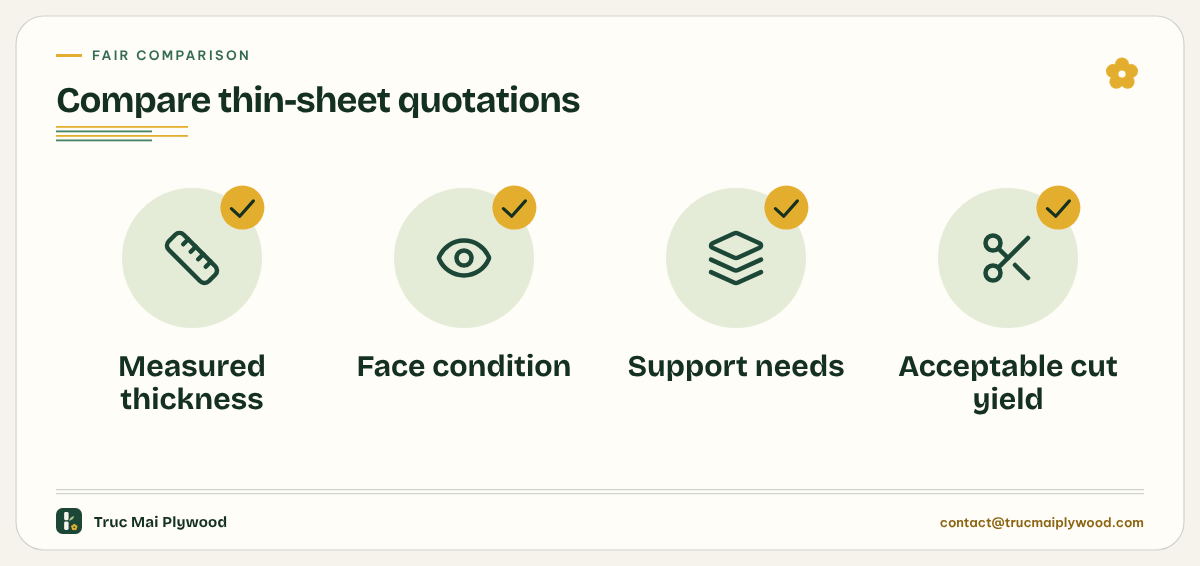
Compare plywood price 1/4 quotations on measured thickness, face condition, support requirements and the number of acceptable parts cut from each sheet. Thin plywood is often bought for large-area backing, where minor defects become visible only after a panel is fixed to a frame.
Inspect the sample under the same lighting as the finished job. Look for veneer overlaps, open joints, dents and patches that would show through paint or a thin decorative layer. Ask the supplier to show the face and back separately, rather than using a single product photograph for both.
For a recurring order, include the orientation of the face grain and the direction of the cuts. If panels will be assembled in a repeated run, labelled cut pieces can reduce sorting at the workshop. A cut-to-size plywood option lets the buyer specify the pattern by email: halves, thirds, quarters or six pieces from a standard sheet, with the final dimensions agreed against the cut list.
The acceptance standard should be written before the order. It is far easier to compare two actual samples than to reconcile vague descriptions after delivery.
What does ply board price in philippines include?
No, a plyboard offer does not always describe plywood; the first detail to establish is the exact material construction. Ask whether the board has a veneer core, a block core or another substrate, and whether the quoted surface is bare wood or a factory-applied overlay.
This matters for cabinets because the edge of the board may be exposed at hinges, shelf pins and cutouts. Plywood with a stitched veneer core, a different plyboard construction and a decorative overlay can look similar from the front while requiring different machining settings. Request an edge view and a material specification before approving substitutions.
Use a short comparison record for every line item: substrate, face material, thickness, size, finish, grade, quantity and delivery condition. For an ordinary interior panel, record the glue system and emission requirement separately. The US Department of Agriculture’s Wood Handbook chapter on adhesives explains why adhesive selection and exposure conditions affect bonded wood performance; a decorative face alone does not identify the bond system.
A local board purchase is often the practical route for urgent replacements. Factory production becomes more relevant when many identical components need the same appearance and construction over successive orders.
How does fob hai phong plywood price philippines become landed cost?
No, FOB Hai Phong is not the final Philippine delivered amount; it is the factory-side export quotation basis. Under a comparable import costing, the buyer starts with the FOB shipment amount and separately adds the transport and destination charges applicable to the order. A local quotation can then be placed alongside the landed result.
A useful costing worksheet keeps the components distinct:
| Costing line | FOB shipment | Local-stock purchase |
|---|---|---|
| Panel specification | Factory purchase order | Stock item and grade |
| International sea freight | Add to landed calculation | Already upstream of local selling channel |
| Cargo insurance | Add where arranged by buyer | Check local seller’s delivery terms |
| Import duties and taxes | Assess under applicable classification | Reflected through local purchasing arrangements |
| Clearance and port handling | Obtain destination quotation | Usually outside the buyer’s direct handling |
| Inland transport | Port to warehouse or workshop | Shop or distributor to workshop |
| Usable sheets | Accepted quantity after inspection | Accepted quantity after inspection |
Use the FOB Hai Phong quotation explanation alongside the sea-freight costing method. The import comparison should use the same product and final warehouse location, rather than a factory amount on one side and a delivered local amount on the other.
For Philippine buyers considering a full 40HC, the sheet count matters. The following table preserves the factory planning-model figures for 6 mm, 1220 × 2440 mm panels; it is a planning calculation, not a loading record.
| Core | Packs | Sheets per pack | Sheets | Panel volume (m³) | kg per sheet | Panel weight (kg) | Weight-capped |
|---|---|---|---|---|---|---|---|
| Styrax | 18 | 166 | 2988 | 53.4 | 8.9 | 26680 | No |
| Acacia | 16 | 166 | 2656 | 47.4 | 10.4 | 27510 | No |
| Eucalyptus | 15 | 160 | 2400 | 42.9 | 11.6 | 27860 | Yes |
Planning basis: 40HC panels only; 18, 16 and 15 packs respectively, stacked to 1,000 mm. Sheets per pack are the pack height divided by thickness, rounded down and capped against a 28,000 kg planning payload. Reference densities are Styrax 500, Acacia 580 and Eucalyptus 650 kg/m³. The carrier and route set the permitted payload; packaging and actual sheet weights are checked in the final loading plan. For other dimensions, consult container loading by thickness.
How much is plywood in the Philippines in 2026?
For 2026 purchasing, the usable answer is a current, dated quotation for the exact plywood specification and destination. A single nationwide figure would combine ordinary, decorative, cabinet-grade and other boards that are not equivalent. Buyers should obtain separate offers for the product they actually need.
Likewise, US structural plywood standards should not be used as a substitute description for interior decorative plywood. The National Institute of Standards and Technology’s PS 1-22 covers structural plywood classifications, including bond and face grades. Its structural classifications do not turn an untested interior sheet into a structural product.
A buyer evaluating a furniture-panel supplier can also ask for the applicable emission documentation. For US-bound hardwood plywood with veneer core, 40 CFR Part 770 specifies the TSCA Title VI framework and the 0.05 ppm hardwood-plywood limit. That requirement is relevant to the specified US product and should not be used as a general Philippine retail price indicator.
What is the price of 4x8 plywood in the Philippines?
A 4 × 8 ft plywood sheet is the common 1220 × 2440 mm format; its price is determined by the specified construction and selling channel. To compare offers, state the exact millimetre dimensions, thickness, core and finish. A full sheet is the starting unit even when the workshop ultimately needs smaller components.
A furniture buyer may choose 1220 × 2280 mm for a shorter component programme or 1250 × 2500 mm for a European-format order. Those are different sheet formats and must be recorded separately. A quoted 4 × 8 sheet should never be silently replaced by a smaller sheet just because both are called standard plywood.
For cabinets, the cabinet-grade plywood selection guide helps identify face quality, edge condition and the construction appropriate for visible and concealed parts. A written plywood RFQ should include the destination port, finished dimensions, surface specification, core, emission requirement and expected order quantity.
Truc Mai Plywood manufactures furniture/interior and commercial plywood in Ha Hoa, Phu Tho, Vietnam. Its order discussions can cover calibrated faces, approved face/back samples, core choices and labelled cut-to-size pieces. The next useful step is to send the actual cabinet or panel cut list with the destination and request a specification-matched factory quotation. Before placing a deposit, follow the mill verification checklist.
Send your specification to contact@trucmaiplywood.com or through the quotation form.
Questions buyers ask
Is plyboard always the same as plywood?
No. Philippine sellers use plyboard for different sheet materials. Ask for the construction, veneer-core description and product photograph before comparing quotations.
Can a Philippine cabinet shop buy cut-to-size panels?
Yes. A buyer can specify labelled cuts from a standard sheet and send the cutting list with the order.
Which veneer should I specify for a visible cabinet door?
Specify the appearance sample and the face/back grade pair first. Birch-faced, engineered veneer and other decorative faces are distinct options.
What is the minimum factory order for a container?
Truc Mai Plywood's standard minimum order is one 40HC container. Mixed products can be arranged against an agreed packing plan.
Can different thicknesses share one shipment?
Yes. Mixed thicknesses can be packed in separate labelled bundles, with the total cargo weight and product count set on the packing plan.
What should a supplier's sample show?
Request a full-thickness edge, the finished face and back, and the agreed face-grade reference. Compare the sample with the written purchase specification.
Is an E0 description a glue type?
No. UF is an adhesive type; E0 is an emission designation that needs an identified test method and limit in the buyer's specification.
Does an FSC certificate automatically cover every sheet?
No. The product must be eligible for the FSC claim, and the seller's sales documents must identify the certificate code and product claim.
When is the balance normally paid on a factory order?
The stated factory terms are a 30% deposit and a 70% balance against the scanned bill of lading, by the agreed payment method.
What documents accompany an imported plywood shipment?
The shipment file normally includes an invoice, packing list, bill of lading and agreed origin and product documents. The importer checks the destination-specific requirements before shipment.