
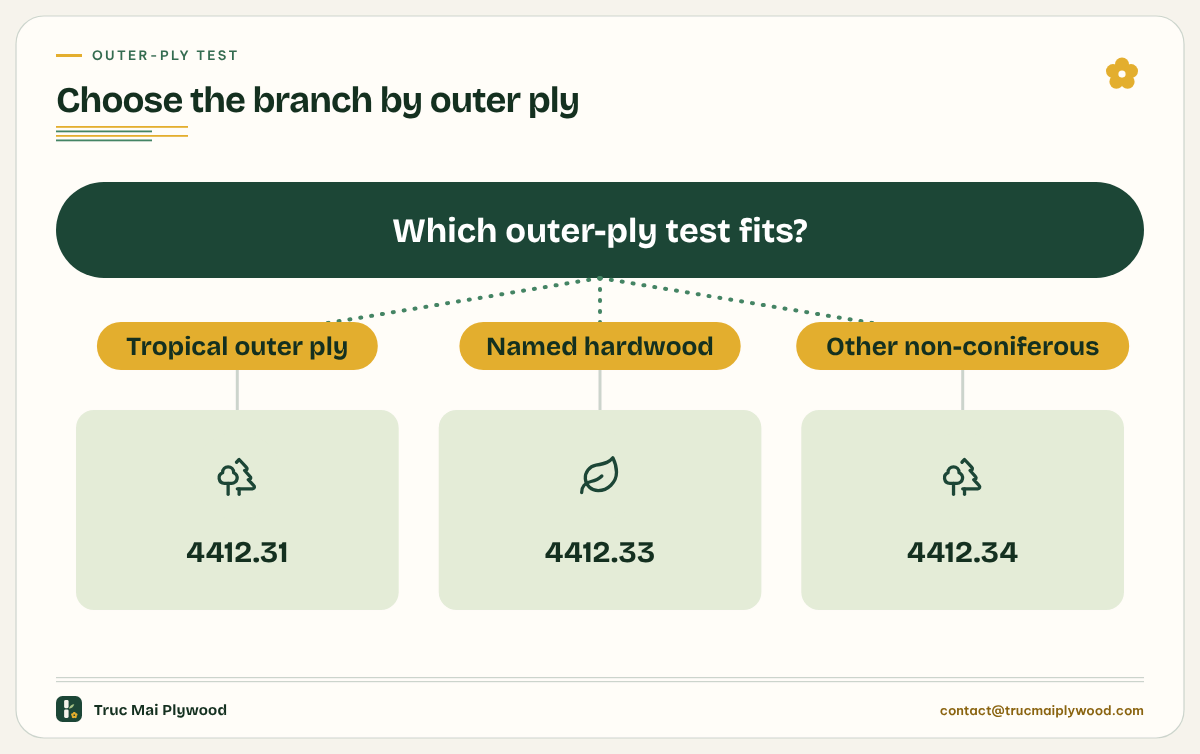
The plywood hs code begins with heading 4412, covering plywood, veneered panels and similar laminated wood. For ordinary veneer plywood, the six-digit branch follows the species of the outer plies: 4412.31 for listed tropical woods, 4412.33 for named hardwoods including birch and poplar, 4412.34 for other hardwoods and 4412.39 for coniferous faces. LVL has separate codes.
What is the HS code for plywood?
The Harmonized System heading for plywood, veneered panels and similar laminated wood is 4412. For ordinary plywood made solely of wood sheets, with every ply no thicker than 6 mm, the six-digit branch is 4412.31, 4412.33, 4412.34 or 4412.39, selected by the outer-ply species. The World Customs Organization’s Chapter 44 schedule sets out the international divisions.
For a shipment of Vietnamese furniture panels, describe the panel construction before choosing the suffix. A veneer-faced sheet and a laminated veneer lumber section can share heading 4412 while belonging to different six-digit branches. A face made of birch on a Vietnamese eucalyptus core is still birch-faced plywood; the core does not turn it into an all-birch panel.
Which plywood hs code matches each face veneer?
4412.33 covers ordinary veneer plywood with at least one outer ply of listed non-coniferous species, including birch, poplar and eucalyptus, provided the construction meets the 6 mm per-ply rule. The species test concerns the outer ply, not the internal core. For a product with a tropical outer ply, first check the separate 4412.31 category.
| Six-digit HS branch | Construction and outer-ply test | Illustrative panel description |
|---|---|---|
| 4412.10 | Bamboo plywood or similar bamboo laminated wood | Bamboo-based panel |
| 4412.31 | Ordinary plywood, each ply at most 6 mm, at least one outer ply of tropical wood listed in the Chapter 44 note | Qualifying tropical-veneer face |
| 4412.33 | Same ply construction, at least one outer ply of the specifically named non-coniferous species | Birch-, poplar- or eucalyptus-faced plywood |
| 4412.34 | Same ply construction, at least one outer ply of another non-coniferous species | A qualifying hardwood face absent from the named list |
| 4412.39 | Same ply construction, both outer plies coniferous | Pine on both outside surfaces |
| 4412.41 / 4412.42 / 4412.49 | Laminated veneer lumber, tropical / other non-coniferous / both coniferous outer plies | LVL section |
| 4412.51 / 4412.52 / 4412.59 | Blockboard, laminboard or battenboard, classified by outer ply | Lumber-core panel |
| 4412.91 / 4412.92 / 4412.99 | Other panels within heading 4412, classified by outer ply | Other laminated-wood construction |
The table follows the WCO HS 2022 nomenclature. A plywood sheet 18 mm thick can enter the ordinary plywood branch when its individual veneers meet the rule. Overall panel thickness and individual ply thickness answer different classification questions.
What is the HSN code for commercial plywood?
Commercial plywood uses HSN heading 4412 when the goods are plywood rather than a different board product. India’s Harmonised System of Nomenclature uses more digits beyond the international six-digit code, so an Indian import or tax document needs the relevant Indian tariff line. The words commercial plywood alone do not select that line.
For a commercial panel, request a build description showing whether it consists solely of veneers, whether each ply is at most 6 mm, and the wood species on each exposed face. A loose-laid or jointed inner core is a manufacturing description; it is not a replacement for the customs construction test. The order can use an AB core and a face/back pair without that grade label determining the tariff subheading.
Does furniture plywood use a different HS code?
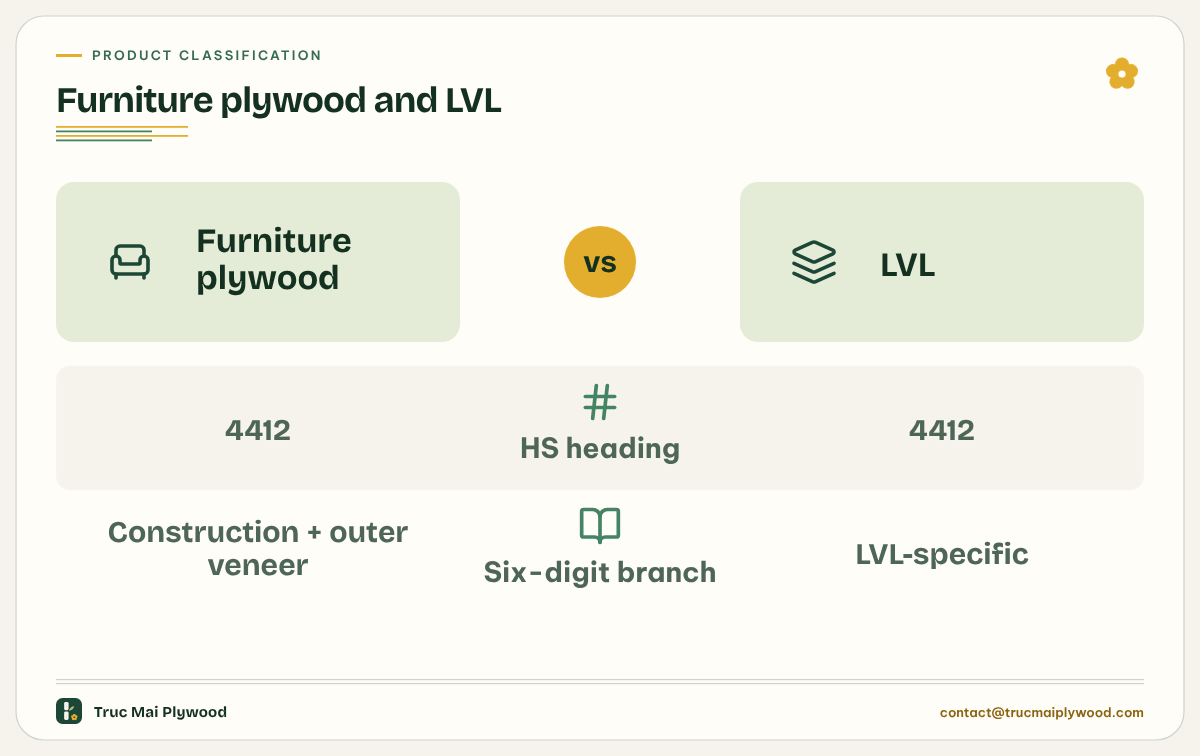
Furniture plywood supplied as plywood sheets uses heading 4412; the six-digit branch follows its construction and outer veneer. A cabinet factory’s intended use does not, by itself, create a separate furniture-plywood heading. The distinction is between a panel supplied as material and a finished furniture article classified under another heading.
A furniture manufacturer buying birch-faced plywood should record birch as the face species and the actual Vietnamese core separately. For engineered veneer panels, the veneer species and construction need to be identified rather than using the appearance name alone. This is especially useful for a repeat programme where the same colour or grain pattern is ordered across different core constructions.
Cabinet-grade, UV-ready, melamine-faced and HPL-faced are commercial descriptions. The customs review still begins with what the goods physically are. A surface treatment can call for closer examination of the tariff text; a buyer should send the actual coating or overlay specification with the panel section drawing.
HS code LVL: which subheading covers laminated veneer lumber?
Laminated veneer lumber (LVL) uses HS 2022 six-digit subheadings 4412.41, 4412.42 and 4412.49. The split is tropical outer ply, other non-coniferous outer ply and both coniferous outer plies, respectively. The WCO’s 2022 correlation table records the creation of the LVL-specific branches from the older classification.
Truc Mai offers non-structural LVL for furniture components, door and frame stock, bed slats and packing. The LVL sizes and sections page describes the order dimensions. For customs, supply a cross-section, the direction of the veneer grain, the outer species and a plain description of the intended component. Do not enter a normal plywood-sheet code simply because the product contains glued veneers.
Does the core species change the six-digit code?
No, not by itself within the ordinary 4412.31 to 4412.39 branch: the outer veneer species determines the species split after the construction test. A eucalyptus core beneath birch faces does not make the sheet eucalyptus-faced. Conversely, eucalyptus faces over a styrax core remain eucalyptus-faced for that split.
This matters at a mill that makes several core choices for the same visible finish. Truc Mai offers eucalyptus, acacia, styrax, pine and combined cores. A quotation may change the core for weight or cost planning while retaining the face/back specification. The buyer’s technical sheet should name both layers, so the customs description does not silently inherit a core species as the face species.
For a mixed-specification order, keep one row for each distinct outer-face and construction combination. If a buyer substitutes a face veneer after sampling, the commercial description and proposed classification should be revisited before shipping paperwork is prepared.
How do birch, poplar and eucalyptus faces classify?
4412.33 expressly names birch (Betula), poplar (Populus) and eucalyptus (Eucalyptus) among the qualifying outer-ply species. This gives buyers a clear branch for ordinary plywood built solely from wood sheets of no more than 6 mm per ply. The WCO heading text names the genera.
A birch face is a veneer identification, not proof that every internal ply is birch. The same distinction applies to bleached poplar and engineered poplar veneer. Where a face is reconstituted, record its wood species in the product description. An engineered appearance name alone does not tell the customs reviewer which botanical species was used.
For the eucalyptus-faced panel range, identify the face species separately from the core option and glue/emission specification. The latter two fields are essential to the commercial order but do not substitute for the WCO outer-ply test.
What about okoume, bintangor and other tropical faces?
4412.31 is the branch for ordinary plywood with at least one outer ply of tropical wood specified by the Chapter 44 subheading note. A supplier’s description of a face as tropical is not enough: the botanical identity must match the listed species. For an okoume-faced panel or bintangor-faced panel, the invoice description should identify the actual veneer species.
The WCO chapter notes provide the controlling list; the trade name printed on a sample label can differ from the botanical designation used in customs. Record the common and scientific names where available, especially when the veneer was imported before pressing into a Vietnamese-core panel.
A mixed face/back construction also needs both outside surfaces described. The tariff text says at least one outer ply for the tropical branch. That means a buyer cannot classify solely by the decorative front face while omitting a materially different back veneer.
When does pine-faced plywood use 4412.39?
4412.39 applies to ordinary plywood whose both outer plies are coniferous wood and whose individual wood sheets meet the 6 mm rule. Pine-faced plywood can enter that branch when pine is present on both outside surfaces. A pine front with a different hardwood back requires the actual two-face combination to be assessed under the preceding species branches.
For pine plywood, a product description that merely says pine face leaves the back unresolved. Write the face/back pair and identify any overlay. This is a small paperwork detail that can prevent a different code appearing on the quotation, invoice and import entry.
Why do individual ply thickness and construction matter?
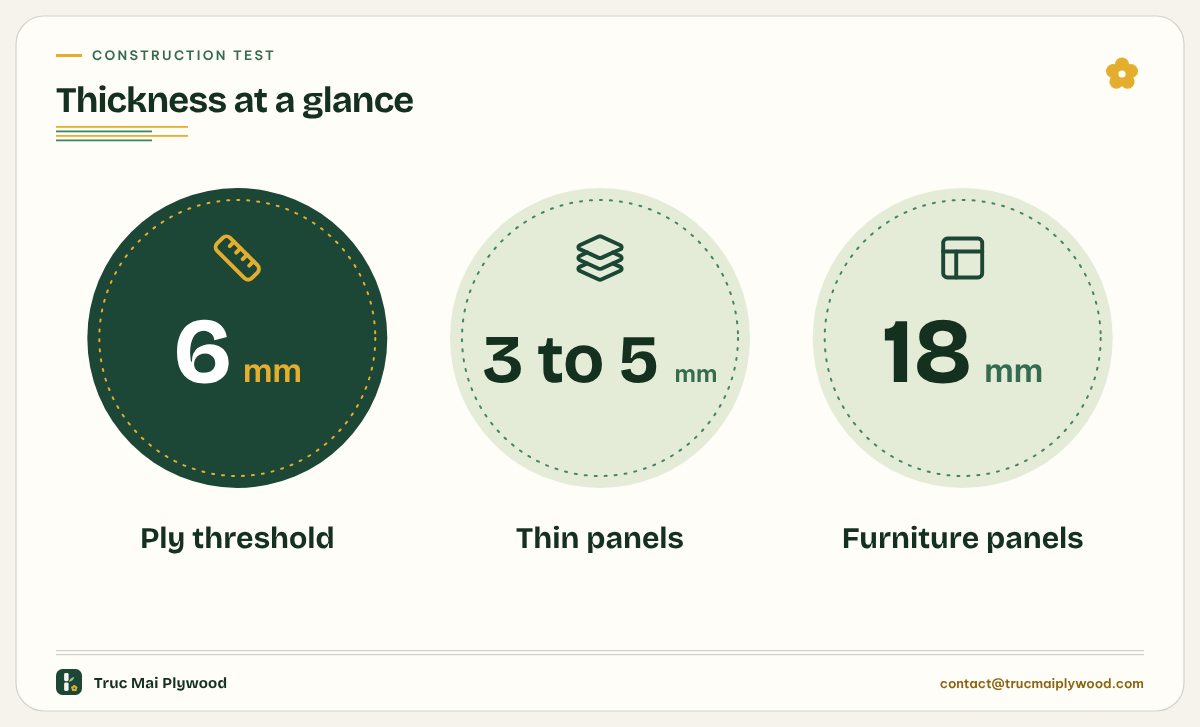
6 mm per individual ply is the threshold in the ordinary plywood branches 4412.31 to 4412.39. It is not a limit on the finished sheet thickness. An 18 mm sheet built from thinner veneers can meet this test; a laminated product containing a thicker wood layer requires another construction assessment.
A buyer should request the ply schedule, not just a total thickness. At the mill, the ply count and core-veneer dimensions are manufacturing specifications, while the tariff rule looks at each wood sheet. Thin 3 to 5 mm panels are built with five plies in the Truc Mai range; 18 mm furniture panels commonly use 11 to 13. Neither statement replaces a ply schedule for the actual ordered construction.
A blockboard with a lumber-strip centre belongs to the separate 4412.51 to 4412.59 family. LVL also has its own branch. Treating all laminated wood as interchangeable under 4412.33 overlooks these structural distinctions.
What is the difference between an HS code and a US HTS code?
Six digits are the internationally harmonised level; the US Harmonized Tariff Schedule adds national digits for its tariff and statistical lines. The US International Trade Commission’s 2026 HTS is the current US lookup, and its tariff information page identifies Revision 23, published 10 November 2026.
For a US-bound shipment, do not stop at the international code. The US schedule further separates some 4412 goods by face species, surface treatment, thickness, dimensions or intended product category. A birch-faced sheet therefore needs its full construction and dimensions checked against the relevant national line.
The buyer should send the US entry description to the customs filer with the mill’s specification sheet. The US plywood import steps page covers the wider import sequence; classification is one field in that process.
How should EU, UK and other importers check the national code?
Start with 4412 and the correct six-digit branch, then consult the destination’s live tariff schedule for the additional digits. EU Combined Nomenclature, UK commodity codes and other national schedules use their own subdivisions and measures. The WCO code gives the common framework, not the final destination-specific entry.
The buyer’s market matters for the tariff line, while the mill’s construction determines the underlying goods description. Keep the same physical specification across markets, then have the importer identify the applicable national extension. An EU importer can follow the EU plywood import steps for the other documents that accompany a container.
An origin certificate, a preference claim and an HS code answer separate questions. Origin paperwork describes where the goods qualify as originating; classification describes the goods; the destination tariff and applicable measures determine treatment. The documents per container page identifies the shipment documents to align with the entry.
What records should match the classification on a shipment?
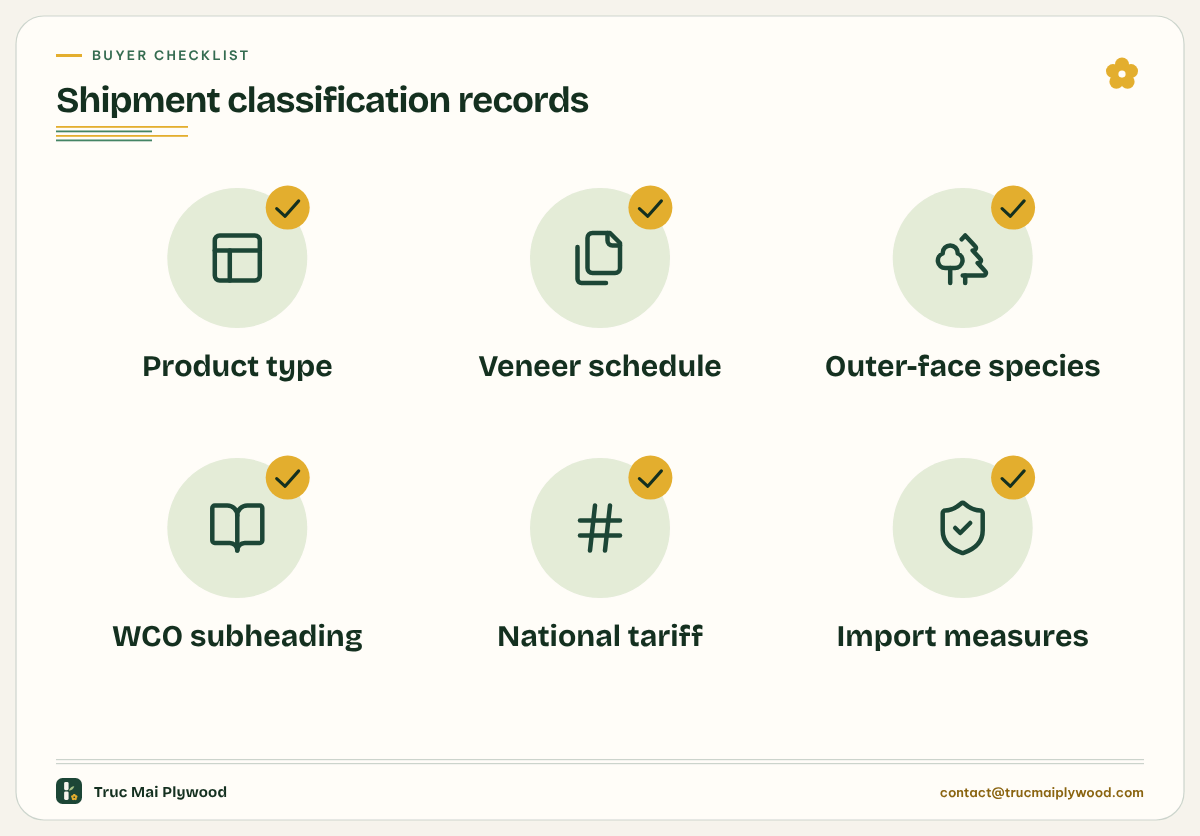
The invoice, packing list, product specification and customs declaration should describe the same panel. The six-digit heading is easier to support when the record contains the face and back species, core construction, ply schedule, sheet dimensions and surface finish.
A practical review before the first container follows five steps:
- Identify the article as plywood sheet, LVL or another laminated-wood construction.
- Obtain the actual veneer schedule and both outer-ply species.
- Apply the WCO six-digit subheading text to that construction.
- Check the importing country’s additional tariff digits and applicable measures.
- Copy the agreed goods description onto the invoice and packing list, with distinct lines for different constructions.
Truc Mai’s standard order records the application, core, glue and emission specification, face, size, packing and quantity. For customs, add the species and ply detail. A repeat buyer should retain the approved specification alongside the first shipping-document set, so later containers are classified from the same product description.
Does an HS code prove formaldehyde or origin compliance?
No. HS 4412 describes a customs product family; emissions certification and wood-origin due diligence use separate evidence. The US EPA TSCA Title VI rule, 40 CFR Part 770 addresses formaldehyde in covered composite wood products, including defined hardwood plywood, independently of the tariff heading.
For veneer-core hardwood plywood in the Truc Mai range, CARB P2 and TSCA Title VI certification covers 3 to 25 mm under certificate CARB/EPA26053. A buyer ordering thicker panels should specify the applicable compliance requirement separately. The Phase 2 formaldehyde limits page explains the emission requirement and the certified product scope.
For EU-bound wood products, the EUDR due-diligence file tracks the face veneer as well as the Vietnamese core, including plot geolocation records. Classification does not replace that material traceability. The EUDR dates for panel buyers page covers the regulatory timetable.
Can cut-to-size panels remain under heading 4412?
Yes, rectangular cut-to-size plywood can remain under 4412 when cutting leaves it a plywood panel rather than a finished article of another heading. HMRC guidance on classifying wood confirms that plywood under heading 4412 can be cut or formed into shapes other than square or rectangular.
A mill can label cut pieces for a furniture buyer. Typical patterns include two lengthwise pieces from a standard sheet, three shorter panels or four quarter sections; six-piece layouts are also available. The exact cut list, saw allowance and resulting dimensions belong on the purchase specification. See cut-to-size plywood panels for the manufacturing option.
If parts arrive drilled, shaped or assembled for a specific finished article, the importer should assess the condition as imported rather than automatically reusing the parent-sheet line. For straightforward rectangular blanks, keep the parent sheet construction and the delivered piece dimensions together in the document pack.
What should a plywood buyer put in the RFQ and customs description?
Send a seven-field product specification: application, core, glue/emission, face and back, sheet size and thickness, packing, and quantity. Add the destination country and request the actual veneer species and ply schedule for the classification review.
For example, a furniture-panel enquiry can identify birch face over styrax core, UF glue at the agreed emission grade, 1220 × 2440 mm sheets, calibrated thickness tolerance and one 40HC. The buyer then adds the required surface grade, labels and packing arrangement. This gives the mill a manufacturable specification and gives the customs filer the physical details needed for the 4412 branch.
Truc Mai Plywood manufactures commercial and furniture/interior panels in Ha Hoa, Phu Tho, Vietnam, with annual capacity around 60,000 m³. Its normal minimum order is one 40HC, with FOB Hai Phong, CFR or CIF terms. Use the plywood RFQ checklist to assemble the specification and the quotation page to send it. Ask for the face/back species and individual-ply construction to appear on the shipping description before the first shipment.
Questions buyers ask
Does HS 4412 include veneer-faced plywood?
Yes. Heading 4412 includes plywood, veneered panels and similar laminated wood; the six-digit branch follows construction and outer species.
Is 4412.33 a universal code for all hardwood plywood?
No. It names a defined list of non-coniferous outer-ply species within the ordinary plywood branch. Other hardwood and tropical faces have separate branches.
Can an 18 mm panel have individual plies under 6 mm?
Yes. The tariff test refers to each wood sheet, not the total finished thickness.
Does the front veneer alone determine the code?
Both outer plies matter. Some branches require at least one qualifying outer ply, while the coniferous branch requires both outside plies to be coniferous.
Is an engineered veneer face the same as a wood species?
No. Engineered veneer describes how the face is made; the underlying botanical species should be recorded for customs classification.
Does an FSC invoice claim determine the HS subheading?
No. FSC chain-of-custody documentation concerns certified material claims, while HS classification describes the imported goods.
Can a buyer use the same six-digit code in different countries?
The international six-digit HS subheading is shared across adopting jurisdictions, while national tariff extensions differ.
Should mixed plywood and LVL loads have separate invoice lines?
Yes. Separate lines let the importer classify each construction against its applicable subheading.
Does the container size determine the HS code?
No. A 40HC is a shipping unit; the code follows the goods and their physical construction.
Can a product trade name replace a botanical veneer name?
A trade name can identify a finish, but the actual outer-ply wood species provides the classification evidence.