
China plywood anti dumping rules in the EU impose duties on specified Chinese-origin hardwood plywood, not automatically on panels manufactured in Vietnam. The EU measure sets two exporter-rate categories. Truc Mai Plywood makes commercial and furniture panels in Vietnam and provides origin records for buyers checking classification and supply documentation.
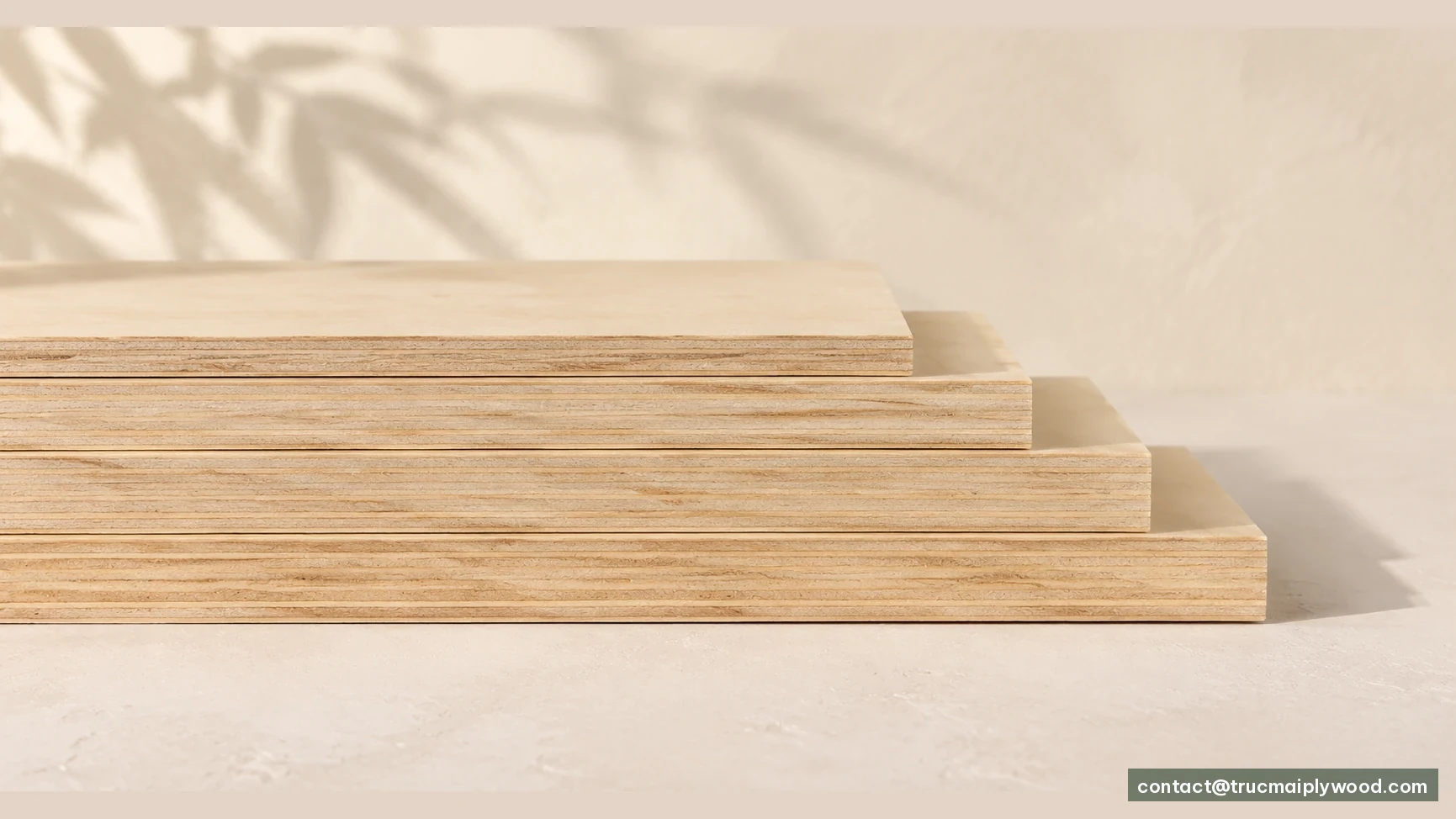
What does china plywood anti dumping mean for an EU importer?
The EU applies a definitive anti-dumping duty to specified hardwood plywood originating in China under Regulation (EU) 2025/2333. For an importer, the practical question is whether the particular shipment meets the regulation’s product description and has Chinese non-preferential customs origin. A purchase order that merely says “hardwood plywood” supplies neither answer.
The measure is a trade-defence duty, separate from the ordinary customs tariff. It addresses the imports described in Article 1 of the Commission’s definitive regulation. It is not a blanket surcharge on all plywood, all wood products from China, or panels supplied by an Asian company. A buyer needs the construction, face species, tariff classification and origin of the finished goods before selecting a rate.
Start with the physical panel. Record the species of the outer plies, the construction of the inner plies, and whether the surface is coated. Compare that description with Article 1 rather than relying on the supplier’s marketing grade. Then establish the manufacturer and the finished panel’s customs origin from the production record. Finally, have the customs representative check the relevant Combined Nomenclature (CN) and integrated EU tariff (TARIC) entry for the intended declaration date.
This order matters when purchasing mixed consignments. A shipment may contain panels with different faces, constructions or origins even when the commercial invoice uses one broad product family. A separate description for each distinct line allows the importer to check each line against the legal scope. The country from which the vessel departed is useful shipping information, but it is not a substitute for the origin assessment.
A useful purchasing file therefore contains the agreed technical specification, an identifiable producer, a clear origin statement, and documents that connect the goods on the invoice to those specifications. Buyers comparing possible sources can use the import duty table for panels as a planning route, while the regulation and live tariff entry provide the operative legal detail.
Which Chinese hardwood plywood products are covered?
Article 1 defines the covered plywood by veneer species, ply construction and listed CN and TARIC codes. The operative description concerns plywood consisting solely of wood sheets other than bamboo and okoumé, with each ply no thicker than 6 mm, and at least one outer ply of specified tropical or non-coniferous wood. Coated and surface-covered versions can also fall within the description when the other conditions are met.
The word “hardwood” in a catalogue is therefore insufficient to decide coverage. Inspect the actual outer veneers and the stack of plies. A coated face does not automatically remove an otherwise covered construction from scope. Conversely, the presence of a hardwood component somewhere inside a different construction is not enough to treat it as covered. Article 1 supplies the test, and its precise wording takes priority over a convenient trade label.
The regulation lists the following TARIC lines for the defined Chinese-origin product:
| CN family | TARIC codes listed in Article 1 |
|---|---|
| 4412 31 | 4412 31 10 80; 4412 31 90 00 |
| 4412 33 | 4412 33 10 12; 4412 33 10 22; 4412 33 10 82; 4412 33 20 10; 4412 33 30 10; 4412 33 90 10 |
| 4412 34 | 4412 34 00 10 |
These are the codes stated in Article 1 of Regulation (EU) 2025/2333, rather than an independent classification of any particular buyer’s panel. The words “ex” in the legal and tariff context indicate that the described measure concerns a defined portion of a broader tariff heading. A code match is a starting point for the product-scope check, not a replacement for it.
For procurement, request a construction schedule that identifies the face and back veneers, the core composition, individual ply thickness and surface treatment. A photograph of the face alone cannot show the full lay-up; an edge photograph or approved sample helps link the written construction to the ordered goods. Keep the agreed description consistent across the quotation, order confirmation and invoice.
When a specification changes from one veneer face to another, repeat the scope check rather than carrying forward the previous classification. The HS 4412 subheadings guide gives buyers a place to organise classification questions before their customs broker applies the live EU nomenclature. This is especially useful where commercial descriptions such as furniture plywood, decorative plywood and hardwood plywood overlap but do not settle the legal classification.

What rates apply and which exporter receives each rate?
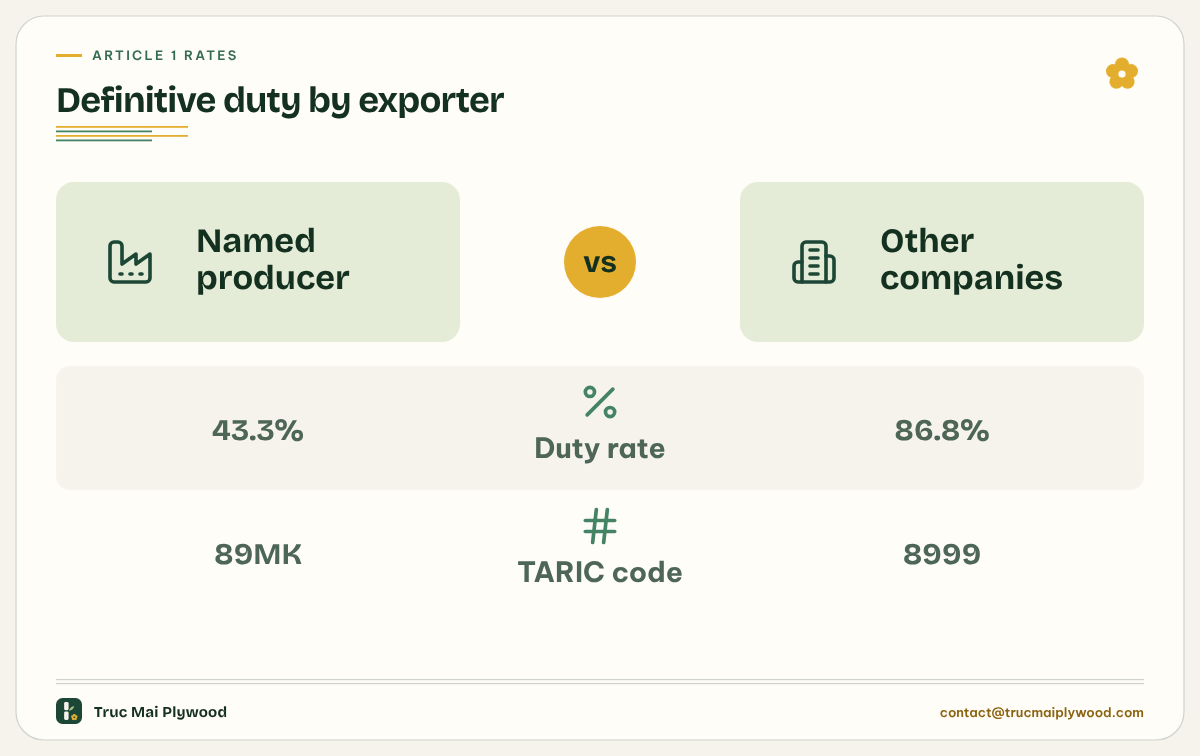
The definitive rates are 43.3% for the named exporter and 86.8% for other companies under Article 1. The lower individual rate belongs to the individually named producer for the covered Chinese-origin product it manufactures. It is not a general rate for purchases routed through that company, for a related factory, or for any supplier presenting a similar commercial name.
| Producer of covered Chinese-origin plywood | Definitive anti-dumping duty | TARIC additional code |
|---|---|---|
| the individually named producer | 43.3% | 89MK |
| All other companies | 86.8% | 8999 |
Basis: Article 1(2) of Commission Implementing Regulation (EU) 2025/2333. The percentages apply to the net, free-at-Union-frontier value before duty of the products within Article 1(1). They are anti-dumping rates, not the complete set of charges for import clearance.
Article 1(3) makes the individual rate conditional on a valid commercial invoice carrying a dated and signed declaration by an identified official of the issuing entity. The declaration identifies the volume of covered goods, the manufacturing company and address, the TARIC additional code and the country concerned. If that required invoice is absent, the all-other-companies rate applies to the covered Chinese-origin import.
For the buyer, this makes producer identification a documentary issue as well as a purchasing issue. The exporter named on a sales offer, the entity that actually manufactured the sheets and the party issuing the commercial invoice can be different entities. A buyer seeking the individual rate should establish which legal entity produced the goods and check that the prescribed declaration accompanies the relevant invoice. A supplier’s verbal assurance about a preferential exporter rate is not the document specified by Article 1.
The Commission also says customs authorities can examine shipping and other supporting records when checking a declaration. Maintain a traceable connection between the shipment, invoice, production description and declared origin. This reduces the risk of discovering a mismatch only when the goods are presented for release into free circulation.
Ordinary customs duty and any applicable preferential treatment are separate calculations. The EVFTA duty on panels guide concerns preferential tariff questions for qualifying Vietnamese-origin goods, not the exporter-specific Chinese anti-dumping rates shown here. Buyers should keep these tariff components in separate lines of their import assessment so that one is not mistaken for the other.
When did EU anti-dumping measures on plywood begin, in 2023, 2024 or 2025?
The Commission opened its investigation in October 2024 and imposed definitive duties in November 2025. The chronology explains why an older article may discuss an allegation, registration or provisional measure rather than the definitive rules now used for the covered Chinese-origin plywood.
The notice of initiation published on 11 October 2024 records the complaint lodged by the Greenwood Consortium on 27 August 2024. The notice describes the investigated plywood and the allegation of dumping and injury to EU industry. Opening the case meant the Commission was examining those allegations; it was not the same event as imposing a definitive anti-dumping duty.
The definitive regulation’s procedural history records subsequent registration of imports and the provisional measure imposed on 10 June 2025 under Regulation (EU) 2025/1139. The definitive regulation is dated 19 November 2025 and was published in the Official Journal on 20 November 2025. It also addresses definitive collection of amounts secured under the provisional measure.
| Milestone | Date | Meaning for an importer |
|---|---|---|
| Complaint lodged | 27 August 2024 | Formal complaint preceded the investigation |
| Investigation initiated | 11 October 2024 | Product and origin allegations entered examination |
| Provisional duties imposed | 10 June 2025 | An interim trade-defence measure applied |
| Definitive regulation adopted | 19 November 2025 | Final rates and operative conditions were set |
| Definitive regulation published | 20 November 2025 | Official Journal text became the key reference |
A purchase made during the investigation and an import declaration made after the definitive measure are different events. For an actual entry, use the rules applicable to that customs event, including any collection provisions relevant to earlier provisional duties. Do not lift a provisional rate from a dated supplier circular and present it as the definitive rate.
The history is also helpful when searching for “EU anti-dumping measures plywood Vietnam 2023 or 2024”. This Chinese hardwood plywood proceeding began in 2024; its definitive regulation followed in 2025. The initiating notice identifies China as the country concerned. Buyers can review the panel import duty table alongside the original notices to distinguish a historical investigation milestone from the current measure applicable to their shipment.

Do EU anti-dumping duties on Chinese plywood apply to Vietnamese-origin plywood?
No: the Chinese-origin measure does not by itself impose an anti-dumping duty on plywood genuinely originating in Vietnam. Article 1 of Regulation (EU) 2025/2333 identifies the country of origin as the People’s Republic of China. The country named in that operative provision matters more than the country of the seller, the currency on the invoice or the port used for shipment.
For an EU buyer comparing Vietnamese and Chinese plywood, the first task is to establish the non-preferential customs origin of the finished panel. A Vietnamese supplier’s address is not sufficient evidence that every product it sells was manufactured there. Equally, a Vietnamese-made panel is not turned into Chinese-origin plywood simply because an input veneer was sourced internationally. The assessment concerns the finished goods and the relevant manufacturing operations.
Truc Mai Plywood manufactures commercial and furniture plywood in Ha Hoa, Phu Tho, Vietnam. An importer buying Vietnamese-manufactured panels should retain the order specification and manufacturing records that connect the declared origin to the actual sheets. Those records allow the customs representative to examine the transaction as a specific product and shipment rather than treating “Vietnam plywood” as an undifferentiated category.
There are two separate questions to put to a prospective supplier. First, where was the finished plywood manufactured, and what production evidence supports that account? Second, does the finished panel match the construction and tariff description in the Chinese measure? Answering the origin question first prevents a buyer from assuming that the Chinese rates apply merely because a similar panel design is sold in both countries.
The reverse error is equally important: routing finished Chinese-origin sheets through a Vietnamese warehouse or export port does not turn the goods into Vietnamese-origin products. Documents should describe the real production history. An invoice bearing a Vietnamese business address cannot replace evidence of manufacturing. Buyers can check the broader import sequence in the EU plywood import steps before preparing customs instructions.
The answer to “is there anti-dumping duty on Vietnamese plywood in the EU?” must therefore be framed precisely. The definitive Chinese hardwood plywood measure cited here applies to the specified Chinese-origin goods, not to genuinely Vietnamese-origin panels. This statement concerns that particular measure, rather than every possible EU tariff or trade-defence action. The buyer still needs the appropriate tariff classification and an origin file for the individual shipment.
How should buyers compare Vietnamese and Chinese plywood under EU anti-dumping tariffs?
Yes: compare Vietnamese and Chinese plywood offers by customs origin and product scope first, then match face, core, thickness, emission specification and packing.
The next task is to make the two offers technically comparable. A birch-faced panel can have an imported birch face over a eucalyptus, acacia or mixed-species core. The appearance may be similar to a panel with another core construction, yet machining, edge appearance, weight and intended application can differ. For cabinet production, identify the visible face and reverse face separately, then specify the core construction and the surface preparation needed for finishing. For example, birch-faced plywood describes a face choice; it is not shorthand for a birch core.
| Comparison point | What the buyer should request | Why it changes the decision |
|---|---|---|
| Origin | Finished-panel manufacturing country and supporting production records | Establishes the origin assessment independently of the port of loading |
| Product description | Ply construction, face species and proposed customs code | Allows the buyer to compare the actual goods with the measure’s scope |
| Face and back | Named veneer species, appearance requirement and finishing condition | Prevents a decorative face description from concealing a different reverse face |
| Core | Species, combination and joining method | Makes edge quality and machining expectations comparable |
| Thickness | Nominal thickness and contractual tolerance | Avoids comparing calibrated furniture panels with a looser commercial specification |
| Emissions | Named emission requirement and test documentation for the ordered build | Keeps chemical-performance evidence distinct from the customs decision |
| Packing | Sheet count per pack, edge protection and identification marks | Makes receiving, storage and order reconciliation easier |
For Truc Mai Plywood, the available face selection includes engineered veneer, poplar, bleached poplar, birch, okoume, bintangor, pine, eucalyptus, gurjan and sapele. Eucalyptus, acacia, styrax, pine and combined-species cores allow the buyer to specify the construction beneath those faces. This matters when the same visual finish is requested for cabinet doors, shelving and general interior panels but the fabrication requirements differ.
Can routing Chinese plywood through Vietnam evade EU anti-dumping duties?
No. Routing finished Chinese plywood through Vietnam, changing its shipping documents or repacking it does not by itself confer Vietnamese non-preferential origin. EU customs origin depends on the applicable product rules and actual manufacturing operations. Importers should obtain production records showing where the plywood was made before determining whether the Chinese-origin measure applies.
A change of vessel, warehouse, invoice issuer or port does not describe a new manufacturing operation. If finished Chinese plywood is unloaded in Vietnam, stored, repacked and exported onwards, the buyer needs to distinguish that logistics history from the production history of the panels. The shipment route answers where the goods travelled; the origin file answers how and where they were made.
EU non-preferential origin analysis focuses on the manufacturing operations and the applicable rules for the product. The European Commission’s non-preferential origin guidance distinguishes substantial processing from minimal operations. This is the practical reason to ask for factory records rather than relying on a certificate header or an exporter’s location. For a panel assembled from materials sourced in several countries, identify the origin of the inputs and the actual operations that produced the finished sheet.
A useful production trail begins with incoming veneer identification. It then follows core lay-up, adhesive application, pressing, trimming, sanding and final packing through the manufacturing records. Record which site performed each operation and which production lot was involved.
The same distinction applies when imported face veneer is used over a Vietnamese-grown core. An imported decorative face is not equivalent to importing a finished panel. The file should show that the face was an input and explain how it was incorporated into the manufactured plywood. The face veneer origin files guide gives buyers a way to organise the source records without confusing raw-material provenance with finished-goods origin.
For purchasing teams, the most useful control is to connect the supplier’s production statement to identifiable physical goods. Put the production lot on the packing list, connect it to the relevant input records, and preserve the manufacturing description with the order file. When a container combines different panel constructions, keep the lot and specification mapping separate. A single broad description of the container makes later checks unnecessarily difficult.
What is the status of EU investigation into China plywood imports and alleged duty evasion?
Regulation (EU) 2026/1840 opened an investigation into slightly modified Chinese hardwood plywood, not a finding that Vietnamese production circumvents duties.
The distinction between an investigation and an adopted finding matters for purchase orders. An investigation identifies conduct and products for examination. It is not an instruction to classify every panel sourced from another country as Chinese, nor a substitute for checking the actual origin of a shipment. Buyers should read the initiating measure’s product description and the subsequent legal record before attaching a trade-defence conclusion to a particular order.
The subject described in Regulation (EU) 2026/1840 is slightly modified Chinese hardwood plywood. The investigation therefore needs to be distinguished from a hypothetical case involving the transhipment of finished Chinese plywood through Vietnam or the genuine manufacture of plywood in Vietnam using imported veneers. These are different factual patterns. A sourcing team’s file should describe the one that actually applies.
For an importer, a practical monitoring note has four fields: the legal instrument, the product description, the country or countries named, and the procedural status. Add the date of the check. It also separates the underlying definitive Chinese-origin measure from a later proceeding addressing a particular modification or practice.
When suppliers offer alternative constructions, preserve the detailed panel description. Small changes in a product’s construction can matter to the wording of a trade-defence investigation. Record veneer species, number and arrangement of plies, finishing and the proposed classification. Do not rely on a sales phrase such as ‘EU duty free plywood’ to describe the product or its legal treatment.
The buyer’s next action is documentary, not speculative: obtain the exact legal text relevant to the proposed entry and reconcile it with the panel specification and manufacturing evidence. A broader discussion of country-specific measures belongs in trade defence on Vietnamese panels. That separates the status of measures concerning Chinese products from any assessment of goods declared as Vietnamese origin.
Which origin records should accompany a Vietnamese order?
A Vietnamese-origin order should have consistent manufacturing, veneer-source, commercial and shipping records supporting its declared origin.
Start with a product-level description. The purchase order should identify the face and back veneers, core construction, thickness, size, finish and intended use. A generic invoice line such as ‘plywood sheets’ leaves too much of the product identity to be reconstructed after shipment.
Next, connect the raw materials to the production lot. Face veneer records should identify imported inputs separately from Vietnamese-grown core material. Core species and the mill’s manufacturing operations should be recorded in the production file. The purpose is to show the sequence from inputs to finished panels, with enough identifiers to connect the documentation to the goods being shipped.
A buyer-facing document pack can be organised as follows:
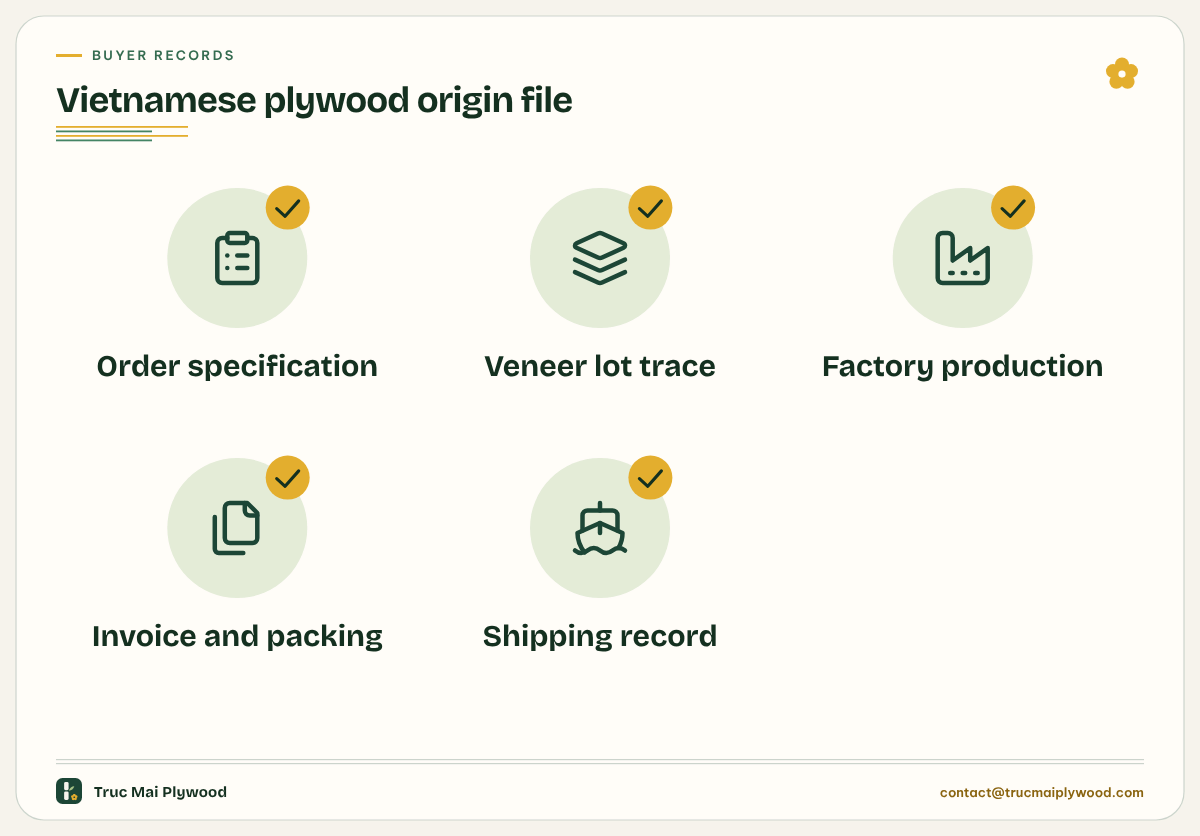
- Order and specification: approved quotation, product description, drawings where relevant, and agreed packing instructions.
- Material trace: veneer-source records and the lot references connecting face and core inputs to production.
- Manufacturing trace: factory production records showing the operations undertaken in Vietnam and the finished lot identification.
- Commercial records: invoice and packing list with consistent descriptions, quantities and marks.
- Transport records: bill of lading and the shipping details matching the physical consignment.
- Origin documentation: the applicable certificate of origin and supporting evidence used for the declared origin.
The documents per container guide covers the shipping pack in more detail. For origin marks and documentary formalities, see origin marks and legalisation. These are complementary tasks: a well-prepared transport file helps reconcile a shipment, while the production evidence explains the origin assertion.
Review the documents as a set, not as isolated forms. The face species on the invoice should match the order. The dimensions and packing units should agree between the packing list and the physical bundles. The factory lot should connect to the manufacturing record. If the order contains several face constructions, assign separate line descriptions and keep their lot identifiers visible. These checks reduce the effort required when a customs broker asks how the declared product was made.
For EU-bound shipments, the commercial file can also include the agreed product-specific certificate and test documents, with the relevant environmental due-diligence information maintained as its own evidence stream. A wood-origin plot record serves a different purpose from the manufacturing trail for customs origin. Keeping both accessible is useful; collapsing them into one label is not.
What does the Truc Mai mill actually manufacture?
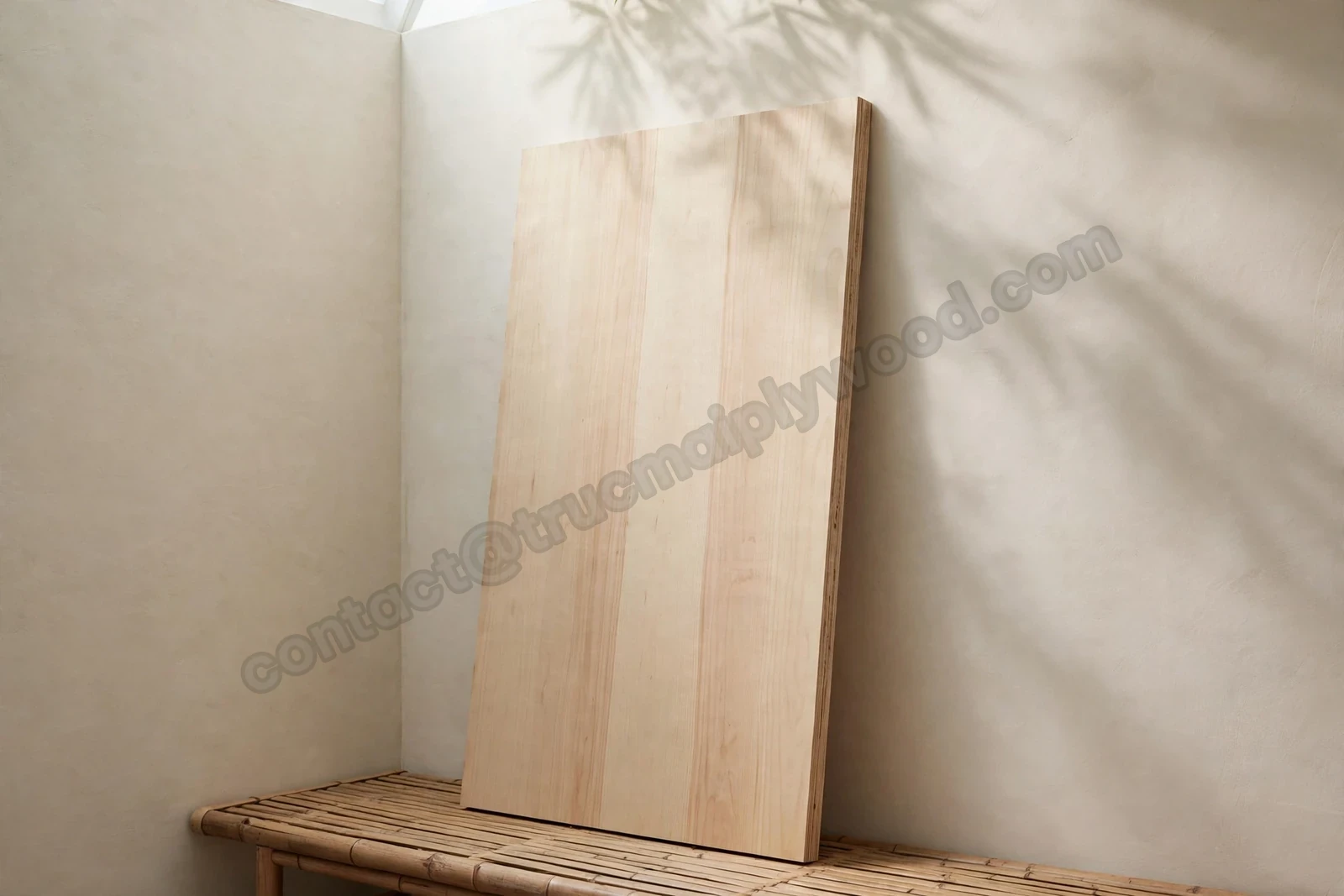
Truc Mai Plywood manufactures furniture and commercial plywood in Ha Hoa, Phu Tho, Vietnam, with capacity around 60,000 m³ annually.
Its production range centres on panels for furniture, cabinetry, interior fit-out and commercial applications. Buyers can specify a decorative veneer face over a core selected for the intended fabrication process. The available cores include eucalyptus, acacia, styrax and pine, as well as combined-species constructions. The face selection includes engineered veneer, poplar, bleached poplar, birch, okoume, bintangor, pine, eucalyptus, gurjan and sapele.
That separation between face and core is important when discussing a Vietnamese alternative to an imported panel. A birch-faced cabinet panel describes its visible surface; it does not imply a birch core. An engineered-veneer face can give a different appearance while the core remains a Vietnamese-grown wood construction. The buyer should specify both elements rather than asking only for a named decorative species.
The furniture and interior plywood range includes veneer-faced panels and surfaces prepared for further finishing. Melamine-faced and high-pressure-laminate-faced options address applications where a finished decorative surface is needed. Commercial plywood and packing plywood serve different handling and appearance requirements. Non-structural laminated veneer lumber is also offered for suitable interior components.
A production discussion should begin with the final use. For visible cabinet parts, the face pair, sanding and edge appearance matter. For components cut into narrow strips, core continuity and the joining method become important. For panels that will be laminated, the surface preparation must suit the selected finish. These distinctions produce a more useful specification than simply asking for ‘hardwood plywood’.
The mill’s manufacturing scope also gives an origin enquiry a concrete starting point. A buyer can ask which face materials entered the mill, what core was laid up and which production steps created the finished panel. That manufacturing account can then be compared with the order description and the supporting records. It is the actual production history, rather than a country label on a quotation, that makes an origin file intelligible.
For a first technical exchange, send the required face and reverse face, core preference, nominal thickness, final dimensions, finishing requirements, expected cutting process and packing format. If the product is intended for EU furniture or interior work, include the applicable emission requirement in the same specification. The supplier can then describe a particular panel build, while the buyer’s customs team evaluates the corresponding origin and classification separately.
How do face veneer and core origin affect the file?
The file must distinguish imported face veneer from the Vietnamese-grown core and record the production process that made the finished panel.
A plywood sheet can combine timber harvested in different countries. Its face may arrive as a prepared veneer, while its inner plies are peeled, dried and assembled from locally sourced logs. Those inputs need separate material records even though the buyer receives one finished article. For a European importer reviewing china plywood anti dumping exposure, the useful question is what happened to each material before the panel was manufactured, rather than whether a particular veneer species sounds Chinese or Vietnamese.
For example, engineered veneer (EV) used as a face can be reconstituted from plantation poplar, Populus deltoides, sourced in China. A documented EV supply chain can include the source plantation, veneer producer, export declaration, Vietnamese import declaration and subsequent allocation to the production lot. The Vietnamese core may instead contain acacia, eucalyptus, styrax or pine veneers, including combinations of these species. Its records begin with Vietnamese timber sourcing and follow the core material through manufacture. This distinction makes the import file readable: Chinese-origin face material is identified as an input, and the finished plywood is described by the operations undertaken in Vietnam.
The production account should connect incoming veneer batches to the panel order. A practical sequence is receipt of the face and core materials, veneer preparation, lay-up, adhesive application, pressing, trimming, sanding, grading and packing. Production logs and material allocation records show how imported and domestic inputs were incorporated into finished sheets. They also let the importer reconcile the stated face pair and core construction with the order specification. An origin review can then consider the manufacturing evidence alongside the applicable customs rules, instead of treating the location of the last shipping port as the answer.
The material file serves a different but complementary purpose under the EU Deforestation Regulation (EUDR). For wood products within scope, the EU operator needs information about the plots where the relevant wood was produced. The face and the core therefore require their own traceable source information. The mill supplies origin records and geolocation files for both streams, including GeoJSON data. A dossier can connect the face material to its plantation records and the Vietnamese core to local harvest records without putting private landholder details on a commercial quotation.
A buyer can ask for a short cross-reference sheet with the order number, finished panel description, face veneer material, core species, incoming batch identifiers and corresponding production records. The cross-reference is more useful than a loose collection of certificates whose product names and dates do not line up. It also helps purchasing, customs and compliance colleagues examine the same construction without reconstructing the supply chain from emails.
For the face-side evidence, see face veneer origin files. Keep the underlying material records connected to the finished order throughout sampling, approval and dispatch. A sample made with one face or core combination should be labelled accordingly, so the production order can be compared against the approved specimen.
Which EU compliance records are separate from trade duties?
EUDR due diligence, product emissions and FSC sales claims are separate checks from anti-dumping origin and tariff classification.
An importer may need all these records for the same consignment, but each answers a different question. The customs review asks how the finished goods are classified, where they originate and which trade measures apply. The EUDR file follows the wood back to its production plots. Emissions documentation concerns the panel configuration and the relevant test method. An FSC sales claim identifies eligible certified material through the chain-of-custody system. Filing one document in place of another creates gaps that are easy to avoid by organising the evidence by purpose.
The European Commission’s July 2026 EUDR update sets application from 30 December 2026 for large and medium operators and for micro and small operators already covered by the EU Timber Regulation, and from 30 June 2027 for other micro and small operators. The operator’s due-diligence process includes identifying wood species, country of production, relevant production plots and evidence of lawful production. A due diligence statement is submitted through the EU Information System as applicable. The EUDR dates for plywood buyers page helps teams schedule their document collection before cargo is booked.
Emissions should be specified against the intended European application and a named test method. The EU’s REACH formaldehyde restriction for furniture and wood-based articles is a product-emissions issue, not a customs-origin test. For a panel order, the buyer should retain the relevant report, identify the tested construction and compare it with the proposed adhesive and panel build. A report on a different core, adhesive system or surface treatment is not a substitute for identifying what was tested. The emissions specification belongs in the purchasing documents as well as the compliance folder.
FSC has its own documentary chain. Under FSC-STD-40-004, eligible sales documents carry the seller’s certificate code and the product’s FSC claim. For an FSC 100% order, the claim must appear against the relevant product on the sales paperwork. Buyers can use verify an FSC licence code when checking a supplier’s credentials. An FSC claim addresses certified sourcing and handling; the customs file still needs its own product and manufacturing description.
Organise the records as separate, labelled sets: customs classification and origin; EUDR source and plot data; emissions reports and product specification; and FSC transaction documents where an FSC order is requested. Put the same order reference and panel construction on the covering index. That approach makes an EU buyer’s internal review quicker and reduces follow-up when different departments request evidence for the same shipment.
Which Commission implementing regulation and EU tariff entry should an importer check before shipment?
Regulation (EU) 2025/2333 is the starting point: check its current text, the precise TARIC line, the declared origin and any later trade-defence action before booking.
A customs check should use the actual product specification rather than the commercial description alone. “Hardwood plywood” on an invoice does not capture every distinction in a trade-defence measure. The number and arrangement of plies, veneer species, thickness and relevant tariff wording may all matter. Ask the supplier for a construction sheet and compare it with the legal product description and the proposed customs entry. Keep the construction sheet with the order so the customs broker can work from the same details as purchasing.
A workable pre-shipment sequence is:
- Fix the product identity. Record the face and back veneer, core species, ply construction, nominal thickness, dimensions and intended use. Check the specification against the physical sample and the purchase order.
- Check classification. Determine the applicable Combined Nomenclature and TARIC entry from the goods as manufactured. Review the relevant explanatory material and the current tariff record rather than copying a code from a previous shipment with a different construction.
- Check declared origin. Examine the production location and the supporting manufacturing and material records. Match the country of origin on the proposed invoice and certificate of origin to the documentary file.
- Read the legal measure. Compare the goods with Article 1 of Commission Implementing Regulation (EU) 2025/2333, including the product wording and origin condition. Check subsequent amendments, extensions and investigations separately.
- Review the complete import entry. Have the broker check the applicable tariff components, any additional measures and the required customs documents for the intended date of importation.
- Approve draft documents. Compare the invoice, packing list, transport details and origin papers with the purchase order before the shipment is finalised.
This sequence also prevents a common purchasing error: applying a rate from a headline to every sheet described as plywood. The legal measure is tied to a defined product and origin. The importer’s working file should preserve the exact legal reference and the tariff entry checked, together with the date of the check. That provides a clear record if the classification or trade-defence position is reviewed later.
For Vietnamese production, ask for records showing the actual manufacturing steps and how imported face material was handled. The invoice’s country field should agree with the production evidence. If the product has been changed since sampling, update the construction sheet and repeat the classification review. A different veneer arrangement or panel build can affect how the goods are described for customs purposes.
The shipping document set should be prepared as a matched package: commercial invoice, packing list, bill of lading and the agreed origin documents, with product-specific compliance records where relevant. The supplier can circulate draft shipping documents after loading for buyer approval. For a fuller workflow, use importing plywood into the EU. Make the tariff check a defined purchasing milestone, before the freight booking is treated as final, rather than an exercise left entirely to the arrival agent.
What specifications belong in a plywood quotation request?
Send the application, core, adhesive and emission class, face pair, dimensions, packing, quantity and destination port in one RFQ.
A quotation request should describe the panel the buyer needs to receive, not merely a species name and thickness. Two suppliers can quote the same headline product while offering different veneer construction, surface preparation, adhesive systems and tolerances. These differences affect machining, finishing, packing and the documents needed for an EU import. An organised request lets purchasing compare like with like and gives the supplier a basis for preparing a sample that represents the intended order.
Start with the use: cabinet components, furniture carcasses, decorative interior panels, door components or commercial packaging. State whether the sheet will be laminated, painted, veneered again or machined into small parts. The application helps determine the face quality, core arrangement and surface preparation. If the panels will be visible, identify the exposed side and back-side requirements separately. A balanced face pair matters more to the buyer than a broad label such as “furniture grade”.
Then describe the core and adhesive system. Specify eucalyptus, acacia, styrax, pine or the agreed mixed core, and indicate any requirements for core joints, gaps and sanding. Give the required emissions specification and named test method independently of the adhesive description. Include the intended indoor environment and any finishing process that the panel will undergo. If the project needs supporting laboratory documents, name the report or testing information to be included in the quotation package.
For the face, identify the species and whether the request is for natural or engineered veneer. State the face/back combination, visible colour or grain expectations and the agreed appearance reference. EV, poplar, birch, okoume, bintangor, pine, eucalyptus, gurjan and sapele are available face options. Birch-faced plywood should be specified as a face construction rather than described as an all-birch panel. A photograph can illustrate appearance, but a labelled sample and written face specification are better references for repeat purchasing.
Record the sheet dimensions and machining instructions. Common formats include 1220 × 2440 mm, 1220 × 2280 mm and 1250 × 2500 mm. If the order requires cut-to-size parts, provide a cutting schedule, orientation requirements and part labels. Thickness tolerance should be agreed on the order: calibrated furniture panels can be specified at ±0.3 mm, while other constructions use their corresponding agreed tolerance. Include any length and width tolerance needed for the buyer’s machinery. A nominal dimension alone does not communicate the acceptable finished range.
Finally, describe the commercial and logistics requirements: estimated quantity, pallet or bundle arrangement, protection for faces and edges, shipping marks, destination port and the requested delivery term. Specify the documents the purchasing team needs for origin, EUDR due diligence, emissions and any FSC order. Keep document requirements alongside the product specification so they are included when the supplier prepares the offer rather than requested after the goods are packed.
The guide to writing a plywood RFQ provides a useful structure. Buyers can also request a quotation with their application, face pair, core, dimensions, packing and port in one message. Attach the cut list and any approved sample reference. A complete RFQ turns the trade-duty discussion into a specific importable product with a clear manufacturing description and a traceable order file.
Questions buyers ask
Does an EU anti-dumping rate replace ordinary customs duty?
No. Anti-dumping duty is a separate trade-defence measure; the importer checks all applicable tariff components against the declared classification and origin.
Can an EU buyer use a Chinese veneer on Vietnamese-made plywood?
Yes. Record the veneer origin and the manufacturing operations in Vietnam; the finished panel’s customs origin requires its own assessment.
Is every hardwood plywood sheet within the Chinese measure?
No. The measure specifies construction, species, customs codes and Chinese origin; review Article 1 before applying its rates.
What is the difference between an investigation and a definitive duty?
An investigation examines alleged practices. A definitive duty is imposed by a legal measure after the relevant determination.
Do an FSC claim and customs origin mean the same thing?
No. FSC is a chain-of-custody sales claim, while customs origin is determined under applicable origin rules.
Does EUDR geolocation establish Vietnamese customs origin?
No. EUDR geolocation traces wood production plots; customs origin also concerns the processing and manufacture of the imported goods.
Which plywood face species can Truc Mai quote?
Truc Mai offers EV, poplar, birch, okoume, bintangor, pine, eucalyptus, gurjan and sapele faces, with other faces on request.
What dimensions can be included in a first RFQ?
Standard sizes include 1220 × 2440 mm, 1220 × 2280 mm and 1250 × 2500 mm; send the cut list for labelled cut-to-size panels.
How should an importer check a current EU measure?
Read the current implementing regulation and TARIC classification, then compare the origin and product description against the entry.
Can the EU investigation into modified Chinese panels be treated as a Vietnam finding?
No. Regulation (EU) 2026/1840 concerns specified slightly modified imports from China and does not itself establish circumvention by a Vietnamese manufacturer.