
3.6 mm ply is the thin hardwood plywood sheet UK merchants commonly list for backs, linings and lightweight interior components. Truc Mai Plywood supplies thin furniture and commercial panels from Vietnam with specified faces, veneer cores, calibrated thickness and export packing. Buyers should match the merchant's nominal size to a written factory specification before ordering.

What does 3.6 mm ply mean on a UK merchant shelf?
3.6 mm ply is a nominal thin plywood designation used in UK sheet-material listings. It tells a buyer the advertised thickness, but it does not identify the species of every veneer, the bond classification, the surface appearance or the measured thickness of the delivered panels.
A merchant listing might describe a hardwood face, a combination core or eucalyptus throughout. Those descriptions are different constructions even when the displayed thickness is identical. The purchasing document should therefore name the face, back, core, adhesive system, dimensional tolerance and intended interior application. A trade name is a starting point for selection, rather than a complete production instruction.
For a distributor, the useful question is whether the sheet can be replenished to the same agreed build. A retail label describes a stock item; a factory order describes the repeatable product behind that label. Record the approved edge sample and face sample alongside the specification. This makes later comparisons possible without relying on colour descriptions or a supplier’s shorthand.
Which thickness should a buyer specify: 3.6 mm ply, 3 mm or 4 mm?
Specify 3.6 mm only when the purchase order and approved sample define that nominal thickness. The factory’s regular thin-panel programme includes 3, 4, 5 and 6 mm; a UK merchant’s 3.6 mm listing should be translated into a manufacturing specification rather than treated as automatically identical to either neighbouring size.
| Merchant request | Factory discussion | Purchasing check |
|---|---|---|
| 3.6 mm nominal | Agree the required finished thickness | Record measured sample and tolerance |
| 3 mm | Regular thin-panel specification | Confirm face, core and intended fitting |
| 4 mm | Regular thin-panel specification | Confirm veneer build and production timing |
| 5 mm | Regular thin-panel specification | Confirm appearance and edge quality |
| 6 mm | Regular thin-panel specification | Agree ply construction on the order |
The distinction matters in cabinet grooves, fitted backs and repeat-cut parts. A drawing designed around a merchant’s nominal sheet should be checked against the physical sample before a distributor commits to its own stock code. See the separate 3 mm sheet specification and 4 mm panel specification for adjacent sizes.
What face veneers can be supplied for thin hardwood plywood?
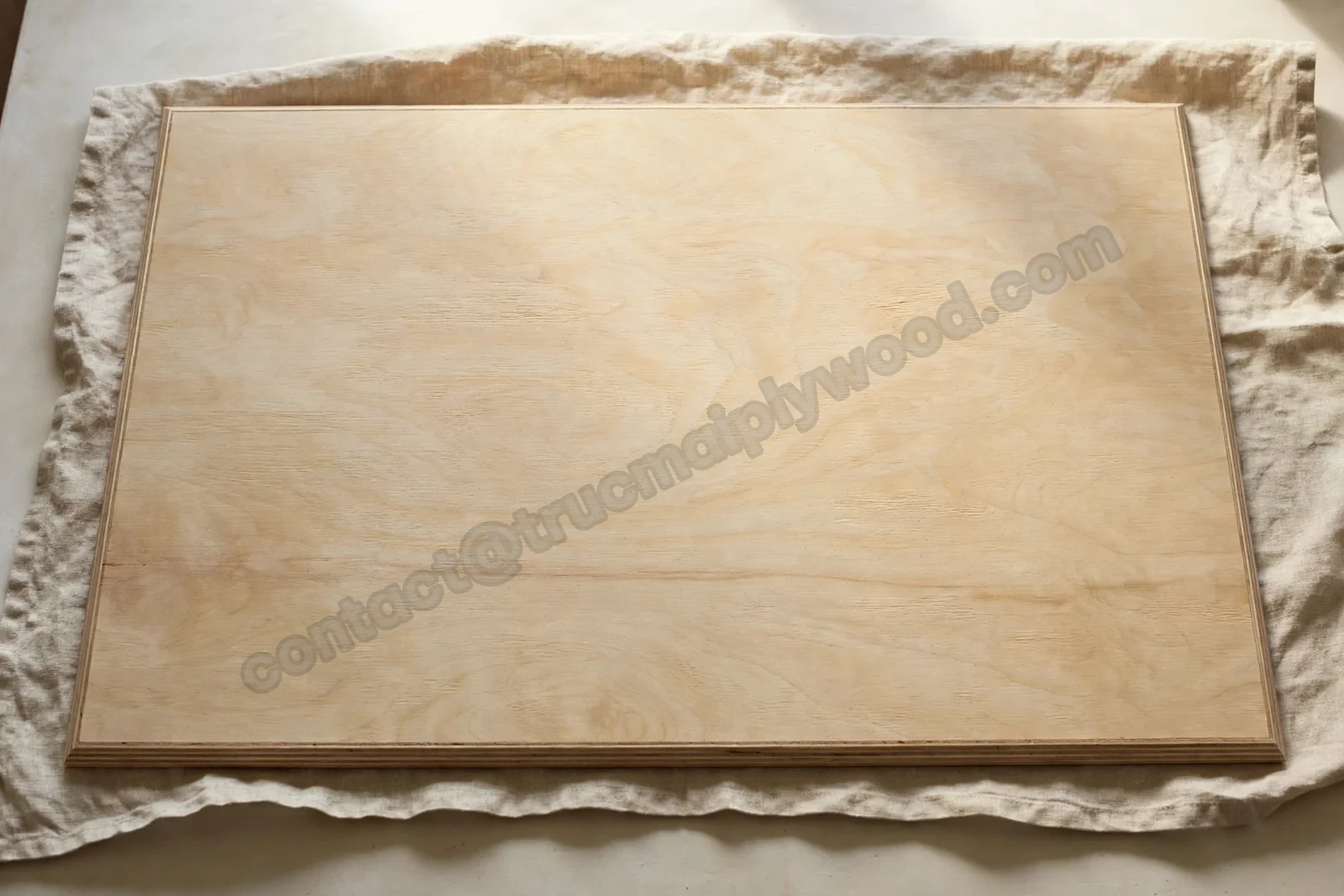
The face can be engineered veneer, poplar, bleached poplar, birch, okoume, bintangor, pine, eucalyptus, gurjan or another agreed veneer. The visible face and the core should be specified separately, since the buyer sees the surface while the edge and machining process reveal the internal construction.
A pale face can suit an interior lining intended for finishing; an engineered veneer can give a repeatable decorative pattern across batches. Birch-faced plywood means a birch veneer over the selected Vietnamese core, not an all-birch panel. Face selection also affects how knots, patches and colour variation are judged against the reference sample.
For private-label stock, approve both the front and the back. A sheet displayed face-up in a merchant rack may have a different back grade, and the distinction matters when both sides remain visible after installation. Ask for photographs of a full sheet as well as a close view of the veneer. The engineered veneer range and birch-faced plywood range illustrate two different surface choices.
Which core construction suits a thin merchant sheet?
Styrax, eucalyptus, acacia, pine and combined-species veneer cores are available. The core choice changes the weight, machining behaviour, visible edge and cost structure of the sheet, so it belongs on the order line beside the face veneer.
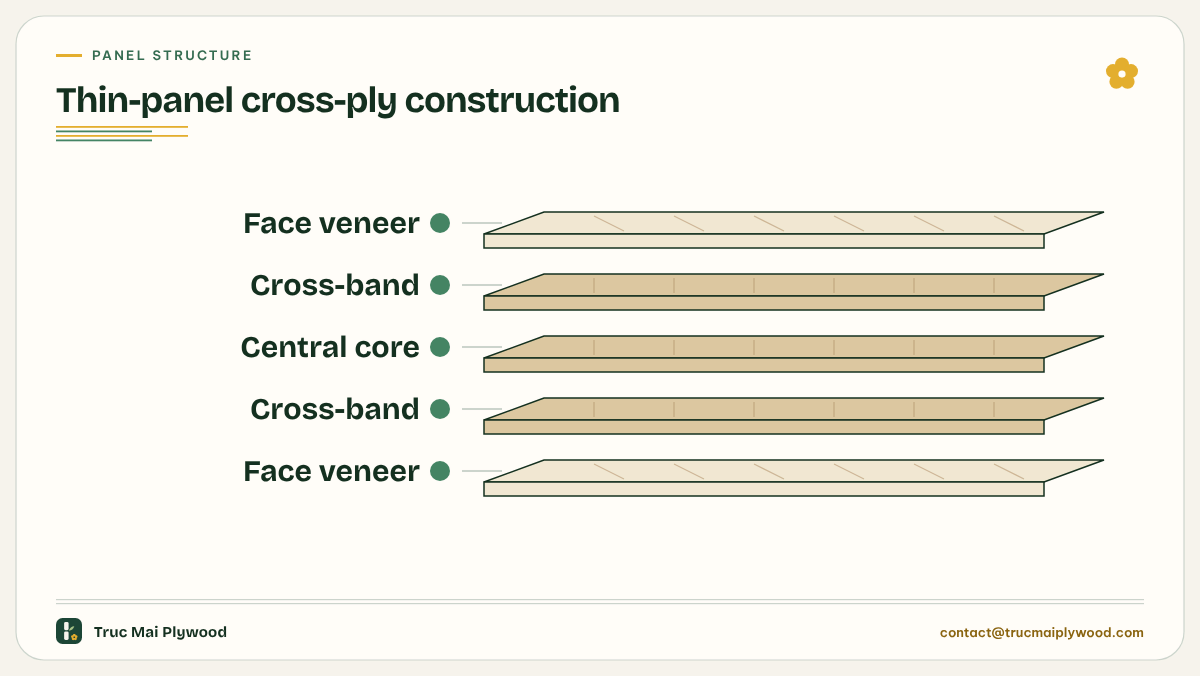
Thin 3–5 mm panels use five plies. At 3 mm the lay-up comprises a central core ply, two cross-bands and two faces; 4 and 5 mm use three core plies and two faces. For 6 mm the ply count is agreed for the order. The cross-grain arrangement is central to plywood construction, and the appearance of the exposed edge helps a buyer inspect the lay-up.
The mill can stitch outer core plies across and along a sheet. Stitching improves continuity at the core joints, particularly where the buyer expects clean routing or a stable decorative face. A merchant buying an inexpensive backing sheet may prioritise a different core grade from a furniture producer ordering a calibrated panel for close-fitting parts. Compare the construction rather than selecting by the word hardwood alone.
How should surface grade and finish be described?
State the face and back grades against an approved physical sample, then specify sanding and calibration. Descriptions such as B/BB or BB/CC are commercial shorthand; they do not automatically map to an ISO appearance class.
ISO 2426-2:2020 classifies hardwood plywood surface appearance using classes E, I, II, III and IV. A UK merchant’s grade label should therefore be accompanied by its own defect and repair limits, preferably illustrated by an approved sample board.
For visible cabinet backs, record acceptable knots, filler, veneer joints, colour range and sanding marks. For concealed linings, a different appearance grade can be appropriate while the buyer still requires a sound edge and the agreed thickness. The cabinet-grade plywood article explains why the word grade needs a complete face-and-core specification. Finish preparation and veneer appearance are separate decisions: a smooth surface can still have an appearance grade with visible repairs.
What thickness and size tolerances belong on the order?
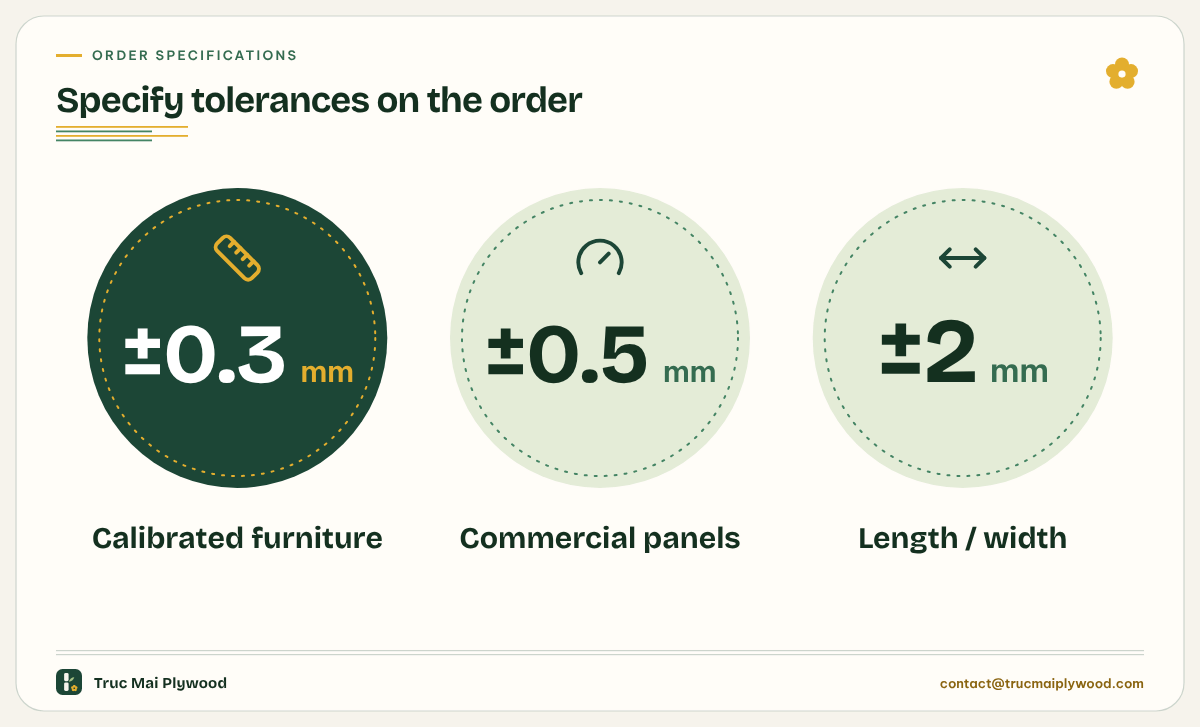
Write the finished thickness tolerance on the order, with ±0.3 mm for sanded and calibrated furniture panels and ±0.5 mm for commercial panels. The brand’s typical order range is ±0.3–0.5 mm; the length and width tolerance is ±2 mm.
These agreed factory figures should be distinguished from general standards tables. EN 315:2000 addresses plywood dimensional tolerances and measurement conditions, including moisture conditioning. A purchaser using a nominal retail description still needs the tolerance actually contracted for the chosen construction.
For fitted backs, the critical check is the fit in the customer’s groove after finishing. Request measurements across several points of a sample sheet and compare the results with the drawing. Surface calibration, edge squareness and the cutting specification should be reviewed together. If the order includes parts cut at the mill, define the finished piece dimensions separately from the parent sheet dimensions.
Which standard sheet formats are practical for UK distribution?
The regular export formats are 1220 × 2440 mm, 1220 × 2280 mm and 1250 × 2500 mm. The first corresponds to the familiar 4 × 8 ft merchant format; the shorter format can suit furniture-part programmes, while the larger metric format serves buyers using European cutting layouts.
| Format | Buyer use | Order detail |
|---|---|---|
| 1220 × 2440 mm | UK merchant stock and cabinet sheet goods | Confirm finished dimensions and pack label |
| 1220 × 2280 mm | Shorter furniture blanks | Confirm cutting programme |
| 1250 × 2500 mm | Metric nesting and interior parts | Confirm machine feed and storage |
A distributor should check warehouse racking, vehicle handling and the intended cutting equipment before choosing its stock format. The sheet size is also part of the delivery label, so mixed sizes need unmistakable pack identification. Buyers looking for shorter blanks can consult 1220 × 2280 mm panels. Do not substitute a metric sheet for an imperial drawing without first checking the final cut list.
Can thin plywood be cut and labelled at the mill?
Yes. Cut-to-size is an order option, with the exact piece dimensions set from the parent sheet and the buyer’s cutting list. The mill can split a standard sheet into two lengthwise pieces, three, four or six pieces, then label the resulting panels for the buyer’s handling process.
A two-piece example is 610 × 2440 mm from the standard sheet. Other established patterns include 1200 × 800 mm for a three-piece programme and 1220 × 610 mm for quarters. The cut pattern, finished size and label text are agreed by email before production.
For a merchant supplying furniture factories, the benefit is a more precise stock unit: labelled blanks can go to a cutting or assembly station without the customer first breaking down a full sheet. The mill cut-to-size page covers the ordering option. Supply the drawing revision, orientation of the visible face, permissible edge marks and packing sequence with the cut list.
Which glue and emission specification should be requested?
Specify the adhesive system and the emission requirement as two distinct lines. For interior plywood the factory’s default is UF glue at E0 emission; the buyer should state the required test method and emission criterion in the purchasing specification.
The USDA Forest Products Laboratory’s Wood Handbook, chapter 10 describes urea-formaldehyde adhesives as suited primarily to interior panel applications, with limited resistance to prolonged wetting. An adhesive name alone does not determine the emission result, and an emission description does not establish a bond class.
For a UK interior stock line, describe the actual use: dry cabinet backs, decorative linings or another defined environment. Then request the relevant emission documentation for the supplied construction. The formaldehyde limits page separates regulatory limits from the commercial grade names. Keep the test method, specimen construction and report identity with the order so a later shipment can be checked against the same requirements.
How is bond performance distinguished from a trade grade?
Bond performance is established by the agreed test and panel construction, not by a merchant’s face-grade label. EN 314-2 separates dry, humid and exterior bond classes, while EN 636 describes plywood use conditions; the buyer should identify the intended environment before specifying either.
The EN 314-2 standard preview describes bond classes and associated requirements. A six-hour boiling-water pre-treatment is associated with the Class 2 bond test, rather than being a general property of every interior adhesive.
For a thin furniture backing, dry-service suitability and dimensional fit may matter more than an exterior designation. If a merchant wants to advertise a named class, obtain a report on the relevant build and retain the class designation on the specification. Do not infer the class from a supplier’s adhesive nickname. The same care applies when comparing a retail listing described as external grade with a factory sheet described as furniture grade.
How should UK merchants compare apparently similar sheets?
Compare the construction line by line before comparing stock descriptions. Two thin sheets with the same nominal thickness can differ in face veneer, core joints, sanding, glue system and permitted dimensional deviation.
A practical comparison uses the same inspection sequence for both samples: look across the whole face under consistent light, inspect the back, count the visible plies at the edge, check the thickness at several positions, then cut a small test piece using the customer’s normal tooling. Note edge breakout, surface tear and any difference between the two faces.
For distributor replenishment, add a documentation check. The approved sample, specification revision, carton label and packing-list description should all identify the same product. A merchant that changes supplier without preserving those details can inadvertently change the sheet its customers have already qualified. The supplier shortlist checklist offers a broader mill-assessment framework, while the Vietnamese plywood grade article covers grade descriptions in greater depth.
How are thin panels protected for sea freight?
Thin panels are stacked into identified packs with edge protection and a loading plan that accounts for their handling sensitivity. For a UK distributor, the important controls are flat support, protection against corner impact and labels that remain legible after unloading.
A thin sheet has more exposed face area relative to its thickness than a heavy furniture panel, so handling damage can be especially visible at the corners and edges. Ask the supplier to show the proposed pack arrangement, the face protection between vulnerable surfaces and the handling method at the destination warehouse. Where a crated presentation is selected, record the crate design on the order and identify how the customer will open it safely.
Pack marks should distinguish face, core, size, thickness and quantity. If the container contains several merchant stock codes, each code needs a separate packing-list line and an identifiable physical pack. The documents per container article explains how the packing list connects the goods to the commercial paperwork.
What should a buyer know about 40HC loading?
A 40HC load is planned by pack geometry and cargo weight, with the final loading plan checked against the carrier booking. The factory planning model uses a cargo payload of 28,000 kg, while the actual sheet weight and packing materials are checked before loading.
Thin sheets can create large piece counts in each pack. A pack that is practical for production must also remain practical for forklift movement, storage and unloading. The packing team therefore considers the height of a stack and the load on its pallet feet, rather than using sheet count alone as a target.
Core density changes the number of panels that can travel in a container. A merchant buying a lighter core and another buying a denser core should not compare headline sheet counts without checking their specifications. The m³ per 40HC by thickness article provides the separate planning model; the purchase order and packing list identify the actual goods for this shipment.
Which UK import and traceability records matter?
Great Britain importers placing timber products on the market need a due-diligence system under the UK Timber Regulations. The UK government guidance, updated August 2025, identifies the information to collect, the risk assessment and the steps for risk mitigation.
For plywood, record the species present in the face and core, their harvest countries, the supplier and the quantity. An imported decorative face may have a different harvest origin from the Vietnamese core, so a country-of-manufacture label is only one part of the traceability file. Keep the specification connected to the invoice and shipment records.
HMRC’s wood classification guidance places plywood and veneered panels under heading 4412. The final commodity classification should follow the actual panel construction and the current tariff description. Plant-health checks are a separate subject: the Forestry Commission import guidance explains the requirements for regulated wood material. Confirm which requirements apply to the goods and any accompanying solid-wood packing.
What certificate information can be supplied with an order?
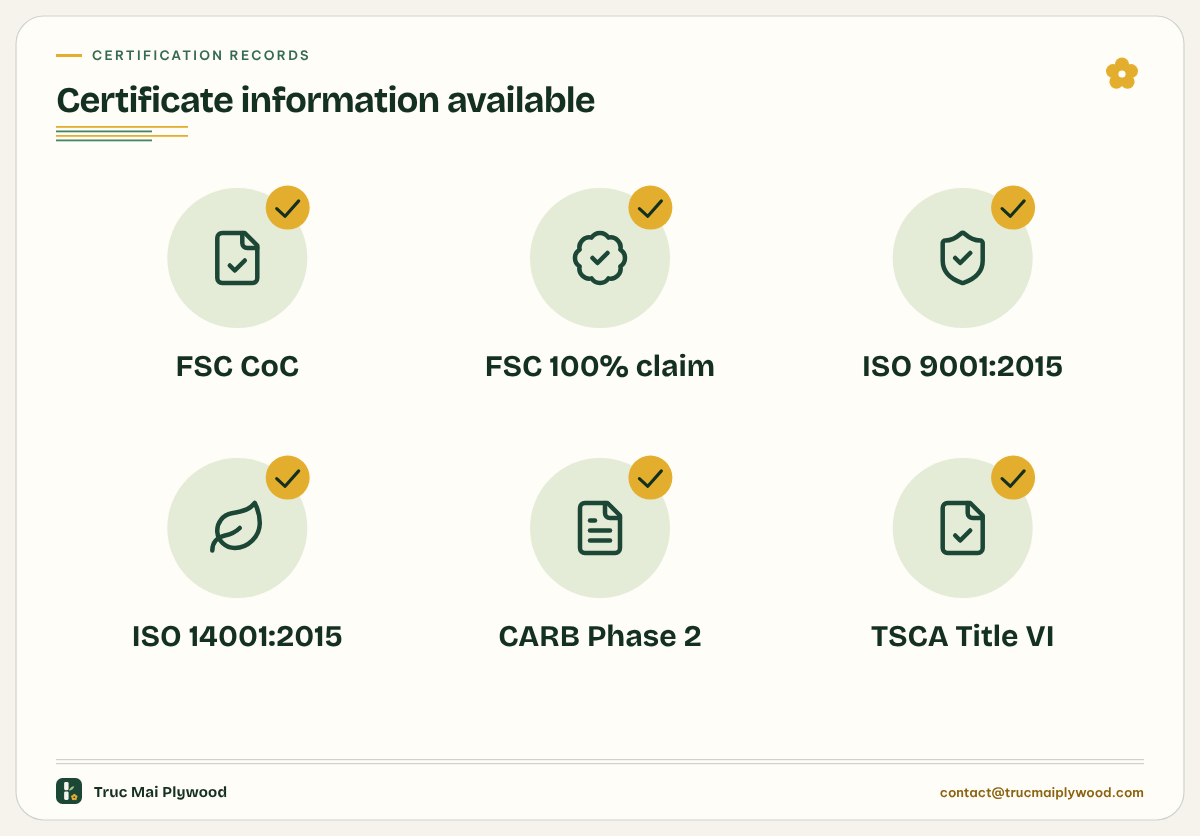
The mill holds FSC chain-of-custody certification under licence FSC-C196493 and certificate SA-COC-014545. Eligible products can be sold with an FSC 100% claim when that claim is included in the relevant sales documentation.
The FSC Chain of Custody standard, section 5.1, specifies the certificate code and product-level claim required on sales documents. Ask for the certificate identity and the claim applicable to the exact ordered panel rather than treating a mill certificate as a blanket label for every stock item. The FSC licence verification article explains how a buyer checks the code.
The mill also holds ISO 9001:2015 and ISO 14001:2015 management-system certifications. CARB Phase 2 and TSCA Title VI certification covers its specified hardwood plywood veneer-core products from 3–25 mm under CARB/EPA 26053. A UK buyer should choose documentation according to the destination market and the panel actually ordered, with certificate scope reflected in the specification.
How should a UK distributor arrange samples and repeat orders?
Start with a physical sample and a written specification, then use the approved combination as the reference for repeat containers. A distributor should keep the same stock code for the same face, core, adhesive system, finished thickness and pack format.
A useful sample review involves the merchant’s purchasing team and one representative downstream customer. The buyer checks the appearance and edge; the customer tests the sheet in its actual cutting or assembly process. Record any agreed changes in a new revision rather than relying on an email description such as slightly smoother or a little lighter.
The sample ordering process covers requesting material, while first order to monthly supply explains the transition to repeat purchasing. For a merchant stocking multiple thin sizes, separate sample approvals prevent a face accepted on one thickness from being silently treated as accepted on another. Attach the final sample reference to the first purchase order.
What should the RFQ say for a UK thin-sheet programme?
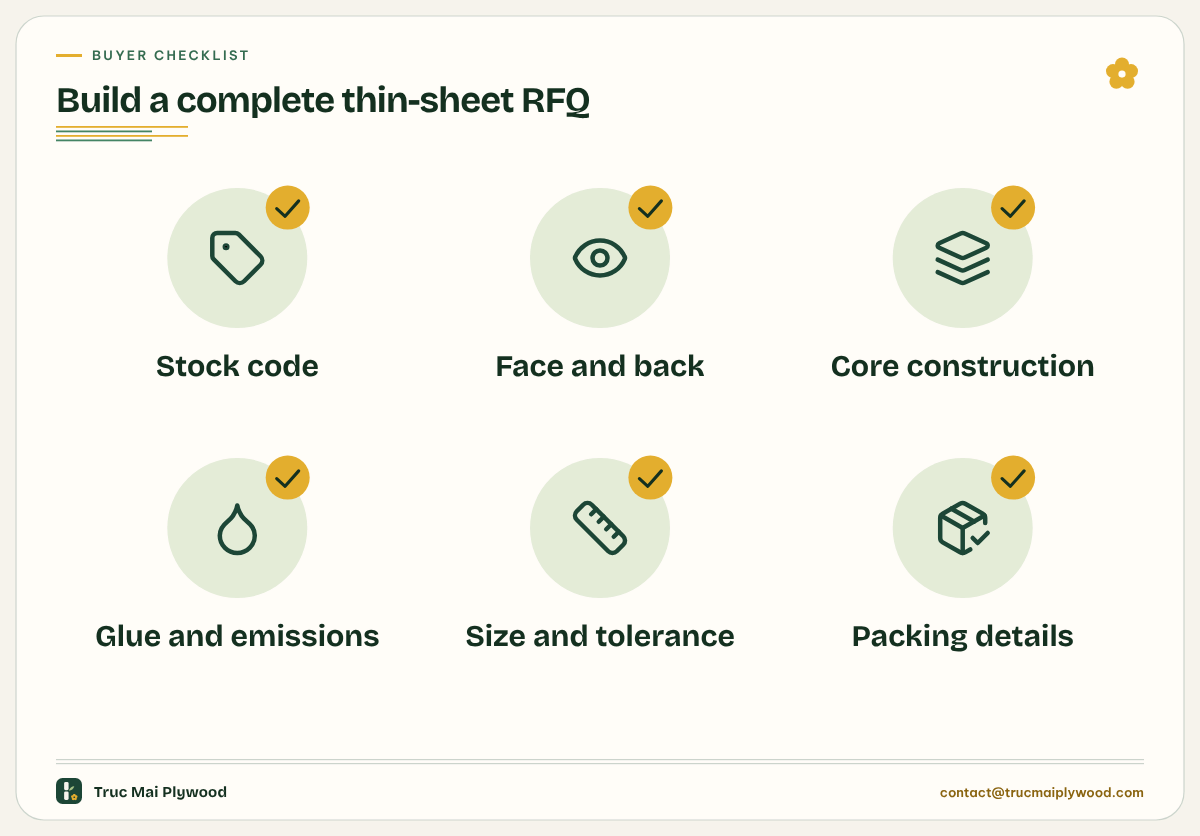
An RFQ should state the application, face and back, core, adhesive and emission requirement, finished thickness, sheet size, packing and quantity. Add the destination port, desired documentation and the reference sample or drawing revision.
Use the following sequence when preparing the order:
- Name the merchant stock code and intended interior use.
- State the front and back veneers, appearance grade and approved sample.
- Identify the core species and ply construction.
- Write the adhesive system, emission criterion and any test requirement separately.
- Specify finished thickness, tolerance, full-sheet or cut-piece dimensions and edge finish.
- Define pack identification, protection, container mix and quantity.
- Attach the destination, requested shipping documents and the latest drawing.
The mill’s standard minimum order is one 40HC, with FOB Hai Phong, CFR or CIF terms. Production is normally scheduled for 15–45 days after a 30% deposit, with the remaining 70% against the scanned bill of lading. Use the plywood RFQ checklist and send the completed specification to contact@trucmaiplywood.com.
Questions buyers ask
Can a UK merchant sell the sheet under its own label?
Yes. Specify the merchant label, carton or pack identification and the exact panel description on the purchase order.
Is a birch face the same as an all-birch core?
No. Birch-faced plywood describes the visible veneer; the inner plies can be another named species.
Can the face and back have different appearances?
Yes. State the face and back grades as a pair and approve a reference sample before production.
Is a polished surface available?
Yes. Sanded and calibrated faces are standard preparation; polishing can be specified separately.
Can the mill supply a sample before a container order?
Yes. Samples are available; new buyers arrange the courier, with its cost credited against an order.
Can different thin panel specifications share one container?
Yes. One or two products are usual, and three to six can be combined by agreement with a separate packing-list line for each.
Does the mill apply UV coating to these panels?
No. UV-ready panels have prepared faces for the buyer's subsequent coating process.
Can the buyer choose the destination port under a CIF quotation?
Yes. State the destination port in the RFQ and request the applicable CIF terms.
Should the merchant keep a retained reference sample?
Yes. Keep an approved face and edge sample alongside the written specification for repeat-order inspection.
Is the country of manufacture the same as the veneer origin?
No. A Vietnamese-made sheet can contain imported face veneer; request species and harvest-origin records for the actual build.