
Plywood price in UAE buying starts with the panel specification, not a single market figure. Dubai merchants quote individual sheets for immediate supply; a direct Vietnamese container adds ocean freight, Jebel Ali clearance and inland delivery. Compare identical thickness, face, core, adhesive and quantity before choosing either route.
What does a sheet of plywood cost in the UAE?
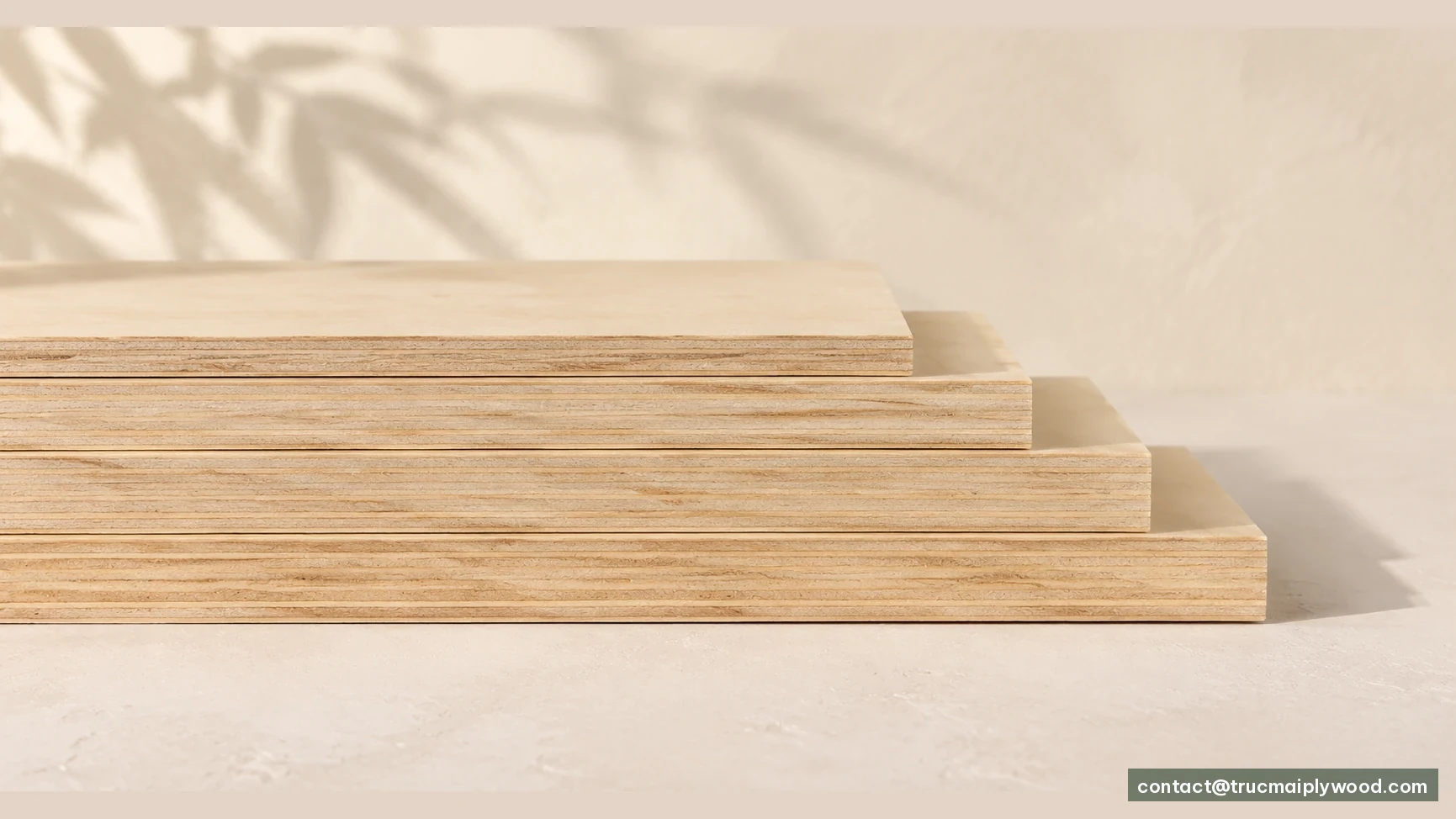
A UAE plywood sheet has no single market price: its cost depends on the specified panel, delivery point and order quantity. A 12 mm commercial sheet differs from an 18 mm decorative furniture sheet. Merchant quotations can include local stock and delivery, while factory quotations follow the agreed manufacturing and shipping terms.
For a useful 18mm plywood price in UAE enquiry, ask for the actual thickness, sheet dimensions, face/back grade, core species, bond specification and whether tax and delivery are included. Apply the same discipline to a 12mm plywood price in UAE enquiry.
| Item on the quotation | Record for every offer | Why the buyer needs it |
|---|---|---|
| Sheet | 1220 × 2440 mm or 1250 × 2500 mm | Different area and cutting yield |
| Thickness | 12 mm or 18 mm, measured and specified | Different material volume and stiffness |
| Core | Styrax, Acacia or Eucalyptus | Weight, packing count and handling |
| Face and back | Veneer species and approved grade pair | Visible appearance and finishing yield |
| Adhesive and emission | Separate specification lines | Bond performance and indoor use |
| Supply point | Merchant collection, delivered warehouse or port | Different logistics scope |
The guide to how plywood is priced explains why matching a product name is insufficient.
How do Dubai merchant prices compare with a direct container?
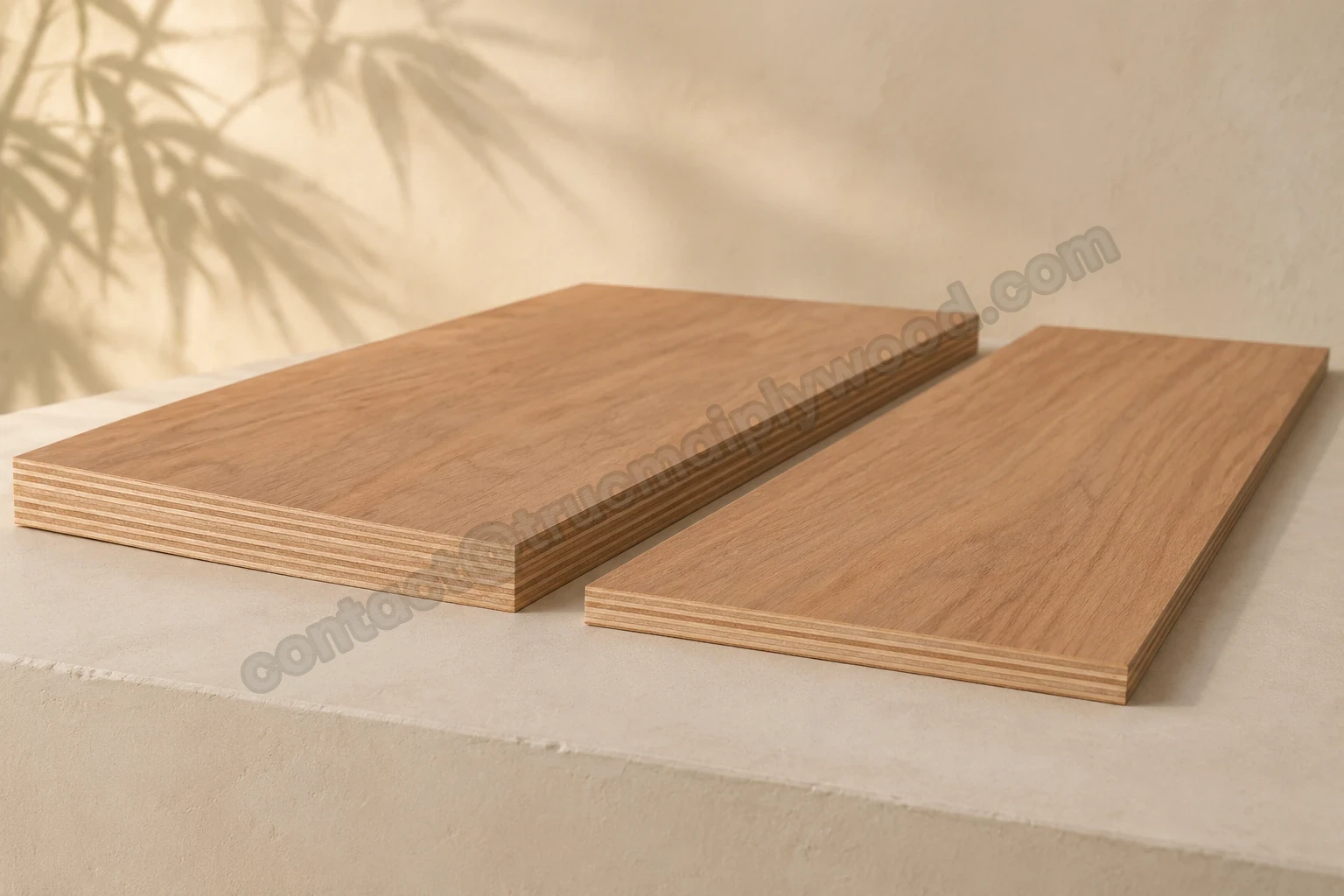
Dubai merchant supply is the simpler route for small, urgent or mixed purchases; direct-container supply is the route to examine when a factory consumes a repeatable panel specification at scale. The merchant provides local availability and smaller releases. The importer arranges a full shipment, accepts the import workflow and controls the factory specification directly.
Compare both offers at the same warehouse door, in the same units and for the same panel. A merchant quote may cover immediate collection but exclude cutting. A direct offer may start at FOB Hai Phong, where the buyer still arranges the main carriage.
| Buying route | Operational advantage | Work left for the buyer |
|---|---|---|
| Local merchant | Small releases, local stock, rapid replacements | Verify grade consistency and delivery scope |
| Direct 40HC | Repeatable specification, one production run, full-pack handling | Freight booking, customs, receiving and storage |
| Merchant with cutting | Parts arrive closer to production format | Check cut tolerances, labels and waste allocation |
| Mill-cut order | Cut plan follows approved manufacturing specification | Confirm piece labels and packing sequence |
The right decision turns on stock turnover. A cabinet manufacturer consuming full packs each month should model container supply against its actual usage, storage and defect allowance. See FOB Hai Phong quotation components before comparing the two routes.
What does a 40HC of Vietnamese plywood cost landed in Jebel Ali?
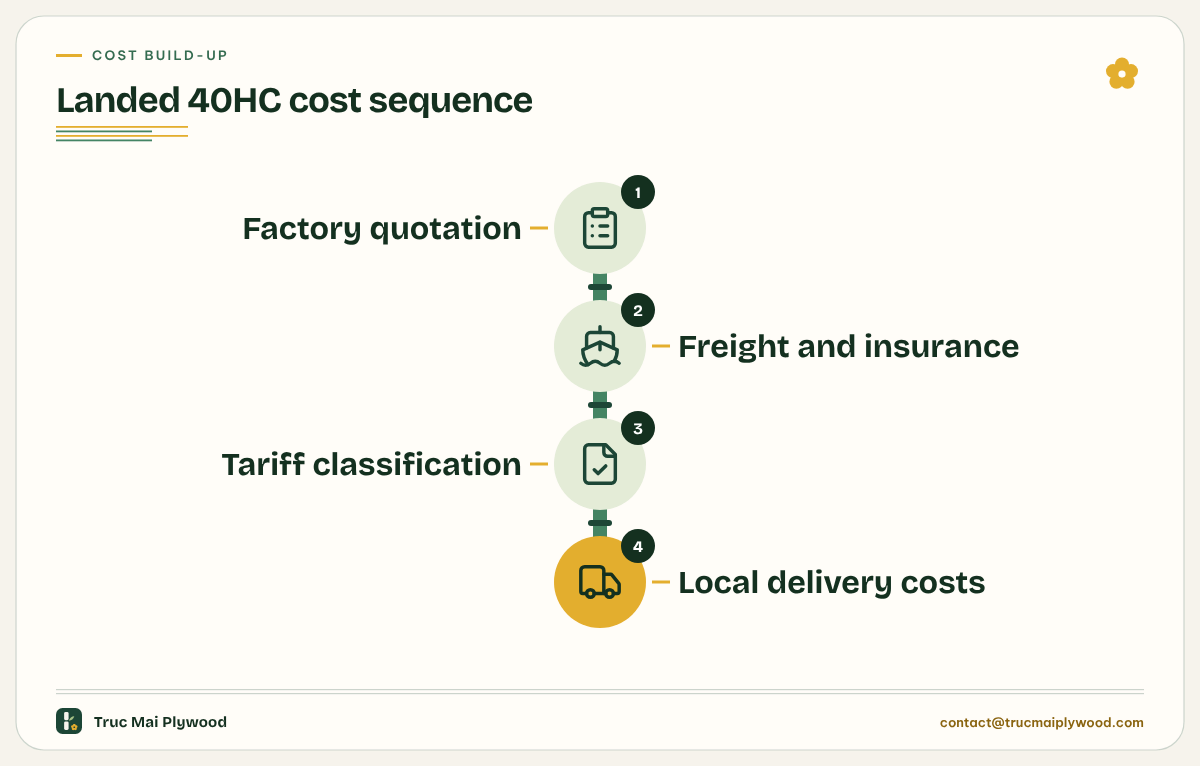
A landed 40HC cost at Jebel Ali is the accepted goods invoice plus international freight, insurance, applicable customs duty, port and clearance charges, and onward delivery. No verified dated factory quotation or freight booking is provided for this article, so a numerical total would misrepresent the shipment. Build the landed calculation from actual written offers and the customs declaration.
Dubai Customs states that its customs value uses cost, insurance and freight (CIF) up to the GCC port of entry in its 2025 service guide. Its customs FAQ explains the CIF duty basis; the applicable commodity classification is checked against the integrated tariff. Duty, tax treatment and charges belong on separate lines rather than being hidden in a single landed figure.
- Obtain the factory quotation with the agreed Incoterm and exact panel construction.
- Obtain the freight forwarder’s sailing quotation, insurance basis and destination charges.
- Classify the actual panel using the UAE customs tariff, with the broker checking the full commodity description.
- Add customs, clearance, handling, local transport and unloading to the same delivery point.
- Divide the completed landed amount by the actual accepted sheets or cubic metres on the packing list.
For a working cost sheet, cost one container to the delivery door and keep the underlying documents alongside it. The following table gives a usable physical denominator for planning, without inventing a commercial price.
How many 12 mm and 18 mm sheets fit into a 40HC?
The 40HC planning model produces different sheet counts for Styrax, Acacia and Eucalyptus cores because the panels have different reference densities. These are calculated panel-only figures, not measured shipments. Every row below reproduces the supplied calculation, including its original rounding.
| Core | Thickness | Sheet size, mm | Packs | Sheets per pack | Sheets | Volume, m³ | kg per sheet | Panel weight, kg | Weight capped |
|---|---|---|---|---|---|---|---|---|---|
| Styrax | 12 mm | 1220 × 2440 | 18 | 83 | 1494 | 53.4 | 17.9 | 26680 | No |
| Acacia | 12 mm | 1220 × 2440 | 16 | 83 | 1328 | 47.4 | 20.7 | 27510 | No |
| Eucalyptus | 12 mm | 1220 × 2440 | 15 | 80 | 1200 | 42.9 | 23.2 | 27860 | Yes |
| Styrax | 18 mm | 1220 × 2440 | 18 | 55 | 990 | 53.0 | 26.8 | 26520 | No |
| Acacia | 18 mm | 1220 × 2440 | 16 | 55 | 880 | 47.2 | 31.1 | 27350 | No |
| Eucalyptus | 18 mm | 1220 × 2440 | 15 | 53 | 795 | 42.6 | 34.8 | 27690 | Yes |
Calculation basis: 40HC planning model, panels only. Maximum packs: Styrax 18, Acacia 16, Eucalyptus 15. Pack height: 1,000 mm. Sheets per pack are the pack height divided by thickness, rounded down and capped by a 28,000 kg planning payload. Reference densities: Styrax 500 kg/m³, Acacia 580 kg/m³ and Eucalyptus 650 kg/m³. The planning payload is unconfirmed; the carrier and route determine the permitted load. This is a planning figure, not a loading record.
The weight figures above exclude packing materials. Real sheets and packing are weighed before the loading plan is finalised. The buyer can use the container loading guide to understand why comparing one full container with another requires the same core and sheet dimensions.
Which plywood specification makes UAE offers comparable?
A comparable UAE plywood offer starts with one written build specification and one approved physical sample. For furniture production, a sanded face, stitched A-grade core and calibrated thickness describe a different panel from a commercial AB-core board with lighter sanding. Both can serve legitimate uses, but they should be costed as different lines.
Write the face and back grades as a pair. For example, a birch-faced panel uses birch veneer on a Vietnamese core; it is not automatically all-birch plywood. Specify whether the face is bleached poplar, engineered veneer, okoume, eucalyptus, pine or another available species. The core can be Styrax, Eucalyptus, Acacia, Pine or an agreed combination. Matching a face species alone leaves the weight, internal construction and finishing result unresolved.
An RFQ for cabinetry should also record whether the panels arrive unfinished, UV-ready, melamine-faced or HPL-faced. UV-ready means that the surfaces are prepared for the buyer’s coating process. See the 18 mm hardwood plywood specification for the product-level choices.
Does plywood thickness change the plywood price in UAE comparison?
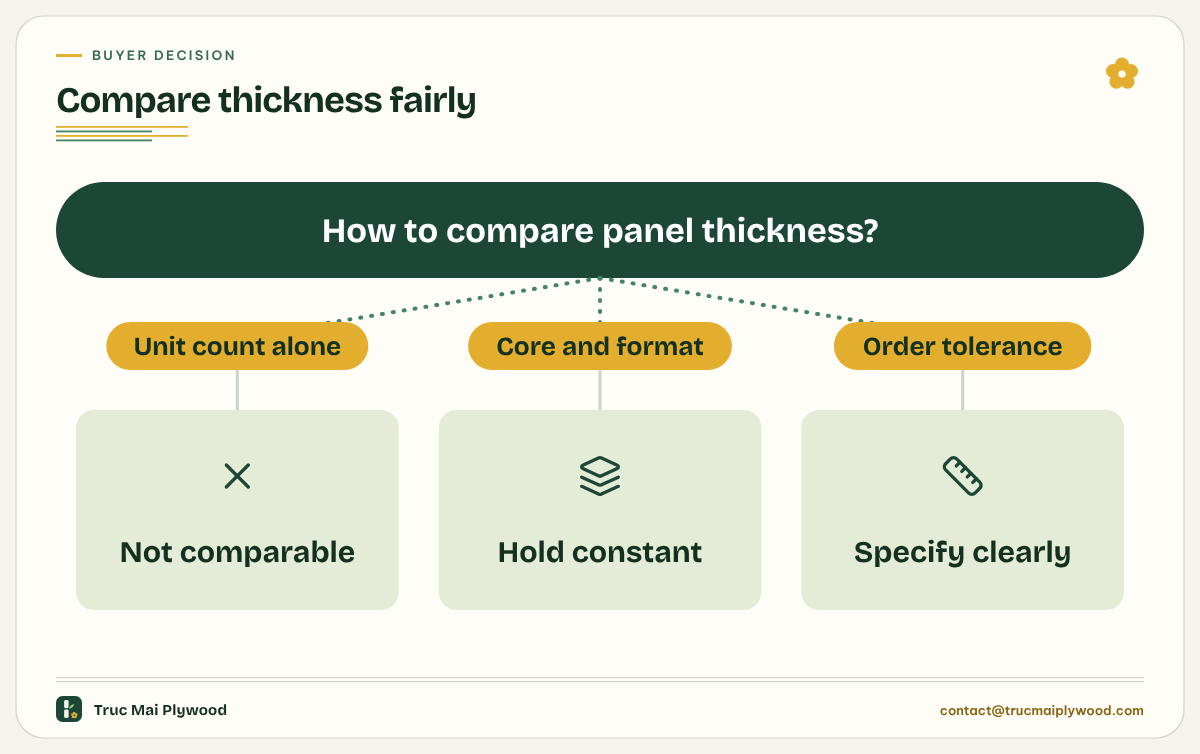
Yes. Thickness changes the sheet’s material volume, edge appearance, machining allowance and number of sheets in a pack. A 12 mm panel and an 18 mm panel cannot be compared on unit count alone. The 40HC table above makes the difference visible while keeping core and sheet format constant.
Record nominal thickness and the agreed manufacturing tolerance. Truc Mai Plywood writes thickness tolerance per order, with ±0.3 mm on sanded and calibrated furniture panels, ±0.5 mm on commercial grade and ±0.5–1.0 mm on packing grade. Length and width tolerance is ±2 mm. For CNC cutting, the buyer can set the approved sample beside the machine’s actual tooling allowance.
Specify thickness for the furniture design and fastening method; request an edge sample showing ply arrangement and core joints.
Which faces and cores work for Gulf interiors?
Styrax and Eucalyptus are practical core options for interior and commercial plywood, with Acacia or Pine available for a different weight and construction preference. The visible veneer should be chosen for the intended finish. A painted cabinet carcass, a clear-finished door and a concealed packing component do not require the same face.
A furniture manufacturer ordering a clear finish should approve the actual face grain, patch allowance and colour spread. For laminate application, the substrate should be flat, calibrated and prepared for the adhesive system. For a melamine-faced order, specify the décor and face finish rather than treating every white panel as interchangeable. Truc Mai’s range also includes bleached poplar and engineered veneer faces for consistent decorative appearance.
Keep incoming packs on level bearers and acclimatise them before precision machining.
How should adhesive and emissions be written on a quotation?
Adhesive type and formaldehyde emission are two different specifications. The mill’s default interior build is UF glue at E0 emission, while a moisture-resistance requirement calls for a separately agreed adhesive build. A buyer should never infer a bond class from an emission label or the reverse.
For US-bound veneer-core hardwood plywood, the EPA’s 40 CFR Part 770 specifies the TSCA Title VI formaldehyde framework. The factory’s CARB Phase 2 and TSCA Title VI certificate covers veneer-core hardwood plywood from 3 to 25 mm, certificate CARB/EPA 26053, with TPC-43. That scope can inform a procurement file, but the buyer should write the actual emission requirement on the order line.
For interior furniture projects, also distinguish a decorative appearance grade from the performance requirements of the finished product.
What happens at Jebel Ali before panels reach the warehouse?
The importer or appointed clearance agent submits the customs declaration, pays the applicable charges and arranges release and onward movement. The import documents must agree on description, origin, quantity, weights and consignee details.
Dubai Customs explains that a company with a customs business code, or an authorised clearance agent, can submit a declaration in its official customs FAQ. Ask the forwarder for a written destination schedule showing terminal handling, documentation, examination arrangements, storage and the final delivery movement.
For a Vietnamese factory shipment, the standard document set includes the commercial invoice, packing list, bill of lading, certificate of origin and the agreed plant-health or fumigation papers. Insurance documentation accompanies CIF shipments. The container document checklist gives the buyer a practical way to reconcile the paperwork before the cargo reaches the terminal.
How do Dubai and Riyadh purchasing routes differ?
Dubai and Riyadh are different landed destinations, even when the mill, panel and ocean leg start from the same origin. A Dubai merchant quotation is a UAE domestic offer. A Riyadh buyer needs the Saudi import or onward-distribution route and its own clearance, transport and tax treatment. The 18mm plywood price in Saudi Arabia and plywood price in Riyadh searches therefore describe a different delivery scope from Dubai stock collection.
Saudi Arabia’s official integrated tariff enquiry service provides classification searches by product description or tariff code. The buyer should obtain the correct commodity line and any applicable clearance requirements from the Saudi broker before asking for a delivered quotation. The UAE’s integrated tariff uses a GCC 12-digit structure, according to Dubai Customs, but a shared classification framework does not turn the two destinations into the same logistics job.
Ask the supplier to identify the intended destination in the RFQ: Jebel Ali, another UAE port or a Saudi entry point. A separate local-delivery line makes the comparison intelligible to the purchasing manager and the freight forwarder.
When does factory-direct buying fit a UAE furniture workshop?
Factory-direct buying fits a workshop with stable consumption, an approved panel build and enough receiving space for a full container. Truc Mai Plywood manufactures furniture/interior and commercial plywood in Ha Hoa, Phu Tho, Vietnam, with annual capacity around 60,000 m³. The minimum order is one 40HC, so the buyer should map consumption and storage before requesting a shipment.
Production normally runs 15–45 days after the deposit, depending on the agreed order and manufacturing conditions. Sea transit, customs and inland delivery are additional stages. A purchasing team should plan its next reorder from the factory production window plus the forwarder’s route schedule, rather than assuming the warehouse receives stock when production ends.
A buyer who consumes several faces or thicknesses can discuss mixed packing, with each product identified on the order. For repeat supply, keep the first approved face sample and tolerance specification as the reference for later deliveries. The first-order to monthly-supply guide describes how to organise repeat procurement.
How can cutting and packing change the effective sheet yield?
A labelled cut-to-size pack can reduce sorting and preparation work when the buyer’s cutting pattern is known before manufacture. Standard sheets can be split lengthwise into two 610 × 2440 mm pieces, into three 1200 × 800 mm pieces, into four 1220 × 610 mm pieces or into six pieces by agreement. Exact cut dimensions follow the buyer’s original sheet and cut list, with the final pattern agreed by email.
The purchase order should show the parent sheet, cutting orientation, piece label and pack sequence. A cabinet shop may prefer full sheets for flexible nesting; a repetitive furniture line may prefer labelled pieces that move directly to edge treatment. In either case, record yield against the usable parts required for the job.
The plywood RFQ checklist helps buyers specify finished parts and offcuts.
Which certificates and origin files belong with the shipment?
The shipment file should contain the documents relevant to the exact panel ordered, including any agreed FSC claim, emissions certificate and origin records. Truc Mai’s FSC chain-of-custody licence is FSC-C196493, with FSC 100% claims for eligible products on the applicable schedule. An FSC claim is written on the relevant sales documents rather than assumed for all plywood.
The factory also holds ISO 9001:2015 quality-management and ISO 14001:2015 environmental-management certification for plywood manufacture. Those are management-system credentials. For buyers preparing EU shipments, the factory supplies an EUDR due-diligence file with core and face-veneer origin records and geolocation information. A Gulf buyer can request the agreed provenance and compliance documents at the quotation stage when onward distribution requires them.
For verification, see verifying an FSC licence code.
What should a buyer send for a UAE or Saudi plywood quotation?
Send one RFQ with the end use, core, adhesive and emission requirement, face/back grade, thickness, sheet size, packing format, quantity and destination. The most useful first enquiry also states whether the buyer needs full sheets or labelled parts, and whether the quotation should cover FOB Hai Phong, CFR or CIF terms.
A workable specification line might read: cabinet interiors; Styrax core; UF adhesive with the agreed emission class; engineered veneer face with approved back grade; 18 mm; 1220 × 2440 mm; full sheets in labelled packs; one 40HC; destination Jebel Ali. This is an example of the information to provide, not a published stock offer.
Attach the intended finish and any sample photographs. Ask for the packing schedule and the certificate documents associated with that build. Once the mill’s quotation and the forwarder’s destination costs are on the same sheet, purchasing can compare direct supply with local merchant stock without mixing unlike products.
Send your specification to contact@trucmaiplywood.com or through the quotation form.
Questions buyers ask
Is commercial plywood the same as birch-faced plywood?
No. Commercial describes a broad buying category, while birch-faced describes the visible veneer. A birch face can be bonded to a different core species.
Can I order a European sheet size for the UAE?
Yes. Truc Mai Plywood offers 1250 × 2500 mm as well as 1220 × 2440 mm sheets. Specify the format on the order.
Can the mill label cut panels for a cabinet factory?
Yes. Cut-to-size panels can be labelled to the buyer's cut list, with the piece dimensions agreed by email.
Does a sanded face mean the panel is already coated?
No. UV-ready panels have prepared faces for the buyer's coating process; the mill does not apply UV coating.
Is the face grade the same on both sides?
Not necessarily. Face and back grades are written as a pair and approved against a sample.
Can a UAE buyer mix products in one container?
Yes. One or two products is usual, and three to six products can be mixed by agreement. Each product needs its own packing line.
Which payment terms apply to a factory order?
The standard terms are a 30% deposit and 70% against the scanned bill of lading, by T/T or irrevocable L/C at sight.
Can I request a physical sample before a bulk order?
Yes. Samples are free; a new buyer books the courier, and that courier cost can be credited against an actual order.
Is an FSC claim automatic for every sheet?
No. Eligible FSC 100% products are identified by the applicable certificate and sales-document claim. The agreed product schedule determines eligibility.
Are 30 mm panels included in the US emissions certificate?
No. The CARB Phase 2 and TSCA Title VI certification covers veneer-core hardwood plywood from 3 to 25 mm.