
To learn how to test plywood quality, start with the purchase specification, identify the tested panel and read each result against its named method and limit. Check formaldehyde emission separately from glue-bond strength, then verify dimensions, density, veneer grade and the laboratory record before approving a commercial shipment.
How to test plywood quality before approving a shipment
Start with six checks: product identity, visible construction, dimensions, moisture and density, glue-bond performance, and formaldehyde emission. The order specification decides which measurements matter and which report is relevant. A convincing number on a laboratory page is useful only when the tested specimen matches the panels being purchased.
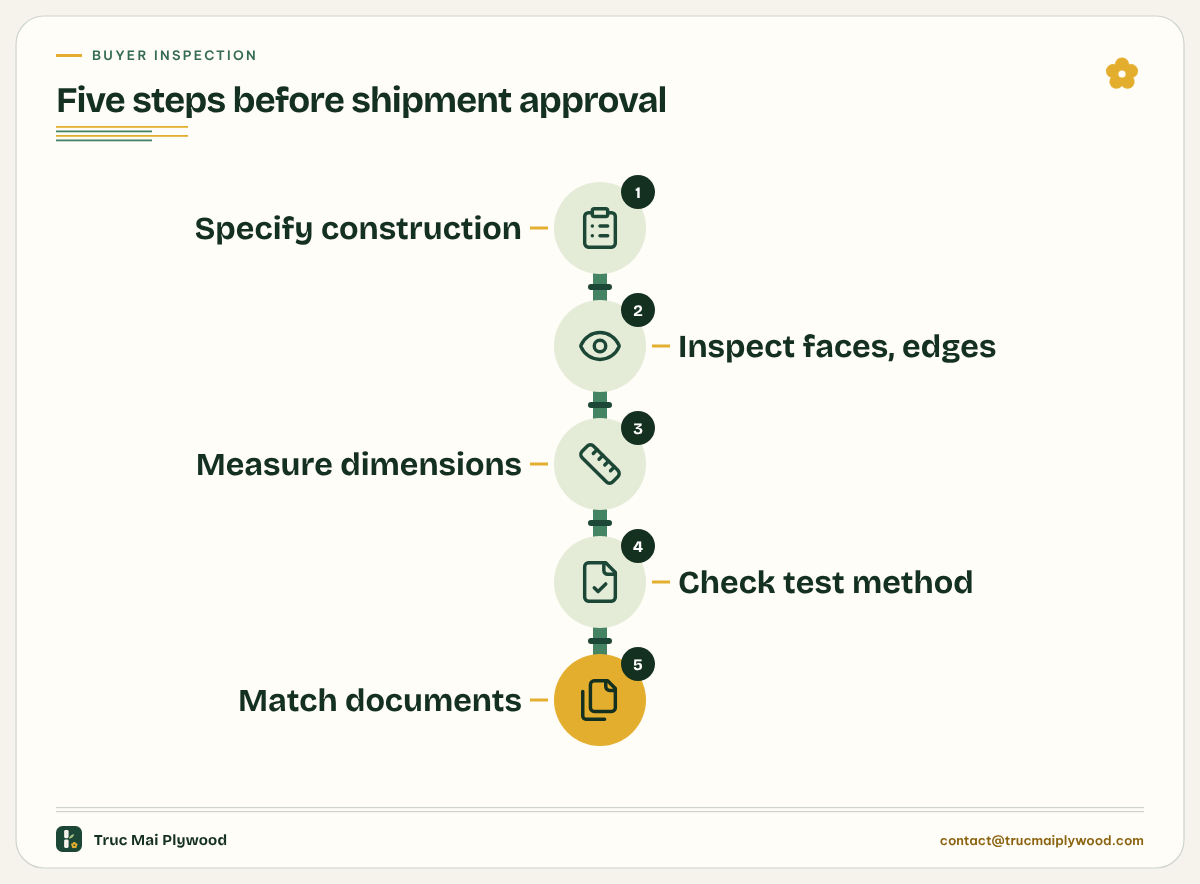
- Write the intended application and the exact face/back grade, core species, adhesive system, nominal thickness and sheet size.
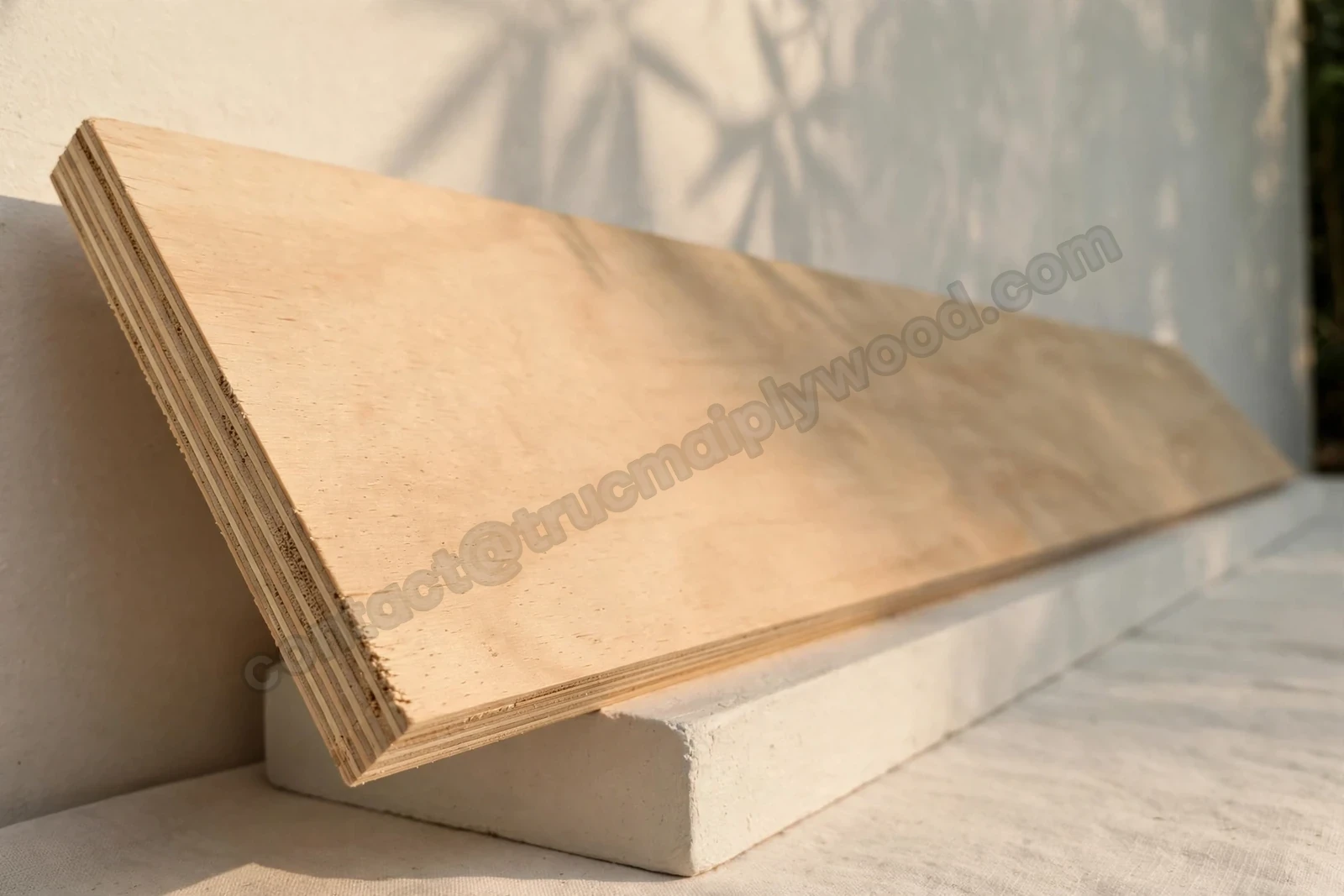
- Inspect a representative sample in good light. Look along the edges for gaps, overlaps and uneven plies; examine both faces for repairs, splits and sanding marks.
- Measure thickness at several positions and check length, width, squareness and edge straightness with suitable instruments.
- Read the laboratory method, specimen conditioning, result and acceptance criterion as a single unit.
- Match the report identification and construction to the pro forma invoice (PI), approved sample and shipment documents.
- Record discrepancies by order line, rather than rejecting or approving every panel on appearance alone.
A buyer ordering cabinet components needs a different evidence package from one purchasing general packing panels. For a practical pre-deposit supplier review, use the mill verification checklist alongside the test review.
What should a genuine plywood laboratory report contain?
A usable third-party report identifies the laboratory, customer or submitting party, specimen, test method, test conditions, measured result and report date. Check the report number on every page and read footnotes and annexes. A page headed “PASS” without a legible method or sample identity is a weak basis for accepting a different commercial build.
| Report field | What the buyer checks | Typical mismatch to investigate |
|---|---|---|
| Sample description | Core, face, thickness, adhesive and finish | Tested bare plywood, ordered overlaid panel |
| Method and edition | Named standard and conditioning procedure | Boil result used as emission evidence |
| Result and units | Value, unit and limit in the same method | ppm compared directly with mg/m³ |
| Laboratory identity | Issuer, report reference and signature or verification channel | Cropped or incomplete report |
| Dates and annexes | Sampling, testing and issue dates, attached specimen images | Old sample or missing appendix |
Ask for the original electronic report and verify its number through the issuing laboratory’s published contact channel. The objective is to establish the tested configuration and the traceable result, not merely to collect a certificate image.
How do emission test reports differ from bond-strength reports?
Emission tests measure formaldehyde released under specified conditions; bond tests assess adhesive-joint performance after specified conditioning. The two results answer different purchase questions. A plywood panel can have an emission result and still require separate evidence for a humid-service bond specification.
Read the specimen description first. Next identify whether the measurement is chamber concentration, gas analysis, glue-line shear strength or wood failure. Finally find the applicable limit and compare like with like. Glue type, emission class and bond class belong on separate lines of the purchase specification.
A laboratory may test a selected construction rather than every thickness and face combination in a catalogue. Record exactly which combination appears on the report. The formaldehyde limits explainer gives additional context for US-market documentation.
Which formaldehyde number applies to a US hardwood plywood order?
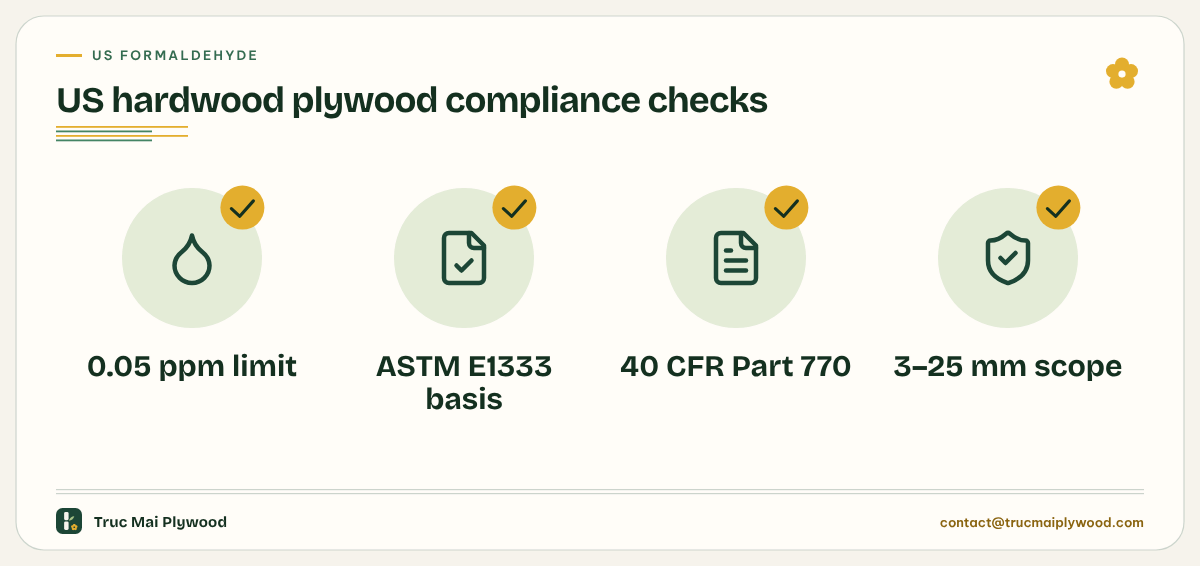
For hardwood plywood with veneer core, 0.05 ppm is the formaldehyde emission limit in US TSCA Title VI, using the ASTM E1333 reference basis. The US regulation, 40 CFR Part 770, specifies the regulated product categories, certification framework and testing provisions.
Read the product classification on the report before reading the number. Veneer-core hardwood plywood is distinct from particleboard and medium-density fibreboard. A buyer should check the manufacturer or mill identification, the approved third-party certifier and the covered thickness range. A certificate for one category is not a generic result for every panel made by the same business.
Truc Mai Plywood holds CARB Phase 2 and TSCA Title VI third-party certification for hardwood plywood with veneer core, 3–25 mm, under certificate CARB/EPA 26053, mill ICTT-26053, TPC-43. The report or certificate supplied for an order should be matched to the specified construction; thicker products are outside that stated certificate scope.
How should an EU buyer read E1 and REACH results?
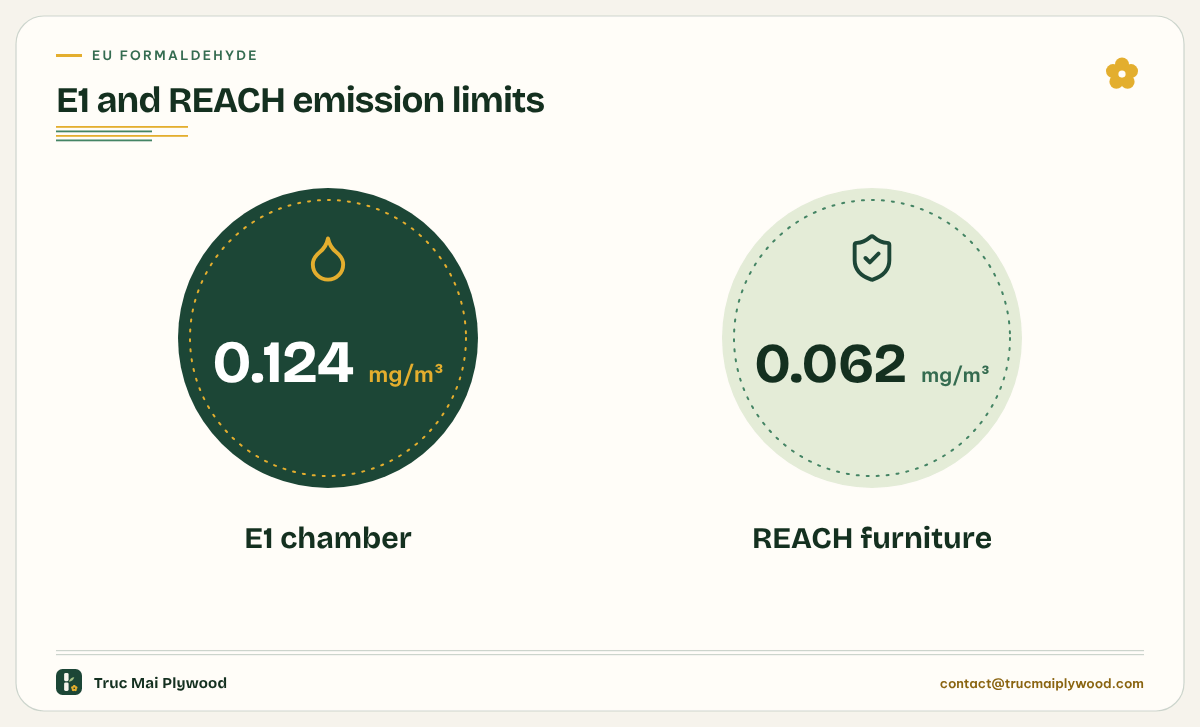
E1 and the EU REACH furniture restriction are different test frameworks. E1 under EN 13986 is associated with a chamber concentration of 0.124 mg/m³ under EN 717-1. For furniture and wood-based articles, the EU restriction sets 0.062 mg/m³ under its prescribed conditions. The European Commission’s formaldehyde restriction notice describes the article categories and limit.
Check whether the report names EN 717-1, a gas-analysis procedure or the REACH restriction test conditions. The conditioning, loading factor and specimen preparation affect interpretation. Do not take an E1 designation as a numerical REACH result, or translate a US ppm reading into an EU chamber value.
When the PI specifies an emission requirement, copy the method and limit onto the order line. That prevents an attractive but irrelevant test certificate being substituted at document review.
What does an EN 314 glue-bond result actually show?
EN 314-2 Class 1 covers dry conditions, Class 2 humid conditions and Class 3 exterior conditions. The conditioning procedure and the subsequent shear and wood-failure measurements determine the reported bond performance. A simple photograph of a boiled offcut does not replace the laboratory record.
The EN 314-1 procedures include a 24-hour water soak, a 6-hour boil for the Class 2 conditioning route and a 72-hour boil among the Class 3 procedures. The report should state the procedure applied, the number of pieces, mean shear strength and apparent cohesive wood failure. The latter helps interpret whether separation occurred through wood or at the adhesive line.
A buyer of interior furniture plywood can specify the required service environment without importing an unrelated structural or marine classification. If the order calls for a tested bond class, request the report for the matching adhesive and panel construction. Use the plywood quality-by-grade reference when defining a commercial acceptance schedule.
How can density and moisture results be checked?
Density is mass divided by volume, expressed for panels in kg/m³. Moisture content is a separate measurement. A report should show the specimen dimensions, measured mass, moisture method and conditioning details, because the measured density changes with the state of the wood.
For practical receiving inspection, compare pieces from the same specified construction and measure their actual thickness rather than assuming nominal thickness. A heavier sheet may reflect a denser core, different moisture state or different lay-up. Weight alone does not identify the wood species or certify the adhesive.
When comparing samples, use the same balance, measurement positions and conditioning procedure. Record the range of readings instead of choosing the most favourable sample. Keep the laboratory values in the original units and preserve the source report with the purchase file.
How do sheet dimensions and veneer grades affect acceptance?
A nominal thickness is an order description; acceptance uses the written tolerance and measuring method. For Truc Mai furniture panels, the specified sanded and calibrated tolerance can be ±0.3 mm; commercial and packing constructions have their own agreed tolerances. Length and width tolerance is specified separately.
Inspect several points on the face and across the panel edges. A centre reading alone can miss taper or local sanding differences. Check edge straightness and squareness for parts that will be machined or nested. Mark any measured defect with its position and photograph it next to a scale.
Face appearance is another specification, not a density result. Compare the delivered face and back independently against the approved sample and grade pair. Trade labels such as B/BB or BB/CC need the supplier’s written defect allowance. For cabinet-grade plywood, machining suitability and face consistency are often more actionable than a broad marketing grade.
What does a 40HC weight table tell you about plywood quality?
A 40HC loading calculation checks the consistency of sheet mass, core density and pack planning; it is not a laboratory strength test. The following figures are the exact derived rows in the supplied planning model. They illustrate why a density figure should be read together with dimensions and pack count.
| Core | Thickness | Sheet size (mm) | Packs | Sheets/pack | Sheets | Volume (m³) | kg/sheet | Total kg | Weight-capped |
|---|---|---|---|---|---|---|---|---|---|
| Styrax | 12 mm | 1220x2440 | 18 | 83 | 1494 | 53.4 | 17.9 | 26680 | No |
| Acacia | 12 mm | 1220x2440 | 16 | 83 | 1328 | 47.4 | 20.7 | 27510 | No |
| Eucalyptus | 12 mm | 1220x2440 | 15 | 80 | 1200 | 42.9 | 23.2 | 27860 | Yes |
| Styrax | 15 mm | 1220x2440 | 18 | 66 | 1188 | 53.0 | 22.3 | 26520 | No |
| Acacia | 15 mm | 1220x2440 | 16 | 66 | 1056 | 47.2 | 25.9 | 27350 | No |
| Eucalyptus | 15 mm | 1220x2440 | 15 | 64 | 960 | 42.9 | 29.0 | 27860 | Yes |
| Styrax | 18 mm | 1220x2440 | 18 | 55 | 990 | 53.0 | 26.8 | 26520 | No |
| Acacia | 18 mm | 1220x2440 | 16 | 55 | 880 | 47.2 | 31.1 | 27350 | No |
| Eucalyptus | 18 mm | 1220x2440 | 15 | 53 | 795 | 42.6 | 34.8 | 27690 | Yes |
| Styrax | 21 mm | 1220x2440 | 18 | 47 | 846 | 52.9 | 31.3 | 26440 | No |
| Acacia | 21 mm | 1220x2440 | 16 | 47 | 752 | 47.0 | 36.3 | 27270 | No |
| Eucalyptus | 21 mm | 1220x2440 | 15 | 45 | 675 | 42.2 | 40.6 | 27430 | Yes |
Calculation basis: 40HC planning model, panels only; 18 packs for Styrax, 16 for Acacia and 15 for Eucalyptus; pack height 1,000 mm; sheets per pack from height divided by thickness, rounded down and then weight-capped against a 28,000 kg planning payload. Reference densities: Styrax 500 kg/m³, Acacia 580 kg/m³ and Eucalyptus 650 kg/m³. These are planning figures rather than measured loading records; the carrier and route determine the booking limit. Packaging mass and actual sheet weights are checked for final loading.
This table can expose a misread density value or an inconsistent nominal size in a quote. For commercial transport planning, the documents per container checklist helps connect the specification with the final packing list.
Can a supplier provide a plywood emission test report Vietnam download?
Yes, request the complete PDF for the exact product build and its test method. A downloadable example found online is useful for learning report layout, but the purchase file needs evidence identifying the mill, specimen and applicable certification scope. Ask the supplier to send the laboratory document and its associated certificate before confirming the order.
For a Vietnamese veneer-core furniture plywood purchase, state whether the destination requires TSCA Title VI evidence, an EU emission test, or both. Then match the panel’s face veneer, core species, adhesive, thickness and finish to the report. An unsigned screenshot with no specimen details is insufficient for comparing offers.
If FSC material is part of the order, request the certificate code and product-level sales claim separately from the emission report. The FSC licence verification guide explains the document check. Do not treat a forestry chain-of-custody record as a formaldehyde test.
How can an FSC certificate be checked against the invoice?
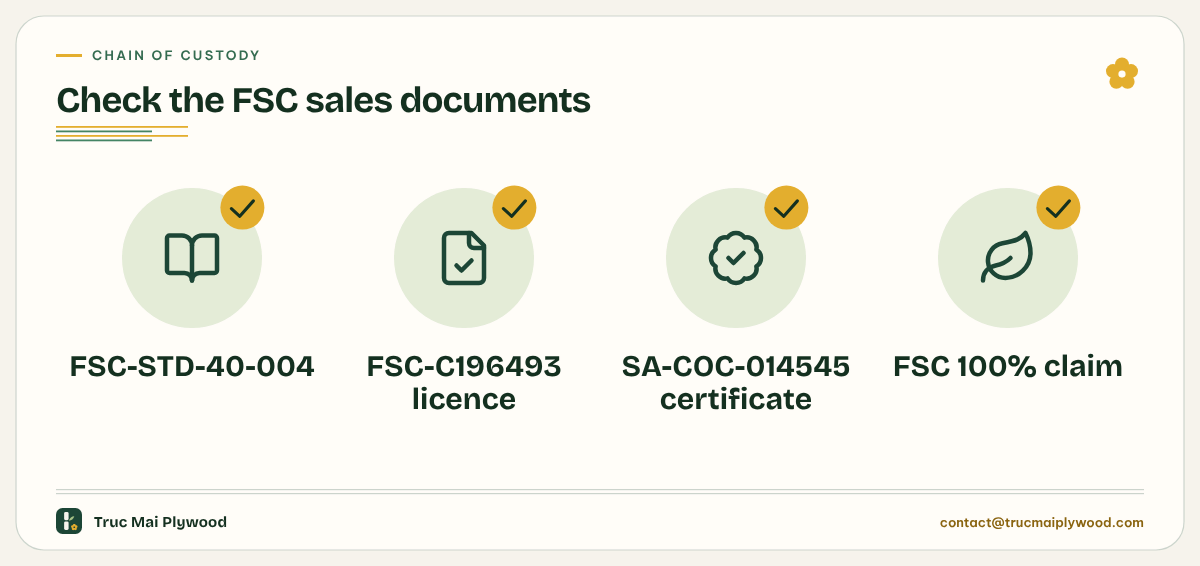
Match the seller’s FSC certificate code and the FSC claim for the product line on the sales document. The FSC Chain of Custody standard, FSC-STD-40-004 sets out the sales-document information required for certified outputs.
Truc Mai Plywood’s chain-of-custody licence is FSC-C196493, with certificate SA-COC-014545. Its eligible claim is FSC 100% for products on the certificate’s applicable schedule. Compare the ordered item and invoice claim with that schedule and retain the record with the shipment papers.
The emission certificate, FSC chain-of-custody record and quality management certificate have different purposes. File each under its own heading rather than presenting a combined logo panel as proof of all product characteristics.
What should the buyer compare with the pro forma invoice?
Compare the report against the PI line by line before the deposit. The best document package ties the tested product to the commercial description, approved reference sample and inspection criteria. A test for a different core or glue system is a different piece of evidence even when the product name is identical.
| PI specification | Evidence to attach | Decision to record |
|---|---|---|
| End use and service condition | Bond test method and classification | Appropriate to use |
| Face/back and core build | Approved sample, construction description | Matches sample |
| Thickness and sheet size | Measured sample and tolerance schedule | Within agreed limits |
| Emission requirement | Laboratory result and applicable certificate | Method and scope match |
| Quantity and packing | Packing specification and inspection record | Count and labels match |
Write each deviation against the precise order line and agree the remedy before production. A useful plywood RFQ template prompts the buyer for the construction details that make later report review straightforward.
Which checks can be done on a factory sample without a lab?
Visual inspection and dimensional measurement can screen a sample immediately. Lay the panel flat, inspect both faces in raking light and examine all four edges. Count visible plies where possible; look for open joints, overlapping veneers, surface blisters, edge crushing and patchwork that exceeds the approved appearance standard.
Use a calliper for thickness and a tape or straightedge for panel dimensions. Photograph any discrepancy with the tool visible. Check whether the surface is sanded, calibrated or prepared for the buyer’s own coating. For laminated products, inspect the overlay edges and surface finish as separate acceptance features.
A kitchen-cabinet buyer may prioritise flatness and screw-holding suitability, while a packaging buyer may focus on panel integrity and cut size. These checks support sampling decisions, but the laboratory method supplies the formal numerical classification. The sample ordering process is a practical starting point for comparing approved and delivered material.
How should an importer compare reports from different mills?
Use one comparison sheet with the same test method, specimen construction and acceptance criterion for every offer. Record the laboratory, report reference, test date and product identification before comparing the results. A lower numerical emission value measured by a different procedure is not automatically a better result.
Separate verified facts from proposed specifications. One mill may offer a sanded interior panel with a stitched core; another may quote an unsanded commercial panel. Those are different constructions even when both are called hardwood plywood. Compare like-for-like face quality, core joining, tolerance, adhesive system and supporting evidence.
If the face veneer is imported, ask for its origin documents and the core’s origin documents as separate records. The face veneer origin file explainer describes the information needed for traceability. Avoid treating a country-of-origin statement as evidence of a bond or emission test.
What documents should accompany the approved test results?
Keep the signed specification, approved sample record, laboratory reports and shipment papers together. The commercial invoice and packing list should use product descriptions that can be reconciled with the PI. The bill of lading identifies the transport movement; the certificate and test records identify relevant product characteristics.
For EU-bound orders, the due-diligence file may include species identification, origin records and plot geolocation for core and face veneer. This material belongs in the traceability file, separate from the laboratory emission and bond records. It is useful to index the file by order reference so the purchasing, logistics and compliance teams work from the same version.
At dispatch, compare actual pack labels and quantities against the final packing list. For a repeat order, keep the prior approved construction as a reference and record any change in core, veneer or adhesive before reusing a report.
How do you turn the results into an actionable plywood order?
Write the accepted method, limit, panel construction and inspection criteria into the purchase specification. Give the supplier a single controlled document with the intended application, face/back pair, core, adhesive and emission requirement, dimensions, packing and quantity. Attach the relevant reports by reference number rather than pasting isolated test values into an email.
For a factory-direct quotation, state the destination port and whether the order is a standard sheet or labelled cut-to-size panels. Cut patterns and finished dimensions should be agreed against the buyer’s cutting list. Truc Mai Plywood offers furniture/interior and commercial constructions with several face and core options, so the specification should identify the exact configuration being quoted.
Send the completed specification and supporting reports with the quotation request. The next commercial decision is then based on the same tested construction, sample and order line, rather than on competing interpretations of a certificate headline.
Send your specification to contact@trucmaiplywood.com or through the quotation form.
Questions buyers ask
Can I use a phone photograph of a report for purchase approval?
Request the complete legible PDF, including the laboratory identity, specimen description, method, result, date and any annexes. Compare it with the purchase specification.
Should I test every veneer species separately?
Choose representative constructions by core, face, adhesive system and intended use. A changed construction calls for a fresh review of the relevant test evidence.
Does an ISO 9001 certificate give the panel a strength rating?
No. ISO 9001 concerns the quality management system; a panel strength rating needs the relevant product test and classification.
What if the sample looks better than the delivered boards?
Retain the signed reference sample, photograph the delivered face and edges under consistent light, and compare the agreed face/back grade and inspection terms.
Is a laboratory report the same as an inspection certificate?
No. A laboratory report records specified tests on identified specimens; an inspection document records observations or checks against an order or shipment.
Can a supplier use an old report for a new order?
Compare the report specimen and test date with the current core, adhesive, veneer and manufacturing specification. Request evidence for the configuration being ordered.
Does an E0 label identify a universal European emission limit?
No. E0 is not a class under EN 13986; the buyer should specify the numerical threshold and test method.
How should I store reports for repeat purchases?
Index each PDF by supplier, product build, report number, date, test method and purchase order. Keep the approved specification alongside it.
Can I test a delivered sheet without laboratory equipment?
You can check dimensions, visible defects, edge construction and packaging condition with simple tools. Formal emission and bond classifications need the specified laboratory method.
Should the face and back grades be recorded separately?
Yes. Record a face/back pair against the approved sample so a good face does not conceal a back that falls outside the purchase specification.