
For PVC furniture vs plywood furniture, plywood is usually the stronger choice for screw-fixed kitchen carcasses, long shelves and wardrobes. Solid PVC can suit a persistently wet sink compartment. Truc Mai Plywood supplies furniture-grade plywood with specified core, face and adhesive, so cabinet makers can compare actual constructions rather than material names.

Which is better for a modular kitchen, PVC or plywood?
Plywood is the better default for a modular kitchen’s main carcasses; solid PVC is a useful alternative for a small compartment that faces repeated water contact. A cabinet side carries shelf supports and hinge plates. A sink base faces leaks around pipe penetrations.
A plywood carcass uses cross-laid wood veneers. It gives the assembler a continuous material into which screws can bite, and it accepts decorative surfaces including melamine and high-pressure laminate. See plywood for kitchen cabinets for a more detailed specification of the timber option.
For a sink compartment, choose the material after deciding how leaks will be contained and how the cabinet can be opened for repair. A plastic panel does not absorb water like wood, but hinges, joints, backing, fasteners and adjacent furniture still need inspection. A removable sink-floor liner and accessible plumbing can make a plywood assembly easier to maintain.
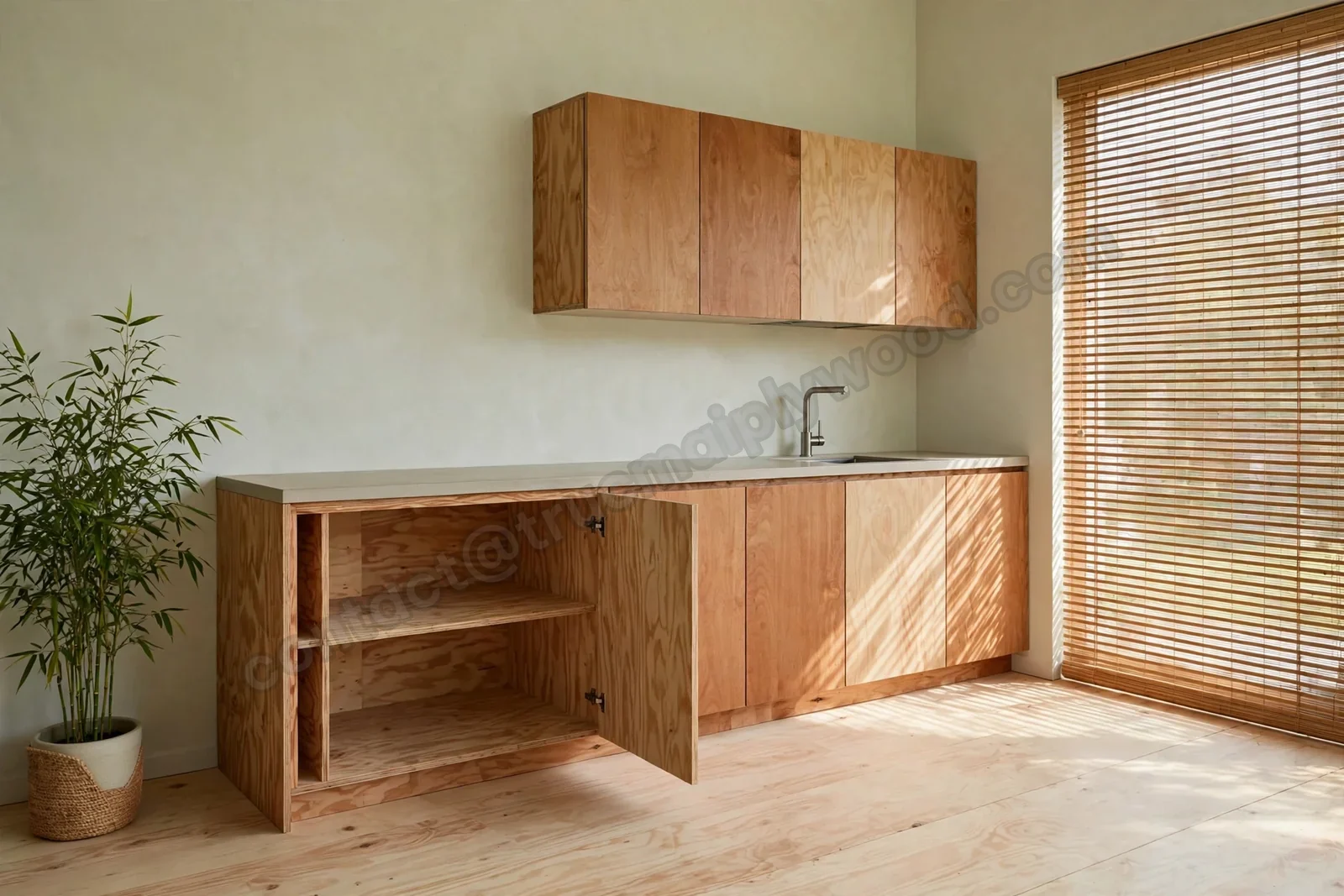
How does PVC furniture vs plywood furniture compare by component?
PVC furniture vs plywood furniture differs most at the joint, shelf and exposed edge, rather than at the visible colour. Use the following comparison for cabinet carcasses, not for worktops or appliance housings.
| Decision point | Solid or foam PVC board | Veneer-core plywood | Buying check |
|---|---|---|---|
| Hinge screw fixing | Depends on density and insert design | Continuous veneer layers accept conventional wood fixings | Repeated hinge-cycle trial |
| Long shelf | Check creep and sag under sustained load | Good candidate for loaded shelves with suitable supports | Same span, load and thickness |
| Water at an exposed edge | Polymer does not swell as wood does | Edge sealing and bond specification matter | Wet-edge assembly trial |
| Warm hob-adjacent zone | Thermal movement and softening need checking | Bond and surface finish need checking | Appliance clearance and heat exposure |
| Decorative face | Colour and texture depend on board system | Veneer, melamine and HPL options | Approved finish sample |
| Damaged screw hole | Insert or local reinforcement may be needed | Larger fixing or repair block may be possible | Repair procedure on sample |
| Machining | Chips, dust and tool settings vary by formulation | Woodworking tools and edge preparation | Factory cutting trial |
| Repeated orders | Specify exact polymer formulation | Specify core, glue, face and tolerance | Approved reference sample |
Test the finished corner joint, shelf and hinge plate with the same fasteners.
Does PVC board hold screws as well as plywood?
No, ordinary PVC board is not a direct substitute for plywood at repeatedly loaded wood-screw joints. Plywood’s veneer layers offer a familiar substrate for cabinet screws; PVC fixing capacity is strongly affected by whether the board is hollow, foamed or solid and by the manufacturer’s approved fastener system.
A door repeatedly opens, closes and loads its mounting plate in several directions. Ask the cabinet maker to mount the intended hinge on both candidate panels, cycle it, then remove and refit it.
For plywood, the core construction matters. An A-grade stitched furniture core provides more predictable fixing zones than a loosely laid core with gaps. See cabinet grade plywood for core selection. Truc Mai’s furniture line uses stitched core construction and sanded faces; its commercial line can use a different joining method. The order should therefore name the core build, not merely say ‘plywood’.
Inserts, through-bolts or local reinforcement can change the joint design.
What is the best material for a kitchen cabinet?
Furniture-grade plywood with a suitable moisture-resistant bond is a practical first choice for the main kitchen cabinet box.
Choose the carcass before choosing the shutter. The countertop, cabinet body, back panel, shelf and shutter can each have a different specification. A melamine-faced plywood body can pair with a painted shutter, while a plain plywood body can receive a laminate at the cabinet factory.
Cabinet makers should request a full-sized side panel and a shelf sample. Measure the delivered thickness, inspect the exposed core, check the cut edge and fit the intended hardware.
What happens when water reaches the sink cabinet?
PVC avoids wood-fibre swelling at the panel itself, while plywood needs sealed edges and a bond chosen for the exposure.
On plywood, water enters most readily at exposed cuts, drill holes and damaged edges. Specify edge banding or a compatible sealing system after machining. Keep the cabinet base accessible, support the sink independently where necessary and avoid trapping moisture behind an impermeable finish.
The US Forest Service’s Wood Handbook chapter on adhesives distinguishes the wetting resistance of urea-formaldehyde, melamine-based and phenolic adhesive families. That supports selecting a bond system for the intended service conditions, not calling every plywood sheet water-resistant.
How should a buyer compare MR and moisture-resistant plywood bonds?
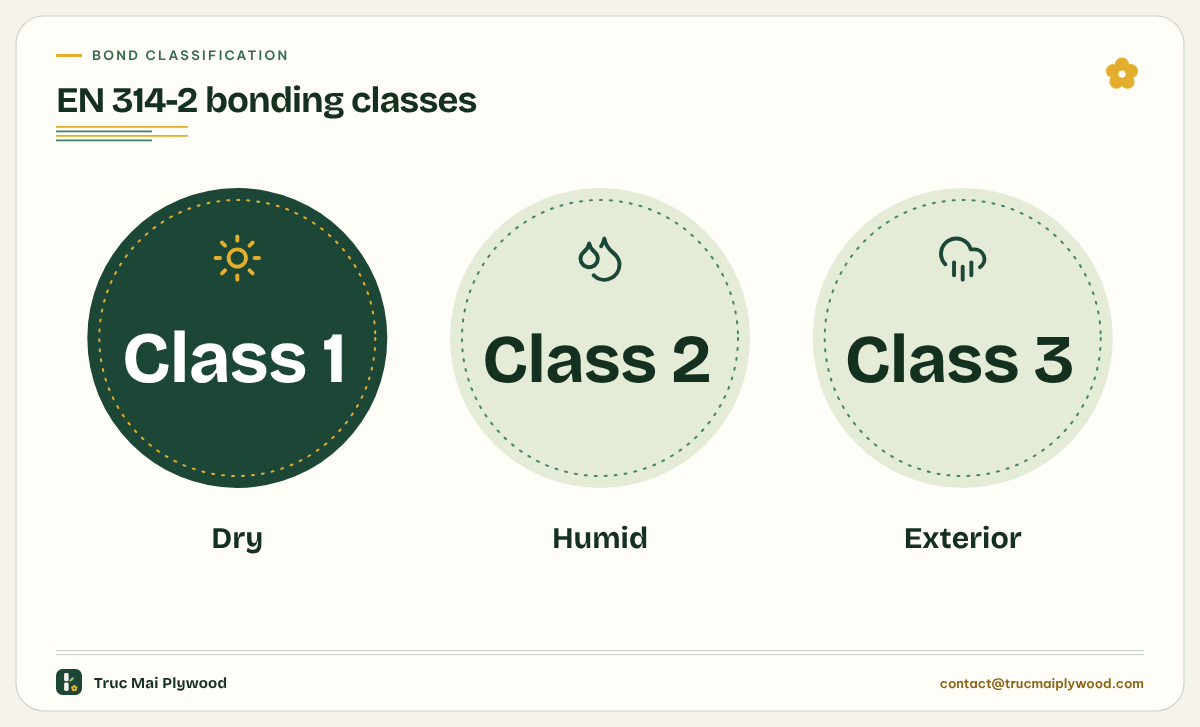
Specify the adhesive system and the tested bond requirement separately. UF adhesive is associated with dry interior panels; melamine-modified and phenolic systems offer different resistance to wet conditions.
The European EN 314-2 framework distinguishes Class 1 dry, Class 2 humid and Class 3 exterior bonding conditions. Its standard preview identifies the bond-quality requirements.
For a furniture programme, write the expected kitchen zone and the bond performance on the specification sheet. Request a test report for the actual panel construction when a named class is part of the purchase. Compare two panels only after their core, face and adhesive are known.
Which material works better beside a hob or oven?
Plywood is generally the more practical cabinet substrate beside a hob when the installation follows the appliance maker’s clearance and shielding instructions. PVC needs particular attention to heat distortion and movement.
Ask the fabricator to identify the cabinet part nearest the appliance, its surface finish and the method used to protect its exposed edge. Examine a finished sample after a representative heating cycle, looking for warping, softened edges, loosened adhesive and changed hinge alignment.
Check the appliance manufacturer’s specified gaps and air paths before finalising the cutting list. See plywood for kitchen cabinets for carcass choices.
Is an aluminium wardrobe better than plywood?
No for a conventional built-in wardrobe with shelves and wood-style finishes; plywood is usually the easier material to machine, finish and repair. Aluminium becomes attractive where the designer wants a metal frame, a lightweight modular system or surfaces that are regularly wiped down in a damp setting.
An aluminium wardrobe is often a framed assembly with separate infill panels. A plywood wardrobe is commonly a panel carcass whose sides and shelves form the box.
For a plywood wardrobe, the main decisions are face appearance, thickness, shelf span and the quality of the exposed edge. A birch-faced panel, for example, describes the visible veneer, not an all-birch core. The supplier should write the core species and face grade separately.
Which is costly, aluminium or plywood?
A complete aluminium wardrobe can cost more to fabricate than a conventional plywood carcass when its profiles, connectors and specialist fittings are included; the reverse is possible for a highly finished plywood design. Compare finished assemblies, not the weight or area of raw material.
Request two bills of materials based on the same wardrobe drawing. The aluminium version needs profiles, corner connectors, infill panels, sliding or hinged hardware and installation labour. The plywood version needs carcass panels, edging, surface finish, fasteners, machining and installation.
A purchasing team can use a simple checklist without inventing a universal material-price ranking: are the doors included, are drawer runners identical, is backing included, and who supplies installation? A quotation that omits a profile or finish operation cannot be compared with one that includes it. For plywood procurement, how plywood is priced explains the construction variables behind an offer.
How should PVC, WPC and uPVC be distinguished?
PVC, wood-plastic composite (WPC) and unplasticised PVC (uPVC) are different material descriptions and should occupy separate lines on a cabinet specification. PVC is a polymer family, while WPC contains wood-derived filler in a polymer matrix; uPVC identifies a rigid PVC formulation.
Request the board’s cross-section, nominal thickness, density specification, approved screw system and temperature-use information. A hollow extrusion should not be judged by the same fixing assumptions as a solid sheet. A foamed board should be tested for local compression under hinge plates and shelf supports. Surface films and decorative skins should be identified separately from the core material.
Preserve a labelled sample of the accepted formulation and ask the assembler to demonstrate cutting, drilling and edge finishing on that sample.
How do finishes and appearance change the decision?
Plywood offers the broader route to wood-veneer appearance and conventional decorative laminates; PVC offers colour-through or decorative plastic finishes.
A plywood buyer can specify engineered veneer, poplar, birch-faced or other decorative faces, then choose a laminate or melamine surface for a consistent cabinet interior. A UV-ready plywood face means prepared for the customer’s coating process, not a factory-applied UV coating. With PVC, verify how the decorative film joins the edge and how a scratched or detached film is repaired.
Inspect a full sheet, a cut edge and an assembled corner under the same lighting. Check colour agreement between door and body, edge-banding colour, surface flatness and whether the selected finish shows fingerprints. For large furniture programmes, keep the approved face and back samples with the purchase specification so later deliveries can be checked against the same reference.
How do panel thickness and core selection affect furniture production?
Thickness, core and face must be specified together for repeatable plywood cabinet production. Truc Mai offers 3–40 mm furniture and commercial panels in regular formats of 1220 × 2440 mm, 1220 × 2280 mm and 1250 × 2500 mm. A cabinet maker should choose the thickness from the finished drawing and the hardware manufacturer’s fixing requirements.
A Styrax core can be useful where weight and handling matter; Acacia and Eucalyptus are options where a denser core is desired. Pine and combined cores are also available. For furniture panels, thickness tolerance is written on the order, commonly ±0.3–0.5 mm, with tighter selection within that stated range for calibrated work.
Check the delivered thickness at several positions, inspect veneer joints and compare the panel with the approved face sample. A long production run needs consistent machining behaviour, because a small change in thickness changes the fit of grooves, edging and connectors. The 18 mm plywood specification provides a separate reference for that common cabinet dimension.
Can cut-to-size plywood reduce cabinet assembly work?
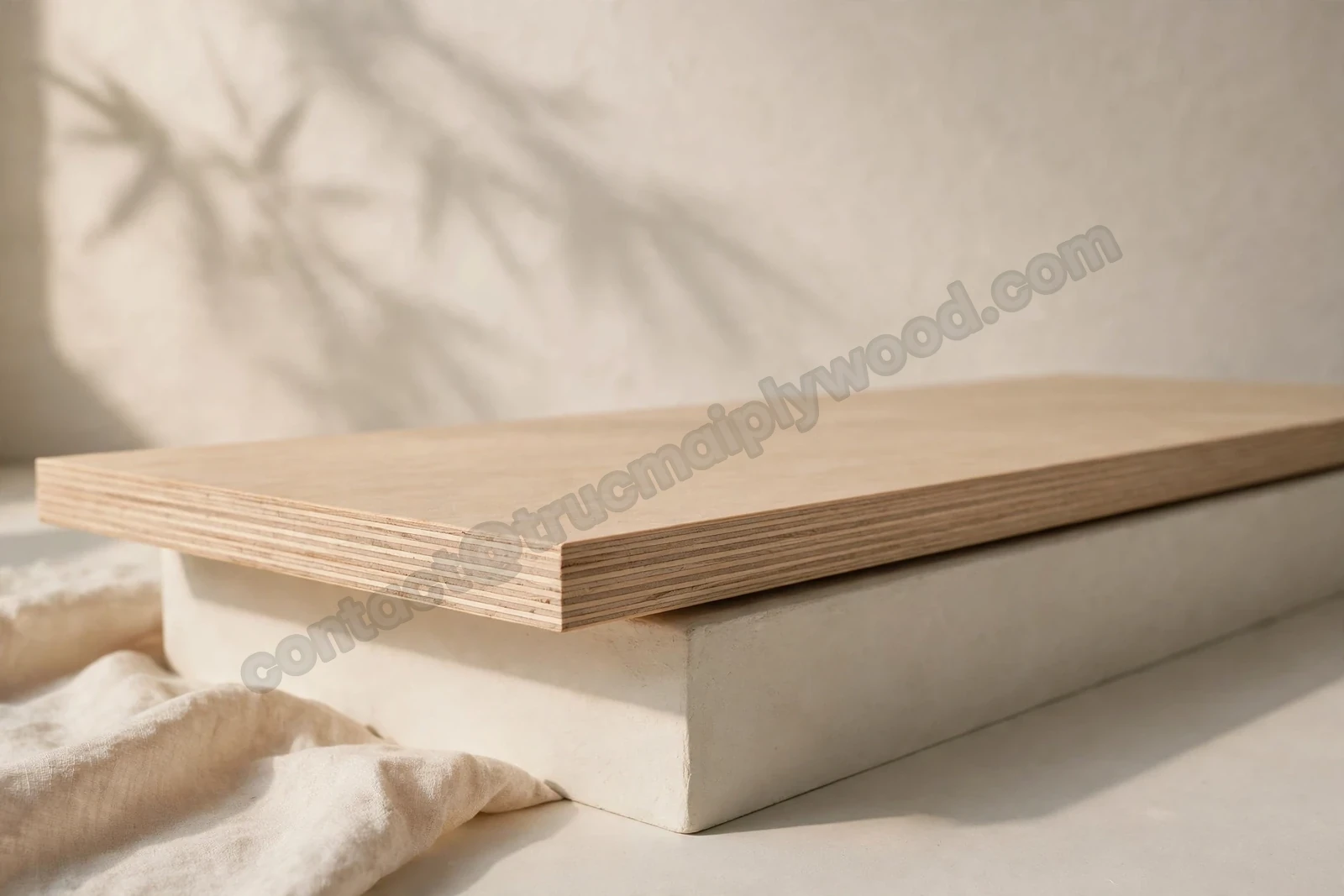
Yes. Factory-cut, labelled plywood components can reduce repeated cutting and sorting at the cabinet shop. The mill works from the buyer’s approved sheet size and cutting list, with finished piece dimensions agreed before production. The cutting plan must also identify the face direction and any grain matching requirement.
A standard sheet can be divided lengthwise into 610 × 2440 mm halves, into 1200 × 800 mm parts for a specified layout, or into 1220 × 610 mm quarters. Six-part layouts are also available. Other piece dimensions are settled from the cut list and an appropriate parent sheet rather than inferred from a nominal catalogue format.
For a repeat modular kitchen, send the part code, dimensions, quantity, visible face, edge treatment and pack group for each item. Request labelled stacks grouped by cabinet or production batch. See cut-to-size plywood panels for the supply route.
Which tests should a furniture importer ask for?
Ask for a fixing trial, a moisture-exposure assembly trial and the emission documents required in the destination market. A hinge trial checks the joint; a wet-edge trial checks the assembled cabinet; a formaldehyde report concerns emissions from the specified wood-based panel.
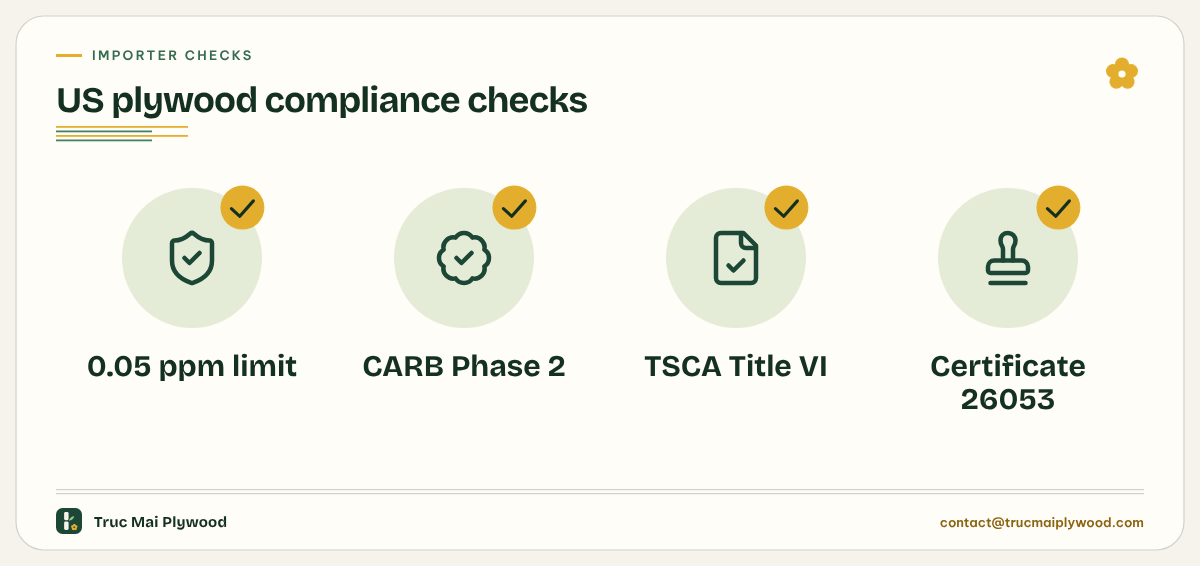
For US-bound veneer-core hardwood plywood, 40 CFR Part 770 sets a formaldehyde limit of 0.05 ppm for the covered product category. The US EPA’s composite wood products page explains that the TSCA Title VI and CARB Phase II emission standards are set at identical levels and backed by a third-party certification programme. Truc Mai holds CARB Phase 2 and TSCA Title VI certification for veneer-core hardwood plywood in the certified 3–25 mm scope, certificate CARB/EPA 26053. This certificate is relevant to emissions, not to a PVC comparison’s screw or wet-edge test.
Keep the report’s sample construction and method attached to the purchasing file. Do not replace a cabinet-specific trial with a generic certificate. The Phase 2 formaldehyde limits page covers the US documentation question in more detail. If a retailer specifies another destination standard, put that requirement on the order before sampling.
How should a factory compare the total cost per carcass?
Compare one completed, installed carcass built to the same drawing and service requirements. The purchasing worksheet should cover board, cutting, edging, hardware, assembly, packing, transport and repair. A lower raw-board quote can lead to more work if the chosen material needs special inserts, reinforcement or a different cutting process.
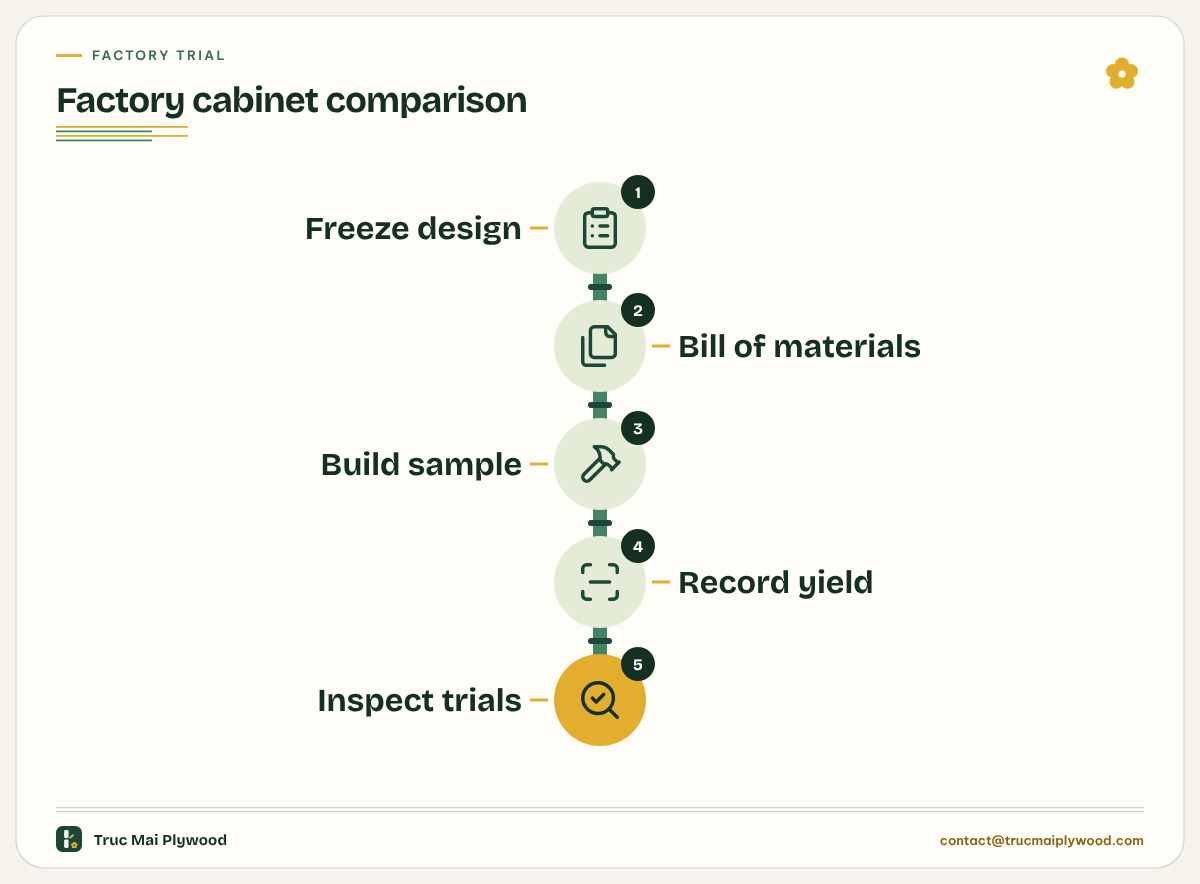
- Freeze the cabinet drawing, shelf loads, door hardware and exposure zones.
- Obtain a bill of materials for each material system, including the backing and fixings.
- Build a sample cabinet with the intended machines and assembly crew.
- Record cutting yield, edge-finishing work, hinge installation and damaged components.
- Inspect the sample after the agreed loading and moisture trials.
- Compare the accepted assemblies on the same delivery and installation basis.
A furniture factory ordering by container can also compare packaging efficiency and repeatability, because damaged or mislabelled parts consume workshop time. The RFQ writing checklist helps buyers turn a sample result into an order specification.
What should the plywood RFQ say for a modular kitchen programme?
Write the application, core, adhesive and emission requirement, face, dimensions, packing and quantity as separate order lines. Add the approved cabinet drawing and the hinge or shelf test that the sample must pass.
A furniture-carcass enquiry can request a stitched core, sanded faces, a named decorative finish and a thickness tolerance agreed in writing. State whether the delivery should be full sheets or labelled parts. The mill’s regular furniture range includes melamine-faced and HPL-faced panels as well as veneer-faced sheets. Truc Mai’s standard minimum is one 40HC, with FOB Hai Phong, CFR or CIF terms available for container programmes.
Use the quotation page to send the cabinet application, core, glue/emission requirement, face, sheet size or cutting list, packing plan and order quantity. Attach the accepted sample reference and destination port. A quotation built around those fields gives the factory and the buyer the same basis for the first shipment and later repeat orders.
Questions buyers ask
Is hollow PVC board suitable for heavy kitchen shelves?
Hollow PVC board is a poor default for heavily loaded shelves because its internal voids reduce the material available for fixing and bending resistance. Request a loaded-span demonstration for the actual shelf and supports.
Can a plywood cabinet have a white factory-finished face?
Yes. White melamine-faced plywood provides a ready decorative surface while retaining a veneer core for cabinet construction. Specify the face and back together.
Is uPVC the same as WPC board?
No. uPVC is unplasticised polyvinyl chloride; WPC is a wood-plastic composite formulation. Their density, fastener performance and machining requirements should be evaluated separately.
Can PVC doors be fitted to a plywood cabinet?
Yes. The shutter material and carcass material can be specified independently. Check hinge fixing and door weight with the chosen hardware.
What plywood face works beneath a decorative laminate?
A sanded, even furniture face makes a practical laminate substrate. Specify face preparation, core quality and adhesive compatibility rather than selecting by veneer species alone.
Should cut plywood edges be sealed in a kitchen?
Yes. Seal exposed edges and drilled penetrations, especially around sinks and floor contact. A decorative surface alone leaves cut edges exposed.
Does a CARB certificate prove that plywood is water-resistant?
No. CARB Phase 2 concerns formaldehyde emissions from covered composite wood products. Water resistance needs its own bond and assembly evidence.
Can a cabinet maker order labelled plywood parts?
Yes. Cut-to-size plywood panels can be supplied with labels according to the approved cutting list. The buyer specifies finished dimensions, orientation and packing groups.
Can melamine-faced plywood be used for cabinet carcasses?
Yes. Melamine-faced plywood combines a decorative surface with a layered veneer core. Edge treatment, hinge placement and the selected core still determine assembly quality.
What information belongs on a cabinet-panel sample request?
State the intended cabinet zone, core, adhesive and emission requirement, face, thickness, dimensions and finish. Include the fixing hardware and moisture exposure for a useful sample trial.