
Curved ply for furniture is made by bonding thin wood veneers around a shaped former until the adhesive cures. The finished part keeps the moulded profile, unlike a flexible sheet that bends during fitting. Truc Mai Plywood supplies flat furniture-grade plywood and cut blanks for buyers planning separate shaping or assembly operations.
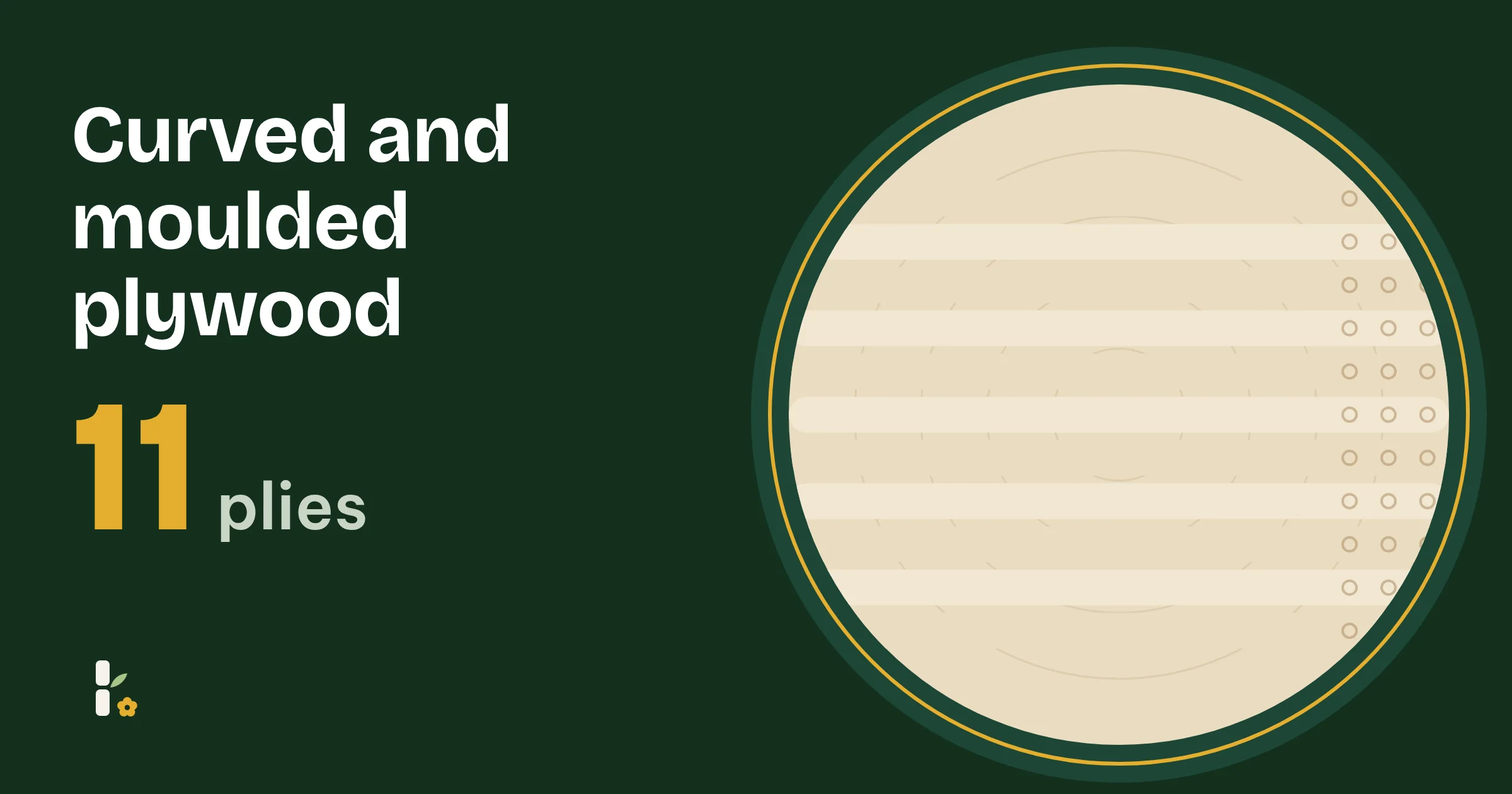
What is curved ply, and how does it differ from a flexible sheet?
Curved ply describes plywood used in a curved form, but the phrase covers two different products. Moulded plywood is bonded into its final shape around a former. Flexible plywood is sold as a flat panel designed to bend when it is installed or laminated into a structure. A third approach uses thin, conventional plywood for a gentle curve within its tested limits.
The distinction changes what the buyer orders. A moulded chair seat is a shaped component, with its geometry already set. A flexible sheet is an input to a fabricator who supplies the radius, support and final fixing. A conventional thin sheet has a defined core, grain orientation and adhesive system; it is not automatically a substitute for a dedicated flexible construction.
For furniture procurement, describe the required deliverable first: a finished curved shell, a flat bending sheet or a flat blank for further processing. The bendable plywood explained page addresses flat flexible stock, while this article concentrates on moulded furniture and the upstream panel specification.
How is moulded plywood pressed into a permanent shape?
A moulded plywood component is formed by placing adhesive-coated veneers into a shaped press and holding them until the bond has developed. The layers follow the tool rather than being forced to retain the curve after an ordinary flat-panel press cycle.
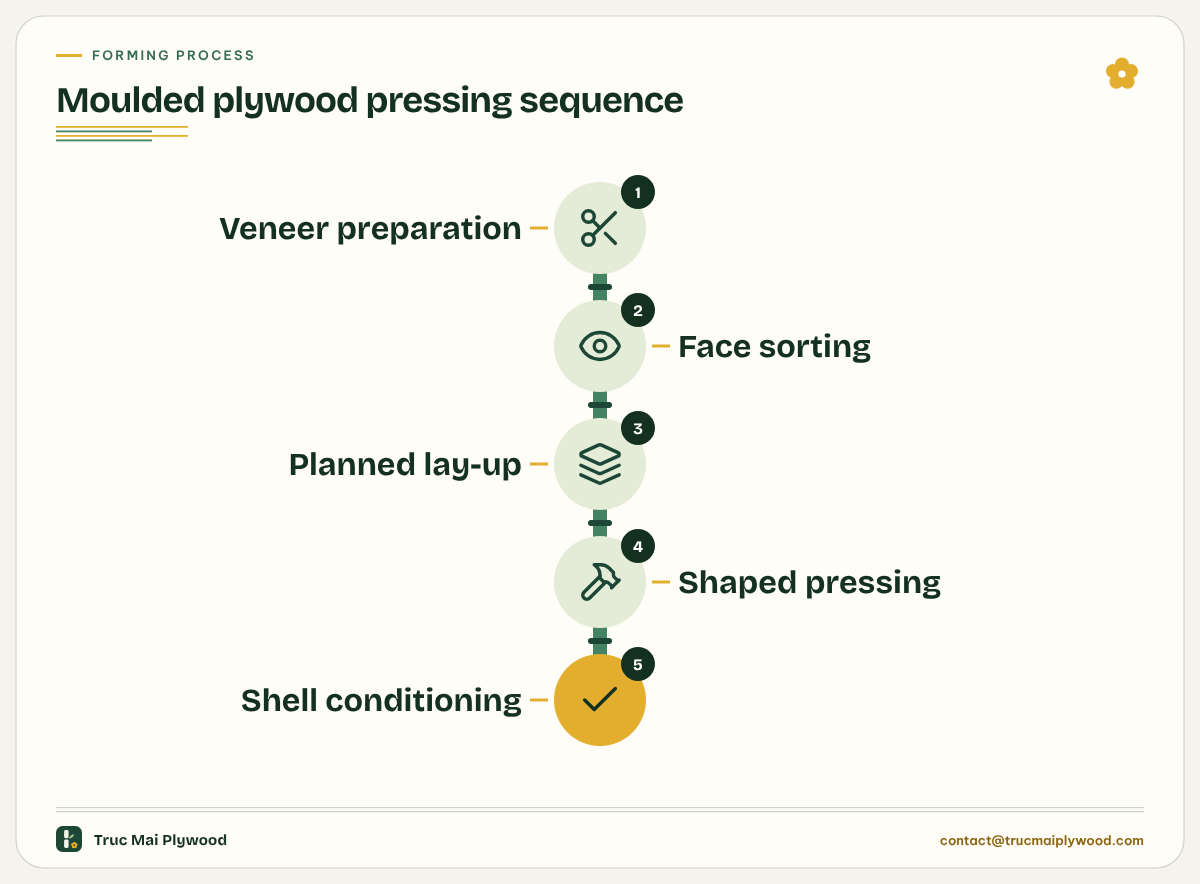
A typical production sequence has distinct control points:
- Cut and condition veneers for the component’s grain direction and mould dimensions.
- Sort visible faces and prepare the adhesive according to the forming line’s process.
- Lay up the veneers in the planned sequence, with the face and back oriented correctly.
- Place the lay-up between matched tools or against a shaped former and apply pressure.
- Maintain the specified pressing cycle, then release and condition the formed shell.
- Trim its perimeter, drill fixing points and inspect the profile against a template.
The USDA Forest Products Laboratory’s Wood Handbook, chapter 10 explains why veneer surface preparation, moisture control, adhesive spreading, pressing and post-cure conditioning influence bond performance. Those principles apply to forming work, although a moulding shop establishes its own validated press cycle.
Which furniture parts use bent plywood?
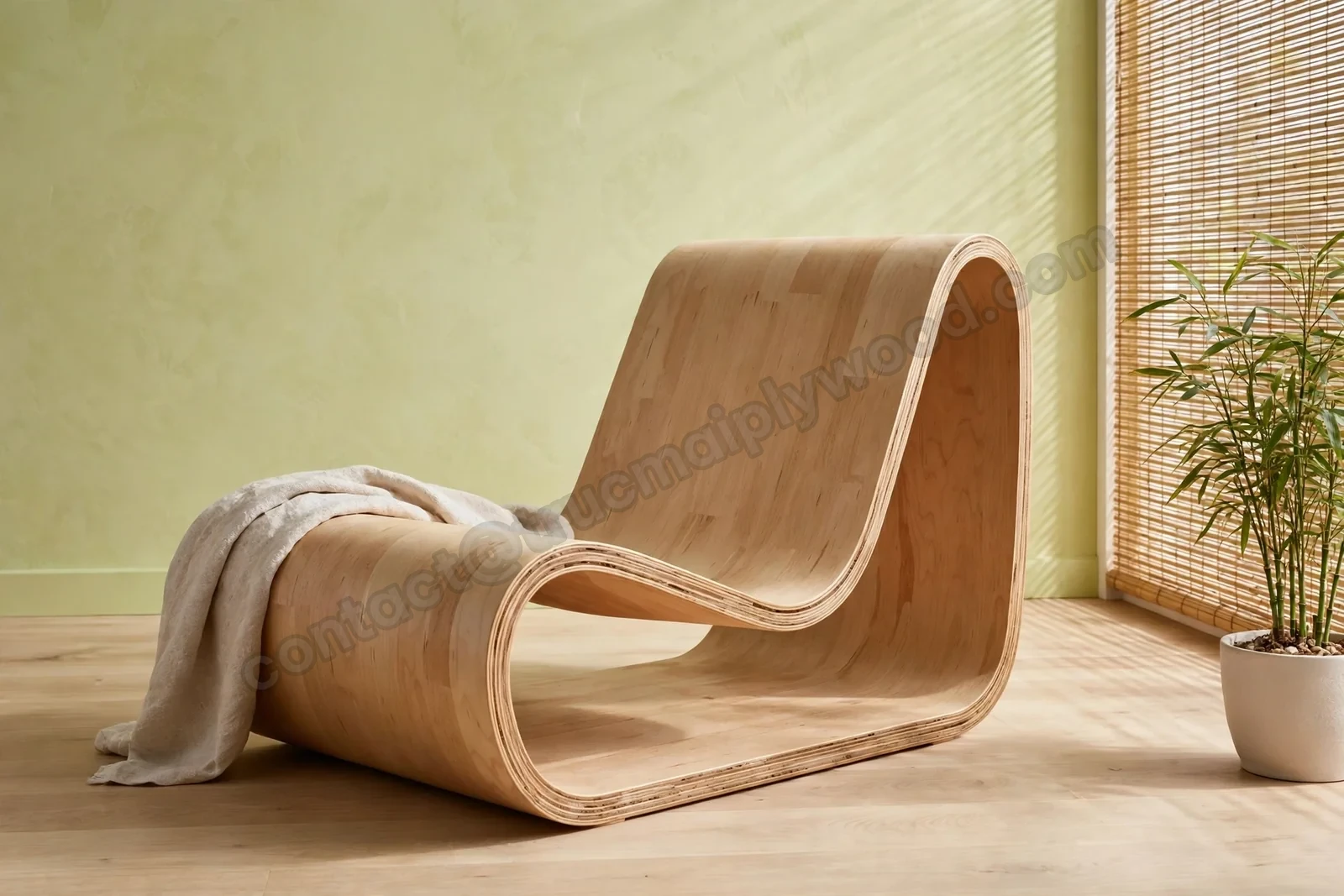
Bent plywood is used for chair backs, seats, stool shells, curved cabinet fronts, decorative fascias and shaped interior panels. Each part needs a different balance of visible grain, curvature, edge appearance and attachment detail.
A chair shell takes repeated body loads at the seat-to-back transition. A decorative fascia may carry little service load but has strict requirements for face continuity and colour. A cabinet front must align with hinges, handles and neighbouring flat panels. These are different acceptance tests even when the drawings all show a curve.
Specify the final surface and the hidden face separately. Where a veneer remains exposed, agree its appearance against a sample. Where upholstery or a laminate covers the shell, core consistency and reliable attachment points can matter more than decorative grain. Best plywood for interiors explains the wider flat-panel selection used alongside these parts.
Which construction should a moulding shop order?
Order a veneer lay-up developed for the required mould, rather than choosing by the word plywood alone. Thin individual veneers permit the fabricator to arrange layers around a tool before bonding. Flat plywood blanks are suitable for cutting, machining and some separately tested forming applications.
| Input | Supplied condition | Typical next operation | Main purchasing check |
|---|---|---|---|
| Individual veneers | Flat, unbonded layers | Lay up and press in a mould | Grain, thickness, moisture and face quality |
| Flexible plywood | Flat, bending-oriented sheet | Bend onto a supported former | Bend direction and tested radius |
| Thin conventional plywood | Flat, bonded panel | Cut, laminate or trial-form | Core, glue and thickness |
| Moulded plywood shell | Finished curved component | Trim, finish and assemble | Profile, springback and fixing points |
A supplier of flat panels and a maker of finished chair shells provide different manufacturing services. Request samples from the party responsible for each operation. The thin plywood panels range is relevant to flat inputs; it is not a catalogue of pre-formed shells.
How do grain direction and veneer sequence affect the curve?
Grain direction changes how a veneer responds when it is wrapped around a tool. The fibres resist extension along the grain, while bending across and along grain produces different stresses. Alternating veneer directions can help balance a finished plywood part, but a forming lay-up must also follow the shell’s load path and surface requirements.
A practical drawing marks the principal curve, the visible grain direction and the face that contacts the tool. For a chair back, the visual grain may run vertically while the tightest bend is near the seat junction. For a cabinet fascia, continuous grain across adjoining doors can be the dominant visual requirement.
The forming shop should approve the veneer sequence with trial parts before production. If the input is an already bonded panel, the buyer needs the actual ply construction, rather than an assumption that every nominal thickness contains the same number of layers. At 18 mm, furniture plywood commonly uses 11 to 13 plies, with 11 frequent in the mill specification.
What controls the minimum bending radius?
The minimum workable radius is established by testing the exact material and forming method. Veneer thickness, species, grain orientation, adhesive, moisture condition and the tool profile all affect cracking, buckling and springback.
A simple cylindrical curve and a compound chair shell are separate forming problems. A panel can bend around one axis yet wrinkle when the same surface is required to curve in two directions. Tight corners concentrate strain, particularly near cut-outs and abrupt changes in section.
Send the forming shop a full-size profile or CAD drawing and ask for a trial at the tightest transition. Record the radius on the approved drawing rather than using a radius quoted for a different product. The bending thin panels article covers flat-panel trials and the support needed during installation.
Can standard furniture plywood be moulded after manufacture?
Standard furniture plywood can be tested for modest curves, but tight permanent moulded shells are normally designed from a forming lay-up. An already cured flat panel contains adhesive bonds and cross-layers that resist reshaping.
For a curved cabinet front, a fabricator might laminate several thin layers onto a former. That process bonds a new assembly around the shape; it differs from forcing a thick finished panel into the same profile. The intended finished thickness must be established from the complete assembly, including any decorative facing.
A flat-panel mill can supply accurately specified inputs and cutting patterns. It should not be described as a moulded-chair manufacturer merely because its plywood can enter a furniture production chain. The mill-cut plywood blanks page shows the procurement route for prepared flat parts.
Which face veneers suit curved furniture?
Choose the face by the appearance required after forming and finishing. Birch gives a pale, even visual character; okoume provides a different warm-toned appearance; engineered veneer offers a repeatable decorative pattern. Poplar and bleached poplar can serve light-coloured interior schemes.
A decorative face is a thin veneer, not the whole core. For example, birch-faced plywood can be made over a Vietnamese Styrax, Acacia or Eucalyptus core. Do not order it as all-birch construction without a separate specification. Face and back should be agreed as a pair, with a sample showing acceptable colour, joins and surface repairs.
A moulded shell also exposes the edge, so a face that looks attractive on a flat sheet must be reviewed around the finished profile. Buyers comparing birch-faced plywood and okoume door skins should compare the actual veneer and the intended finish, not the species name alone.
What core and thickness should be specified for flat blanks?
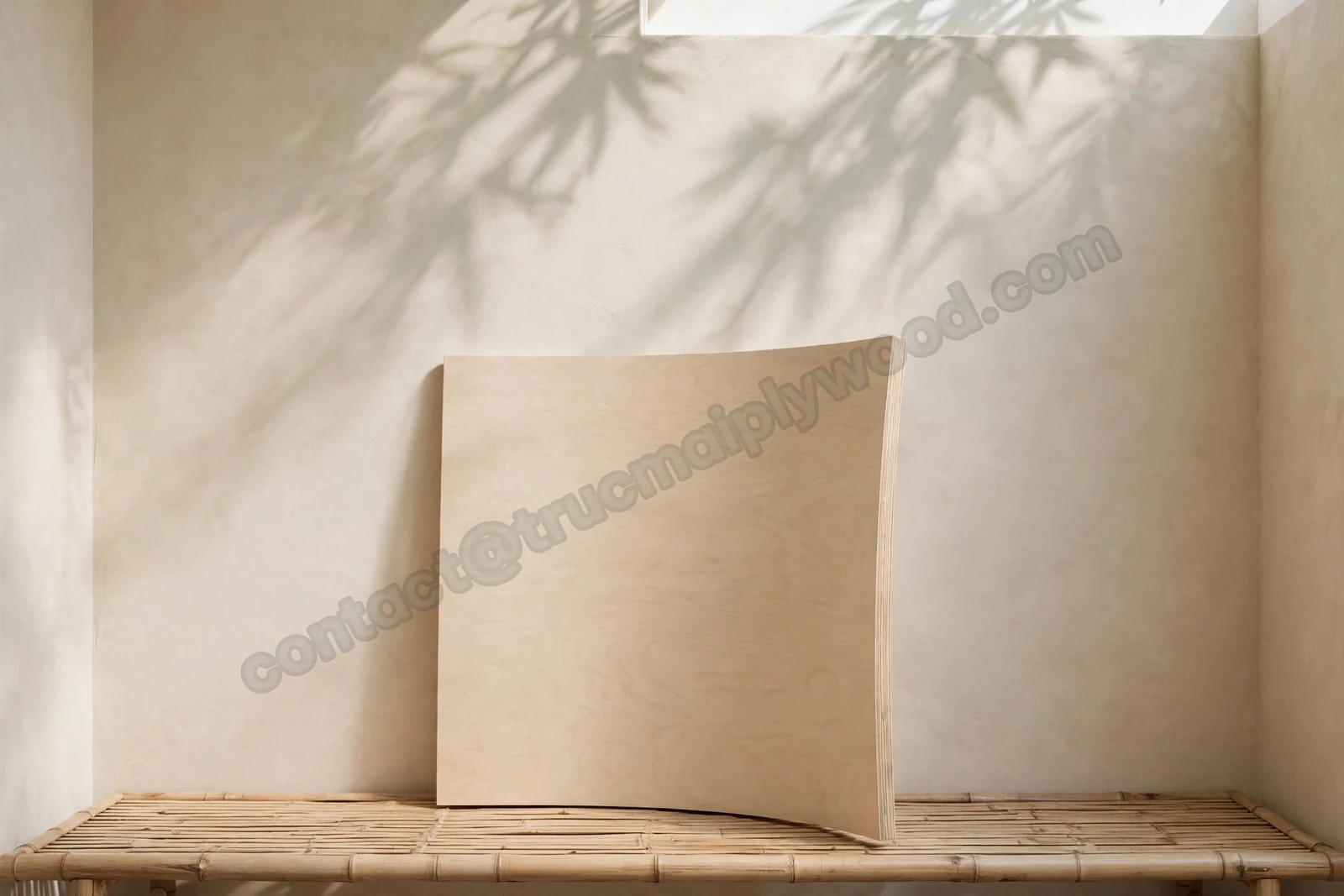
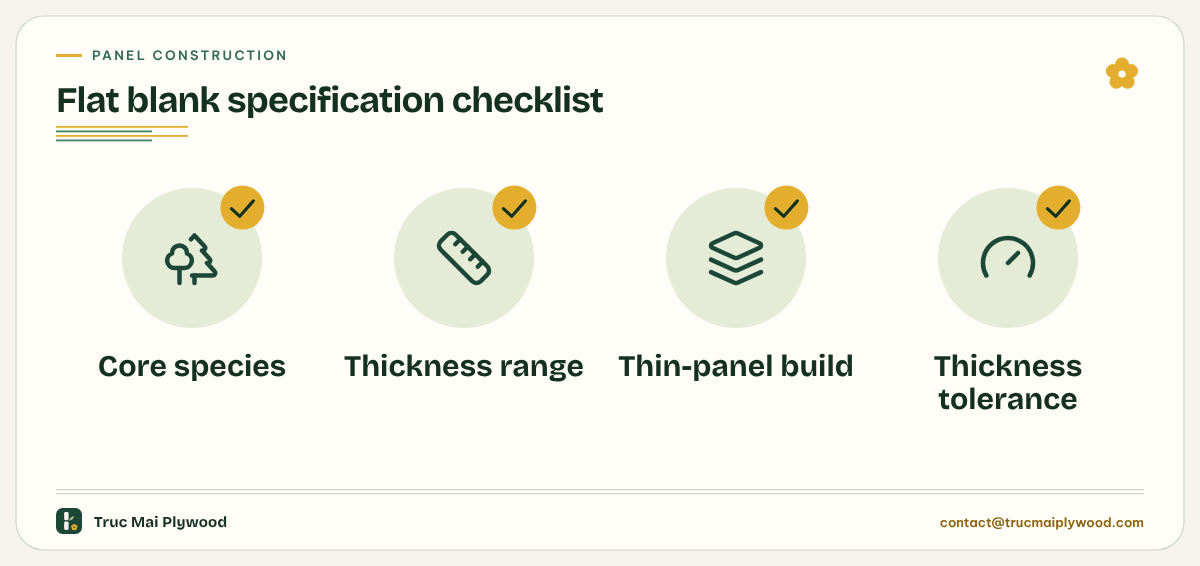
Flat blanks should be specified by their end use, with thickness and core recorded on the order. Truc Mai’s furniture and commercial panels cover 3–40 mm, using Styrax, Eucalyptus, Acacia, Pine or combined cores. The thin 3–5 mm constructions use five plies; 6 mm is built to the order.
A light furniture fascia may prioritise handling weight and a smooth face. A cabinet component may need a denser core around fixings. A moulding shop working from individual veneers should order those veneers as a separate material rather than infer that a five-ply flat panel will behave like five loose sheets.
For repeat purchasing, keep the core species, face veneer, glue system and thickness together on the specification. The thickness tolerance is written per order, commonly ±0.3–0.5 mm, with sanded and calibrated furniture panels specified at ±0.3 mm. This helps the next batch match the first approved sample.
How do adhesive and moisture requirements change the specification?
Specify the adhesive system separately from the emission requirement. Urea-formaldehyde (UF) adhesive is commonly used for dry interior panels, while moisture-resistant formulations are chosen for more demanding exposure conditions. The USDA Wood Handbook distinguishes the water resistance of UF, melamine-based and phenolic adhesive families.
A curved furniture part needs a bond that survives its intended service and its forming process. A moulding shop should qualify the adhesive with the veneer, pressing schedule and final coating. The adhesive used to manufacture a flat input panel does not identify the adhesive later used to assemble a curved component.
For Truc Mai flat furniture plywood, UF glue at E0 emission is a documented mill specification. The buyer should state the required emission method and the finished article’s market, because a trade label alone does not give the test conditions.
What emission documents matter for furniture shipped to the USA?
For covered hardwood plywood, US TSCA Title VI sets a formaldehyde emission limit of 0.05 ppm for veneer-core products. The US electronic Code of Federal Regulations, 40 CFR 770 defines the covered products and exclusions, including certain curved plywood.
That distinction is important when a buyer purchases flat certified plywood and then manufactures a moulded component. Identify the regulatory category of the supplied input and the final article instead of transferring a flat-panel certificate automatically to every new construction.
Truc Mai holds CARB Phase 2 and TSCA Title VI certification for hardwood plywood with veneer core, 3–25 mm, under certificate CARB/EPA 26053. The order should name the relevant flat-panel build and request its applicable certification documents. The Phase 2 formaldehyde limits page covers the panel-side documentation.
What surface preparation and finishing should buyers request?
Specify the final coating route before ordering the face. A clear finish shows veneer colour and joints, while an opaque finish can hide visual differences but still reveals dents and uneven sanding. Laminates and upholstery introduce separate bonding and trimming requirements.
Truc Mai supplies sanded and calibrated furniture faces and offers UV-ready surfaces. UV-ready means prepared for the buyer’s own UV coating; it does not mean the panel has already received that coating. For a curved part, the finisher should approve a formed sample because coatings behave differently at edges and high-curvature areas.
Record whether the face is intended for clear lacquer, paint, veneer overlay, high-pressure laminate or upholstery. The laminates for plywood article discusses flat-panel overlays and helps separate the substrate order from the later surface process.
How should a curved component be inspected?
Inspect the finished profile against the approved drawing and physical reference piece. A useful inspection plan covers shape, surface, edges, bond condition and the positions of mounting holes.
| Inspection point | What to record | Why it matters |
|---|---|---|
| Profile | Template fit at named stations | Reveals springback and local distortion |
| Face | Approved sample match under agreed lighting | Controls colour and visible defects |
| Edge | Layer continuity and trim quality | Shows gaps, chips and exposed layers |
| Bond | Agreed test and conditioning record | Checks the formed assembly |
| Fixings | Hole location against drawing | Protects assembly fit |
The forming shop should measure the released part after its specified conditioning period. A flat plywood mill checks sheet thickness, face and core construction before dispatch; those incoming checks complement, rather than replace, inspection of the shaped component.
How are flat panels cut and labelled for moulding shops?
Flat sheets can be cut into labelled blanks against a buyer’s cutting list. Truc Mai offers halves, thirds, quarters and six-part layouts, with final piece dimensions agreed by email from the selected parent sheet.
Examples include a 610 × 2440 mm lengthwise half, a 1200 × 800 mm third, and a 1220 × 610 mm quarter. These are cut formats, not promised finished chair-shell dimensions.
Send a drawing that identifies the grain direction, blank identifier, machining allowance and any parts that must remain matched in colour. Label each pack to the cutting schedule so the receiving moulding shop can trace blanks without sorting mixed faces. Ordering plywood samples is a useful first step before a repeat cut programme.
What should a supplier quotation distinguish?
A quotation should separate flat plywood supply from shaped-part manufacture. Ask whether the offer covers uncut sheets, labelled blanks, loose veneers or completed moulded components. The difference changes the quality checks, tooling responsibilities and delivery condition.
For a flat-panel order, provide the application, core, adhesive and emission specification, face and back, sheet size, thickness, cutting layout, packing and quantity. Add the destination port and required documents. If the buyer needs finished curved shells, the moulding supplier also needs the tool drawing, radius, profile tolerance, finish and fixing pattern.
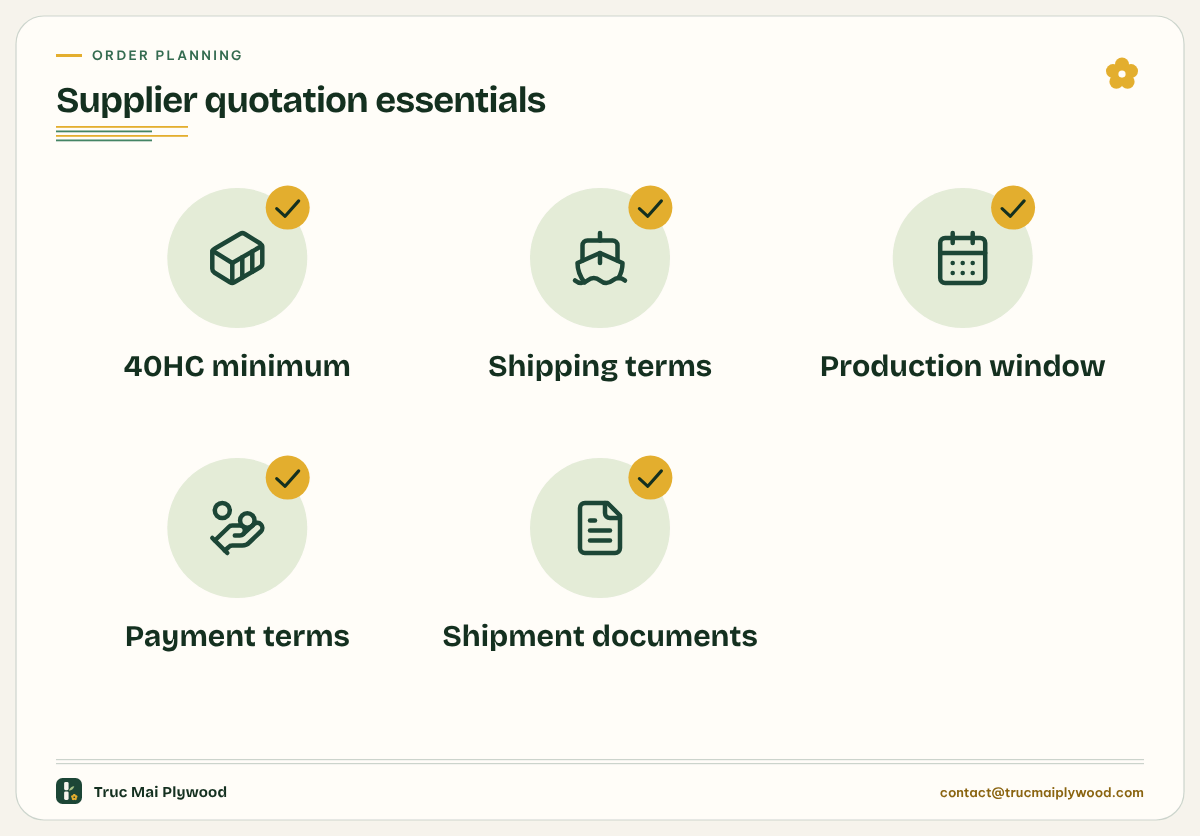
Truc Mai’s standard order starts at one 40HC, with FOB Hai Phong, CFR or CIF shipping terms. Production is scheduled 15–45 days after the deposit under the agreed order. A buyer can prepare the technical lines using writing a plywood RFQ and then send the finished request to the quotation desk.
Which records support repeat orders and traceability?
Keep the approved sample, revision-controlled drawing, panel specification and packing identification together. A repeat furniture programme is easier to run when the next container uses the same face grade, core construction, cutting labels and acceptance reference.
For eligible FSC 100% material, the seller’s sales documents identify the certificate code and product claim. FSC Chain of Custody Standard FSC-STD-40-004 sets out the sales-document requirements. Truc Mai’s licence is FSC-C196493 and its chain-of-custody certificate is SA-COC-014545; the claim is attached to eligible order lines.
For EU orders, the buyer can request origin and geolocation records for both the core and face veneer. For shipping, identify each cut-blank pack on the packing list. The container volume by thickness page provides planning context for flat sheets, while the actual packing list records what was dispatched.
Questions buyers ask
Can a curved chair shell be ordered as a flat sheet?
A finished chair shell has already been formed in a mould. Flat plywood is a separate input and needs a forming process designed around its construction.
Is a 3 mm sheet suitable for every curve?
No. A 3 mm sheet can be tested for gentle forming, while tight compound curves often need individual veneers and a dedicated mould.
Can I specify a birch appearance without a birch core?
Yes. Birch-faced plywood uses birch face veneer over a separately specified core, such as Styrax or Acacia.
Does a furniture drawing replace a physical sample?
No. The drawing defines dimensions; a sample shows grain, surface finish, edge construction and the acceptable visual result.
Can a mill cut pieces for a curved furniture project?
Yes. Flat blanks can be cut and labelled from agreed sheet layouts, ready for a separate forming operation.
Should both sides of a chair panel have the same veneer?
Specify both face and back. A balanced appearance and construction are easier to assess when both sides are recorded in the order.
Is UV-ready plywood already UV-coated?
No. UV-ready describes prepared faces for the buyer to coat; the coating is a separate operation.
What is the minimum shipment for Truc Mai panels?
The standard minimum is one 40HC container. Mixed products can be agreed in the packing plan.
Can a buyer request FSC 100% material?
Yes, for eligible products in the certificate scope. The sales documents identify the FSC claim and certificate code.
What does a moulding shop need from the panel supplier?
Send the flat blank dimensions, thickness, face and back veneer, core, adhesive and emission requirements, quantity and packing instructions.