
To distinguish a plywood supplier factory or trader, verify the registered seller, identify who operates the presses, and connect a current production walkthrough to inspection and shipping documents. A trading company can be a useful supplier, but buyers should know which entity manufactures, controls quality and accepts responsibility for each order.

Plywood supplier factory or trader: what is the practical difference?
A factory operates the production process that turns veneers into finished plywood; a trader buys panels from another producer and sells them onward. Both can arrange export, sampling and quality checks. The commercial difference is which company controls the presses, workers, materials, rework and production schedule when an order changes.
A factory normally controls veneer preparation, core assembly, adhesive application, hot pressing, trimming, sanding and packing. Some operations may be subcontracted, so ask which stages are on the quoted production site. A trader can still add value by combining mill outputs, arranging smaller specifications, sourcing unusual faces or coordinating shipments. The correct choice follows the buyer’s requirements rather than the label on a website.
The most useful opening question is: Which legal entity makes the plywood, at which plant, and which entity signs my contract? A precise answer names the roles separately. Follow it with a request for a current line walkthrough and one sample of the production record format. A glossy factory photograph answers neither question.
Use the supplier shortlist checklist to compare candidates consistently. A supplier offering a broad catalogue may manufacture part of it and source the rest. Request a product-by-product answer, especially when veneer-faced interior panels, coated panels and non-structural LVL appear together.
Buyer decision: Choose a factory-direct arrangement when repeated construction control and traceable production records matter most. Choose a trading arrangement when the seller’s documented coordination and consolidated sourcing solve the actual purchasing problem. In either case, identify the producer before approving the sample.
What are the main Vietnam plywood supplier types?
Three useful categories are manufacturing mills, export-oriented trading companies and integrated supplier groups with both production and sourcing functions. The distinction is operational: a mill controls its own line; a trader contracts with mills; an integrated supplier may use its own production for some goods and partner capacity for others.
| Supplier type | Who runs the production line? | What to request | Main purchasing use |
|---|---|---|---|
| Manufacturing mill | The quoted manufacturer | Site walkthrough, production order, in-process checks | Repeated specification control |
| Export trader | A separately identified producer | Producer identity, approved sample chain, inspection mandate | Consolidating suppliers or product types |
| Integrated supplier | Own plant plus disclosed external plants | Plant allocation for each order line | Mixed catalogue with defined accountability |
A sales office, export licence or warehouse does not settle this classification. A mill may use an export agent; a trading firm may maintain a technically competent inspection team. Ask the supplier to draw the chain from veneer purchase through production and dispatch. If several entities appear, write each role into the order file.
The supplier’s ability to explain core construction is another useful clue. Ask who selects Acacia, Eucalyptus, Styrax or Pine veneers, who checks core joints, and who approves the face grade. A genuine manufacturer should be able to route a technical question to the responsible production or quality person without inventing a generic answer.
When comparing a plywood trading company with a mill, look at the service being purchased. A trader’s fee can correspond to sourcing, consolidated quality control and documentation work. A mill’s quotation may give clearer access to production decisions. Neither commercial structure automatically determines the final panel quality.
How do I know if a Vietnam plywood supplier is a trading company or a factory?
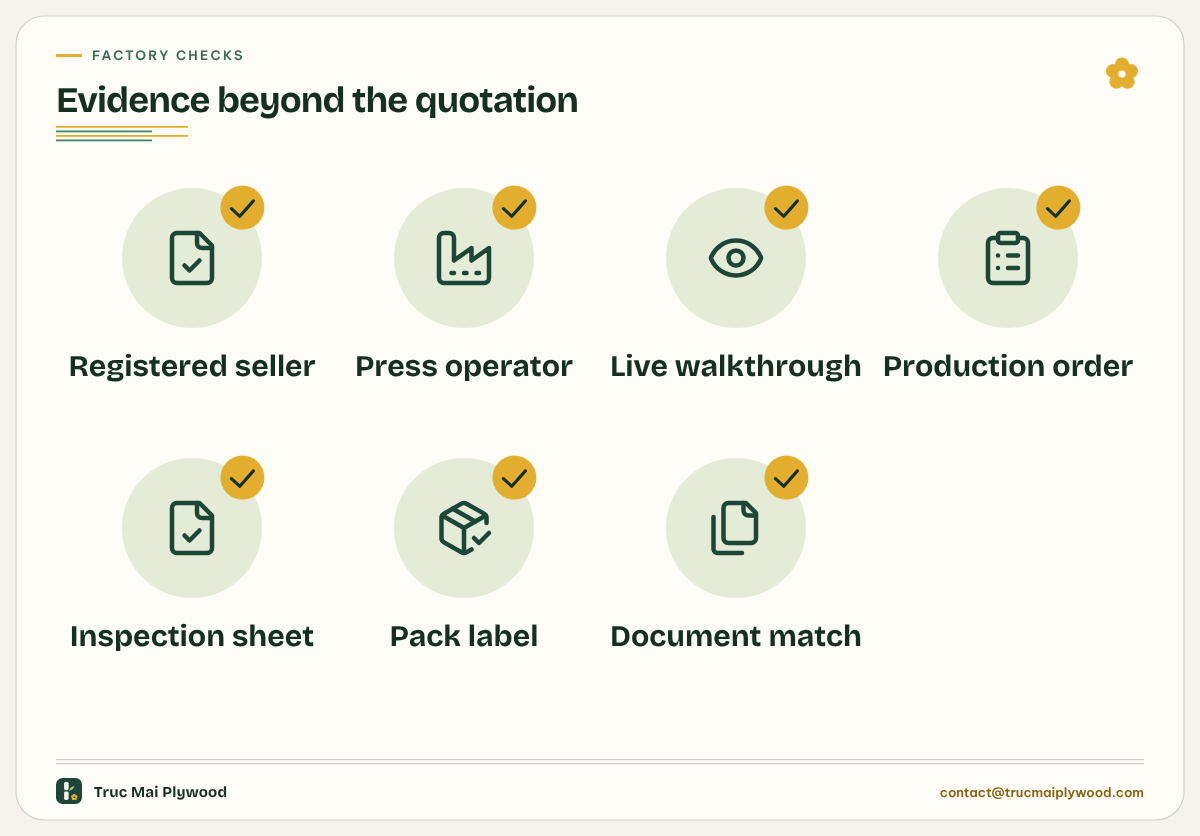
Use four independent evidence groups: corporate identity, live production, batch-level quality records and shipment paperwork. A factory claim becomes persuasive when all four point to the same producer and production location.
- Ask for the full registered name and enterprise code of the contracting seller, then check the official register.
- Ask who owns or operates the press line and whether the proposed product is made there.
- Arrange a live walkthrough that follows veneer lay-up through pressing, trimming and packing.
- Ask to see a redacted production order, an in-process inspection sheet and a finished-goods pack label.
- Match the manufacturer named in the order records with the plant, the approved sample and the export documents.
- Use a site visit or independent inspection when the order’s risk warrants it.
A convincing walkthrough is continuous rather than a sequence of edited promotional clips. Ask the operator to show the current date on an ordinary work document, walk between adjacent stations and point out where thickness and face quality are checked. A real production line has material flow: veneers enter, glued assemblies reach the press, panels are conditioned, trimmed and graded, then packs are marked. You are checking operational continuity, not camera quality.
A trader may openly arrange the same visit at its supplying mill. That is useful transparency. What matters is whether the producer and inspection access are clearly documented. If the company says it manufactures everything, ask it to identify the exact site for each product family.
The mill verification before deposit process can be run alongside sample approval. Keep copies of the seller’s answers in a single supplier file rather than relying on calls that are difficult to reconstruct later.
How can I use the Vietnam National Business Registration Portal at dangkykinhdoanh.gov.vn?
The official National Business Registration Portal is the starting point for identifying a Vietnamese company. It provides an enterprise search and links to information services and the electronic gazette. Search the entity that will sign the sales contract, then separately search any named producer or export company.
The portal’s official search instructions describe searches by enterprise name, foreign-language name, short name and enterprise code. Public records can show the registered name, status, head office and legal representative. These details help you establish identity and detect a mismatch between a quotation and the entity presenting itself as the seller.
Use the Vietnamese registered name when available. English trading names can differ from the name in the register. Keep the enterprise code in your supplier file because names can be transliterated, abbreviated or shared by unrelated firms. A matching registration record identifies a legal entity; factory operation is checked separately through the production evidence.
For the buyer, the outcome should be a compact identity sheet: contracting company, enterprise code, registered status, producer, factory location and payment beneficiary. The corporate check is the first layer of the investigation, followed by physical and document checks.
How do I search a company on dangkykinhdoanh.gov.vn?
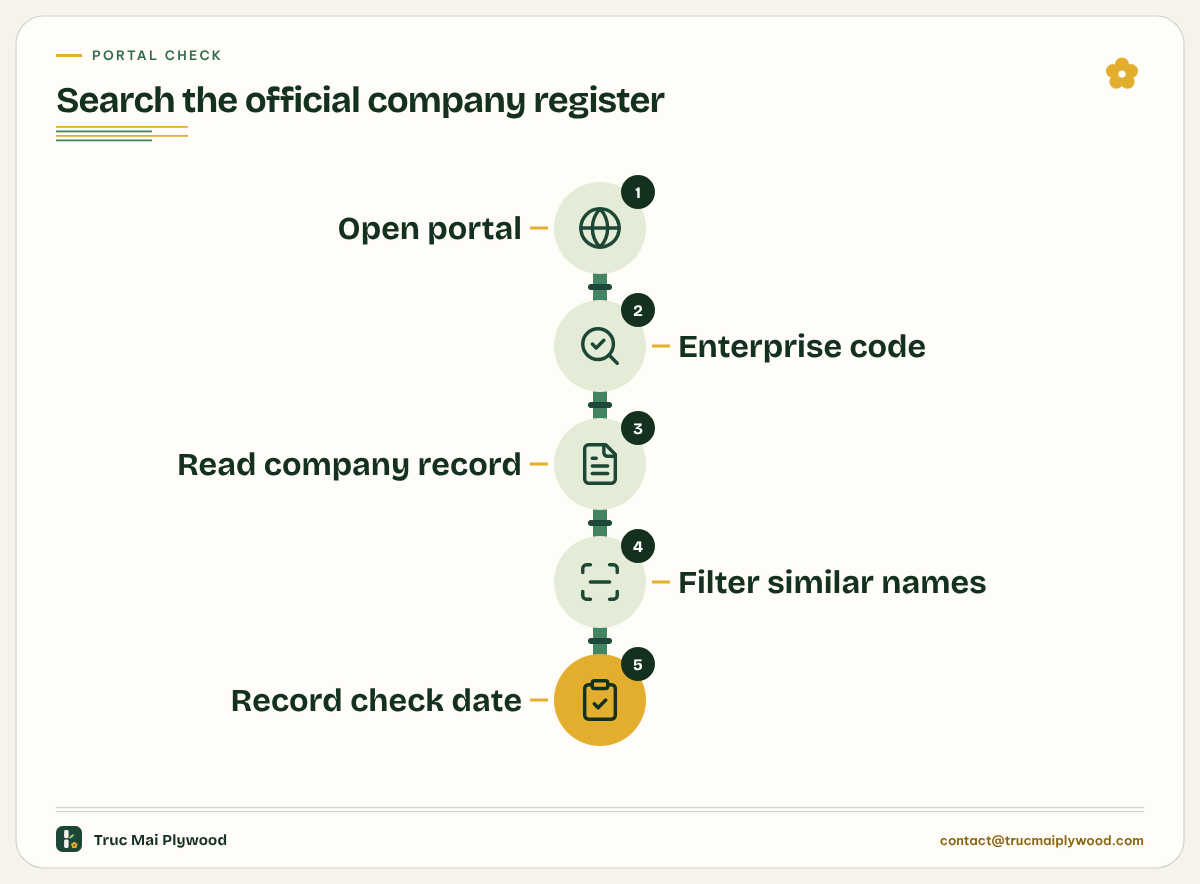
Start with the enterprise code when the supplier provides one; otherwise search the registered Vietnamese name. The portal’s published search guide describes instant suggestions and an advanced search with location and company fields.
- Open the official portal and select Enterprise search.
- Enter the enterprise code or registered name supplied on the quotation.
- Select the matching result and read its registered name, enterprise type, legal status, representative and head-office address.
- Use advanced search filters when multiple businesses have similar names.
- Record the result and the date checked in the procurement file.
- Compare the registered entity with the contract draft, invoice issuer and the producer identified during the walkthrough.
The portal describes its search functions in an Agency for Business Registration explanation. It distinguishes public search information from additional information services. If a requested record is unavailable in the free view, use the official information-service route rather than a third-party directory screenshot.
Example of a mismatch to investigate: the quotation is signed under an English sales name, the contract uses a different Vietnamese entity, and the beneficiary belongs to a third company. Ask for a written explanation of each role and supporting documents before treating them as one supplier. A legitimate export structure can involve multiple entities; clarity is the test.
How do I verify Vietnam company registration through the National Business Registration Portal?
Match the enterprise code and registered name first, then verify the company’s current status and representative. The National Business Registration Portal’s information page explains that its public search displays core legal identity fields.
Use a simple comparison grid in the purchasing file:
| Field | Source document | Match against |
|---|---|---|
| Registered entity name | Portal result | Contract and pro forma invoice |
| Enterprise code | Portal result | Seller’s registration details |
| Legal status | Portal result | Seller’s representation |
| Representative | Portal result | Contract signatory or authority letter |
| Registered head office | Portal result | Corporate contact details |
| Manufacturing location | Site evidence | Production order and inspection record |
Registration and manufacturing are different questions. A company can be registered to conduct commercial activity without owning the plant that makes your panels. Conversely, a manufacturer may use a separate legal entity to handle international sales. The evidence chain should show the arrangement without leaving gaps.
Save a dated copy of the result for internal reference and revisit it when the contracting entity changes. A supplier’s website and business card are useful contact material, but the government register provides the stronger identity baseline.
Can I verify Vietnam company registration online without visiting the factory?
Yes, company registration can be checked online through the official portal; production capability requires separate evidence. An overseas buyer can complete the legal identity check remotely and then commission a live walkthrough or an independent site inspection.
Begin with the registration record, a signed quotation and the seller’s written description of its manufacturing role. Request a video call from the claimed site. During the call, ask the operator to move from the veneer store to lay-up, pressing, sanding and finished packing, following a real batch where practical. Compare the machinery and workflow with the product specification under discussion.
Ask for a sample quality record that identifies the panel construction and the checking station. The document can have commercial details redacted. For a repeat programme, request the record format that will accompany subsequent production lots, so the first order establishes a repeatable evidence trail.
A remote process can also include an inspector who visits the premises and reports on equipment, material flow, stock segregation and production control. Specify whether the inspection is an identity visit, a process audit or a pre-shipment product inspection. Those are different assignments with different deliverables.
For more detail, use the supplier verification checklist to record findings in the same format for every candidate.
What does the Vietnam General Department of Taxation lookup at tracuunnt.gdt.gov.vn tell a buyer?
The tax-number lookup is an additional identity cross-check for the enterprise and its tax registration details. Use the government taxation domain supplied in the registry question, tracuunnt.gdt.gov.vn, alongside the national business registration search, and compare the enterprise identifier with the seller’s documents.
The useful result is consistency: the registered business, the tax identifier and the invoice issuer should form a documented chain. If the taxation lookup is unavailable, use the official business registration result and ask the seller for its tax registration details rather than relying on an unofficial copy of the database.
Do not infer ownership of presses or a production site from a tax record. A tax registration answers a legal identity question; the plant walkthrough and batch records answer the manufacturing question. This separation avoids two common errors: rejecting a legitimate export intermediary solely because it is not a mill, and accepting a factory claim solely because the company is registered.
File the two government checks together with the contract draft. If an invoice arrives under another name, resolve the difference before processing payment.
What can a real plywood mill show on its production line?
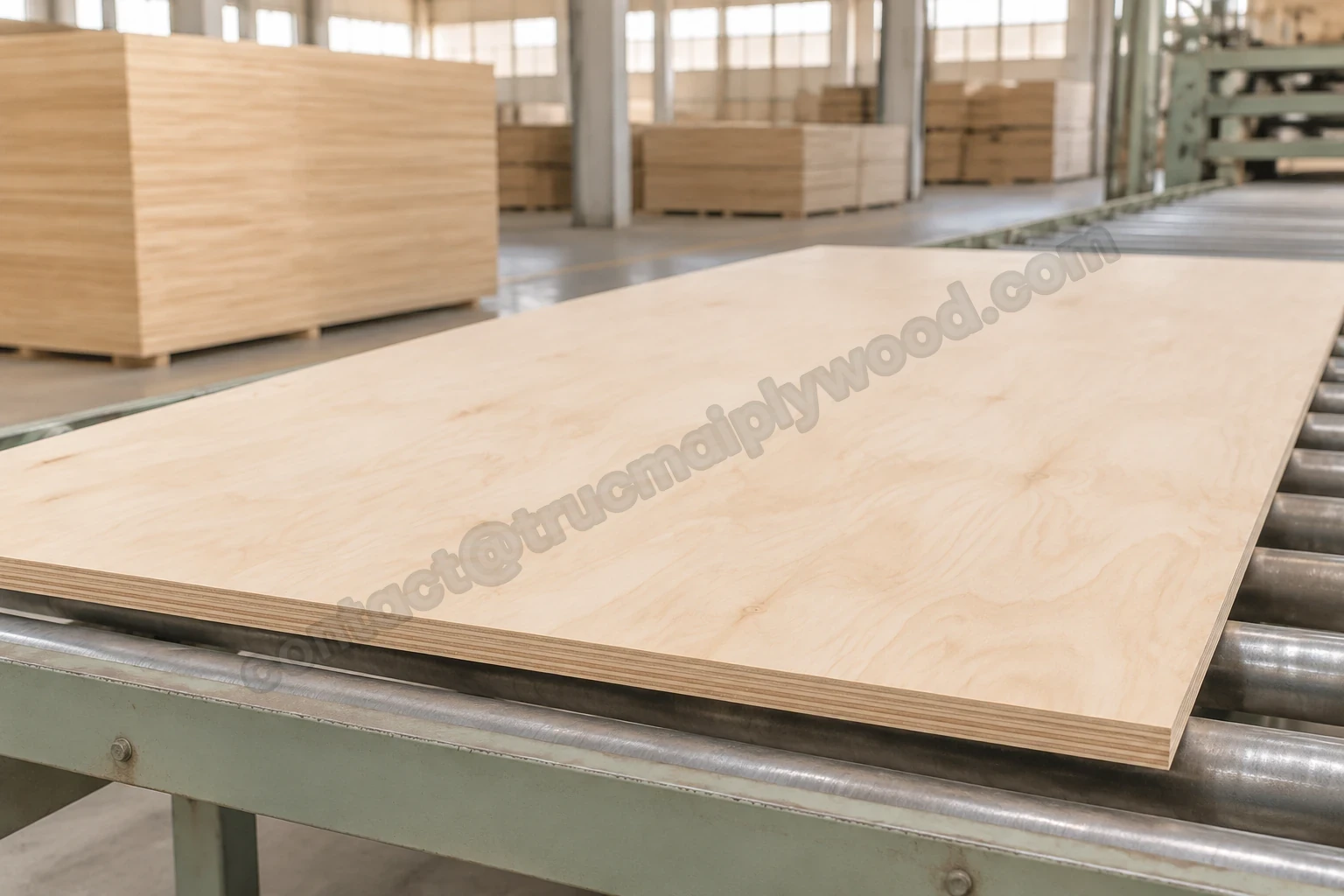
A mill can demonstrate how a particular panel specification moves from veneer selection to labelled finished packs. The strongest evidence is a connected sequence with the production staff able to explain the controls used at each stage.
Ask the mill to show veneer sorting, the way core veneers are joined, adhesive application, lay-up orientation, pressing, trimming, thickness calibration, face inspection and pack identification. For furniture plywood, face appearance and core continuity deserve attention because a visually attractive face can conceal a different inner construction. A cut edge or sample cross-section helps buyers inspect the ply arrangement.
For Truc Mai Plywood, furniture/interior and commercial plywood are made in Ha Hoa, Phu Tho. Its stated production capacity is around 60,000 m³ annually. The factory offers Acacia, Eucalyptus, Styrax and Pine cores, including combinations; a buyer should still identify the exact core in the order. Thin 3–5 mm panels use five plies, while an 18 mm panel commonly uses eleven. These construction details are more useful than a general assertion of factory size.
A practical inspection question is: Show the approved sample and the production traveller for the same construction. Compare face species, core, thickness, glue specification and grade. If a salesperson cannot explain an issue, ask for the quality or production person who can. Direct technical access makes specification changes easier to manage.
Use the plywood RFQ guide to write a specification that can be traced through these stages.
Which quality records distinguish production control from a sales brochure?
Production control is evidenced by dated checks linked to an identifiable lot, not by a catalogue claim. Ask for a blank inspection form and a redacted completed example. The forms should identify what is measured, who accepts the result and how rejected material is handled.
For plywood, useful fields include the approved face/back pair, veneer species, ply construction, adhesive system, nominal thickness, measured thickness, sheet dimensions, surface defects, pack count and batch identifier. A supplier can show how its internal inspection criteria correspond to the buyer’s acceptance sheet. Ask where the actual values are entered and who signs the release.
Truc Mai’s standard order specification writes glue type and emission grade as separate lines. For interior work, its default is UF glue at E0 emission. Furniture panels can be sanded and calibrated to a stated ±0.3 mm thickness tolerance, while other grades are specified against their own tolerances. These details belong in the agreed order and inspection sheet, rather than being inferred from a general product title.
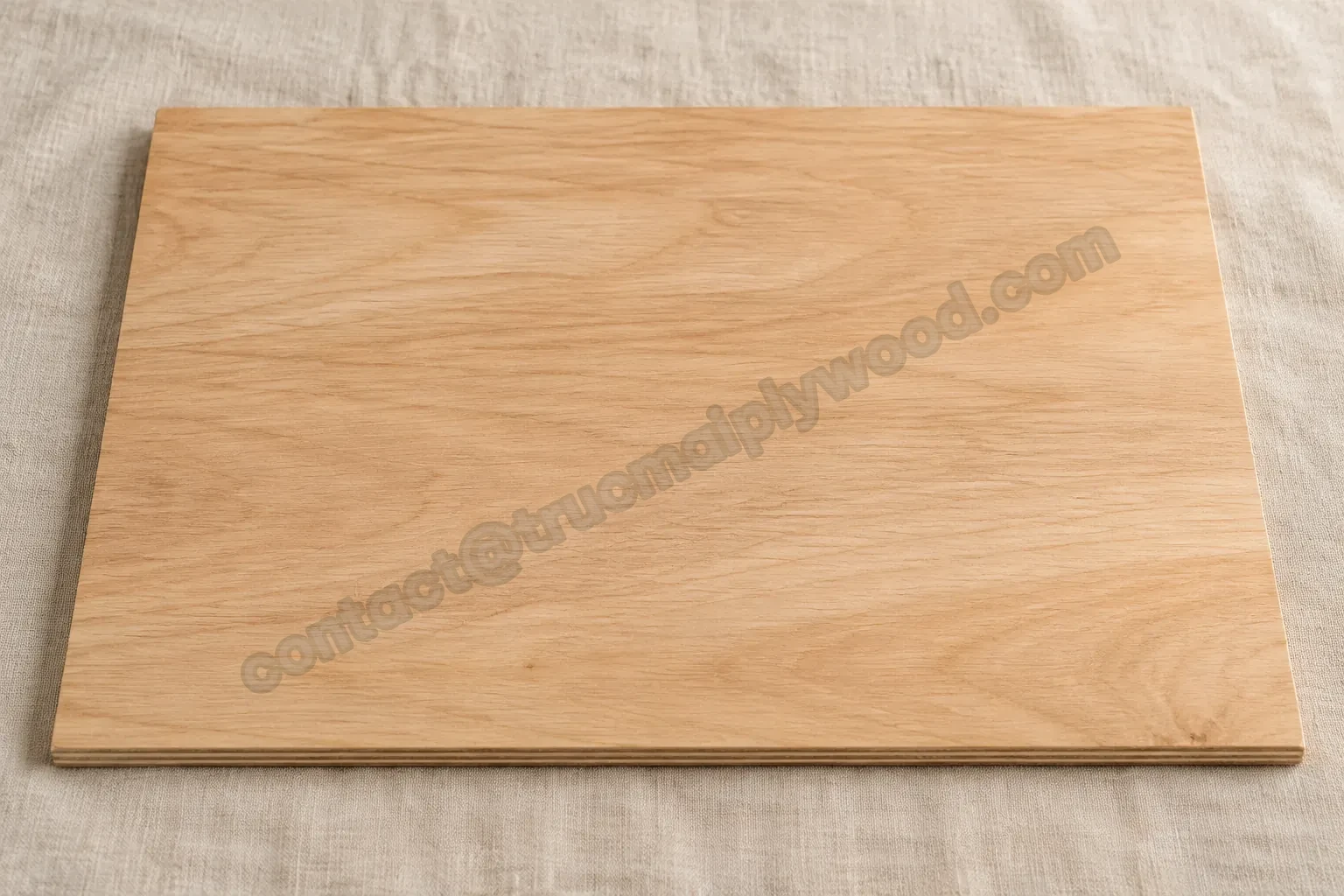
A sample report is most useful when it refers to the same build as the quotation. For example, a birch-faced panel uses an imported birch face veneer on a Vietnamese core; the inspection record should distinguish those two components. The sample ordering process gives the buyer a reference to approve before the factory produces the full lot.
Compare the seller’s proposed acceptance method with the quality-claim handling guide so the evidence collected before shipment can also resolve later discrepancies.
How do certificates reveal the producer and the product scope?
A certificate should identify its holder, certification scope and the product or management system covered. Compare those fields with the legal entity, manufacturing site and exact panel configuration on the quotation.
For FSC chain of custody, FSC-STD-40-004 sets out sales-document requirements, including the certificate code and FSC claim for each eligible product. Buyers should check the certificate holder and the product claim on the commercial documents, not merely look for a logo in a catalogue. The FSC licence verification guide explains the checks.
For the US, 40 CFR Part 770 governs formaldehyde standards and certification for specified composite wood products, including hardwood plywood. The applicable certificate should identify the product type and scope. Truc Mai’s CARB Phase 2 and TSCA Title VI certification covers hardwood plywood with veneer core, 3–25 mm, under certificate CARB/EPA 26053 and mill ICTT-26053. This is a concrete scope to match against the order, rather than a blanket statement about all panel sizes.
Truc Mai also holds FSC chain-of-custody licence FSC-C196493, certificate SA-COC-014545, with FSC 100% claims for eligible scheduled products, and ISO 9001:2015 and ISO 14001:2015 management-system certifications for plywood manufacturing. A buyer should place the relevant certificate identification on the order file and check that the seller’s sales documents carry the agreed claim.
Certificate verification is a useful cross-check because it links a named organisation to a defined scope. It complements physical inspection, quality records and the contract rather than replacing those checks.
What should a plywood RFQ reveal about who controls the specification?
A strong request for quotation identifies the product so precisely that a producer can quote and inspect the same construction. Ask the supplier to return the specification as an order-line table and mark any proposed substitutions before sample approval.
| RFQ field | What to write | Evidence to request |
|---|---|---|
| Application | Cabinet, door, interior lining or packing | Intended-use confirmation |
| Core | Species and joining method | Cross-section and build sheet |
| Face/back | Veneer species and agreed grade pair | Approved physical sample |
| Adhesive | Glue system and emission requirement separately | Relevant test or certificate scope |
| Dimensions | Nominal thickness and sheet size | Tolerance and measuring method |
| Finish | Sanded, UV-ready, melamine or HPL | Surface acceptance sample |
| Packing | Pack marks, protection, cut list | Draft packing specification |
| Quantity | Panels or packs by line | Production and load plan |
For a factory, these fields guide veneer selection and pressing. For a trader, they guide the instruction sent to the producing mill. Ask to see how the approved specification will be transferred to the actual production order. A seller who changes the core or face to meet an attractive quotation must make that change visible in the written offer.
Truc Mai offers 1220 × 2440 mm, 1220 × 2280 mm and 1250 × 2500 mm sheets within its furniture and commercial range. Cut-to-size panels can be labelled and supplied from an agreed cut list, including halves, thirds, quarters or six-piece layouts. Specify the final piece dimensions by email; do not assume that a casual description such as ‘quarter sheet’ fixes the cut geometry.
The cut-to-size panel page is useful when the buyer needs labelled furniture components rather than full sheets. The comparison of mill quotations helps keep different offers on a common construction basis.
How can container plans and shipping papers test the supplier story?
A packing plan connects the production quantity to physical goods and shipping documents. Ask who prepares the pack labels, who weighs the goods and which entity issues the packing list. Compare pack counts and sheet dimensions with the purchase order before loading.
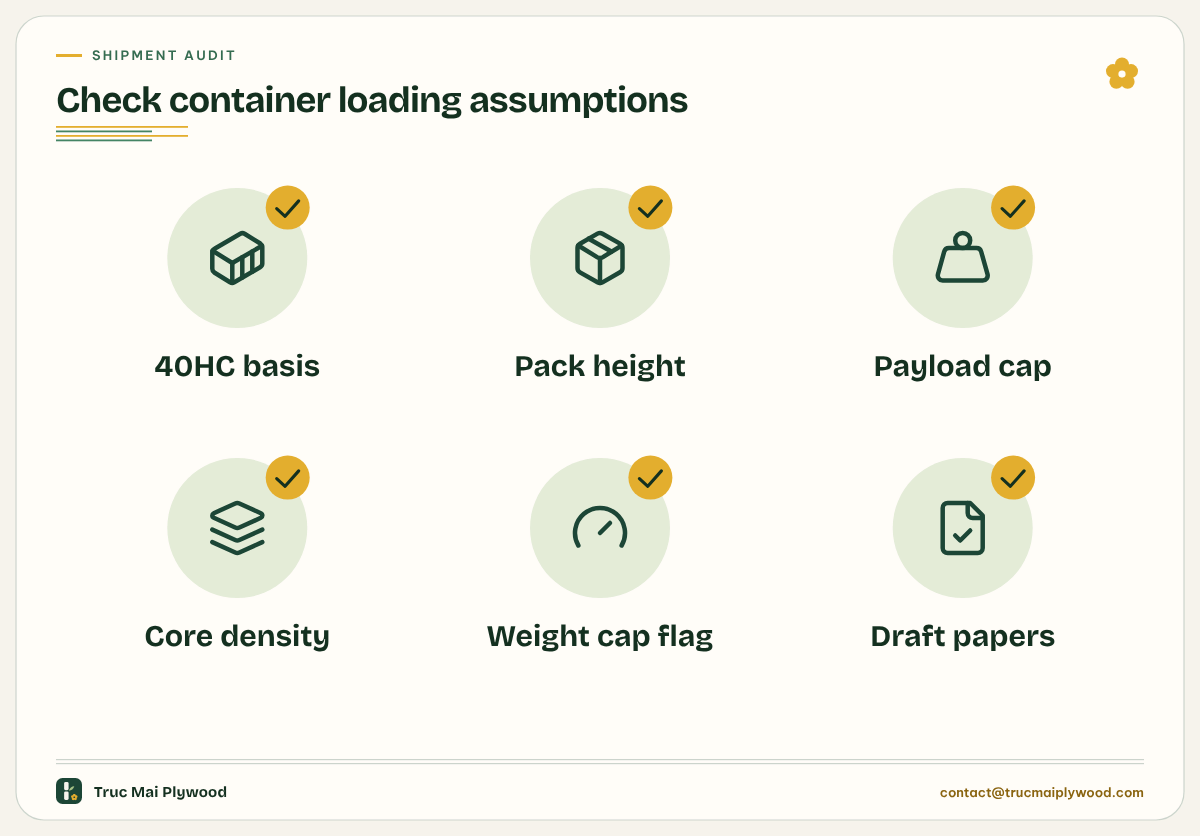
The following figures come directly from the Truc Mai 40HC planning model. They describe panels only, using the model’s pack counts and weight assumptions, rather than measured shipment records.
| Core | Thickness (mm) | Sheet size (mm) | Packs | Sheets/pack | Total sheets | Volume (m³) | kg/sheet | Total kg | Weight capped |
|---|---|---|---|---|---|---|---|---|---|
| Styrax | 12 | 1220x2440 | 18 | 83 | 1494 | 53.4 | 17.9 | 26680 | No |
| Acacia | 12 | 1220x2440 | 16 | 83 | 1328 | 47.4 | 20.7 | 27510 | No |
| Eucalyptus | 12 | 1220x2440 | 15 | 80 | 1200 | 42.9 | 23.2 | 27860 | Yes |
| Styrax | 15 | 1220x2440 | 18 | 66 | 1188 | 53.0 | 22.3 | 26520 | No |
| Acacia | 15 | 1220x2440 | 16 | 66 | 1056 | 47.2 | 25.9 | 27350 | No |
| Eucalyptus | 15 | 1220x2440 | 15 | 64 | 960 | 42.9 | 29.0 | 27860 | Yes |
| Styrax | 18 | 1220x2440 | 18 | 55 | 990 | 53.0 | 26.8 | 26520 | No |
| Acacia | 18 | 1220x2440 | 16 | 55 | 880 | 47.2 | 31.1 | 27350 | No |
| Eucalyptus | 18 | 1220x2440 | 15 | 53 | 795 | 42.6 | 34.8 | 27690 | Yes |
| Styrax | 21 | 1220x2440 | 18 | 47 | 846 | 52.9 | 31.3 | 26440 | No |
| Acacia | 21 | 1220x2440 | 16 | 47 | 752 | 47.0 | 36.3 | 27270 | No |
| Eucalyptus | 21 | 1220x2440 | 15 | 45 | 675 | 42.2 | 40.6 | 27430 | Yes |
Model basis: 40HC planning model, panels only; maximum packs by core: Styrax 18, Acacia 16, Eucalyptus 15; pack height 1,000 mm; sheets per pack are derived from pack height divided by thickness, rounded down and capped by a 28,000 kg planning payload. Reference densities are Styrax 500 kg/m³, Acacia 580 kg/m³ and Eucalyptus 650 kg/m³. The carrier and route set the actual payload, and finished packs are weighed for loading.
These values show why a factory needs both a production count and a loading calculation. The same nominal sheet size can produce different container quantities when the core density changes. A buyer can compare the proposed packing list with the model and ask the mill to explain any material difference in core, pack construction or shipping constraint.
The shipment file normally includes commercial invoice, packing list and bill of lading, plus the origin, treatment, insurance and certificate documents required by the order. Check the documents per container and the 40HC planning reference before approving the draft papers. The named producer, contracting seller and export party should be consistently identified across the file.
How should a buyer test a supplier before the first deposit?
Approve the sample, the legal seller and the production evidence before releasing the deposit. A small number of well-chosen checks gives more usable information than a long questionnaire with no documents attached.
First, request a complete order-line specification and a sample matching that construction. Second, check the corporate identity through the government portal and map the seller, producer and beneficiary. Third, inspect the production route live or through a qualified independent inspector. Fourth, agree the acceptance criteria and the documents required before shipment. Fifth, review the contract terms, inspection access and the process for handling discrepancies.
A common commercial structure is a deposit followed by a balance against agreed shipping documents. For Truc Mai, standard terms are 30% deposit and 70% against the scanned bill of lading, with production typically 15–45 days after deposit. These are production and payment terms, not a substitute for an approved specification or inspection plan.
Use the deposit and balance terms page to align payment milestones with the order’s documents. If the seller is a trading company, ask how it can authorise the inspector to enter the producing mill and who signs the corrective-action decision. If the seller is the mill, ask the same question of its own quality department.
The test of a supplier is how it resolves a specific discrepancy. Present a sample with an identified face defect or thickness question and ask for the inspection rule that would accept or reject it. A credible response refers to the approved sample, a measurement and an accountable decision-maker.
How do factory and trader arrangements affect repeat container orders?
Repeat supply works best when the buyer can identify the unchanged specification, the plant responsible for each lot and the evidence needed before shipment. A factory may provide direct continuity of pressing and grading; a trader can provide continuity by controlling a documented producer network and checking every shipment against the same approved sample.
For a repeat programme, maintain one master specification with controlled revisions. Record the approved face/back pair, core, adhesive, thickness tolerance, sheet size, packaging, marks and certificate requirements. Every subsequent order should cite that version. A change in core species or face veneer should trigger a new sample decision, rather than an informal substitution.
Ask for a production slot and a planned inspection point for each shipment. The quality team should be able to connect the lot number to the manufacturing run and finished packs. The buyer can then compare records across shipments, identify recurring issues and focus inspections on the operations that matter.
The first order to monthly supply approach builds this continuity into the purchasing process. A supplier’s commercial title becomes less important once the operational roles, document trail and acceptance authority are consistently clear.
For the next enquiry, send the application, panel construction, surface requirement, dimensions, quantity and destination. Ask the seller to identify the manufacturing entity and return the proposed inspection and document chain with the quotation. That request turns ‘factory or trader’ from a marketing question into a practical procurement decision.
Send your specification to contact@trucmaiplywood.com or through the quotation form.
Questions buyers ask
Should the invoice and bank beneficiary names match?
Ask the supplier to explain any difference between the contracting seller, invoice issuer and beneficiary before paying. Keep the explanation with the signed contract and payment instructions.
Can a manufacturer use a separate export company?
Yes. The mill can manufacture the goods while another registered entity contracts and exports them. Record both entities and their roles.
Is a factory video enough evidence?
No. Ask for a continuous walkthrough showing production stages, current work and a sample order specification, then compare it with records and a live conversation.
Can I request a third-party inspection?
Yes. Specify the inspection scope, sampling method and acceptance criteria in the purchase agreement before production.
What if the factory refuses a visit?
Offer a scheduled video walkthrough or an independent site inspection and evaluate the explanation alongside other evidence.
Who should approve the final packing list?
The seller prepares it and the buyer checks quantities, sizes, marks and document consistency against the order before shipment.
Can a supplier combine several products in one container?
Yes. Put each specification on a separate order line and ask for a packing plan that identifies the corresponding packs.
What should I send with my first enquiry?
Send the application, core, face, glue and emission requirement, thickness, sheet size, destination and quantity. Attach a drawing for cut parts.
Does a certificate cover every thickness?
Read the certificate product scope. A certificate can cover a specified product type and thickness range rather than the entire catalogue.
How do I compare two samples fairly?
Use the same dimensions and inspection method, label each sample, and compare against a written face grade and construction specification.