
Laminated plywood colours include white, black, grey, warm neutrals, bright solids, woodgrains and stone effects. The visible colour comes from the decorative surface, not the plywood core. For container orders, specify the complete decor code, finish and approved sample for each line, then allocate packs by core and thickness.
Which laminated plywood colours and decors are available on melamine and laminated plywood?
White, black, grey, cream, coloured solids, woodgrain and stone-effect surfaces are the main decor families for furniture-grade melamine and laminated plywood. A buyer should choose the face material and finish alongside the colour: two panels described as “grey laminated plywood” may have different gloss, texture, thickness and edge appearance.
A colour family is a useful first filter, not a purchase specification. White can be warm, cool or neutral; grey ranges from pale silver to charcoal; black may be smooth, textured or gloss. Wood effects can have a straight, cathedral or irregular grain. Stone effects can depict marble veining, concrete, slate or terrazzo. Printed effects are visual patterns, not the stone or timber species they resemble.
| Decor family | Typical visual choices | Useful application | Specify beyond the colour |
|---|---|---|---|
| White and cream solids | Bright white, ivory, off-white | Cabinet interiors, shelves, wardrobe bodies | Warm/cool tone and surface sheen |
| Black and dark grey solids | Jet black, graphite, charcoal | Doors, displays, contrasting furniture | Texture, cleaning expectations and edge match |
| Mid-grey and neutral solids | Silver, dove grey, beige, taupe | Office furniture, fitted interiors | Reference sample under installed lighting |
| Coloured solids | Green, blue, red, yellow | Feature panels and display joinery | Exact code, batch reference and finish |
| Woodgrain prints | Oak, walnut, ash, pine effects | Furniture fronts, wardrobes, wall panels | Grain direction, repeat and texture |
| Stone and mineral prints | Marble, concrete, slate effects | Decorative wall and furniture faces | Vein direction, panel sequencing and finish |
The term laminated plywood is broad. Melamine-faced plywood has a decorative paper surface impregnated with resin. High-pressure laminate (HPL) is a separately made decorative laminate bonded onto plywood. These are different constructions, so use the laminate types for plywood when deciding which face suits a project, and the melamine-faced plywood page for the finished panel.
For white cabinet interiors, a clean solid face can simplify matching to edge banding and hardware. For a prominent door, grain alignment and surface texture matter as much as the base hue. The buyer’s design schedule should identify visible faces, concealed faces and which parts must match when installed side by side. That separates an appearance decision from a panel engineering decision.
A digital image helps shortlist decors, but a physical control sample is the practical approval standard. View the sample vertically and horizontally, in daylight and under the intended artificial lighting. Compare adjacent samples rather than isolated photographs. Keep the approved swatch beside a labelled panel offcut so the surface, substrate and edge are evaluated together.
Is black laminated plywood made with a black paper or a dyed core?
Black laminated plywood normally gets its black appearance from a black decorative surface, not from a black-dyed plywood core. The inner veneer layers remain a separate construction choice. A cut edge may therefore show natural wood layers even when both broad faces are black.
On melamine-faced plywood, the visible black is in the resin-treated decorative paper. On HPL-faced plywood, the black decor belongs to the laminate surface. The cut edge reveals the core and any laminate build-up. A buyer who wants a visually continuous black edge should specify an edge-banding or edge-finishing solution instead of assuming the board is black throughout.
There are three distinct design outcomes: black face with a natural layered edge, black face with matching applied edging, or a specialty through-colour decorative laminate whose edge appearance is defined by its own construction. Through-colour laminate does not mean that the plywood beneath has been dyed. A black laminate plywood sheet should be described with both its face material and its edge treatment.
Ask for a face-on photograph and an edge-on photograph of the same approved sample. An edge photo reveals whether the surface is a thin paper finish, a thicker bonded laminate or another construction. It also exposes gaps, uneven layers and the visual contrast between face and core. For cabinetry, the finished edge often determines whether a black panel looks intentional or unfinished.
Black surfaces are not interchangeable merely because they are all called black. A textured matt black can scatter reflections and disguise some handling marks, while a smooth gloss black emphasises reflections. Neither finish can be selected reliably from a small colour name alone. Compare the sample against the intended door handle, edge band and adjacent worktop or wall finish.
The same principle applies to grey melamine plywood and coloured plywood laminate. A grey face does not imply a grey core. If a design calls for a deliberately exposed plywood edge, specify the core species and visible layer quality independently from the face colour. The HPL-faced plywood range illustrates the alternative surface construction.
Can a full container mix several decors, and how many sheets per decor?
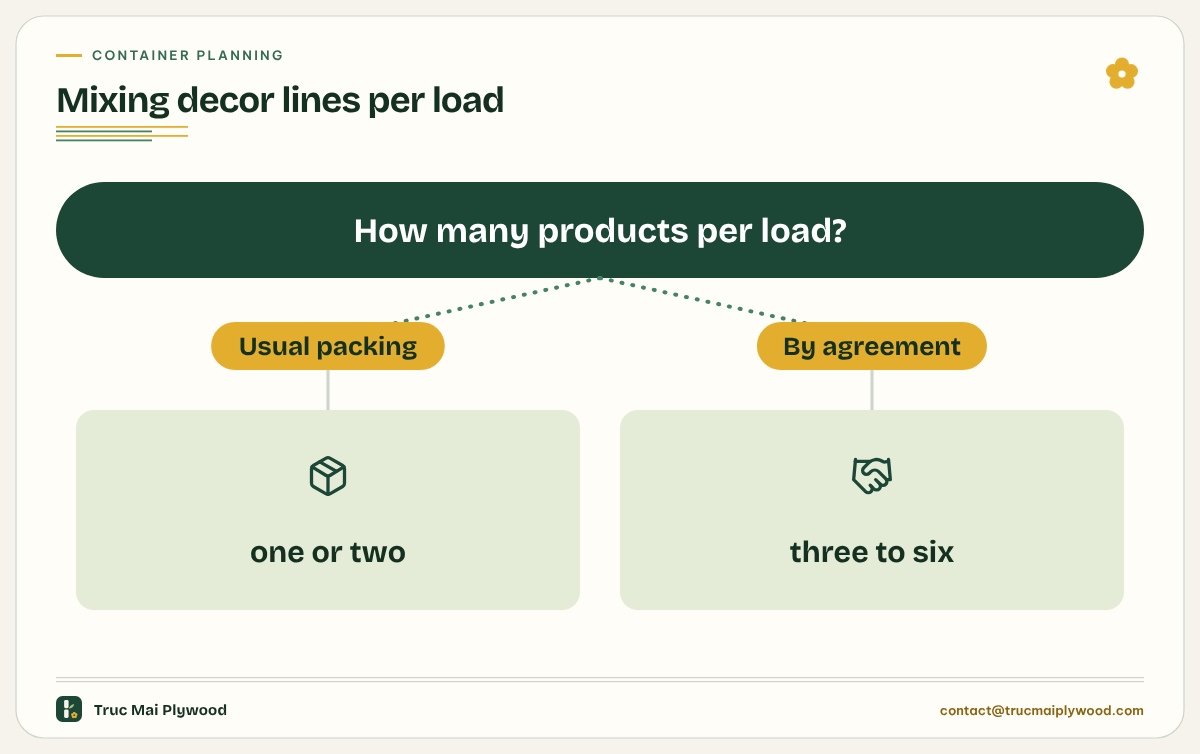
Yes. A 40HC order can combine decor lines: one or two products is the usual packing arrangement, while three to six products can be mixed by agreement. The number of sheets assigned to each decor comes from the agreed pack plan, not a universal minimum sheets-per-colour rule.
Truc Mai Plywood uses a one-container minimum order. A buyer can propose a mix of white, black, grey and printed decors within that order, listing the quantity and construction for each line. A practical allocation starts with complete packs, then checks the combined cargo mass, loading layout and the number of different items that need separate labels. A supplier-specific minimum for any individual decor has not been published, so no fixed sheet count should be treated as a standard factory rule.
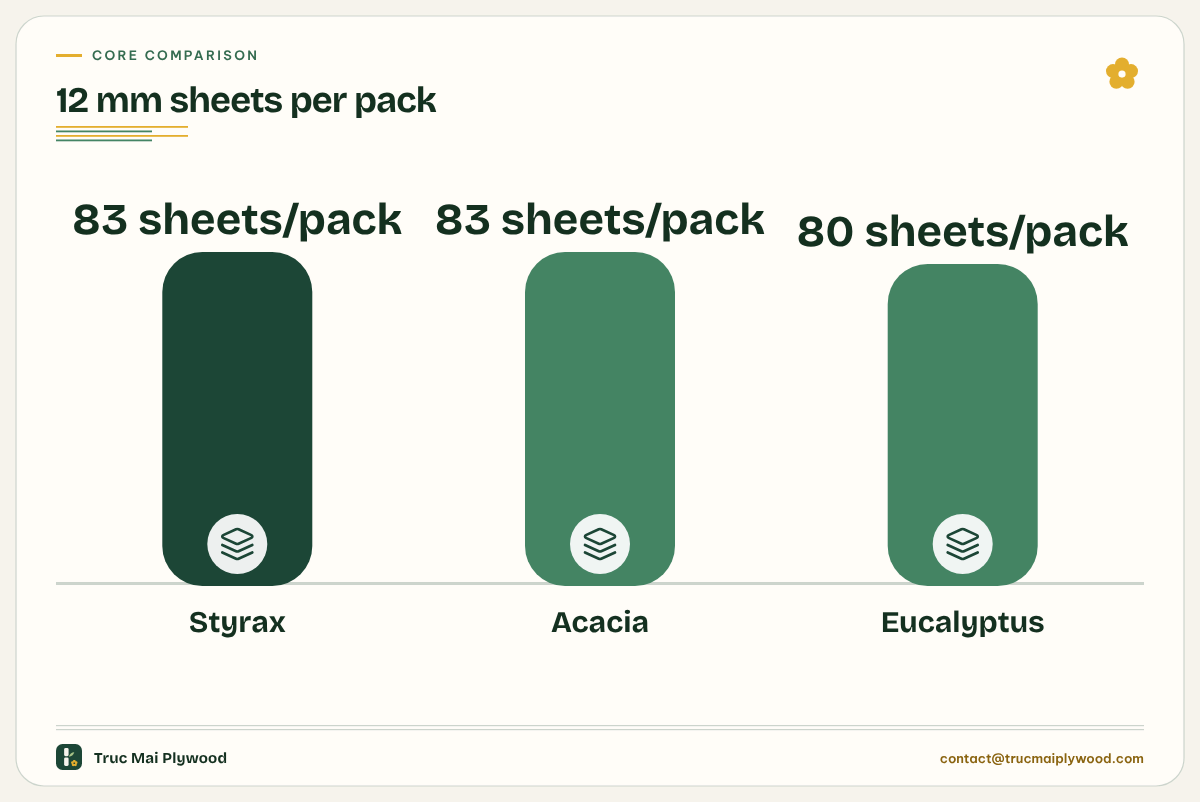
The table below reproduces the supplied 40HC planning model for 1220 × 2440 mm sheets. Its basis is panels only, with Styrax, Acacia and Eucalyptus reference densities of 500, 580 and 650 kg/m³; respectively 18, 16 and 15 packs by core; approximately 1,000 mm pack height; sheets per pack rounded down from pack height divided by thickness, then weight-capped against a 28,000 kg planning payload. The carrier and route set the booked payload. These are planning figures rather than loading records.
| Core | Thickness | Sheet size | Packs | Sheets/pack | Weight capped | Total sheets | Volume | kg/sheet | Total kg |
|---|---|---|---|---|---|---|---|---|---|
| Styrax | 12 mm | 1220x2440 mm | 18 | 83 | No | 1494 | 53.4 m³ | 17.9 | 26680 |
| Acacia | 12 mm | 1220x2440 mm | 16 | 83 | No | 1328 | 47.4 m³ | 20.7 | 27510 |
| Eucalyptus | 12 mm | 1220x2440 mm | 15 | 80 | Yes | 1200 | 42.9 m³ | 23.2 | 27860 |
| Styrax | 15 mm | 1220x2440 mm | 18 | 66 | No | 1188 | 53.0 m³ | 22.3 | 26520 |
| Acacia | 15 mm | 1220x2440 mm | 16 | 66 | No | 1056 | 47.2 m³ | 25.9 | 27350 |
| Eucalyptus | 15 mm | 1220x2440 mm | 15 | 64 | Yes | 960 | 42.9 m³ | 29.0 | 27860 |
| Styrax | 18 mm | 1220x2440 mm | 18 | 55 | No | 990 | 53.0 m³ | 26.8 | 26520 |
| Acacia | 18 mm | 1220x2440 mm | 16 | 55 | No | 880 | 47.2 m³ | 31.1 | 27350 |
| Eucalyptus | 18 mm | 1220x2440 mm | 15 | 53 | Yes | 795 | 42.6 m³ | 34.8 | 27690 |
| Styrax | 21 mm | 1220x2440 mm | 18 | 47 | No | 846 | 52.9 m³ | 31.3 | 26440 |
| Acacia | 21 mm | 1220x2440 mm | 16 | 47 | No | 752 | 47.0 m³ | 36.3 | 27270 |
| Eucalyptus | 21 mm | 1220x2440 mm | 15 | 45 | Yes | 675 | 42.2 m³ | 40.6 | 27430 |
The table gives whole-container quantities for single-specification planning cases. It does not assign a minimum to a white, black or woodgrain decor. For a mixed load, each line consumes part of the container’s pack positions and weight allowance. The total must be recalculated from the actual mix, including packing material, rather than adding the full-container rows together.
Label each pack with its decor reference, finish, face/back arrangement, thickness and quantity. Pack segregation helps the receiving warehouse identify goods before opening every bundle. When multiple decors use similar shades, put the complete code on the packing list rather than writing only “grey” or “oak”.
Use the 40HC loading by thickness explanation to understand why sheet counts change with construction. The cut-to-size plywood panels option is useful when a furniture line needs labelled parts rather than full sheets. Cut lists are agreed from the parent sheet and the required finished pieces; they are not an alternative measure of full-container capacity.
How are decor codes matched between orders?
Match repeat orders by the full supplier decor code, finish code and an approved physical sample. A colour name alone cannot identify a repeatable surface. “Warm white”, “slate grey” and “natural oak” can describe visibly different products across collections.
A workable decor register keeps the design intent separate from the manufacturing identifier. The design team may call a surface “light oak”; the purchasing team records the exact code, texture, sheen, face/back selection and approved sample reference. Both labels can appear on the order, but the technical identifier governs the finish.
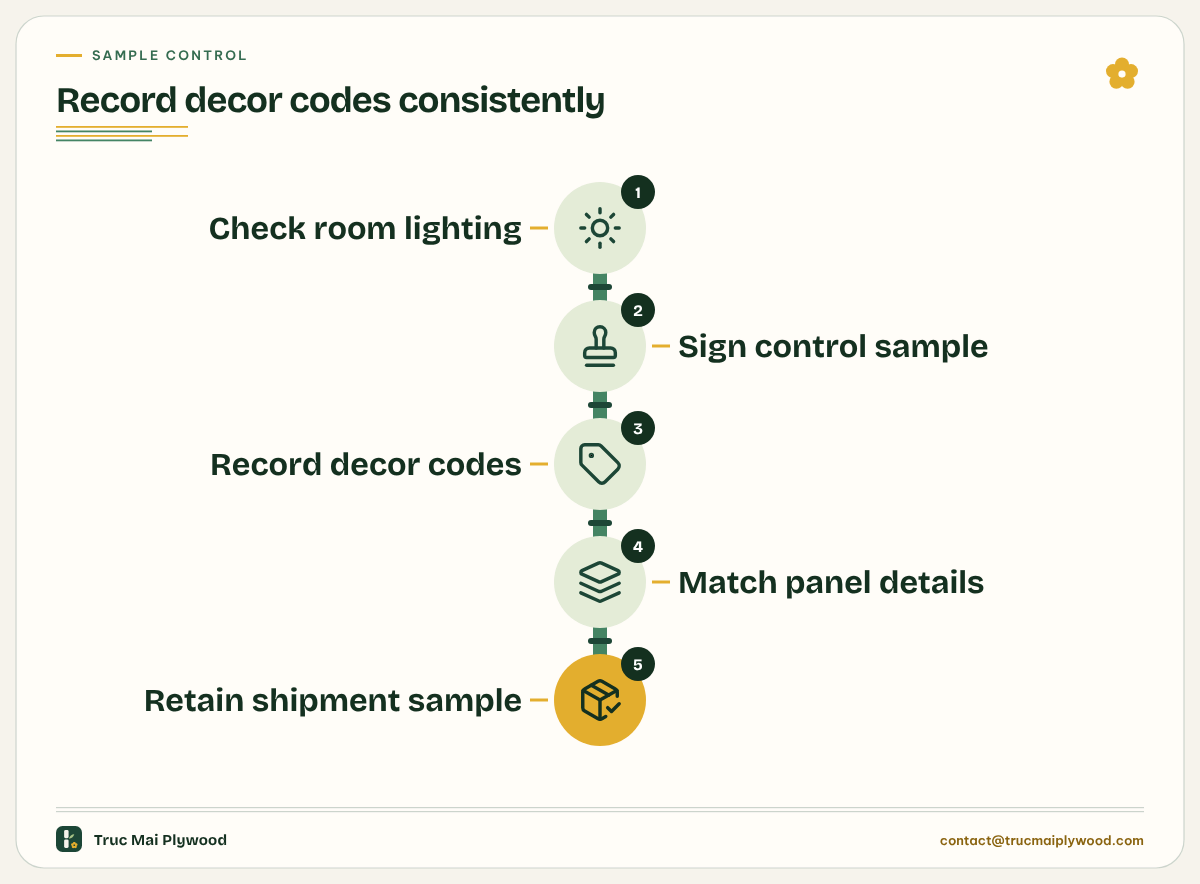
- Approve the physical reference. Compare the chosen decor under the intended room lighting, then sign or otherwise record the control sample.
- Record the full identity. Include the collection or supplier, decor code, finish or texture code and the sample approval reference.
- Attach the panel specification. Record core species, thickness, sheet size, face/back pairing and any edge-banding match.
- Keep the first-order record. Retain a labelled sample and the purchase specification with the shipment documents.
- Repeat against the record. On the next order, compare the new production sample to the approved reference before authorising the decor line.
Codes matter particularly for printed woodgrains. Two oak prints can have similar colour but different grain scale, plank direction, knot distribution and surface embossing. A replacement door made from a visually close but differently patterned print may stand out in a row of otherwise matching fronts. Stone effects have a similar issue: the vein arrangement and orientation can be more noticeable than the overall background shade.
The approved sample should show the finished surface on the actual panel type. A loose laminate swatch is useful for decor selection, but it does not show the final panel edge or how the chosen finish appears beside the selected core. Keep both references when the order involves HPL-faced plywood. For melamine-faced plywood, retain a finished panel offcut with the order identification.
Use a simple change-control rule: a different finish suffix is a different finish, even when the main decor number is unchanged. If a collection changes or a decor is discontinued, treat the proposed replacement as a new approval rather than silently substituting a near match. This is especially important when supplying multiple containers to a furniture programme over time.
The buyer’s order document should also distinguish the front face from the back. A premium visible face can be paired with a different back finish when that is the agreed design. If both sides will be seen, list both sides as controlled surfaces. For a useful starting format, see writing a plywood RFQ and ordering plywood samples.
Do woodgrain and stone decors cost more than solid colours?
Printed woodgrain and stone decors can cost more than standard solid colours when the selected print, texture, overlay or production run requires a different decorative material. A woodgrain or stone pattern does not carry a fixed price premium. Compare the complete panel construction, not just the image printed on the face.
A common solid white and a specialised embossed oak finish may have different material availability and finishing requirements. Yet a regularly stocked woodgrain may be easier to source than an unusual custom solid. Surface chemistry, texture, matching back face and order quantity can each change the manufacturing route. Colour family alone is therefore a poor basis for comparing offers.
Use this comparison checklist for equivalent quotations:
| Comparison point | Hold constant | Allow to change |
|---|---|---|
| Plywood construction | Core species, core grade, thickness, size | Decorative face |
| Surface process | Melamine or HPL route | Print, colour, texture and sheen |
| Face arrangement | One-sided or two-sided finish | Decor code on each side |
| Edges | Edge-band requirement and profile | Band colour or matching print |
| Packing | Sheet count and pack labelling | Segregation by decor |
| Approval | Physical control sample method | Approved design reference |
Request like-for-like offers for the same core and dimensions. An apparent difference between black laminated plywood and woodgrain plywood may instead come from a different face material or a different substrate. The laminated plywood cost factors article separates these variables.
A buyer who needs both economical cabinet interiors and decorative doors can specify a solid interior face for the carcass and a printed finish for the visible fronts. This makes the design requirement explicit without treating every panel as the same decorative grade. For fitted furniture, the plywood for kitchen cabinets page provides additional application context.
What is the difference between melamine-faced plywood and HPL-faced plywood?
Melamine-faced plywood uses resin-impregnated decorative paper on the panel, whereas HPL-faced plywood carries a separately produced laminate sheet bonded to its surface. The choice affects the finish specification, edge detail and how the panel is worked in the furniture shop.
Melamine is a practical route for repeatable cabinet surfaces and interior components. HPL offers a separate laminate specification with its own decor and surface finish. Both can be white, black, grey or patterned, so the words “black laminate” alone do not identify the construction. Specify the process before choosing the colour code.
For visible joinery, request a finished offcut with an exposed edge and a finished edge. Compare the laminate transition, corner treatment and intended hardware clearance. A buyer may approve the face colour and still reject the edge appearance; keeping these decisions separate prevents that mismatch.
Which sheet sizes and cores should a decor specification include?
Specify the finished panel size, thickness and core species alongside the decor. Truc Mai’s standard formats include 1220 × 2440 mm, 1220 × 2280 mm and 1250 × 2500 mm, with a furniture and commercial plywood thickness range of 3–40 mm.
Styrax, Eucalyptus, Acacia and Pine are core options, including combined-species builds. The decor sits on the face; changing the core can change weight, edge appearance and the number of panels that fit the shipping plan. A birch-faced sheet is not an all-birch core sheet, and a printed birch-effect surface is not a birch veneer face.
For cabinet doors, consider whether the design calls for full sheets or pre-cut labelled parts. A standard sheet can be divided into two lengthwise, three, four or six pieces according to the agreed cut list. Typical patterns include 610 × 2440 mm halves, 1200 × 800 mm thirds and 1220 × 610 mm quarters. Exact finished dimensions are agreed from the chosen parent sheet and cutting layout.
How should a buyer inspect colour consistency before production?
Inspect a finished sample against the signed control sample, with attention to colour, gloss, grain direction and edge treatment. The first inspection should be visual, followed by a written record of any agreed tolerances or appearance criteria.
Place samples next to each other under the lighting used in the intended room. Rotate woodgrain samples to check whether the direction matters for the final doors. For a stone print, align the proposed panels in the sequence intended for installation and judge whether the pattern transition is acceptable. A printed image viewed alone can conceal a mismatch that becomes obvious across adjacent units.
Record acceptance with the decor code, finish code, panel build and sample identifier. A photo is helpful as a record of arrangement, but the physical reference remains the best comparison for subtle tone and texture. If the furniture programme is repeated, store the reference away from direct light and heavy handling.
What should the specification say about surface and edge finish?
Name the surface finish and the edge finish as separate lines. A matt face does not automatically include matt edging, and a printed oak surface does not automatically produce a matching plywood edge.
Write down grain direction where the printed face is directional. Horizontal oak grain across a run of cabinets is a different visual order from vertical grain on every door. For a stone-effect wall, note whether veining should continue across panel joints or whether each panel can be independent.
How do colour choices affect cutting and installation?
Colour selection affects cutting schedules when the decor has a directional grain or repeating pattern. A plain solid can often be nested without regard to grain orientation; a woodgrain or veined stone print may need parts aligned to one direction, changing the practical cutting plan.
The cut list should identify the visible face, orientation arrow and edge-band sides for each part. A label on every bundle helps the furniture shop keep similar-looking decors apart. If black, charcoal and dark walnut panels arrive together, relying on visual identification alone invites mistakes under warehouse lighting.
For printed stone, the buyer should decide whether adjacent pieces must be matched or whether the effect is decorative without a continuous pattern requirement. This decision belongs in the cutting drawing before the order is packed. It can be difficult to reconstruct the intended sequence after individual panels have been separated.
Which documents matter for EU and US furniture buyers?
For EU and US furniture supply, request the panel construction and the relevant emission documents for the actual product scope. Surface colour does not determine formaldehyde compliance, which is assessed against the applicable product and test requirements.
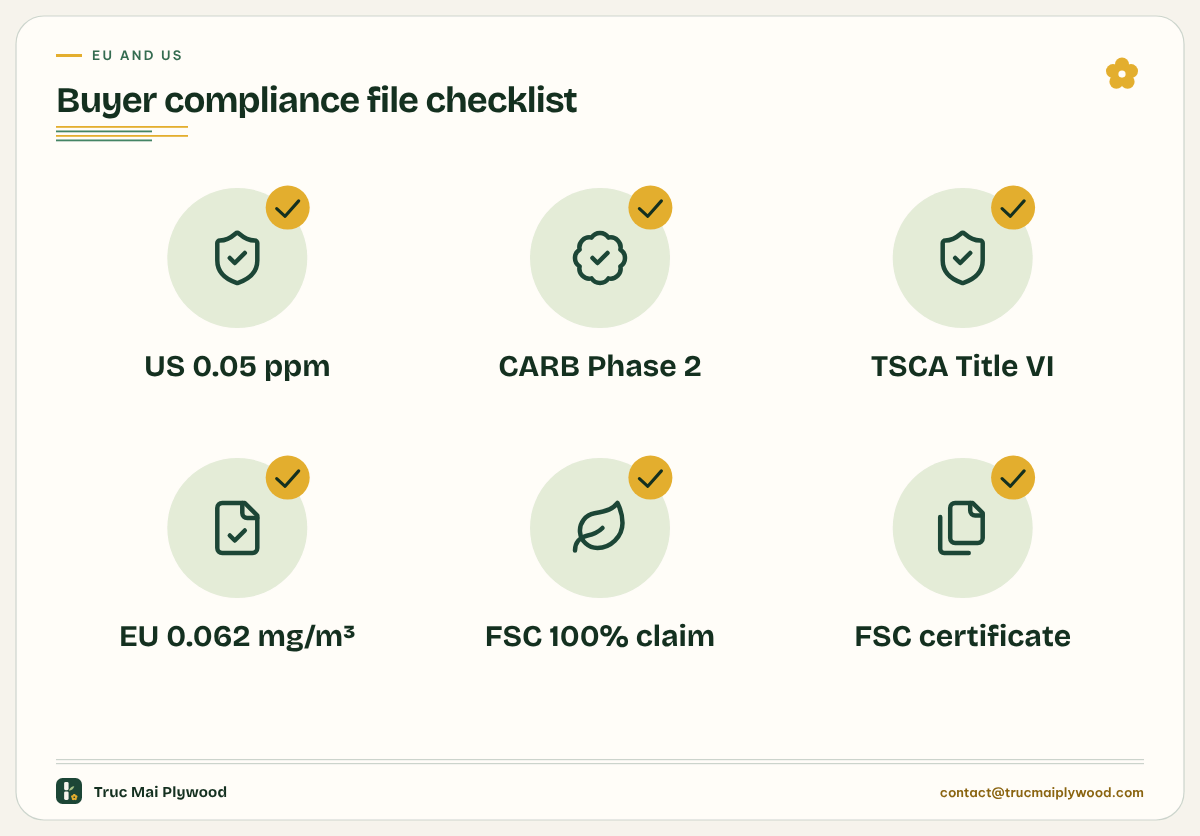
Under 40 CFR Part 770, the US TSCA Title VI limit for hardwood plywood with veneer core is 0.05 ppm by the specified chamber method. Truc Mai’s CARB Phase 2 and TSCA Title VI certification covers hardwood plywood with veneer core in the 3–25 mm range, certificate CARB/EPA 26053, mill ICTT-26053, third-party certifier TPC-43. Specify the certified configuration on the purchase order.
For EU furniture and wood-based articles, the European Commission’s formaldehyde restriction explanation identifies the 0.062 mg/m³ indoor-air emission limit. The test conditions and units differ from the US framework; the buyer should ask for documentation relevant to the intended market and product.
For an FSC 100% order, the claim is recorded on the sales documentation for eligible certified products. The FSC Chain of Custody standard requires the relevant claim and certificate information on sales documents. Truc Mai holds FSC licence FSC-C196493 and certificate SA-COC-014545. For origin files, the face veneer origin files page explains the paperwork associated with the surface material.
How should the final decor order be written?
Write one purchase-order line per distinct decor, finish and panel construction. This gives the factory, packing team and receiving warehouse a common identifier for every bundle.
A useful order line includes application, core species, face material, complete decor and finish codes, front/back arrangement, thickness, sheet size, cut pattern, edge requirements, quantity and destination port. Attach the approved sample reference and the desired pack label format. When several colours share one container, put the quantities on separate lines and attach the combined loading request.
For the first order, prioritise a small, clearly labelled set of physical samples rather than a large collection of near-identical digital swatches. Once the final codes are approved, the same register can support repeat orders and spare-part production. Send the completed schedule with the plywood RFQ so the decor and substrate are quoted as one finished panel.
Send your specification to contact@trucmaiplywood.com or through the quotation form.
Questions buyers ask
Can melamine plywood be used for cabinet doors?
Yes. Melamine-faced plywood is used for cabinet doors and carcasses when the panel construction, edge treatment and hardware are selected for the application.
What is the difference between a matt and gloss laminate?
Matt has lower surface reflection; gloss reflects more light and makes fingerprints and uneven lighting more noticeable. Approve a physical finish sample.
Can I order grey on one face and white on the other?
A two-sided decor specification can name different faces. State the front and back separately in the purchase specification.
Are colour names interchangeable between suppliers?
No. A name such as charcoal or oak is descriptive, while a supplier-specific code and physical control sample identify the intended finish.
Does a white melamine face mean the plywood core is white?
No. White describes the decorative surface; the core species and veneer construction are separate specifications.
Should the edge be painted or banded?
Choose edge banding when the visible edge must match the decorative face; a clear or painted edge is a different design choice.
Can a dark laminate show scratches more clearly?
Dark, smooth surfaces can make light-coloured dust and abrasion marks more visible. Judge the chosen finish with a handling sample.
Are HPL and melamine-faced plywood identical?
No. High-pressure laminate is a separately manufactured surfacing sheet bonded to the panel; melamine-faced board uses resin-impregnated decorative paper.
What details belong on a decor sample label?
Record the decor supplier, complete code, finish, face orientation, panel core and approval reference on the sample label.
Can a plywood panel be supplied cut to size?
Yes. Supply the parent sheet size, finished piece dimensions, cutting pattern, edge treatment and pack labels with the order.