
Matt plywood Vietnam supply for laminating is a calibrated, unfinished plywood base intended for a later melamine, high-pressure laminate or veneer surface. Truc Mai Plywood offers furniture and commercial cores with thickness tolerance written into the order. Buyers should specify surface preparation, core construction and the downstream bonding process together, then approve a trial panel.

What does matt plywood Vietnam mean for a laminating factory?
Matt plywood Vietnam is raw, calibrated plywood supplied for a separate laminating operation. Matt describes its unfinished surface, not a certified grade. Buyers running melamine, high-pressure laminate (HPL) or veneer presses should specify thickness consistency, surface preparation and core construction. See furniture and interior plywood for the base-panel range.
What is plywood with laminate?
Plywood with laminate is a veneer-core wood panel with a separate decorative sheet or surface layer bonded to one or both faces. The plywood carries the panel’s thickness and internal construction; the added layer provides the chosen appearance and working surface. Laminate can refer to several materials, so the purchase specification must name the actual facing.
HPL is a distinct decorative surfacing material, while a thin decorative veneer gives a wood appearance. Melamine-faced plywood is another finished panel category. The terms are not interchangeable, particularly when the buyer intends to bond the surface after import. See laminates for plywood for the facing choices and HPL faced plywood for a factory-faced product.
An order for a raw plywood base should say unlaminated substrate. An order for finished decorative sheets should identify the facing on both sides, the appearance reference and the accepted finished thickness. That distinction avoids comparing an unfinished sheet with a fully surfaced one.
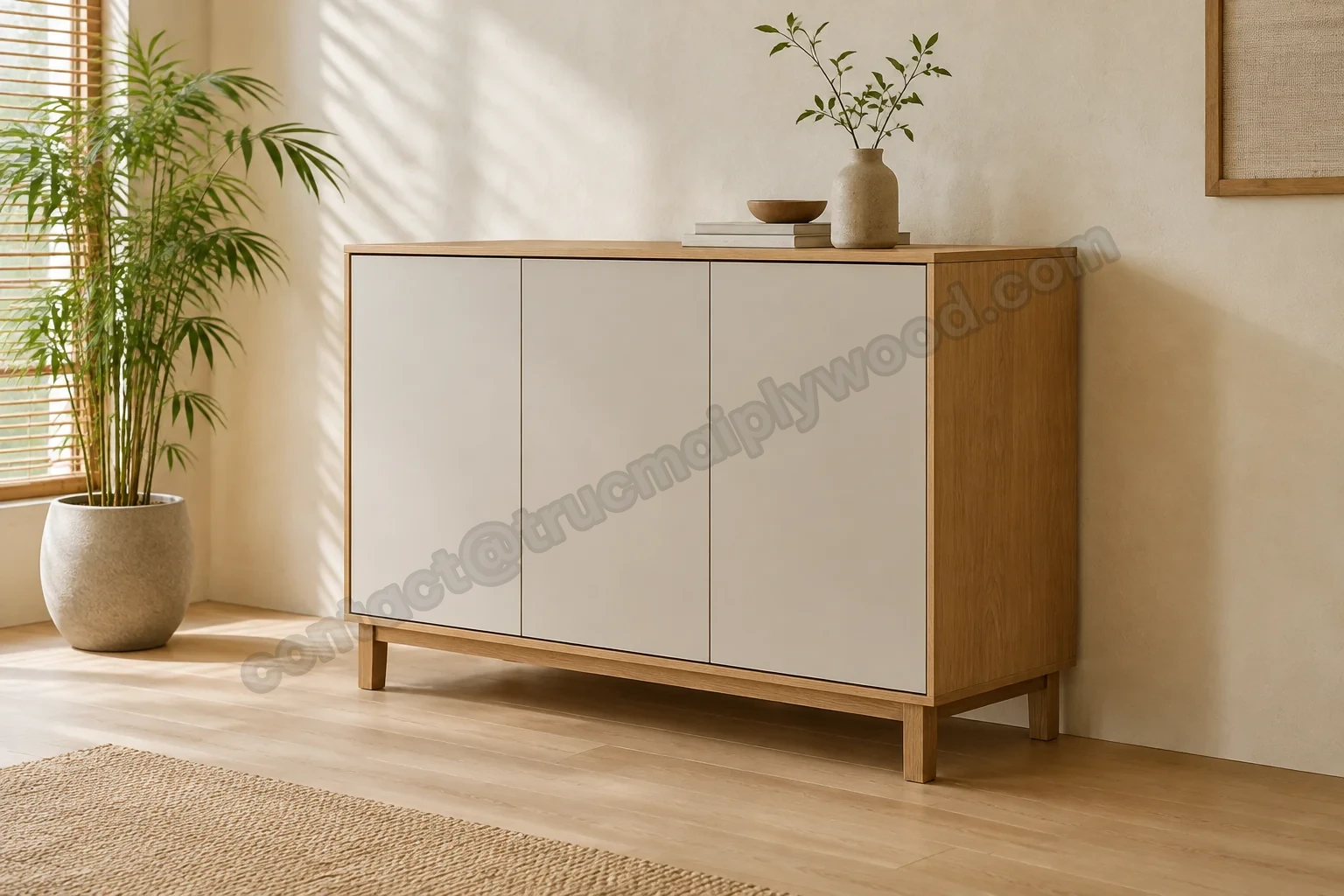
What is melamine plywood, and how is its base panel specified?
Melamine plywood is plywood carrying a decorative melamine-based surface, commonly a resin-impregnated decorative paper. Its base panel is specified by core species, construction, thickness, flatness, surface preparation and the glue and emission requirements of the intended market. The decorative face and the base are separate specification decisions.
For a production order, distinguish a raw base for melamine application from melamine faced panels supplied ready for furniture manufacture. The laminator needs a face that takes the chosen process consistently; a finished-panel buyer instead checks the decorative surface, edges and appearance after pressing.
Can eucalyptus plywood be used as a lamination base?
Yes. Eucalyptus-core plywood can be used as a lamination base for furniture and interior panels when the veneer construction, calibration and bonding surface meet the laminator’s specification. Eucalyptus is a core option in the Truc Mai range, alongside Styrax, Acacia, Pine and combined cores. Panel construction, rather than species alone, decides the outcome.
A dense core changes sheet handling and packing weight. It also makes consistent veneer joining and flat pressing important when the laminate must sit evenly across the face. Ask to see a cut edge and a trial-faced panel from the proposed construction. Check for core overlaps, gaps, raised joints and telegraphing after pressing. A flat sheet before laminating can still reveal a local joint once the decorative skin is bonded.
Which core construction should a furniture buyer request?
A stitched, A-grade core with prepared faces is the starting construction for furniture/interior orders. Commercial plywood normally uses an AB core with loose-laid or jointed veneers and a less finished face. Those descriptions refer to different production choices, even if the outside sheet dimensions match.
At the mill, stitching can run across and along the sheet, typically on the outer core plies. A buyer laminating a broad, uninterrupted surface should look for well-joined veneers directly beneath the face. The location of a void matters: one near the surface can become a visible hollow, while a central gap can weaken a machined edge.
Compare samples by cutting across several positions, inspecting the edge and checking the face under raking light. If the intended product is a cabinet carcass, the cabinet grade plywood specification provides a useful adjacent buying reference. Record the approved core joining method in the purchase order rather than relying on the term commercial grade.
What thickness and dimensional tolerance belong on the order?
A calibrated furniture substrate can be ordered with a thickness tolerance of ±0.3 mm, written against the nominal thickness and the agreed measuring method. The wider Truc Mai order range is ±0.3–0.5 mm; the tighter furniture line uses sanded and calibrated faces. A laminating plant should state the acceptable thickness of the base before surfacing, separately from its finished laminate thickness.
| Specification line | What to write | Why the laminator needs it |
|---|---|---|
| Nominal thickness | Selected plywood thickness, in mm | Sets press clearance and component size |
| Thickness tolerance | Agreed limit, such as ±0.3 mm for calibrated furniture panels | Controls variation across incoming sheets |
| Face condition | Raw, calibrated, sanded or prepared to the approved sample | Sets the bonding interface |
| Core construction | Species, grade and joining method | Controls voids and surface support |
| Face/back | Agreed pair and approved sample | Controls appearance and surface defects |
| Finished condition | Raw base or laminate already applied | Separates two different products |
The 18 mm plywood specification shows how one thickness can be described alongside core and loading requirements. For a laminating trial, measure multiple points rather than accepting a single edge reading. Keep the incoming-panel measurements and the finished-board measurements in separate inspection records.
How should a raw plywood face be prepared for bonding?
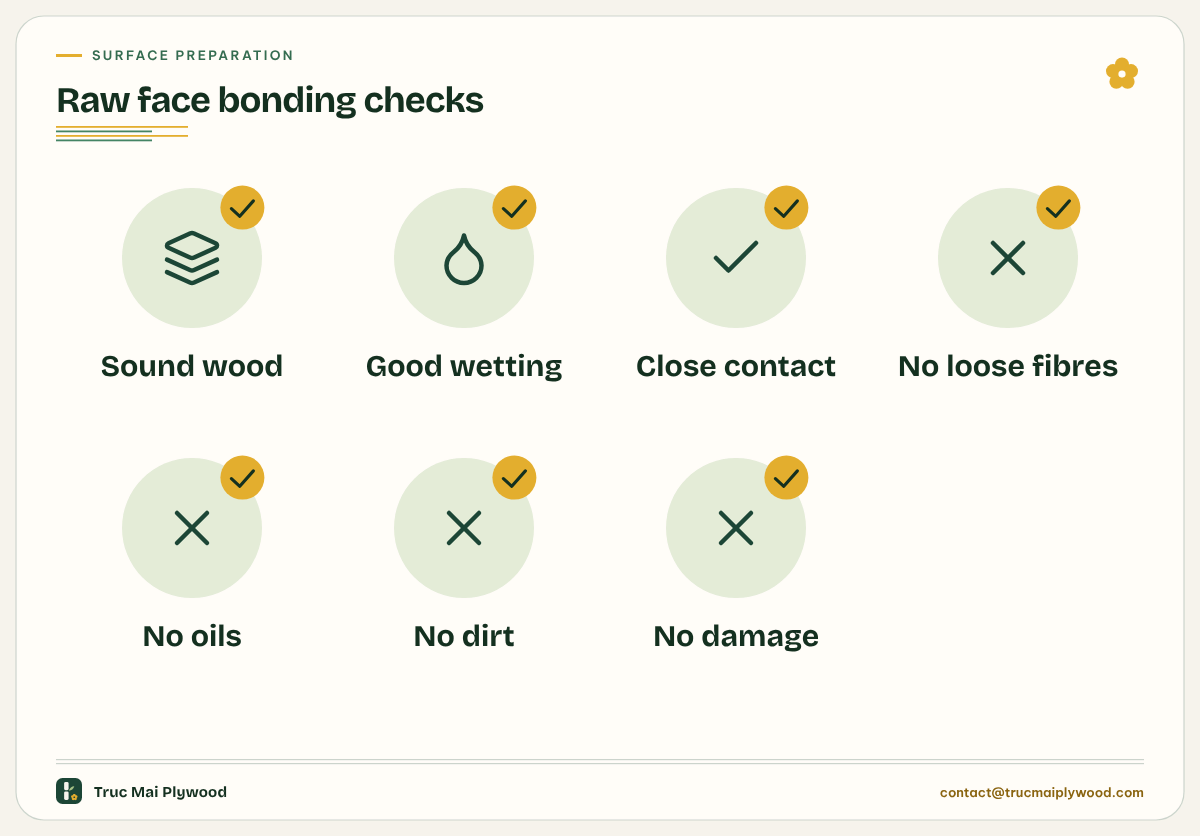
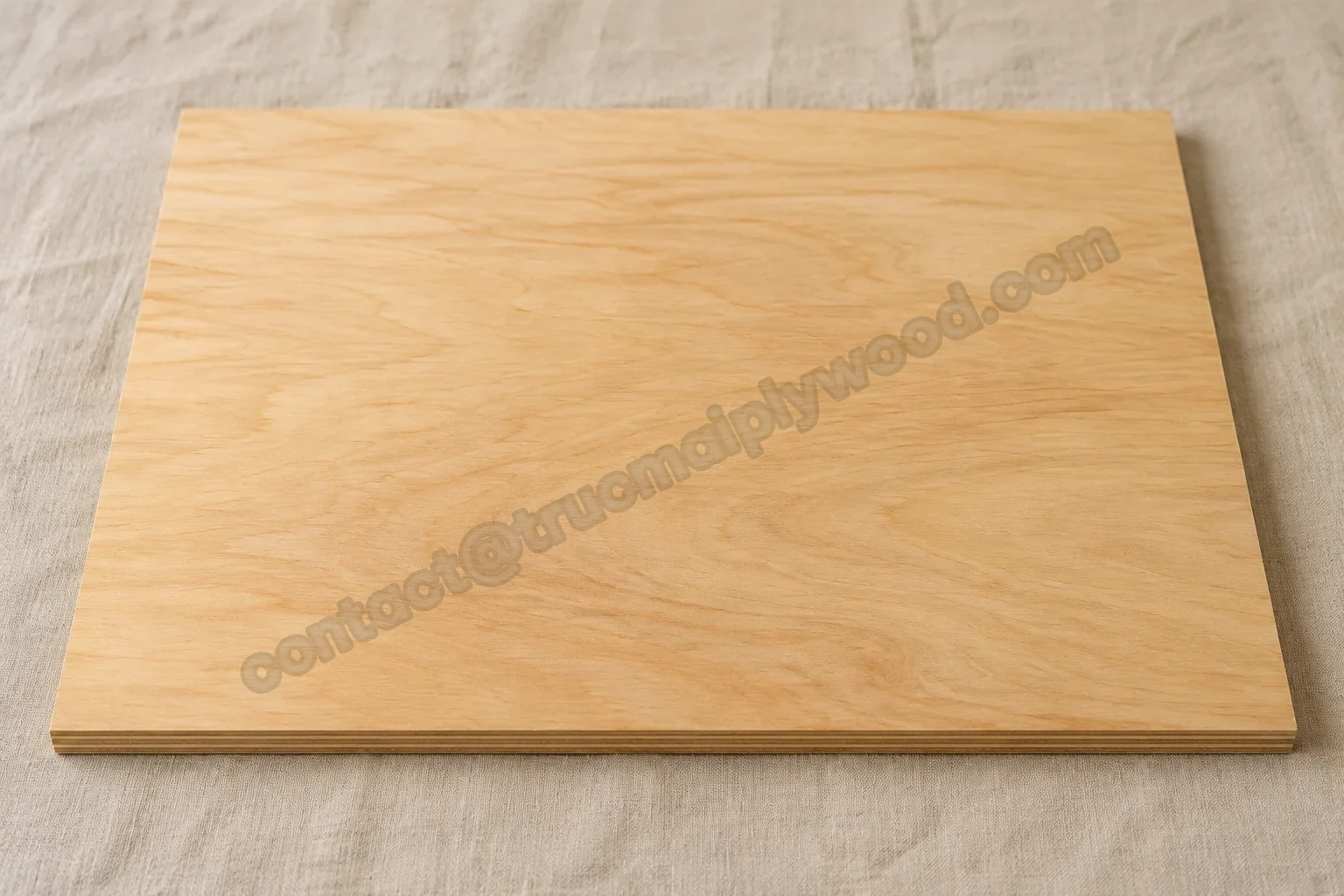
A clean, even surface with sound fibres is the preferred bonding face. Calibration establishes thickness; surface preparation addresses the interface between the wood and the adhesive. An unfinished, matt-looking face is useful only when its texture suits the actual adhesive and pressing process.
The US Department of Agriculture’s Wood Handbook, chapter 10 explains that wood bonding relies on wetting and contact with sound wood; loose fibres, oils, dirt and damaged surfaces interfere with that contact. A face can look smooth while still having contamination or compressed fibres. That is why a visual check and a trial bond answer different questions.
For the incoming inspection, check for sanding lines, local raised grain, torn veneer, dust and patches that appear polished by excessive compression. Use the approved production sample as the reference. The laminator then sets adhesive spread, dwell and pressing conditions according to its decorative material and adhesive supplier’s process instructions.
What happens during a plywood lamination process?
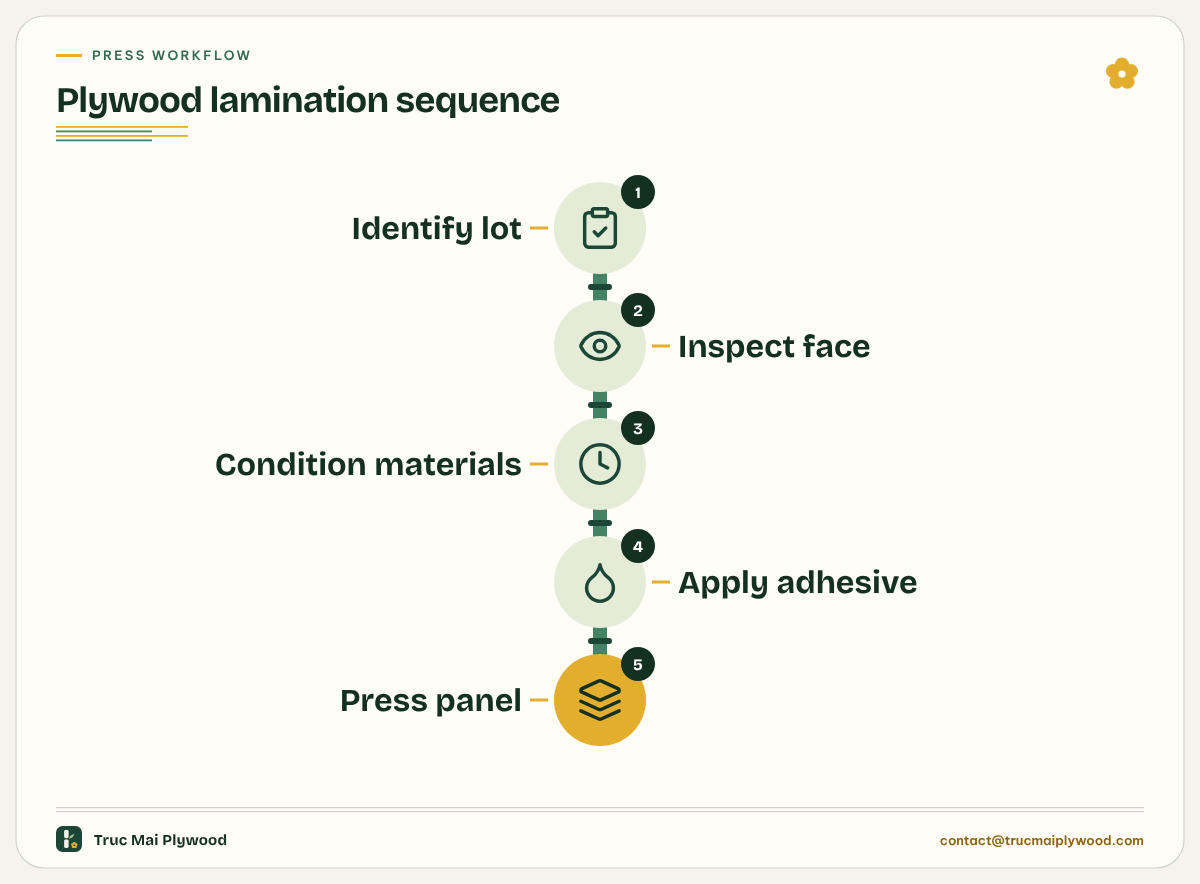
A plywood lamination process joins the decorative layer to a prepared substrate under controlled adhesive application and pressing. The base should be accepted before the line adds a costly surface. The sequence for a factory trial is straightforward:
- Identify the incoming substrate by core, thickness, face condition and lot.
- Inspect the face and edge; isolate sheets with loose veneer or visible voids.
- Condition the substrate and decorative material to the laminator’s process requirements.
- Apply the specified adhesive or use the designated resin-treated facing.
- Press under the chosen material supplier’s temperature, pressure and time settings.
- Inspect both sides and the edges after cooling and conditioning, then cut trial components.
Do not substitute the plywood mill’s hot-press settings for the laminator’s process settings. They bond different interfaces. The USDA wood adhesive reference describes moisture control, adhesive spreading, assembly and pressing as separate parts of bond formation. For repeat production, keep the trial settings alongside the accepted sample and the incoming-panel specification.
How do melamine, HPL and veneer differ as facing choices?
Melamine, HPL and decorative wood veneer produce different finished surfaces and require different process decisions. Choose the facing before approving the substrate because the surface can reveal or conceal different defects. An opaque printed facing makes base colour less visible; a thin natural veneer can show more of the base’s texture.
| Facing route | Buyer receives | Substrate check before production |
|---|---|---|
| Melamine-based decorative surface | Decorative paper-faced plywood or raw base for the buyer’s press | Flatness and uniform face support |
| HPL | Laminate-faced plywood or raw base for separate HPL bonding | Adhesive compatibility and stable thickness |
| Natural or engineered veneer | Decorative wood-faced panel or a base for veneering | Surface continuity and face quality |
The practical choice is between buying the finished panel and running the final bonding operation in-house. The first puts finished appearance acceptance into the mill order; the second puts trial-press performance into the buyer’s qualification process. Both routes can use a plywood core, but their inspection checkpoints differ.
Which adhesive and emission details must be kept separate?
The plywood’s internal glue specification and the laminator’s facing adhesive are two separate lines. Truc Mai’s default interior construction uses UF glue at E0 emission; the buyer should write the required emission test method and limit when using an E0 designation. A finished laminated assembly can introduce another adhesive, so its emission and bond requirements need their own acceptance plan.
The USDA Wood Handbook describes urea-formaldehyde adhesives as common in interior panels, with limited resistance to prolonged wetting and high temperature. That material behaviour is different from the formaldehyde-emission result. Do not treat a bond test as an emission test or assume that a glue trade name proves a particular bond class.
For US-bound hardwood plywood with veneer core, the EPA’s TSCA Title VI mill guidance lists the formaldehyde limit as 0.05 ppm under its specified test basis. The mill’s CARB Phase 2 and TSCA Title VI certification covers veneer-core hardwood plywood in its stated 3–25 mm scope. For an incoming base, ask for the product type and certificate identification matching the ordered build.
How can a buyer inspect flatness and face quality before pressing?
A three-stage incoming inspection separates dimensional variation, surface defects and internal construction. First, measure thickness across the sheet. Next, examine both faces in directional light. Finally, inspect representative edges and cut samples for veneer joining and internal gaps. Record each type of defect separately, because they have different remedies.
A useful acceptance sheet has columns for panel identity, thickness readings, face condition, visible joints, edge condition and trial-press result. Do not merge all of these into one vague quality score. A sheet with good thickness but a loose face is unsuitable for the same reason as a visually clean sheet with an unacceptable core joint: the defect sits at a different production stage.
What should a sample trial prove before a container order?
A sample trial should prove that the proposed plywood construction works with the buyer’s own laminate and press process. Request raw sheets from the intended core and face preparation, then run the actual facing material through the planned production sequence. An attractive loose sample is less informative than a pressed and machined trial component.
Test the areas where the finished furniture is most demanding: broad visible faces, machined edges, cut-outs and joints. Inspect for bubbling, lifting, surface ridges and edge defects after the sample has cooled and settled. Keep one accepted reference piece for the receiving department and one for the laminating line.
The ordering samples page explains the sample route. Send the trial outcome back with a clear photograph and the specification line that produced it. A repeat purchase then references an accepted build instead of beginning a new material comparison every time.
What panel formats and cut lists work for furniture lines?
The regular sheet formats include 1220 × 2440 mm, 1220 × 2280 mm and 1250 × 2500 mm. The shorter format suits furniture components where full-length sheets create avoidable trimming. The mill also offers labelled cut-to-size panels based on an agreed sheet and cutting list.
Examples of cut patterns include two lengthwise pieces of 610 × 2440 mm, three pieces of 1200 × 800 mm, four pieces of 1220 × 610 mm, or a six-piece arrangement. The final cutting drawing, saw allowance and labels are agreed by email, rather than assumed from a generic pattern name. See panels cut at the mill.
A laminating factory must decide whether to laminate full sheets before cutting or to face pre-cut blanks.
How does the core affect container planning and repeat orders?
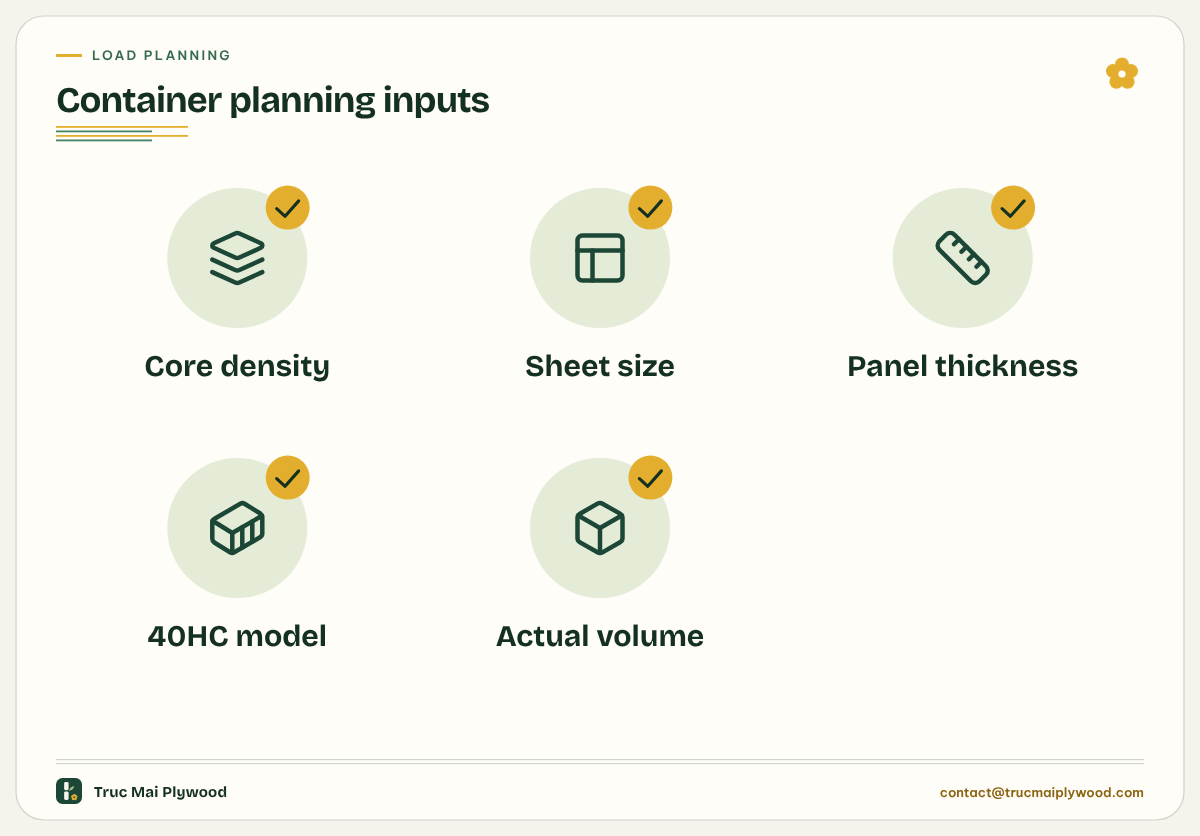
Core density changes the load plan for a 40HC even when the sheet size and thickness are identical. The buying decision therefore has a freight and handling dimension as well as a lamination dimension. A lighter core can move more panel volume within the same cargo weight, while a denser core changes how many packs fit under the booked payload.
Use the cubic metres per 40HC reference for the separate packing model rather than treating the nominal container volume as the actual shipment. That model is for planning; the final booking and weighed sheets determine the loading instruction. When several substrates share a container, identify each construction separately on the pack list.
Repeat buyers gain consistency by holding the core, joining method, face preparation and thickness tolerance steady from order to order. Changing the face veneer without changing the named core can still affect how a trial laminate looks. Keep the approved sample reference and the packing identification together in the purchase file.
Which compliance documents matter for a laminating substrate?
The relevant document set follows the ordered product and the market, not the descriptive term matt plywood. For a US-bound veneer-core hardwood plywood order, ask for the CARB/TSCA certificate and the identification of the certified product scope. For an FSC 100% order, the sales documents must identify the applicable FSC claim and seller certificate code.
The FSC Chain of Custody standard, section 5.1 requires the seller’s certificate code and the claim to appear on the sales documents for certified products. Truc Mai holds FSC licence FSC-C196493 and chain-of-custody certificate SA-COC-014545; the licence verification page explains how to check the code. Eligible orders carry the FSC 100% claim in their documents.
For EU buyers, the origin and geolocation file set can cover both core wood and face veneer, with the importing operator using that information in its own due-diligence process. Ask for the relevant species and origin records for the exact build. Treat a decorative facing imported from another country as a separate traceability input, even where the plywood core is Vietnamese.
How should mills be compared for raw laminating substrates?
Compare mills on a matched written specification and a trial-faced sample, not on the word matt. Two suppliers may quote the same nominal thickness while offering different core joining, surface preparation or face quality. A useful comparison sheet records what each mill is actually producing and what the buyer’s press accepts.
Ask each supplier for the proposed core species, veneer joining method, thickness tolerance, raw-face condition, adhesive and emission specification, standard sheet format, cut-panel option and sample route. A plant that can supply a consistent raw base is more useful to a laminator than one presenting only photographs of a decorative finished panel.
Truc Mai Plywood manufactures furniture and commercial plywood in Ha Hoa, Phu Tho, with around 60,000 m³ of annual capacity. For a buyer planning regular containers, the relevant capability is maintaining an agreed construction across repeat orders. A production sample and a written tolerance are better purchasing evidence than a broad description of output volume.
What belongs in a quotation request for matt substrate plywood?
A complete request for quotation names the application, core, internal glue and emission requirement, face condition, sheet size, packing and quantity. State clearly whether the order is for an unfinished laminating substrate or a panel already faced with melamine, HPL or veneer. Add the destination port and the trial-press reference if one has been approved.
Write the specification in this order: application and final facing; core species and joining; plywood glue and emission test requirement; raw face/back condition; nominal thickness, tolerance and sheet size; cutting labels, packing and container quantity. Attach the cutting drawing for pre-cut blanks. The plywood RFQ checklist helps keep the lines consistent across suppliers.
Send that specification to contact@trucmaiplywood.com or through the quotation desk named in the site navigation. Ask for the raw-base sample matching the order line, then use the accepted trial piece as the reference for production and receiving inspection.
Questions buyers ask
Is matt plywood the same as a matt decorative finish?
No. Matt substrate plywood is an unfinished base panel prepared for a subsequent decorative layer. The final laminate determines the visible finish.
Can I specify different face and back grades?
Yes. Write the face and back grades as a pair and approve the reference sample before production.
Can the factory supply samples for a trial press?
Yes. Request a sample of the proposed core, face preparation and adhesive configuration for a trial on your own line.
Are cut panels labelled for assembly?
Cut-to-size panels can be labelled to the buyer’s cutting and packing instructions. Supply a drawing and piece identification list.
Can a matt base be supplied with a decorative face already attached?
Yes. The product range includes melamine-faced and HPL-faced plywood; specify whether you want a raw base or a finished panel.
Is a pale face necessary beneath an opaque laminate?
No. For an opaque covering, surface evenness and bonding compatibility matter more than decorative veneer colour.
What documents accompany an FSC order?
For an eligible FSC 100% order, the sales documentation identifies the certificate code and the FSC claim for the product.
Can a buyer combine several panel specifications in one container?
Yes. A mixed load is arranged by agreement, with each specification and pack identified separately.
What is the minimum order quantity?
The standard minimum is one 40HC container. Send the panel mix and packing requirements with the enquiry.
Should I request the same adhesive for the plywood and the laminate?
No. Specify the plywood glue and the downstream laminating adhesive separately, and trial the complete assembly.
Does the factory apply UV lacquer to UV-ready plywood?
No. UV-ready means the plywood faces are prepared for the buyer’s coating process; the mill does not apply the UV coating.