
This eucalyptus plywood review finds it a practical choice for furniture panels when the core construction, face quality and adhesive match the job. Its dense core can suit cabinet parts and machining, while weight, edge fixing and flatness need a panel-level check. Specify the complete build rather than buying by species name alone.
Is eucalyptus wood good for plywood?
Yes. Eucalyptus is a useful hardwood veneer and core material for furniture plywood, including cabinet components, shelving and laminate substrates. A eucalyptus-faced sheet can contain Styrax, Acacia, Pine or mixed core veneers, while a eucalyptus-core sheet can carry another decorative face. Specify face and core separately on the order.
Plywood gains dimensional balance from alternating veneer grain directions. The US Forest Products Laboratory explains how cross-oriented layers reduce movement compared with wood joined in one direction in its Wood Adhesives chapter. That benefit comes from the lay-up and sound bonds, not from the word eucalyptus printed on a bundle. A dense species can provide a firm substrate, but density alone does not describe a completed panel’s bending, screw withdrawal or flatness.
For an initial purchase, request the core species, veneer arrangement, face/back pair, adhesive system, thickness tolerance and an edge photograph. Then assess the sample as a component in the intended cabinet or furniture assembly. The eucalyptus plywood specifications provide a product starting point; the purchase decision belongs to the whole construction.
Eucalyptus plywood review: what counts as good quality?
Good quality means a panel that meets the agreed visual, dimensional and machining specification, not simply one that feels heavy. Inspect both faces under the same light, examine all four edges for overlapping veneers and voids, and compare sheets from different bundles. A polished showroom sample can conceal a production problem if the order has no written acceptance criteria.
A practical incoming inspection separates appearance from construction. The decorative face is judged for grain, colour, repairs and sanding marks. The edge is judged for ply continuity, joint quality and gaps. The finished component is judged for flatness, machining and the behaviour of its chosen fittings. These are different questions, so a single grade letter cannot settle them.
For commercial and furniture lines, Truc Mai Plywood offers eucalyptus, Acacia, Styrax, Pine and combined cores. Furniture panels use a stitched, sanded core construction; commercial panels may use a different core preparation. The factory’s standard thickness range is 3–40 mm, with the final tolerance written on the order. Buyers can use the Vietnamese plywood grade guide to turn trade labels into inspectable specifications.
Is eucalyptus wood high quality?
Yes, eucalyptus can provide high-quality plywood veneer, but the species label is not a quality grade. Logs, peeling, drying, jointing, pressing and sanding determine whether a batch makes a clean panel. A buyer selecting an appearance face should judge the actual veneer, while a buyer selecting a core should judge the lay-up and edge integrity.
The face and back should be specified as a pair against an approved sample. A uniform decorative face can still sit over an unsuitable internal construction, while an excellent internal core can carry a face intended only for painting or overlay. Both may be correct products, but they serve different jobs.
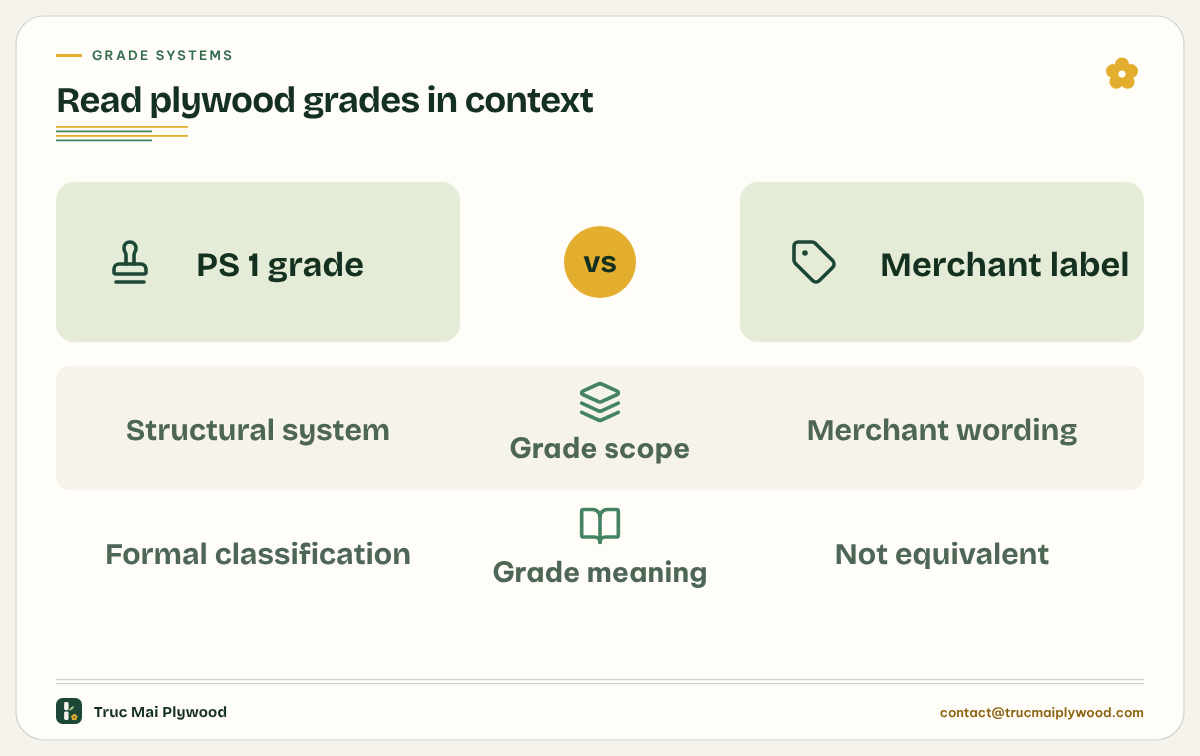
The US NIST PS 1-22 standard illustrates why a formal grade has to be read within its own system: it specifies structural plywood classifications, veneer grades and bond performance. A furniture buyer should not borrow a structural stamp or assume that a merchant’s B/BB label means the same thing as a PS 1 grade. Agree the commercial face criteria directly with the seller.
Can eucalyptus plywood be used as a lamination base?
Yes. Sanded, calibrated eucalyptus-core plywood can be used beneath melamine, high-pressure laminate (HPL) or other decorative overlays when the substrate is flat, clean and compatible with the lamination process. A dense core gives the buyer a firm working panel, but the surface preparation and moisture balance decide how the overlay behaves.
A lamination trial should use the actual adhesive, press settings, overlay and edge treatment. Check whether the face telegraphs core joints after pressing, whether the laminate stays flat after cooling, and whether machining exposes gaps at the edges. Record which face received the overlay and whether the reverse side has a balancing finish. For a painted or UV-coated product, confirm that the surface preparation matches the finisher’s own coating system.
UV-ready means a prepared surface for the buyer’s coating line, not a factory-applied UV finish. If a finished laminate is required, specify the overlay itself rather than describing a bare board as laminated. The guide to laminates for plywood explains the distinct surface options.
Which eucalyptus panel construction should a furniture buyer order?
Start with the application and work backwards to the core, face and adhesive. A cabinet side with concealed surfaces needs a different face specification from an exposed drawer front. A broad laminated counter panel places greater emphasis on substrate flatness and surface preparation. A cut component with many edge fixings puts the emphasis on internal gaps and repeatable machining.
| Purchase line | Write on the specification | Inspect on the sample |
|---|---|---|
| Core | Eucalyptus, Styrax, Acacia, Pine or agreed combination | Edge continuity and joints |
| Face and back | Named veneer and approved grade pair | Colour, repairs, sanding |
| Thickness | Nominal millimetres and agreed tolerance | Several measurement positions |
| Adhesive | Named glue system separately from emission | Bond documentation for that build |
| Finish | Sanded, UV-ready or specified overlay | Trial finish and surface flatness |
| Cut parts | Drawing, orientation and label code | Dimensions and edge quality |
The practical rule is to compare like with like. Two sheets called eucalyptus plywood can differ in core species, number of plies, jointing, veneer thickness and face preparation. Each difference affects a buyer’s manufacturing result. The cabinet plywood selection guide helps connect those choices to cabinet use.
How does eucalyptus core weight affect handling and shipping?
A eucalyptus core is heavier than a lighter Styrax core at the reference densities used for container planning. Weight matters at the cutting table, during manual handling, in cabinet hardware design and in a loaded container. It can also affect the number of sheets per shipment even when the sheet dimensions are identical.
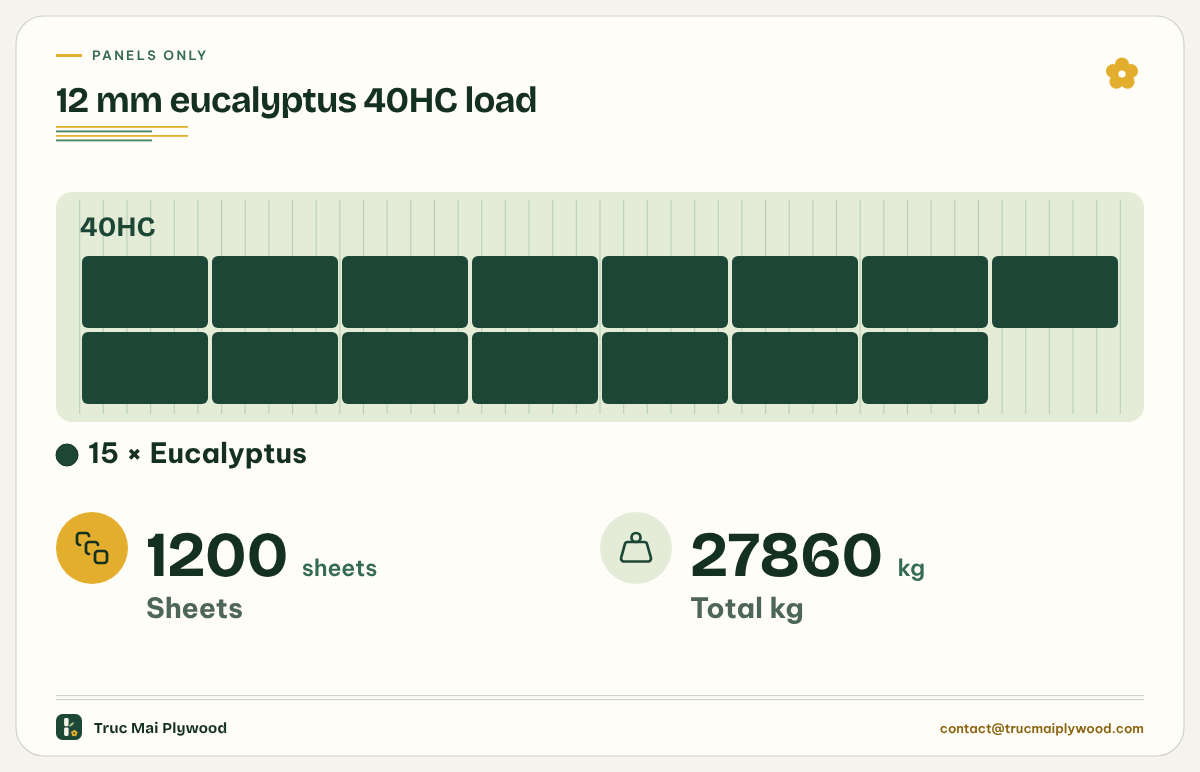
The following is the complete supplied 40HC planning calculation for 12 mm and 15 mm sheets. It uses panels only, a 1,000 mm pack height, the specified core-dependent pack counts and a 28,000 kg planning payload. Reference densities are Styrax 500 kg/m³, Acacia 580 kg/m³ and Eucalyptus 650 kg/m³. Actual booking and route limits govern the final loading plan.
| Core | Thickness (mm) | Size (mm) | Packs | Sheets/pack | Sheets | m³ | kg/sheet | Total kg | Weight capped |
|---|---|---|---|---|---|---|---|---|---|
| Styrax | 12 | 1220x2440 | 18 | 83 | 1494 | 53.4 | 17.9 | 26680 | No |
| Acacia | 12 | 1220x2440 | 16 | 83 | 1328 | 47.4 | 20.7 | 27510 | No |
| Eucalyptus | 12 | 1220x2440 | 15 | 80 | 1200 | 42.9 | 23.2 | 27860 | Yes |
| Styrax | 15 | 1220x2440 | 18 | 66 | 1188 | 53.0 | 22.3 | 26520 | No |
| Acacia | 15 | 1220x2440 | 16 | 66 | 1056 | 47.2 | 25.9 | 27350 | No |
| Eucalyptus | 15 | 1220x2440 | 15 | 64 | 960 | 42.9 | 29.0 | 27860 | Yes |
| Styrax | 18 | 1220x2440 | 18 | 55 | 990 | 53.0 | 26.8 | 26520 | No |
| Acacia | 18 | 1220x2440 | 16 | 55 | 880 | 47.2 | 31.1 | 27350 | No |
| Eucalyptus | 18 | 1220x2440 | 15 | 53 | 795 | 42.6 | 34.8 | 27690 | Yes |
| Styrax | 21 | 1220x2440 | 18 | 47 | 846 | 52.9 | 31.3 | 26440 | No |
| Acacia | 21 | 1220x2440 | 16 | 47 | 752 | 47.0 | 36.3 | 27270 | No |
| Eucalyptus | 21 | 1220x2440 | 15 | 45 | 675 | 42.2 | 40.6 | 27430 | Yes |
The table is a calculated comparison rather than a record of shipped loads. Packaging mass, verified sheet weight and the carrier’s accepted payload are checked before dispatch. For additional thicknesses, see container capacity by thickness. A useful purchasing comparison is cost and handling per finished component, not simply the number of sheets in a container.
Where does eucalyptus plywood crack or chip during machining?
Chipping most often appears where a blade exits the face, while splits can begin near a poorly supported edge or a fastener installed without suitable clearance. Neither fault should be attributed automatically to the wood species. Tool condition, feed direction, face veneer thickness, internal gaps and the selected screw all contribute.
For 18 mm cabinet parts, use a sharp blade intended for veneered panels and support the exit face. For drilling, clamp a backing board beneath the sheet. For edge screws, trial the hole diameter and distance from the edge with the actual fitting. For routing, check that the tool leaves a clean face and does not reveal a core gap. Record defects by position and bundle so the mill can distinguish a machining issue from a repeatable panel issue.
A sample test should reproduce the buyer’s manufacturing sequence. A perfect hand-sawn offcut says little about a production nesting line. Use the same feed speed, blade, drill and finishing sequence intended for the order. Inspect the part after assembly, because a clean unfastened edge can still fail when a screw expands the local veneer stack.
How should flatness and thickness be checked?
Check flatness on a supported sheet after it has acclimatised to the working environment, and measure thickness at several positions away from damaged edges. A nominal thickness is only the start of the specification. A calibrated furniture panel can be ordered to ±0.3 mm, while commercial and packing constructions use different tolerances. Agree the actual line and tolerance before production.
Panel bow, twist and local waviness need separate observations. Bow affects long cabinet sides and door blanks; twist makes assembly difficult; local waviness can show through a decorative overlay. Record the support arrangement and whether the defect persists after the panel is turned over. The objective is a repeatable acceptance check that matches the assembly process.
The European EN 315 dimensional specification preview provides a separate standardised framework for plywood dimensions. A buyer’s contractual mill tolerance should be written explicitly rather than inferred from a standard’s broad nominal limits.
Which glue and emission specification belongs on the order?
Specify adhesive and formaldehyde emission separately. Urea-formaldehyde (UF) is a common interior-panel adhesive; a different bonding system may be selected for a more moisture-demanding application. The US Forest Products Laboratory describes the different wetting resistance of adhesive families in its wood bonding reference. A glue name alone is not an emission test result.
For United States-bound hardwood plywood with veneer core, 40 CFR Part 770 sets a 0.05 ppm formaldehyde limit under the relevant TSCA Title VI framework. Truc Mai’s CARB Phase 2 and TSCA Title VI third-party certification covers hardwood plywood with veneer core from 3–25 mm, under certificate CARB/EPA 26053. The buyer should put the covered product construction and certificate documents on the order.
For European furniture, the REACH formaldehyde restriction is a separate consideration from a supplier’s E0 or E1 shorthand. The European Commission’s formaldehyde restriction explanation describes the regulatory framework. Use a test report with the applicable method and the actual article configuration, rather than translating a US ppm result into a European chamber value. The formaldehyde limits explainer provides the US context.
What makes eucalyptus plywood suitable for cabinets and shelving?
A cabinet or shelf needs sufficient panel stiffness, sound joints and a surface appropriate to its finish. Eucalyptus core can be selected for a substantial feel and consistent machining, but shelf span and load cannot be decided from species alone. Support spacing, thickness, edge reinforcement and the finished assembly determine whether a shelf remains straight.
For an 18 mm cabinet carcass, make a trial corner joint with the specified confirmat screw, dowel or cam fitting. Inspect the edge after assembly and disassembly. For a shelf, test a representative span with the expected contents and supports. For a veneered door, test the finish on both sides and examine the blank after pressing. These practical checks are more informative than a generic claim that hardwood plywood is strong.
Where weight is critical, compare an alternative core using the same face, thickness and finish. That isolates the effect of core choice and avoids confusing a lighter sheet with a better face. An attractive eucalyptus veneer can also be specified over a lighter core when the visible appearance matters more than internal density.
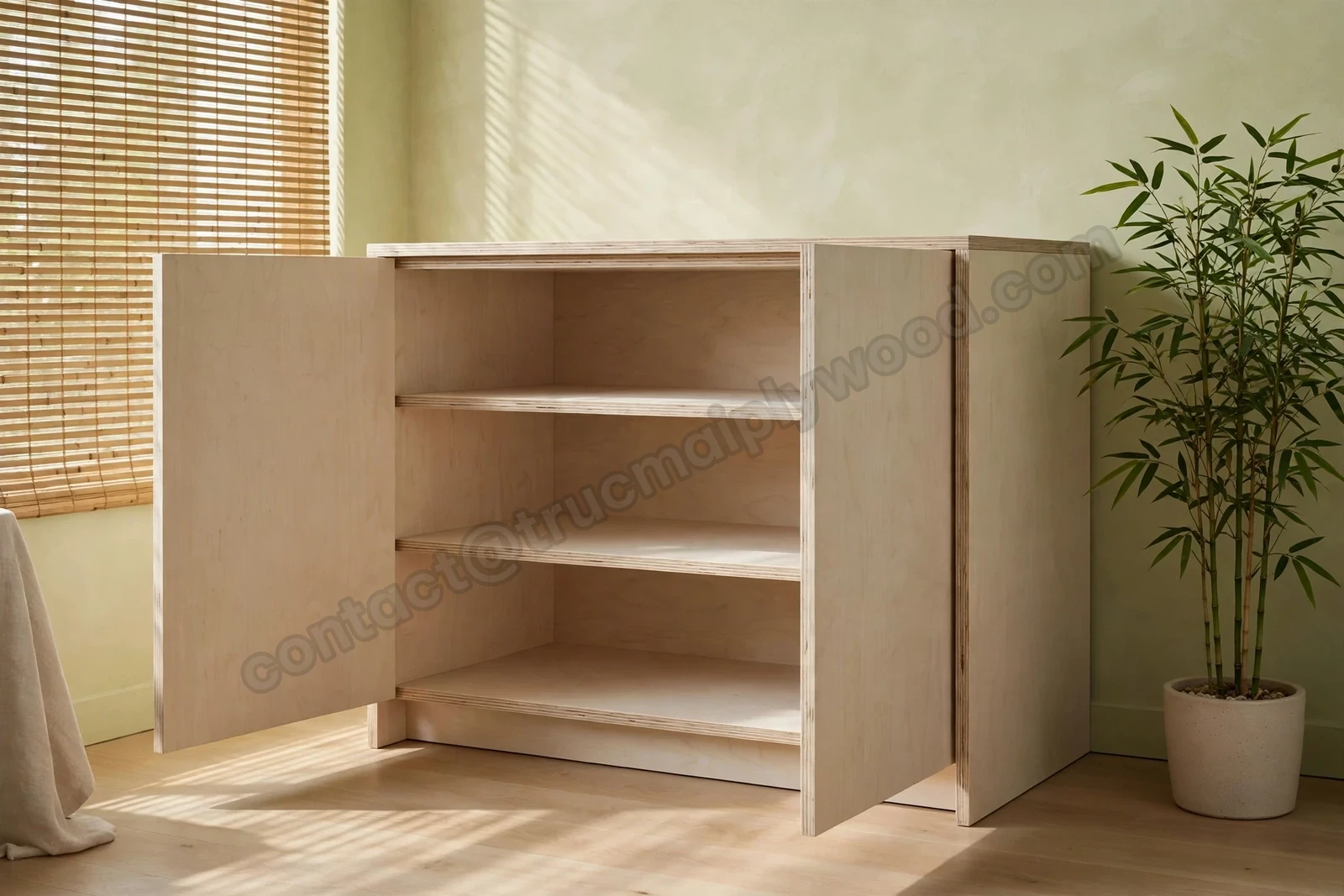
How do eucalyptus face and eucalyptus core differ?
Eucalyptus face means the visible veneer is eucalyptus; eucalyptus core means the internal veneer layers are eucalyptus. A panel may have either, both, or neither. This distinction matters because the face drives the appearance and finishing trial, while the core drives much of the edge machining, weight and fastening behaviour.
When comparing quotations, ask for an edge image and a clear construction line. The face veneer can be thin relative to the whole panel, so a photograph of the broad face does not identify the core. Similarly, a cut edge showing eucalyptus layers does not prove that the decorative face is eucalyptus. A face/back pair and core description remove that ambiguity.
For buyers seeking a pale finish or a repeatable decorative pattern, compare other veneer options on the same core rather than switching the entire construction. That keeps the mechanical and machining trial comparable. The face veneer origin files show the type of traceability information relevant when faces and cores have different origins.
What should be checked before approving a production sample?
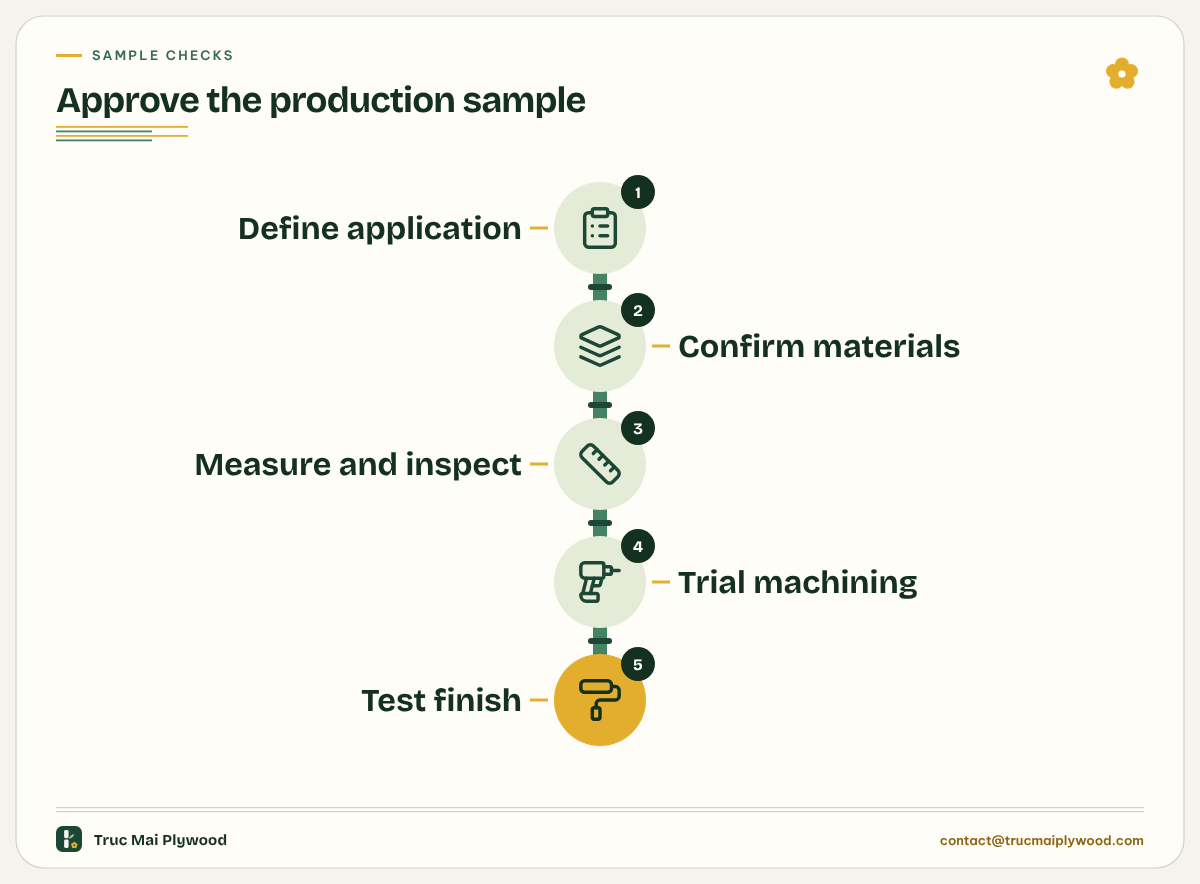
Approve the sample against a written checklist covering appearance, internal construction, machining, lamination and packing. Keep the approved sample or a controlled set of photographs for comparison with production sheets. The checklist should describe observable defects and the acceptance method, not rely on adjectives such as premium or high quality.
- Record the application, finished component dimensions and visible faces.
- Identify the core species, face/back veneer and adhesive specification.
- Measure thickness at multiple positions and inspect the four edges.
- Saw, drill and fasten a trial part with production tools.
- Apply the actual finish or laminate and inspect the surface after curing.
- Agree bundle labels, cut-part identification and the inspection record.
Use ordering plywood samples to prepare a representative trial, and preserve the tested construction in the purchase order. A revised face or core needs a revised sample because the earlier approval describes a particular panel, not every product sold under the same name.
For a furniture line, make the sample decision at component level rather than approving only a full sheet. A cabinet side, drawer bottom and visible door panel impose different demands on the same veneer construction. Mark the face that will remain visible after assembly, then cut each test piece in its production orientation. Compare the exposed edge after trimming and after hardware installation. This separates a surface defect from a joint problem and gives purchasing a clear reason for accepting or rejecting the proposed construction.
A useful sample record includes the supplier’s construction description beside photographs taken before machining. Photograph the broad face under even light, the reverse face, a freshly cut edge and the completed trial joint. Identify the tested cutting tool and the intended decorative finish. If the next sample changes from eucalyptus core to a mixed core, give it a separate reference. Otherwise a later production team could approve a different internal build against photographs of the original face alone.
The factory can prepare furniture panels with stitched cores and sanded faces. Core stitching helps hold the veneers in position during lay-up, while sanding prepares the outer surface for the buyer’s next operation. Neither step replaces inspection of the pressed panel. Ask to see whether adjacent core veneers meet cleanly at the cut edge and whether face repairs remain acceptable after finishing. Record the inspection position, because an isolated edge defect and a repeated defect across bundles call for different corrective action.
For an overlay trial, keep a control piece without the decorative covering. The control makes it easier to distinguish a substrate ripple from an issue introduced during lamination. Examine both pieces on the same support surface and under the same lighting. A trial that looks flat on the press table should also be checked after cooling and cutting. If the finished component needs edge banding, apply the intended band to a sample edge and inspect the transition between face and band.
For screw fixing, prepare a trial joint that reproduces the real assembly. Use the specified fastener, pilot-hole method and panel orientation, then inspect the edge around the installed screw. Check whether the mating parts remain flush and whether the veneer layers separate during tightening. Repeat the trial at the edge positions that the cutting drawing actually uses. A successful screw placed far from an edge does not answer the buyer’s question about a narrow cabinet rail or a corner fitting.
Packing approval belongs in the sample record as well. Identify whether the order uses full sheets or labelled cut parts, and agree which faces need protection during transport. A smooth decorative face can be damaged by sliding against an unprotected edge even when the panel passed its factory surface inspection. Check how the bundle label identifies core, face, thickness and destination. The receiving team should be able to match each bundle to the same approved construction without interpreting a trade grade from memory.
Finally, turn the trial observations into written acceptance lines. State which face defects are permitted, which edge gaps cause rejection, how thickness will be measured and what finished joint must pass the buyer’s own trial. Attach the sample photographs and cutting drawing to the purchase specification. When repeat orders use the same construction, those records give the mill and buyer a shared comparison point. When the face, core or finish changes, run the affected part of the trial again before accepting production sheets.
How can buyers specify cut-to-size eucalyptus panels?
Supply the finished part dimensions, grain direction, cutting pattern, edge requirements and label code. Cut-to-size is a manufacturing option rather than a separate species or grade. A standard sheet can be split lengthwise into two 610 × 2440 mm pieces, into three 1200 × 800 mm pieces, or into four 1220 × 610 mm pieces. Six-piece layouts are also arranged against the buyer’s drawing.
A cut list should distinguish nominal sheet size from the required finished piece. Saw kerf, trimming and grain direction affect the usable layout, so the mill agrees exact pieces from the sheet and cut list by email. Labels should match the customer’s assembly or stock-keeping system, particularly when one container holds several furniture components.
Before approving a cutting pattern, check the assembly drawing rather than just the rectangular dimensions. Two pieces with identical dimensions may need different grain direction or face orientation. For edge-banded components, identify which edges receive banding after cutting. This prevents a seemingly efficient nesting plan from producing unusable cabinet parts.
What documents matter for an EU or US plywood import?
The relevant documents are the commercial shipment set, the product’s certification evidence and the traceability file appropriate to the destination. For EU supply, Truc Mai provides origin records and plot geolocation files for both Vietnamese core wood and imported face veneer. The EU importer uses the information for its due-diligence process under the European Union Deforestation Regulation (EUDR).
The European Commission’s EUDR page explains the deforestation-free, legal-production and geolocation requirements. The compliance process is based on source records and the operator’s statement, not on a product label. Where an FSC 100% product is ordered, the FSC claim is identified on the relevant sales documents under the certified product scope.
For a US order, specify the veneer-core hardwood plywood construction covered by the emission certificate. For either market, match invoice, packing list, certificate evidence and the actual order description. A mismatch in core, thickness or face can create an avoidable document query even if the physical panels are usable.
How should two eucalyptus plywood quotations be compared?
Compare quotations line by line using the same application, panel construction and acceptance criteria. A nominally identical sheet can conceal differences in core joining, sanding, face repairs, adhesive, tolerances and packing. The quotation with the clearest construction often makes the more reliable production trial possible.
Request the face/back sample pair, core lay-up, thickness and dimensions, glue and emission evidence, surface finish, packing method and production quantity. Include the destination port and preferred shipping term. If the panels are for a CNC line, add a trial cut and fastening requirement. If they are for lamination, add the overlay trial and surface condition.
The plywood RFQ checklist provides a structured request. It is particularly useful when comparing a dense eucalyptus core with a lighter construction, because it keeps the decorative face and finished application constant while the internal material changes.
What is the next step for a furniture-panel order?
Send a concise RFQ using the plywood RFQ checklist with the application, core species, glue and emission requirement, face/back veneer, sheet or cut-part dimensions, packing quantity and destination port. Attach a drawing or sample photograph when a finished component has critical grain orientation or edge details.
For a first trial, request free samples and test them with the intended cutting, fastening and finishing sequence. Keep the approved sample reference on the purchase order. That turns a general eucalyptus plywood review into a repeatable product specification that the purchasing, production and quality teams can all use.
Send your specification to contact@trucmaiplywood.com or through the quotation form.
Questions buyers ask
Can eucalyptus plywood be cut with ordinary woodworking tools?
Yes. Use a sharp carbide-tipped blade, support the exit face and test a cut on an offcut before running a production batch.
Which face grade should I specify for visible cabinets?
Specify an approved face-and-back sample pair, permitted repairs and the finish expected after sanding. Trade grade names alone do not define the finished appearance.
Can eucalyptus plywood take screws near an edge?
Yes, with a suitable pilot hole and edge distance. Test the exact screw, panel thickness and core construction in a sample joint.
Is eucalyptus-faced plywood the same as eucalyptus-core plywood?
No. The face describes the visible veneer; the core describes the internal plies. A panel can combine a eucalyptus face with a different core.
Can I order cut-to-size eucalyptus panels?
Yes. Supply a cut list, finished dimensions, edge orientation and labels for each furniture part.
What thickness suits cabinet carcasses?
Choose thickness from the cabinet span, joint design and hardware requirements; 18 mm is a common purchasing specification for cabinet components.
What should an importer inspect on arrival?
Compare the packing list with bundle labels, check visible face and edge damage, and measure representative sheets against the approved specification.
Does FSC chain of custody apply to every sheet?
No. The FSC 100% claim belongs to eligible products on the certificate schedule and is identified on the relevant sales documents.
What is the difference between glue and emission grade?
Glue describes the adhesive system; emission grade describes formaldehyde release under a stated test method. They are separate purchase specifications.
Can I mix eucalyptus and lighter cores in one shipment?
Yes, a mixed-container order can be agreed with a pack plan that accounts for the different sheet weights.